Have a personal or library account? Click to login
Low error Kramers-Kronig estimations using symmetric extrapolation method Cover

Low error Kramers-Kronig estimations using symmetric extrapolation method

By: G.A. Ruiz and  C.J. Felice  
Open Access
|Dec 2021

Figures & Tables

Fig.1

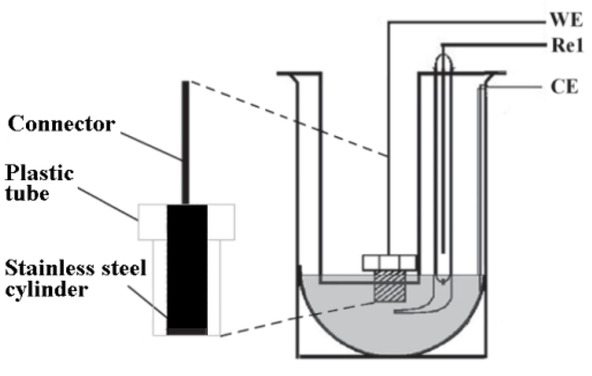
Three-electrode cell. WE: working electrode, Re1. reference electrode, CE: counter-electrode.
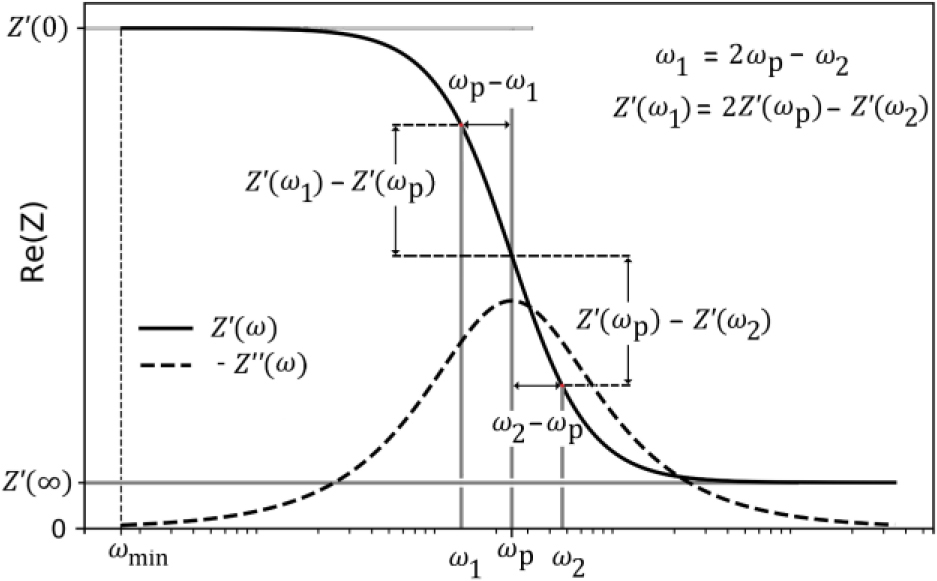

Fig.2

Frequency and amplitude of the interpolated points. ωp:
${{\omega }_{p}}:$central frequency of the dispersion.
Frequency and amplitude of the interpolated points. ωp: ${{\omega }_{p}}:$central frequency of the dispersion.

Fig.3

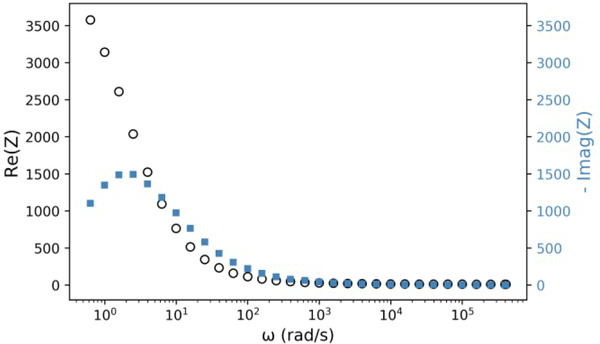
Resistance (Black) and reactance series equivalents (Steel Blue) of the EEI versus frequency for AISI 304 stainless steel electrode polished with sandpaper #180 in NaCl 0.9% solution. Overpotential applied = 10 mV.
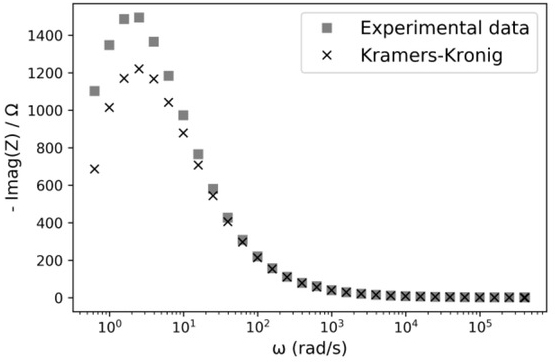

Fig.4

Reactance series equivalent of the ZEEI versus frequency. Experimental data (◼) and applying the KK equation (4) to the experimental data (x).
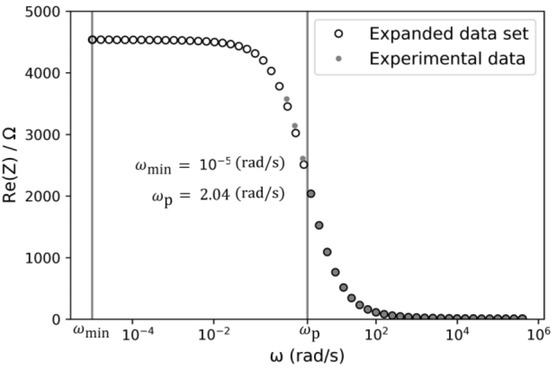

Fig.5

Resistance series equivalent of the EEI impedance. Expanded dataset (ο) and Experimental data (∙).
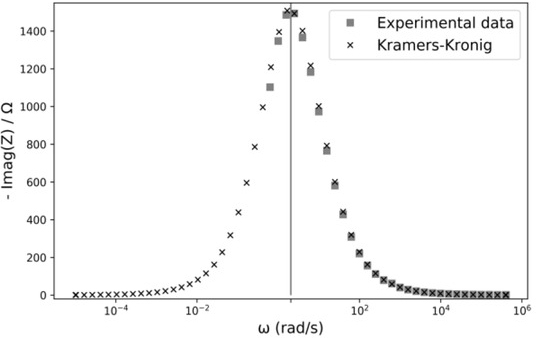

Fig.6

Reactance series equivalents of the EEI versus frequency. Experimental data () and applying the KK equation (4) to the expanded dataset (x).
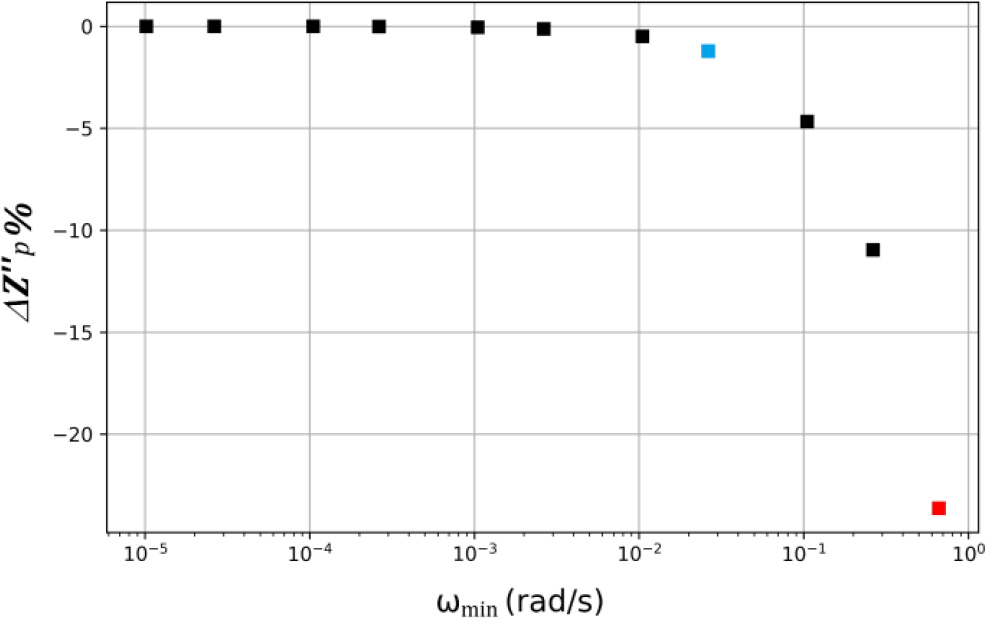

Fig.7

Percentage change of Zp′′(ΔZp′′%)  versus ωmin.
$Z_{p}^{\prime \prime }\left( \Delta Z_{p}^{\prime \prime }\text{%} \right)\,\,\text{versus}\,{{\omega }_{min}}.$Red point: case without extrapolation (figure 4). Blue point: ΔZp′′%=−1.
$\Delta Z_{p}^{\prime \prime }{\text%}=-1.$
Percentage change of Zp′′(ΔZp′′%)  versus ωmin. $Z_{p}^{\prime \prime }\left( \Delta Z_{p}^{\prime \prime }\text{%} \right)\,\,\text{versus}\,{{\omega }_{min}}.$Red point: case without extrapolation (figure 4). Blue point: ΔZp′′%=−1. $\Delta Z_{p}^{\prime \prime }{\text%}=-1.$
Language: English
Page range: 147 - 152
Submitted on: Sep 1, 2021
|
Published on: Dec 27, 2021
Published by: University of Oslo
In partnership with: Paradigm Publishing Services
Publication frequency: 1 issue per year

© 2021 G.A. Ruiz, C.J. Felice, published by University of Oslo
This work is licensed under the Creative Commons Attribution 4.0 License.