
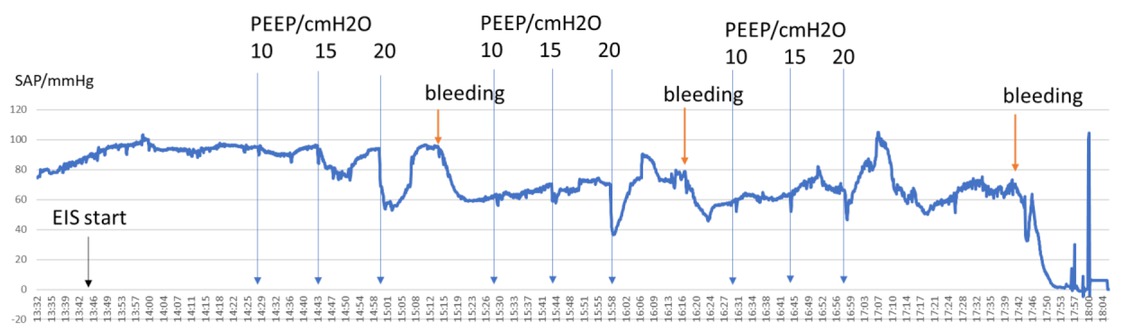
Figure 1
Mean arterial pressure (SAP) during the recoding and challenges (bleeding and PEEP). Y-axis is in mmHg; X-axis is clock time. EIS recording stated at 13.43.
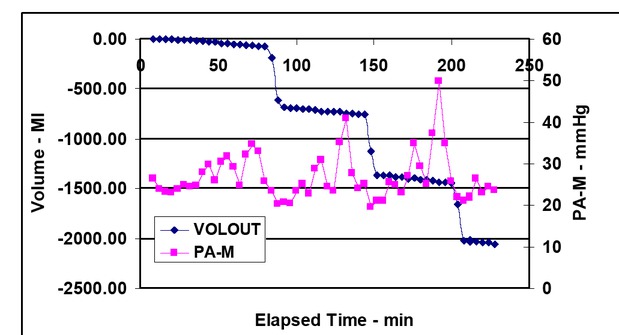
Figure 2
Mean pulmonary arterial pressure (PA-M) and simulated hemorrhage (VOLOUT) vs elapsed time. PA-M is not affected by the amount of bleeding prior to the first bleeding. However, PEEP produces an increase in PA-M following the first and second bleed periods.
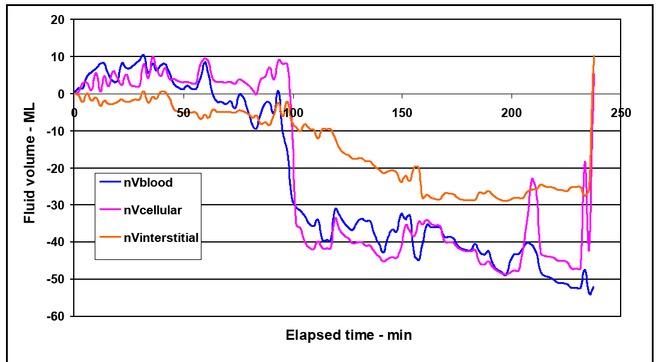
Figure 3
Normalized intravascular (nVblood), cellular (nVcellular) and interstitial (nVinterstital) calf compartment volumes vs. elapsed time.
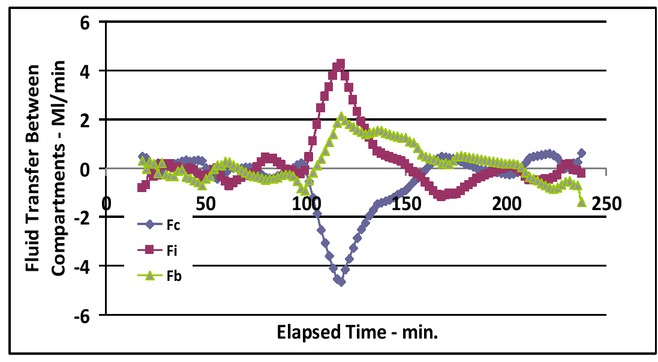
Figure 4
Fluid transfer in and out of the cells (Fc), interstitial space (Fi), and intravascular compartment (Fb) vs. elapsed time.
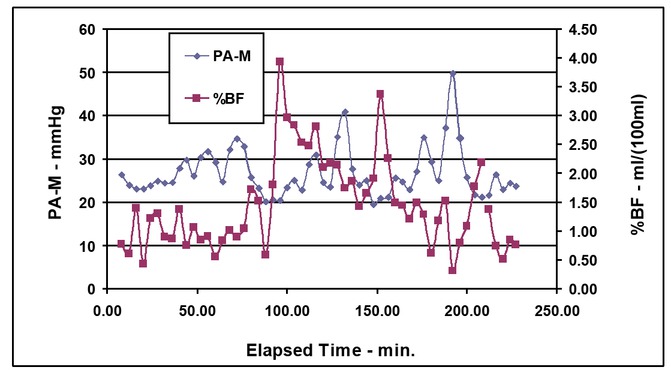
Figure 5
Mean pulmonary arterial pressure (PA-M) and calf percent blood flow (%BF) vs. elapsed time.
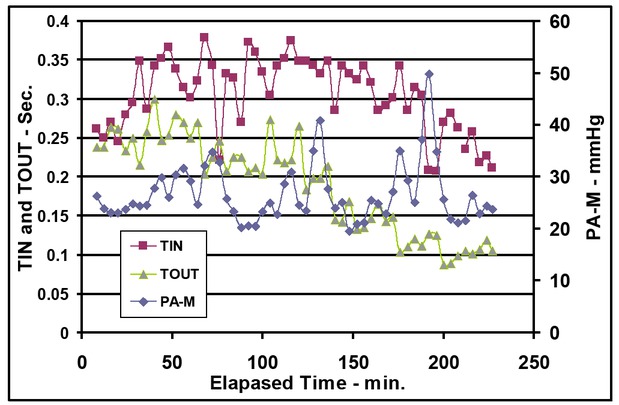
Figure 6
Mean pulmonary arterial pressure [PA-M], time of arterial blood inflow (TIN), and time of venous outflow (TOUT) vs. elapsed time.
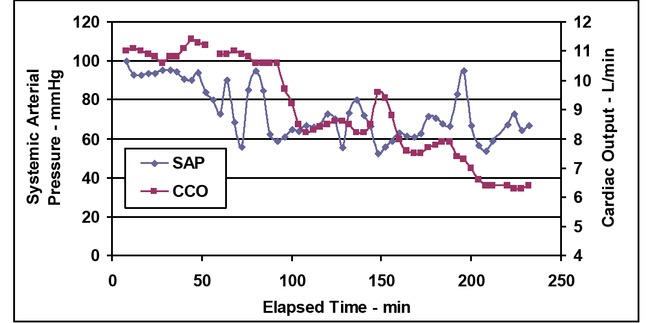
Figure 7
Systemic arterial pressure (SAP) and continuous cardiac output (CCO) vs. elapsed time.
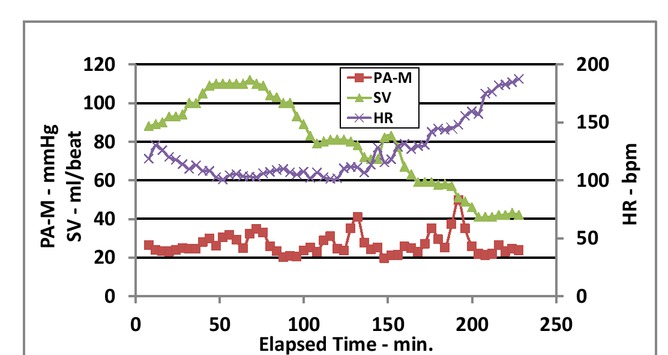
Figure 8
Mean pulmonary arterial pressure (PA-M), stroke volume (SV), and heart rate (HR) vs. elapsed time.
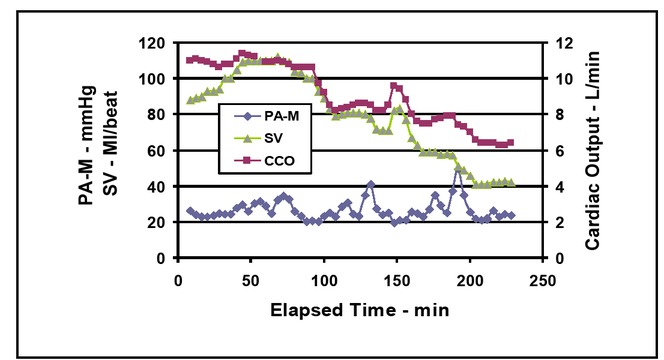
Figure 9
Mean pulmonary arterial pressure (PA-M), stroke volume (SV), and mean cardiac output (CCO) vs. elapsed time.
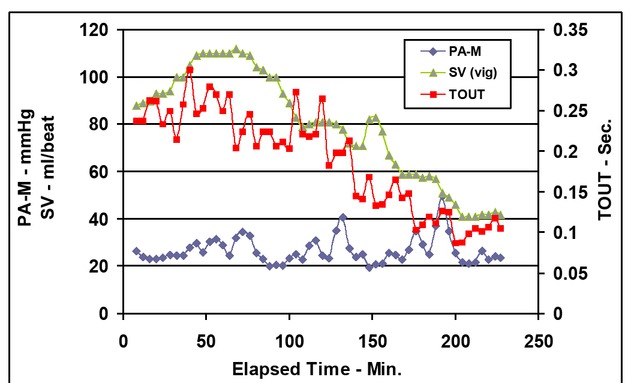
Figure 10
Mean pulmonary arterial pressure (PA-M), stroke volume (SV), and time of venous outflow (TOUT) vs. elapsed time.
Table 1
Summary of CBF AR changes.
| Challenge | SAP | CFa | CFm | REG1d | CBF | LDF | ICP | CVP | PAP | CO2 | pO2 |
|---|---|---|---|---|---|---|---|---|---|---|---|
| iso-prop | |||||||||||
| transit | + | - | - | - | - | + | - | - | +/- | 0 | - |
| PEEP 10 | - | + | - | + | + | - | + | - | 0 | + | - |
| PEEP 15 | - | + | - | + | +/- | + | + | - | 0 | + | - |
| PEEP 20 | - | + | - | + | +/- | + | + | - | - | + | - |
| hemorrhage 1 | - | + | - | + | + | + | -/+ | + | + | - | -/+ |
| PEEP 10 | 0 | 0 | -/+ | + | 0 | 0 | + | - | - | + | - |
| PEEP 15 | - | -/+ | -/+ | + | + | 0 | + | - | - | + | - |
| PEEP 20 | - | -/+ | -/+ | + | -/+ | -/+ | + | - | + | + | - |
| CO2 inhalation | + | 0 | 0 | 0 | + | 0 | + | 0 | - | + | - |
| hemorrhage 2 | - | + | +/- | + | - | 0 | - | + | + | 0 | +/0 |
| PEEP 10 | 0 | 0 | + | - | + | 0 | + | - | - | + | - |
| PEEP 15 | + | - | + | - | + | 0 | + | + | - | + | - |
| PEEP 20 | -/+ | - | - | - | + | + | + | + | - | + | - |
| hemorrhage 3 | - | + | - | + | + | 0 | - | - | - | + | 0 |
| PEEP 10 | + | 0 | 0 | 0 | 0 | 0 | + | +/- | + | + | + |
| lethal | |||||||||||
| bleeding | - | +/- | - | +/- | - | - | - | -/+ | +/- | -/+ | +/- |
| CBF AR active | 7 | 1 | 9 | 4 | 3 | 6 | 3 | 4 | 5 | 3 |
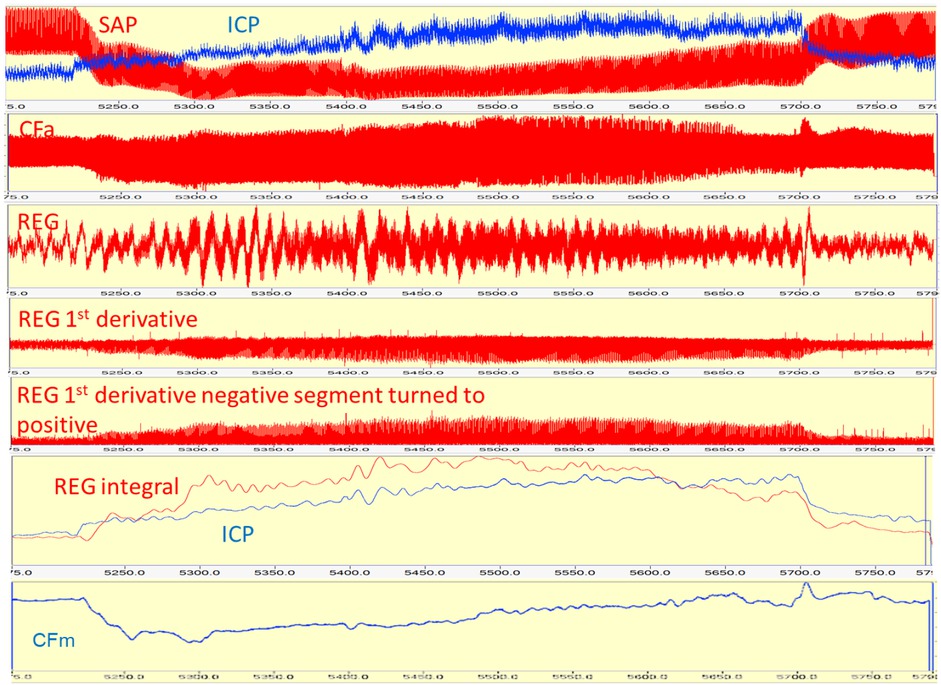
Figure 11
Continuous analog parameters (as a strip chart) vs. time. CBF AR is active.
Table 2
Percent changes of mean ICP and REG integral during 15 and 20 cmH2O PEEPs before first (1) and after first bleedings (2), and after second bleeding (3). Values are in percentage of their own baseline. Measurement was made at the highest values. Note that after 2nd bleeding REG values are negative, indicating that CBF AR is passive.
| 15 cm H2O | 20 cm H2O | 15 cm H2O | 20 cm H2O | |
|---|---|---|---|---|
| 1 | 132 | 148 | 15 | 31 |
| 2 | 133 | 148 | 28 | 40 |
| 3 | 74 | 48 | -19 | -41 |
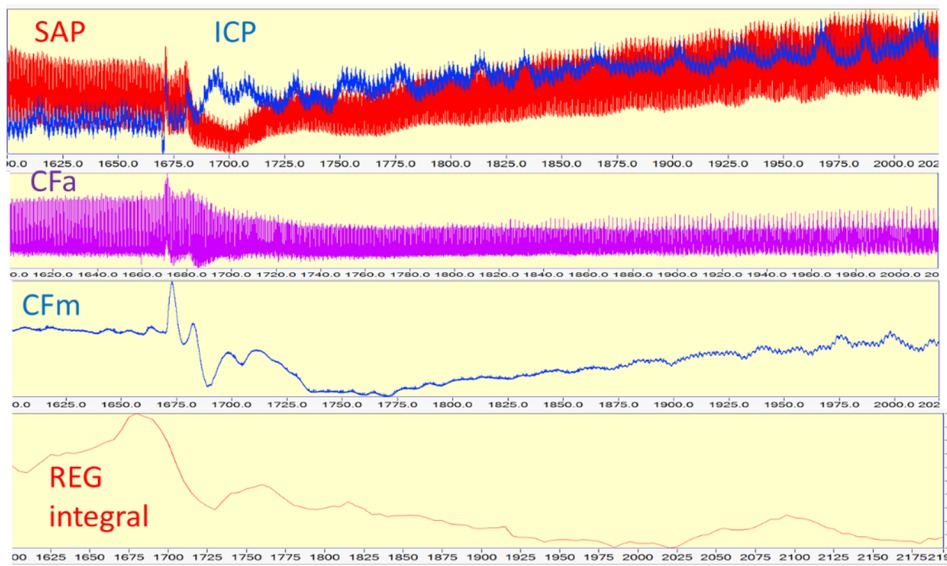
Figure 12
Continuous analog parameters (plotted as a strip chart) vs. time. CBF AR is passive.
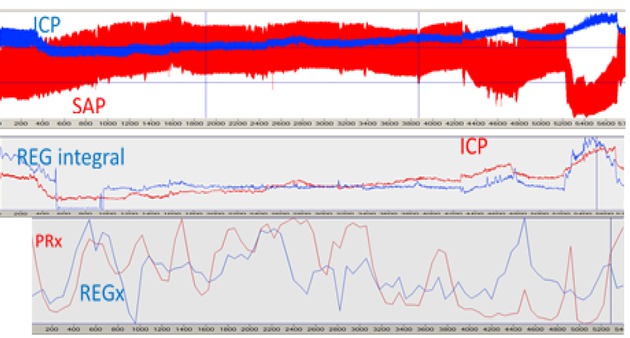
Figure 13
Intracranial pressure (ICP), systemic arterial pressure (SAP), REG integral (REG integral), PRx, and REGx plotted as analog strip chart vs. time. The first number of PRx and REGx calculations starts at 300 sec of the original signal. Pig CBF 9, file 13:32, time window 96.52 min.
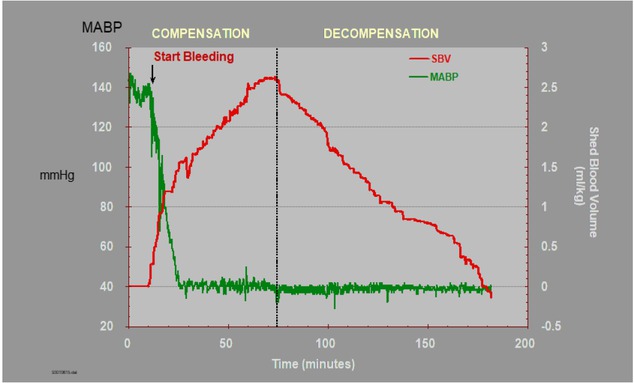
Figure 14
Phases of shock. The shock phases defined as compensatory represent the removal of 50% and 100% of peak shed blood volume (3% of body weight). Shock phases defined as decompensatory represent the return of 20 and 75% of the shed blood volume [58].