
Tab.1
Electrical properties of the materials used in FEM simulations.
| Material | Conductivity (S/m) | Resistivity (Ωm) |
|---|---|---|
| lowConductivity | 0.1 | 10 |
| mediumConductivity | 1 | 1 |
| highConductivity | 10 | 0.1 |
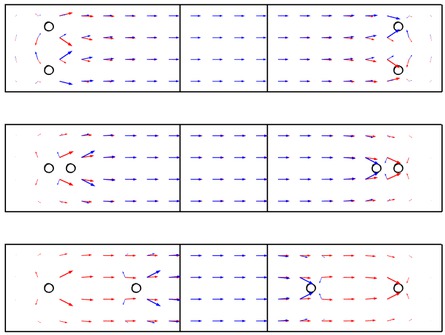
Fig.1
Current density vector plots for the three models, starting with model A at the top followed by model B and C. The red vectors are CC current densities and the blue vectors are reciprocal current densities.
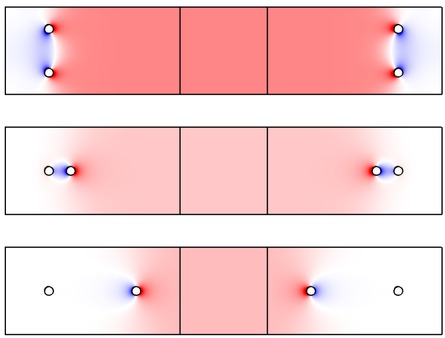
Fig.2
Sensitivity field plots for the three models, starting with model A at the top followed by model B and C. The red regions represent positive sensitivity while the blue regions represent negative sensitivity. The absolute value is higher the stronger the color is.
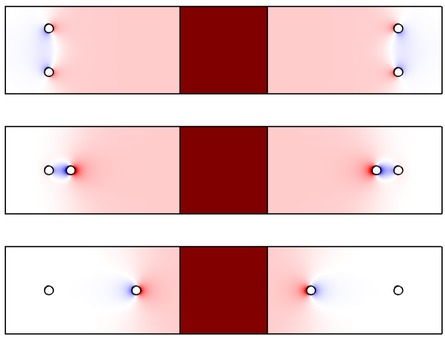
Fig.3
Volume impedance density field plots for the three models, starting with model A at the top followed by model B and C. The red regions represent positive volume impedance density while the blue regions represent negative volume impedance density. The absolute value is higher the stronger the color is.
Tab. 2
Simulated impedances and associated perceptivities for the three models. Units for perceptivities are left out since we are considering change in phenomena which can be non-physical changes.
| Parameter | Model A | Model B | Model C |
|---|---|---|---|
| Sim. 1 | 12.645 Ω | 12.645 Ω | 10.985 Ω |
| Sim. 2 | 11.736 Ω | 11.736 Ω | 10.076 Ω |
| Sim. 3 | 13.545 Ω | 13.545 Ω | 11.885 Ω |
| Sim. 4 | 12.545 Ω | 12.545 Ω | 10.885 Ω |
| Ψm | -3.636 | -3.636 | -3.636 |
| Ψg | 3.600 | 3.600 | 3.600 |
| Ψ | -0.400 | -0.400 | -0.400 |
| Ψrm | -0.288 | -0.288 | -0.331 |
| Ψrg | 0.266 | 0.266 | 0.303 |
| Ψr | -0.032 | -0.032 | -0.036 |