Have a personal or library account? Click to login
On the selection of excitation signals for the fast spectroscopy of electrical bioimpedance Cover

On the selection of excitation signals for the fast spectroscopy of electrical bioimpedance

By: Jaan Ojarand and  Mart Min  
Open Access
|Dec 2018

Figures & Tables

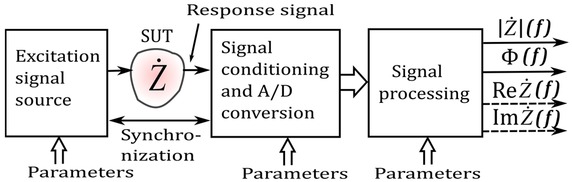
Fig.1

Simplified structure of the EBI spectroscopy system.
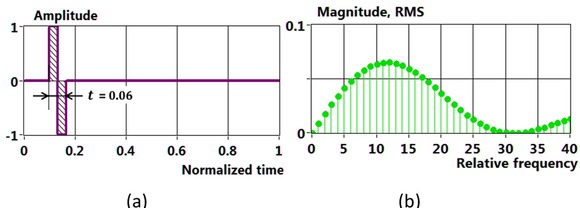

Fig.2

Waveform (a) and magnitude spectrum (b) of the pulse with relative duration t = (64/1000).
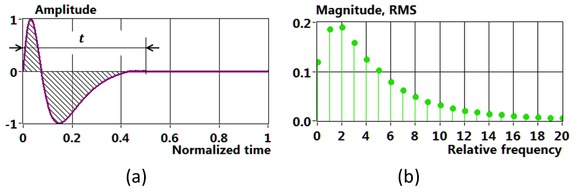

Fig.3

Waveform (a) and magnitude spectrum (b) of the exponentially modulated short chirp with relative duration t = 0.5.
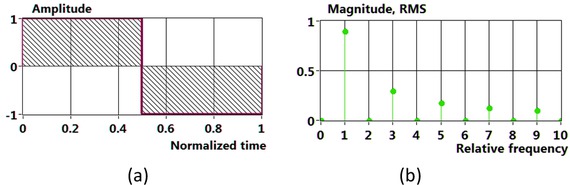

Fig.4

Rectangular waveform (a) and its magnitude spectrum (b).
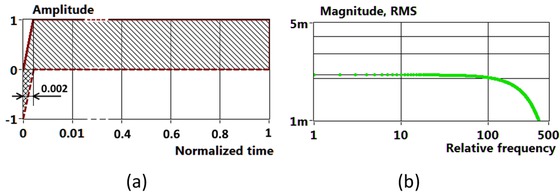

Fig.5

Waveforms (a) and magnitude spectrum (b) of the step waveform with a rise time of 1/500 of the signal period. Note that the first part of the time scale is magnified by 20. Diagonal hatch illustrates the energy content of the signal starting from zero and cross-hatches the energy content of the signal starting from -1.
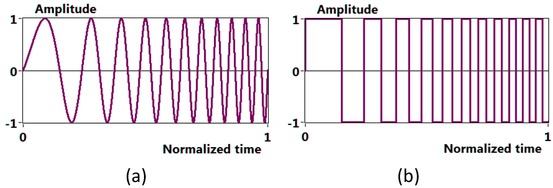

Fig.6

Waveforms of the sinusoidal (a) and signum-chirp (b).
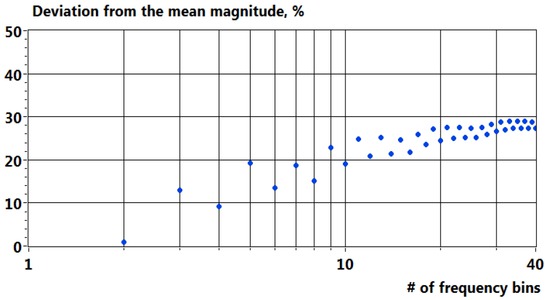

Fig.7

Relative deviation of RMS magnitudes of the frequency components from their mean values of the linear sinusoidal chirp with normalized frequencies in the range from 10 to 50.
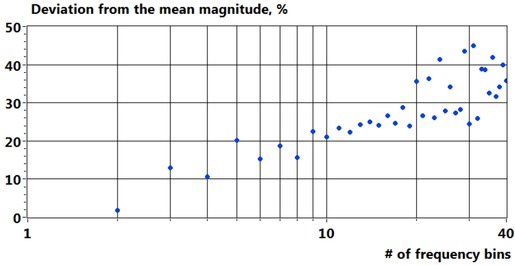

Fig.8

Relative deviation of RMS magnitudes of frequency components from their mean values of the signum chirp with normalized frequencies in the range from 10 to 50.
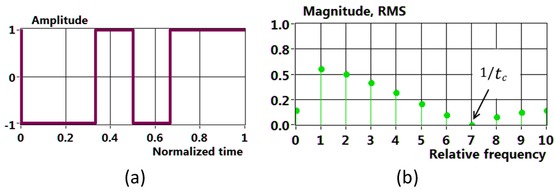

Fig.9

Waveform of the 3-rd order MLBS (a) and its magnitude spectrum (b).
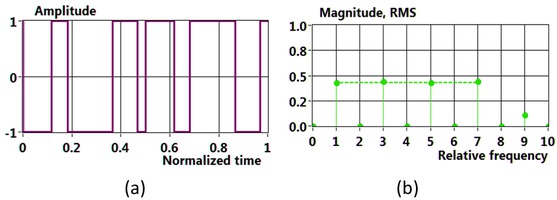

Fig.10

BMS waveform (a) and its magnitude spectrum (b) with four equally emphasized components (frequency bins 1, 3, 5, 7).
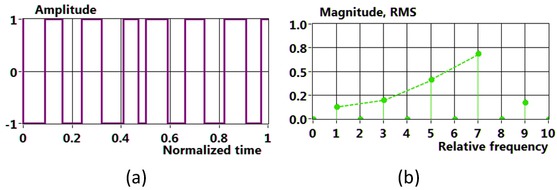

Fig.11

BMS (a) and its magnitude spectrum (b) with rising levels of components (frequency bins 1, 3, 5, 7).
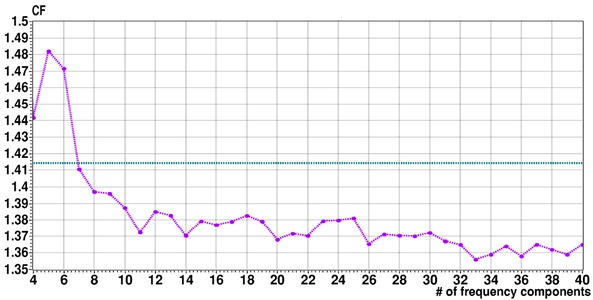

Fig.12

CF of the optimized multisine signal with a consequent frequency distribution (i = 1,2,3,4 …. k), for a k in the range from 4 to 40. A green line level corresponds to the CF of a single sine wave.
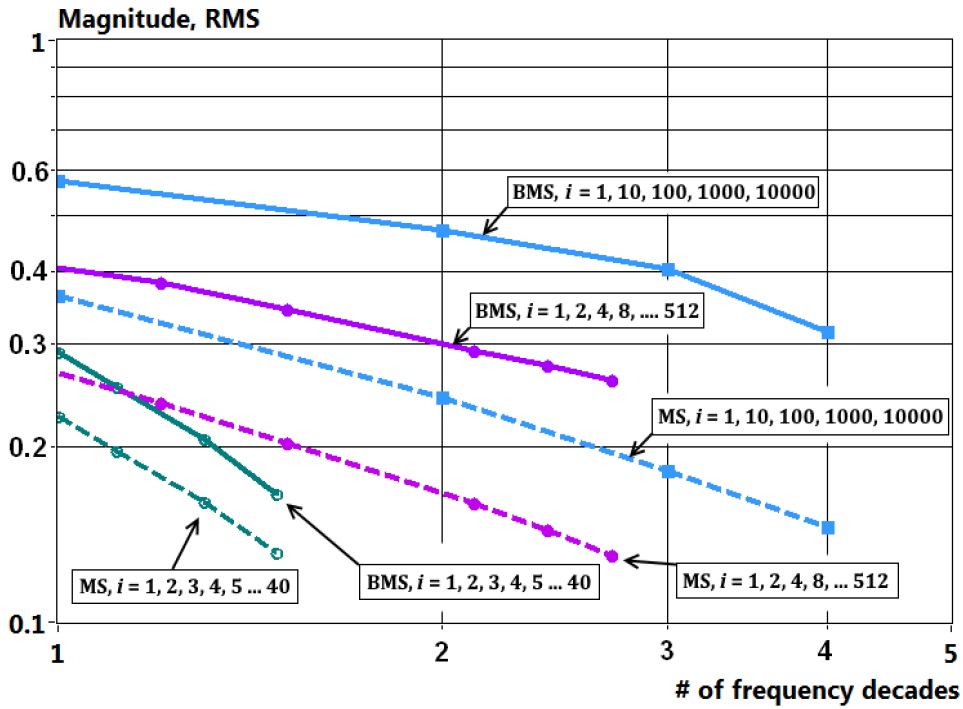

Fig.13

Normalized RMS magnitudes of consecutively and logarithmically distributed frequency components of optimized multisines (MS, dashed lines) and BMS (solid lines) vs. a number of frequency decades a signal covers.
Language: English
Page range: 133 - 141
Submitted on: Dec 11, 2018
Published on: Dec 31, 2018
Published by: University of Oslo
In partnership with: Paradigm Publishing Services
Publication frequency: 1 issue per year

© 2018 Jaan Ojarand, Mart Min, published by University of Oslo
This work is licensed under the Creative Commons Attribution-NonCommercial-NoDerivatives 3.0 License.