
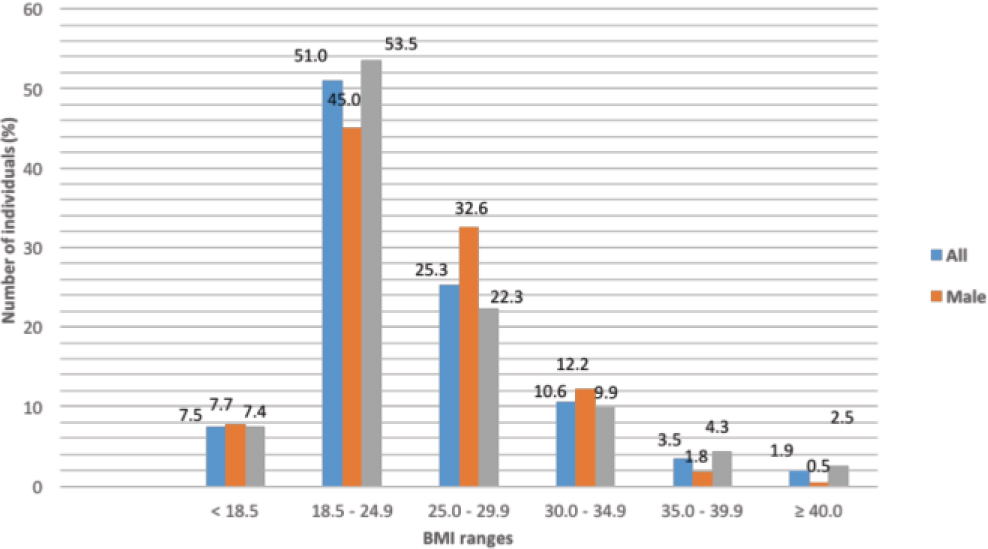
Figure 1
Subject distribution (%) according to the ranges of classification of nutritional status proposed by the body mass index (kg/m2) and divided by gender.
Table 1
Anthropometric and body composition characterization of the study sample.
| Variable | Total | Males | Females | P value |
|---|---|---|---|---|
| N | 1301 | 386 | 915 | 0.3033 |
| Age (years) | 35.7±17.6 | 36.5±17.6 | 35.4±17.6 | <0.0001∗ |
| Weight (kg) | 67.6±16.0 | 75.8±15.9 | 64.2±14.8 | <0.0001* |
| Height (cm) | 164.9±9.5 | 173.9±8.2 | 161.1±7.1 | 0.5471 |
| BMI (kg/m2) | 24.9±5.5 | 25.0±4.6 | 24.8±5.8 | <0.0001∗ |
| Total FM (%) | 27.6±10.0 | 19.4±7.6 | 31.0±8.8 | <0.0001∗ |
| Left arm FM (kg) | 28.6±11.9 | 20.0±11.6 | 32.3±10.0 | <0.0001∗ |
| Right armFM (kg) | 27.4±10.8 | 18.5±6.4 | 31.2±10.1 | <0.0001∗ |
| Right leg FM (kg) | 30.8±11.5 | 17.7±7.6 | 36.3±7.9 | <0.0001∗ |
| Left leg FM (kg) | 30.6±10.9 | 18.5±7.6 | 35.7±7.6 | <0.0001∗ |
| Trunk FM | 25.2±10.1 | 20.5±8.7 | 27.3±9.9 | <0.0001∗ |
| Total FFM (kg) | 45.8±10.2 | 57.3±9.8 | 41.0±5.3 | <0.0001∗ |
| Left arm FFM (%) | 2.4±0.8 | 3.2±0.7 | 2.0±0.4 | <0.0001∗ |
| Right arm FFM (%) | 2.4±0.7 | 3.2±0.7 | 2.0±0.4 | <0.0001∗ |
| Right leg FFM (%) | 7.8±1.9 | 9.9±1.9 | 6.9±1.0 | <0.0001∗ |
| Left leg FFM (%) | 7.6±1.8 | 9.7±1.8 | 6.8±0.9 | <0.0001∗ |
| Trunk FFM | 25.6±5.4 | 31.1±5.6 | 23.2±3.1 | <0.0001∗ |
| TBW (%) | 52.8±7.5 | 57.7±7.2 | 50.7±6.6 | <0.0001∗ |
∗ Data are expressed as mean ± standard deviation and the p value was calculated by the Student t-test, with p< 0.05 indicating a statistically significant difference between males and females
∗ Data are expressed as mean ± standard deviation and the p value was calculated by the Student t-test, with p< 0.05 indicating a statistically significant difference between males and females
∗ Data are expressed as mean ± standard deviation and the p value was calculated by the Student t-test, with p< 0.05 indicating a statistically significant difference between males and females
∗ Data are expressed as mean ± standard deviation and the p value was calculated by the Student t-test, with p< 0.05 indicating a statistically significant difference between males and females
∗ Data are expressed as mean ± standard deviation and the p value was calculated by the Student t-test, with p< 0.05 indicating a statistically significant difference between males and females
∗ Data are expressed as mean ± standard deviation and the p value was calculated by the Student t-test, with p< 0.05 indicating a statistically significant difference between males and females
∗ Data are expressed as mean ± standard deviation and the p value was calculated by the Student t-test, with p< 0.05 indicating a statistically significant difference between males and females
∗ Data are expressed as mean ± standard deviation and the p value was calculated by the Student t-test, with p< 0.05 indicating a statistically significant difference between males and females
∗ Data are expressed as mean ± standard deviation and the p value was calculated by the Student t-test, with p< 0.05 indicating a statistically significant difference between males and females
∗ Data are expressed as mean ± standard deviation and the p value was calculated by the Student t-test, with p< 0.05 indicating a statistically significant difference between males and females
∗ Data are expressed as mean ± standard deviation and the p value was calculated by the Student t-test, with p< 0.05 indicating a statistically significant difference between males and females
∗ Data are expressed as mean ± standard deviation and the p value was calculated by the Student t-test, with p< 0.05 indicating a statistically significant difference between males and females
∗ Data are expressed as mean ± standard deviation and the p value was calculated by the Student t-test, with p< 0.05 indicating a statistically significant difference between males and females
Table 2
Correspondence between the cutoff points of the BMI (kg/m2) and body fat ranges (%) according to Gallagher et al (2000).
| Fat mass (%) | BMI (kg/2) | Total | |||
|---|---|---|---|---|---|
| < 18.5 | 18.5 – 24.9 | 25 – 29.9 | ≥ 30.0 | ||
| Men (%) | |||||
| < 8 | 3.1 (12) | 4.6 (18) | 0.5 (2) | 0 (0) | 8.3 (32) |
| 8–20 | 3.9 (15) | 29.3 (113) | 11.6 (45) | 1.8 (7) | 46.6 (180) |
| 20 – 25 | 0.5 (2) | 6.7 (26) | 10.1 (39) | 2.8 (11) | 20.2 (78) |
| > 25 | 0.3 (1) | 4.4 (17) | 10.4 (40) | 9.8 (38) | 24.8 (96) |
| Total | 7.8 (30) | 45.0 (174) | 32.6 (126) | 14.5 (56) | 100 (386) |
| Women (%) | |||||
| < 21 | 4.9 (45) | 7.3 (67) | 0.1 (1) | 0 (0) | 12.3 (113) |
| 21 – 33 | 2.5 (23) | 39.9 (365) | 5.2 (48) | 0.7 (7) | 48.4 (443) |
| 33– 39 | 0 (0) | 5.3 (49) | 10.5 (96) | 2.8 (26) | 18.7 (171) |
| ≥ 39 | 0 (0) | 1.0 (9) | 6.4 (59) | 13.1 (120) | 20.5 (188) |
| Total | 7.4 (68) | 53.5 (490) | 22.3 (204) | 16.7 (153) | 100 (915) |
Table 3
Comparative summary of studies proposing new cutoff points for the BMI for the classification of overweight/obesity in men and women.
| Reference | Country | n | BMI cutoff points Men (kg/m2) | BMI cutoff points Women (kg/m2) |
|---|---|---|---|---|
| Deurenberg-Yap et al. (2000) | Singapore | 291 | 26.0 to 27.0 | 26.0 to 27.0 |
| Frankenfield et al. (2001) | US | 141 | 22.6 | 20.1 |
| Ko et al. (2001) | China | 5153 | 23.0 – 26.0 | 23.0 – 26.0 |
| Dudeja et al. (2001) | India | 123 | 21.5 | 19.0 |
| Oh et al. (2004) | Korea | 773915 | 25.0 | 25.0 |
| Kagawa et al. (2006) | Japan | 139 | - | 23.0 |
| Bozkirli et al. (2007) | Turkey | 909 | 28.24 | 28.02 |
| Romero-Corral et al. (2008) | US | 13601 | 25.8 | 25.5 |
| Laughton et al. (2009) | Canada | 77 | 22.1 | 22.1 |
| Mialich et al. (2011) | Brazil | 200 | 21.84 – 26.11 | 22.0 – 25.3 |
| Gupta and Kapoor (2012) | India | 578 | 22.9 – 28.8 | 22.9 – 28.8 |
| Gómez-Ambrozi et al. (2012) | Spain | 6123 | 29.0 | 27.0 |
| Laurson et al. (2011) | US | 8268 | 83rd percentile | 80th percentile |
| Mialich et al. (2014) | Brazil | 501 | 28.38 | 25.24 |
| PRESENT STUDY | Brazil | 1301 | 27.15 | 27.03 |
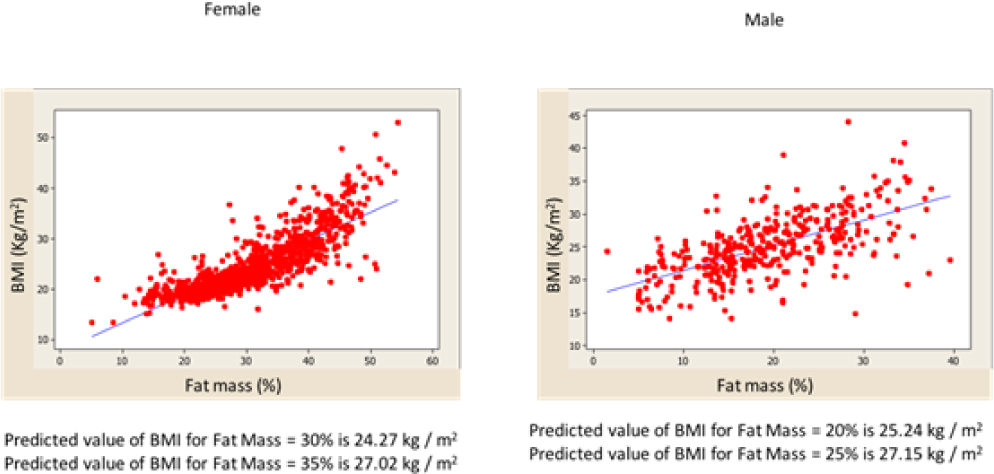
Figure 2
Cut-off point of the traditional BMI for the detection of obesity in men and women of the sample studied, considering percentages of body fat for the classification of overweight and obesity of 20% and 25% and 30% and 35% for men and women, respectively.
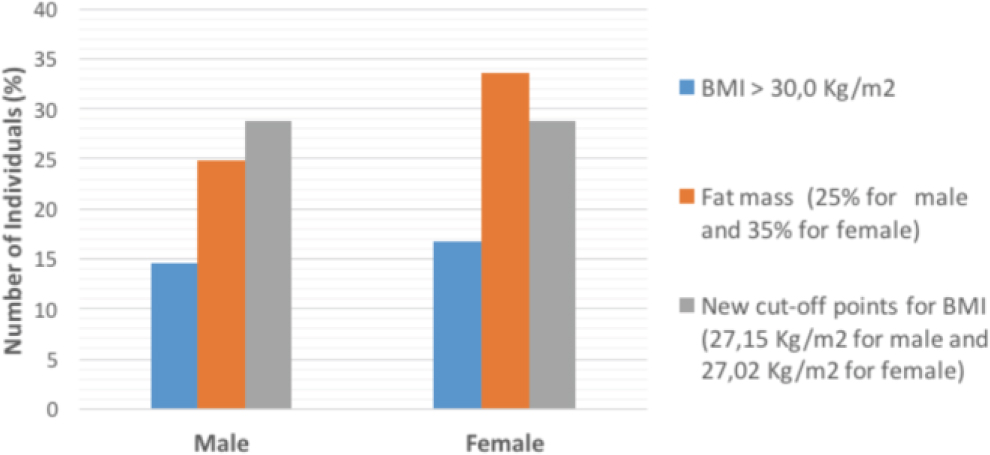
Figure 3
Number of individuals (%) classified as obese accordig to 3 different criteria: BMI higher than 30 kg/m2 for men and women, fat mass (%) higher than 25% for men and 35% for women, and new cutoff points for the BMI of 27.15 kg/m2 for men and 27.02 kg/m2 for women.