

Introduction
The anniversary resolutions of the Sejm and Senate of the Republic of Poland are among the various mechanisms used to commemorate the past – specifically, anniversaries of historical events and figures of significance to the Polish nation and state. These resolutions serve as a tool of memory politics and are categorized in the literature as a type of commemorative resolution. They represent a symbolic, non-binding, and non-controlling form of parliamentary expression (Maroń 2014; Secler 2018). Parliamentary anniversary resolutions play a significant role in shaping collective memory. In this sense, not only is their content important, but also the form and circumstances under which they are adopted. These resolutions often become the focal point of heated political debates, reflecting, in essence, differing attitudes toward the past. As tools of memory politics, anniversary resolutions help to propagate a particular vision of the past. They can also serve the partisan interests of the ruling political parties, especially when they are passed by a majority vote rather than being adopted by acclamation by the Sejm and Senate.
After 1989, several hundred such resolutions were passed in the Sejm and Senate (see Chart 1). A notable increase in these acts is observed after 2000. This period coincides with a surge in memory policy initiatives and disputes over historical issues – topics that had previously not generated such strong emotions. In his book Spory o historię 2000–2011, Paweł Machcewicz notes that “Poles began to pay increasing attention to history because the passing decade of the 1990s had already seen a painful political and economic transformation, which consumed the bulk of ordinary people’s attention, especially during the early years of that period. The profound changes in daily existence . . . were not conducive to reflection on the past. . . . On the other hand, for most political elites and opinion makers in the first decade of independent Poland, the tasks of reforming the economy, rebuilding the state, and changing Poland’s international position seemed more important than historical settlements” (Machcewicz 2012, 10–11).
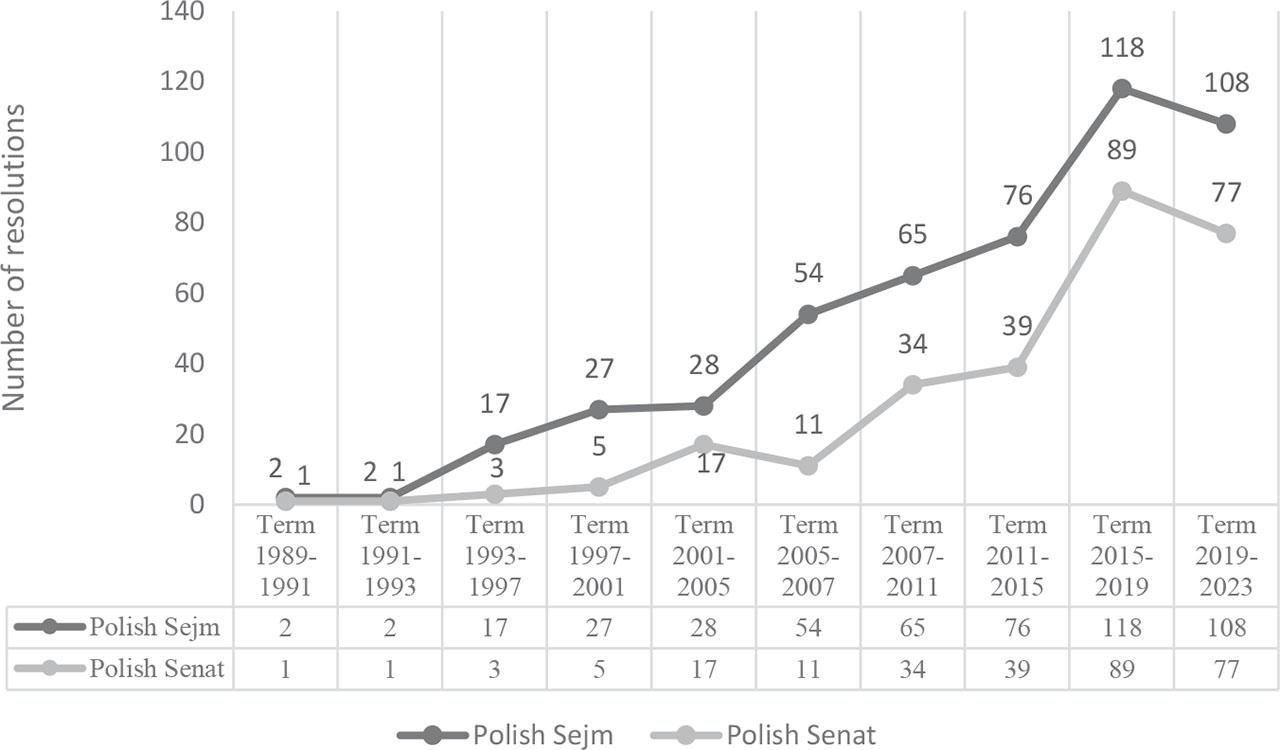
Chart 1.
Anniversary resolutions of the Sejm and Senate of the Republic of Poland (1989–2023).
Source: Own study.
Themes covered by anniversary resolutions of the Sejm and Senate are very diverse. They address various aspects of the past, commemorating uprisings, wars, significant events in recent Polish history, while also tackling complex issues in relations with neighboring countries (Secler 2017).
The research problem addressed in this article centers on the role of anniversary resolutions in the politics of remembrance. The goal is to present the main findings of a research project focused on the commemoration of historical anniversaries by the Polish Parliament after 1989. The theoretical framework of the article situates historical anniversaries as a “medium of memory policy” (Wolff-Powęska 2009). The research presented in the text is primarily guided by a political science approach, based within the broader interdisciplinary context of memory studies.
Commemorating historical anniversaries: Theoretical context
The celebration of historical anniversaries is a ritual designed to emphasize the connection between the present and the past. At the same time, it is also a method of shaping collective memory. Rituals have always accompanied human existence, being connected with everyday experiences, such as fear, anxiety, survival, and the making of important decisions (Motyl 2014). Encyclopedically, a ritual is defined as an established pattern of behavior, involving the performance of specific actions during magical or religious ceremonies, or various formal events, including state ceremonies. Rituals are characterized by a distinct structure. They include symbolic behaviors that are structured and repeated, thereby imparting meaning to reality. Repetition within rituals suggests the continuation of the past into the present and ensures that the memory of the past is preserved for the future. Several types of rituals can be distinguished: 1) religious rituals (e.g., services, funeral ceremonies); 2) secular rituals (e.g., vows, oaths); 3) collective rituals (e.g., public holidays); 4) individual rituals (e.g., personal prayer) (Motyl 2014).
Émile Durkheim stresses that in the social context, rituals play a crucial role in maintaining memory and connecting to the group’s traditions. They serve to renew and reinforce the essential elements of social consciousness. Their primary functions include the moral reconstruction and strengthening of society, as well as the formation and consolidation of individual and collective identities (Kapralski 2014). Their cyclical repetition helps to cement and strengthen communal bonds, making rituals an antidote to the routine of everyday life (Wolff-Powęska 2011).
Maurice Halbwachs sets ritual primarily within a religious context. He highlights the role of a collection of gestures, words, and liturgical objects that, through their repetition and relatively unchanging form, carry historical events beyond time, presenting them as exemplifications of eternal and unchanging principles. Rituals are integral to the social framework of memory, perpetuating and transmitting institutionalized forms of memory, including cultural and official memory (Halbwachs 2008). Returning to É. Durkheim, it is worth noting that he attributed ritual to the essential forms of religious life, distinguishing two categories. The first he defined as negative worship, which encompasses a set of prohibitions aimed at delineating what belongs to the sacred sphere and what belongs to the profane. Durkheim considered the division between the sacred and the profane as fundamental to understanding religious life. The second category, which he called positive worship, involves creating a bond with the sacrum, often through various forms of commemorative rituals (Motyl 2014).
Paul Connerton explores the concept of rituals in the context of commemorative rites, emphasizing that these rites differ from other rituals by directly referencing events and individuals, whether mythically or historically grounded (Connerton 2012). Similarly, David I. Kertzer argues that rituals and symbols are used in all political systems to maintain the status quo, shape and perpetuate identity, and legitimize authority (Kertzer 1988). Since antiquity, rituals have served as a critical platform for developing political activity, manifesting political aspirations, and defining one’s position in the power structure. For example, monarchical power often manifested itself through ritualistic actions. Rituals actualize and realize power, . . . meaning that the memory of power, its actions, and undertakings, is frequently preserved as the memory of ritualized gestures, behaviors, or words. These rituals provided a way to store, transmit, and perpetuate the memory of the ruler and his deeds in the most accessible and comprehensive manner. Consequently, within narrative transmission, ritual became a central element of description and, by extension, a crucial factor shaping political reality (Dalewski 2005).
In this context, it is crucial to recognize that commemorative rituals, designed to protect the past from oblivion, play a vital role in shaping the identity of members within a given community or sociopolitical order. The practice of commemorating significant events or figures, often in the form of memory holidays, dates to ancient pagan times. The rhythm of these commemorative practices was closely related to natural cycles (Wolff-Powęska 2009). Among the oldest were rituals connected to the cycles of nature and animal worship. For instance, in Ancient Egypt, animal cults were widespread by the mid-fourth century, with sacred animals like cats in Bast, dogs and gazelles in Thebes, and crocodiles in Sheldet being venerated. They had their own temples and priests. Sakkara, the burial place of kings and high-ranking Egyptian officials, was among the largest centers of animal worship. In these catacombs, animals ‘accompanied’ the buried officials. In ancient Egyptian religion, animals were the equivalent of Christian saints. Baboons, for instance, were revered and idolized as incarnations of Osiris after death. They were buried in wooden boxes within underground crypts. Pilgrims visiting Sakkara would ritually seek advice, cures for diseases, or revelations of the future, believing that the baboon Osiris would convey their requests to the gods (Wilkinson 2020; Assmann 2019).
Over time, the calendar emerged as a tool to organize time using symbols, myths, and rituals. Its significance was already evident in early Rome, where control of the calendar was exercised by the pontiffs, members of the highest priestly college. This control extended beyond annual festivals; the calendar determined the nature of individual days, such as whether courts could operate, or the senate could convene. Timekeeping systems of the era grappled with the challenges posed by the 365-day annual cycle – the approximate time it takes the Earth to orbit the Sun. According to Mary Beard, John North, and Simon Price, “the Republican Roman calendar had 355 days, so a full month was added (‘intercalated’) at intervals determined by the pontiffs. The college of pontiffs also had the responsibility of setting dates for the celebration of certain important festivals that had no predetermined dates. Additionally, the rex sacrorum, a priestly office within the college of pontiffs [note BS], was tasked with announcing the beginning of each month. This practice possibly originated from earlier calendar systems, where months began upon the observation of a new moon (Beard et al. 2017, 52).
The festive ceremonies of ancient Greece and Rome were assimilated into Christian culture, which subsequently influenced national and state traditions. Secular celebrations, for example, often incorporated objects used in daily religious practices. A significant turning point occurred with the French Revolution, which led to the secularization of culture and society. This period also saw the emergence of nation-states, further shaping the evolution of these traditions.
Anna Wolff-Powęska noted that “nations require a continual renewal of their ideological foundations, and memorial festivals offer a broad platform where communication rituals are brought to life, where embellishments of history are made, and the blemishes of past events are smoothed over. Conversely, where the remnants of the shared memory are fading, the illusion of it must be constructed. During these occasions, history can be monumentalized, selectively emphasized, relegated, or downplayed” (Wolff-Powęska 2011, 402). The modern state, as an active organizer of commemorative holidays, uses the holiday calendar and historical anniversaries to fulfill its political objectives. These occasions not only serve to recreate the past in the present but also play an important role in the politics of memory by selecting events deemed important for the community’s identity. In this context, Marcin Napiórkowski refers to anniversaries of historical events as a form of “memory synchronization.” The mechanism of anniversaries operates “on the principle of ‘memory time’ which delineates in the community’s calendar the moments of symbolic recall and repetition of the past. The designation of an anniversary . . . is a momentous and meaningful act. . . . The announcement of the anniversary of an event highlights its significance, and the celebration which follows cements it as part of history” (Napiórkowski 2016, 150–51). It should be added that the same mechanism applies to the commemoration of individuals important for the state, nation, or a given community.
When trying to define an anniversary, we must deal with its temporal dimension. An anniversary defines a date falling a few years after a historical event. Dictionary definitions distinguish between round, important, special, beautiful, great, national, and state anniversaries. The word “anniversary” originates from the word “year.” We also use anniversaries to measure the time that has passed since an event. Consequently, an anniversary can be further defined by the hour of an event. These time units organize past events commemorated in the present, giving it a certain rhythm and meaning. Days and hours become points of reference for memories, celebrations, reckoning with the past, its reinterpretations, disputes, and conflicts. Thus, anniversaries exhibit a culture-bearing nature (Piotrowska 2019).
Major upheavals generate interest in anniversaries. For the state and the national community, anniversaries related to specific events, such as uprisings, battles, and wars, are frequently associated with figures, including national heroes, leaders of particular significance for the state and nation, and people of science or culture. They also mark significant systemic and political upheavals. For example, in Polish history, dates such as 1918, 1939, 1945, and 1989 establish a new order, while political decision-makers, because of novus ordo, modify the calendar of anniversaries. In this sense, the anniversaries commemorated are called historical, state, or national, and become a medium of memory politics (Wolff-Powęska 2009). The analysis of the calendar of historical anniversaries leads to specific conclusions regarding the role and significance authorities assign to certain events and individuals, while shaping the framework of memory policy. The celebrations of historical anniversaries can be a political manifestation exposed to specific narration and interpretation. Thus, the political practice uses anniversaries to support current interests, and they are susceptible to be instrumentalized.
Robert Traba aptly notes that the elite creates such signs, symbols, and anniversary rituals, which they seek to introduce to the general calendar of events to build the unity of a community. In this sense, anniversaries are “invented” and the emotional connection to a given date is perpetuated by periodical celebration. There are countries that try to mobilize their societies around anniversaries, such as the anniversary of independence or some other important sociopolitical breakthrough. Governments try, with varying degrees of success, to ensure that historical anniversaries promote a positive message and associated value system. They thus recognize that it is a natural form of communication with the society. An anniversary is often part of the myth constituting a foundation of a society and its community spirit (Traba 2009). Emotions also play an essential role in social rituals. According to the sociology of emotions, these can be categorized into primary and secondary emotions. Primary emotions include basic feelings such as anger, fear, happiness, sadness, or disappointment. Secondary emotions, however, are more complex and socially constructed, often blending primary emotions. Examples of secondary emotions include pride, shame, guilt, hostility, and nostalgia (Wiśniewski et al. 2019). These emotions are directly or indirectly related to the selection of anniversaries, the reasoning behind their commemoration, and how they are perceived by the society. They can also be found in political rhetoric, where appeals to pride in certain events and figures are a staple of political discourse and commemorative acts. Emotions vividly bring these commemorations into public consciousness (Traba 2009), playing an important role in political relationships, debates over ideas and values, and the shaping of the politics of remembrance. Given that anniversaries are often the product of political disputes, emotional responses to changes in the anniversary calendar are almost inevitable (Traba 2009).
The celebration of historical anniversaries holds compensatory significance in the public domain. For some, the demonstration of ceremonialism is essential to historical identity, while for others, “it is a suspicious dictate of the calendar, where the cyclical repetition of national holidays triumphs over critical reflection on the meaning and significance of specific historical events” (Wolff-Powęska 2007, 5). A 2016 TNS Poland survey conducted for the National Cultural Center explored Poles’ views on commemorating holidays and anniversaries. The survey identified November 11 (regaining of independence; 73%) and May 3 (adoption of the Constitution; 57%) as the two most deserving of special commemoration. These were followed by August 1 (the outbreak of the Warsaw Uprising; 36%), April 13 (Katyn Massacre Remembrance Day; 29%), and September 1 (the outbreak of World War II; 28%). On the other hand, when asked about their manner of celebrating national holidays, 62% of respondents declared that they mainly celebrate with their families (41%), take part in commemorative services and masses (13%), or attend collective events such as marches and festivals (11%). In contrast, 32% of respondents reported that they do not typically celebrate these occasions (TNS Poland 2016). This result could be interpreted as a weakness in the current policy of remembrance, which aims to unite society around a shared history and foster a sense of community and belonging through the organized celebration of historical anniversaries.
Anniversary celebrations are instrumental in constructing a specific image of the past and maintaining its memory. They are designed to stage historical continuity and serve various functions, including: 1) Assigning symbolic value to particular moments of time; 2) shaping collective identity; 3) integrating society and political elites; 4) mobilizing people for action; 5) harnessing emotional potential; 6) reflecting the historical orientation of the state or embodying a sense of continuity; 7) recalling past events and figures; 8) protecting against forgetting past events and figures; 9) legitimizing or delegitimizing the political order; 10) settling accounts with the past (Wolff-Powęska 2009). Periodic commemoration of the past can also be seen as a way of authenticating the present by appealing to the future for the sake of the past. However, as Pierre Nora points out, it is the uncertainty of the future that compels us to turn to the past. This creates a sense of obligation to preserve all visible connections and material traces that testify to who we were and how we have changed over time (Żakowski 2002).
Methodological approach and main research findings
The historical anniversaries addressed in the anniversary resolutions adopted by the Sejm and Senate of the Republic of Poland after 1989 have been analyzed within the theoretical framework outlined above. As mentioned in the introduction (see again Chart 1), the analysis included 774 anniversary resolutions – selected from the broader category of commemorative resolutions passed by the Polish parliament between 1989 and 2023, covering all completed terms of the Sejm and Senate during this period. 2 The basic criterion for selecting these resolutions from the pool of commemorative resolutions was the association with significant anniversaries.
The primary source material for this research consisted of resolutions passed by the Sejm and Senate. The search and selection process included several stages. Initially, all resolutions passed by the Sejm and Senate after 1998 were gathered. Then, occasional resolutions passed by both chambers of parliament were identified and extracted. Finally, in the third stage, commemorative anniversary resolutions were selected. Consequently, it was essential to evaluate the content to determine whether the enactment of a resolution was the commemoration of an event’s anniversary. Simple reference to the resolution’s title was insufficient; the nature of the resolution had to be confirmed by its content and the intent to honor a particular anniversary had to be explicitly stated. In certain instances, it was necessary to delve into the justification behind the content, where the applicable intent to commemorate an event or individual was explicitly articulated. In addition to the content of resolutions, other source materials were also collected and analyzed, including Sejm and Senate stenographic reports.
The research process addressed key questions: Who drafts anniversary resolutions? What motivates their creation? What events and/or individuals do they commemorate? And how is commemoration expressed? The final question involved identifying patterns or lines of argumentation. Additionally, the context of a given anniversary resolution was also considered important. Writing about historical narrative, Jerzy Topolski stressed that it is a rhetorical tool that reveals author’s views. Thus, it is neither objective nor free from interpretation. Historical imagery contains metaphors, allegories, and myths (Topolski 1998; see also Topolski 1996). Hayden White also referred to the rhetorical dimension of historical narrative, its logic and grammatical composition. In his opinion, it is pivotal as it produces the content of discourse, referring to facts and explicit relations as well as plot patterns that shape the story. This translates facts into a story, or implicit relations (Małochleb 2014). By selecting elements such as events or individuals and creating a composition through rhetorical devices, a story about the past is given a specific meaning. Therefore, I assume that the anniversary resolutions of the Sejm and Senate of the Republic of Poland can be considered a type of historical narrative, a story about the past.
Qualitative methods were central to the research, with a predominant focus on political science. However, it is important to underscore that the nature and subject matter of anniversary resolutions allow for their analysis from various other research perspectives, such as legal or sociological bases. In analyzing the collected anniversary resolutions of the Sejm and Senate, institutional-legal and interpretative approaches were used. The research method involved collection, selection, description, and scientific interpretation of the facts contained within the documents. Additionally, qualitative content analysis was provided, followed by comparative and historical analyses and elements of parliamentary discourse analysis, and quantitative analysis.
The research highlights that both the Sejm and the Senate of the Republic of Poland play a significant role in the policy of remembrance, actively contributing not only to the domestic but also the international stage. Moreover, even though the positions expressed in anniversary resolutions by the Polish parliament are not legally binding, these resolutions play an important role in shaping the policy of remembrance. The quantitative and qualitative analysis of anniversary resolutions confirms that they are an important mechanism in commemorating past events and figures. Being symbolic acts of commemoration, anniversary resolutions help to introduce new heroes into the state’s historical narrative and revive the memory of important historical events and facts. The narratives in some of the anniversary resolutions often focus on addressing and condemning past events, particularly those related to the victims of the communist regime in Poland before 1989. For example, many of the resolutions condemn actions taken by the then authorities responsible for the implementation of martial law on December 13, 1981.
The analyzed resolutions carry both historical and political significance. In the political dimension, it was observed that the selection of historical anniversaries deemed worthy of commemoration through anniversary resolutions is closely linked to the ideological principles and interests of political groupings. These conclusions are drawn from an analysis of political party agendas, as well as draft resolutions, their justifications, and transcripts from the sessions of the parliamentary and senate committees deliberating on these draft anniversary resolutions.
It is also important to note the frequent occurrence of memory conflicts, which can be examined through Jan Assmann’s concept of the alliance between memory and power. In this context, it is evident that political power often utilizes anniversary resolutions as tools to legitimize itself retrospectively. This is achieved, for example, by interpreting the past in a way that aligns with its ideological stance (Assmann 2008). Additionally, the authority seeks to legitimize itself prospectively by engaging in memorable acts, such as passing anniversary resolutions. These resolutions often attribute national heroism to figures important to a particular political camp in power during a specific term of the Polish Sejm and Senate. Upon analyzing the collected research material, including anniversary resolutions, alternative narratives were identified.
These narratives arise from differing interpretations of the past and specific historical events. Alternative narratives frequently become the catalyst for memory conflicts and politically charged disputes, involving accusations from political opponents of distorting, or rewriting history for partisan purposes. This contention is one of the most divisive aspects of historical politics in Poland. The research further indicates that anniversary resolutions do not contribute to unified and consistent memory policy within the Polish state. Instead, they often reflect the prevailing political and ideological priorities of their authors, i.e., parties and/or their representatives. Based on the analyzed research material, it can be concluded that the parliamentary discourse in Poland regarding the procedure and enactment of anniversary resolutions is highly polemical. The primary axis of contention revolves around the struggle to define and preserve historical truth. However, this truth is often interpreted differently by various political actors.
The analysis of anniversary resolutions of the Sejm and Senate of the Republic of Poland reveals a highly diverse genre, which may seem difficult to categorize. Nevertheless, during the research process, an attempt was made to categorize these resolutions, resulting in the development of a specific typology. The typology is based on six criteria, each with assigned specific variables, as outlined in Table 1.
Table 1:
Typology of anniversary resolutions passed by the Sejm and Senate of the Republic of Poland
| Criterion | |||||
|---|---|---|---|---|---|
| Subject | Object | Temporary | Spatial | Goal | Decision |
|
|
|
|
|
|
The first criterion categorizing anniversary resolutions is the state institution responsible for enacting them. This criterion distinguishes between anniversary resolutions adopted by the Sejm and those adopted by the Senate. Procedures for drafting and adopting anniversary resolutions are governed by specific rules for each chamber. Additionally, anniversary resolutions can be adopted by the National Assembly, both chambers of the parliament. In past parliamentary practice, such resolutions have typically been adopted to mark significant anniversaries. For example, in 2016, the National Assembly adopted a resolution to commemorate the 1050th anniversary of the Baptism of Poland. The next criterion pertains to the thematic nature of anniversary resolutions, which are categorized into those related to historical events and those honoring specific individuals. While the calendar plays a significant role in selecting anniversaries, it is crucial to note that in political practice the choice of events and figures to commemorate is ultimately a matter of political decision-making. Regarding historical events, commemorations typically include wars, battles, uprisings, and other important milestones that have shaped the nation and state. Additionally, resolutions also commemorate anniversaries of events related to state, social, scientific, and cultural institutions. However, in the case of individuals, such resolutions typically honor their merits or achievements. The adoption of a resolution often coincides with the anniversary of a significant date in the life of the commemorated individual, such as birth, death, or an important event.
Another criterion in the typology concerns the historical timeframe covered by anniversary resolutions. The following periods can be distinguished: 1) Ancient Poland, from the establishment of the state to the formation of the Polish-Lithuanian Commonwealth with the Lublin Union in 1569; 2) the First Republic, ending with the First Partition of Poland in 1772; 3) the era of the Republic under partitions, spanning from 1772 to 1918; 4) the Second Polish Republic, from 1918 to 1939; 5) World War II, from 1939 to 1945; 6) the Polish People’s Republic, from 1944 to 1989, that is, the time of “People’s Poland” and officially named the Polish People’s Republic in 1952; 7) the Third Polish Republic, starting in 1989.
The spatial (territorial) coverage: this category distinguishes anniversary resolutions commemorating events and individuals: 1) Exclusively Polish context, such as the resolution of the Polish Sejm commemorating the 70th anniversary of President Gabriel Narutowicz’s assassination or the resolution of the Polish Senate commemorating the 35th anniversary of the introduction of martial law in Poland on December 13, 1981; 2) international context, such as the resolution of the Polish Sejm on the 10th anniversary of the Russian Federation’s aggression against Georgia; 3) domestic and international contexts, like the resolution of the Sejm on commemorating the 82nd anniversary of the Great Famine in territories of present-day Ukraine and honoring its Polish victims, and the resolution on the 60th anniversary of the Second World War in Europe. It is worth noting that when commemorating individuals through anniversary resolutions, the Polish parliament often emphasizes their global significance in terms of their achievements or influence on historical events. For example, in 2013, while honoring Prince Józef Poniatowski, the Polish parliament highlighted his outstanding contributions to Poland, his heroism in the fight for independence of the Republic, and his role as Marshal of France, marking him as a pivotal figure in the enduring history and friendship between Poland and France.
In the above context, it is worth strongly emphasizing the international significance of the Polish parliament’s anniversary resolutions and their conflicting nature. Conflict anniversaries, for example those related to Polish-Ukrainian relations concerning the Volhynian massacre or Polish-Russian relations concerning the USSR’s aggression against Poland on September 17, 1939, affect the shape of international relations and constitute an incentive to construct memory laws, the aim of which is to protect historical truth that is important for national and social identities (Koposov 2018, Radwan & Berent 2020). The main problems and controversies surrounding historical truth refer to historical relativism, historical revisionism or the politics of memory imposing specific interpretations of history, which may displace other, less convenient facts to create a coherent image of the past.
In the context of the above typology, as well as the research problem discussed in the article, the criterion of purpose is particularly relevant. This criterion helps to uncover the motives behind these resolutions, shedding light on specific historical anniversaries. The criterion of purpose consists of:
1) Commemorating historical anniversaries related to events and individuals: The Polish Sejm and Senate commemorate national heroes to honor their contributions, express gratitude for their sacrifices (for example, the heroic struggle for Poland’s freedom and sovereignty), and emphasize their significance to the state and the nation. These commemorations also serve to set these figures as models for future generations. For example, in 20006, the Polish parliament commemorated the 260th anniversary of Tadeusz Kosciuszko’s birth, emphasizing that his legacy remains a vital example for shaping contemporary patriotic attitudes (Resolution of the Sejm of the Republic of Poland of April 6, 2006). In commemorating individuals, the Polish parliament often uses value-laden terms such as “an outstanding Pole,” “a devoted patriot,” or “a great writer.” However, it is important to recognize that these terms are difficult to quantify. Nevertheless, the attribution of specific qualities or adjectives to the commemorated individuals reflects the political sympathies of those in power rather than accurately representing the shape of Polish collective memory. Conversely, when commemorating historical events, the content of anniversary resolutions usually emphasizes their significance for the continuity of history. For instance, during the 50th anniversary of Poland’s October 1956, the Polish Sejm highlighted that the “democratic changes and the process of Poland’s regaining sovereignty in politics, economy, and culture” were initiated due to the people’s active resistance to Stalinism (Resolution of the Sejm of the Republic of Poland of October 27, 2006).
2) Reconstruction of the past: this primarily involves the reconstruction of historical facts. The content of resolutions often provides a comprehensive historical context for the commemorated anniversaries, outlining the causes, progression, and consequences of the events commemorated.
3) Restoring memory and/or counteracting forgetting: this is best illustrated by the 2017 Senate commemoration of the Polish victims of the NKVD crimes of 1937–1938 with a resolution that stated: “The Senate of the Republic of Poland, committed to preserve the history and public memory of the suffering endured by Poles living in the former borderlands of the Republic, and in the spirit of historical justice, is dedicated to pursuing a responsible historical policy. In this light, the Senate pays tribute to the Victims of the NKVD’s ‘Polish operation’ of 1937–1938 and declares that it is the responsibility of the Polish State to restore their memory to Polish society and the whole world” (Resolution of the Senate of the Republic of Poland of July 19, 2017). In commemorating historical anniversaries, the Polish parliament appeals to other state institutions, non-governmental organizations, foundations, and associations to engage in activities that promote specific events or people. For example, in 2001, the Polish parliament, through a resolution commemorating the victims of Konzentrationslager Warschau, urged the erection of a monument to honor “the thousands of Polish residents of Warsaw who were murdered in KL Warschau as part of the plan to destroy the Polish capital, and exterminate citizens of other nationalities such as Jews, Greeks, Roma, Byelorussians, and Italian officers” (Resolution of the Sejm of the Republic of Poland of July 27, 2001). In 2004, the Warsaw City Council passed a resolution approving the construction of this monument. However, a dispute over the number of victims and the proposed location has since blocked the initiative. It should also be clearly noted here that the controversies surrounding KL Warschau (which was also the subject of the discussion in the above-mentioned anniversary resolution) are mainly related to historical interpretations that give an unclear image of KL Warschau (Trzcińska 2002, 2007; Kopka 2007; Engelking, Leociak 2013; Kozubal 2017).
4) Accounting for and/or condemning the past: One of the key purposes of the Polish parliament’s adoption of anniversary resolutions is to address and often unequivocally condemn the past and its interpretation, especially during difficult or painful anniversaries in Polish history. A notable example of such a resolution is the one passed by the Polish Sejm in 2007, which commemorated the 60th anniversary of the falsification of the first post-war parliamentary elections in 1947. The resolution declared that these events “constitute one of the darkest sides of Poland’s recent history.” In condemning the election rigging, it further stated, “Polish hopes for democratic order in our Homeland awakening to a new life after the nightmare of World War II were ultimately dashed then” (Resolution of the Sejm of the Republic of Poland of January 25, 2007).
The last criterion in the typology of anniversary resolutions concerns the decision-making process by which they are adopted. These resolutions can be passed by a vote or adopted by acclamation. Notably, in the Polish parliament, the latter method provides a far more solemn commemoration of historical anniversaries than adopting resolutions through voting. Establishing a unified stance and adopting a resolution across political divides, particularly in an era of significant polarization of the political scene, is considered extremely valuable.
The analysis of research material collected helped to distinguish six functions of the anniversary resolutions of the Polish Sejm and Senate:
1) Cognitive function: anniversary resolutions serve as carriers of information about historical events and figures, facilitating the dissemination of knowledge and enabling reflection on the past and its political or social significance.
2) Identity function: by giving meaning to the past in the present and defining its relevance for the future, these resolutions promote certain values and behavioral patterns. Thus, they influence collective and individual memory. Importantly, the commemorated events and figures are not neutral and help to identify, perceive, and interpret values and behavioral patterns politically and strengthen group and/or individual identities.
3) Integrative function: anniversary resolutions show and promote the bond between citizens and the state, rooted in a shared history or past experiences based on the memory of past events and figures. This function also supports the integration of political elites around historical events and figures important to the state.
4) Emotional function: anniversary resolutions are emotionally charged, contain narratives about events and figures, and use certain linguistic and rhetorical devices, often relevant for the current political narrative, for instance, describing someone as a traitor.
5) Mobilizing function: anniversary resolutions can inspire and motivate further specific actions by public institutions, social institutions, groups, and individuals, for example, education events, exhibitions, or days of remembrance promoting knowledge about events and figures and counteracting forgetting. The narratives of many of the analyzed anniversary resolutions are characterized using the verbs “must,” “should,” and the imperative mood.
6) Legitimizing or delegitimizing function: anniversary resolutions can justify and endorse a particular political order, recognize the legitimacy of a given political power, or disapprove a given political system, power, and people associated with it. For example, the delegitimizing function is manifested in the resolutions of the Polish parliament in relation to the authorities of the communist period. The tone of the resolutions, or the lines of argument adopted, focus on holding this authority accountable and condemning it, especially in the aspect of the tragic events that occurred in the post-war fate of Poland (for example, pacification of strikes, political repression). Above all, the methods of exercising power were condemned, and it was indicated that those responsible for violence had lost moral, legal, and social recognition.
These functions of the anniversary resolutions analyzed largely coincide with the functions of historical anniversaries as described in the literature and already referred to above. It should also be noted that an important characteristic of the anniversary narratives adopted by the Sejm and Senate is the frequent use of historical analogies, metaphors, and topoi, as well as associations within the content of these resolutions. Additionally, references to national values and timeless elements significant to the Polish history, such as specific political elites or founding myths, are commonly evoked. Another notable feature is the frequent use of the wishful participle “let” as in, for example, “let the memory of Polish heroes last.” In several anniversary resolutions, the Polish parliament has assumed a responsibility to preserve and cultivate the memory of national heroes and historical events. This suggests that the Polish Sejm and Senate view themselves as playing an important role in shaping the policy of remembrance. However, it is important to note that this mission is not formally outlined in the tasks of parliament as defined by the Polish constitution.
Conclusions and research perspectives
Commemorating events plays an important role in shaping the identity of national and political communities. Historical anniversaries and their commemorations are integral to commemorative rituals, deeply embedded in the practice of memory policy, a policy that influences the collective memory of the society. One of the mechanisms of memory policy is the use of anniversary resolutions by the Sejm and Senate, which the article has focused on. Accepting the view that memory is a tool of power, it is important to emphasize that those in power often exercise their authority arbitrarily in the use of anniversary resolutions – to determine what or who will be commemorated. They also shape the narrative surrounding past events and figures. In response to the research question posed in the introduction regarding the role of anniversary resolutions adopted by the Polish parliament, it can be stated that these resolutions serve as an important tool for the authorities to promote their vision of memory policy. Through anniversary resolutions, many events and individuals have been brought into focus, contributing to the official historical canon established through parliamentary commemorations.
The research findings presented above – especially those related to the typology of anniversary resolutions and their functions – are important for the advancement of memory studies within political science. They offer valuable insights into the role of anniversary resolutions adopted by the Sejm and Senate as instruments of memory policy, addressing the broader issue of shaping the collective memory of the society. Anniversary resolutions hold primarily historical and political significance. After 1989, the Polish parliament, through the commemoration of historical anniversaries related to events and individuals, not only preserves the memory of the past but also frequently articulates its stance on the most pressing issues related to the history of the Polish nation and state.
In conclusion, it is important to recognize that the Polish memory policy since 1989 has been characterized by significant dynamism. Given the trends observed over the past two decades, it is likely that this dynamism will continue in the near and distant future. This creates a strong potential for further research into the significance of the anniversary resolutions adopted by the Sejm and Senate in shaping the policy of remembrance. Moreover, future studies should verify and expand the research findings. This potential also extends to comparative research on an international scale, particularly in the context of Central and Eastern European countries. It would be intriguing, for example, to study mechanisms used for creating the policy of remembrance by national parliaments of selected countries, while considering similar tools as anniversary resolutions adopted by the Polish Sejm and Senate.
In the above international scope, further research could focus on the following areas:
Comparative research on anniversary resolutions in Central and Eastern Europe: the first step in this research area is to compare anniversary resolutions in different countries. The aim is to understand which anniversaries are officially celebrated, how they are defined, and what is the legislative nature of these resolutions in the context of memory politics. Research questions could include:
scale and frequency of anniversary resolutions. How often do Central and Eastern European countries adopt anniversary resolutions? Are they regular or rather sporadic reactions to political or international changes? Which anniversaries are most important to them (for example, war anniversaries, liberation anniversaries, anniversaries of the fall of communist regimes)?;
the status of anniversary resolutions. What significance is attributed to these resolutions? Are they only symbolic or are they related to specific political actions (such as in the field of education, financing of commemorative activities)? Do these resolutions change anything in public policy?;
functions of anniversary resolutions. What functions do they fulfill in the politics of memory? Are they aimed at strengthening national identity, consolidating society around a common memory, or are they an attempt to build a narrative about recent history? What are the reactions of international communities to these anniversaries (such as in the context of anniversaries related to wars, occupations, the Holocaust, or mass deportations?);
instrumentalization of memory. To what extent are anniversary resolutions used by governments to pursue political goals, such as building social support, mobilizing the electorate, or reporting on historical traumas in the context of contemporary political tensions?
Comparative research analyzing national narratives on commemorating historical anniversaries. Comparative research in this area would allow for understanding how different narratives are shaped in the context of a common history, as well as how individual countries accept or reject certain common experiences. In this context, it is worth asking the following questions: What anniversaries are treated as “transnational” and how are they commemorated in different countries (for example, anniversaries related to the fall of communism, anniversaries related to political repression, etc.)? How do the countries of the region cooperate or compete in the field of memory policy, for instance, in organizing joint celebrations or commemorations? What narratives dominate official anniversary commemorations, in the context of , for example, contemporary relations between Poland, Ukraine, Hungary, the Czech Republic, or the Baltic states?
Parliaments as mechanisms for shaping national memory. It is also worth examining the role of national parliaments in shaping memory policy, especially in the context of anniversary resolutions and other official activities related to commemorating important events. There are many interesting issues that could be the subject of research in this area: How do parliaments in Central and Eastern European countries participate in the commemoration process? To what extent does the role of parliaments differ depending on the political system (say, authoritarian vs. democratic states)? What are the mechanisms of cooperation between the parliament and social organizations, interest groups, memory organizations (such as foundations commemorating victims of war, war crimes)? What narratives are shaped within the framework of parliamentary debates on anniversary resolutions? What political forces dominate these debates? Do politicians try to translate these debates into contemporary issues (for example, national identity, international relations)?
The author once again expresses his conviction that research on anniversary resolutions and memory policy in Central and Eastern Europe opens a wide range of research possibilities. Memory policy, understood as the shaping, preservation, and dissemination of common historical memory, both at the level of state institutions and society, is of great importance for the dynamics of national and state identity and collective memory.