Have a personal or library account? Click to login
Arrhythmogenic Cardiomyopathy in Children. Case Series and Review of the Literature Cover

Arrhythmogenic Cardiomyopathy in Children. Case Series and Review of the Literature

Open Access
|Mar 2025

Figures & Tables

FIGURE 1.

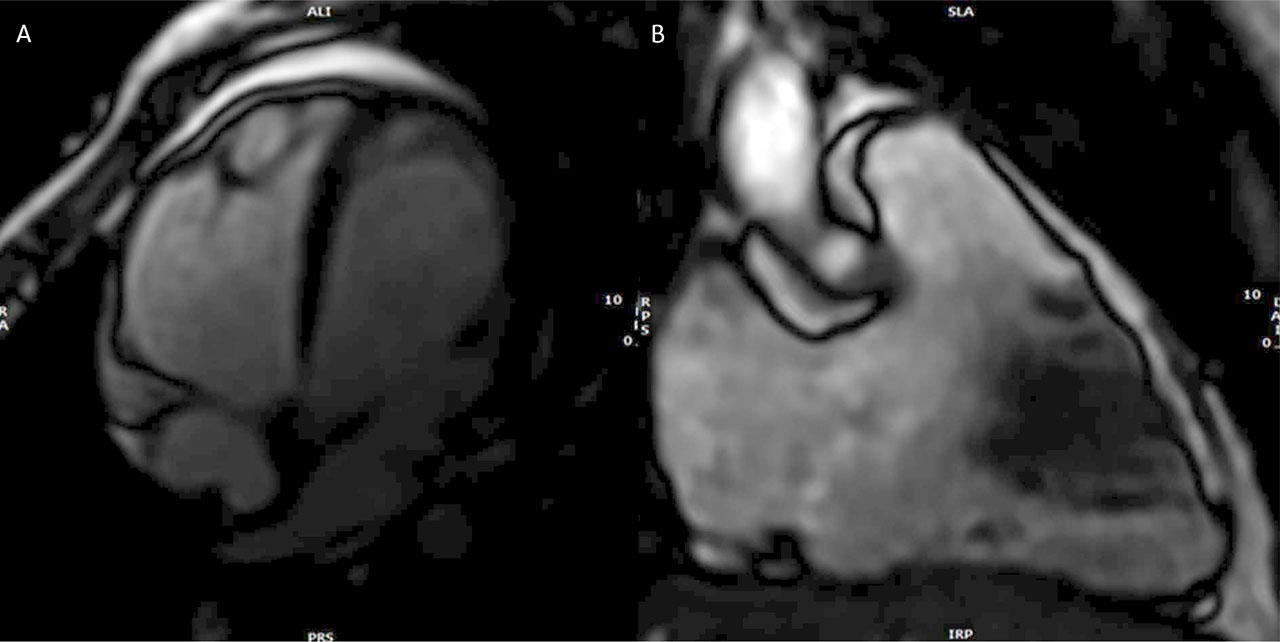
MRI scans from our cases. A. Apical 4-chamber view of cardiac MRI scan of the first patient reveals biventricular dilatation. B. Right ventricular vertical long-axis view scan in our second patient shows dilated right ventricle, with elevated indexed volume.
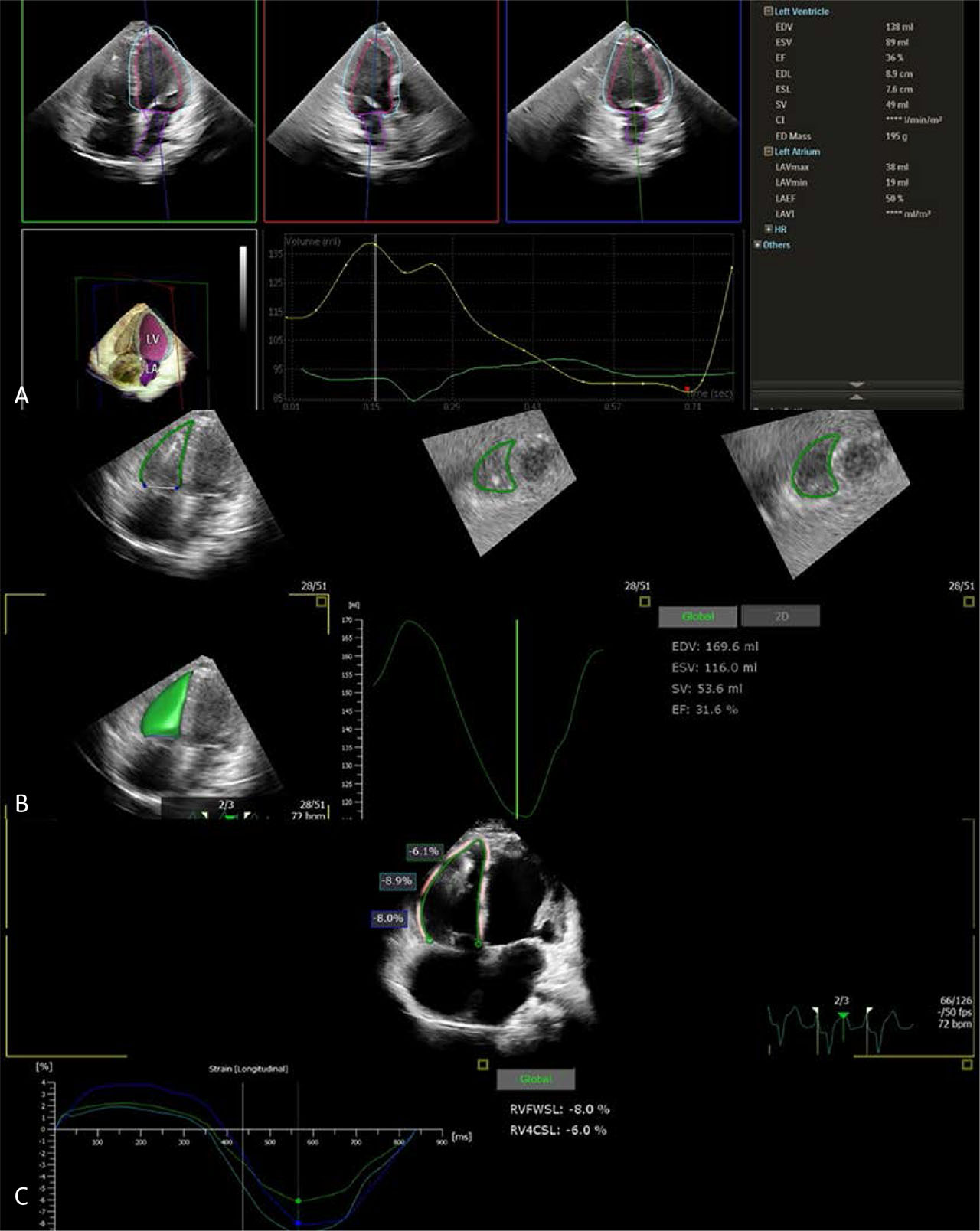
FIGURE 2.

Quantification of LV and RV volumes and EF using 3D speckle-tracking analysis. A. Impaired systolic function of the LV with increased volumes. B. Elevated RV volumes and reduced RV EF. C. Illustration of RV strain measurement using speckle-tracking echocardiography showing impaired values of RV GLS and RVFW-LS. ESV, end-systolic volume; EDV, end-diastolic volume; SV, stroke volume. RV GLS, right ventricular global longitudinal strain; RVFW LS, right ventricle free wall longitudinal strain.
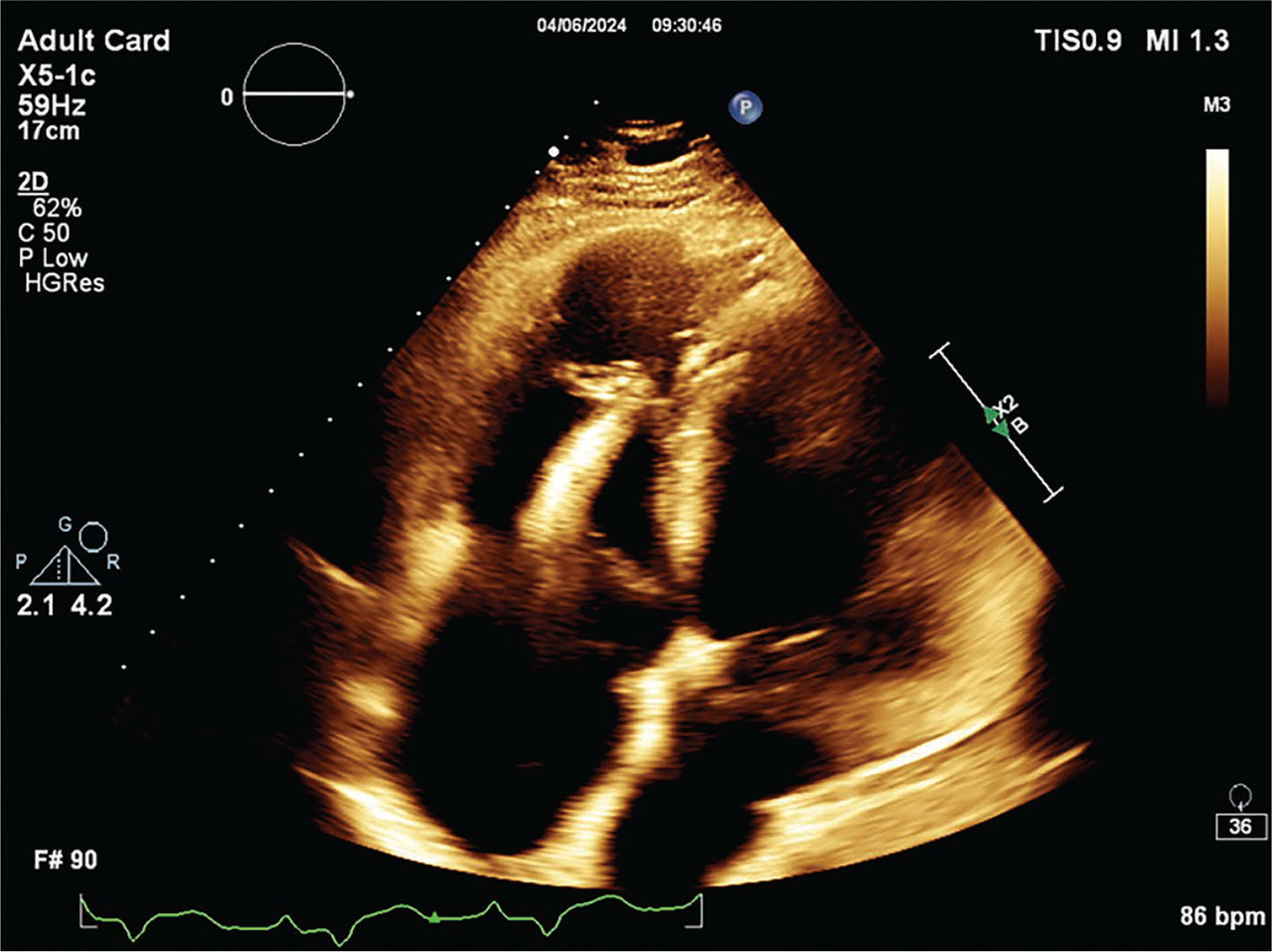
FIGURE 2.

Apical 4-chamber view (2D) shows the dilated RV with an aneurysmal apex, and the ICD lead is visible.

Correlation analysis of patient characteristics and cystatin C levels

Case 1Case 2Case 3Case 4
Age at diagnosis1.4 years12 years12 years17 years
Symptoms
  • Intolerance to physical exertion

  • Palpitations

  • Dizziness

  • Precordial pain

  • Intolerance to physical exertion

  • Palpitations

  • Diaphoresis

  • Cardiac arrest

  • Intolerance to physical exertion

  • Weakness

  • Extreme fatigue

Family history
  • Father and sister DCM and SCD

  • Brother DCM

  • Uncle WPW syndrome

  • Uncle HCM

  • Uncle PVC with LBBB morphology

  • Grandfather SCD

ECG
  • Negative T waves in V1–V4

  • Negative T waves in V1–V4

  • Negative T waves in V2–V5

  • Diffuse concave ST-segment elevation

  • PVC with LBBB morphology

  • Negative T waves in V1–V3

  • RBBB

  • Left anterior fascicular hemiblock

Holter ECG
  • Multifocal PVCs with LBBB morphology

  • Multifocal PVCs with RBBB and LBBB morphology

  • Non-sustained VT

  • Multifocal PVCs with RBBB and LBBB morphology

  • Multifocal PVCs with RBBB and LBBB morphology

  • Non-sustained VT

Echocardiography
  • Mildly dilated LV, initial LVEF 50%, then 60–65%

  • Mild mitral insufficiency

  • Mildly dilated LV, LVEF 50%

  • Minor mitral insufficiency

  • RV hypokinesia and dyskinesia of RV free wall, RV apical aneurysm

  • Severely dilated LV, LVEF 15%

  • Thrombosis of the walls and apex of both ventricles

MRI
  • LVEF 57%, segmental hypokinesia

  • RVEF 46.5%, increased indexed volume (118 ml/m2), dilatation of the anterior portion of the RV free wall

  • LVEF 52%, mild inferior and inferoseptal hypokinesia

  • RVEF 43%, increased indexed volume (93.8 ml/m2), regional dyskinesia of the RV free wall

  • LVEF 60.5%, with depressed global longitudinal strain (−14.6)

  • RVEF 41%

  • LVEF 27%, global hypokinesia

  • Subendocardial fibrotic lesions

  • RVEF 51%, increased indexed volume (221 ml/m2) with accentuated trabeculae

GeneticsMutation in the TTN gene (VUS)Mutation in the TTN gene (VUS)Mutation in the FLNC gene (VUS)Mutation in the DSC2 gene (VUS)
TreatmentPharmacologicalICD implantationICD implantationICD implantation
DOI: https://doi.org/10.2478/jce-2024-0018 | Journal eISSN: 2457-5518 | Journal ISSN: 2457-550X
Language: English
Page range: 36 - 42
Submitted on: Jun 28, 2024
|
Accepted on: Aug 28, 2024
|
Published on: Mar 28, 2025
In partnership with: Paradigm Publishing Services
Publication frequency: 4 issues per year

© 2025 Asmaa Carla Hagau, Diana-Ramona Iurian, Marian Pop, Ioana Șus, Carmen Corina Șuteu, Andrei-Samuel Dunareanu, Iolanda Muntean, published by Asociatia Transilvana de Terapie Transvasculara si Transplant KARDIOMED
This work is licensed under the Creative Commons Attribution 3.0 License.