
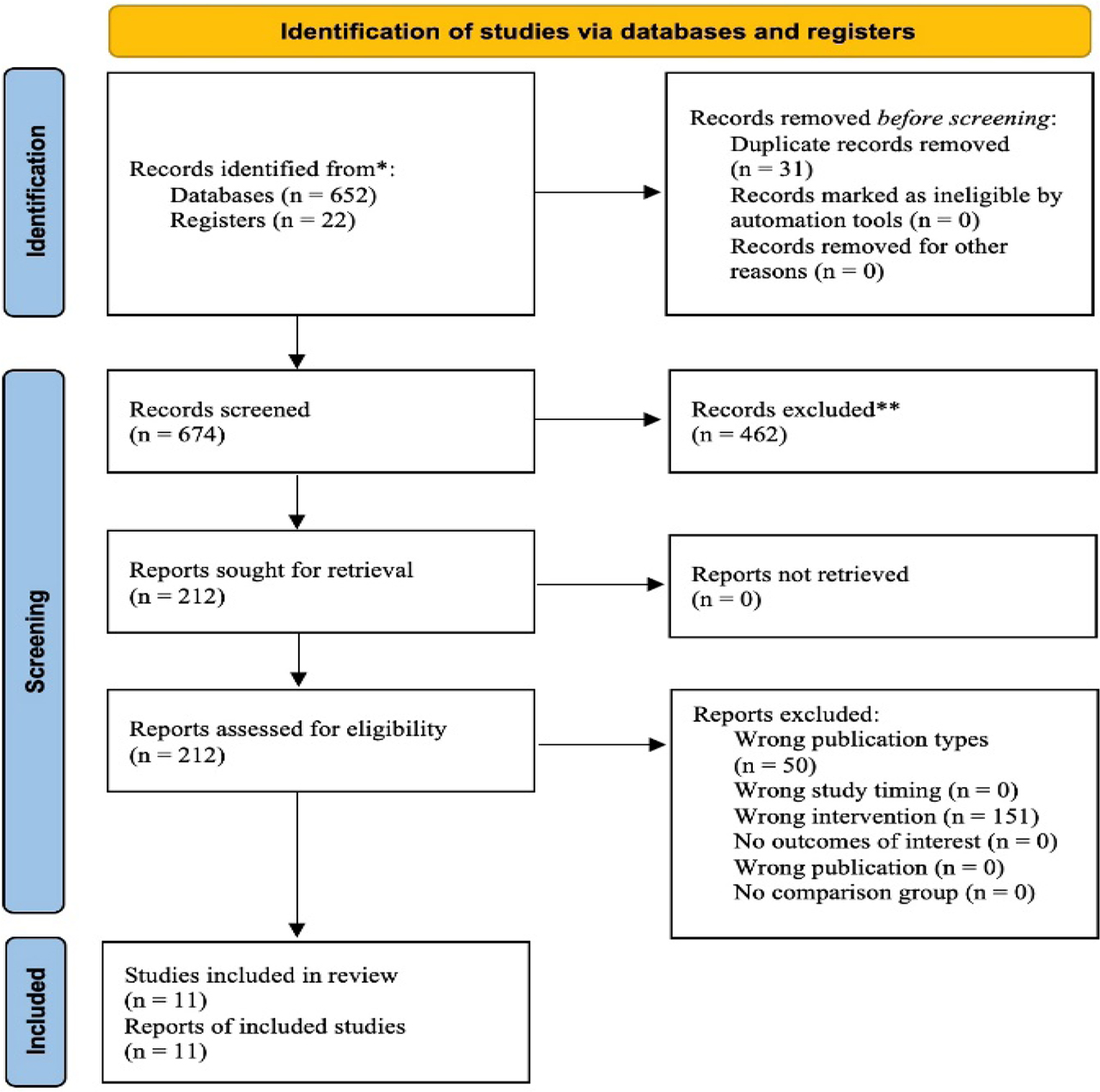
Fig. 1.
PRISMA flow diagram
Table 1.
Characteristics of studies included in the systematic review.
| Study No. | Study name | Study type | ICU Mortality | Length of ICU stay | Length of hospital stay | Improvement in tissue oxygenation | Vasopressor requirement | Survival to the ICU / hospital discharge | Other Outcomes |
|---|---|---|---|---|---|---|---|---|---|
| 01. | Park et al., 2014. | 32 patients (21 males) with refractory septic shock were retrospectively reviewed. Baseline: Shock-ECMO interval 30.5 hours, CPR duration (median) 23 minutes. | CPR strongly predicts in-hospital mortality after ECMO. |
| Not reported | Survivors had lower peak lactate levels (4.5 mmol/l) and higher peak troponin I values (32.8 ng/ml) than non-survivors. | Not reported | 7 survived, 19 died from shock/multiorgan failure. |
|
| 02. | Huang et al. | Retrospective study, 52 patients; inclusion criteria: age >18 years, V-A ECMO, positive culture/serology, exclusion criteria: ECMO primarily for respiratory support. | Not reported | Median 90.1h (IQR 28.3 – 314.7) | Median: 114.1 hours (IQ 52.3 – 404.7) | Not reported | Not reported | Survival: 15% survived, 64% died. Age <60 better survival (P=0.029). |
|
| 03. | Cheng et al. 2013. | Propensity-matched ECMO study: 108 septic vs. 108 non-septic patients, age 16+, VA & VV-ECMO, non-first time ECMO excluded. | Septic ECMO patients had higher mortality, especially in patients over 55 years old. | Not reported | Not reported | Not reported | IABP during ECMO: septic (n=108) 19.0%, non-septic (n=108) 25.3% (P=0.285) |
| CPR during ECMO is more common in non-septic group (n=108). Post ECMO neurologic deficit higher in non-survivors (n=71). |
| 04. | Brechot et al. 2013 | Survey of 14 patients with refractory cardiovascular failure associated with sepsis and other criteria for VA-ECMO use, excluding certain conditions. | ICU mortality in 14 patients was 29%, with 4 deaths during ICU stay (2 during ECMO). | Shorter in non-survivors (median 10 days) compared to survivors (median 17.5 days). | Not reported | ICU patients had a peak troponin value post-ECMO of 5.8 ng/ml. | Not reported | 10 (71%) out of 14 patients. | ECMO duration: median (range) (n=10) 5.5 (2–12) days in survivors vs (n=4) 3 (1–7) days in non-survivors. |
| 05. | Banjas et al., 2018 | Inclusion: ECMO-treated patients. | 56% 6-year hospital mortality. | Mean: 20 (8–31) | Mean hospital stay: 27 (15–40) |
| Not reported | Not reported | Not reported |
| 06. | Yeo et al., 2017 | Patients with septic shock and ARDS were included. (n=8) |
| Not reported | Not reported |
| Not reported | Not reported | Not reported |
| 07. | Lee et al. 2018 |
| 6 patients died, only 2 were discharged from the hospital. | Median 4 days (1–13) | Not reported | Immediately before the start of ECMO, the median serum lactate level, CRP, and total bilirubin were higher in the survivor group. | Not reported | Survival to discharge: 25% (2 out of 8 patients). 3 patients weaned successfully, but 1 died before discharge |
|
| 08. | Ro et al. 2018 | Adults (>20 y/o) with refractory shocks who received venoarterial ECMO support. | In-hospital mortality: 93%. 90-day mortality rates: 87.3%. | Not reported | Not reported | Non-survivors had higher arterial lactate, lower platelet count, and higher total bilirubin. | Not reported | Septic shock: 5 patients (7%) survived to discharge | 11 patients (15.5%) successfully weaned off ECMO in median 7.9 days. |
| 09. | Han et al. 2016 |
| 15/23 patients died; 3 died after weaning. | ICU stay was shorter for the survival group (median of 12 days) compared to the death group (median of 16.5 days). |
| Mean lactate levels were lower in the survival group (4.4 mmol/L) than in the death group (6.8 mmol/L). | Not reported | 5 discharged alive, 15 unsuccessful weaning, 3 deaths after weaning. | Not reported |
| 10. | Vogel et al. 2018 | Retrospective analysis of ECMO database to identify suitable patients, followed by clinical data extraction from electronic medical records. | 3 patients (25%) died, 2 from multiorgan failure and 1 from cerebral edema with brain herniation. | Not reported | Not reported |
| 5 patients (41.7%) received vasopressin and 2 patients (16.7%) received adrenaline, dobutamine, or milrinone. | 9 (75%) survived after VAV ECMO decannulation. | No deaths reported during follow-up (median 6 months). |
| 11. | Falk et al. 2019 | Inclusion: ECMO support received by adult patients with septic shock admitted between January 2012 and December 2017 (n=37). | 8/37 patients died. | Not reported | Not reported | Venoarterial patients had a higher Pao2-to-Fio2 ratio, higher lactate levels, and higher ECMO flow than venovenous patients. | 71.4% (5/7) of patients survived who experienced CPR before admission. | ECMO survival: 81.1%. Hospital survival: 78.4%. Long-term follow-up survival: 59.5% (median 46.1 months). | Ten (37%) started venovenous ECMO and 27 on venoarterial ECMO. Venovenous-ECMO was associated with higher risk for in-hospital death (50% vs 11%; p=0.011). |
Table 2.
Risk of bias
| Authors’ ID & year of publication | Study Design | A sample representative of the population (Risk of Selection Bias) | Evaluation of the outcome (Risk of Performance Bias) | Follow-up long enough | Follow up complete | Conflict of Interest | Other Limitations |
|---|---|---|---|---|---|---|---|
| Park et al., 2014 | Retrospective review /32 patients | Not a true representative sample (high) | Record review (high) | Not applicable. | Not applicable. | None. |
|
| Huang et al., 2013 | Retrospective cohort study / 52 patients | Not a true representative sample (high) | Record review (high) | Yes. | Yes. | None. |
|
| Cheng et al., 2013 | Propensity-matched analysis of ECMO registry /108 matched | Not a true representative sample (high) | Record review (high) | Yes. | Yes. | None. |
|
| Brechot et al., 2013 | Retrospective cross-sectional survey/14 patients | Not a true representative sample (high) | Record review (high) | Not applicable. | Not applicable. | Two of the authors took payments from companies |
|
| Banjas et al., 2018 | Retrospective Cohort/131 patients | Not a true representative sample (high) | Record review (high) | Yes. | Yes. | None. |
|
| *Yeo et al., 2017 | Brief communication | Case series; not representative sample (High) | Record review (high) | Yes. | Yes. | None. |
|
| Lee et al., 2017 | Retrospective cohort/24 patients | Not a true representative sample (high) | Record review (high) | Not applicable | Not applicable | None. |
|
| Ro et al., 2018 | Retrospective review/71 patients | Not a true representative sample (high) | Record review (high) | Not applicable | Not applicable | None. |
|
| Han et al., 2019 | Retrospective cohort/23 patients | Not a true representative sample (high) | Record review (high) | Not applicable | Not applicable | None. |
|
| Vogel et al., 2018 | Retrospective case series/12 patients | Not a true representative sample (high) | Record review (high) | Yes. | Yes. | None. |
|
| Falk et al., 2019 | Retrospective cohort/37 patients | Not a true representative sample (high) | Record review (high) | Yes. | Yes. | None. |
|