
Table 1.
AKI incidence in patients with COVID-19 disease
| Author and Reference | Location | Period | Definition | Patients no. | Critically ill no. | COVID-AKI no. (%) | COVID-AKI in ICU no. (%) | RRT no. (%) |
|---|---|---|---|---|---|---|---|---|
| Bubenek-Turconi [13] | Romania | 25.03.2020–26.03.2021 | KDIGO | 9058 | 9058 | 2183 (24.1) | 2183 (24.1) | 453 (5) |
| Huang [15] | Wuhan | 16.12.2019–02.01.2020 | KDIGO | 41 | 13 | 3 (7.31) | 3 (23.08) | 3 (7.31) |
| Richardson [16] | New York | 01.03.2020–04.04.2020 | KDIGO | 5700/2351# | 373 | 523 (22.2) | NR | 81 (3.4) |
| Hirsch [17] | New York | 01.03.2020–05.04.2020 | KDIGO + all stages | 5449 | 1395 | 1993 (36.6) | 1060 (76) | 285 (5.2) |
| Gupta [18] | USA | 04.03.2020–04.04.2020 | KDIGO stage 2/3 | 2215 | 2215 | 952 (43) | 952 (43) | 443 (20) |
| Mohamed [19] | Louisiana | 01.03.2020–31.03.2020 | KDIGO | 575 | 173 | 161 (28) | 105 (61) | 89 (15.5) |
| Schaubroeck [20] | Belgium | 01.02.2020–31.01.2021 | KDIGO + all stages | 1286 | 1286 | 1094 (85.1) | 1094 (85.1) | 126 (9.8) |
| Sullivan [21] | United Kingdom | 17.01.2020–5.12.2020 | KDIGO + all stages | 85687 | NR | 13000 (31.5) | NR | 2198 (2.6%) |
| Wang [22] | Wuhan | 01.01.2020–03.02.2020 | KDIGO | 138 | 36 | 5 (3.62) | 3 (8.33) | 2 (1.45) |
| Guan [23] | China | 11.12.2019–29.01.2020 | KDIGO | 1099 | 173 | 12 (1.09) | 6 (3.47) | 9 (0.82) |
| Cao [24] | Wuhan | 03.01.2020–01.02.2020 | KDIGO | 102 | 18 | 20 (19.61) | 8 (44.44) | 6 (5.88) |
| Zhang [25] | Wuhan | 02.01.2020–10.02.2020 | KDIGO | 221 | 55 | 10 (4.52) | 8 (14.55) | 5 (2.26) |
| Xu [26] | China | 01.01.2020–20.02.2020 | NR | 355 | 71 | 56 (15.77) | 21(29.58) | NR |
| Li Z [27] | China | 06.01.2020–21.02.2020 | KDIGO | 193 | 65 | 55 (28.5) | 43(66.15) | 7 (3.63) |
| Zheng [28] | Hangzhou | 22.01.2020–05.03.2020 | KDIGO | 34 | 34 | 7 (20.59) | 7 (20.59) | 5 (14.71) |
| Arentz [29] | Seattle | 20.02.2020–05.03.2020 | KDIGO | 21 | 21 | 4 (19.05) | 4 (19.05) | NR |
CVD, cardiovascular disease; DM, diabetes mellitus; ESRD, end-stage renal disease; HTN, hypertension; ICU, intensive care unit; KDIGO, Kidney Disease: Improving Global Outcomes; No., number; NR, not reported; RRT, renal replacement therapy;
Table 2.
Potential risk factors associated with COVID-AKI
| Socio-demographic risk factors | Risk factors at admission | Post-admission risk factors |
|---|---|---|
| Advanced age (> 70 years) | Elevated viremia | Nephrotoxins (e.g., contrast agents) |
| Diabetes mellitus | Leukocytosis and lymphopenia | Vasopressors |
| Hypertension | Increased levels of ferritin, CRP, and D-dimers | Mechanical ventilation |
| Congestive heart failure | Hypovolemia/dehydration | Hypovolemia |
| Obesity | Multiorgan involvement | Hypervolemia |
| Chronic kidney disease | Rhabdomyolysis | Metabolic disturbances (e.g., hyperglycemia) |
| Immunosuppression | Exposure to ACE inhibitors, ARBs, and NSAIDs | Fluid imbalances (e.g., use of hydroxyethyl starch, increased chloride levels) |
[i] ACEI = angiotensin converting enzyme inhibitor; ARB = angiotensin receptor blocker; CRP = C reactive protein; HES = hydroxyethyl starch; NSAID = non-steroidal anti-inflammatory drug.
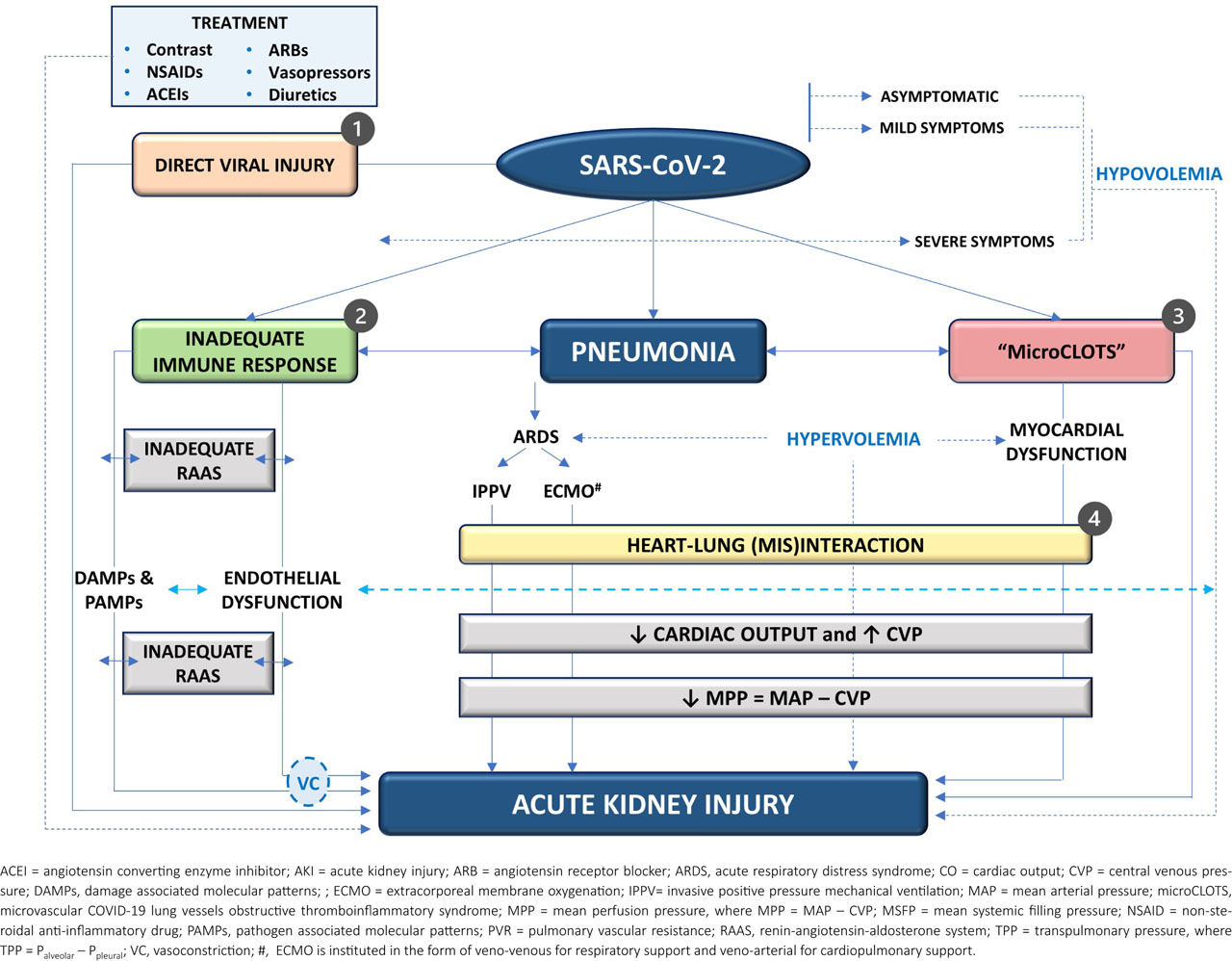
Fig. 1.
Pathophysiology of AKI in COVID-19. AKI arises from multiple intricated mechanisms, including 1) glomerulo-tubular injuries secondary to potentially direct viral cytopathic effects, 2) an inadequate immune response, initially localized to the lungs and later becoming systemic, 3) a ubiquitous process of thrombotic microangiopathy referred to as “microCLOTS,” and 4) a complex heart-lung interaction that requires active and individualized therapeutic intervention. Endothelial dysfunction is an all-pervasive driver of organ dysfunction. There is inadequate activation of RAAS, leading to both immediate and long-term renal consequences such as glomerular dysfunction, inflammation, fibrosis, and vasoconstriction. The initiation of IPPV has hemodynamic repercussions dependent on lung mechanics: 1) in the L subphenotype (i.e., normal lung elastance), the gradient that ensures venous return (MSFP - CVP) is reduced, mimicking hypovolemia; 2) in the H subphenotype (i.e., increased lung elastance), an increased TPP along with other pulmonary and extrapulmonary factors (e.g., hypoxemia, hypercapnia, microthrombosis in pulmonary and cardiac capillaries, hypervolemia), contribute to the development of pulmonary artery hypertension and acute cor pulmonale. A reduced MPP is the end result of all hemodynamic derangements. This may involve a decrease in MAP with or without a decrease in CO, an increase in CVP, or both. Medications can have aggravating consequences. An adequate hemodynamic and respiratory support should avoid fluid overload, reduce vasopressor doses, and optimize MPP and systemic tissue perfusion.
Table 3.
CARDS phenotyping – a mechanistic overview.
| Criterion | CARDS subphenotype | |
|---|---|---|
| L subphenotype | H subphenotype | |
| Pulmonary mechanics | EL and ECW are normal EELV is normal Normal strain and stress at TV 6–8ml/kg IBW | EL is increased and ECW is normal EELV is reduced Increased strain and stress at TV 6–8ml/kg IBW |
| Computer Tomography | Aerated Ground glass Normal weight | Dependent atelectasis Condensations Increased weight |
| Histopathologic substrate | microCLOTS | Diffuse alveolar damage |
| Gas exchange abnormality | V/Q mismatch Decreased fluid tolerance | Shunt Severely decreased fluid tolerance |
| Positive pressure transmission Ppleural = Palveolar × (ECW/ET) | Mainly in the pleural space Ppleural increases, so then CVP increases | Mainly transpulmonary Alveolar pressure increases, so then TPP increases, TPP = Palveolar - Ppleural |
| Cardiac effects | RV preload is reduced Mimicking hypovolemia | RV afterload is increased Risking acute cor pulmonale |
| Renal effects | Decreased arterial flow Decreased MPP | Decreased arterial flow Decreased MPP Venous congestion |
| Respiratory strategy | Low recruitment potential Avoid open lung approach PP responsiveness is low | High recruitment potential Individualized open lung approach PP responsiveness is high |
| Hemodynamic strategy | Prevent fluid overload. Optimize RV preload | Reduce lung water. Optimize RV afterload |
| Hemodynamic monitoring | Ultrasound TPTD PPV/SVV: useful for fluid management. | Ultrasound TPTD PPV/SVV: less useful, increased rate of false negatives if used with VT < 8ml/kg IBW or of false positives if acute cor pulmonale ensues. A VT challenge helps discriminate the false negatives. Cardiac ultrasound helps discriminate the false positives. |
[i] CARDS, COVID-19 induced acute respiratory distress syndrome; CVP, central venous pressure; EL, lung elastance; ECW, chest wall elastance; ET, total elastance where ET is EL + ECW; EELV, end expiratory lung volume; IBW, ideal body weight; MAP, mean arterial pressure; MPP, mean perfusion pressure where MPP = MAP– CVP; PP, prone position; PPV/SVV, pulse pressure variation/stroke volume variation; RV, right ventricle; TPP, transpulmonary pressure where TPP is Palveolar – Ppleural; TPTD, transpulmonary thermodilution; TV, tidal volume; V/Q, ventilation/perfusion.
Table 4.
Preventive measures in COVID-AKI
| Intervention | Argument | Recommendation |
|---|---|---|
| Renal function | Staging AKI and assessing clinical risk are epidemiological imperatives with crucial therapeutic implications. | Recommend the use of serum creatinine and urine output for monitoring renal function, paying attention to limitations of both parameters. (Level of evidence: 1B) |
| Hemodynamic profiling | Inadequate tissue perfusion contributes to the worsening of organ dysfunction (e.g., kidney, lung, liver, and heart). | Recommend an individualized hemodynamic strategy based on dynamic and quantitative indices of cardiovascular evaluation. (Level of evidence: 1B) |
| Fluids | Fluid composition has systemic consequences, including renal. High chloride content was associated with an increased incidence of AKI, and the use of hydroxyethyl starch derivatives in sepsis is contraindicated. | Recommend the use of balanced crystalloids for initial volume resuscitation in at-risk patients or those who develop COVID-AKI, in the absence of other specific indications. (Level of evidence: 1A) |
| Glycemic control | Insulin resistance and hypercatabolism are frequently encountered in patients with COVID-19. | Suggest the use of an intensive glycemic control strategy. (Level of evidence: 2C) |
| Nephrotoxins | Various nephrotoxins are commonly prescribed to patients with COVID-19. | Recommend limiting exposure to nephrotoxic medications and vigilant monitoring when they cannot be avoided. (Level of evidence: 1B) |
| Contrast agents | The relevance of contrast agent toxicity is uncertain. | Recommend optimizing intravascular volume as the only preventive measure. (Level of evidence: 1A) |
| Mechanical ventilation | Increased intrathoracic pressure results in: 1) elevated central venous pressures and peripheral venous congestion; 2) sympathetic adrenergic and renin-angiotensin-aldosterone system activation; 3) mechanical disadvantage, particularly for the right ventricle; 4) renal, hepatic, and splanchnic cross-talk. | Suggest the use of a protective ventilatory strategy for both the lungs and the right ventricle, individualized and continuously tailored to the patient's real-time physiology. (Level of evidence: 2C) |
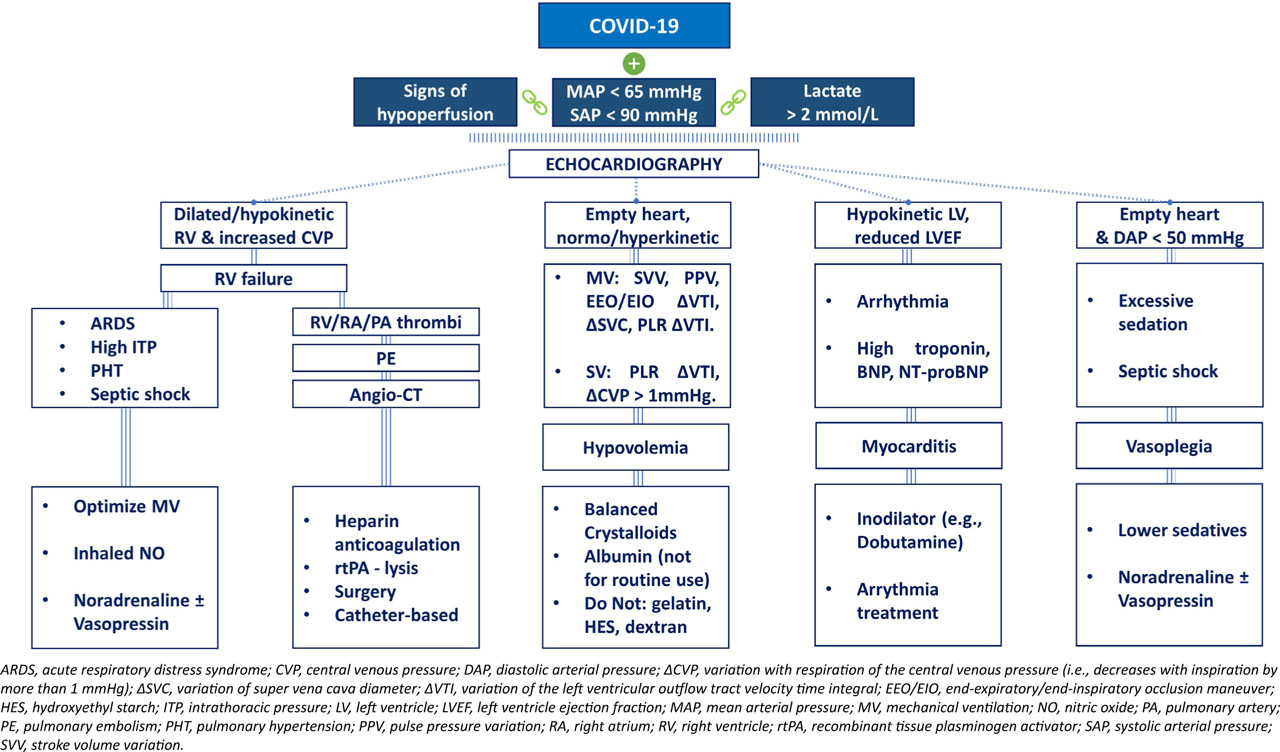
Fig. 2.
Echocardiography as a tool to diagnose, monitor and treat cardiocirculatory collapse.
Table 5.
Recommendations for the good clinical practice of RRT
| RRT Component | Management |
|---|---|
| Indication | When metabolic byproducts (e.g., hyperkalemia, acidosis, hypervolemia) exceed renal clearance. An individualized approach that should consider the decreased fluid tolerance observed in patients with severe forms of COVID-19. |
| Modality | Selection of RRT technique depends on the metabolic and hemodynamic priorities of the patient, as well as on the local expertise and resources. CRRT benefit hemodynamically unstable or fluid overloaded patients. Reduced tolerance to intercompartmental fluid shifts favors the use of CRRT. IHD may be useful in stable hemodynamic patients with progressively favorable outcomes. |
| Dose | CRRT: effluent rate of 25–30 ml/kg/h. IHD: ≥ 3 sessions/week, alternating days. Adjustment of effluent doses based on individual metabolic needs. Correction of effluent doses based on periods of circuit clotting and transportation outside the ICU. To protect the filter, avoid filtration fractions greater than 20%. |
| Anticoagulation | Adjusted to coagulation status. RCA: initial dose of 4% trisodium citrate set at 3.5 mmol/L and post-filter Ca2+ at 0.25–0.35 mmol/L. HNF: initial dose set at 10–15 IU/kg/h, with a target aPTT of 60–90 seconds. LMWH: initial dose set at 3.5 mg/h, with a target residual anti-Xa activity of 0.25–0.35 IU/ml. |
| Vascular access | Ultrasound guidance reduces costs and complications. First choice: right internal jugular vein; avoid subclavian access. |
| Fluid removal | Functional hemodynamic monitoring is essential for optimizing fluid removal rate. In the most basic functional hemodynamic model, the concurrent monitoring of CO, CVP, and MAP is essential. In this model, the ideal removal rate seeks to preserve stable CO and MAP levels while decreasing CVP, all without requiring an escalation of vasoactive support. Sustaining removal rates above 1.75 ml/kg/hour without a hemodynamic feedback loop may worsen hemodynamics. |
[i] CO = cardiac output; CRRT = continuous renal replacement therapy; CVP = central venous pressure; ICU = intensive care unit; IHD = intermittent hemodialysis; LMWH = low-molecular weight heparin; MAP = mean arterial pressure; RCA = regional citrate anticoagulation; RRT = renal replacement therapy; UFH = unfractionated heparin.