
Table 1.
Description of the studies included in the systematic-review.
| Study | Group (N) APACHE-II | Intervention | Configuration | Duration | Outcomes |
|---|---|---|---|---|---|
| Batterham et al. (2014) | CG:30 APACHE-II:16.4(7.8) IG:29 APACHE-II:15.9(7.9) | CG: Standard care(medical follow-up, no rehabilitation) IG : Program with cycle ergometer 30′ of moderate intensity, 2 supervised sessions/1 unsupervised | SF-36 (PF) | 9 weeks Follow up: 26 weeks | SF-36 (PF): IG : 43.5 (18)vs CG: 40.1(23), 95% confidence interval [-1.4-8.2]) |
| Battle et al. (2018) | CG :30 APACHE-II:15 (12-19) IG :30 APACHE-II:13 (9-19) | CG : Standard care (no rehabilitation prescription) IG : Personalized supervised exercise program in an outpatient gym | 6MWT, Berg balance, HG | 6 weeks after hospital Follow up:7 weeks, 6 months, 12 months | At 6 weeks 6MWT: IG:379.3(207.9) vs CG:283.6(229.3), p=0.491 Berg :IG :53.4(6.2) vs CG:50.5 (7.0), p=0.99 HG(L): IG:20.7(11.4) vs19.5(12.5),p=0.287 |
| Connolly et al. (2015) | CG :10 APACHE-II:23.5 (21-30.3) IG :10 APACHE-II:24.5(18.8-29.5) | CG: Weekly telephone follow-up IG: 16 sessions in an outpatient gym | ISWT, 6MWT, SF-36 (PCS), | 3 months after hospital | Change in outcomes ISWT(m): CG: 170(40-315)vs IG: 115(-2.5-237.5) 6MWT(m):CG:185(40-285)vs IG:140(35.8-210.3) PCS: CG: 11(4.3-28.3) vs IG:1.8 (-6.8-15.9) |
| Elliot et al. (2011) | CG: 91 APACHE-II:19.5(7.2) IG: 92 APACHE-II:19.4(12.6) | CG : Standard care (medical follow-up) IG : Home rehabilitation program with an emphasis on increasing muscle strength & walking | SF-36 (PF), 6MWT | 8 weeks Follow up: 26 weeks | SF-36 (PF) :IG :39.9 vs CG :41.0, p<0.05, while the effect time was notable for PF (p=0,034) and for 6MWT(p=0,0003). |
| McDowell et al. (2016) | CG : 30 APACHE-II:15.2(5.6) IG : 30 APACHE-II:17.3 (7.7) | CG : Standard care(no support) IG : personalized exercise program in the hospital gym (supervised-2 sessions) or at home (unsupervised-1 session) | SF-36(PF),ISWT HG | 6 weeks Follow up: 6 months | SF-36(PF) :IG :6.8(10.9) vs CG:3.9(8.2),p=0,26 ISWT : IG :135.5(119.8) vs CG:52.4(126.7),p=0.03 HG(dominant): IG:6.1(28.1)vs CG:12.5(22.8), p=0.39 |
| McWilliams et al. (2016) | CG :36 APACHE-II:15.9(5.3) IG :37 APACHE-II:16.6(5.7) | CG : Standard care (no exercise prescription or consultation) IG : supervised session with a 10-station program-cardiovascular exercises | SF-36 (PCS), | 7 weeks | Degree of improvement SF-36 (PF) IG :3.5(95% CI;1.6-6.7 vs CG :8.6(95%;5.4-10.6), p=0,048) |
| Vitacca et al. (2016) | CG :24 IG :24 | OE: Standard care (medical support, free to conduct physical activity without monitoring or support) IG : pulmonary rehabilitation program at home under supervision | MIP/MEP, BADL, MRC-SS, | 6 months | MIP: IG : +33cm H2O vs CG : +26cm H2O,p<0.03 MEP :IG : +42cm H2O vs CG : +28cm H2O, p<0.03 BADL: p=0.63 Biceps MRC-SS: p=0.07 Quadriceps MRC-ss:p=0.53 |
| Veldema et al. (2019) | CG : 14 IG : a)13 b)12 | OE: Standard care IG : a) cycle ergometer program, b) resistance program (inpatients in a neurological rehabilitation clinic) 5times/week, 4 sets of 15 repititions | FAC, TUG test, 10MWT, MMS test SF-36(PF) | 2 weeks 4 weeks | 6MWT (4 weeks): p<0.05 within groups TUG(4weeks):p<0.05 within groups FAC(2weeks):p<0.05 between groups MRC knee flexion (2weeks): p<0.05 between groups |
| Shelly et al (2017) | CG:18, IG:17 | IG: 4 weeks unsupervised home rehabilitation program CG: no exercise prescrition | SF-36 (PF) | 4weeks | SF-36 (PF ): IG: 10.32(8.51-14.92) vs CG: 7.36(3.68-8.48), p=0.003 |
[i] IG: Intervention Group, CG: Control Group, 6MWT: 6 Minute Walk Test, ISWT: Incremental Shuttle Walk Test, PF: Physical Functioning, PCS: Physical Component Summary, TUG: Time Up and Go,STS-5: Sit-to-Stand 5times, HG: Hand Grip, ICUaw: Intensive Care Unit Acquired weaknsess, FAC: Functional Ambulation Category test, MMS: Manual Muscle Test, MRC-ss: Medical Research Council-strength scale, BADL: Basic Activities of daily living, MIP: Maximal Inspiratory Pressure, MEP: Maximal Expiratory Pressure
Values are represented either as Median(IQR) or Mean (SD)
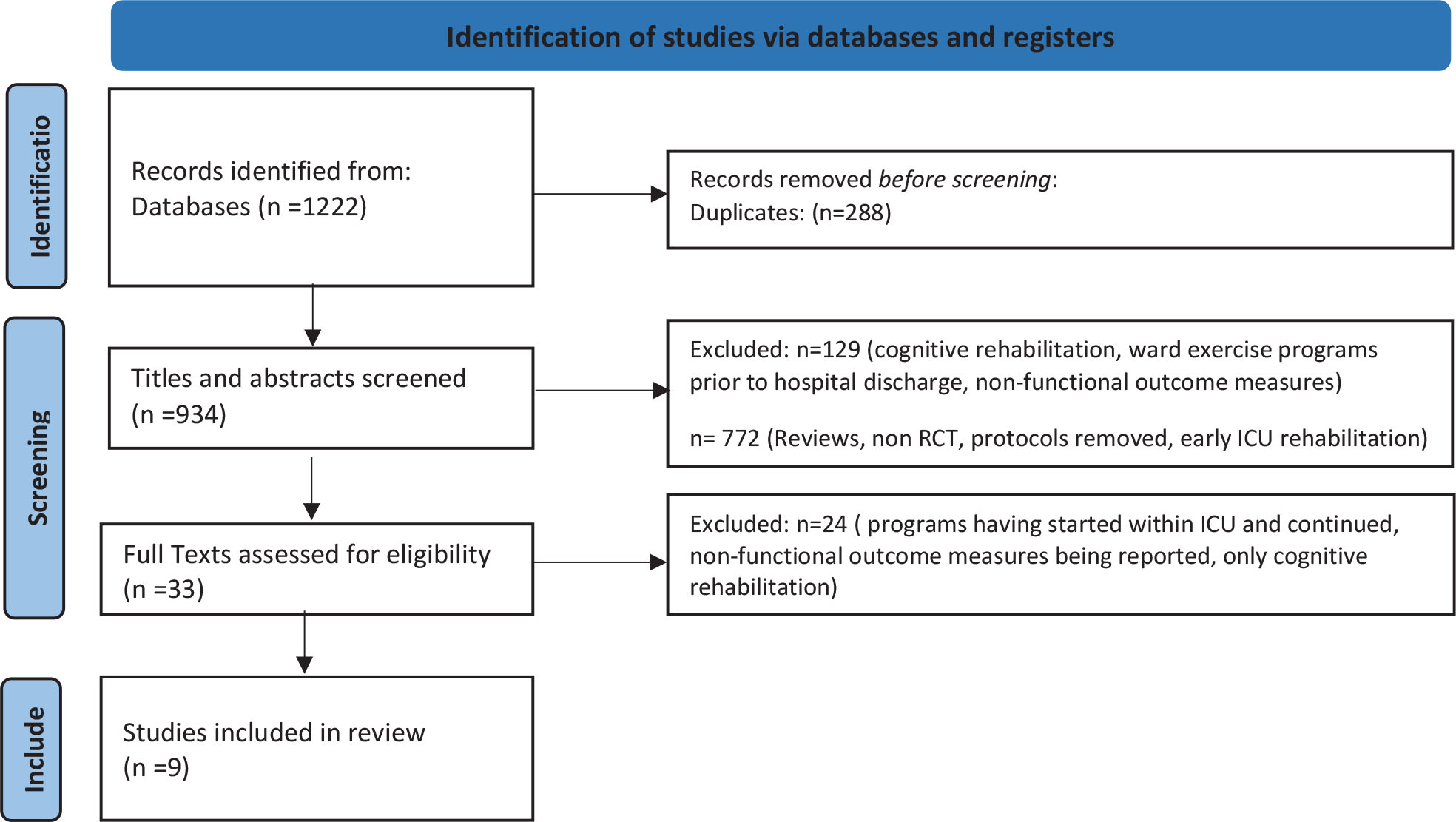
Fig. 1.
Prisma Flow diagram
Table 2.
Quality of the RCT studies of stroke patients on Pedro Scale (item1 doesn’t contribute to total score)
| Batterham et al (2014) | Battle et al (2018) | Connolly et al (2015) | Elliott et al (2011) | McDowell et al (2016) | McWilliams et al (2016) | Vitacca et al (2016) | Veldema et al (2019) | Shelly et al (2017) | |
|---|---|---|---|---|---|---|---|---|---|
| 1 | √ | √ | √ | √ | √ | √ | √ | √ | √ |
| 2 | √ | √ | √ | √ | √ | √ | √ | √ | |
| 3 | √ | √ | √ | √ | √ | ||||
| 4 | √ | √ | √ | √ | √ | ||||
| 5 | √ | ||||||||
| 6 | √ | √ | |||||||
| 7 | √ | √ | √ | √ | √ | ||||
| 8 | √ | √ | √ | √ | |||||
| 9 | |||||||||
| 10 | √ | √ | √ | √ | √ | √ | √ | √ | √ |
| 11 | √ | √ | √ | √ | √ | √ | √ | √ | √ |
| Total | 6/10 | 7/10 | 4/10 | 8/10 | 8/10 | 7/10 | 5/10 | 6/10 | 5/10 |
Table 3.
Description of the rehabilitation program that the intervention group followed.
| Study | Duration / Intensity / Frequency | Intervention |
|---|---|---|
| Batterham et al. (2014) | Duration: 30 minutes | Cardiorespiratory exercises: cycle ergometer (12-14 Borg Scale) |
| Intensity: moderate and progressively increasing | 3 minutes at 60rpm and 3 minutes break | |
| Frequency: 2 times/week | Pedal resistance increased by 10 and 20W/min (The program included warm-up and recovery) | |
| Battle et al. (2018) | Duration: 60 minutes | Cardiorespiratory exercises: cycle ergometer, treadmill, rowing machines |
| Intensity: progressively increasing | Muscle strength and balance exercises with strength balls and bands, weights | |
| Frequency: 2 times/week | Functional balance exercises in a sitting and standing position, balance board | |
| Connolly et al. (2015) | Duration: 40 minutes | Cardiorespiratory exercises |
| Intensity: progressively increasing | Exercises to strengthen upper and lower limb muscle strength | |
| Frequency: 2 times/week | Balance exercises | |
| Functional exercises (The program included warm-up and recovery) | ||
| Elliot et al. (2011) | Duration: 20-30 minutes | Cardiorespiratory exercises-5 exercises (walking at 80% walking speed) |
| Intensity: moderate to heavy (progressively increasing) | Core stabilization exercises (3 exercises) | |
| Upper-lower limb strengthening exercises with weights (8 reps/3 sets with progressive weight increase from 0.25 to 1.5 kg) | ||
| Frequency: 5 times/week | Flexibility exercises and stretching (3 exercises and 4 respectively) (Total 16 different exercises) | |
| Mcdowell et al. (2016) | Duration: 60 minutes | Strengthening exercises (10 repetitions upper-lower limbs-trunk and stretching exercises) |
| Intensity: moderate-gradually increasing | Cardiorespiratory exercises: walking, cycle ergometer, treadmill (from 10-30 minutes and 3-4 Borg) | |
| Frequency: 3 times/week | (The program included warm-up and recovery) | |
| McWilliams et al. (2016) | Duration: 20 minutes | Circuit Training 10 stations [(1 minute exercise/statìon)*2] (3-4 Borg) |
| Intensity: moderate-progressively increasing | ||
| Frequency: 3 times/week | ||
| Vitacca et al. (2016) | Duration: 60 minutes | Program of passive-active and assisted exercises (increasing range of motion-passive transfers-standing-stand-up/sit down) |
| Intensity: progressively increasing | Breathing exercises (2 sessions daily-breathing cycle-chest expansion-violent breathing-coughing) | |
| Frequency: 6 times/week | ||
| Balance exercises | ||
| Application of electroneuromuscular stimulation to the lower limbs | ||
| Cardiorespiratory exercises: cycle ergometer, treadmill | ||
| Strengthening exercises | ||
| Veldema et al. (2019) | Duration: 20 minutes | Cardiorespiratory exercises: cycle ergometer (13 Borg Scale) |
| Intensity: moderate to heavy-progressively increasing | Strength exercises with weights (4 sets/15 repetitions with a 30-40” rest) | |
| Frequency: 5 times/week | ||
| Shelly et al. (2017) | Duration: 30-40 minutes | Ambulation |
| Frequency: 5 times/week | Exercises on bed (each exercise 10times/per set) | |
| Ambulation twice a day (11-13 on Borg scale) | Respiratory exercises | |
| Dynamic quadriceps |