
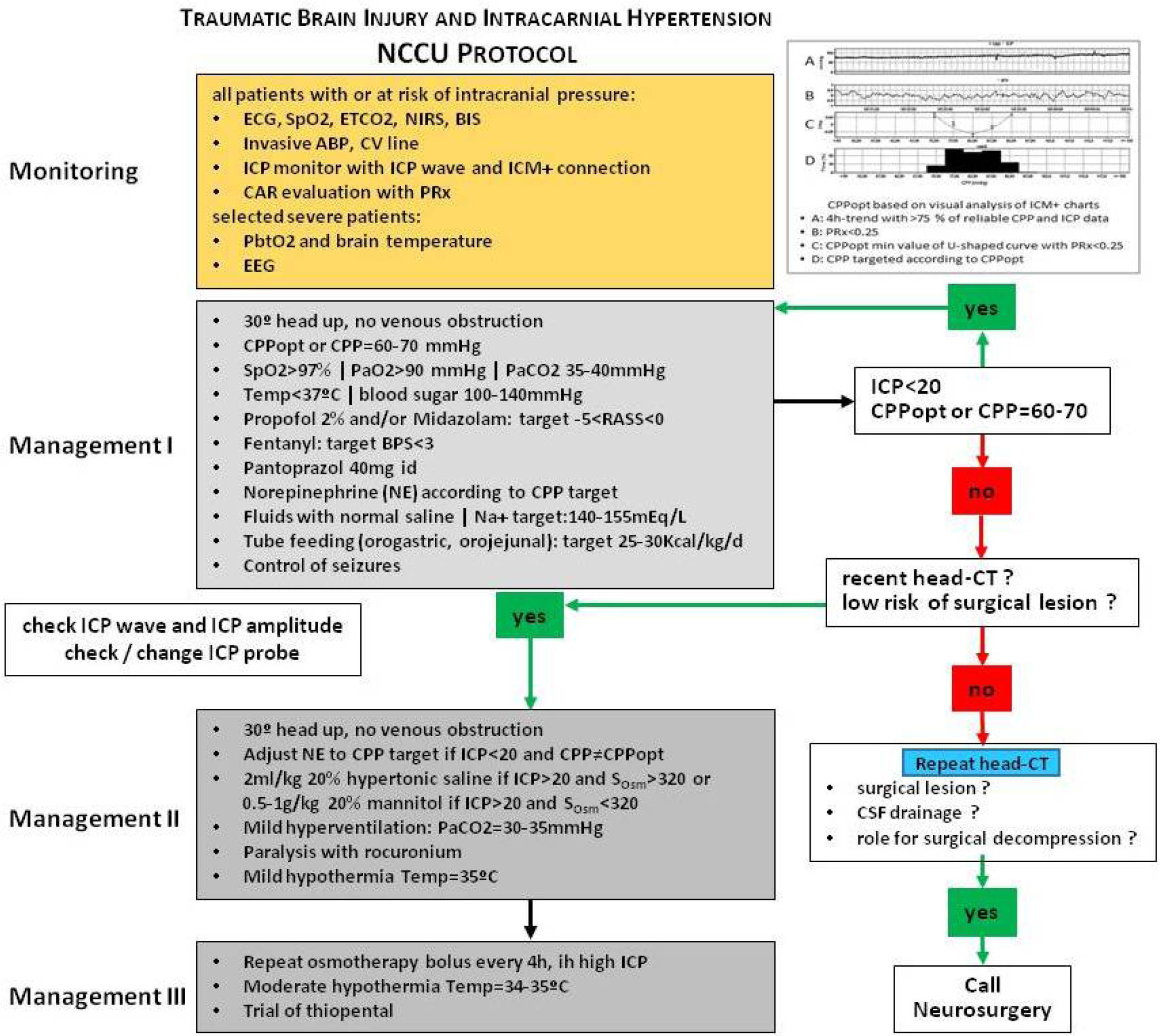
Fig. 1.
Neurocritical Care Unit (NCCU) protocol for Traumatic Brain Injury and Intracranial Hypertension Management. Optimal cerebral perfusion pressure evaluated continuously at bedside with cerebrovascular reactivity index and intracranial pressure control below 20 mmHg are primary targets. ECG electrocardiogram, SpO2 pulse oximetry, ETCO2 endtidal carbon dioxide, ABP arterial blood pressure, NIRS cerebral oximetry with near-infrared light, BIS bispectral index, CVP central venous pressure, ICP intracranial pressure, ICM+ multimodal brain monitoring software, CAR cerebral autoregulation, PRx cerebrovascular reactivity index CPP cerebral perfusion pressure, CPPopt optimal CPP, PbtO2 brain tissue oxygen pressure, EEG electroencephalogram, PaO2 arterial oxygen pressure, PaCO2 arterial carbon dioxide pressure, Temp temperature, RASS Richmond agitation–sedation scale, BPS behavioral pain scale, Na+ serum sodium, SOsm serum osmolalityhead-CT head computerized tomography, CSF cerebral spinal fluid.
Table 1.
Demographic, Monitoring, Management and Outcome data of patients with severe acute Traumatic Brain Injury.
| Variables | Mean±sd /Median (IQR) | |
|---|---|---|
| Demographic Data | ||
| Number of Patients | Total | 92 |
| Multiple Trauma | 45 (49%) | |
| Thoracic Trauma | 19 (21%) | |
| Age (Years) | 53 ± 21 | |
| Gender | Male | 79 (86%) |
| Female | 13 (14%) | |
| GCS at admission | 7 (IQR 5) | |
| APACHE II | 19 ± 6 | |
| Apache II mortality (%) | 33 ± 17 | |
| CT Marshall Classification | 3 (IQR 2) | |
| Monitoring and Management Data | ||
| FiO2 | 0.5 ± 0.13 | |
| PFratio | 305 ± 88 | |
| PaO2(mmHg) | 146.5 ± 28.5 | |
| PaCO2(mmHg) | 38.1 ± 3.7 | |
| SaO2(%) | 98.6 ± 0.74 | |
| RR (cycles/min) | 17 ± 4 | |
| MV (L/min) | 9.45 ± 2.18 | |
| PEEP (cmH20) | 6,2 ± 1,3 | |
| Ppl (cmH20) | 19.7 ± 4.8 | |
| DP=Ppl-PEEP (cmH20) | 15.9 ± 3.5 | |
| Shunt fraction (Qs/Qt) (%) | 16.3±6.7 | |
| Compliance | 43 ± 13.8 | |
| Fluid Balance (ml/d) | 171 ± 564 | |
| Therapy Intensity Level (TIL) | 2 (IQR 1) | |
| HR (bpm) | 71.9 ± 10.5 | |
| ABP (mmHg) | 96.7 ± 7.0 | |
| ICP (mmHg) | 11.2 ± 5.8 | |
| CPP(mmHg) | 85.9 ± 7.4 | |
| PRx | 0.03 ± 0.19 | |
| CPPopt (mmHg) | 88.7 ± 8.5 | |
| CPP-CPPopt (mmHg) | −2.8 ± 10.2 | |
| Outcome Data | ||
| LOS ICU (days) | 22 ± 26 | |
| LOS Hosp (days) | 48 ± 48 | |
| Mortality | 14 (15.2%) | |
| GOS at 3 months | 3 (IQR 2) | |
[i] sd – standard deviation; IQR – interquartile range; GCS-Glasgow Coma Scale; APACHE II - Simplified Acute Physiology Score; APACHE II % - mortality prediction at hospital discharge; CT-Marshall Classification (CT classification for TBI). FiO2 (Fraction of inspired O2,), PFratio (PaO2/FiO2 ratio), PaO2 (arterial oxygen pressure), PaCO2 (arterial carbon dioxide pressure), SaO2 (% of saturation of O2), RR (respiratory rate), MV (respiratory minute volume), PEEP (positive end-expiratory pressure), Ppl (plateau pressure), DP=Ppl–Peep (driving pressure), Compliance, HR (heart rate), ABP (mean arterial blood pressure), ICP (intracranial pressure), CPP (cerebral perfusion pressure, PRx (pressure reactivity index), CPPopt (optimal CPP), CPP-CPPopt (difference between CPP and CPPopt), LOS ICU/hosp (length of stay in intensive care unit / in hospital), GOS at 3M (Glasgow outcome scale at 3 months; 1 - dead).
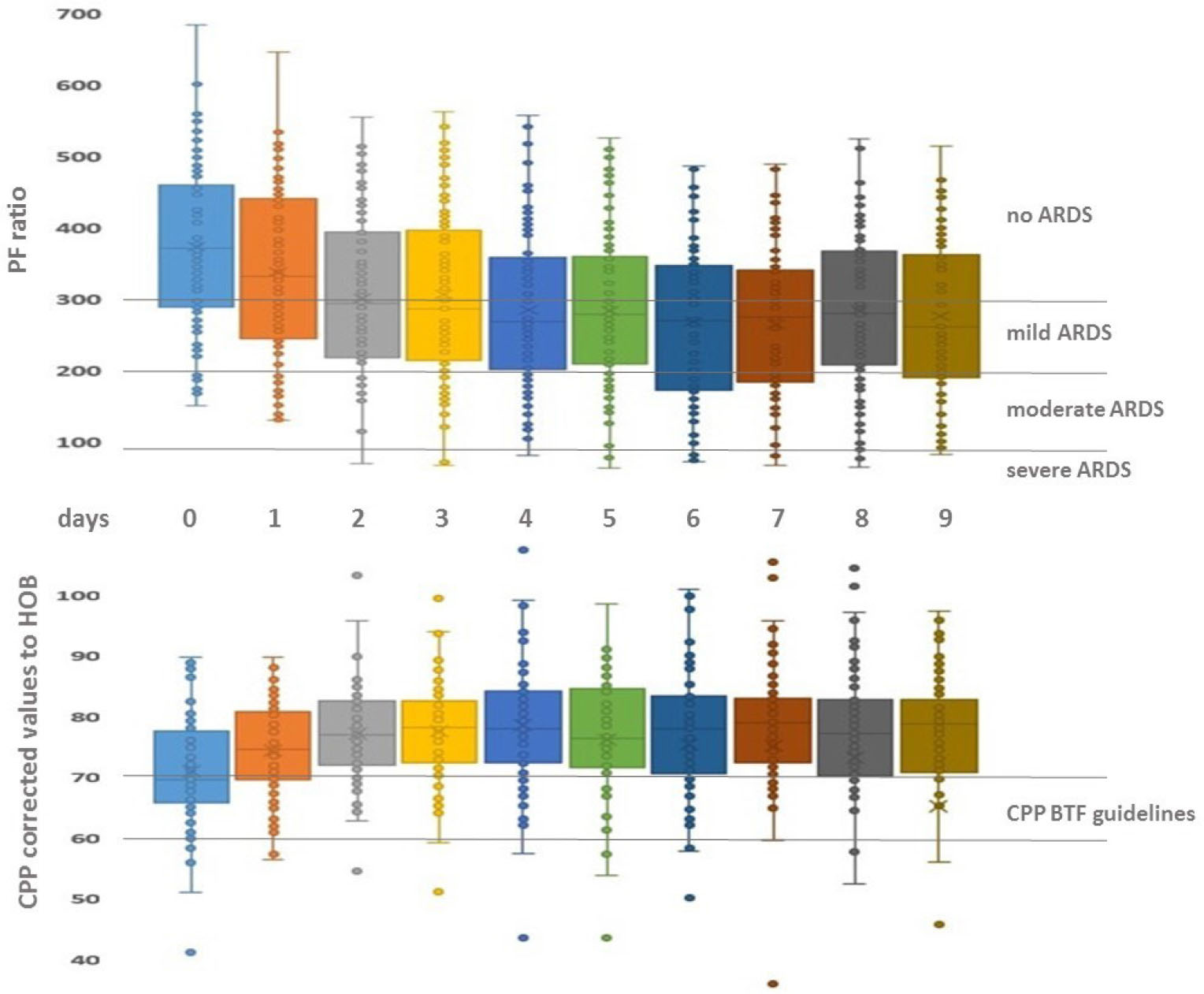
Fig. 2.
Time evolution of PF ratio across the first ten days of admission for the whole sample according to ARDS definition of PFratio intervals by the Berlin Task Force (top). CPP evolution across the first ten days of admission for the whole sample and CPP definition interval according to Brain Trauma Foundation (bottom). PF ratio: ratio between oxygen arterial pressure and inspired fraction of oxygen; CPP: Cerebral Perfusion Pressure; HOB: Head of bed elevation (30o).
Table 2.
Estimates from the final mixed-effects regression models for PFratio, CPP-CPPopt and Driving Pressure across time (10 days), adjusted for other variables of interest.
| Variables | FIXED EFFECTS | RANDOM EFFECT | ||
|---|---|---|---|---|
| Coefficient | St Error | p-value | St deviation | |
| Model for the time-effect on PFratio | ||||
| Intercept | 436.42 | 17.63 | <0.001 | 59.25 |
| Time (days) | −27.12 | 4.56 | <0.001 | |
| Days2 | 2.175 | 0.48 | <0.001 | |
| Female | 99.28 | 23.39 | <0.001 | |
| PRx | −49.99 | 15.68 | 0.002 | |
| Ppl-Peep | −5.34 | 0.97 | <0.001 | |
| Model for the time-effect of outcome on CPP-CPPopt | ||||
| Intercept | −2.37 | 1.58 | 0.133 | 2.95 |
| Dead | −0.79 | 1.72 | 0.647 | |
| Time (days) | −0.56 | 0.28 | 0.048 | |
| Time*Dead | 1.10 | 0.31 | <0.001 | |
| Model for the time-effect of outcome on Driving Pressure | ||||
| Intercept | 14.76 | 1.10 | <0.001 | 2.85 |
| Dead | −0.43 | 1.20 | 0.718 | |
| Time (days) | 0.68 | 0.15 | <0.001 | |
| Time*Dead | −0.34 | 0.17 | 0.041 | |
[i] For the PFratio model, the best structure for the residual correlation matrix was a time autocorrelation structure of order 1, with a coefficient estimated at 0.384 (95% CI: 0.272 – 0.485). The model evaluating the time-effect of the outcome (Dead/Alive) on CPP-CPPopt and driving pressure used the same residual correlation structure and the coefficient was, respectively, estimated at 0.231 (95% CI: 0.123 - 0.334) and 0.426(95% CI: 0.312 – 0.527). Female (sex), PRx (pressure reactivity index), Ppl–Peep (driving pressure as the difference between plateau and Peep pressures).
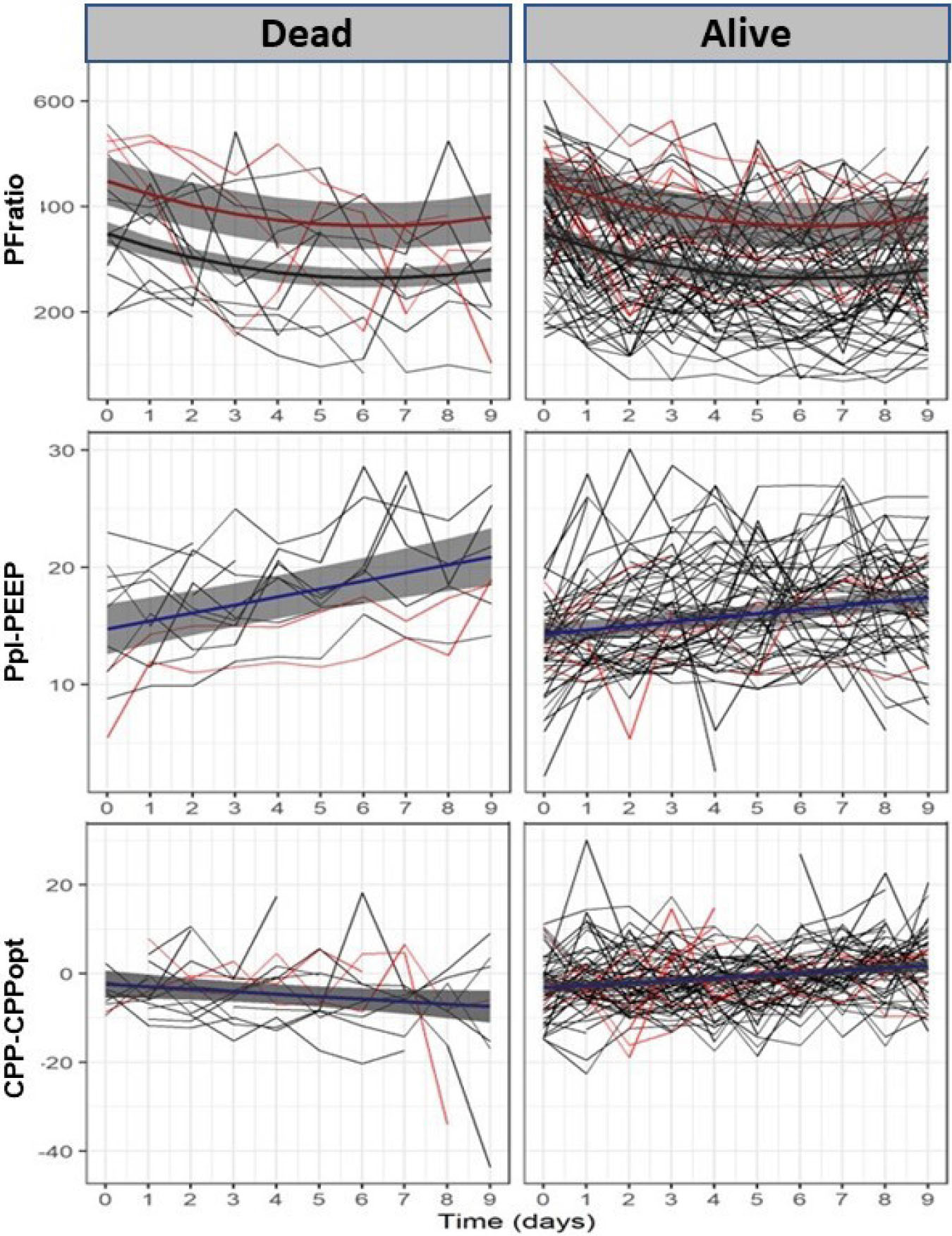
Fig. 3.
Time evolution of PFratio (top), Ppl-PEEP (middle) and CPP-CPPopt (bottom), for each patient (fine lines), according to the Outcome (Dead or Alive) and Sex (Female, in red; Male, in black). The mean and 95% confidence band of the prediction model, based on the fixed-effects, are also pictured. PFratio: ratio between oxygen arterial pressure and inspired fraction of oxygen; Ppl–PEEP: difference between plateau pressure and PEEP (driving pressure); CPP-CPPopt: difference between cerebral perfusion pressure and optimal CPP.