
Table 1
Survey questions used to collect data on metaraminol use in hospitals in United Kingdom
| We are conducting a survey to evaluate the frequency and circumstances of metaraminol use in critical care settings in the UK. Your answers will not be discussed individually, and data will not be identifiable, as they will only be used as part of the whole sample. |
|---|
| 1. Do you use metaraminol in the pre-critical care setting in your hospital? |
| 2. If so, under which circumstances? |
| 3. If metaraminol was started pre-ICU, is it continued in the critical care? |
| 4. Do you ever use metaraminol as a first line vasopressor in Critical Care? |
| 5. If so, under which circumstances? |
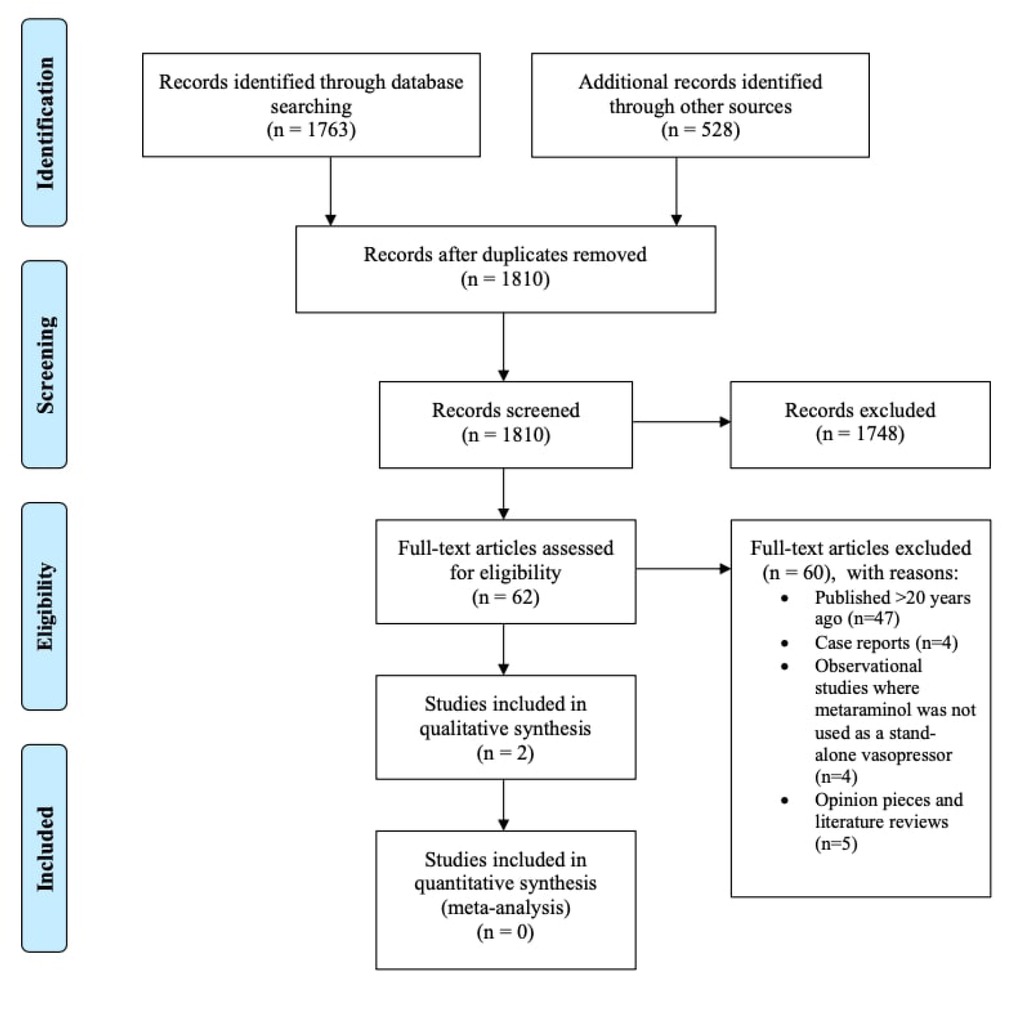
Fig. 1
PRISMA flow chart of the study selection process
Table 2
Review of articles selected by our literature review regarding the use of metaraminol in critical care settings
| Author and year of study | Type of the study | Number of patients and population | Outcome(s) evaluated | Narrative outcome | Quality assessment |
|---|---|---|---|---|---|
| Natalini et al, 2005(35) | Prospective cohort study | 10 patients in with septic shock. All initially started on norepinephrine, then changed to metaraminol, dose titrated to reach same mean arterial blood pressure. Pulmonary catheter used for measurement of haemodynamic variables. | - Haemodynamic variables; - Medication doses needed to maintain same blood pressure; - Acid-base status - Cardiac output increase of more than 30% | No significant changes in haemodynamic variables. No relationship between norepinephrine and metaraminol doses (R2=0.087), needed to maintain the same mean arterial blood pressure was found. | The sample size was small. The study was not blinded. Only immediate effect was evaluated, and the authors did not comment on the effects that metaraminol can have on long term outcomes |
| Ruchti et al, 2021(33) | Prospective observational study | 100 patients with shock or hypotension of any cause. First 50 given metaraminol, other 50- norepinephrine. | - Haemodynamic variables; - Duration of vasopressor support - Need of central venous catheter - Cost of treatment | No statistically significant changes in measured clinical outcomes were found in both groups. Cost of treatment was significantly higher in metaraminol group. | Patients were not randomised to intervention. Norepinephrine administered peripherally, which is not standard practice. Study presented as a letter, hence limited information available regarding methods and results. |
Table 3
Reported use of metaraminol in pre-critical areas as per the size of the critical care capacity
| All pre-critical care areas | Emergency department/resus | Theatres | Recovery | Ambulance/ Transfer | Wards | |
|---|---|---|---|---|---|---|
| All respondent (26 hospitals) | 23 (88%) | 16 (70%) | 9 (39%) | 5 (22%) | 1 (4%) | 16 (70%) |
| <10 bedded (4 hospitals) | 4 (100%) | 4 (100%) | 2 (50%) | 1 (25%) | 0 | 3 (75%) |
| 10-20 bedded (10 hospitals) | 9 (90%) | 4 (40%) | 2 (20%) | 0 | 0 | 5 (50%) |
| >20 bedded (12 hospitals) | 10 (83%) | 8 (67%) | 5 (42%) | 4 (33%) | 1 (8%) | 8 (67%) |
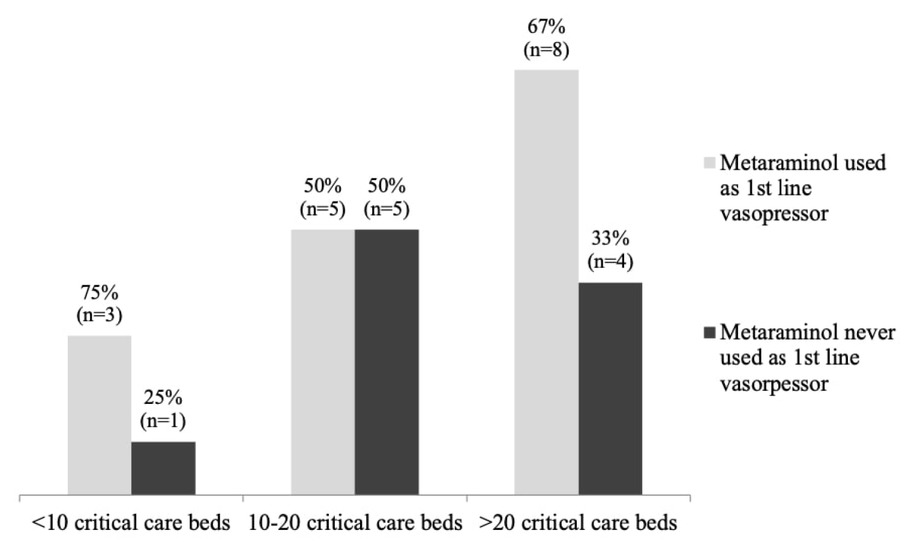
Fig. 2
Use of metaraminol as first line vasopressor, in the critical care setting, based on the critical care capacity
| Author and year published | Type of article | Main medical condition reported | Comments on metaraminol use |
|---|---|---|---|
| Hou et al, 2007 (24) | Retrospective observational cohort study | Patients admitted to the intensive care units with septic shock | Metaraminol used together with dopamine. Haemodynamic variables and impact on renal function evaluated as outcome measures. |
| Abu Sardaneh et al, 2021 (34) | A retrospective cohort study to determine the dose equivalent between metaraminol and noradrenaline | Patients with shock of any cause in the intensive care unit. | The conversion dose ratio between continuous infusion metaraminol and norepinephrine ranged between 8 and 13 in the primary and sensitivity analyses. |
| Abu Sardaneh et al., 2021 (21) | A retrospective observational study | Patients with shock of any cause in the intensive care unit. | Metaraminol was the most commonly used first line vasopressor. The study reported on the practice and did not focus on outcomes. |
| Abu Sardaneh et al, 2021 (23) | A retrospective matched observational study | Patients with shock of any cause in the intensive care unit. | In critically ill patients, metaraminol used alongside norepineohrine may be associated with a longer time to resolution of shock compared with those who only receive norepinephrine. |
| Da Silva and Furtado, 2018 (22) | A case report | Anaphylactic shock | Metaraminol mentioned as a vasopressor in shock |
| Anderson and Chatha, 2017 (25) | Literature review | Metaraminol use in the Emergency Department | Concluded that it is widely used in the emergency department setting with little evidence to support the practice. |
| Hayward et al, 2016 (26) | A review of practice | Review of medications used by Australian aeromedical prehospital and retrieval service. | Metaraminol only briefly mentioned as a treatment option utilised by the Australian pre-hospital service |
| Redmond et al, 2013 (27) | A case report | Takotsubo cardiomyopathy | A patient, suffering from at that point undiagnosed Takotsubo cardiomyopathy progressed to pulseless ventricular tachycardia following bolus administration of metaraminol. |
| Isbister and Duffull, 2009 (28) | A case report | Quetiapine overdose | Metaraminol used successfully to maintain blood pressure (as opposed to conventional vasopressors) |
| Dewachter et al, 2007 (29) | A review of current practice | Perioperative anaphylaxis | Metaraminol briefly mentioned as a vasopressor used to treat hypotension |
| Brown, 2005 (30) | Review of management of anaphylaxis | Anaphylactic shock | Metaraminol briefly mentioned as a vasoconstrictor in shock. |
| Wood et al, 2005 (31) | A case report | Amlodipine overdose | Metaraminol used successfully to maintain blood pressure (as opposed to conventional vasopressors) |
| Holmes, 2005 (32) | Opinion piece | Opinion piece on vasopressors in the Intensive Care | Metaraminol mentioned alongside other vasopressors used to treat hypotension |