
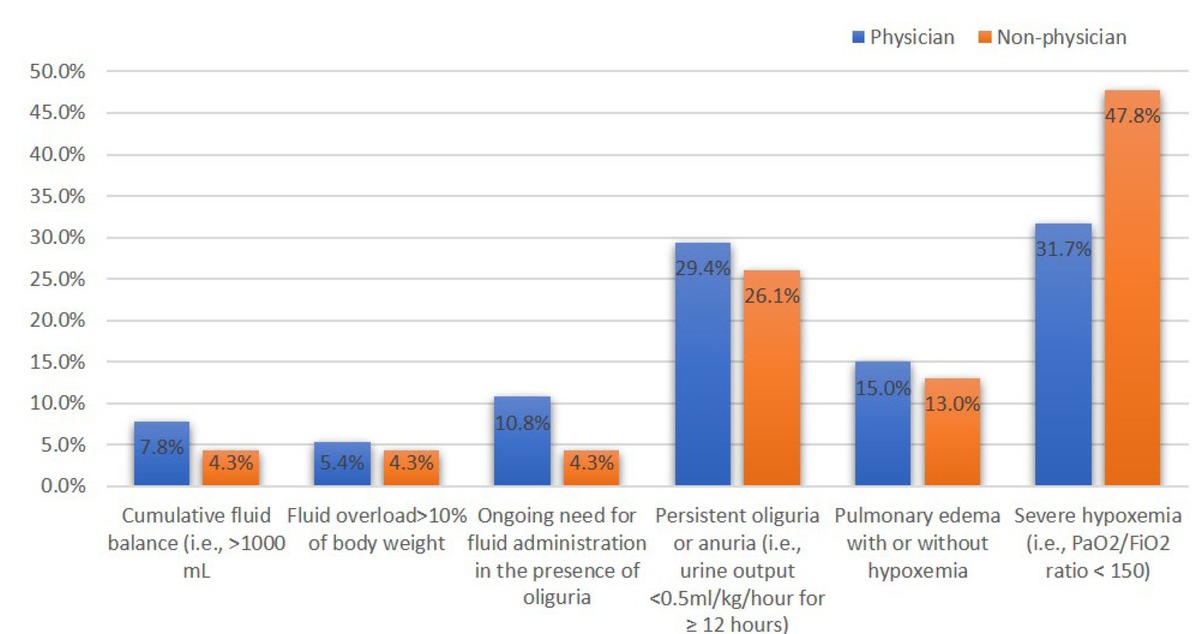
Fig.1
Reported Criteria Used for Initiating Fluid Removal
Table 1
Characteristics of U.S. Survey Respondents and Practice of Net Ultrafiltration
| All (n=465) | Physician (n=196) | Nurse & Nurse Practitioner (n=269) | ||
|---|---|---|---|---|
| Years of practice, median (IQR) | 8.7 (4.2-19.4) | 8.8 (4.4-16.7) | 8.7 (4.1- 21.0) | 0.41 |
| Hospital typea | ||||
| University-based | 295 (64.8) | 128 (66.3) | 167 (63.7) | |
| Community-based | 140 (30.8) | 50 (25.9) | 90 (34.4) | 0.003 |
| Government | 20 (4.4) | 15(7.7) | 5(1.5) | |
| Maximum dose of loop diuretic in milligrams equivalent to furosemide dosing before determining diuretic resistance, mgs/dayb | ||||
| <100 | 10 (4.8) | 8 (4.4) | 2(8) | |
| 100-250 | 131 (63.0) | 114(62.3) | 17 (68) | |
| 251-500 | 53 (25.5) | 50 (27.3) | 3 (12) | 0.30 |
| 501-750 | 4(1.9) | 4(2.2) | 0 | |
| <751-1000 | 9 (4.3) | 6 (3.3) | 3 (12) | |
| >1000 | 1 (0.5) | 1 (0.55) | 0 | |
| Criteria for initiating fluid removalb,c | ||||
| Cumulative fluid balance (i.e., >1000 mL) | 14 (7.4) | 13 (7.8) | 1 (4.3) | |
| Fluid overload>10% of body weight | 10 (5.3) | 9 (5.4) | 1 (4.3) | |
| Ongoing need for fluid administration in the presence of oliguria | 19 (10.0) | 18 (10.8) | 1 (4.3) | 0.72 |
| Persistent oliguria or anuria (i.e., urine output <0.5ml/kg/h for >12 hours) | 55 (28.9) | 49 (29.4) | 6 (26.1) | |
| Pulmonary edema with or without hypoxemia | 28 (14.7) | 25 (15.0) | 3 (13.0) | |
| Severe hypoxemia (i.e., PaO2/FiO2 ratio < 150) | 64 (33.7) | 53 (31.7) | 11 (47.8) | |
| Criteria used for prescribing UFNETb,c | ||||
| 24-hour fluid balance | 21 (10.6) | 20 (11.5) | 1 (4.2) | |
| Cumulative fluid balance since ICU admission | 24 (12.1) | 23 (13.2) | 1 (4.2) | |
| Hemodynamic status (i.e., HR, BP, CVP, PPV, dose of vasopressors) Radiographic features suggestive of fluid overload | 141 (71.2) 6 (3.0) | 121 (69.5) 5(2.9) | 20 (83.3) 1 (4.2) | 0.61 |
| Volume of anticipated fluid administration in the next 24 hours | 1 (0.5) | 1 (0.6) | 0 | |
| Weight gain since ICU admission | 5(2.5) | 4(2.3) | 1 (4.2) | |
| Intermittent hemodialysis, median (IQR) | ||||
| Percent use last month | 10.0 (2.2-30.0) | 10.0 (5.0-30.0) | 10.0 (2.0-30.0) | 0.29 |
| Typical prescription, liters per session | 2.0 (2.0-3.0) | 2.0 (2.0-3.0) | 2.0 (1.6-2.4) | 0.07 |
| Slow forms of IHD, median (IQR) | ||||
| Percent use last month | 1.0 (1.0-15.0) | 2.0(0-23.0) | 1.0(0-10.5) | 0.08 |
| Typical prescription, liters per session | 2.0 (1Ό-2.5) | 2.0 (1.0-2.5) | 2.0 (1.2-2.4) | 0.17 |
| Percent of assessment of prescribed-to- delivered dose, median (IQR) | 90.0(20.0-100.0) | 90.0 (50.0-100.0) | 72.5 (2.7-100.0) | 0.02 |
| CKRT, median (IQR) | ||||
| Percent use last month | 60.0 (20.0-90.0) | 80.0(50.0-90.0) | 50.0(10.0-80.0) | <0.001 |
| Initial UFNET rate for hemodynamically stable patient, mL per hour | 100.0 (79.0-200.0) | 100.0 (100.0-197.0) | 100.0(52.0-200.0) | 0.96 |
| Maximal UFNET rate for hemodynamically stable patient, ml per hour | 285.0(200.0-341.0) | 298.0 (200.0-351.0) | 253.5 (200.0-310.5) | 0.22 |
| UFNETrate for hemodynamically unstable patient, ml per hour | 51.0(25.0-100.0) | 52.0 (49.0-100.0) | 51.0 (10.0-100.0) | 0.91 |
| Method used to achieve UFNET d | ||||
| By varying ultrafiltration rate only | 205 (61.9) | 75 (54.3) | 130(67.4) | |
| By varying replacement fluid rate only | 13 (3.9) | 8 (5.8) | 5(2.6) | 0.04 |
| By varying both ultrafiltration and replacement fluid rate | 113 (34.1) | 55(39.9) | 58 (30.1) | |
| How frequently did you check net fluid balancee | ||||
| 1 hour | 211 (58.2) | 43 (28.7) | 168 (79.2) | |
| 2 hours | 19 (5.2) | 10(6.7) | 9 (4.2) | |
| 4 hours | 34 (9.4) | 24 (16.0) | 10 (4.7) | |
| 6 hours | 13 (3.6) | 11 (7.3) | 2 (0.9) | <0.001 |
| 8 hours | 16 (4.4) | 9 (6.0) | 7(3.3) | |
| 12 hours | 34 (9.4) | 24 (16.0) | 10 (4.7) | |
| 24 hours | 35 (9.7) | 29 (19.3) | 6(2.8) | |
[i] IQR, interquartile range; HR, heart rate; BP, blood pressure; CVP, central venous pressure; PPV, pulse pressure variation; IHD, intermittent hemodialysis; CKRT, continuous kidney replacement therapy
aTen practitioners answered other hospitals which included private and mixed community and academic centers
bOnly the physicians and advanced practice provider were asked these questions and nurses were excluded.
cThese data were analyzed from clinicians who have active role in initiating dialysis; other answers such as I do not make decision to initiate dialysis were excluded in the analysis
d These data were analyzed from answers of one of the three options; other answers such as I do not know or not applicable were excluded in the data analysis
e These data were analyzed from answers of one of the seven listed options; other answers were excluded in the analysis
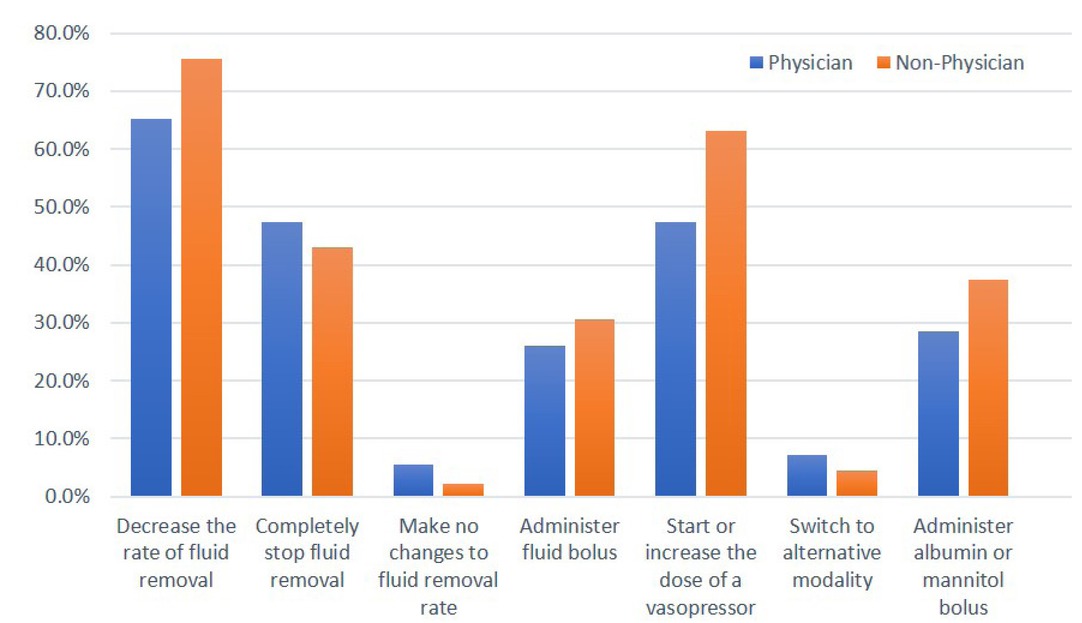
Fig.2
Reported Interventions Performed for Hemodynamic Instability During Net Ultrafiltration
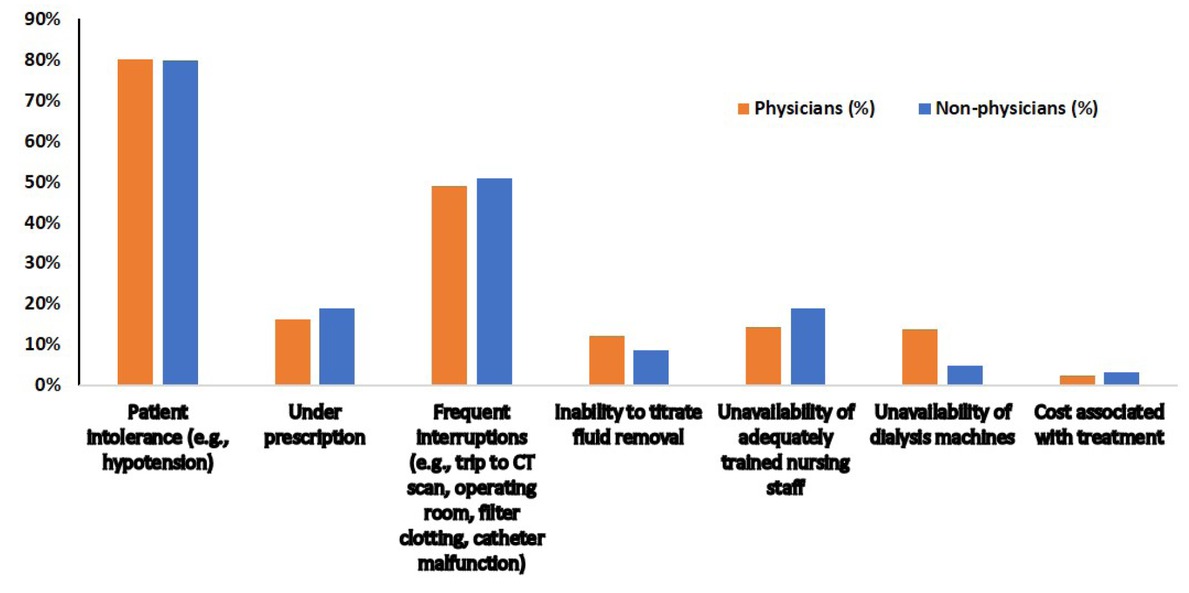
Fig.3
Perceived Barriers to Net Ultrafiltration
Table 2
Hemodynamic Management and Perceived Barriers to Net Ultrafiltration
| All (n=465) | Physician (n=196) | Nurse & Nurse Practitioners (n=269) | ||
|---|---|---|---|---|
| Percentage of patients developing new hemodynamic instability during UFNET median (IQR) | 25.0 (10.0-100.0) | 25.0 (13.2-35.0) | 20.5 (10.0-50.0) | 0.79 |
| interventions performed for hemodynamic instabilitya | ||||
| Decrease the rate of fluid removal | 331 (71.2) | 128 (65.3) | 203 (75.5) | 0 .02 |
| Completely stop fluid removal | 206 (44.3) | 93 (47.4) | 113 (43) | 0.24 |
| Make no changes to fluid removal rate | 17 (3.7) | 11 (5.6) | 6 (2.2) | 0.05 |
| Administer fluid bolus | 133 (28.6) | 51 (26) | 82 (30.5) | 0.29 |
| Start or increase the dose of a vasopressor | 263 (56.6) | 93 (47.4) | 170 (63.2) | <0.001 |
| Switch to alternative modality | 26 (5.6) | 14 (7.1) | 12 (4.5) | 0.21 |
| Administer albumin or mannitol bolus | 157 (33.8) | 56 (28.6) | 101 (37.5) | 0.04 |
| Perceived barriersa | ||||
| Patient intolerance (e.g., hypotension) | 371 (79.8) | 156 (80.0) | 215 (79.9) | 0.93 |
| Under prescription | 83 (17.8) | 32(16.3) | 51 (19.0) | 0.47 |
| Frequent interruptions (e.g., trip to CT scan, operating room, filter clotting, catheter malfunction) | 233 (50.1) | 96 (49.0) | 137 (50.9) | 0.67 |
| Inability to titrate fluid removal | 47 (10.1) | 24 (12.2) | 23 (8.6) | 0.19 |
| Unavailability of adequately trained nursing staff | 79 (17.0) | 28 (14.3) | 51 (19.0) | 0.18 |
| Unavailability of dialysis machines | 40 (8.6) | 27 (13.8) | 13 (4.8) | 0.001 |
| Cost associated with treatment | 11 (2.0) | 5 (2.5) | 6 (3.1) | 0.83 |
Table 3
Attitudes Toward Timing, Use of a Protocol and Willingness to Enroll Patients in a Clinical Trial of Protocol-based Net Ultrafiltration
| Characteristic | No. (%) | P value | ||
|---|---|---|---|---|
| All (N=465) | Physician (N=196) | Nurse & Nurse Practitioners (N=269) | ||
| I believe early fluid removal is beneficial | ||||
| Strongly agree | 148 (31.8) | 56 (28.6) | 92 (34.2) | |
| Agree | 195 (41.9) | 68 (34.7) | 127 (47.2) | |
| Somewhat agree | 71 (15.3) | 42 (21.4) | 29 (10.8) | |
| Neither agree nor disagree | 37 (8.0) | 19 (9.7) | 18 (6.7) | <0.001 |
| Somewhat disagree | 7 (1.5) | 6 (3.1) | 1 (0.4) | |
| Disagree | 3 (0.6) | 2 (1.0) | 1 (0.4) | |
| Strongly disagree | 4 (0.9) | 3 (1.5) | 1(0.4) | |
| I believe a protocol-based fluid removal strategy would be beneficial | ||||
| Strongly agree Agree | 113 (24.4) 160 (34.6) | 28 (14.3) 60 (30.6) | 85 (31.5) 100 (37.2) | |
| Somewhat agree | 108 (23.3) | 57(29.1) | 51 (20.0) | <0.001 |
| Neither agree nor disagree | 52 (11.2) | 33 (16.8) | 19 (7.1) | |
| Somewhat disagree | 18 (3.9) | 9 (4.6) | 9 (3.3) | |
| Disagree | 11 (2.4) | 7 (3.6) | 4 (1.5) | |
| Strongly disagree | 3 (0.6) | 2 (1.0) | 1 (0.4) | |
| I would enroll my patient in a clinical trial comparing protocol-based | versus usual | care | ||
| Strongly agree | 108 (23.2) | 46 (23.5) | 62 (23.0) | 0.001 |
| Agree | 168 (36.1) | 84 (42.9) | 84 (31.2) | |
| Somewhat agree | 52 (11.2) | 24 (12.2) | 28 (10.4) | |
| Neither agree nor disagree | 107 (23.0) | 26 (13.3) | 81 (30.1) | |
| Somewhat disagree | 4 (0.9) | 3 (1.5) | 1 (0.4) | |
| Disagree | 15 (3.2) | 9 (4.6) | 6 (2.2) | |
| Strongly disagree | 9 (1.9) | 4 (2.0) | 5 (1.9) | |