
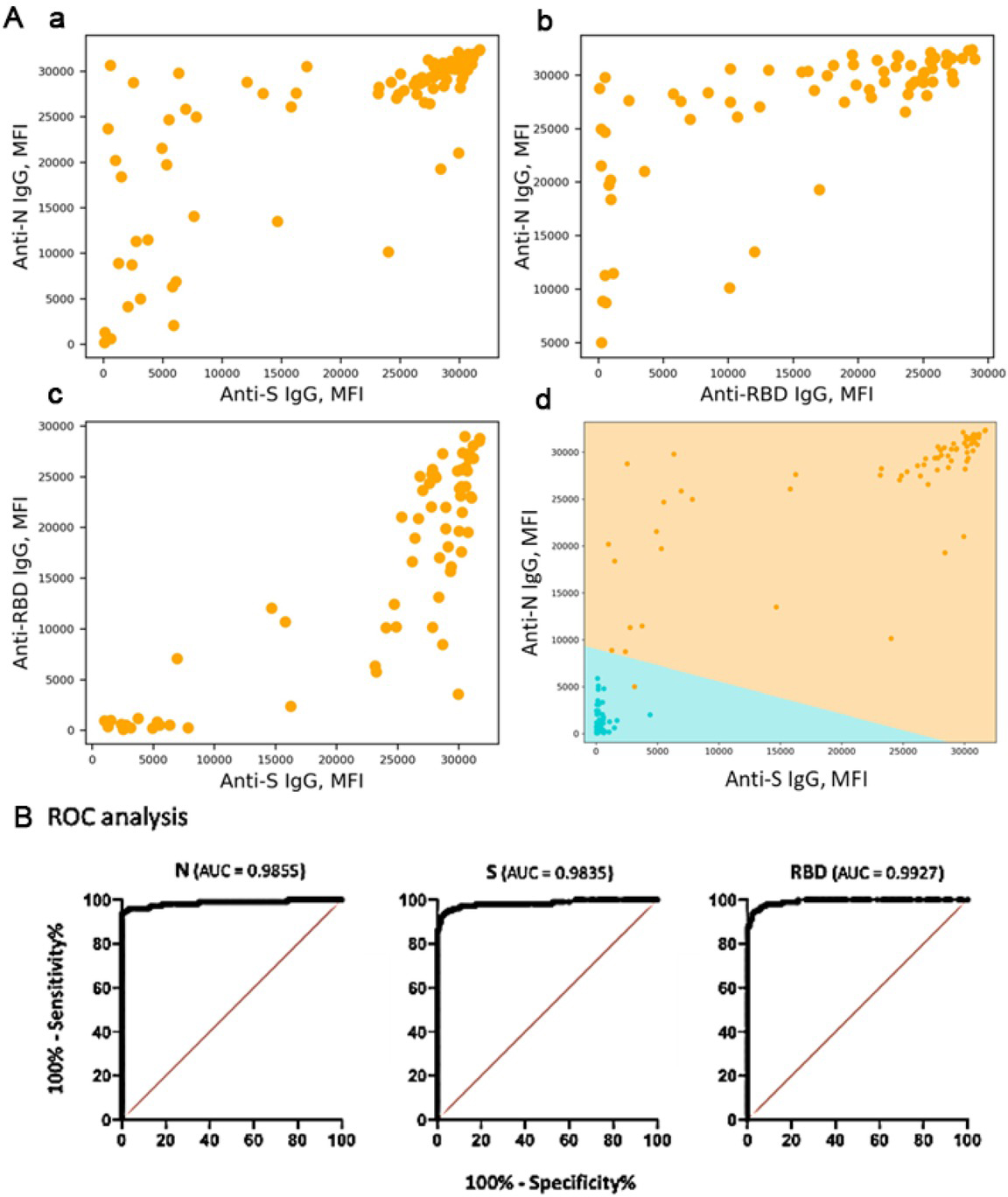
Fig. 1
Training data set used in the support vector machine (SVM) and applied to classification of HCW serostatus and sensitivity/specificity analysis from PCR confirmed SARS-CoV-2 positive patients and pre-pandemic negative control samples are shown. A. Luminex values (MFI) show the relationship between (a) N and S, (b) N and RBD, (c) S and RBD in COVID-19 patients. (d) Illustrates how the SVM identifies cut off between HCW classified seropositive (orange) and seronegative (blue) samples taking into account the MFI binding to each antigen tested. The background colour indicates whether a sample at that location would be classified as seropositive (pale orange) or seronegative (pale blue). The classification is made based on all antigens at once, i.e. there is no single cut off point for any single antigen. The cut off shown here assumes the average pre-pandemic anti RBD response. For lower RBD responses the blue orange cut off is moved down and left. B. Receiver Operator Curves (ROC) for individual N, S and RBD antigens demonstrates the sensitivity and specificity of the Luminex assay with area under the curve (AUC) value embedded in each ROC analysis.
Table 1
Cohort demographic for age, sex, ethnicity and work location and by serostatus by multiplex (N=498 classified). Values: N= (% of total and of cohort by demographic classification to nearest whole number). Age: years.*p=0.017 : age of seropositive and seronegative cohort (MW-U).
| Total (%) | Seropositive (%) | Seronegative (%) | ||
|---|---|---|---|---|
| Number recruited | 500 | 70 (14) | 428 (86) | |
| Age (yrs, median with IQR) | 42 (33-51) | 40 (32-50) | 47 (36-53)* | |
| Sex | male | 146 (29) | 20 (14) | 126 (86) |
| female | 352 (70) | 50 (14) | 302 (86) | |
| Ethnicity group | 1:white | 390 (78) | 45 (12) | 345 (88) |
| 2:mixed | 16 (3) | 4 (25) | 12 (75) | |
| 3:asian | 79 (16) | 16 (20) | 63 (80) | |
| 4:black | 11 (2) | 2 (18) | 9 (82) | |
| 5: other | 1 (0.2) | 0 | 1 (0.2) | |
| NA | 3 (1) | 0 | ||
| Work location | Critical Care patient facing | 126 (25) | 10 (7.9) | 116 (92) |
| Non-Critical Care patient facing | 284 (57) | 40 (14) | 244 (86) | |
| Non-patient facing | 63 (13) | 12 (19) | 51 (81) | |
| NA | 27 (5) |
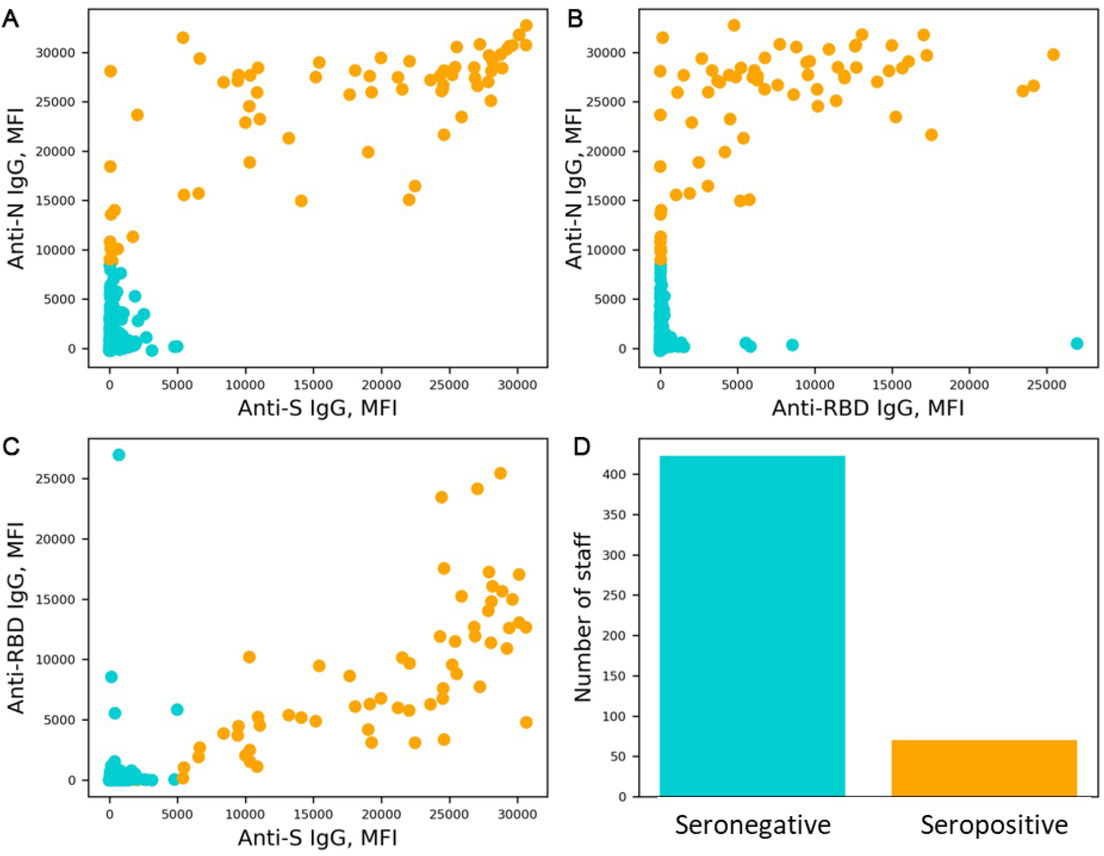
Fig. 2
Serostatus Classification. The mean fluorescent intensity (MFI) by Luminex of staff serum IgG binding to SARS-CoV-2 proteins N, S and RBD, showing the relationship of binding between the three proteins : (A) N and S, (B) S-RBD and N, (C) S and S-RBD. (D) shows the number of staff classified as seropositive or seronegative by the trained SVM. Serostatus is indicated by colour in all four panels: blue: seronegative; orange: seropositive.
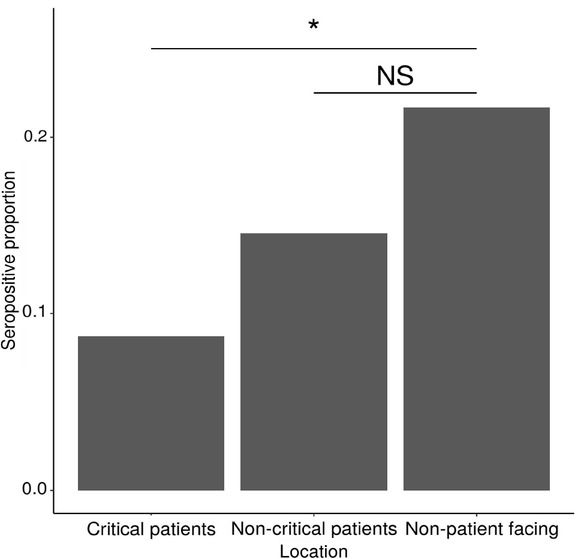
Fig. 3
Proportion of staff being classified as seropositive based on working location. (Proportion determined by Binomial regression. Significance determined by Wald-Z test. *p=0.017.
Table 2
PCR Swab Positive and Symptom Severity Score by Serostatus. N= (% of total and of each cohort by severity score).
| Total | Seropositive | Seronegative | ||
|---|---|---|---|---|
| PCR positive nasal swab | 12 (2) | 9 (75) | 3 (25) | |
| Symptom Severity Score | 1: asymptomatic | 275 (55) | 17 (6) | 258 (94) |
| 2: mild | 195 (39) | 39 (20) | 156 (80) | |
| 3: moderate | 26 (5) | 9 (35) | 17 (65) | |
| 4: severe | 1 (0.2) | 1 | 0 | |
| NA | 3 (0.6) |
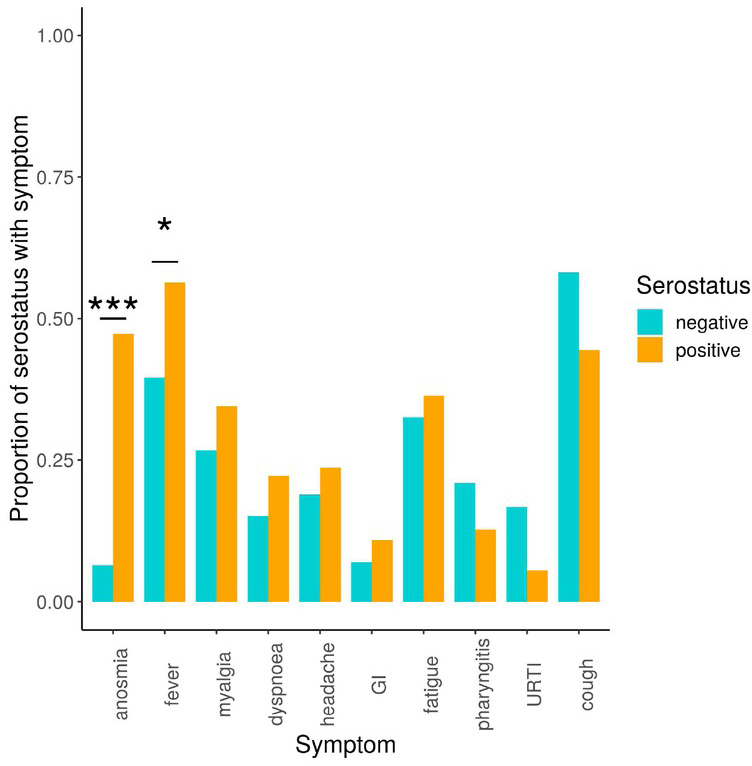
Fig. 4
Proportion of seronegative and seropositive staff reporting specific symptoms. Bars in orange indicate the proportion of seropositive staff with a symptom while bars in turquoise indicate seronegative staff proportions. Symptoms are ordered by difference in proportion between seropositive and seronegative staff. * *p=0.031; ***p<0.001.
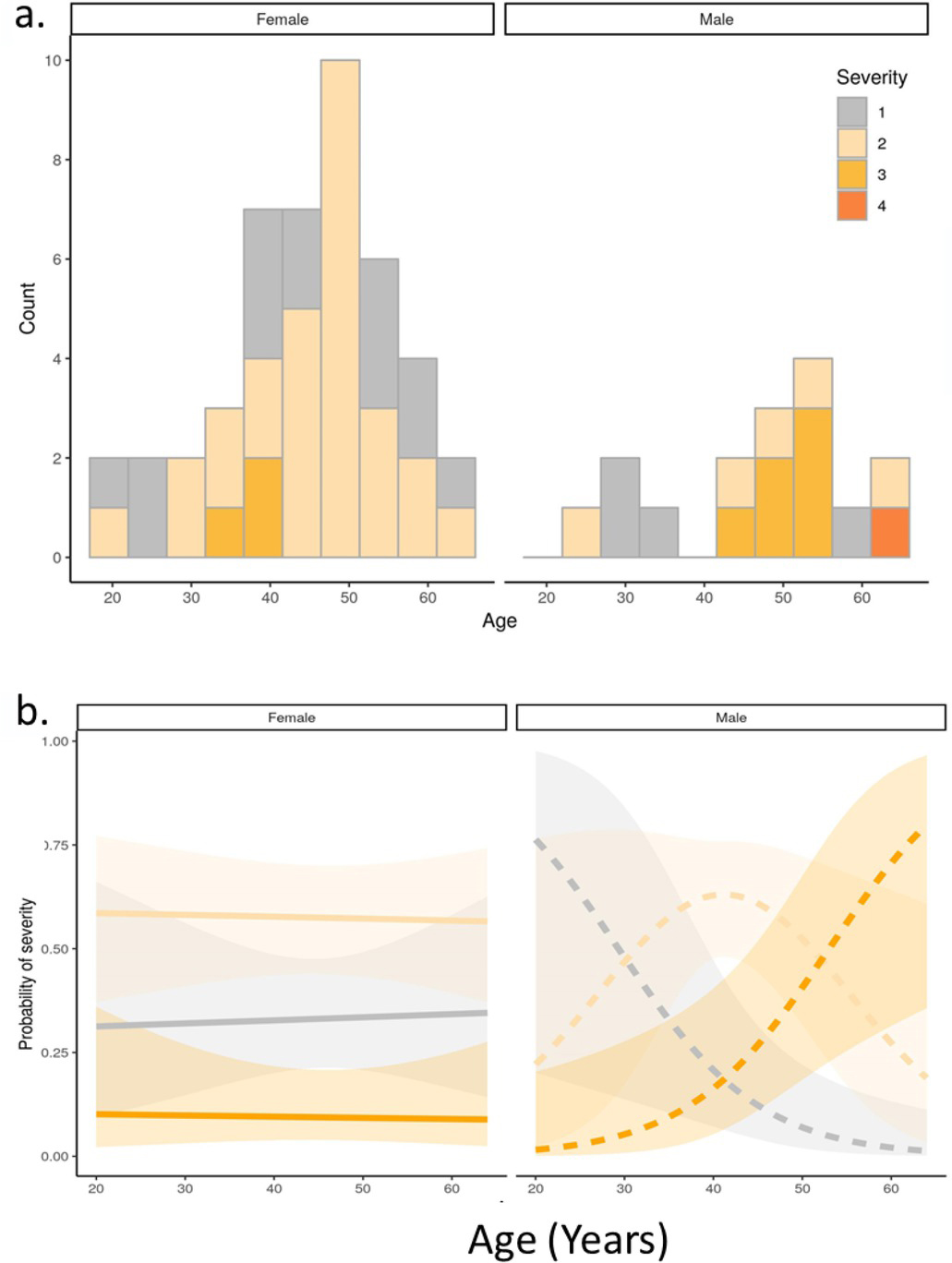
Fig. 5
Symptom severity score by age and sex. a. Stacked histogram of seropositive staff age split by sex and coloured by severity of infection. b. Probability of disease severity based on age and sex of seropositive staff. Severity of infection is indicated by colour; grey is class 1 (asymptomatic), pale orange is class 2, and dark orange is class 3 or 4 (grouped due to small sample size).