
Table 1
Severity criteria for PH also includes Cardiac Index (severe < 2), mean RAP (>15), and low mixed venous O2 saturation and the presence of pericardial effusion. Mean Pulmonary Artery Pressure (mPAP).
| Severity | Mean mPAP (mmHg) |
|---|---|
| Mild | 20-40 |
| Moderate | 41-55 |
| Severe | >55 |
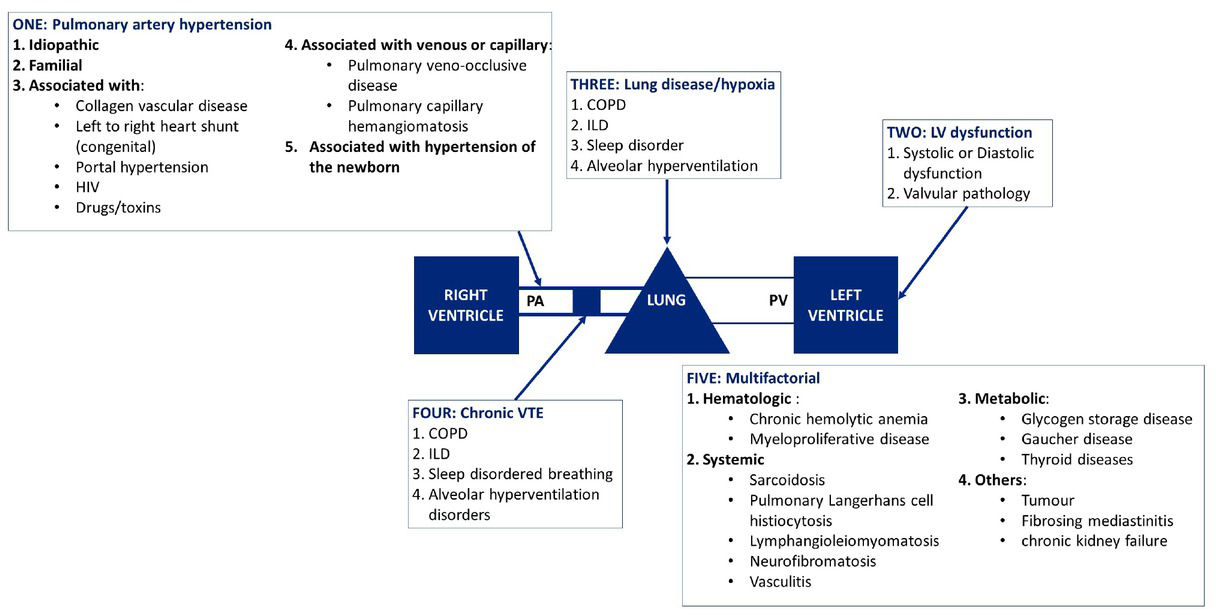
Fig. 1
Aetiology of pre-and post-capillary PH (PA: Pulmonary artery, PV: Pulmonary vein, COPD: Chronic Obstructive Pulmonary Disease, ILD: interstitial lung disease, HIV: Human immunodeficiency virus)
Table 2
Haemodynamic characteristics of pulmonary hypertension. Mean Pulmonary Arterial Pressure (mPAP), Pulmonary Artery Wedge Pressure (PAWP) and Pulmonary Vascular Resistance.
| Classification | Parameter | Value |
|---|---|---|
| Pre-capillary | mPAP | > 20mmHg |
| PAWP | ≤ 15mmHg | |
| PVR | ≥3 WU | |
| Isolated Post capillary | mPAP | >20mmHg |
| PAWP | >15mmHg | |
| PVR | <3 WU | |
| Combined pre- and | mPAP | >20mmHg |
| post-capillary | PAWP | >15mmHg |
| PVR | ≥3 WU |
Table 3
Perioperative investigations
| Investigation | Comments | |
|---|---|---|
| Bedside | ECG | RVH -RBBB, RAD, rSR’ complex in V1 |
| RV enlargement -P pulmonale | ||
| ABG | Type one respiratory failure | |
| Bloods* | BNP | RV failure |
| Imaging | CXR | Dilated pulmonary arteries |
| Right ventricular enlargement | ||
| Echocardiography | PA diameter, >25mm | |
| Right ventricle outflow doppler acceleration time, <105ms | ||
| Early diastolic pulmonary regurgitation (PR) velocity. >2.2 m/s | ||
| Peak TR velocity, >2.8 m/s | ||
| Cardiac MRI imaging | ||
| Additional | Lung function test | Obstructive or restrictive defect |
| Low TLCO a marker of disease severity | ||
| CPET | ||
| Pulmonary artery catheter |
Table 4
General anaesthetic management principles
| Perioperative management techniques and goals | ||||
|---|---|---|---|---|
| Preoperative | Medication | Pulmonary vasodilator agents | Continue | |
| Anticoagulation | Switch long term anticoagulation to IV heparin | |||
| Induction | GA | Opioids | Widely used | |
| Propofol/thiopentone | Widely used | |||
| LA | Regional | Widely used | ||
| Neuro-axial | Widely used | |||
| Intraoperative | Agents | Volatile anaesthetics | Widely used | |
| N20 | Avoid | ↑PVR | ||
| NMBD | Safe | |||
| Monitoring | BP/ECG/HR/SaO2/ETCO2 | Essential | ||
| CVP/TTE/PCA | Additional | |||
| Arterial line (+ABG) | ||||
| Physiology | Respiratory | FIO2 > 0.6 Hyperventilation Recruitment manoeuvres Lung protective ventilation (Tv 6-8ml/kg) | O2 = Pulmonary VD / weak systemic VC Avoid V/Q mismatch and over-inflation | |
| Cardiovascular | Preload - normovolemia | |||
| Heart | ||||
| Rate – Low normal | ||||
| Rhythm - SR | ||||
| Contractility -preserve | ||||
| Afterload – Avoid ↑PVR | ||||
| Haematological | pH >7.35 | |||
| Others | Normothermia | |||
| Post-operative | Location | Level 2/3 care | ||
Table 5
Goals for perioperative cardio-respiratory parameters
| Severity | Mean MAP (mmHg) | Units |
|---|---|---|
| SBP (or Above sPAP) | ≥90 (40) | mmHg |
| MAP (or Above mPAP) | ≥65 (20) | |
| mPAP (or lower than MAP) | <35 (25) | mmHg |
| PVR/SVR | <0.5 | |
| Cardiac Index | >2.2 | l/min/m2 |
Table 6
Perioperative management of PH
| Agent | Physiological response | |
|---|---|---|
| ↓ RV Afterload | Inhalational | |
| Prostanoids | ||
| Nitric oxide | ↓PVR/ SVR | |
| Intravenous | ||
| Prostanoids (epoprostenol, treprostini) | ||
| ↑ Myocardial perfusion | Intropes | |
| Milrinone / levosimendan | Positive inotropic (<-> HR) | |
| Dobutamine / epinephrine | Positive inotropic (↑HR) | |
| Vasopressors | ||
| Norepinephrine / vasopressin / terlipressin | ↑SVR/PVR/RV load |