
Table 1
Demographic characteristics and professional details of the subjects
| Variables | N (%) |
|---|---|
| Gender | |
| Men | 37 (23) |
| Women | 125 (77) |
| Age (yrs), mean(SD) | 39(9) |
| Marital status | |
| Married | 88 (54) |
| Not married | 64 (40) |
| Separated, divorced, widow/er | 10 (6) |
| Children | |
| Yes | 85 (52) |
| No | 31 (48) |
| Living alone | |
| Yes | 31(20) |
| No | 131 (80) |
| Education | |
| High school graduate | |
| Technological educational | 26 (16) |
| institution graduate | 59 (36) |
| University graduate | 77 (48) |
| University Degree, Master’s Diploma, | |
| PhD | |
| Profession | |
| Physician | 43 (27) |
| Nurse | 102 (63) |
| Technician | 17 (10) |
| Department | |
| Intensive Care Unit | 95 (59) |
| Emergency department | 17 (10) |
| High Dependency Unit | 34 (20) |
| Laburnout ratory | 16 (11) |
Table 2
Comparisons between professional groups; means (SD) or 25thpercentile/median/75thpercentile
| IES-R (Post-traumatic stress disorder) score | |
|---|---|
| Physicians | 23.51(16.15) |
| Nurses | 30.04(18.96)* |
| Technicians | 32.23(26.268)* |
| MBI emotional exhaustion score | |
| Physicians | 16.69(9.41) |
| Nurses | 22.78(11.20)* |
| Technicians | 19.29(13.45) |
| MBI personal accomplishment score | |
| Physicians | 31.46(11.34) |
| Nurses | 33.54(8.58) |
| Technicians | 35.05(12.18) |
| MBI depersonalization score | |
| Physicians | 2.00/6.00/10.75 |
| Nurses | 2.00/6.00/13.00 |
| Technicians | 0.00/3.00/9.50 |
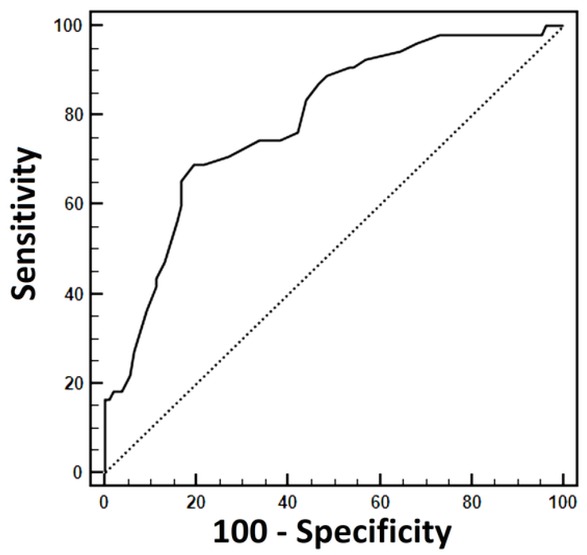
Fig. 1
Receiver Operating Characteristic plot of the emotional exhaustion score of the MBI vs presence of post-traumatic stress disorder; with a cut-off of 24 in this scale, sensitivity was 69%, and specificity was 80%.