
Introduction
Nasopharyngeal carcinoma (NPC) constitutes a distinct subset of head and neck malignancies, defined by unique epidemiological patterns, biological characteristics, and therapeutic responses (1). Unlike other squamous cell carcinomas of the upper aerodigestive tract, NPC demonstrates a strong predilection for certain geographic regions and populations (2), and is frequently associated with viral oncogenesis, environmental exposures, and genetic susceptibility (2,3). The anatomical location of the tumor within the nasopharynx, its proximity to critical neurovascular structures, and its early tendency for nodal spread collectively complicate its management paradigm (3).
Over the past decade, substantial advances in RT delivery, imaging, and systemic therapy have transformed the management of NPC (4). Intensity-modulated radiation therapy (IMRT) (5) and volumetric modulated arc therapy(VMAT) have improved dose conformity while reducing toxicity. Induction and concurrent chemotherapy have become standard components of treatment for locally advanced disease, enhancing radiosensitization and systemic control (6,7). Despite these advances, recurrence and distant metastasis remain major challenges, supporting continued evaluation of prognostic determinants (5,7).
This study reports a decade of experience from a dedicated cancer institution in a lower-middle-income country (LMIC), evaluating patients with NPC treated with definitive RT between 2013 and 2023. The analysis focused on overall survival (OS), recurrence-free survival (RFS), patterns of failure, and clinical and treatment-related prognostic factors to identify determinants of survival and areas requiring further optimization.
Materials and Methods
Study Design
This retrospective cohort study included 431 patients diagnosed with NPC over a 10-year period (2013–2023) at Shaukat Khanum Memorial Cancer Hospital and Research Centre. The Institutional Review Board granted ethical exemption for this study (Reference No. EX-04-02-26-09) and waived informed consent due to the retrospective design.
Demographic details, clinical, treatment, and outcome variables were extracted from institutional databases. Disease staging was performed according to the standard staging systems in use at the time of treatment.
Patient Population
Patients with histologically confirmed NPC who completed definitive treatment and had available follow-up data were included in the study. All patients received definitive radiotherapy, with or without chemotherapy.
Treatment Protocol
RT was delivered using either conventional three-dimensional conformal radiotherapy (3DCRT) or intensity-modulated techniques, including IMRT or VMAT, according to treatment availability. Prescribed RT doses were documented and categorized, with 65 Gy used as the threshold for analysis. Chemotherapy was administered in the induction setting using cisplatin 75 mg/m2 and gemcitabine 1000 mg/m2 on days 1 and 8 for 2–3 cycles, followed by concurrent cisplatin 75–100 mg/ m2 on days 1 and 22. These treatment variables were evaluated in univariate and multivariate analyses. As shown in Table 1, 95.6% of patients received induction chemotherapy. Earlier in the study period, a small proportion of patients received adjuvant chemotherapy, reflecting historical practice based on prior evidence. Patients who developed recurrent disease were offered palliative chemotherapy when clinically indicated; commonly used regimens included paclitaxel, methotrexate, or capecitabine.
Follow-Up
Treatment response was assessed after therapy using clinical examination, including fiber-optic laryngoscopy, and imaging. Most patients underwent MRI at the first follow-up in accordance with institutional protocol. When MRI was contraindicated, CT imaging was performed instead. Response was classified as complete or non-complete, including partial response, stable disease, or progressive disease. Patients were followed regularly in accordance with institutional protocols. Survival status was obtained from hospital records and supplemented by telephone interviews with patients or next of kin when required. Disease recurrence was documented and categorized as local or distant. Survival status and recurrence outcomes were recorded at last follow-up.
Outcome Measures
The primary endpoints were OS and RFS. OS was defined as the time from diagnosis to death from any cause or last follow-up. RFS was defined as the time from completion of primary treatment to the first documented recurrence or last follow-up.
Statistical Analysis
Data were entered and analyzed using IBM SPSS Statistics (Version 27.0), Microsoft Excel, and R Statistical Software. Continuous variables were assessed for normality using the Shapiro-Wilk test. Normally distributed data are presented as mean ± standard deviation (SD), whereas non-normally distributed data are reported as median with interquartile range, as appropriate. Categorical variables are presented as frequencies and percentages.
For comparisons between groups, including survivors and non-survivors, continuous variables were analyzed using the independent-samples t-test for normally distributed data and the Mann-Whitney U test for non-normally distributed data. Categorical variables were compared using the chi-square test or Fisher’s exact test, as appropriate.
OS and RFS were estimated using the Kaplan-Meier method. Differences between survival curves were assessed using the log-rank test.
Univariate and multivariate analyses (UVA and MVA) were performed using Cox proportional hazards regression to identify predictors of OS and RFS. Baseline clinicopathological variables were first assessed using univariate Cox regression. All variables were then entered simultaneously into the multivariable Cox regression model using the forced-entry method, regardless of univariate significance.
Hazard ratios (HRs) with 95% confidence intervals (CIs) were reported for both univariate and multivariate analyses. The proportional hazards assumption was evaluated using Schoenfeld residuals and the Cox.zph test. No significant violation of the proportional hazards assumption was observed for any covariate. Multicollinearity assessment using generalized variance inflation factors (GVIF) demonstrated no significant multicollinearity among covariates.
Missing data were handled using complete-case analysis, with only patients having complete baseline and outcome data included in the analysis.
Five-year, 7-year, and 10-year OS and RFS rates were calculated using the Kaplan-Meier method, with corresponding 95% confidence intervals.
A p-value ≤0.05 was considered significant.
Results
Among 431 patients, 364 (84.5%) were alive, and 67 (15.5%) had died at the last follow-up. Survival status was not significantly associated with age (p=0.542), sex (p=0.776), clinical stage according to the AJCC 8th edition (p=0.107), or nodal stage (p=0.191).
Regarding treatment characteristics, RT technique (p=0.481), chemotherapy setting (p=0.190), and RT dose (p=0.095) were not significantly associated with survival status. Concurrent chemotherapy was more common among survivors than non-survivors (92.3% vs. 82.1%; p=0.019). Complete response was also more frequent among survivors than non-survivors (73.9% vs. 56.7%; p<0.008). Recurrence was significantly associated with death (p<0.001), and patients who required palliative chemotherapy were more likely to be in the deceased group (62.0% vs. 36.6%; p=0.003) (Table 1).
Table 1.
Clinicopathological characteristics and treatment outcomes according to survival status in Nasopharyngeal Carcinoma.
| Characteristics | Total n=431 | Alive 364(84.5%) | Dead 67(15.5%) | p-value |
|---|---|---|---|---|
| Patient Characteristics | ||||
| Age (Median)@ | 48 (16–94) | 48 (16–94) | 45 (19–71) | 0.542 |
| Age Groups | ||||
| <40 Years | 148 (34.3) | 126 (34.6) | 22 (32.8) | 0.889 |
| ≥40 Years | 283 (65.7) | 238 (65.4) | 45 (67.2) | |
| Gender | ||||
| Female | 139 (32.3) | 119 (32.7) | 20 (29.9) | 0.776 |
| Male | 292 (67.7) | 245 (67.3) | 47 (70.1) | |
| Stage Group | ||||
| Stage I | 4 (0.9) | 3 (0.8) | 1 (1.5) | 0.107 |
| Stage II | 35 (8.1) | 33 (9.1) | 2 (3.0) | |
| Stage III | 101 (23.4) | 90 (24.7) | 11 (16.4) | |
| Stage IV | 291 (67.5) | 238 (65.4) | 53 (79.1) | |
| Nodal Stage | ||||
| N0 | 40 (9.3) | 32 (8.8) | 8 (11.9) | 0.195 |
| N1 | 71 (16.5) | 61 (16.8) | 10 (14.9) | |
| N2 | 179 (41.5) | 158 (43.4) | 21 (31.3) | |
| N3 | 141 (32.7) | 113 (31.0) | 28 (41.8) | |
| Treatment Variables | ||||
| Planning Technique | ||||
| 3DCRT/Conventional | 143 (33.2) | 118 (32.4) | 25 (37.3) | 0.481 |
| IMRT/Rapid Arc | 288 (66.8) | 246 (67.6) | 42 (62.7) | |
| Radiotherapy Dose | ||||
| ≥65 Gy | 412 (95.6) | 351 (96.4) | 61 (91.0) | 0.095 |
| <65 Gy | 19 (4.4) | 13 (3.6) | 6 (9.0) | |
| Chemotherapy Setting | ||||
| Induction | 412 (95.6) | 349 (95.9) | 63 (94.0) | 0.191 |
| Adjuvant | 8 (1.9) | 5 (1.4) | 3 (4.5) | |
| No chemotherapy | 11 (2.6) | 10 (2.7) | 1 (1.5) | |
| Concurrent Chemotherapy with RT | ||||
| Yes | 391 (90.7) | 336 (92.3) | 55 (82.1) | 0.019* |
| No | 40 (9.3) | 28 (7.7) | 12 (17.9) | |
| Outcomes | ||||
| Treatment Response | ||||
| Complete | 307 (71.2) | 269 (73.9) | 38 (56.7) | <0.008** |
| Other (partial/stable/progression) | 124 (28.8) | 95 (26.1) | 29 (43.3) | |
| Recurrence | ||||
| Yes | 143 (33.2) | 90 (24.7) | 53 (79.1) | <0.001** |
| No | 288 (66.8) | 274 (75.3) | 14 (20.9) | |
| Site of Recurrence (n=143) | ||||
| Local | 70 (49.0) | 45 (50.0) | 25 (47.2) | 0.863 |
| Distant | 73 (51.0) | 45 (50.0) | 28 (52.8) | |
| Palliative Chemotherapy (n=184) | ||||
| Yes | 80 (43.5) | 49 (36.6) | 31 (62.0) | 0.003** |
| No | 104 (56.5) | 85 (63.4) | 19 (38.0) | |
| Recurrence Free Survival | ||||
| > 5 years | 125 (29) | 122 (33.5) | 03 (4) | <0.001** |
| ≤ 5 years | 306 (71) | 242 (66.5) | 64 (96) | |
| Survival | ||||
| > 5 years | 184 (42.7) | 175 (48) | 09 (13) | <0.001** |
| ≤ 5 years | 247 (57.3) | 189 (52) | 58 (87) |
Prognostic Factors for Overall Survival (OS)
On UVA, concurrent chemotherapy and advanced clinical stage were significantly associated with OS. Concurrent chemotherapy was associated with improved OS (HR=0.495, 95% CI: 0.258–0.948; p=0.034) and remained independently associated with improved OS on MVA (HR=0.411, 95% CI: 0.189–0.891; p=0.024). Advanced clinical stage was independently associated with poorer OS on both UVA and MVA (HR=6.984, 95% CI: 1.541–31.657; p=0.021) (Table 2).
Table 2.
Univariate and Multivariate Analysis of Prognostic Factors for Overall Survival in Nasopharyngeal Carcinoma.
| Factors | Univariate | Multivariate | |||
|---|---|---|---|---|---|
| HR [95% CI] | P-value | HR [95% CI] | P-value | ||
| Gender | Female | Ref | - | 1.32(0.761–2.292) | 0.324 |
| Male | 1.176(0.695–1.989) | 0.545 | |||
| Age (Years) | Age <40 | Ref | - | 1.206(0.698–2.084) | 0.503 |
| Age ≥ 40 | 1.116(0.668–1.861) | 0.676 | |||
| Chemotherapy concurrent | Yes | 0.495(0.258–0.948) | 0.034* | 0.411(0.189–0.891) | 0.024* |
| No | Ref | - | |||
| Chemotherapy setting | Induction | Ref | - | 1 | |
| Adjuvant | 2.364 [0.740–7.556] | 0.147 | 1.196(0.323–4.431) | 0.789 | |
| No Chemo | 0.501(0.069–3.169) | 0.493 | 0.329(0.035–3.104) | 0.331 | |
| Stage | I, II | Ref | - | 6.984(1.541–31.657) | 0.021* |
| III, IV | 4.627 [1.129–18.961] | 0.033* | |||
| RT Dose | <65 Gy | 1.440(0.570–3.635) | 0.440 | 2.134(0.744–6.118) | 0.158 |
| ≥ 65 Gy | Ref | - | |||
| Planning Technique | 3D Conformal + Conventional | Ref | - | - | - |
| IMRT | 0.885(0.121–6.482) | 0.905 | 0.786(0.105–5.870) | 0.815 | |
| VMAT | 0.330(0.041–2.642) | 0.296 | 0.316(0.038–6.118) | 0.284 | |
Prognostic Factors for Recurrence-Free Survival (RFS)
RT dose <65 Gy was significantly associated with poorer RFS on UVA (HR=2.731, 95% CI: 1.464–5.027; p=0.002). Advanced-stage disease showed a trend toward poorer RFS but did not reach statistical significance (p=0.061). On MVA, age ≥40 years independently predicted poorer RFS (HR=1.554, 95% CI: 1.065–2.267; p=0.022). RT dose <65 Gy was also independently associated with poorer RFS (HR=4.372, 95% CI: 2.288–8.352; p<0.001). VMAT was associated with improved RFS (HR=0.279, 95% CI: 0.083–0.935; p=0.039) (Table 3).
Table 3.
Univariate and Multivariate Analysis of Prognostic Factors for Recurrence-free Survival in Nasopharyngeal Carcinoma
| Factors | Univariate | Multivariate | |||
|---|---|---|---|---|---|
| HR [95% CI] | P-value | HR [95% CI] | P-value | ||
| Gender | Female | Ref | - | 1.175(0.812–1.701) | 0.392 |
| Male | 1.172(0.821–1.672) | 0.382 | |||
| Age (Years) | Age <40 | Ref | - | 1.554(1.065–2.267) | 0.022* |
| Age ≥ 40 | 1.346(0.943–1.922) | 0.102 | |||
| Chemotherapy concurrent | Yes | 0.870(0.492–1.540) | 0.663 | 0.553(0.296–1.034) | 0.063 |
| No | Ref | - | |||
| Chemotherapy | Induction | Ref | - | - | - |
| Adjuvant | 0.383(0.054–2.740) | 0.339 | 0.206(0.027–1.565) | 0.127 | |
| No Chemo | 0.209(0.029–1.496) | 0.119 | 0.104(0.013–0.831) | 0.033* | |
| Stage | I, II | Ref | 2.047(1.027–4.081) | 0.42 | |
| III, IV | 1.905(0.970–3.744) | 0.061 | |||
| RT Dose | <65 Gy | 2.713(1.464–5.027) | 0.002** | 4.372(2.288–8.352) | <0.001** |
| ≥ 65 Gy | Ref | ||||
| Planning Technique | 3D Conformal +Conventional | Ref | - | - | - |
| IMRT | 0.522(0.163–1.665) | 0.272 | 0.472(0.147–1.522) | 0.209 | |
| VMAT | 0.322(0.097–1.067) | 0.064 | 0.279(0.083–0.935) | 0.039* | |
Median follow-up, calculated using the reverse Kaplan-Meier method, was 61 months for OS and 59 months for RFS (Table 5). Estimated OS rates at 5, 7, and 10 years were 83.3%, 81.3%, and 71.2%, respectively; corresponding RFS rates were 63.2%, 55.6%, and 55.6% (Table 4).
Table 5.
Restricted Mean Survival Time and Median Follow-Up in Nasopharyngeal Carcinoma.
| Statistics | Overall (months) | Recurrence Free (Months) |
|---|---|---|
| Restricted Mean Survival Time | 176.43±11.51 (153.88–198.98) | 91.08±3.40 (84.42–97.74) |
| Median1 Follow-up | 61.0 (57.55–64.45) | 59.00 (56.56–61.44) |
Table 4.
Long-Term Overall and Recurrence-Free Survival Rates in Nasopharyngeal Carcinoma.
| Time Point | Survival Rate (%) (95% C.I) | |
|---|---|---|
| Overall | Recurrence Free | |
| 5- Year | 83.3 (79.3–87.4) | 63.2 (58.4–68.5) |
| 7-Year | 81.3 (76.9–86.0) | 55.6 (49.2–62.7) |
| 10-Year | 71.2 (61.7–82.2) | 55.6 (49.2–62.7) |
Kaplan-Meier analysis demonstrated poorer OS and RFS among patients with advanced-stage disease, supporting its adverse prognostic impact in NPC (Figures 1 and 2).
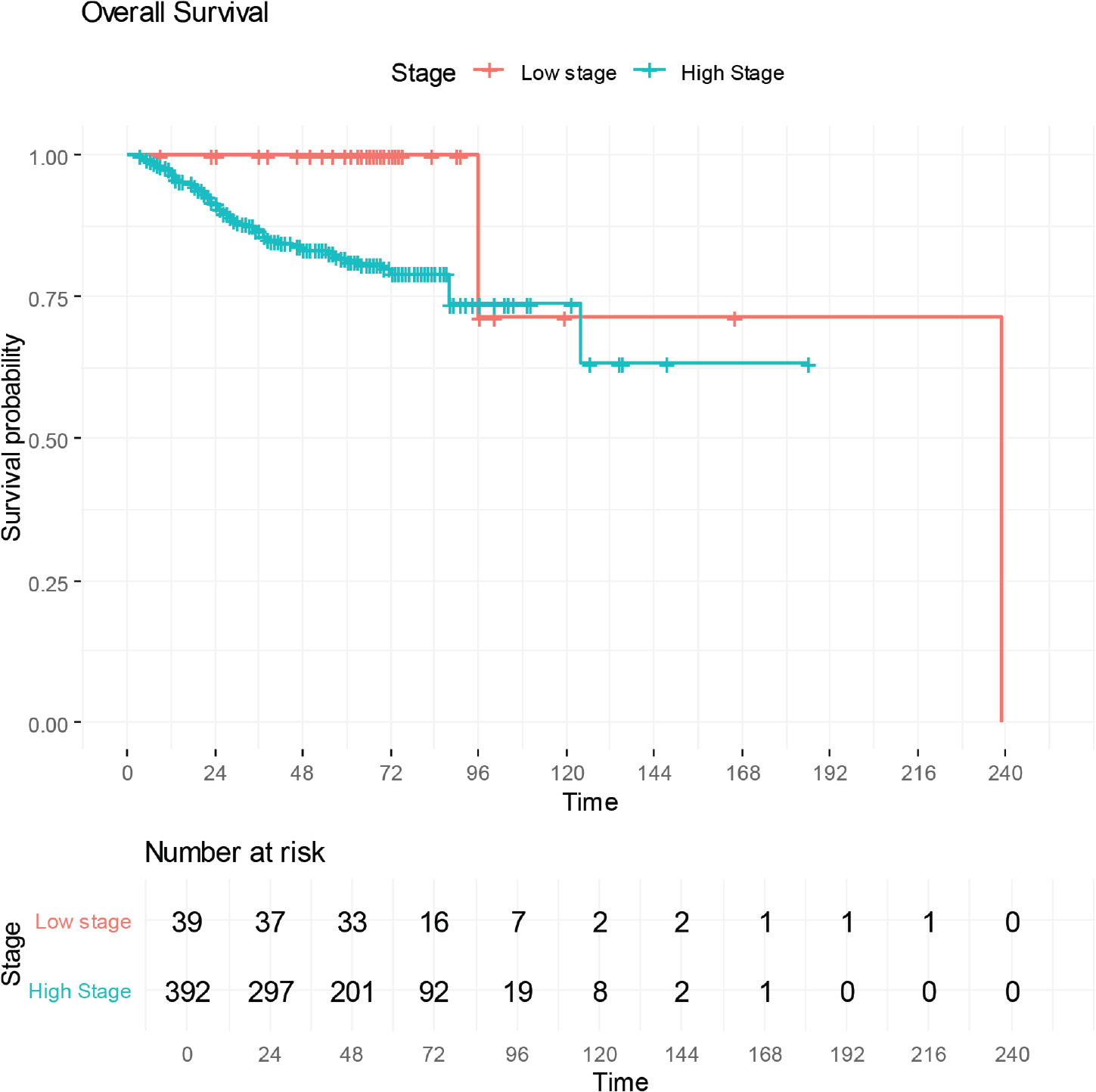
Figure 1.
Kaplan-Meier curve of overall survival according to clinical stage in nasopharyngeal carcinoma.
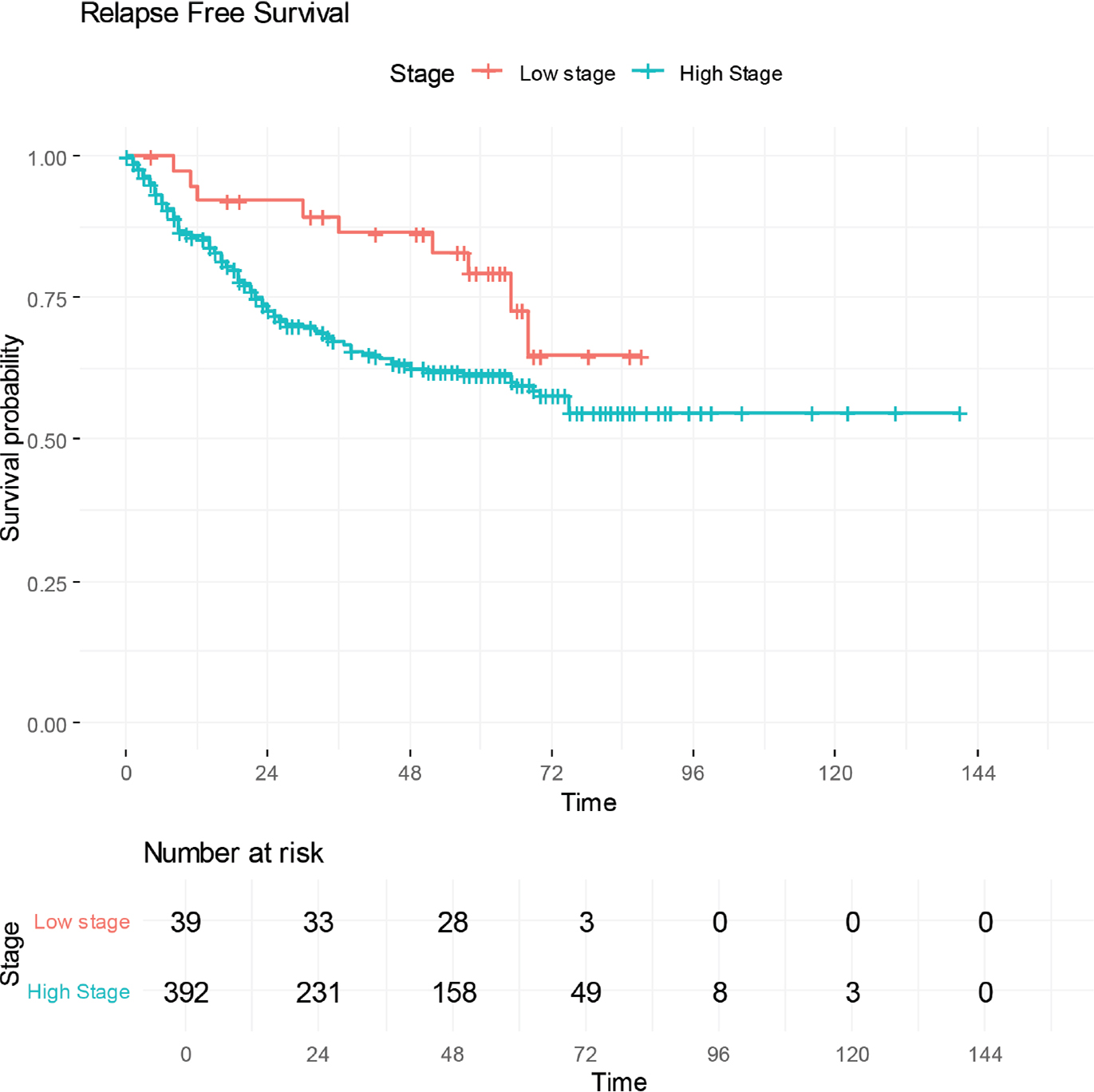
Figure 2.
Kaplan-Meier curve of recurrence-free survival according to clinical stage in nasopharyngeal carcinoma.
Discussion
In this large retrospective cohort of patients with NPC treated at a dedicated cancer institution in a lower-middle-income country (LMIC), contemporary multimodality therapy was associated with favorable long-term outcomes despite the predominance of advanced-stage disease. The estimated 5-, 7-, and 10-year OS rates were 83.3%, 81.3%, and 71.2%, respectively, while the corresponding RFS rates were 63.2%, 55.6%, and 55.6% (Table 4). These results compare favorably with reports from both endemic and non-endemic regions and support the routine integration of RT with systemic chemotherapy in contemporary NPC management (1,8,9).
Series incorporating chemotherapy, particularly for locoregionally advanced disease, consistently report improved long-term disease control and survival, supporting the continued role of systemic therapy in this population (8,9). In our study, concurrent chemotherapy was independently associated with improved OS on univariate (p=0.034) and multivariate analysis(p=0.024), consistent with established clinical trial evidence (6,7).
The role of induction chemotherapy in NPC has been established by randomized phase III evidence. The landmark trial by Zhang et al. demonstrated that gemcitabine-cisplatin induction chemotherapy followed by concurrent chemoradiotherapy significantly improved RFS and OS compared with concurrent chemoradiotherapy alone in patients with locoregionally advanced disease (11). At a median follow-up of approximately 43 months, induction chemotherapy reduced the risk of recurrence or death by nearly 50%, with a corresponding improvement in OS. These findings have influenced international guideline recommendations and clinical practice (11,12).
In our study, induction chemotherapy was administered to most patients (95.6%), reflecting broad real-world adoption of this sequence. Although induction chemotherapy did not independently predict outcomes in the MVA (p=0.789; Table 2), its near-uniform use limits statistical discrimination between groups. The observed RFS rates are broadly consistent with those reported in the trial and subsequent validation studies, suggesting that outcomes achieved in controlled trial settings may be reproducible in routine clinical practice (11,12). Disease recurrence was strongly associated with death in our analysis (p<0.001). Failure patterns were distributed roughly equally between local and distant sites, reflecting the modern shift toward distant relapse as locoregional control has improved (1,5). Survival status did not differ significantly between local and distant recurrence (p=0.863), highlighting that recurrence of any type remains a major barrier to long-term survival. Complete treatment response was also more frequent among survivors, reinforcing the prognostic importance of achieving initial complete remission.
Advanced clinical stage (III–IV) was an independent predictor of inferior OS on MVA, conferring a nearly seven-fold increased risk of death (HR 6.984, 95% CI: 1.541–31.657; p=0.021; Table 2) (1,3). Kaplan-Meier curves confirmed poorer survival trajectories among patients with advanced-stage disease (Figures 1 and 2) (8,9,10). Although the advanced stage showed a trend toward poorer RFS on UVA (p=0.061; Table 3), it did not remain independently significant on MVA (p=0.42; Table 3). Instead, age ≥40 years independently predicted poorer RFS (HR 1.554, 95% CI: 1.065–2.267; p=0.022; Table 3), suggesting that older patients may require closer surveillance for recurrence.
Radiotherapy delivery metrics were important for durable disease control. RT dose <65 Gy was independently associated with a more than four-fold increased risk of recurrence on multivariate analysis (p<0.001), supporting the importance of definitive-dose RT when clinically feasible. VMAT was associated with improved RFS (p=0.039), although this should be interpreted cautiously because treatment technique may reflect temporal changes in practice, patient selection, and unmeasured confounding. A higher proportion of patients who died required palliative chemotherapy during their disease course compared with survivors (62.0% vs. 36.6%; p=0.003), underscoring the clinical burden of recurrent disease requiring salvage systemic therapy.
This study has several limitations. Its retrospective, single-institution design introduces potential selection bias, and treatment heterogeneity across the study period may have influenced outcomes. Changes in RT delivery and systemic therapy protocols over time also introduce potential confounding that cannot be fully addressed in a retrospective analysis. Molecular risk stratification, including Epstein-Barr virus DNA quantification, was not available. Descriptive survival categories in baseline tables should therefore be interpreted cautiously and should not substitute for time-to-event analyses. Nevertheless, the large sample size, mature follow-up, and multivariate modeling provide meaningful real-world evidence for contemporary NPC management.
The discrepancy between cross-tabulation and Cox regression findings reflects methodological differences: cross-tabulation does not account for time-to-event data or censoring, whereas Cox regression provides hazard-based estimates adjusted for follow-up time.
Despite these limitations, this study is strengthened by its large sample size, mature follow-up, and comprehensive survival analyses. The findings support continued integration of induction chemotherapy, concurrent chemoradiotherapy, and modern RT techniques for durable long-term disease control, while highlighting the need to reduce distant relapse through optimized systemic strategies.
In conclusion, this institutional experience shows favorable long-term survival among patients with NPC treated with contemporary multimodality therapy. Concurrent chemotherapy and advanced clinical stage were independent predictors of OS, whereas older age and RT dose <65 Gy were associated with poorer RFS. Recurrence remains a key challenge, underscoring the need for molecular risk stratification, optimized systemic therapy, and risk-adapted follow-up. Future studies incorporating molecular markers and novel systemic agents may help refine treatment selection and improve outcomes for high-risk patients.
Notes
[16] Author Contributions
Conceived and designed the analysis: MUDK, AH, SMR, ZA, AR.
Collected the data: SMR, AH, AA, SL, HS.
Contributed data or analysis tools: SMR, AH, AA, SL, HS, AK.
Performed the analysis: AK, MUDK.
Writing the paper: AH, SMR, MUDK, SL, AA, HS, AK, AR, ZA.