
Introduction
GLOBOCAN's 2022 report identified Pancreatic Ductal Adenocarcinoma (PDAC) as the twelfth most frequently diagnosed cancer, with 510,566 new cases worldwide. However, PDAC is considered to be the cause of 467,005 deaths per year, thus ranking it sixth in cancer related deaths [1]. The PDAC has a very low (20–25%) one-year survival rate, which reduces further to a global low value (10%) 5-years survival rate [2]. The incidence of PDAC is marginally higher in males (5.5 per 100,000, with 269,583 cases) compared to females (4.0 per 100,000, with 240,983 cases) [1] The incidence rates of this disease mirror the mortality rates, and it is predicted to become the second biggest cancer killer within the next decade [3]. Unfortunately, there is no effective national screening program for healthy adults to detect pancreatic cancer early [4]. Survival is better for those in whom the cancer is localized to the pancreas only, because at present, surgery is the only potential chance of a cure. Unfortunately, around 80–85% of patient's cohort has a very poor prognosis due to late presentation, advanced disease locally or metastatic disease [5]. Several randomized controlled trials and meta-analyses have provided enough evidence that systemic chemotherapy can alleviate symptoms and increase the overall survival in comparison to best supportive care.
Pancreatic cancer is currently considered a systemic disease. Most patients present either with metastatic disease or the majority of patients presenting with allegedly localised disease suitable for surgical resection relapse within 1 year of surgery. Gemcitabine was known as the standard of care treatment for patients with the diagnosis of advanced pancreatic cancer, until practice changing trials showed clinical benefit of combination therapy with FOLFIRINOX (Oxaliplatin, Irinotecan, Leucovorin, 5FU) and gemcitabine/nab-paclitaxel in 2011 and 2013 respectively. More than a decade later, the treatment paradigm for patients with advanced pancreatic cancer has not drastically changed but importantly, we have learned about the activity of the two approved regimens in a “real-world” setting and are witnessing some early successes in targeted treatments and precision medicine efforts for this deadly disease.
With so many trials published over the years, it is necessary that we can have a readily available succinct summary of the timelines and the impact each trial has had on the patients of pancreatic cancer standard of care. In this article, we will not only review the current practices but also look at the historical randomised controlled trials and give insights obtained from real-world practices. We will discuss novel biomarker development as well as give future perspectives on pancreatic cancer treatment. This summary will serve as a reference point for clinicians who are interested in the historical aspects of oncological treatment in pancreatic cancer.
Historic perspective of systemic treatment for advanced pancreatic cancer
Patients with metastatic pancreatic cancer have traditionally been challenged with a bleak prognosis, though the outcomes over the past decade have improved with the development of various advances in diagnosis and treatment modalities (Figure 1). It was only Gemcitabine (a nucleoside inhibitor) that demonstrated improvement in survival in comparison to best supportive care since the 1990s. Weinerman and MacCormick in 1994 and then Carmichael et al. in 1996 conducted randomised control studies in advanced pancreatic cancer patients and discovered improvement in overall survival (OS) in the chemotherapy group compared to the best supportive care (BSC) group [6,7]. The median survival was modestly increased by 4 and 6 months for the treatment group against 3 and 2.5 months for BSC, respectively. Another trial in 1996 by Rothenberg demonstrated activity in respect to clinical and survival improvements using Gemcitabine (GEM) in metastatic pancreatic cancer [8]. This was followed by a phase III trial in 1997 by Burris, who compared GEM vs 5-FluroUracil (5-FU) alone. This trial reported better alleviation of disease related symptoms and modest survival improvement with Gemcitabine monotherapy over treatment with 5FU [9].
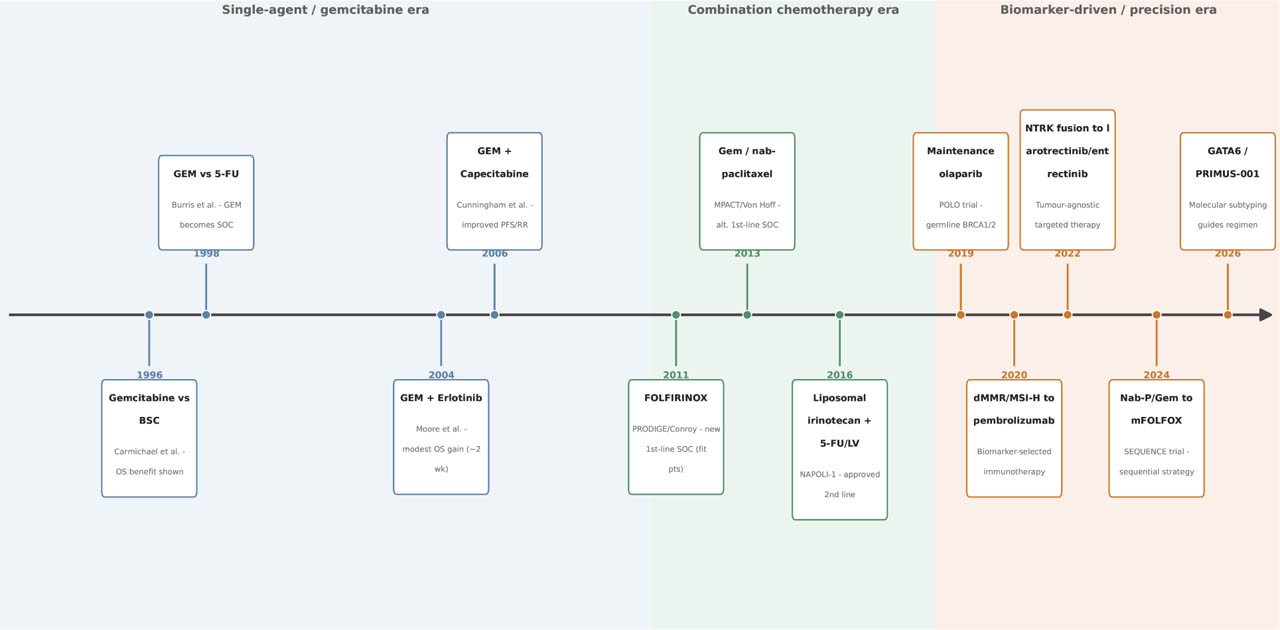
Figure 1.
Evolution of treatment for metastatic pancreatic adenocarcinoma over time.
In the determination to improve survival in patients with metastatic pancreatic cancer, several trials studied the effects of 5-FU combined with Gemcitabine. Combination of Gemcitabine with 5-FU was used by numerous phase II clinical trials with variable orders and administration schedules. These trials using different combination of 5-FU and Gemcitabine did not show significant outcome improvements in terms of progression free survival (PFS), response rates (RR) and overall survival (OS) in the setting of metastatic PDAC [10]. Based on the above, GEM continued to stay as the main oncological treatment option for advanced pancreatic cancer patients till 2010.
A randomized phase III trial undertaken by Cunningham et al, reported that the addition of Capecitabine to Gemcitabine in advanced pancreatic cancer, significantly improved PFS and RR. There was also a tendency toward improvement in OS though this was not found to be significant [11]. Around the same time, another phase III trial combined Erlotinib (EGFR inhibitor) with Gemcitabine and compared the outcomes to Gemcitabine as monotherapy [12]. This trial revealed survival outcome improvement which is statistically significant for patients with metastatic pancreatic cancer when treated with a combination of Erlotinib and Gemcitabine. However, when looked closely at the results, the actual clinical benefit in this study was only a 2 weeks' survival benefit, putting into question the real-world benefits of this combination treatment.
A phase II study evaluated toxicity and response rate of FOLFIRINOX (5-FU, leucovorin, irinotecan and oxaliplatin) on 46 patients in locally advanced pancreatic adenocarcinoma. This cohort also included 35 patients with metastatic disease. This trial showed a promising response rate, a good safety profile, and an improvement in Quality of Life (QoL). This regimen achieved 8.2 months of median time to progression (95% CI, 5.3 to 11.6 months), and 10.2 months of median overall survival (95% CI, 8.1 to 14.4 months) [13]. Following the results of this study, a new standard of care was adopted based on the French PRODIGE Intergroup phase III trial involving 342 patients, in which a single agent, Gemcitabine, was compared to the FOLFIRINOX regimen [14]. According to this trial, the FOLFIRINOX arm's previously unheard-of 4.3-month gain in median overall survival over the gemcitabine arm represented a substantial improvement (11.1 vs. 6.8 months' hazard ratio 0.57; 95% CI 0.45 to 0.73; P < 0.001). The median PFS was 6.4 months as opposed to 3.3 months with FOLFIRINOX (hazard ratio, 0.47; 95% CI, 0.37 to 0.59; P < 0.001). Likewise, the FOLFIRINOX group's objective RR was 31.6%, while the Gemcitabine groups was 9.4% (P < 0.001). Nonetheless, the FOLFIRINOX regimen was linked to noticeably greater rates of grade 2 alopecia, thrombocytopenia, sensory neuropathy, diarrhea, and grade 3 or 4 neutropenia. On the other hand, grade 3 or 4 increased alanine aminotransferase levels were also substantially more common when Gemcitabine was used. It should be noted that patients older than 75 years and those with an ECOG PS ≥2 were not included in this trial. This meant that the regimen was toxic and could only be tolerated by exceptionally fit patients.
To alleviate the side effects of this multi-drug regimen (FOLFIRINOX) and increase its tolerance, several institutions have used modified FOLFIRINOX “(infusion of 5-FU over 46 hours at a rate of 2400 mg / m2, no bolus 5-FU, oxaliplatin intravenous at 85 mg / m2, irinotecan at 150 mg / m2)”. A meta-analysis by Tong Hongxuan investigated the outcomes with modified FOLFIRINOX in patients with chemotherapy naïve metastatic pancreatic cancer. They concluded in their study, that the modified FOLFIRINOX chemotherapy regimen could offer not only a survival advantage by increasing the PFS and OS but also increase tolerance by bringing about fewer adverse effects [15].
An alternate treatment was approved as first line for metastatic pancreatic cancer in 2013 when a combination of Nab Paclitaxel and Gemcitabine was shown to be superior to single agent Gemcitabine in a phase III clinical trial. Von Hoff et al. found that median OS with Gemcitabine/nab-paclitaxel was better by 1.8 months than the Gemcitabine-alone group (HR,0.72; 95% CI,0.62 to 0.83; p<0.001) [16]. According to an independent review, there was 23% response rate in the combination-group compared with 7% in monotherapy group. However, more adverse events were reported in combination chemotherapy arm including neutropenia, fatigue and neuropathy. These studies have demonstrated that while combination regimen groups typically have better results, there is a higher risk of side events. This prompted specialists to examine “real world” results when these regimens are applied outside of a meticulously regulated research trial setting.
Trial data versus “real world” data of 1st line treatments
In the last decade, numerous “real-world” retrospective studies have been published comparing FOLFIRINOX and Gem + nab-pacli combinations in the presence of metastatic pancreatic cancer. Majority of these studies focused on a specific region of the world or hospital experience and were usually small cohort studies with biases associated with such studies. A few of these real-world studies lacked the crucial information needed to precisely compare outcomes between patient groups. Although most studies have shown a survival advantage with FOLFIRINOX compared with gemcitabine plus nab-paclitaxel, some studies have shown similar efficacy between both the regimens. Information regarding toxicity levels varies amongst the studies with some trials reporting no major differences in treatment related adverse effects and others attributing more complications to either FOLFIRINOX or Gemcitabine + Nab-Paclitaxel group.
A survey published in ESMO open showed that even though the overall treatments offered for advanced pancreatic cancer, lined up with the current ESMO guidelines, there is still a degree of variation between the individual European countries [17]. These differences in the treatment choices offered in various countries, were influenced by factors such as physician preference, patient characteristics, drug availability and prior treatment. However, when the study looked at later-line treatment regimens, it revealed the absence of approved and recommended treatment regimens for patients who progress after first-line treatment. This showed the heterogeneity of practices in “real-life(world)” environments when it came to patients in whom the first line treatment modalities became ineffective. Treatment decision in advanced pancreatic cancer must be taken in accordance with patient's performance status, co-morbidities, patients and physicians' choice and reimbursement. Later-line therapy of pancreatic cancer needs to be considered in terms of risk vs benefit for the patient.
Second line treatment options
After the failure of 1st line therapies, the picture becomes muddled as the data is not very robust for these patients. Later-line therapy of pancreatic cancer needs to be considered in terms of risk vs benefit for the patient. The phase III NAPOLI-1 trial evaluated the efficacy of liposomal irinotecan in combination with 5FU and LV in patients with metastatic pancreatic cancer or locally advanced disease who were refractory to gemcitabine-based therapy [18]. They randomization was done and 417 patients were weekly administered FU with LV (the control arm), for four out of every six weeks, every three weeks' administration of liposomal irinotecan, or liposomal irinotecan prior to LV and FU every second week. Patients who received combination therapy had better overall survival and PFS (median 6.1 months versus 4.2 months and 3.1 month versus 1.5 months respectively). The objective response rate was 16:1 percent. However, Liposomal irinotecan monotherapy showed lower efficacy compared with the control arm, and showed greater toxicity than with combination regimen, indicating that its use should be limited to combination therapy. As a result, combination of liposomal irinotecan with FU and LV has been approved, for metastatic pancreatic cancer progression even after gemcitabine-based regimen.
Maintenance treatment
In the challenge to improve survival in metastatic pancreatic cancer, maintenance therapies are designed to improve tumour control with minimal toxicity. In this context, Marina et al. investigated the role of fluorouracil-based maintenance therapy in the patients treated with FOLFIRINOX as a first line treatment [19]. They concluded that maintenance therapy with 5-fluorouracil based chemotherapy is feasible and some patients with advanced metastatic pancreatic cancer may experience prolonged disease control with it. Proper patient selection is critical to maximize treatment benefits and mitigate severe toxicities associated with chemotherapy or disease progression.
There is evolving data for the role of PARP inhibitors (poly adenosine diphosphate-ribose polymerase), benefits in BRCA-associated ovarian and breast cancers [20]. A small subgroup of metastatic pancreatic cancer carries pathogenic germline BRCA1 or BRCA2 mutations [21]. In metastatic pancreatic cancer, there is no proven advantage to administer a PARP inhibitor concomitant with Systemic Chemotherapy. However, there is evidence of improved PFS in germline BRCA and PALB2 pathogenic variant with maintenance therapy with a PARP inhibitor after an initial treatment with platinum-containing chemotherapy.
POLO trial investigated maintenance treatment in metastatic pancreatic cancer [22]. This trial evaluated 154 patients with stable metastatic pancreatic cancer after receiving at least 16 weeks of platinum containing chemotherapy and had been diagnosed with germline BRCA1 or BRCA 2 mutation. The patients were randomized to receive either Olaparib or Placebo. The median PFS was significantly high (7.4 vs 3.8 months) in Olaparib arm compared to the placebo arm.
Similarly, RUCAPANC, a phase 2 trial in pancreatic cancer patients with metastatic disease, investigated the safety as well as efficacy of rucaparib in known deleterious BRCA mutation patients [23]. This trial demonstrated clinical improvement and acceptable safety profile with Rucaparib in BRCA mutation metastatic pancreatic cancer patients.
How to sequence treatment?
The Sequence trial, which is the Sequential treatment with gemcitabine, nab-paclitaxel followed by mFOLFOX) vs Standard Nab/Pacli and Gemcitabine is a new development in metastatic pancreatic cancer [24].”Patients were allocated 1:1 to gemcitabine (1000 mg/m2) on days 1, 8 and 15 plus nabpaclitaxel (125 mg/m2), followed by mFOLFOX-6 (oxaliplatin [85 mg/m2], L-leucovorin [200 mg/m2] or racemic leucovorin [400 mg/m2], 5-fluorouracil bolus [400 mg/m2], and 5-fluorouracil 48-hour continuous infusion [2400 mg/m2]) on day 29 of a 6-week cycle or nab-paclitaxel (125 mg/m2) plus gemcitabine (1000 mg/m2) on days 1, 8 and 15 of a 4-week cycle. The 12-month overall survival rate (OS) was considered as the primary end point. Nab-P/GemmFOLFOX showed manageable safety profile with significantly better clinical activity than the standard nab-P/Gem treatment. As a first-line treatment of metastatic PDAC, this regimen may be considered as a feasible and efficient new option. The caveat being exhaustion of agents for further lines of therapy in case of progression, which almost is inevitable. However further results and reproducible studies on its efficiency and efficacy are warranted.
The main issue with most of these first- and second-line therapies are poor tolerance of the regimens by patients who are already weakened by the disease burden which may not be reflected in the carefully controlled environments of a research study. A prospective clinical cohort study in Germany analyzed real-world data from 1,174 pancreatic cancer patients, focusing on first- and second-line therapies and assessing response rate (RR), progression-free survival (PFS), disease-specific survival (DSS) and overall survival (OS). The study found that three main regimens constituted 89% of first-line treatments: gemcitabine alone (23%), nab-paclitaxel plus gemcitabine (42%), and FOLFIRINOX (24%). Patient characteristics, including age, co-morbidities, and ECOG status, correlated with therapy selection; those receiving gemcitabine were older and had poorer performance status compared to younger patients with better status on FOLFIRINOX. Of 391 second-line treatments noted, nab-paclitaxel plus gemcitabine (29%), FOLFOX (24%), and gemcitabine monotherapy (12%) were most common. Disease control rates for gemcitabine monotherapy were 30%, for nab-paclitaxel plus gemcitabine were 41%, and for FOLFIRINOX were 44%. Median PFS was 4.6 months for gemcitabine, 5.6 months for nab-paclitaxel plus gemcitabine, and 6.3 months for FOLFIRINOX. Six-month OS rates were 58%, 65%, and 80%, respectively. Median DSS was 9.0 months for gemcitabine, 10.6 months for nab-paclitaxel plus gemcitabine, and 11.9 months for FOLFIRINOX, highlighting the significant impact of therapeutic choice on patient outcomes.
Rapid progression of pancreatic cancer patients
The primary challenge in the management of patients with metastatic pancreatic cancer is their rapid functional decline. Many patients are too unwell preventing them from receiving any systemic anti-cancer treatment, let alone treatment within a clinical trial. Of those receiving first-line treatment, only 40–50% are well enough to receive 2nd line therapy which in itself is the strongest prognostic factor [25]. This highlights the importance of good symptom control before and during treatment.
Patients often succumb from the devastating effects of a multifactorial, debilitating muscle-wasting syndrome, known as cachexia. Cachexia is characterized by the involuntary weight loss and skeletal muscle mass and is associated with reduced physical function, decreased tolerance to anti-cancer therapy, a marked reduction in quality of life, poor prognosis and accelerated death [26]. A key factor in the pathophysiology of cancer cachexia is an uncontrolled systemic inflammatory response, which is fuelled by abundant levels of cytokines released by the tumour. Indeed, poor cancer outcomes are predicted by markers of the systemic inflammatory response, including elevated C-reactive protein, hypoalbuminemia (Glasgow Prognostic Score) and a high neutrophil-to-lymphocyte ratio. A randomised, open-label study called the MENAC trial investigated a multimodal intervention (exercise, diet, and anti-inflammatory drugs) for cancer cachexia in patients receiving chemotherapy for advanced lung or pancreatic cancer [27]. It was found that while the intervention stabilised weight in comparison to standard care, it had no discernible effect on muscle mass or physical activity.
Personalising treatment for pancreatic cancer
Above data highlights the need for a more personalised approach of pancreatic cancer treatments. Some patients show better response to FOLFIRINOX, some to gemcitabine/nab-paclitaxel or platinum-containing regimens. Biomarkers for selecting between FOLFIRINOX and gemcitabine/nab-paclitaxel.
Both the FOLFIRINOX and gemcitabine/nab-paclitaxel regimens are good upfront options for patients diagnosed with metastatic pancreatic ductal adenocarcinoma. It may be possible to distinguish the subtypes classical and basal-like pancreatic ductal adenocarcinoma while using GATA6 expression, a predictive marker [28] GATA6 expression may help choose between these two first-line approaches because basal-like PDAC did not respond to fluorouracil-based therapy as well as classical subtypes in the ESPAC-3 and COMPASS trials [29]. Currently ongoing, phase II study of patients with metastatic pancreatic cancer, PRIMUS-001, of FOLFOX-A (FOLFOX and nab-paclitaxel) versus gemcitabine/nab-paclitaxel, is evaluating the role of integration of biomarkers in treatment selection [30].
Other smaller molecular subgroups
PARPi / DNA damaging agents
Germline and somatic mutations in the homologous recombination repair pathway (ATM, BRCA1, BRCA2, or PALB2) are linked to pancreatic ductal cancer [31]. Since homologous recombination deficiency predicts higher sensitivity to platinum treatment and may be therapeutically targetable, the identification of these mutations is clinically relevant.
A phase III trial (POLO) compared maintenance olaparib to a placebo in patients with genetic pathogenic mutations in BRCA1/2 and metastatic pancreatic cancer who had received initial platinum-based therapy. The median overall survival (OS) for patients who did not progress after receiving maintenance placebo and initial platinum-based chemotherapy (the majority of whom received FOLFIRINOX [84 percent]) and remaining received Cisplatin and Gemcitabine was 19 months vs 18 months and PFS was 7.4 versus 3.8 months. [22]. Olaparib is approved by the US Food and Drug Administration (FDA) as the first-line maintenance therapy in patients with germline BRCA gene pathogenic variants who have got a metastatic disease and has not progressed for a minimum of 16 weeks on chemotherapy.
Mismatch repair deficient (dMMR)/microsatellite-instability high (MSI-H)
The frequency of dMMR/MSI-H is uncommon in patients with pancreatic cancer (≤2 percent) [32]. Based on results in treatment-refractory pancreatic cancer, pembrolizumab is recommended as initial therapy instead of chemotherapy for patients with metastatic pancreatic cancer that is dMMR/MSI-H. Although, high-quality data is scarce, combination immunotherapy using nivolumab and ipilimumab is a suitable choice for patients who are medically fit [33].
TRK fusion-positive tumors
In pancreatic cancer, NTRK gene fusions are rare (less than 1%) [34]. Regardless of previous treatment, larotrectinib and entrectinib showed high ORRs (50 and 75 percent, respectively) and durability (median duration of 4 and 13 months response, respectively) among the subset of patients with metastatic pancreatic cancer in phase I/II trials [35]. Larotrectinib and entrectinib both are FDA approved in patients with NTRK gene fusion who progressed despite treatment or lacked satisfactory alternative therapy.
Concluding remarks
Over the past three decades, the systemic treatment of advanced pancreatic ductal adenocarcinoma has progressed from gemcitabine monotherapy to combination regimens — FOLFIRINOX and gemcitabine/nab-paclitaxel — that remain the standard of care. Second-line options including liposomal irinotecan plus 5-FU/LV (following gemcitabine-based therapy) and maintenance olaparib (in germline BRCA1/2-mutated disease) have further expanded the therapeutic armamentarium. The emerging data on sequential regimens and biomarker-driven treatment selection, as seen in the SEQUENCE trial and PRIMUS-001, represent a promising direction for improving outcomes. Limitations of the available evidence must be acknowledged. Much of the real-world data derives from retrospective, single-centre or regionally limited cohorts prone to selection bias and confounding. Predictive biomarkers capable of prospectively guiding first-line chemotherapy selection remain elusive beyond the GATA6/molecular subtype framework. The actionable molecular subgroups — germline BRCA1/2, dMMR/MSI-H, and NTRK fusions — collectively account for fewer than 10% of advanced PDAC cases, leaving the vast majority of patients without a precision medicine option. Furthermore, many pivotal trials enrolled highly selected patients with good performance status, limiting the generalisability of findings to the broader population of patients with advanced PDAC who are too unwell for intensive combination therapy. Looking ahead, the priority must be molecular stratification of patients at diagnosis, enabling biomarker-driven treatment allocation rather than empirical chemotherapy selection. Expanding comprehensive germline and somatic genomic testing, integrating transcriptomic subtypes such as GATA6-defined classical versus basal-like classifications, and developing novel targets within the tumour microenvironment are critical future directions. Prospective registration of real-world outcomes and equitable access to clinical trials in low- and middle-income countries will be essential to ensure that therapeutic advances benefit all patients with this devastating disease.
Acknowledgements
We are grateful to Dr. Zainab Rafiq Department of Surgical Oncology Shaukat khanum Memorial Hospital and Research Centre, for her input in preparation of this manuscript.
Notes
[1] Financial disclosure Financial support and sponsorship
The authors received no financial support for the research, authorship, and/or publication of this article.