
Introduction
Osteosarcoma is the most common malignant bone tumour in children (1). The mainstay of therapy is chemotherapy and surgery. The most commonly used international chemotherapeutic regimen for the treatment of osteosarcoma uses high-dose methotrexate in combination with a platinum drug and an anthracycline (2). Outcomes for paediatric osteosarcoma patients on methotrexate-based regimens have been reported in high income countries (HIC) (3), but are not reported in Pakistan (4) where patients encounter challenges such as treatment abandonment, delayed access to care, lack of surgical implants for limb salvage surgery, and difficulty with laboratory monitoring of methotrexate levels (5). It is important to report the survival rates for paediatric osteosarcoma patients in Pakistan to identify gaps in care and inform future treatment and research. We aimed to report the 3-, 5-, and 10-year overall survival (OS) and event-free survival (EFS) outcomes for paediatric osteosarcoma patients treated at a single centre. Secondary objectives were to identify factors associated with poor survival.
Materials and Methods
We conducted a retrospective review of the electronic medical record (EMR) at our institution. Waiver of informed consent was obtained from the Institutional Review Board (IRB) of Shaukat Khanum Memorial Cancer and Research Centre (IRB Reference number: EX-05-01-26-11). All paediatric patients (age ≤ 18 years) who were treated at our institution between January 1st, 2011, to December 31st, 2020, were included in the study. Review of the EMR included patient notes, radiologic imaging, histopathology diagnosis, and multidisciplinary tumour board (MDT) recommendations. Follow-up was updated through March 12th, 2026, which was defined as the date of last review and used as the censoring date for survival analyses.
Patients who were accepted for treatment at our institution were required to have a confirmed histologic diagnosis of osteosarcoma through review of the following in an MDT: histopathology slides and radiologic images of primary tumour site including x-rays and dedicated magnetic resonance (MR) imaging, computed tomography (CT) imaging of lungs, as well as a technetium-99 bone scan.
Institutional practice was to treat localized osteosarcoma per the standard arm of the EURAMOS-1 (ISRCTN67613327) (6) protocol which was a methotrexate-based treatment regimen, comprising of two 5-week cycles of neoadjuvant chemotherapy with cisplatin 120 mg/m2, doxorubicin 75 mg/m2, methotrexate 12 g/m2 (MAP), and, post-operatively, two further adjuvant cycles of MAP followed by two cycles of just MA. Although, some patients with poor response to chemotherapy (< 90% necrosis), received two cycles of ifosfamide 14 g/m2 and 500 mg/m2 etoposide in the adjuvant setting. The cumulative anthracycline dose was 450 mg/m2. Tentative local control was planned with the orthopaedic surgical team during an initial MDT, while the final local control plan was determined after re-assessment imaging was performed and discussed in an MDT. Baseline tumour size was estimated using the longest craniocaudal dimension on MR imaging. Surgical histopathology including margins and chemotherapy-induced pathologic necrosis was discussed. End-of-treatment (EOT) imaging of the primary tumour site and CT imaging of lungs were performed. Patients were followed for 5 years post-treatment completion after which they were discharged from the hospital system.
The date of diagnosis was defined as the date of publication of histopathology report at our institution. Overall survival (OS) was defined as the time from diagnosis to death or the last follow up. Event-free survival (EFS) was defined as the time from diagnosis to death, progression, relapse, treatment abandonment (abandoned active treatment), or the last follow up. “Abandoned active treatment” was considered an “event” in EFS analysis as recommended by the International Society of Paediatric Oncology Abandonment Working Group (7). Data analysis was performed using SPSS version 27 (IBM Corporation). Kaplan Meier curves were generated in SPSS. Patients who were alive without an event at last follow-up were censored at the date of last contact. Log rank pairwise comparison was conducted using the Mantel-Cox test.
Univariable Cox proportional hazards regression was performed to evaluate the association of age group (child vs adolescent), sex, tumour size (<8 cm vs ≥8 cm), disease stage (localized vs metastatic), and histopathologic response (<90% vs ≥90% tumour necrosis) with overall survival. Two multivariable Cox proportional hazards models were constructed. Model A included age group, sex, tumour size, and disease stage and was performed in the full cohort. Model B additionally included histopathologic response and was restricted to patients with available tumour necrosis data. Hazard ratios (HRs) with 95% confidence intervals (CIs) were reported. Missing data were handled using complete-case analysis, and patients with missing values for variables included in each model were excluded from that analysis. The proportional hazards assumption was assessed using Schoenfeld residuals.
Results
We identified 372 medical charts, of which 35 were excluded (34 abandoned prior to therapy, 1 chondrosarcoma), leaving 337 records for analysis. Patient and disease characteristics are summarized in Table 1. The median age at diagnosis was 13.8 years (range 2.4 – 17.9 years), and 115 patients were female (34.1%). The median duration of symptoms prior to presentation was 3 months (range 1 – 12 months). The most common histopathologic subtype was conventional osteoblastic osteosarcoma (273, 81%). The lower extremity was the most common primary tumour site (286, 84.9%). At baseline, 295 patients (87.5%) had localized disease, while 42 patients had metastatic disease with the lungs being the most common site of metastases (39, 92.9%).
Table 1.
Clinical characteristics
| Median age in years (range) | 13.8 (2.4 – 17.9) |
| Number of children aged < 12 years (%) | 109 (32.3) |
| Number of adolescents aged ≥ 12 years (%) | 228 (67.7) |
| Gender | |
| Number of males (%) | 222 (65.8) |
| Number of females (%) | 115 (34.1) |
| Median duration of symptoms in months (range) | 3 (1 – 12) |
| Tumour size at presentation | |
| ≥ 8 cm, n (%) | 302 (89.6) |
| < 8 cm, n (%) | 35 (10.4) |
| Histopathologic subtype, n (%) | |
| Osteogenic | 273 (81) |
| Chondroblastic | 47 (13.9) |
| Telengiectatic | 6 (1.8) |
| Not specified | 10 (2.9) |
| Parosteal | 1 (0.3) |
| Primary tumour site, n (%) | |
| Lower extremity | 286 (84.9) |
| Upper extremity | 42 (12.7) |
| Cranial | 6 (1.8) |
| Thorax | 2 (0.6) |
| Spine | 1 (0.3) |
| Baseline stage, n (%) | |
| Localized | 295 (87.5) |
| Metastatic | 42 (12.5) |
| Lung metastases | 39 (11.6) |
| Bone metastases | 3 (0.9) |
| Surgery type (n = 253) | |
| Amputation, n (%) | 193 (76.3) |
| Limb salvage, n (%) | 60 (23.7) |
| Bone autograft | 13 (5.1) |
| Frozen bone autograft | 9 (3.6) |
| Mega-prosthesis | 31 (12.3) |
| Vascularized bone autograft | 7 (2.8) |
| Histopathologic necrosis (n = 241) | |
| < 90%, n (%) | 132 (54.8) |
| ≥ 90%, n (%) | 109 (45.2) |
| Surgical margins (n = 261) | |
| Negative, n (%) | 250 (95.8) |
| Close, n (%) | 10 (3.8) |
| Positive, n (%) | 1 (0.4) |
The median follow-up, estimated from censored observations, was 55 months (range, 1–149 months). There were 116 patients who did not complete the 5-year post treatment follow up recommended by the hospital (lost to follow-up). There were 100 deaths observed (75 attributed to disease progression, 18 infection-related, 7 due to cardiotoxicity), while 42 (12.5%) patients abandoned active treatment. The median overall survival was not reached. The estimated 3-year, 5-year, and 10-year overall survival rates with 95% confidence intervals (CI) were 72% (67 – 78%), 65% (59 – 71%), and 55% (44 – 69%), respectively (Figure 1A, Table 2). During the follow-up, 205 events occurred (including 18 deaths due to infection, 7 deaths due to cardiotoxicity, 46 relapses, 82 disease progressions, 42 abandoned active treatment). The median EFS was 26.6 months. The estimated 3-year, 5-year, and 10-year EFS rates with 95% CI were 43% (39 – 49%), 40% (35 – 46%), and 25% (16 – 40%), respectively (Figure 1B, Table 2).
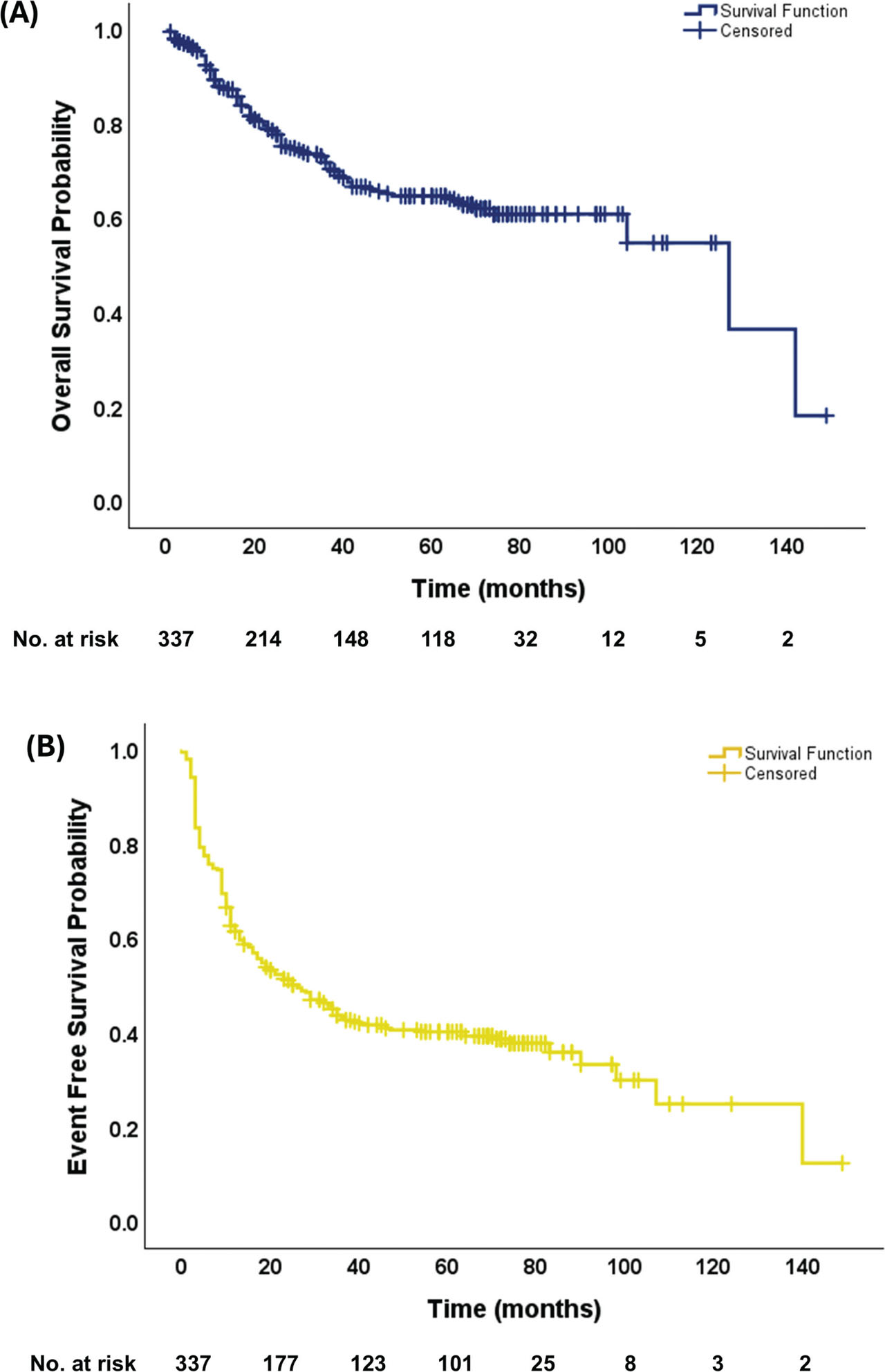
Figure 1.
Kaplan-Meier survival curves for osteosarcoma (A) overall survival, (B) event-free survival.
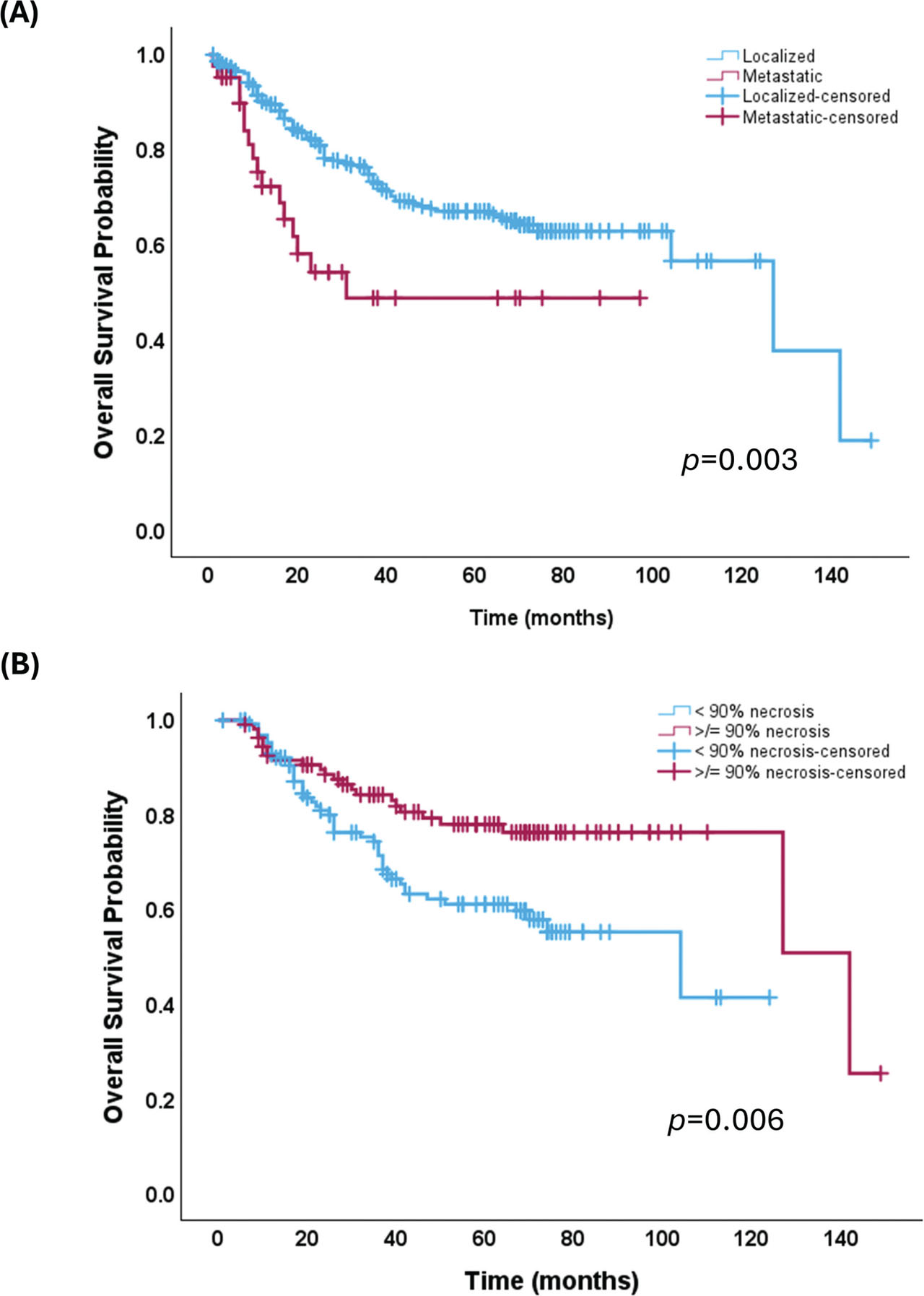
Figure 2.
Kaplan-Meier overall survival curves for osteosarcoma (A) baseline stage, and (B) histopathologic necrosis after neoadjuvant chemotherapy.
Table 2.
Treatment outcomes of osteosarcoma.
| Overall survival % (95% Confidence Intervals) | |
| 3-year | 72 (67 – 78) |
| 5-year | 65 (59 – 71) |
| 10-year | 55 (44 – 69) |
| Event-free survival (%) | |
| 3-year | 43 (39 – 49) |
| 5-year | 40 (35 – 46) |
| 10-year | 25 (16 – 40) |
| Abandonment, n | |
| Abandoned prior to treatment | 34* |
| Abandoned active treatment | 42 |
| Deaths, n (%) | 100 (29.7%) |
| Causes of mortality: | |
| Disease progression | 75 |
| Infection-related | 18 |
| Cardiotoxicity | 7 |
There were no statistically significant differences in overall survival by age group (children vs adolescents), tumour size (< or ≥ 8 cm), or sex. Baseline stage and histopathologic necrosis had a statistically significant impact on overall survival (Figures 2A–B). The median OS time for localized disease was 127 months (10.5 years) while for metastatic disease it was 31 months (2.6 years); the estimated 5-year OS for localized disease with 95% confidence intervals was 67% (61 – 74%) while for metastatic disease it was 49% (33 – 72%) (p=0.003). On univariable Cox proportional hazards analysis, patients with metastatic disease had significantly inferior overall survival compared with those with localized disease (HR 2.23, 95% CI 1.30 – 3.83; p=0.004). Of the 241 patients in which histopathologic response to chemotherapy was reported, 132 had < 90% necrosis (54.8%). The median OS time for patients with < 90% necrosis was 104 months (8.7 years) compared to 142 months (11.8 years) in those with ≥ 90% necrosis; the estimated 5-year OS for < 90% necrosis was 61% (95% CI 54 – 72%) while for ≥ 90% necrosis it was 78% (70 – 87%) (p=0.006). In multivariable Cox regression analysis restricted to patients with available histopathologic response data (n=241), ≥90% tumour necrosis remained independently associated with improved overall survival (HR 0.49, 95% CI 0.29 – 0.83; p=0.008). Metastatic disease was associated with a higher hazard of death, but this did not reach statistical significance after adjustment for age, sex, tumour size, and histopathologic response (HR 1.99, 95% CI 0.94 – 4.21; p=0.074).
There were 18 patients who underwent upfront surgery for local control. The reasons for upfront surgery were as follows: 12 patients had fungating masses, 3 had surgery at an outside facility prior to presentation, one patient had an unclear pathologic diagnosis, one patient had a large tumour mass with tumour-related pain, and one patient had concurrent aplastic anaemia. For the 253 patients with surgical control data, a minority of patients underwent limb salvage in the study period (60, 23.7%). Information on histopathologic necrosis was available in 241 patients while surgical margins were reported in 261 patients (71 patients who did no undergo surgery and 5 patients were margin status was not mentioned in the histopathology report) (Table 1).
Histopathologic necrosis information was missing for 96 patients. Of these, there were 71 patients who did not undergo surgery for local control, 18 underwent upfront surgery, 3 underwent local control with frozen bone autografts where the soft tissue and/or bone specimen submitted was not sufficient to assess necrosis, 3 were missing information about necrosis in the histopathology report, while one patient had surgery done at another hospital and did not have information available on necrosis.
The median OS time after amputation was 142 months (11.8 years), compared to 127 months (10.6 years) after limb salvage surgery, but the difference was not statistically significant. Certain subgroup analyses were not possible due to the small number of patients in the subgroups such as the comparative outcomes for tumour site (only 9 patients had non-extremity osteosarcoma), baseline tumour size (only 35 patients had a baseline tumour size of < 8 cm), margin status (only 10 close margins, 1 involved margin).
Discussion
There is wide variation in survival outcomes reported for osteosarcoma in low- (LIC) and low-middle income countries (LMIC), with 5-year OS ranging from 47–83% (8), which are comparatively less than the 5-year OS reported by the EURAMOS-1 study of 71% (95% CI: 68–73%) (9). Our study is a large, single-centre retrospective cohort with real-world contemporary outcomes to the EURAMOS-1 regimen from a tertiary care cancer centre in an LMIC. When individual studies from LMIC are considered, there are limited reports comparing the outcomes of MAP chemotherapy. One Malaysian retrospective study reported outcomes for 128 patients from a mixed cohort of paediatric and adult osteosarcoma patients with 5-year OS of 56% which is lower than the 5-year OS of 65% (95% CI 59 – 71%) in our cohort (10). A study from India utilized a novel non-methotrexate containing treatment regimen and reported a 5-year OS of 75% for non-metastatic osteosarcoma, but with a median follow up of only 34 months compared to 55 months for our cohort (11). In another study from Thailand, authors reported the survival outcomes after receiving a novel methotrexate-containing regimen (different from EURAMOS-1) with a 3-year OS of 79% with a median follow up time of 29.6 months (12). When considering the longer median follow up time for our cohort, the OS outcomes reported from our cohort are within the expected range for LMIC.
Localized disease and histopathology necrosis ≥ 90% are known good prognostic factors that were confirmed in our cohort (6). The 5-year EFS for our cohort is lower at 40% (95% CI 35 – 46%) compared to EURAMOS-1 at 54% (95% CI: 52–56%), likely due to the relatively high abandonment on active therapy. Concerted efforts for reducing abandonment would be expected to improve the EFS in our population (13). Of note, 33 of the 42 patients (78.6%) abandoned therapy prior to surgery for local control. Strategies to improve pre-surgery counselling may be considered to reduce the rate of abandonment. There were 34 patients who were lost to follow up before initiation of any treatment at our centre and were excluded from the survival analysis which may have conflated the survival estimates.
Early detection of osteosarcoma can improve chances of survival and limb salvage (14). Most patients in our cohort had a baseline tumour size of ≥ 8 cm, which is considered a poor prognostic factor in osteosarcoma (14). In addition, all patients had an open biopsy performed for histopathologic diagnosis prior to acceptance for treatment at our hospital. The use of open biopsies is discouraged in bone tumours due to the higher potential for local contamination and increased risk of complications (15). The relatively larger tumour size and the use of open biopsies may have contributed to the higher proportion of patients who underwent amputations as their local control surgery (193, 76.2%). Alternatively, the rates of limb salvage may be lower due to decreased availability of custom endoprostheses for young children. Although frozen bone autografts do not permit the measurement of histopathologic necrosis, they are an increasingly utilized option for osteosarcoma surgery in young children (16), and was used in 9 patients in our cohort. Since 2021 (after the study period), the utilization of frozen bone autografts and planned closed needle biopsies have increased at our institution, so it will be important to see the impact of these strategies on outcomes in subsequent studies.
Infection-related toxicity was high in our cohort, leading to 18 deaths (18% of mortality), compared to no infection-related deaths reported in the EURAMOS-1 study (3). This is despite the availability of pre-defined febrile neutropenia treatment pathways, a dedicated rapid response team and intensive care unit. This may highlight a gap in supportive care that can be bridged with early identification and management of sepsis (17). In addition, the occurrence of cardiomyopathy-related deaths was high in our cohort at 7%, compared to one cardiomyopathy-related death reported in the EURAMOS-1 study (3). This is despite conducting repeated echocardiographic assessments during chemotherapy. This underscores the importance of prophylactic measures to reduce the occurrence of cardiotoxicity such as early identification of cardiac dysfunction and the prophylactic use of dexrazoxane (18). Further studies are needed to understand the higher rates of toxic deaths in our cohort and their predictors.
The limitations of our study include the retrospective nature of data collection, although a robust EMR ensured that there was low probability of missing data. The follow-up time recommended by the hospital after completion of treatment is 5 years, which meant that very few patients were followed up beyond that time making the estimation of 10-year survival outcomes less robust. The Kaplan-Meier analysis assumed that patients enrolled earlier and later in the study have comparable prognosis. However, changes in supportive care such as effective management of febrile neutropenia may have changed over the decade of study time. For multivariable Cox regression analyses, as histopathologic response (tumour necrosis) data were unavailable for a subset of 96 patients, two separate multivariable models were run, one with the entire cohort and one with the abbreviated dataset including complete necrosis data. No imputation procedures were undertaken because of the retrospective nature of the study.
Future studies should assess the socioeconomic determinants of abandonment, the quality of life of survivors, the factors associated with increased risk of infection-related deaths and cardiotoxicity. It would also be important to see how the advancement in supportive care practices and surgical techniques over time, specifically higher rates of limb salvage, has affected outcomes in recent years.
Conclusion
The 5-year overall survival rates of paediatric osteosarcoma treated with a methotrexate-based treatment regimen were comparable to regional estimates but lower than estimates in HIC. There are important gaps in care that need to be addressed to improve early detection of cancer, and to reduce treatment abandonment and treatment-related mortality.
Notes
[2] Contributed by Author contributions
Conceived and designed the analysis: AS. HS, DA.
Collected the data: DA, MO, AS.
Contributed data or analysis tools: IR, UH, AS.
Performed the analysis: AS, DA.
Wrote the paper: AS, DA, IR, HS, IIS, MO, SS, UH.