
Introduction
Between 2020 and 2022, according to our estimates based on the 2017 census, Pakistan’s population reached 235.7 million, with an average of 120.6 million men and 115.1 million women each year (1). Over three years, Pakistan had a population of 707.2 million. In decreasing order of population size, the regions are listed as follows: Punjab (364.7 m), Sindh (158.9 m), Khyber Pakhtunkhwa (KP (117.0 m), Balochistan (41.9 m), Azad Jammu and Kashmir (12.9 m), Islamabad (6.7 m), and Gilgit-Baltistan (GB (4.9 m) (1,2,3).
A literature review has shown that limited reports are available on hospital-based cancer registration representing Balochistan. The Pakistan Atomic Energy Commission (PAEC) has published comprehensive reports on institutional cancer registration over recent years. These include all the regions of the country in which the PAEC centers function (5,6). Similar reports are available for the Shaukat Khanum Memorial Cancer Hospital and Research Center (SKMCH&RC). As regards population-based cancer surveillance, the Punjab Cancer Registry and the Karachi Cancer Registry are the only two functioning registries in the country (7,8). A recent report on the national cancer data indicates that we need to improve the coverage at the national level (9).
The objective of this research was to conduct a descriptive, retrospective evaluation of the distribution of cancer in the province of Balochistan over a three-year period (2020–2022).
Materials and Methods
Population of Balochistan
Balochistan is in the southwest of Pakistan and is the fourth most populous region in the country. We estimated the population of Balochistan (41.9 m) using an average annual growth rate of 3.20% between 2020 and 2022 (4). The average annual population was 13.9 m; there were 6.8 m (48.7%) children, 1.4 m (10.3%) adolescents, and 5.7 m (40.9%) adults. There was a slight preponderance of males (7.4 m (52.6%)) over females (6.6 m (47.4%)).
Collaborating centers
For this review, we conducted a retrospective study from 2020 to 2022, evaluating the distribution of cancer in Balochistan on data reported by the collaborating centers. The PAEC has 19 hospitals countrywide, represented by six in Punjab, five in Sindh, five in KP, one in Balochistan, one in GB, and one in Islamabad (10). The center in Balochistan operates in its capital city, Quetta, and is named the Center for Nuclear Medicine and Radiotherapy (CENAR) (10). However, the PAEC shared information regarding cancer among the population of Balochistan, regardless of which centers the patients went to—besides the PAEC, SKMCH&RC, and Chughtai Lab also shared their data (11,12,13). Baloch patients visit SKMCH&RC’s two laboratory collection centers in Quetta, the hospitals in Lahore and Peshawar, and the diagnostic center and clinic in Karachi for further evaluation and care (11,12).
Disease classification
We applied the disease classification systems and codes developed by the World Health Organization to code neoplasms (14). We included all malignancies with a behavior code of /2 (in-situ) or /3 (malignant) and the Central Nervous System (CNS) tumors with a behavior code of /0 (benign) and /1 (borderline malignancy) and eliminated duplicate entries using edit checks (15,16).
We conducted the study through a retrospective review of the records to present the anonymized results without disclosing the identity of the subjects. The SKMCH&RC’s institutional review board (reference no. EX-15-02-24-01) granted a waiver of informed consent and an exemption from a complete review.
Results
We recorded 6,492 cases from Balochistan over three years from 2020 to 2022. The mean age of the cohort was 48.18 (±17.50; 1–103 years), with a median age of 50. We computed the proportional distributions of the commonly diagnosed cancers by age category. In children, n=214 (3.3%): 20.1% were Hodgkin lymphomas, 15.0% were tumors of the brain and other parts of the nervous system, 11.7% were tumors of the connective and soft tissue, 11.7% were tumors of the eye, and 11.2% were non-Hodgkin lymphomas (NHL); in adolescents, n=214 (3.3%): 19.6% were NHL, 14.0% were Hodgkin lymphomas, 13.1% were connective and soft tissue tumors, 9.8% were bone tumors, and 7.5% were nasopharyngeal tumors; and in adults, n=6,064 (93.4%): 17.5% were tumors of the breast, 15.6% were esophageal tumors, 8.3% were tumors of the lip and oral cavity, 5.6% were colorectal cancer, and 5.5% were NHL.
Discussion
The most common cancers in our study, according to the proportional distribution of cases, were those of the breast, esophagus, and lip and oral cavity. Iran borders Balochistan in Pakistan’s southwest, while Afghanistan borders it in its Midwest, as shown in Figure 1 (17). The leading cancers in Iran were those of the stomach, breast, and colorectum, and in Afghanistan, cancers of the breast, stomach, and lung (18,19). Therefore, malignancies of the breast and the gastrointestinal system were dominant in these regions, apart from lung cancer in Afghanistan (18,19). In terms of cause and effect, no specific risk factors have been identified for breast and gastrointestinal cancers in Iran or Afghanistan (20,21), but potentially modifiable and non-modifiable factors have been indicated (race-ethnicity, dietary influences, lifestyle factors, and genetic predisposition) (20,21). The National Cancer Registry of Pakistan shows that Balochistan accounted for 3.5% of the national cancer estimates during 2015–2019 (9).
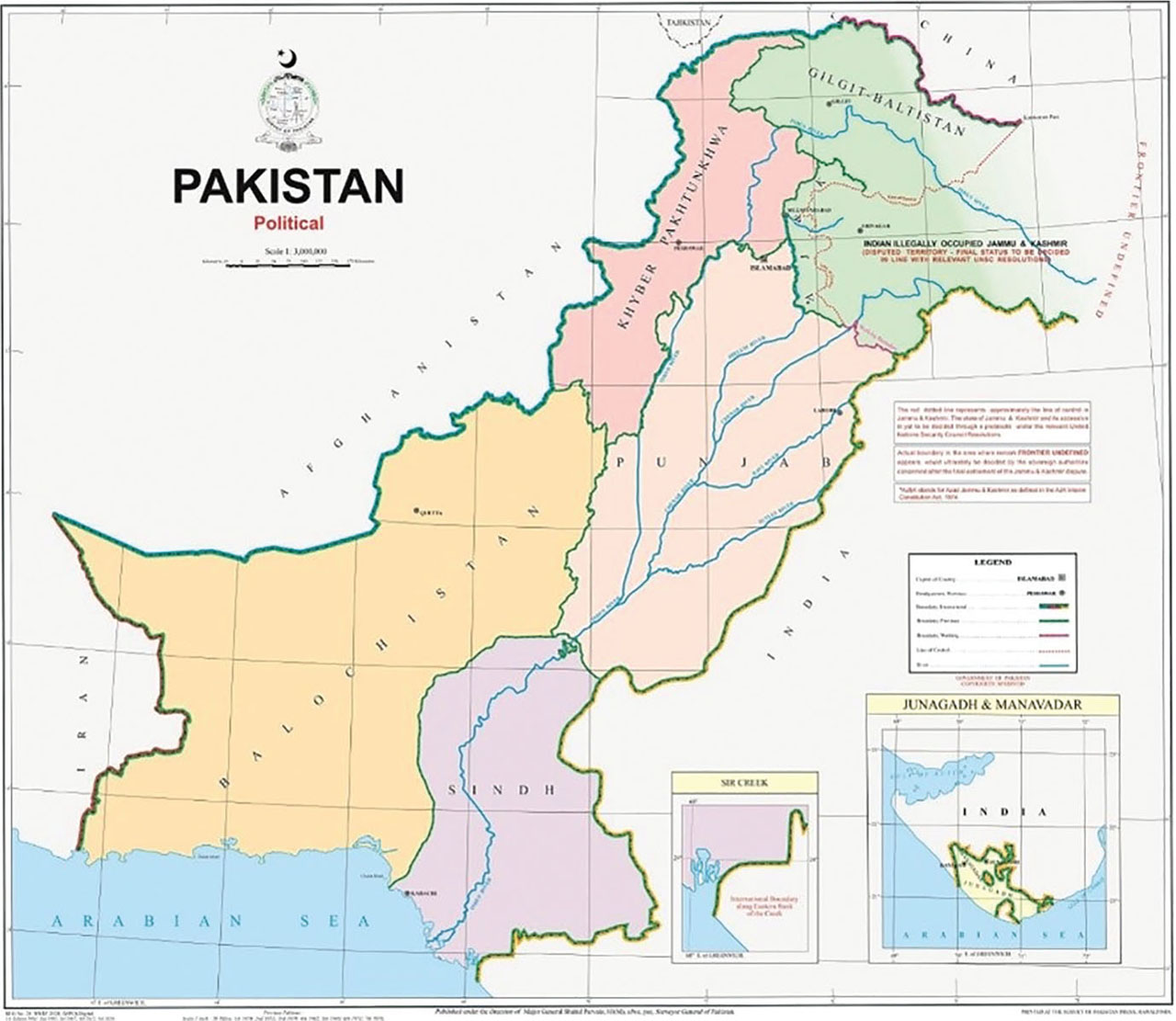
Figure 1.
A map of Pakistan, along with the surrounding countries.
An extensive literature review was conducted to search for cancer registration in Balochistan. The following highlights are presented from a collection of studies that were registered in different hospitals: In a study conducted at a Karachi hospital between January 2011 and September 2020 on cancer of the esophagus, Balochistan accounted for 6.1% of the cases, and most patients had squamous cell carcinoma (22). A study conducted from January 2019 to December 2020 at two hospitals in Quetta found malignancies in 65% of the 207 esophageal biopsies (23). In another study conducted in CENAR from August 2010 to February 2012, 134 breast cancer cases were reported, and 95.5% had invasive ductal carcinoma (24). In a study on 60 subjects (0–19 years old) with gastrointestinal malignancies between March 2004 and April 2006 at a Karachi hospital, Balochistan was identified as a high-risk region for esophageal cancer and diffuse large B-cell lymphoma (25). A report on 87 cases of differentiated thyroid cancer from CENAR in Quetta from January 2003 to December 2009 showed that 81.6% had papillary carcinoma (26). A report from CENAR on 100 urinary bladder cases over five years, from January 1993 until December 1997, showed that 75% had transitional cell carcinoma (27). In another report from Balochistan, the odds of being exposed to cigarette smoke were higher in those with bladder cancer (28). In one report from the Karachi Division and Quetta between 1998 and 2000, the ASIR of esophageal cancer was 25.5 per 100,000 males and 23.4 per 100,000 females, and it was the most common malignancy in both genders in Quetta (29). According to a report by CENAR, Quetta (1990–1999), esophageal cancer accounted for 11.3% of the 5,819 recorded in this center (30). In an old report, during the two years between January 1998 and December 1999, the Karachi Cancer Registry received 1,077 cancer notifications from Quetta (31). The ASIR over two years was 137.0 for males and 92.8 for females per 100,000 (31). It was further shown in a 2020 study that the medical staff at a hospital in Quetta had average knowledge of breast cancer and that it needed to be improved (32).
In conclusion, it is the first report on regional cancer registration in the country’s neglected province of Balochistan. In our study, the cancer counts were low from 2020 to 2022. It remains to be seen if patients did not seek treatment due to a lack of knowledge about the illness and transportation challenges to hospitals in Balochistan. We need to review the statistics over time to see if there are any changes in cancer distributions in this region. We must prioritize cancer registration and develop sustainable processes integrated into the systems for healthcare, vital statistics, and civil registration to improve the surveillance of non-communicable diseases in the country and their impact on healthcare.
Acknowledgment
We are grateful to Dr. Faisal Sultan, Dr. Aasim Yusuf, and Dr. Asif Loya for supporting cancer surveillance in the region. We also express our gratitude to the staff of SKMCH&RC’s Cancer Registry and Clinical Data Management section for their contributions to cancer registration and medical coding.