
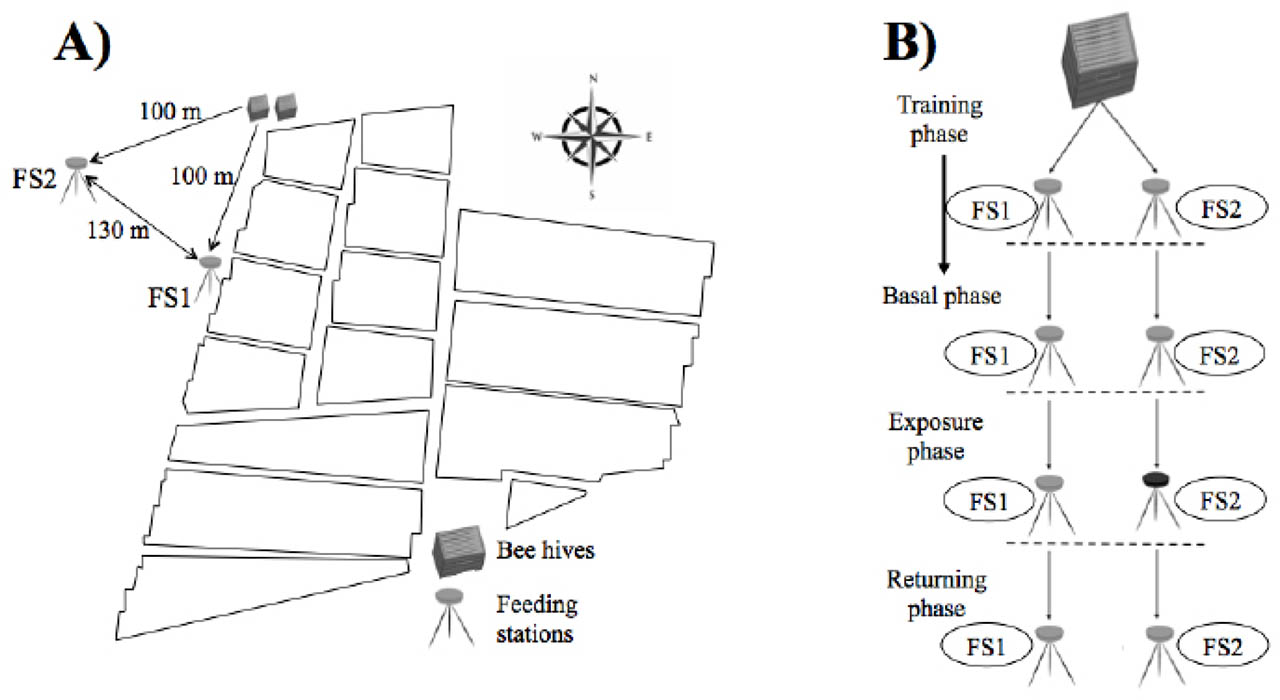
Fig. 1
(A) Location of experimental honey bee colonies and feeding stations (FS1 and FS2) in the plantation. (B) Experimental setup of experiment 1. Training phase, foragers are trained to collect sucrose from both feeders (grey circles). Basal phase, foragers visiting each feeder were counted. Exposure phase, the FS2 was removed and a new one containing Acttra/Entrust was offered (black circle). Returning phase consisted of putting back sucrose solution in FS2. Each phase, except training, lasted 20 min.
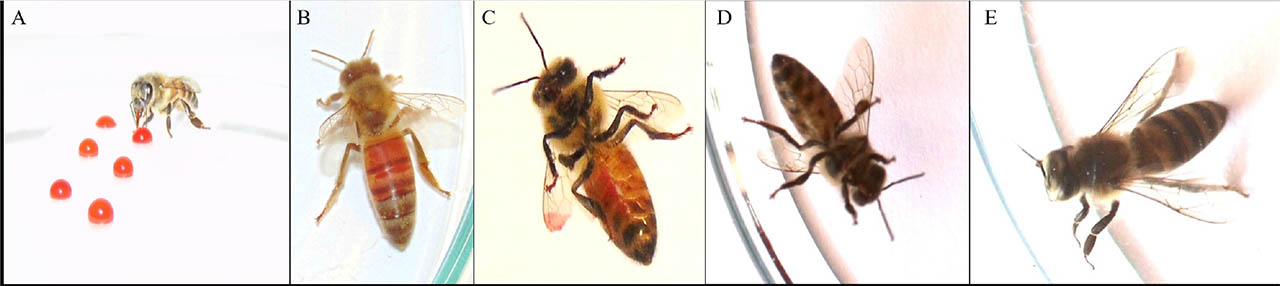
Fig. 2
Apis mellifera exposed to drops of each treatment (A) and foragers with their abdomen colored red after feeding on the treatment containing natural colorant (B and C); foragers that did not consume colored food are also shown (D and E).
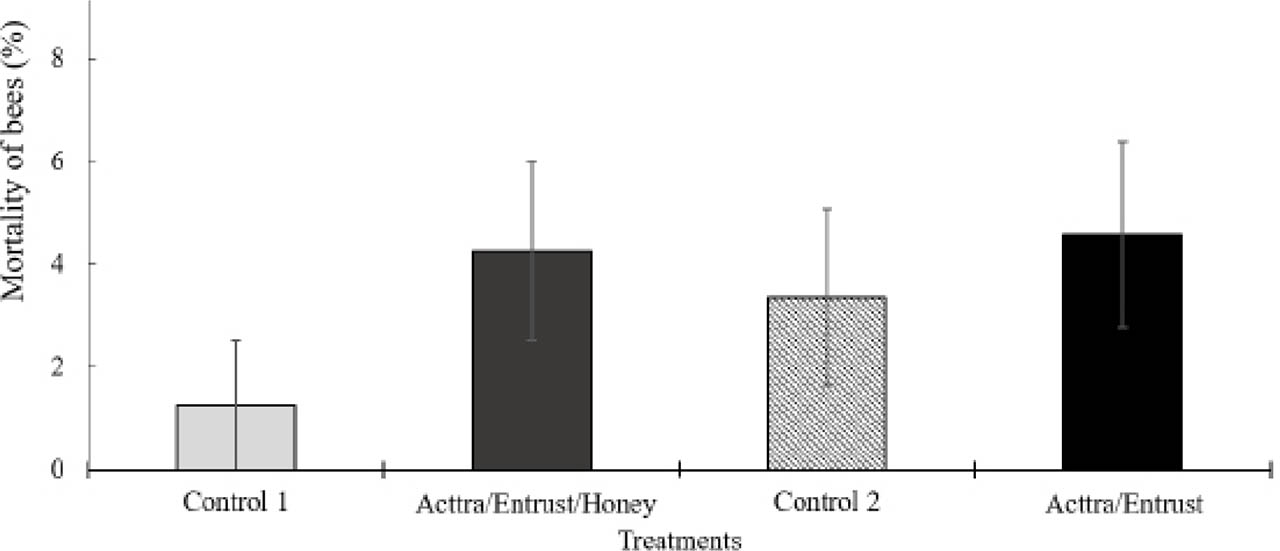
Fig. 3
Mean mortality (± standard error) of foragers exposed to each treatment in experiment 2 (see text for further details). Treatments were not significantly different at α=0.05.
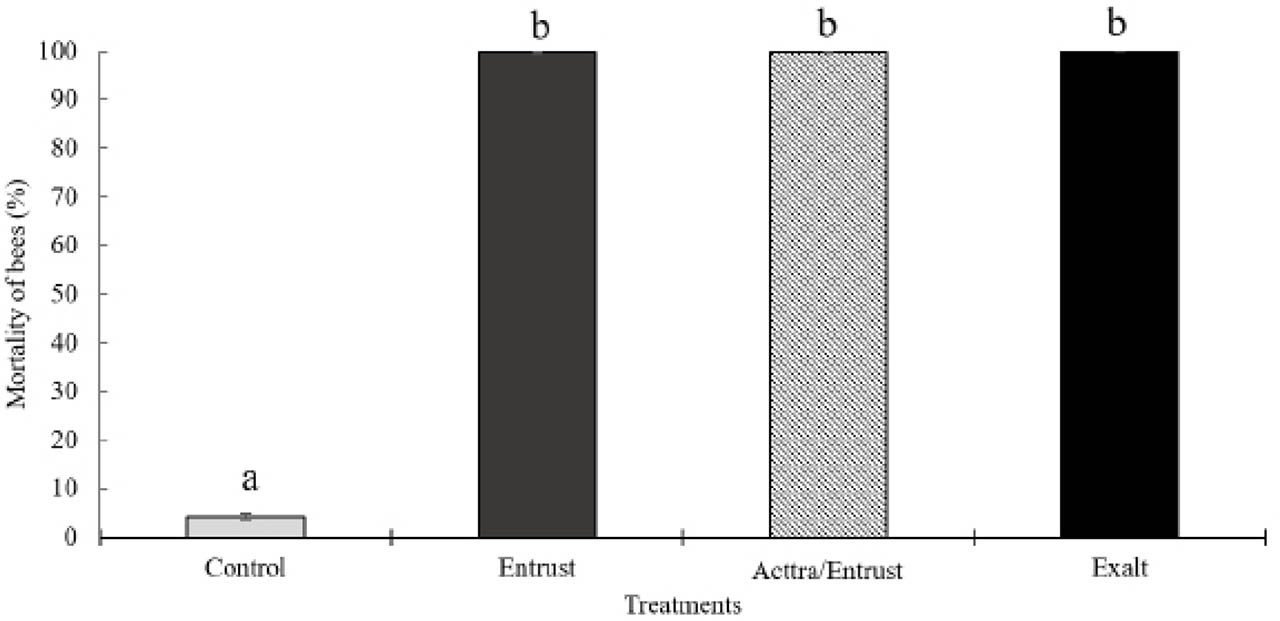
Fig. 4
Mean mortality (± standard error) of honey bee foragers in experiment 3 (see text for further details). The same letter indicates no significant difference (Tukey’s HSD test, α=0.05).
| Active ingredient | Trade name | Manufacturer | Classification | Application dates |
|---|---|---|---|---|
| Nitrogen and aminoacids | Algacell | Agroplasma Ferticell SA de CV | Fertilizers and amendment | 1 and 5 Feb |
| Aminoacids | Amino Plant | Organic Extract Plant | Fertilizers | 25 Jan, 1 and 26 Feb, 5 March |
| Garlic, neem and cinnamon | Aranova | Zare Agrhos | Botanical extracts used as insect repellents | 26 Feb, 24 March |
| Azadiracthin | Aza-direct 1.2 CE | Gowan mexicana S.A.P.I. DE CV | Insecticide | 1 Feb, 15 March, 21 Apr, 4 May |
| Fenhexamid | Elevat | Arysta Lifecience México, S.A. DE C.V. | Fungicide | 25 Jan |
| Seaweed Ecklonia | Kelp | Algas y Bioderivados Marinos, S.A. de C.V. | Fertilizers and amendment | 26 Jan |
| Chrysanthemum extracts | Killwalc | BioCampo, S.A. de C.V. | Botanical extracts used as insect repellents/pesticides | 1 and 26 Feb, 5 March, 14 Apr |
| Nitrogen and organic compounds | Maxigrow | Cosmoflor | Fertilizer | 1 Feb |
| Azoxystrobin | Maxtrobyn | Helm de México, S.A. | Fungicide | 1 Feb |
| Conidia of Isaria fumosorosea | PAE-SIN | Agrobiologicos del noreste S.A. DE C.V. | Biopesticide | 9 March, 2 May |
| Ciprodinil and fludioxonil | Switch 62.5 WG | Syngenta Agro, S.A. DE C.V. | Fungicide | 18 Feb |
| Conidia of Hirrsutella thompsonii | Thompzar | Zare Agrhos | Biopesticide | 26 Feb, 5 March, |
| Conidia of Verticillium lecanni | VERTI-SIN | Agrobiologicos del noreste S.A. DE C.V. | Biopesticide | 9 and 30 March |
| Nitrogen | Wiserganic | WISErg Corporation | Fertilizers and amendment | 1 and 26 Feb, 5 March |
| Siloxane | Xtender | Fertilizantes e Insumos Agrícolas S.A. de C.V. | Adjuvant | 25 Jan, 18 Feb |