
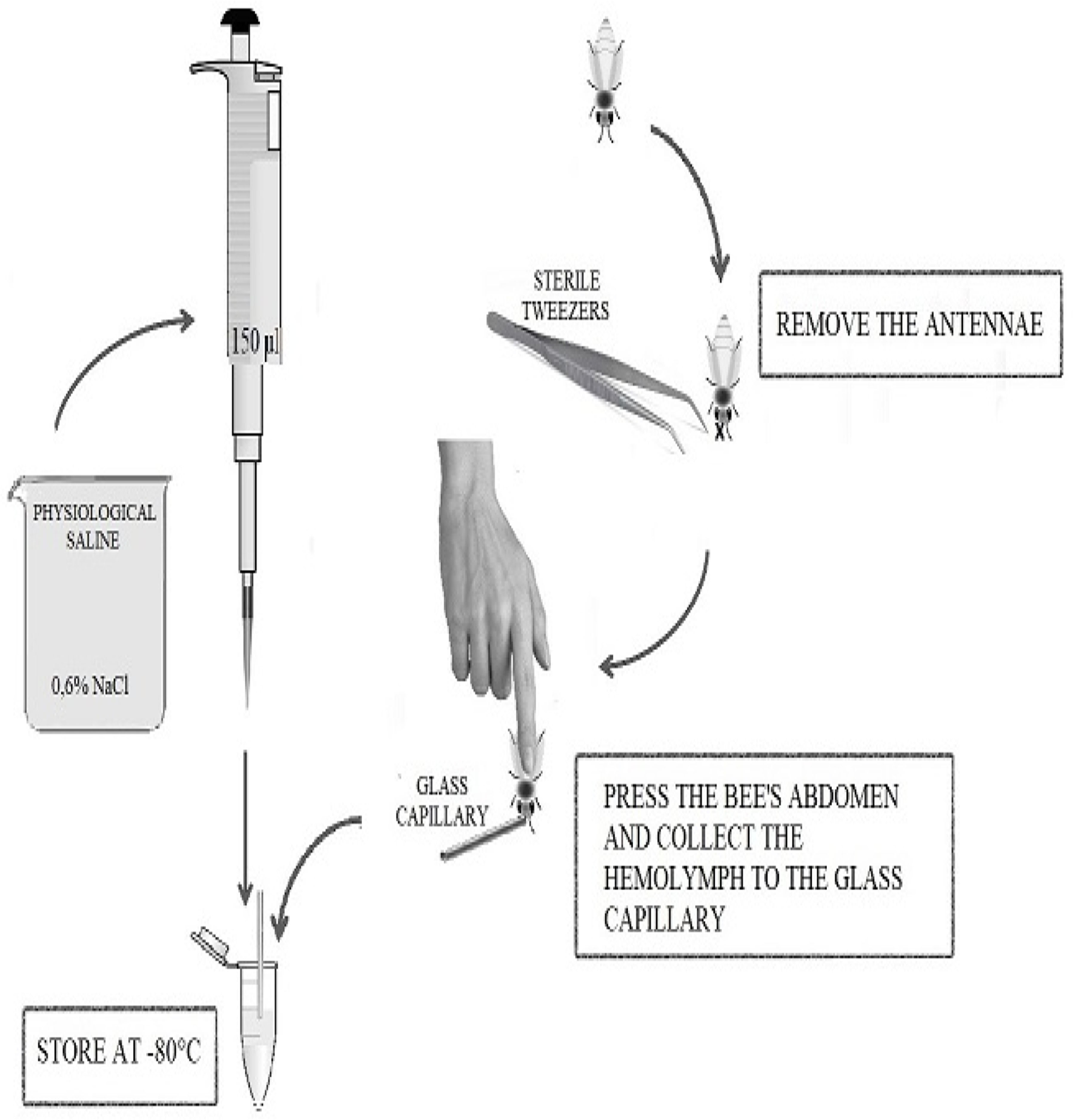
Fig. 1
The scheme of the modified technique of collecting hemolymph flowing out after detachment of the antennae with use of a glass capillary
Table 1
Characterization of the modified method of collecting hemolymph compared to methods presented in the publication by Łoś & Strachecka (2018)
| hemolymph outflow | After detachment of antennae | After incision of body with a scalpel | into a glass capillary by puncturing body | After detachment of antennae with glass capillary (modified method) |
|---|---|---|---|---|
| Difficulty level | easy | difficult | difficult and requiring precision | easy |
| Microbiological contamination of collected material | likely | very likely | unlikely | unlikely |
| Transport | very difficult | very difficult | difficult | easy |
| Approximate amount of collected material | 5-10 μL | 2-8 μL | 6-20 μL | 8-20 μL |
| Stage of insects used for hemolymph extraction | adult | adult and larvae | adult with developed circulatory system | adult |
| Storage of collected material | difficult | difficult | easy | easy |
| Collecting efficiency | fast | slow | slow | fast |
| Possibility of hemocytes adhesion | no | no | yes | yes |