
Table 1
Data sources
| Worked | Did not work | |
|---|---|---|
| Filed | Income tax return data | Income tax return data |
| Did not file | PAYG payment summary data (for salary and wage payments only) | Residual population calculated from ABS estimates |
[i] ABS, Australian Bureau of Statistics; PAYG, Pay-As-You-Go.
Table 2
“Net income from working Indicator 2”: adjusted Australian Taxation Office definition
| Net income from working | ||
|---|---|---|
| = | Total gross salary and wage payments | (1) |
| + | Income from allowances, earnings, tips, director's fees, etc. | (2) |
| + | Attributed personal services income | (3) |
| + | Total reportable fringe benefits (RFB) amounts (if RFB ≥ RFB threshold) | (4) |
| – | Work-related car expenses | (5) |
| – | Work-related travel expenses | (6) |
| – | Work-related clothing expenses | (7) |
| – | Work-related self-education expenses | (8) |
| – | Other work-related expenses | (9) |
| – | Low-value pool deductiona | (10) |
| + | Net income from working (Appendix section)b | (11) |
| + | Total employer superannuation contributions | (12) |
a Low-value pool deductions refer to “low-cost” and “low-value” assets used in the course of generating income. These are assets costing <$1,000, which can be depreciated over multiple tax lodgment years.
b NIFW (Appendix section) refers to business and partnership income that is derived from working.
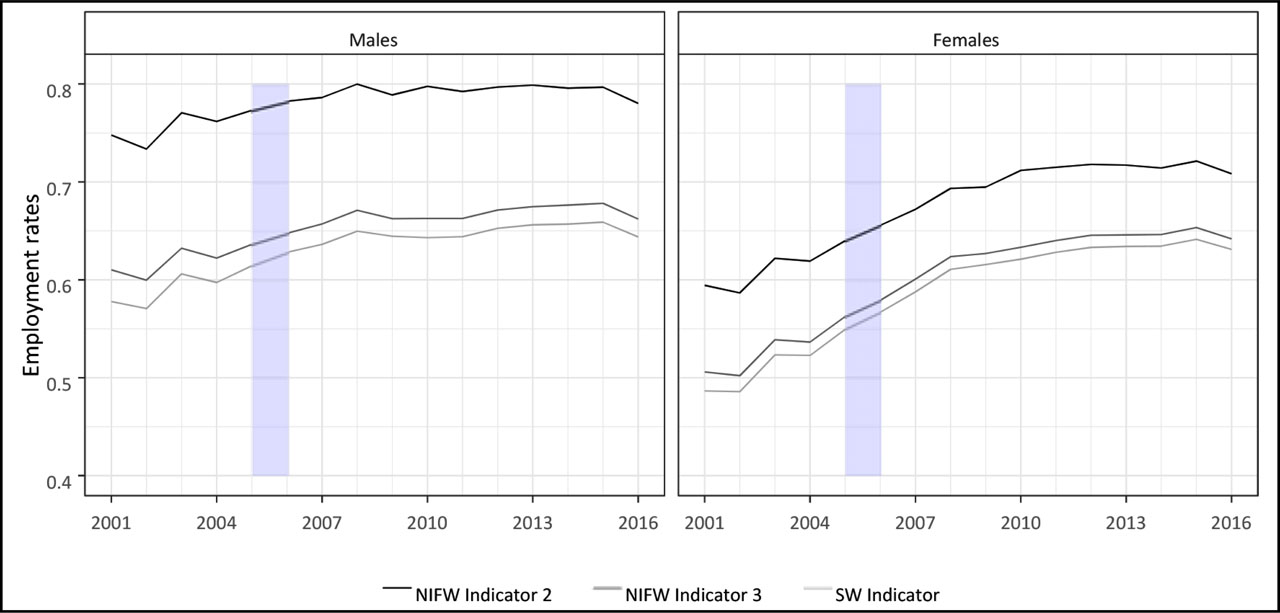
Figure 1
Derived employment rates for individuals aged 56 years.
NIFW, net income from working; SW, salary and wage.
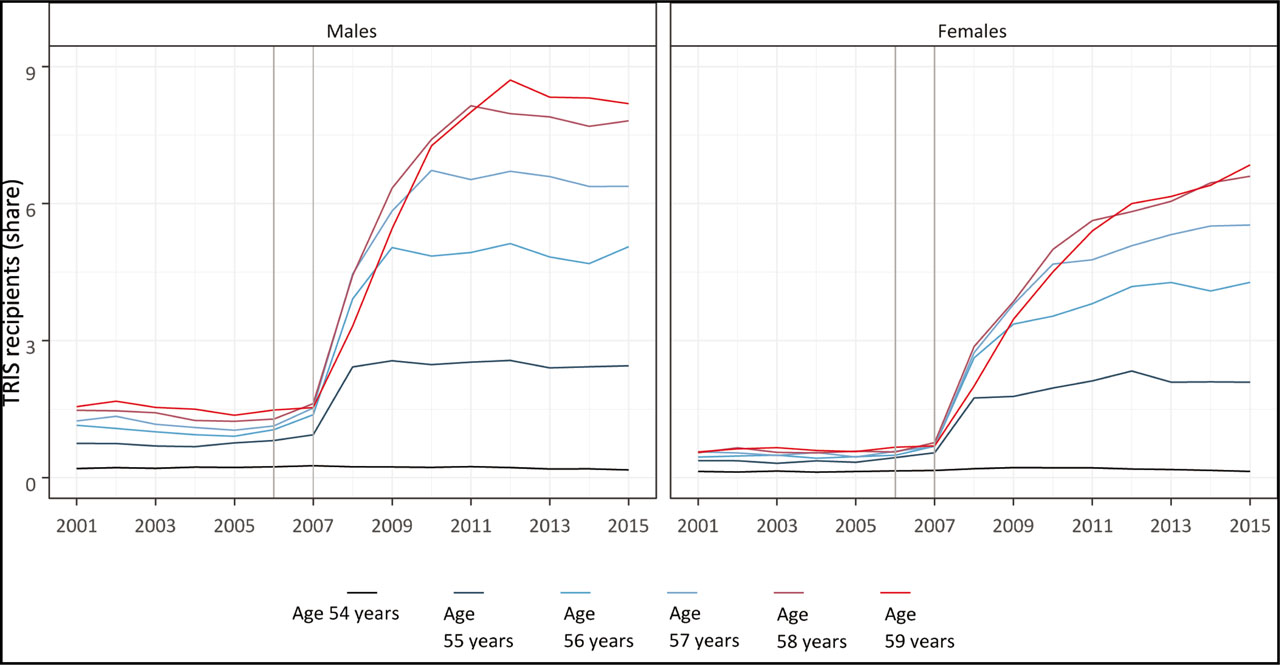
Figure 2
“TRIS-like-behavior”, using NIFW Indicator 2 TRIS rule.
NIFW, net income from working; TRIS, Transition to Retirement Income Streams.
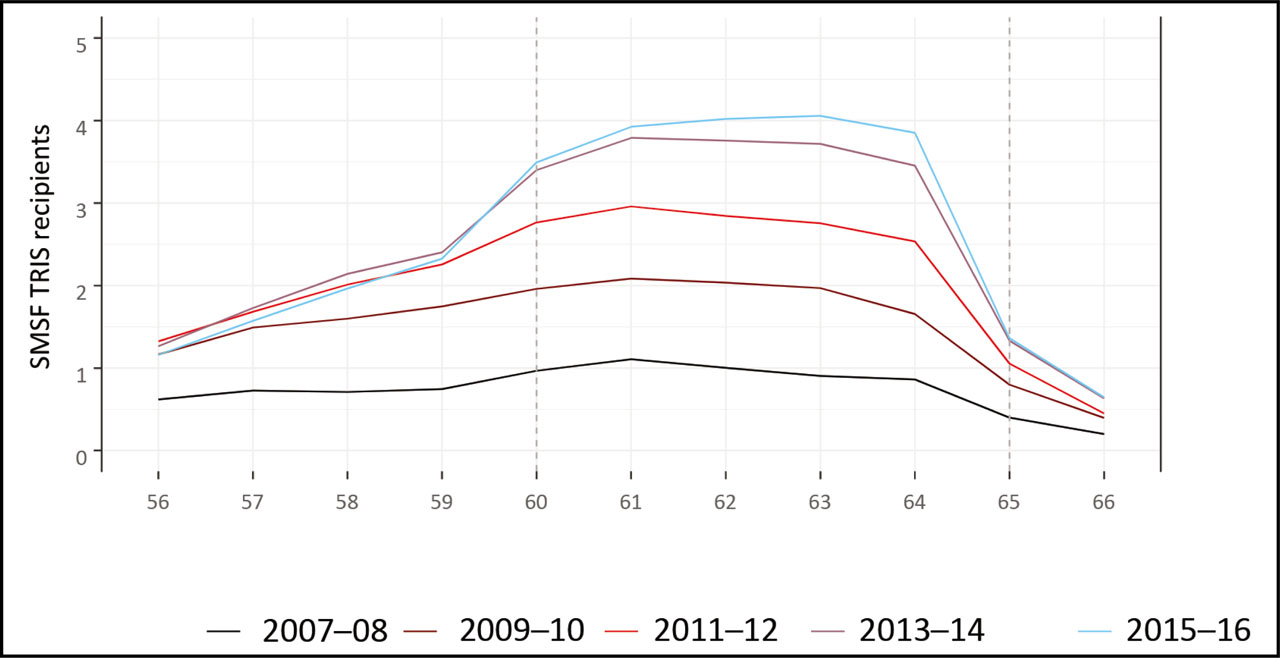
Figure 3
Reported SMSF TRIS, males and females pooled.
SMSF, self-managed superannuation funds; TRIS, Transition to Retirement Income Streams.
Table 3
Labor supply rates in periods before and after the introduction of TRIS
| Pre-TRIS 2004–05 (1) | TRIS 2005–06 (2) | Difference (2 – 1) (3) | Difference-in-difference (4) | ||
|---|---|---|---|---|---|
| Males | |||||
| A | NIFW Indicator 2 | ||||
| Treatment (age: 56 years) [249,728] | 0.7977 (0.0011) | 0.8080 (0.0011) | 0.0102*** (0.0016) | ||
| Control (age: 54 years) [256,949] | 0.8317 (0.001) | 0.8432 (0.001) | 0.0115*** (0.0015) | −0.0013 (0.0022) | |
| B | NIFW Indicator 3 | ||||
| Treatment (age: 56 years) [249,728] | 0.6729 (0.0013) | 0.6867 (0.0013) | 0.0138*** (0.0019) | ||
| Control (age: 54 years) [256,949] | 0.7111 (0.0013) | 0.7234 (0.0012) | 0.0124*** (0.0018) | 0.0014 (0.0026) | |
| C | Salary and wage indicator | ||||
| Treatment (age: 56 years) [249,728] | 0.6557 (0.0014) | 0.6711 (0.0013) | 0.0154*** (0.0019) | ||
| Control (age: 54 years) [256,949] | 0.6962 (0.0013) | 0.7089 (0.0013) | 0.0127*** (0.0018) | 0.0027 (0.0026) | |
| Females | |||||
| D | NIFW Indicator 2 | ||||
| Treatment (age: 56 years) [250,487] | 0.6603 (0.0013) | 0.6778 (0.0013) | 0.0175*** (0.0019) | ||
| Control (age: 54 years) [258,953] | 0.7168 (0.0013) | 0.7362 (0.0012) | 0.0194*** (0.0018) | −0.0019 (0.0026) | |
| E | NIFW Indicator 3 | ||||
| Treatment (age: 56 years) [250,487] | 0.5873 (0.0014) | 0.6060 (0.0014) | 0.0186*** (0.002) | ||
| Control (age: 54 years) [258,953] | 0.6476 (0.0013) | 0.6687 (0.0013) | 0.0212*** (0.0019) | −0.0025 (0.0027) | |
| F | Salary and wage indicator | ||||
| Treatment (age: 56 years) [250,487] | 0.5765 (0.0014) | 0.5959 (0.0014) | 0.0194*** (0.002) | ||
| Control (age: 54 years) [258,953] | 0.6387 (0.0013) | 0.6597 (0.0013) | 0.0211*** (0.0019) | −0.0017 (0.0027) | |
[i] Notes: Labor supply equals one if the specific NIFW measure has a dollar value that does not equal zero. Sample size is presented in square brackets, and robust standard errors are in parentheses.
[ii] ***, **, and * denote statistical significance at the 0.01, 0.05, and 0.1 levels, respectively.
[iii] NIFW, net income from working; TRIS, Transition to Retirement Income Streams.
Table 4
TRIS effects on “labor supply” and “earnings” (D-i-D coefficients)
| 2004–05 vs 2005–06 (1) | 2004–05 vs 2006–07 (2) | |||
|---|---|---|---|---|
| ITR, PAYG, and ABS estimates | 54 years vs 56 years | 54 years vs 56 years | ||
| Labor supply | Males | |||
| NIFW 2 D-i-D (TRIS · Age) | −0.0013 | [0.0022] | 0.0052** | [0.0021] |
| NIFW 3 D-i-D (TRIS · Age) | 0.0014 | [0.0026] | 0.0102*** | [0.0026] |
| Salary and wage D-i-D (TRIS · Age) | 0.0027 | [0.0026] | 0.0101*** | [0.0026] |
| Females | ||||
| NIFW 2 D-i-D (TRIS · Age) | −0.0019 | [0.0026] | −0.0008 | [0.0025] |
| NIFW 3 D-i-D (TRIS · Age) | −0.0025 | [0.0027] | 0.0001 | [0.0027] |
| Salary and wage D-i-D (TRIS · Age) | −0.0017 | [0.0027] | 0.0003 | [0.0027] |
| ITR and PAYG data | 54 years vs 56 years | 54 years vs 56 years | ||
| Earned income | Males | |||
| NIFW 2 D-i-D (TRIS · Age) | 0.0173** | [0.0073] | 0.0244*** | [0.0073] |
| NIFW 3 D-i-D (TRIS · Age) | 0.0018 | [0.0079] | 0.0161** | [0.0079] |
| Salary and wage D-i-D (TRIS · Age) | 0.0021 | [0.0080] | 0.0179** | [0.0080] |
| Females | ||||
| NIFW 2 D-i-D (TRIS · Age) | −0.0080 | [0.0083] | 0.0012 | [0.0082] |
| NIFW 3 D-i-D (TRIS · Age) | −0.0175** | [0.0084] | −0.0099 | [0.0082] |
| Salary and wage D-i-D (TRIS · Age) | −0.0190** | [0.0084] | −0.0084 | [0.0083] |
| 2006–07 vs 2007–08 | 2006–07 vs 2008–09 | |||
| ITR, PAYG, and ABS estimates | 59 years vs 61 years | 59 years vs 61 years | ||
| Labor supply | Males | |||
| NIFW 2 D-i-D (TRIS · Age) | 0.0247*** | [0.0026] | 0.0110*** | [0.0026] |
| NIFW 3 D-i-D (TRIS · Age) | 0.0253*** | [0.0028] | 0.0136*** | [0.0028] |
| Salary and wage D-i-D (TRIS · Age) | 0.0238*** | [0.0028] | 0.0115*** | [0.0029] |
| Females | ||||
| NIFW 2 D-i-D (TRIS · Age) | 0.0134*** | [0.0029] | 0.0058** | [0.0029] |
| NIFW 3 D-i-D (TRIS · Age) | 0.0113*** | [0.0029] | 0.0058** | [0.0029] |
| Salary and wage D-i-D (TRIS · Age) | 0.0113*** | [0.0029] | 0.0050* | [0.0029] |
| ITR and PAYG data | 59 years vs 61 years | 59 years vs 61 years | ||
| Earned income | Males | |||
| NIFW 2 D-i-D (TRIS · Age) | 0.0024 | [0.0088] | 0.0020 | [0.0092] |
| NIFW 3 D-i-D (TRIS · Age) | −0.0149 | [0.0093] | −0.0133 | [0.0097] |
| Salary and wage D-i-D (TRIS · Age) | −0.0166 | [0.0102] | −0.0110 | [0.0099] |
| Females | ||||
| NIFW 2 D-i-D (TRIS · Age) | 0.0074 | [0.0112] | 0.0137 | [0.0111] |
| NIFW 3 D-i-D (TRIS · Age) | −0.0229** | [0.0113] | −0.0197* | [0.0111] |
| Salary and wage D-i-D (TRIS · Age) | −0.0263** | [0.0114] | −0.0217* | [0.0111] |
[i] Notes: Robust standard errors are presented in brackets.
[ii] ***, **, and * denote statistical significance at the 0.01, 0.05, and 0.1 levels, respectively.
[iii] ABS, Australian Bureau of Statistics; D-i-D, difference-in-differences; ITR, income tax return; NIFW, net income from working; PAYG, Pay-As-You-Go; TRIS, Transition to Retirement Income Streams.
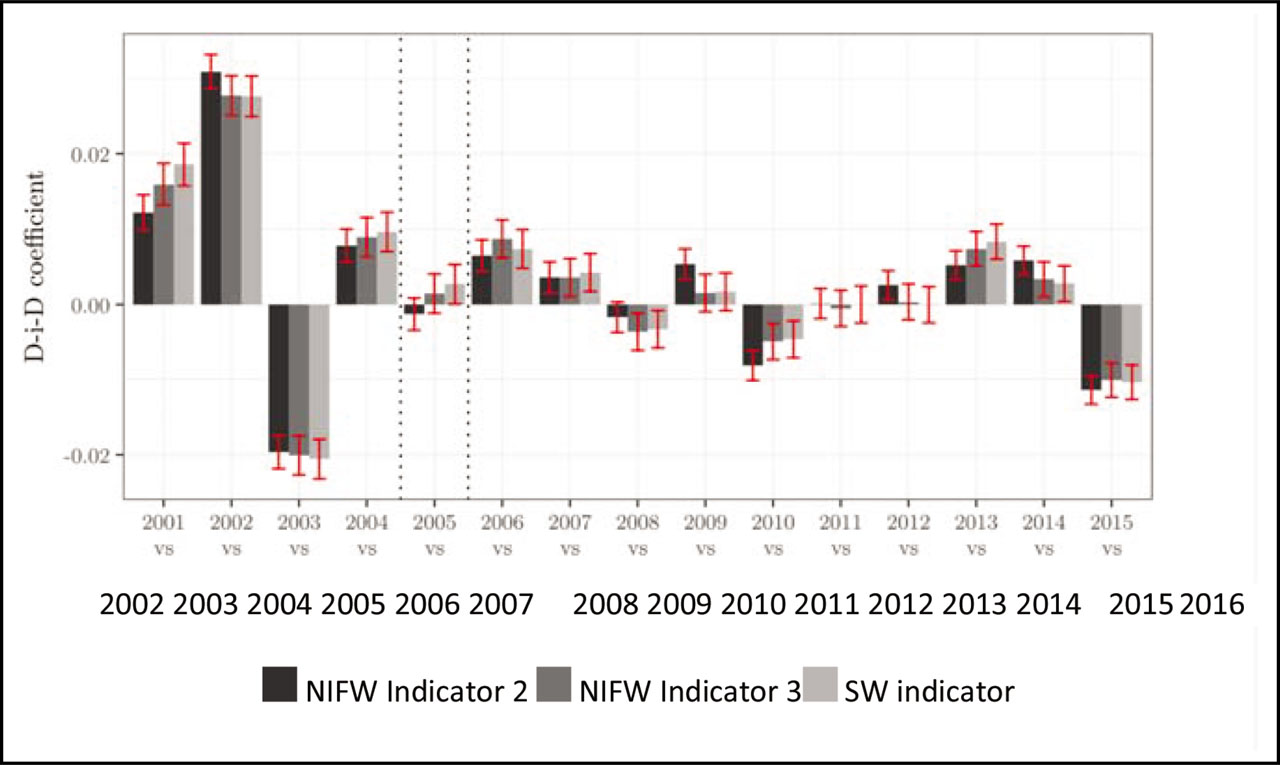
Figure 4
Rolling D-i-D estimates – 54 years vs 56 years of age, males.
D-i-D, difference-in-differences; NIFW, net income from working; SW, salary and wage.
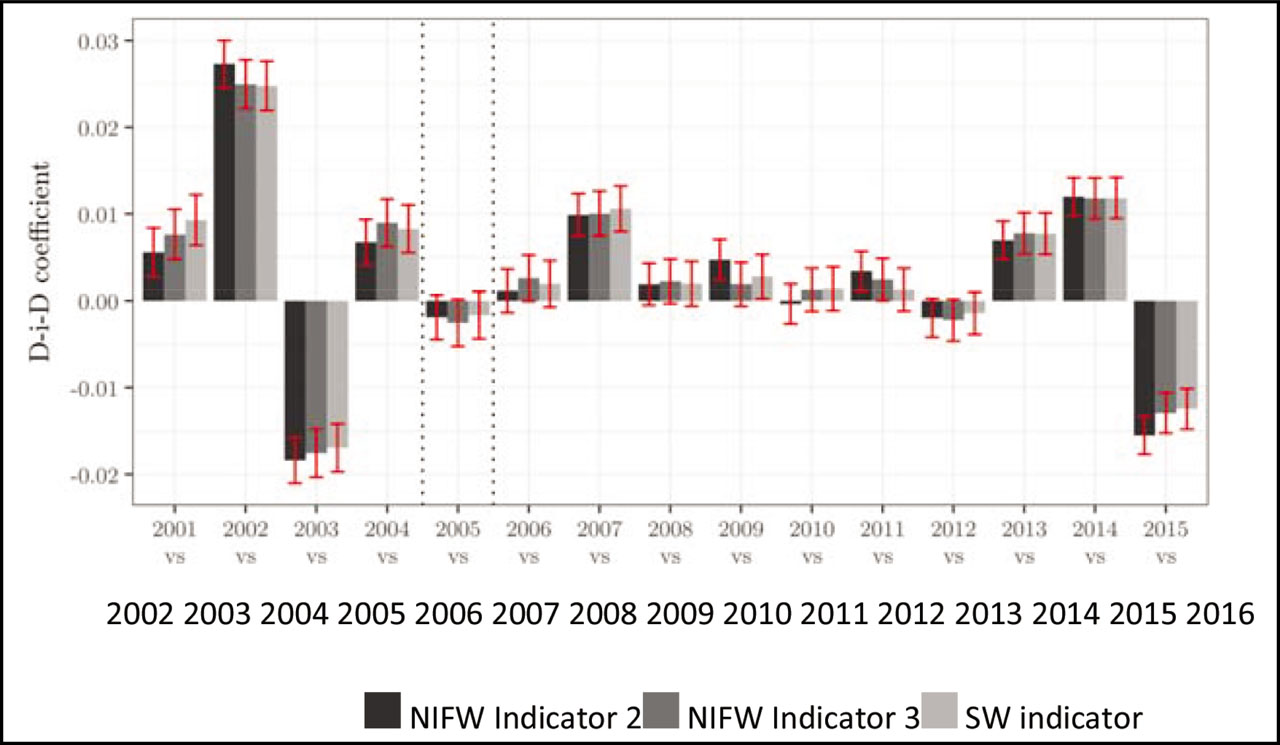
Figure 5
Rolling D-i-D estimates – 54 years vs 56 years of age, females.
D-i-D, difference-in-differences; NIFW, net income from working; SW, salary and wage.
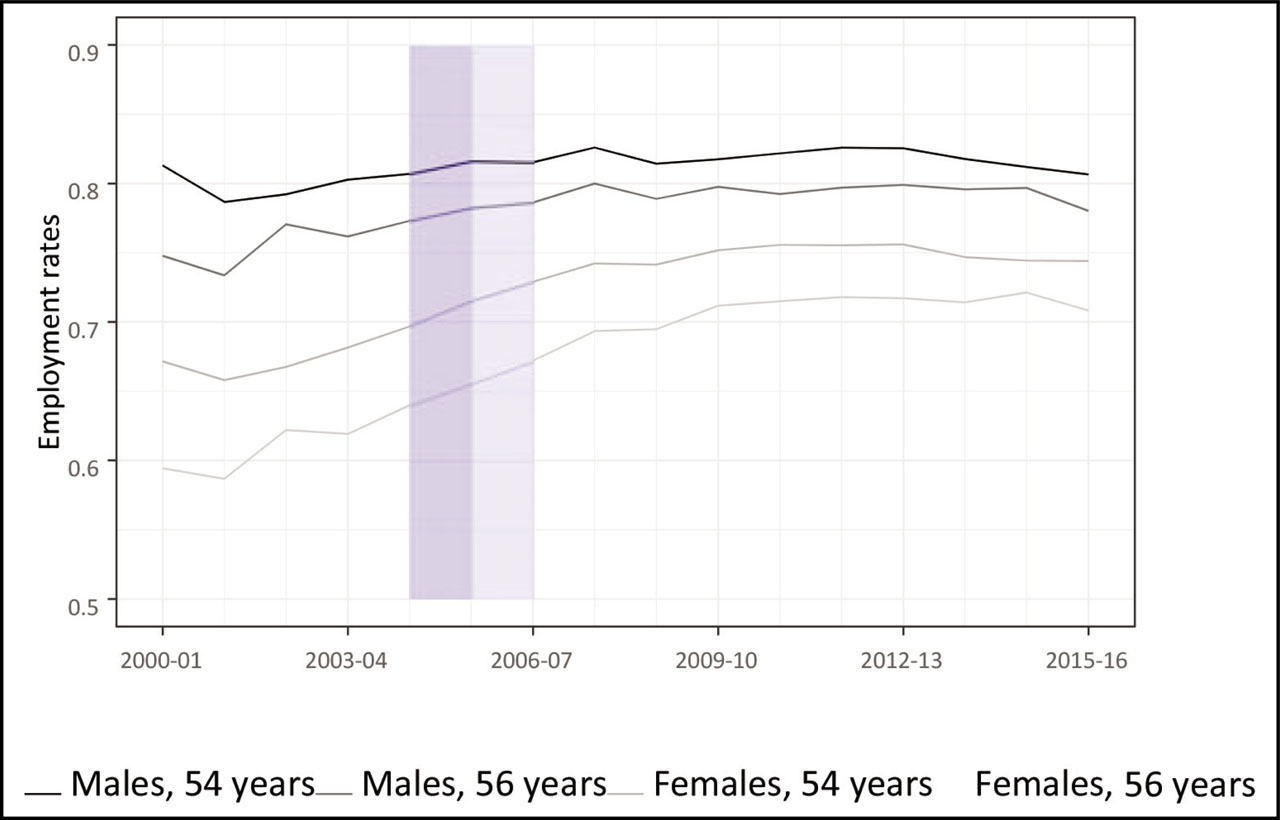
Figure 6
Trends in employment rates (NIFW Indicator 2).
NIFW, net income from working.
Table A1
TRIS measures versus APRA statistics, 55–59 year age range, 2014–151
| APRA-regulated funds | SMSFs | ||||||
|---|---|---|---|---|---|---|---|
| Female | Male | Total | Female | Male | Total | ||
| Count of TRIS recipients (’000s) | |||||||
| A | NIFW Indicator 2 | 30 | 35 | 65 | 7 | 7 | 14 |
| B | NIFW Indicator 3 | 27 | 31 | 58 | 6 | 5 | 11 |
| C | SW indicator | 26 | 30 | 56 | 5 | 5 | 10 |
| D | APRA 55–59 | 21 | 26 | 47 | na | na | na |
| E | APRA 60–64 | 40 | 52 | 92 | na | na | na |
| F | APRA 65–69 | 3 | 4 | 7 | na | na | na |
| Total TRIS payments ($ million) | |||||||
| G | NIFW Indicator 2 | 342 | 498 | 840 | 125 | 182 | 307 |
| H | NIFW Indicator 3 | 298 | 432 | 730 | 98 | 140 | 237 |
| I | SW indicator | 282 | 408 | 690 | 87 | 122 | 208 |
| J | APRA 55–59 | 204 | 325 | 529 | na | na | na |
| K | APRA 60–64 | 438 | 801 | 1,239 | na | na | na |
| L | APRA 65–69 | 38 | 72 | 110 | na | na | na |
1 There is a difference in the reported unit between the APRA and derived TRIS estimates. The APRA statistics are on an account basis, whereas the derived TRIS estimates are on an individual basis.
APRA, Australian Prudential Regulation Authority; NIFW, net income from working; SMSF, self-managed superannuation funds; SW, salary and wage; TRIS, Transition to Retirement Income Streams.
Table A2
Hypothetical TRIS use cases in 2005–06
| Intended use: reducing labor ($ 000s) | Moderate use: bolstering income ($ 000s) | Aggressive use: tax planning ($ 000s) | Notes | ||
|---|---|---|---|---|---|
| Benchmark | |||||
| A | Earnings from work | 80.0 | 100.0 | 140.0 | |
| B | Income tax on earnings | 21.9 | 30.6 | 49.4 | 2004–05 schedule |
| C | Posttax earnings | 58.1 | 69.5 | 90.7 | =A – B |
| D | Employer contributions | 7.2 | 9.0 | 12.6 | =A*0.09a |
| E | Salary-sacrificed contributions | 0.0 | 0.0 | 0.0 | |
| F | Tax on contributions | 1.1 | 1.4 | 1.9 | =(D+E)*0.15 |
| Using TRIS | |||||
| H | Earnings from work | 56.0 | 100.0 | 0.0 | |
| I | TRIS | 19.1 | 25.0 | 35.0 | =R*0.1b |
| J | Assessable income | 75.1 | 125.0 | 35.0 | =H+I |
| K | Tax on earnings | 19.8 | 42.8 | 6.4 | 2004–05 schedule |
| L | TRIS tax offset | 2.9 | 3.8 | 5.3 | =H*0.15 |
| M | Tax minus TRIS offset | 17.0 | 39.0 | 1.1 | =K+L |
| N | Posttax earnings | 58.1 | 86.0 | 33.9 | =J – M |
| O | Employer contributions | 5.0 | 9.0 | 12.6 | =H*.09a |
| P | Salary-sacrificed contributions | 0.0 | 0.0 | 140.0 | |
| Q | Tax on contributions | 0.8 | 1.4 | 22.9 | =O+P*0.15 |
| R | Superannuation balance | 200.0 | 250.0 | 350.0 | A*2.5c |
| Difference | |||||
| S | After-tax earnings | 0.0 | 16.6 | −56.8 | =N – C |
| T | Tax on income | −4.9 | 8.5 | −48.2 | =M – B |
| U | Super contributions | −2.2 | 0.0 | 140.0 | =O+P – D |
| V | Tax on contributions | −0.3 | 0.0 | 21.0 | =Q – F |
| W | Tax paid | −5.3 | 8.5 | −27.2 | =U+W |
Table A3
Summary statistics before and after the introduction of TRIS, males
| Control period | Treatment 1 | Treatment 2 | ||||
|---|---|---|---|---|---|---|
| 2004–05 | 2005–06 | 2006–07 | ||||
| Mean | Std. dev. | Mean | Std. dev. | Mean | Std. dev. | |
| ITR, PAYG, plus ABS estimates | ||||||
| Income year | 2004–05 | 0.00 | 2005–06 | 0.00 | 2006–07 | 0.00 |
| Age at June 30 | 54.98 | 1.00 | 54.99 | 1.00 | 54.98 | 1.00 |
| Employment rates | ||||||
| NIFW Indicator 2 | 0.82 | 0.39 | 0.83 | 0.38 | 0.83 | 0.38 |
| NIFW Indicator 3 | 0.69 | 0.46 | 0.71 | 0.46 | 0.71 | 0.45 |
| SW indicator | 0.68 | 0.47 | 0.69 | 0.46 | 0.70 | 0.46 |
| Earned income | ||||||
| NIFW Indicator 2 ($) | 56,419 | 74,440 | 60,311 | 92,301 | 64,771 | 93,301 |
| NIFW Indicator 3 ($) | 57,697 | 63,970 | 61,602 | 87,307 | 65,952 | 83,799 |
| SW indicator ($) | 57,908 | 60,298 | 61,928 | 82,835 | 66350 | 81,510 |
| Observations (number) | 251,666 | na | 255,011 | na | 258,715 | na |
| ITR observations only | ||||||
| Income year | 2004–05 | 0.00 | 2005–06 | 0.00 | 2006–07 | 0.00 |
| Age at June 30 | 54.98 | 1.00 | 54.98 | 1.00 | 54.97 | 1.00 |
| Employment rates | ||||||
| NIFW Indicator 2 | 0.93 | 0.25 | 0.94 | 0.25 | 0.94 | 0.24 |
| NIFW Indicator 3 | 0.79 | 0.41 | 0.80 | 0.40 | 0.80 | 0.40 |
| SW indicator | 0.77 | 0.42 | 0.78 | 0.42 | 0.79 | 0.41 |
| Earned income | ||||||
| NIFW Indicator 2 ($) | 57,099 | 75,080 | 61,023 | 93,193 | 65,536 | 94,171 |
| NIFW Indicator 3 ($) | 58,539 | 64,496 | 62,477 | 88,249 | 66,881 | 84,624 |
| SW indicator ($) | 58,777 | 60,751 | 62,832 | 83,706 | 67,311 | 82,302 |
| Controls | ||||||
| Reported spouse | 0.59 | 0.49 | 0.62 | 0.48 | 0.62 | 0.48 |
| Self-prepared tax return | 0.20 | 0.40 | 0.20 | 0.40 | 0.20 | 0.40 |
| Business and PSI income | 0.11 | 0.32 | 0.11 | 0.32 | 0.12 | 0.33 |
| Partnership and trust income | 0.21 | 0.41 | 0.20 | 0.40 | 0.20 | 0.40 |
| Dividend income | 0.39 | 0.49 | 0.37 | 0.48 | 0.37 | 0.48 |
| Rental income | 0.21 | 0.41 | 0.21 | 0.41 | 0.22 | 0.41 |
| Remoteness | ||||||
| Major cities | 0.68 | 0.47 | 0.68 | 0.47 | 0.67 | 0.47 |
| Inner regional | 0.20 | 0.40 | 0.21 | 0.40 | 0.21 | 0.41 |
| Outer regional | 0.09 | 0.29 | 0.09 | 0.29 | 0.09 | 0.29 |
| Remote and very remote | 0.02 | 0.13 | 0.02 | 0.13 | 0.02 | 0.13 |
| Not available | 0.01 | 0.09 | 0.01 | 0.10 | 0.01 | 0.11 |
| Observations (number) | 214,771 | na | 219,504 | na | 222,946 | na |
[i] Note: The Earned income measures show the mean and std. dev. for working individuals only. The number of individuals who have Earned income in a given year can be calculated by multiplying the relevant “Participation measure” by the number of observations.
[ii] ABS, Australian Bureau of Statistics; ITR, income tax return; na, not available; NIFW, net income from working; PAYG, Pay-As-You-Go; PSI, personal services income; Std. dev., standard deviation; SW, salary and wage; TRIS, Transition to Retirement Income Streams.
Table A4
Summary statistics before and after the introduction of TRIS, females
| Control period | Treatment 1 | Treatment 2 | ||||
|---|---|---|---|---|---|---|
| 2004–05 | 2005–06 | 2006–07 | ||||
| Mean | Std. dev. | Mean | Std. dev. | Mean | Std. dev. | |
| ITR, PAYG, plus ABS estimates | ||||||
| Income year | 2004–05 | 0.00 | 2005–06 | 0.00 | 2006–07 | 0.00 |
| Age at June 30 | 54.98 | 1.00 | 54.99 | 1.00 | 54.98 | 1.00 |
| Employment rates | ||||||
| NIFW Indicator 2 | 0.69 | 0.46 | 0.71 | 0.46 | 0.72 | 0.45 |
| NIFW Indicator 3 | 0.62 | 0.49 | 0.64 | 0.48 | 0.66 | 0.47 |
| SW indicator | 0.61 | 0.49 | 0.63 | 0.48 | 0.65 | 0.48 |
| Earned income | ||||||
| NIFW Indicator 2 ($) | 35,971 | 29,205 | 38,557 | 32,599 | 41,412 | 36,773 |
| NIFW Indicator 3 ($) | 36,616 | 27,720 | 39,237 | 30,703 | 41,915 | 33,900 |
| SW indicator ($) | 36,251 | 26,713 | 38,861 | 29,807 | 41,385 | 32,733 |
| Observations (number) | 252,876 | na | 256,564 | na | 261,864 | na |
| ITR observations only | ||||||
| Income year | 2004–05 | 0.00 | 2005–06 | 0.00 | 2006–07 | 0.00 |
| Age at June 30 | 54.96 | 1.00 | 54.97 | 1.00 | 54.96 | 1.00 |
| Employment rates | ||||||
| NIFW Indicator 2 | 0.88 | 0.32 | 0.89 | 0.31 | 0.90 | 0.30 |
| NIFW Indicator 3 | 0.79 | 0.41 | 0.80 | 0.40 | 0.82 | 0.39 |
| SW indicator | 0.78 | 0.42 | 0.79 | 0.41 | 0.80 | 0.40 |
| Earned income | ||||||
| NIFW Indicator 2 ($) | 36,353 | 29,213 | 35,699 | 31,473 | 41,818 | 36,853 |
| NIFW Indicator 3 ($) | 37,060 | 27,679 | 39,696 | 30,705 | 42,380 | 33,909 |
| SW indicator ($) | 36,692 | 26,649 | 39,317 | 29,790 | 41,838 | 32,729 |
| Controls | ||||||
| Reported spouse | 0.51 | 0.50 | 0.56 | 0.50 | 0.56 | 0.50 |
| Self-prepared tax return | 0.23 | 0.42 | 0.23 | 0.42 | 0.24 | 0.43 |
| Business and PSI income | 0.05 | 0.22 | 0.05 | 0.22 | 0.06 | 0.24 |
| Partnership and trust income | 0.26 | 0.44 | 0.25 | 0.43 | 0.24 | 0.42 |
| Dividend income | 0.40 | 0.49 | 0.38 | 0.49 | 0.37 | 0.48 |
| Rental income | 0.20 | 0.40 | 0.20 | 0.40 | 0.21 | 0.40 |
| Remoteness | ||||||
| Major cities | 0.69 | 0.46 | 0.69 | 0.46 | 0.69 | 0.46 |
| Inner regional | 0.20 | 0.40 | 0.20 | 0.40 | 0.20 | 0.40 |
| Outer regional | 0.08 | 0.28 | 0.08 | 0.28 | 0.08 | 0.28 |
| Remote and very remote | 0.01 | 0.12 | 0.01 | 0.12 | 0.01 | 0.12 |
| Not available | 0.01 | 0.08 | 0.01 | 0.09 | 0.01 | 0.10 |
| Observations (number) | 192,587 | na | 199,174 | na | 206,331 | na |
[i] Note: The Earned income measures show the mean and std. dev. for working individuals only. The number of individuals that have Earned income in a given year can be calculated by multiplying the relevant “Participation measure” by the number of observations.
[ii] ABS, Australian Bureau of Statistics; ITR, income tax return; na, not available; NIFW, net income from working; PAYG, Pay-As-You-Go; PSI, personal services income; Std. dev., standard deviation; SW, salary and wage; TRIS, Transition to Retirement Income Streams.
Table A5
TRIS adoption – descriptive analysis, males
| Without controls | Plus age | Additional controls | ||||
|---|---|---|---|---|---|---|
| (1) | (2) | (3) | ||||
| Income tax return data only | ||||||
| Intercept | 0.0096*** | [0.0001] | −0.0255*** | [0.0001] | −0.0854*** | [0.0005] |
| D2006 | 0.0008*** | [0.0001] | 0.0003*** | [0.0001] | −0.0000 | [0.0001] |
| D2007 | 0.0027*** | [0.0001] | 0.0025*** | [0.0001] | 0.0021*** | [0.0001] |
| D2008 | 0.0212*** | [0.0002] | 0.0211*** | [0.0002] | 0.0208*** | [0.0002] |
| D2009 | 0.0320*** | [0.0002] | 0.0320*** | [0.0002] | 0.0322*** | [0.0002] |
| D2010 | 0.0376*** | [0.0003] | 0.0378*** | [0.0003] | 0.0363*** | [0.0003] |
| D2011 | 0.0398*** | [0.0003] | 0.0400*** | [0.0003] | 0.0382*** | [0.0003] |
| D2012 | 0.0412*** | [0.0003] | 0.0415*** | [0.0003] | 0.0396*** | [0.0003] |
| D2013 | 0.0397*** | [0.0003] | 0.0401*** | [0.0003] | 0.0373*** | [0.0003] |
| D2014 | 0.0388*** | [0.0003] | 0.0392*** | [0.0003] | 0.0365*** | [0.0003] |
| D2015 | 0.0395*** | [0.0003] | 0.0398*** | [0.0003] | 0.0380*** | [0.0003] |
| Age at June 30 | ||||||
| Age 54 years | – | – | 0.0005*** | [0.0000] | 0.0003*** | [0.0000] |
| Age 55 years | – | – | 0.0219*** | [0.0001] | 0.0215*** | [0.0001] |
| Age 56 years | – | – | 0.0433*** | [0.0002] | 0.0427*** | [0.0002] |
| Age 57 years | – | – | 0.0563*** | [0.0002] | 0.0557*** | [0.0002] |
| Age 58 years | – | – | 0.0660*** | [0.0002] | 0.0654*** | [0.0002] |
| Age 59 years | – | – | 0.0672*** | [0.0002] | 0.0666*** | [0.0002] |
| Additional controls | ||||||
| Log(Taxable income) | – | – | – | – | 0.0046*** | [0.0000] |
| Negative taxable income | – | – | – | – | 0.0463*** | [0.0006] |
| Self-prepared return | – | – | – | – | −0.0012*** | [0.0003] |
| Reported partner | – | – | – | – | −0.0083*** | [0.0002] |
| PSI income | – | – | – | – | −0.0022*** | [0.0003] |
| Business and partnership | – | – | – | – | 0.0046*** | [0.0003] |
| income | ||||||
| Dividend income | – | – | – | – | 0.0168*** | [0.0002] |
| Rental income | – | – | – | – | 0.0062*** | [0.0003] |
| Remoteness | ||||||
| Inner regional | – | – | – | – | 0.0022*** | [0.0003] |
| Outer regional | – | – | – | – | −0.0078*** | [0.0004] |
| Remote and very | – | – | – | – | −0.0189*** | [0.0006] |
| remote | – | – | – | – | ||
| Not available | – | – | – | – | −0.0133*** | [0.0005] |
| Observations | 8,809,835 | 8,809,835 | 8,809,835 | |||
| R-squared | 0.0074 | 0.0280 | 0.0346 | |||
Table A6
TRIS adoption – descriptive analysis, females
| Without controls | Plus age | Additional controls | ||||
|---|---|---|---|---|---|---|
| (1) | (2) | (3) | ||||
| Income tax return data only | ||||||
| Intercept | 0.0051*** | [0.0001] | −0.0228*** | [0.0001] | −0.0728*** | [0.0004] |
| D2006 | 0.0006*** | [0.0001] | 0.0003*** | [0.0001] | 0.0005*** | [0.0001] |
| D2007 | 0.0017*** | [0.0002] | 0.0015*** | [0.0001] | 0.0017*** | [0.0001] |
| D2008 | 0.0170*** | [0.0002] | 0.0169*** | [0.0002] | 0.0172*** | [0.0002] |
| D2009 | 0.0244*** | [0.0002] | 0.0243*** | [0.0002] | 0.0257*** | [0.0002] |
| D2010 | 0.0302*** | [0.0002] | 0.0301*** | [0.0002] | 0.0299*** | [0.0002] |
| D2011 | 0.0335*** | [0.0002] | 0.0334*** | [0.0002] | 0.0330*** | [0.0002] |
| D2012 | 0.0366*** | [0.0002] | 0.0365*** | [0.0002] | 0.0356*** | [0.0002] |
| D2013 | 0.0377*** | [0.0002] | 0.0376*** | [0.0002] | 0.0369*** | [0.0002] |
| D2014 | 0.0388*** | [0.0002] | 0.0386*** | [0.0002] | 0.0379*** | [0.0002] |
| D2015 | 0.0401*** | [0.0002] | 0.0399*** | [0.0002] | 0.0400*** | [0.0003] |
| Age at June 30 | ||||||
| Age 54 years | – | – | 0.0003*** | [0.0000] | 0.0002*** | [0.0000] |
| Age 55 years | – | – | 0.0186*** | [0.0001] | 0.0181*** | [0.0001] |
| Age 56 years | – | – | 0.0361*** | [0.0002] | 0.0355*** | [0.0002] |
| Age 57 years | – | – | 0.0459*** | [0.0002] | 0.0454*** | [0.0002] |
| Age 58 years | – | – | 0.0531*** | [0.0002] | 0.0525*** | [0.0002] |
| Age 59 years | – | – | 0.0529*** | [0.0003] | 0.0524*** | [0.0002] |
| Additional controls | ||||||
| Log(Taxable income) | – | – | – | – | 0.0046*** | [0.0000] |
| Negative taxable income | – | – | – | – | 0.0480*** | [0.0006] |
| Self-prepared return | – | – | – | – | −0.0067*** | [0.0002] |
| Reported partner | – | – | – | – | −0.0045*** | [0.0002] |
| PSI income | – | – | – | – | 0.0017*** | [0.0004] |
| Business and partnership | – | – | – | – | 0.0107*** | [0.0003] |
| income | ||||||
| Dividend income | – | – | – | – | 0.0135*** | [0.0002] |
| Rental income | – | – | – | – | 0.0053*** | [0.0003] |
| Remoteness | ||||||
| Inner regional | – | – | – | – | 0.0008** | [0.0003] |
| Outer regional | – | – | – | – | −0.0063*** | [0.0004] |
| Remote and very | – | – | – | – | −0.0156*** | [0.0006] |
| remote | – | – | – | – | ||
| Not available | – | – | – | – | −0.0095*** | [0.0004] |
| Observations | 8,182,689 | 8,182,689 | 8,182,689 | |||
| R-squared | 0.0079 | 0.0242 | 0.0311 | |||
Table A7
TRIS effects on “labor supply” and “earnings” (double age grouping D-i-D coefficients)
| 2004–05 vs 2005–06 | 2004–05 vs 2006–07 | |||
|---|---|---|---|---|
| (1) | (2) | |||
| ITR, PAYG, and ABS estimates | 53–54 vs 56–57 | 53–54 vs 56–57 | ||
| Labor supply | Males | |||
| NIFW Indicator 2 D-i-D (TRIS · Age) | 0.0100*** | [0.0015] | 0.0144*** | [0.0015] |
| NIFW Indicator 3 D-i-D (TRIS · Age) | 0.0116*** | [0.0018] | 0.0178*** | [0.0018] |
| SW indicator D-i-D (TRIS · Age) | 0.0125*** | [0.0018] | 0.0185*** | [0.0018] |
| Females | ||||
| NIFW Indicator 2 D-i-D (TRIS · Age) | 0.0062*** | [0.0018] | 0.0099*** | [0.0018] |
| NIFW Indicator 3 D-i-D (TRIS · Age) | 0.0057*** | [0.0019] | 0.0103*** | [0.0019] |
| SW indicator D-i-D (TRIS · Age) | 0.0063*** | [0.0019] | 0.0105*** | [0.0019] |
| ITR and PAYG data | 53–54 vs 56–57 | 53–54 vs 56–57 | ||
| Earned income | Males | |||
| NIFW Indicator 2 D-i-D (TRIS · Age) | 0.0153*** | [0.0052] | 0.0264*** | [0.0052] |
| NIFW Indicator 3 D-i-D (TRIS · Age) | 0.0045 | [0.0056] | 0.0132** | [0.0056] |
| SW indicator D-i-D (TRIS · Age) | 0.0037 | [0.0057] | 0.0110* | [0.0057] |
| Females | ||||
| NIFW Indicator 2 D-i-D (TRIS · Age) | −0.0037 | [0.0059] | 0.0048 | [0.0058] |
| NIFW Indicator 3 D-i-D (TRIS · Age) | −0.0037 | [0.0059] | −0.0019 | [0.0059] |
| SW indicator D-i-D (TRIS · Age) | −0.0069 | [0.0059] | −0.0026 | [0.0059] |
| 2006–07 vs 2007–08 | 2006–07 vs 2008–09 | |||
| ITR, PAYG, and ABS estimates | 58–59 vs 61–62 | 58–59 vs 61–62 | ||
| Labor supply | Males | |||
| NIFW Indicator 2 D-i-D (TRIS · Age) | 0.0059*** | [0.0019] | 0.0133*** | [0.0018] |
| NIFW Indicator 3 D-i-D (TRIS · Age) | 0.0094*** | [0.0020] | 0.0146*** | [0.0020] |
| SW indicator D-i-D (TRIS · Age) | 0.0092*** | [0.0020] | 0.0137*** | [0.0020] |
| Females | ||||
| NIFW Indicator 2 D-i-D (TRIS · Age) | 0.0022 | [0.0020] | 0.0072*** | [0.0020] |
| NIFW Indicator 3 D-i-D (TRIS · Age) | 0.0022 | [0.0020] | 0.0078*** | [0.0020] |
| SW indicator D-i-D (TRIS · Age) | 0.0022 | [0.0020] | 0.0073*** | [0.0020] |
| ITR and PAYG data | 58–59 vs 61–62 | 58–59 vs 61–62 | ||
| Earned income | Males | |||
| NIFW Indicator 2 D-i-D (TRIS · Age) | 0.0026 | [0.0067] | 0.0065 | [0.0066] |
| NIFW Indicator 3 D-i-D (TRIS · Age) | −0.0141* | [0.0072] | −0.0046 | [0.0070] |
| SW indicator D-i-D (TRIS · Age) | −0.0191*** | [0.0074] | −0.0064 | [0.0071] |
| Females | ||||
| NIFW Indicator 2 D-i-D (TRIS · Age) | 0.0048 | [0.0081] | 0.0183** | [0.0079] |
| NIFW Indicator 3 D-i-D (TRIS · Age) | −0.0180** | [0.0082] | −0.0126 | [0.0079] |
| SW indicator D-i-D (TRIS · Age) | −0.2060** | [0.0083] | −0.0142* | [0.0079] |
[i] Notes: Robust standard errors are presented in brackets.
[ii] ***, **, and * denote statistical significance at the 0.01, 0.05, and 0.1 levels, respectively.
[iii] ABS, Australian Bureau of Statistics; D-i-D, difference-in-differences; ITR, income tax return; NIFW, net income from working; PAYG, Pay-As-You-Go; PSI, personal services income; SW, salary and wage; TRIS, Transition to Retirement Income Streams.
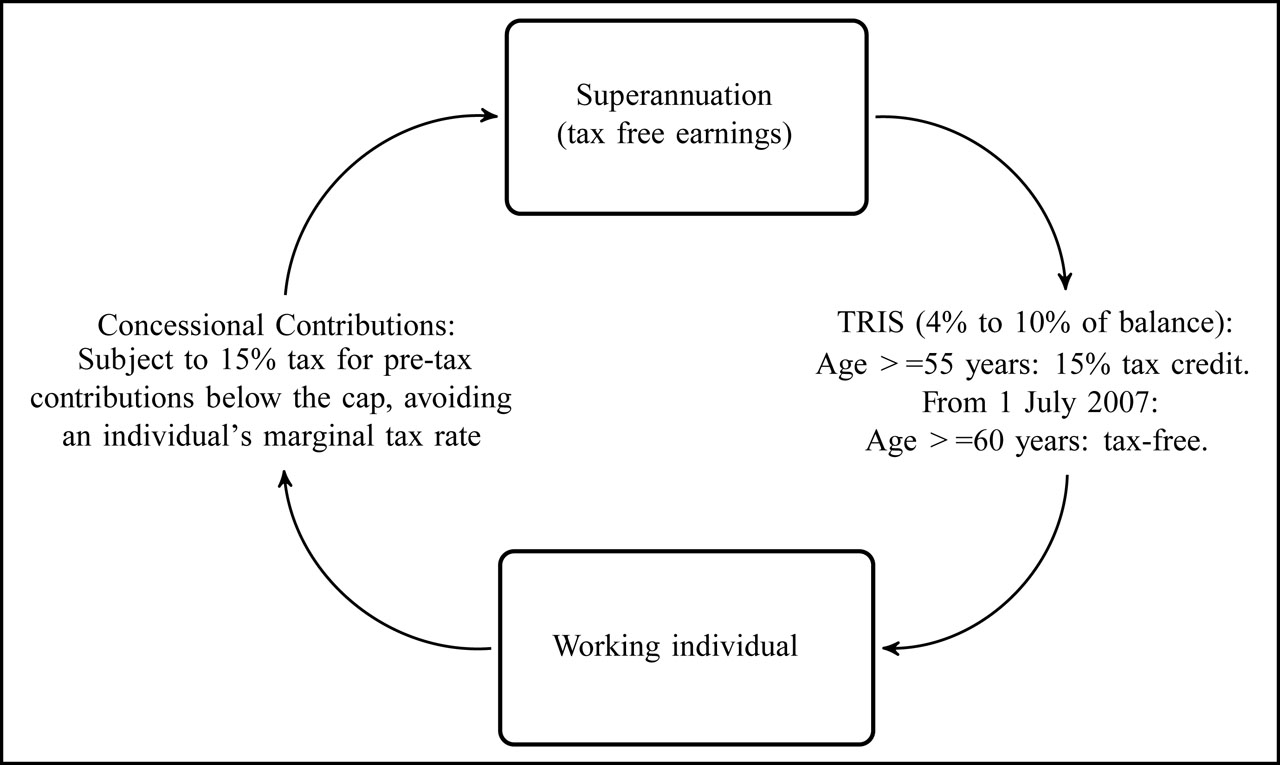
Figure A1
A tax-effective strategy.
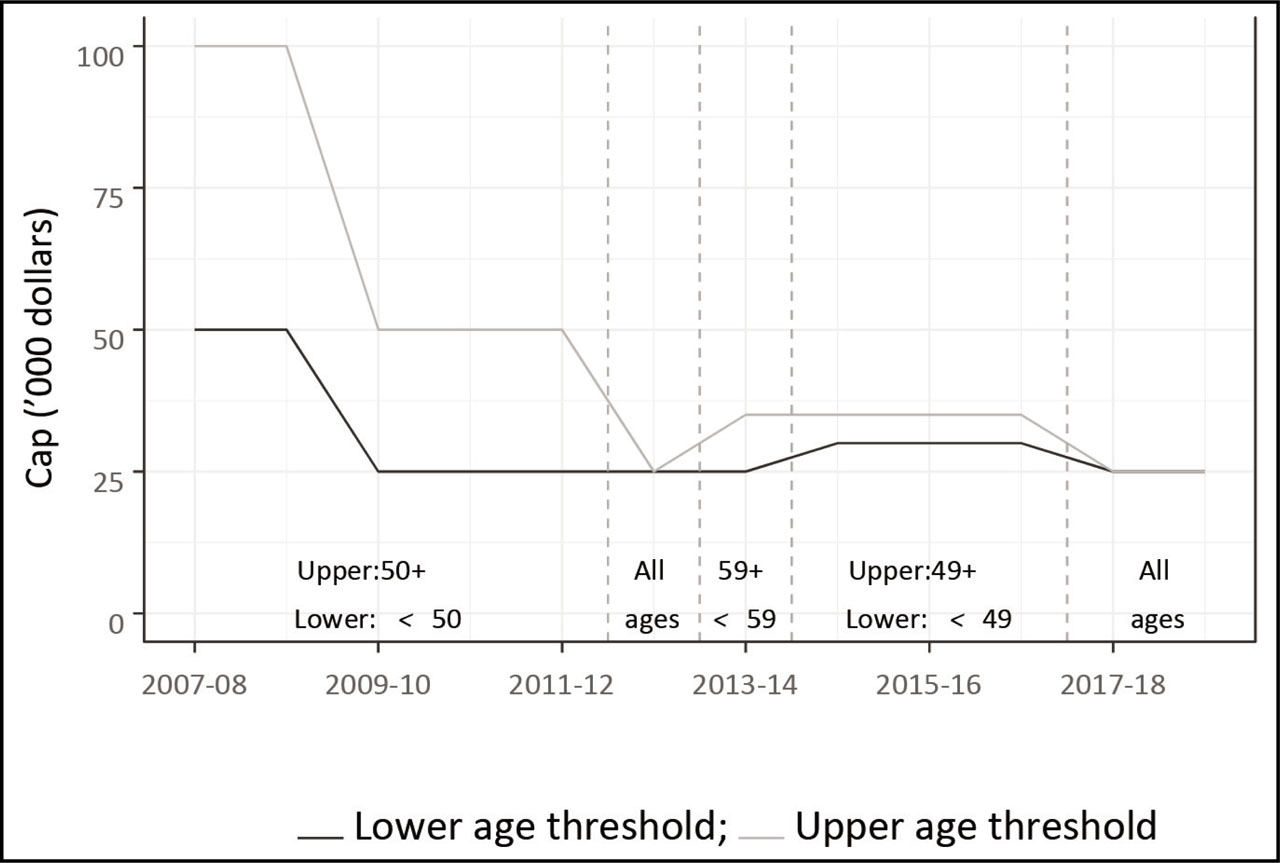
Figure A2
Historical concessional contributions caps.