
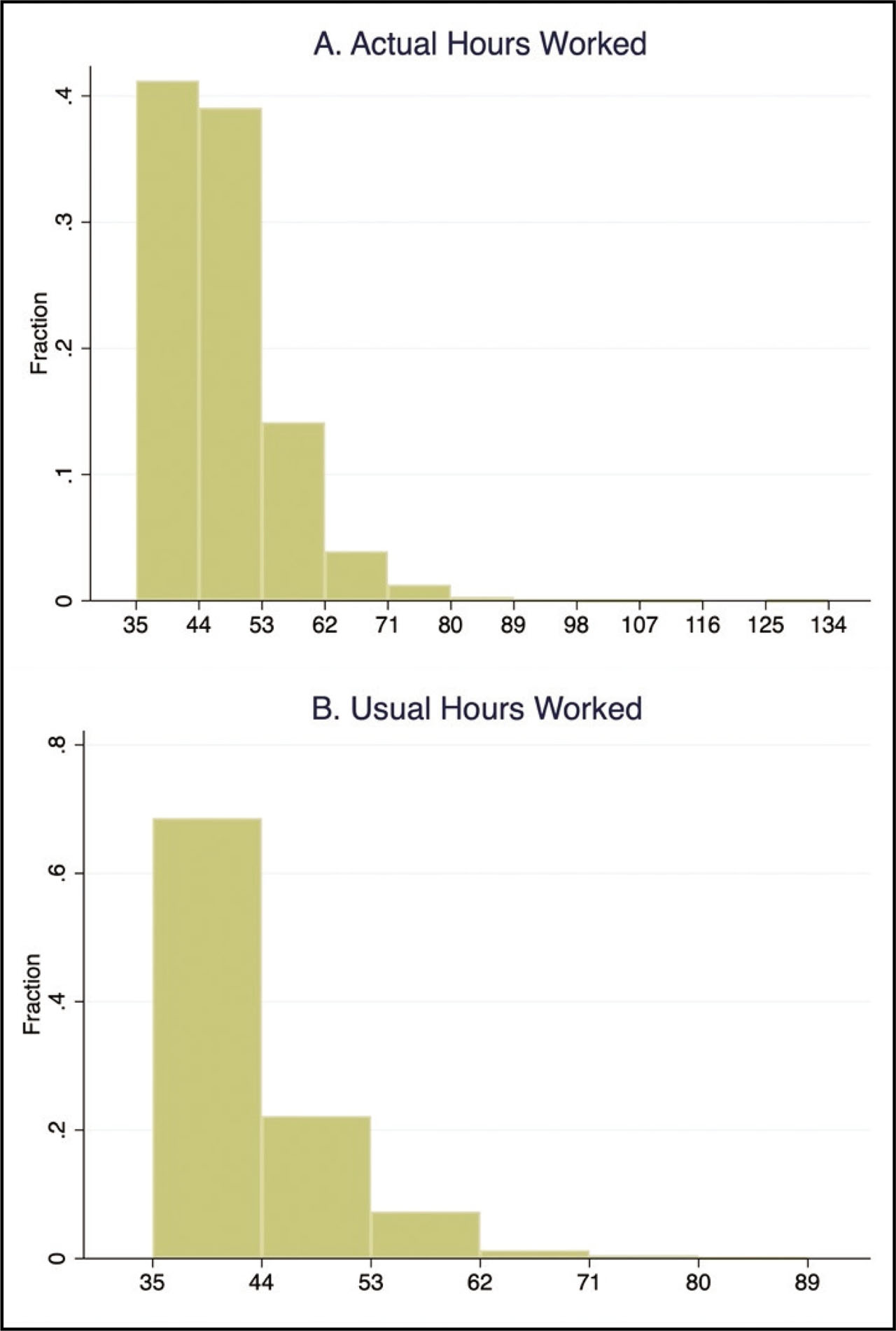
Figure 1
Distribution of hours worked before the policy change.
Notes: (A) Male workers between the ages of 25 and 55, who worked more than 34 h in the reference week, in all industries and establishment sizes subject to the new restriction. (B) Male workers between the ages of 25 and 55, who usually worked more than 34 h/week in all industries and establishment sizes subject to the new restriction.
Table 1
Summary statistics
| Before | After | |||
|---|---|---|---|---|
| Mean | SD | Mean | SD | |
| A. Outcome variables for full-time workers | ||||
| Actual hours worked | 46.971 | 8.134 | 45.188 | 7.056 |
| Usual hours worked* | 43.450 | 6.401 | 43.246 | 5.857 |
| Monthly earnings (10,000 Won)* | 329.171 | 153.306 | 353.503 | 169.142 |
| Hourly wages (10,000 Won)* | 1.783 | 0.906 | 1.909 | 0.981 |
| B. Outcome variables for workers working >52 h/week | ||||
| Actual hours worked | 60.345 | 6.612 | 59.814 | 6.284 |
| Usual hours worked* | 59.894 | 5.627 | 59.436 | 5.453 |
| Monthly earnings (10,000 Won)* | 272.004 | 111.977 | 307.123 | 128.292 |
| Hourly wages (10,000 Won)* | 1.050 | 0.446 | 1.186 | 0.499 |
| C. Demographic characteristics | ||||
| Age | 40.050 | 8.358 | 40.149 | 8.393 |
| Marital status | ||||
| Single | 0.283 | 0.450 | 0.313 | 0.464 |
| Married | 0.683 | 0.465 | 0.655 | 0.476 |
| Widowed | 0.004 | 0.062 | 0.004 | 0.059 |
| Divorced | 0.030 | 0.171 | 0.029 | 0.167 |
| D. Job characteristics | ||||
| Fixed-term contract | 0.100 | 0.300 | 0.107 | 0.310 |
| Status in employment | ||||
| Regular workers | 0.844 | 0.363 | 0.859 | 0.348 |
| Temporary workers | 0.089 | 0.284 | 0.079 | 0.269 |
| Daily hired workers | 0.038 | 0.194 | 0.034 | 0.180 |
| Self-employed with employees | 0.029 | 0.169 | 0.028 | 0.166 |
| Self-employed without employees | 0.000 | 0.004 | 0.000 | 0.002 |
| Unpaid family workers | 0.000 | 0.015 | 0.000 | 0.020 |
| Establishment size | ||||
| 5–9 employees | 0.187 | 0.390 | 0.183 | 0.386 |
| 10–29 employees | 0.246 | 0.430 | 0.249 | 0.433 |
| 30–99 employees | 0.221 | 0.415 | 0.216 | 0.411 |
| 100–299 employees | 0.137 | 0.343 | 0.137 | 0.344 |
| 300+ employees | 0.211 | 0.408 | 0.215 | 0.411 |
| E. Additional job characteristics* | ||||
| Special type of employment | 0.012 | 0.107 | 0.010 | 0.097 |
| Flexible work hours | 0.064 | 0.245 | 0.152 | 0.359 |
| Employer-sponsored pension | 0.897 | 0.304 | 0.913 | 0.282 |
| Employer-sponsored health care | 0.900 | 0.300 | 0.914 | 0.280 |
| Employment insurance | 0.794 | 0.404 | 0.842 | 0.365 |
| Severance pay | 0.890 | 0.313 | 0.906 | 0.292 |
| Bonus | 0.873 | 0.332 | 0.859 | 0.348 |
| Overtime pay | 0.670 | 0.470 | 0.669 | 0.471 |
| Paid vacation | 0.810 | 0.393 | 0.827 | 0.378 |
| Training | 0.681 | 0.466 | 0.675 | 0.468 |
| Salary form | ||||
| Monthly | 0.593 | 0.491 | 0.580 | 0.494 |
| Annually | 0.303 | 0.459 | 0.320 | 0.467 |
| Others | 0.104 | 0.305 | 0.100 | 0.300 |
| Union | ||||
| No union | 0.656 | 0.475 | 0.660 | 0.474 |
| Not eligible for union | 0.076 | 0.265 | 0.077 | 0.266 |
| Eligible but did not join union | 0.078 | 0.268 | 0.082 | 0.275 |
| Union member | 0.190 | 0.392 | 0.181 | 0.385 |
| Observations for all male full-time workers | 174,870 | 113,651 | ||
| Observations for male workers working >52 h/week | 34,322 | 14,212 | ||
| Observations for all male full-time workers* | 20,699 | 13,103 | ||
| Observations for male workers working >52 h/week* | 1,914 | 901 | ||
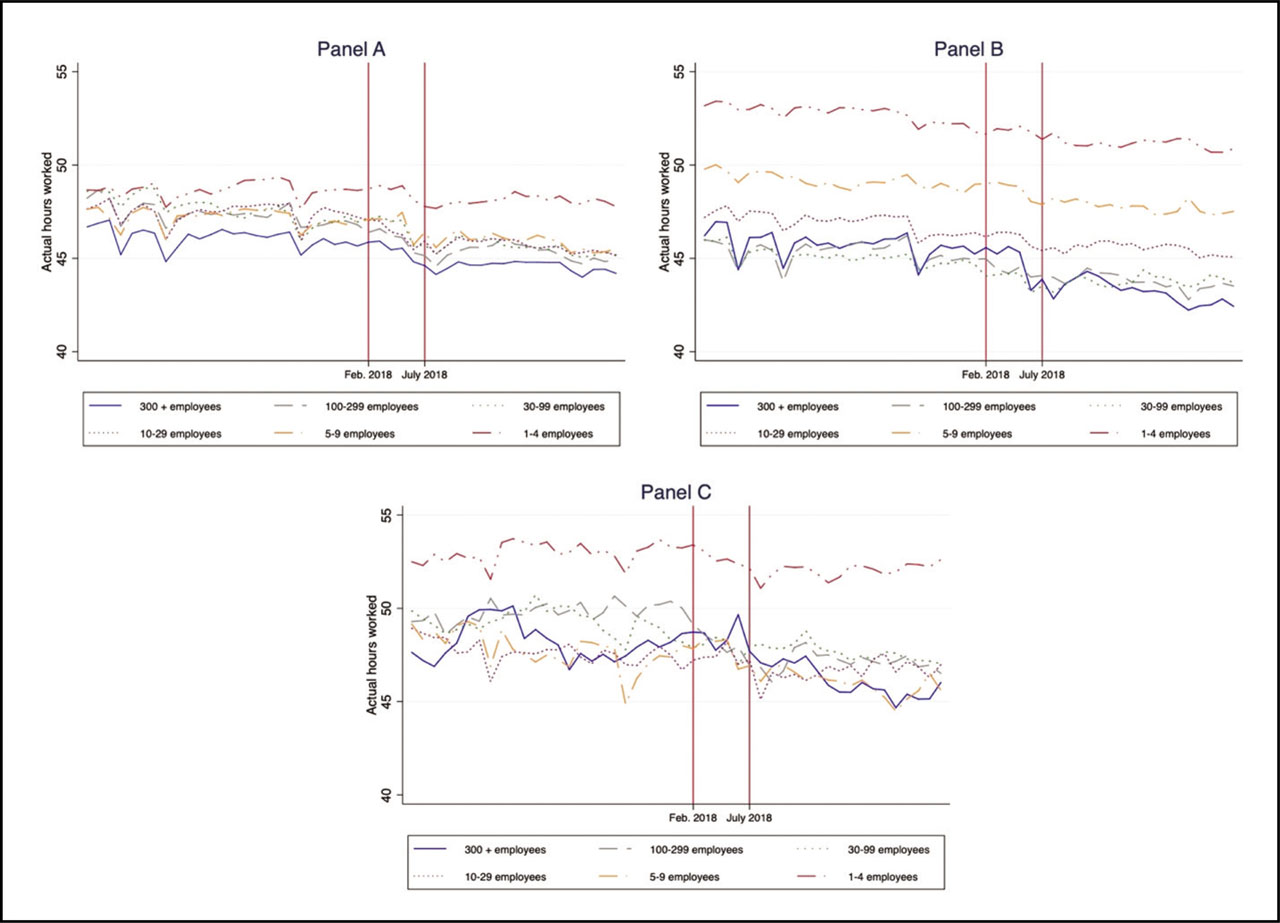
Figure 2
Trends in actual hours worked.
Notes: The new work hour restriction was passed on February 28, 2018 and first implemented on July 1, 2018. (A) Male workers between the ages of 25 and 55, who worked more than 34 h in the reference week in industries where the new restriction was enforced in all subsectors in July 2018. (B) Male workers between the ages of 25 and 55, who worked more than 34 h in the reference week in industries either where the new work hour restriction was enforced in July 2019 or where it was enforced in some subsectors in July 2018 and in the other subsectors in July 2019. (C) Male workers between the ages of 25 and 55, who worked more than 34 h in the reference week in industries where the new restriction was enforced in some subsectors in July 2019 but it would not be compulsory in the other subsectors due to the legal position of special case.
Table 2
Summary statistics for policy intensity
| Min | 1st Quartile | 2nd Quartile | 3rd Quartile | Max | Mean | SD |
|---|---|---|---|---|---|---|
| 0.009 | 0.135 | 0.192 | 0.241 | 0.862 | 0.200 | 0.099 |
| Proportion of workers working >52 h | 19.63% | |||||
| Observations | 174,870 | |||||
[i] Sources: The EAP Survey.
[ii] EAP, economically active population.
Table 3
Individual-level estimation results
| (1) | (2) | (3) | (4) | (5) | (6) | (7) | |
|---|---|---|---|---|---|---|---|
| Actual hours | Usual hours | Log monthly earnings | Log hourly wages | Usual hours | Log monthly earnings | Log hourly wages | |
| Treatment effect | −4.242*** (1.233) | −4.334*** (0.987) | 0.068 (0.054) | 0.142** (0.061) | −4.566*** (0.973) | 0.085* (0.050) | 0.169*** (0.054) |
| Basic controls | X | X | X | X | X | X | X |
| Additional controls | X | X | X | ||||
| Observations | 288,521 | 33,802 | 33,802 | 33,802 | 33,024 | 33,024 | 33,024 |
| R-squared | 0.115 | 0.147 | 0.495 | 0.500 | 0.160 | 0.525 | 0.541 |
Notes: Standard errors in parentheses are clustered at the industry-occupation-education group level. Estimation for actual hours uses monthly data while estimation for the other outcome variables uses annual data. Basic controls include age, age squared and dummy variables for marital status, fixed-term contract, status in employment, and establishment size. Additional controls include dummy variables for all the additional job characteristics described in Table 1.
Table 4
Group-level estimation results
| A. All Workers | ||||
|---|---|---|---|---|
| (1) | (2) | (3) | (4) | |
| Log total work hours | Log total employment | Log total worker pay | Log total worker pay | |
| Treatment effect | −0.143 (0.107) | −0.083 (0.110) | −0.135 (0.261) | −0.137 (0.249) |
| Basic controls | X | X | X | X |
| Additional controls | X | |||
| R-squared | 0.187 | 0.077 | 0.267 | 0.320 |
| B. Full-time Workers | ||||
|---|---|---|---|---|
| (1) | (2) | (3) | (4) | |
| Log total work hours | Log total employment | Log total worker pay | Log total worker pay | |
| Treatment effect | −0.151 (0.111) | −0.077 (0.116) | −0.203 (0.267) | −0.185 (0.279) |
| Basic controls | X | X | X | X |
| Additional controls | X | |||
| R-squared | 0.411 | 0.370 | 0.248 | 0.292 |
| Number of groups | 119 | 119 | 115 | 115 |
| Observations | 5,236 | 5,236 | 575 | 575 |
Notes: Standard errors in parentheses are clustered at the industry-occupation-education group level. Estimation for total work hours and total employment uses monthly data while estimation total worker pay uses annual data. Basic controls include the average age, the average age squared and dummy variables for marital status, fixed-term contract, status in employment, and establishment size. Additional controls include dummy variables for all the additional job characteristics described in Table 1.
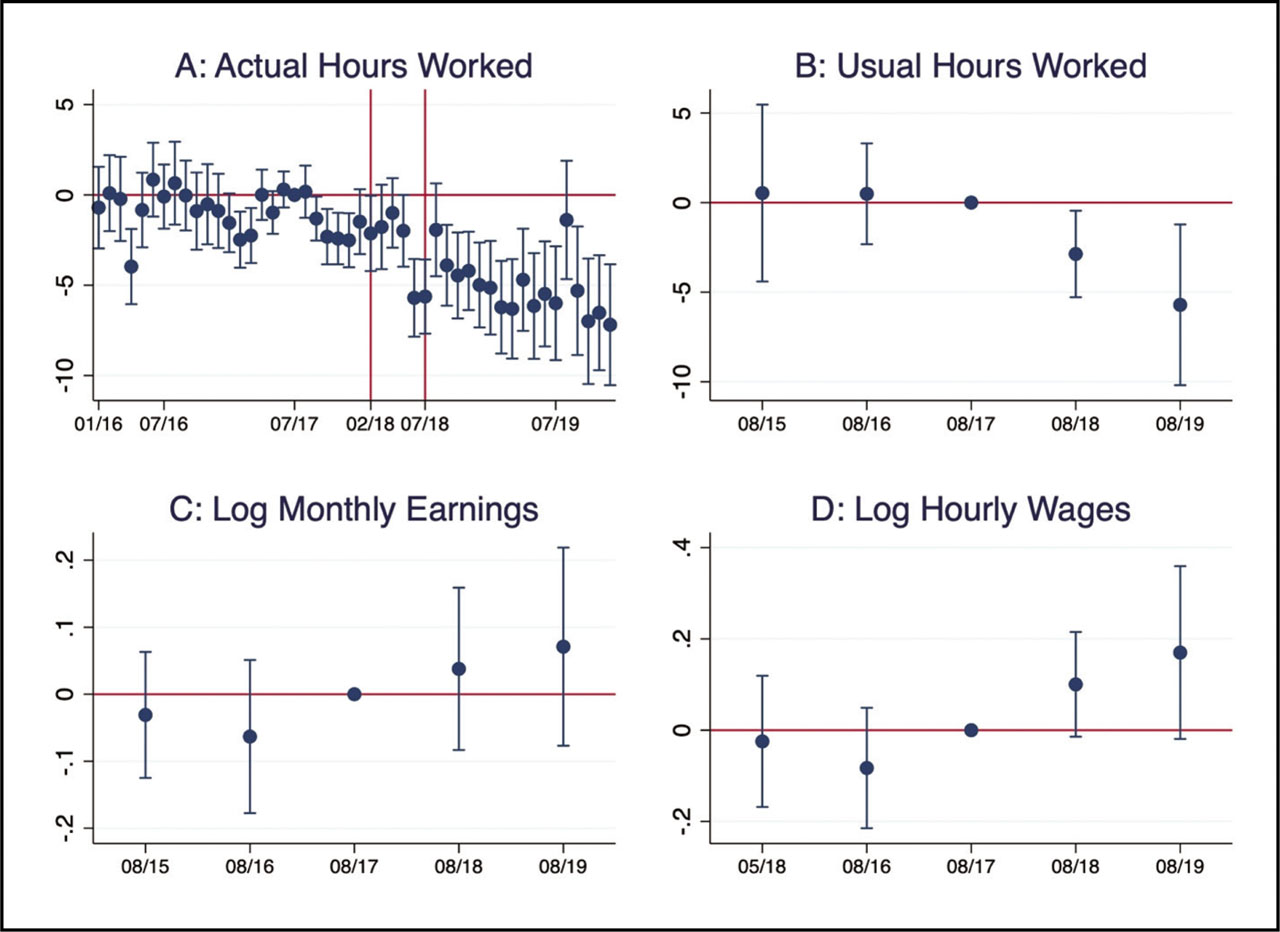
Figure 3
Individual-level event-study estimates.
Notes: The new work hour restriction was passed on February 28, 2018 and was first implemented on July 1, 2018. (A) Male workers between the ages of 25 and 55, who worked more than 34 h in the reference week, in all industries and establishment sizes subject to the new restriction. (B) Male workers between the ages of 25 and 55, who usually worked more than 34 h/week in all industries and establishment sizes subject to the new restriction. (C) Male workers between the ages of 25 and 55, who usually worked more than 34 h/week as salaried or hourly employees in all industries and establishment sizes subject to the new restriction. (D) Male workers between the ages of 25 and 55, who usually worked more than 34 h/week as salaried or hourly employees in all industries and establishment sizes subject to the new restriction.
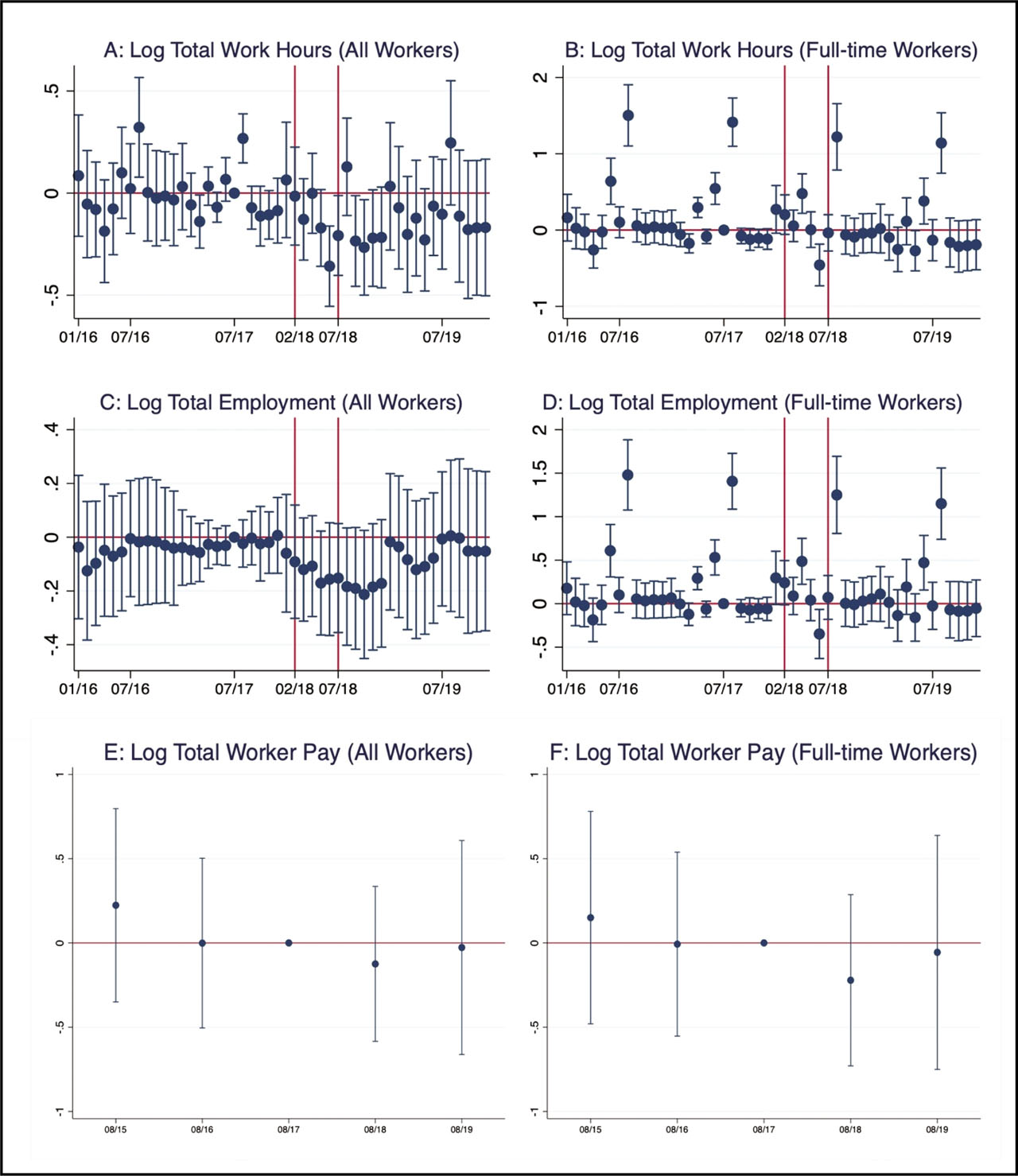
Figure 4
Group-level event-study estimates.
Notes: The new work hour restriction was passed on February 28, 2018 and was first implemented on July 1, 2018. (A) Total work hours are the sum of actual hours worked of all male workers between the ages of 25 and 55 who worked at least an hour in the reference week in all industries and establishment sizes subject to the new restriction. (B) Total work hours are the sum of actual hours worked of all male workers between the ages of 25 and 55 who worked more than 34 h in the reference week in all industries and establishment sizes subject to the new restriction. (C) Total employment is the number of all male workers between the ages of 25 and 55 who worked at least an hour in the reference week in all industries and establishment sizes subject to the new restriction. (D) Total employment is the number of all male workers between the ages of 25 and 55 who worked more than 34 h in the reference week in all industries and establishment sizes subject to the new restriction. (E) Total worker pay is the sum of monthly earnings of all male workers between the ages of 25 and 55 who usually worked at least an hour per week in all industries and establishment sizes subject to the new restriction. (F) Total worker pay is the sum of monthly earnings of all male workers between the ages of 25 and 55 who usually worked more than 34 h/week in all industries and establishment sizes subject to the new restriction.
Table 5
Pre-trend tests for individual-level outcomes
| (1) | (2) | (3) | (4) | (5) | (6) | (7) | |
|---|---|---|---|---|---|---|---|
| Actual hours | Usual hours | Log monthly earnings | Log hourly wages | Usual hours | Log monthly earnings | Log hourly wages | |
| Treatment effect | −1.092 (0.985) | −0.588 (1.742) | 0.038 (0.484) | 0.044 (0.061) | −0.513 (1.726) | 0.038 (0.470) | 0.045 (0.596) |
| Basic controls | X | X | X | X | X | X | X |
| Additional controls | X | X | X | ||||
| Observations | 146,583 | 20,699 | 20,699 | 20,699 | 20,699 | 20,699 | 20,699 |
| R-squared | 0.105 | 0.159 | 0.506 | 0.512 | 0.174 | 0.542 | 0.557 |
Notes: Standard errors in parentheses are clustered at the industry-occupation-education group level. Estimation for actual hours uses monthly data while estimation for the other outcome variables uses annual data. Pre-trend tests re-estimate Eqs (1) and (2) with the monthly data restricted to January 2016 to February 2017 and the annual data restricted to August 2015 to August 2017. Postmt is defined as 0 from January 2016 to February 2017 (from August 2015 to August 2016), and 1 from July 2017 to February 2018 (August 2017). Basic controls include age, age squared and dummy variables for marital status, fixed-term contract, status in employment, and establishment size. Additional controls include dummy variables for all the additional job characteristics described in Table 1.
Table 6
Pre-trend tests for group-level outcomes
| A. All workers | ||||
|---|---|---|---|---|
| (1) | (2) | (3) | (4) | |
| Log total work hours | Log total employment | Log total worker pay | Log total worker pay | |
| Treatment effect | 0.006 (0.100) | 0.054 (0.099) | −0.026 0.275 | 0.064 (0.231) |
| Basic controls | X | X | X | X |
| Additional controls | X | |||
| R-squared | 0.183 | 0.081 | 0.306 | 0.448 |
| B. Full-time workers | ||||
|---|---|---|---|---|
| (1) | (2) | (3) | (4) | |
| Log total work hours | Log total employment | Log total worker pay | Log total worker pay | |
| Treatment effect | 0.032 (0.099) | 0.060 (0.095) | 0.001 (0.289) | 0.074 (0.250) |
| Basic controls | X | X | X | X |
| Additional controls | X | |||
| R-squared | 0.458 | 0.425 | 0.280 | 0.438 |
| Number of groups | 119 | 119 | 115 | 115 |
| Observations | 2,618 | 2,618 | 345 | 575 |
Notes: Standard errors in parentheses are clustered at the industry-occupation-education group level. Estimation for total work hours and total employment uses monthly data while estimation total worker pay uses annual data. Pre-trend tests re-estimate the Eq. (3) with the monthly data restricted to January 2016 to February 2017 and the annual data restricted to August 2015 to August 2017. Postmt is defined as 0 from January 2016 to February 2017 (August 2015 to August 2016), and 1 from July 2017 to February 2018 (August 2017). Basic controls include the average age, the average age squared and dummy variables for marital status, fixed-term contract, status in employment, and establishment size. Additional controls include dummy variables for all the additional job characteristics described in Table 1.