
Table 1
Descriptive statistics on self-employment grants (in €)
| Year | # Grants | # New unlim. liab. firms | # New lim. liab. Firms | Mean amount | Median amount | SD of amount | Total amount |
|---|---|---|---|---|---|---|---|
| 2010 | 282 | 6,539 | 19,074 | 4,061 | 3,983 | 491 | 1,145,272 |
| 2011 | 770 | 7,532 | 19,947 | 3,851 | 3,876 | 744 | 2,965,571 |
| 2012 | 838 | 7,372 | 19,984 | 2,614 | 2,467 | 304 | 2,190,132 |
| 2013 | 4,409 | 9,641 | 30,416 | 2,074 | 1,930 | 1,175 | 9,145,960 |
| 2014 | 2,938 | 7,816 | 22,168 | 3,321 | 3,263 | 1,038 | 9,757,121 |
| 2015 | 2,649 | 7,235 | 21,119 | 3,398 | 3,274 | 643 | 9,000,336 |
| 2016 | 2,162 | 7,652 | 23,337 | 3,415 | 3,308 | 809 | 7,384,163 |
| 2017 | 2,526 | 9,905 | 6,060* | 4,749 | 4,658 | 1,269 | 11,995,409 |
Note: CES grants, unlimited and limited liability firms database. The monetary units are converted to Euros from Croatian Kuna based on the medium exchange rate on the last day of a particular year given by the Croatian National Bank. The period 2009–2014 was a period of recession in the Republic of Croatia.
CES, Croatian Employment Service.
Table 2
Descriptive statistics of unemployment spells which ended in employment
| Individual-level variables | Full sample | Entrepreneurial sample | ||||||
|---|---|---|---|---|---|---|---|---|
| Grant | No grant | Grant | No grant | |||||
| M | SD | M | SD | M | SD | M | SD | |
| Female | 0.426 | 0.494 | 0.523 | 0.499 | 0.428 | 0.495 | 0.458 | 0.498 |
| Age (years) | ||||||||
| ≤20 | 0.027 | 0.163 | 0.104 | 0.305 | 0.027 | 0.163 | 0.051 | 0.221 |
| 20–30 | 0.305 | 0.46 | 0.386 | 0.487 | 0.302 | 0.459 | 0.354 | 0.478 |
| 30–40 | 0.376 | 0.484 | 0.236 | 0.425 | 0.377 | 0.485 | 0.315 | 0.464 |
| 40–50 | 0.203 | 0.402 | 0.173 | 0.378 | 0.204 | 0.403 | 0.192 | 0.394 |
| ≥50 | 0.089 | 0.284 | 0.101 | 0.302 | 0.089 | 0.285 | 0.088 | 0.283 |
| Education | ||||||||
| Elementary or less | 0.057 | 0.232 | 0.152 | 0.359 | 0.058 | 0.233 | 0.088 | 0.284 |
| High school | 0.685 | 0.464 | 0.671 | 0.47 | 0.688 | 0.463 | 0.708 | 0.455 |
| University or more | 0.258 | 0.437 | 0.177 | 0.382 | 0.254 | 0.435 | 0.204 | 0.403 |
| Tenure | ||||||||
| ≤2 years | 0.098 | 0.297 | 0.179 | 0.383 | 0.097 | 0.296 | 0.128 | 0.334 |
| 2–5 years | 0.108 | 0.311 | 0.134 | 0.34 | 0.107 | 0.309 | 0.131 | 0.337 |
| 5–10 years | 0.206 | 0.404 | 0.179 | 0.383 | 0.204 | 0.403 | 0.211 | 0.408 |
| 10–20 years | 0.365 | 0.482 | 0.237 | 0.425 | 0.369 | 0.483 | 0.315 | 0.465 |
| ≥20 years | 0.14 | 0.347 | 0.155 | 0.362 | 0.142 | 0.349 | 0.135 | 0.342 |
| Unemployment episode variables Duration of unemployment episode | ||||||||
| ≤30 days | 0.016 | 0.126 | 0.108 | 0.31 | 0.016 | 0.125 | 0.092 | 0.289 |
| 30–90 days | 0.223 | 0.416 | 0.252 | 0.434 | 0.224 | 0.417 | 0.247 | 0.431 |
| 90–180 days | 0.294 | 0.456 | 0.254 | 0.435 | 0.3 | 0.458 | 0.263 | 0.44 |
| 180 days–1 year | 0.245 | 0.43 | 0.228 | 0.42 | 0.243 | 0.429 | 0.235 | 0.424 |
| 1–2 years | 0.146 | 0.353 | 0.102 | 0.302 | 0.143 | 0.35 | 0.11 | 0.313 |
| 2–3 years | 0.043 | 0.203 | 0.031 | 0.173 | 0.043 | 0.203 | 0.032 | 0.175 |
| ≥3 years | 0.032 | 0.176 | 0.025 | 0.158 | 0.032 | 0.175 | 0.021 | 0.145 |
| Status before unemployment | ||||||||
| Employment | 0.702 | 0.457 | 0.757 | 0.429 | 0.704 | 0.456 | 0.763 | 0.425 |
| Education | 0.036 | 0.185 | 0.083 | 0.275 | 0.034 | 0.182 | 0.047 | 0.211 |
| Inactivity | 0.241 | 0.428 | 0.128 | 0.334 | 0.239 | 0.427 | 0.17 | 0.376 |
| Vocational training | 0.008 | 0.092 | 0.02 | 0.138 | 0.009 | 0.092 | 0.008 | 0.09 |
| Other | 0.013 | 0.113 | 0.013 | 0.112 | 0.013 | 0.115 | 0.012 | 0.108 |
| Employment exit reason | ||||||||
| Not applicable | 0.299 | 0.458 | 0.245 | 0.43 | 0.296 | 0.457 | 0.239 | 0.426 |
| Expiration of contract | 0.226 | 0.418 | 0.446 | 0.497 | 0.225 | 0.418 | 0.309 | 0.462 |
| Expiration of seasonal contract | 0.012 | 0.11 | 0.068 | 0.251 | 0.012 | 0.11 | 0.044 | 0.205 |
| Dismissal (econ., tech., and org. reasons) | 0.309 | 0.462 | 0.16 | 0.367 | 0.311 | 0.463 | 0.272 | 0.445 |
| Dismissal | 0.022 | 0.147 | 0.012 | 0.107 | 0.023 | 0.149 | 0.018 | 0.133 |
| Worker resigned | 0.03 | 0.171 | 0.016 | 0.125 | 0.03 | 0.171 | 0.017 | 0.131 |
| Consensual resignation | 0.085 | 0.279 | 0.043 | 0.203 | 0.084 | 0.278 | 0.054 | 0.227 |
| Firm closure | 0.015 | 0.121 | 0.009 | 0.097 | 0.016 | 0.124 | 0.043 | 0.203 |
| Other | 0.003 | 0.054 | 0.002 | 0.043 | 0.003 | 0.056 | 0.003 | 0.051 |
| Unemployment exit reason | ||||||||
| Job in-country | 0.069 | 0.254 | 0.953 | 0.211 | 0.001 | 0.025 | 0.532 | 0.499 |
| Job abroad | 0 | 0 | 0.017 | 0.128 | 0 | 0 | 0.007 | 0.085 |
| Opening of limited liability firm | 0.337 | 0.473 | 0.003 | 0.056 | 0.362 | 0.481 | 0.135 | 0.341 |
| Opening of unlimited liability firm | 0.593 | 0.491 | 0.007 | 0.084 | 0.637 | 0.481 | 0.31 | 0.462 |
| Other | 0 | 0.016 | 0.02 | 0.139 | 0 | 0 | 0.016 | 0.126 |
| Individual-based spell variables | ||||||||
| Unemployment reentry | 0.129 | 0.336 | 0.661 | 0.473 | 0.13 | 0.336 | 0.602 | 0.489 |
| Days to unemployment reentry | 976.68 | 621.54 | 555.73 | 681.740 | 962.59 | 612.40 | 699.48 | 718.49 |
| Sample size | 15,129 | 1,514,542 | 14,086 | 35,125 | ||||
[i] Note: Full sample consists of all unemployment episodes from January 1, 2009, until November 23, 2017, and finished in employment. The entrepreneurial sample is a subset of the full sample containing all episodes of individuals who exited unemployment due to entrepreneurial reasons at least once. Year of entry and exit, NACE sectors of entry are omitted for brevity reasons.
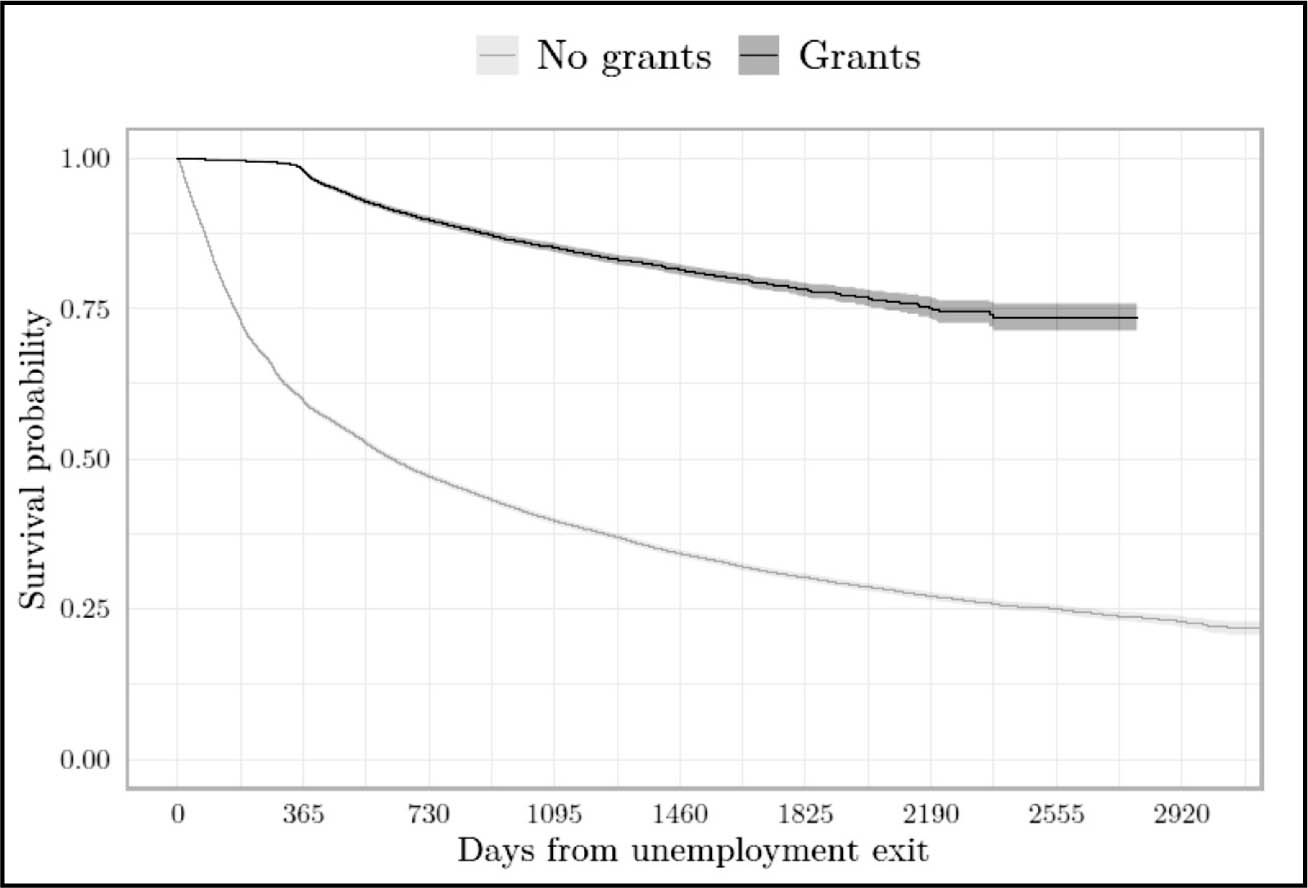
Figure 1
Kaplan–Meier estimate of employment survival.
Table 3
Results, unemployment reentry: linear models
| Sample mean | Entrepreneurial sample | N | ||||
|---|---|---|---|---|---|---|
| (1) | (2) | (3) | (4) | |||
| Not unemployed after | ||||||
| 6 months | 0.768 | 0.197*** (0.004) | 0.191*** (0.004) | 0.023*** (0.003) | 0.020 (0.015) | 48,259 |
| 12 months | 0.652 | 0.335*** (0.004) | 0.326*** (0.004) | 0.066*** (0.004) | 0.086*** (0.017) | 45,692 |
| 18 months | 0.577 | 0.353*** (0.005) | 0.343*** (0.005) | 0.052*** (0.005) | 0.064*** (0.020) | 43,406 |
| 24 months | 0.515 | 0.381*** (0.005) | 0.371*** (0.005) | 0.057*** (0.005) | 0.080*** (0.022) | 40,508 |
| 36 months | 0.416 | 0.354*** (0.006) | 0.342*** (0.006) | 0.020*** (0.006) | 0.073*** (0.024) | 34,530 |
| Individual-based covariates | No | Yes | Yes | Yes | – | |
| Episode based covariates | No | No | Yes | Yes | – | |
| Individual fixed-effects | No | No | No | Yes | – | |
Note: Entrepreneurial sample is a subset of a full sample containing all episodes of individuals who exited unemployment due to entrepreneurial reasons at least once. Individual-based covariates are gender, age, education, tenure, all discretized according to Table 2. Episode-based covariates include duration of the episode, reason for unemployment entry, reason for unemployment exit, reason for employment exit, NACE 1-digit industry sector, year of unemployment entry, and year of unemployment exit, all dummies discretized according to Table 2. Standard errors clustered at the individual level are in parentheses.
Table 4
Results, unemployment reentry: survival models
| Entrepreneurial sample | ||||||
|---|---|---|---|---|---|---|
| COX proportional hazard | Parametric Weibull | COX mixed effects | ||||
| Coefficient hazard ratio | ||||||
| Survival | −0.443*** (0.030) | 0.642 [0.606, 0.680] | 0.501*** (0.033) | 0.640 [0.599, 0.683] | −0.447*** (0.030) | 0.640 [0.603, 0.679] |
| Observations | 49,211 | 49,211 | 49,211 | |||
| Ind. covariates | Yes | Yes | Yes | |||
| Epis. covariates | Yes | Yes | Yes | |||
Note: Entrepreneurial sample is a subset of a full sample containing all episodes of individuals who exited unemployment due to entrepreneurial reasons at least once. All estimates include individual-based covariates—gender, age, education, tenure, and episode-based covariates include duration of the episode, reason for unemployment entry, reason for unemployment exit, reason for employment exit, NACE 1-digit industry sector, year of unemployment entry, and year of unemployment exit, all dummies discretized according to Table 2. Parentheses contain robust standard errors, while brackets contain a 95% confidence interval of the hazard ratio.
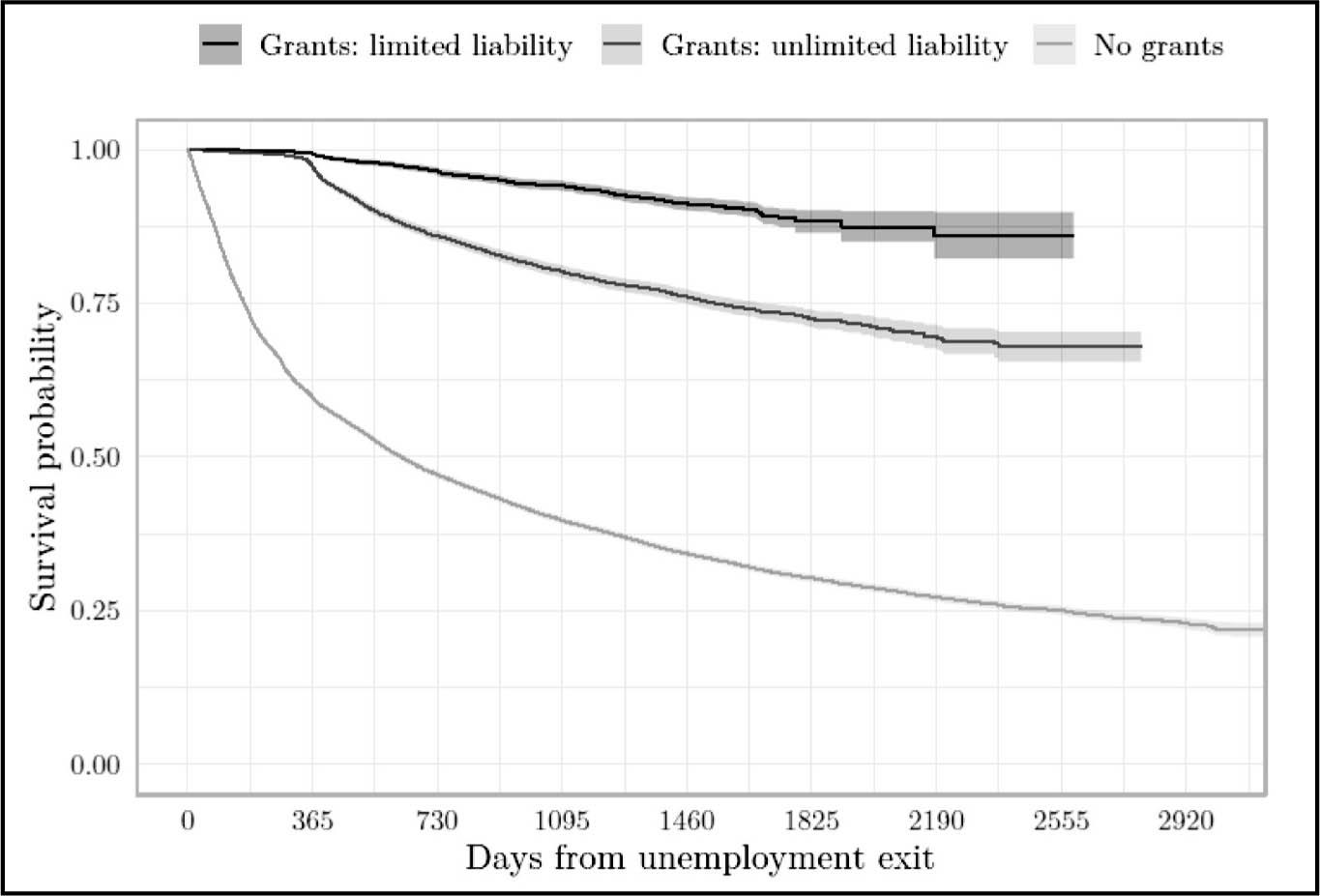
Figure 2
Kaplan–Meier estimate of employment survival by legal form.
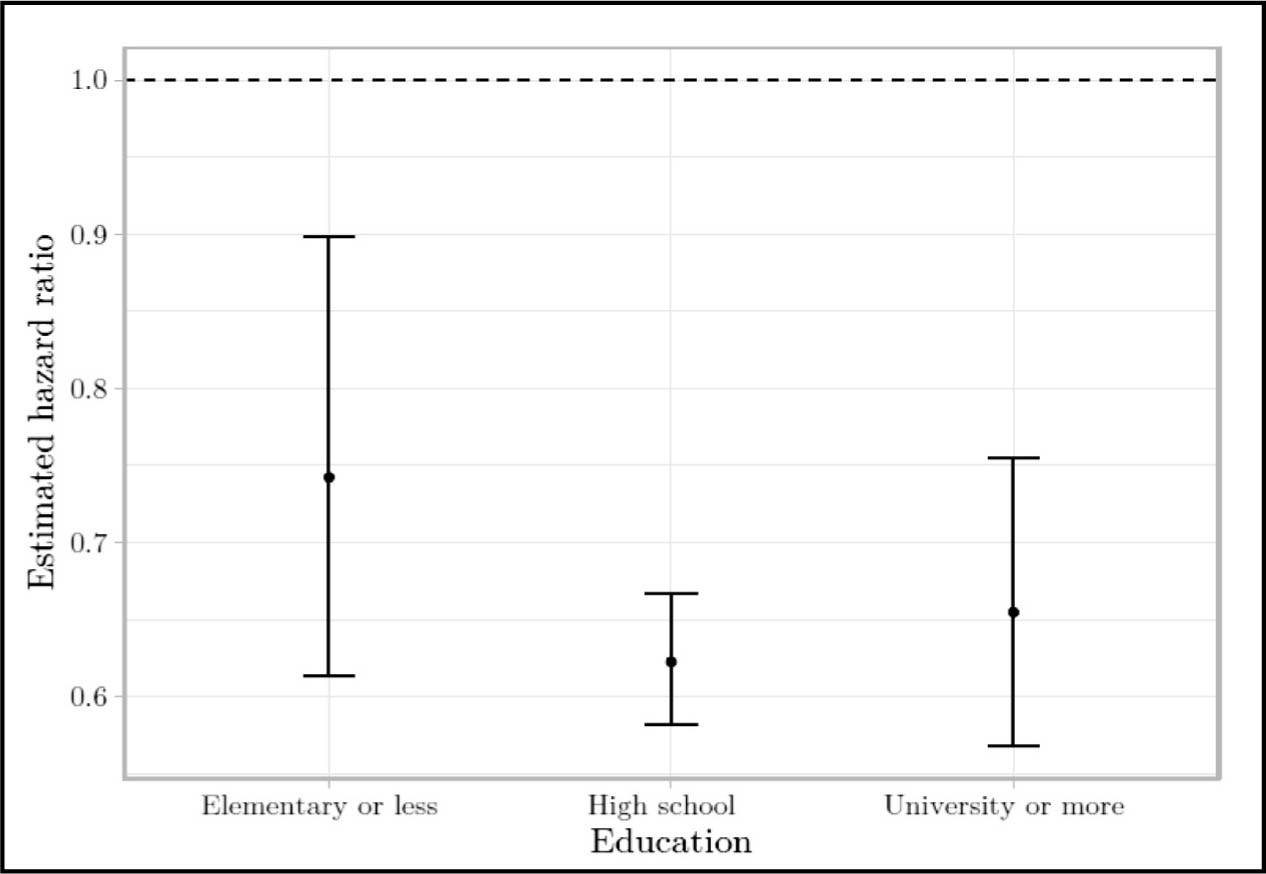
Figure 3
Heterogeneous effects: education.
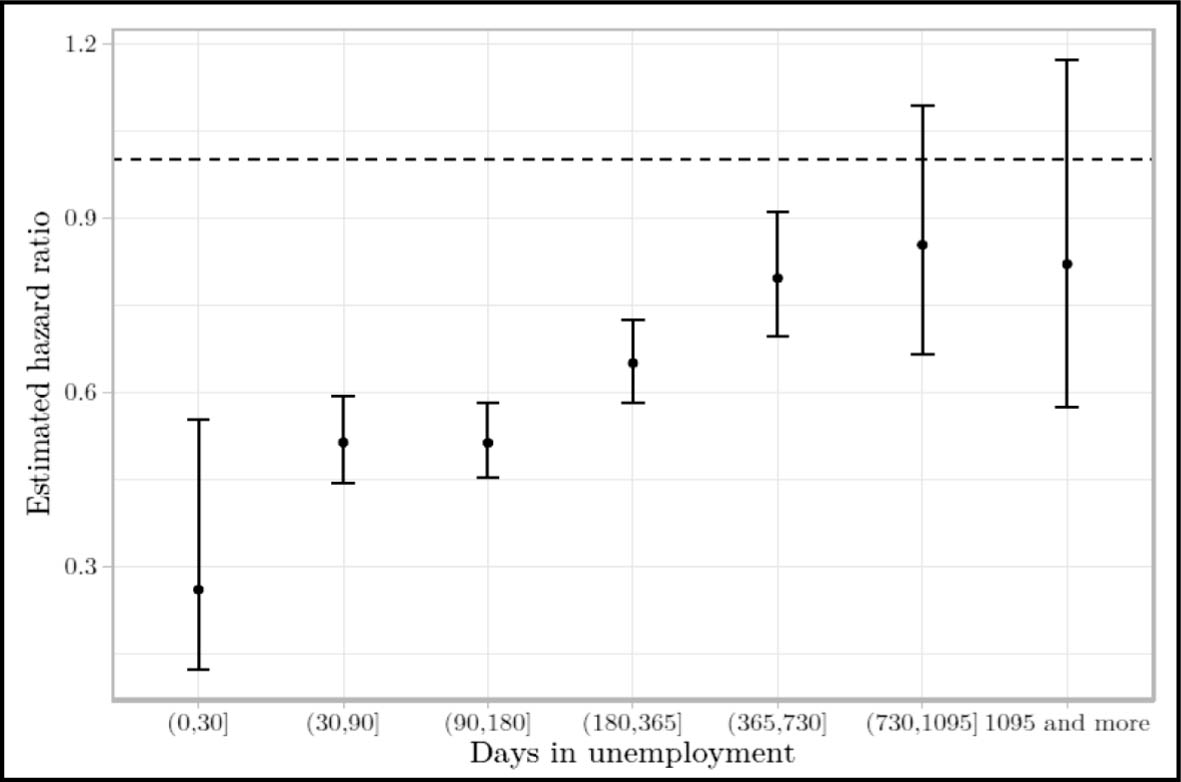
Figure 4
Heterogeneous effects: time spent at the unemployment office.
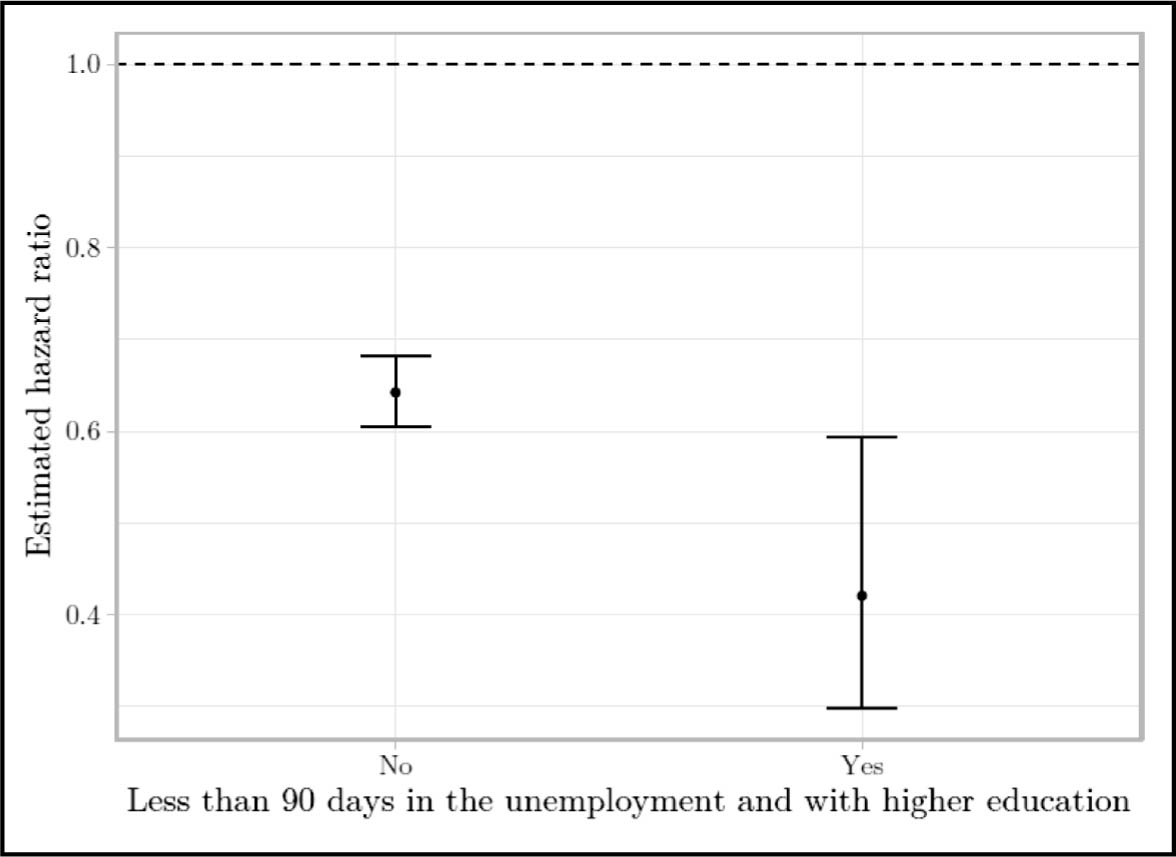
Figure 5
Heterogeneous effects: potentially bogus employment.
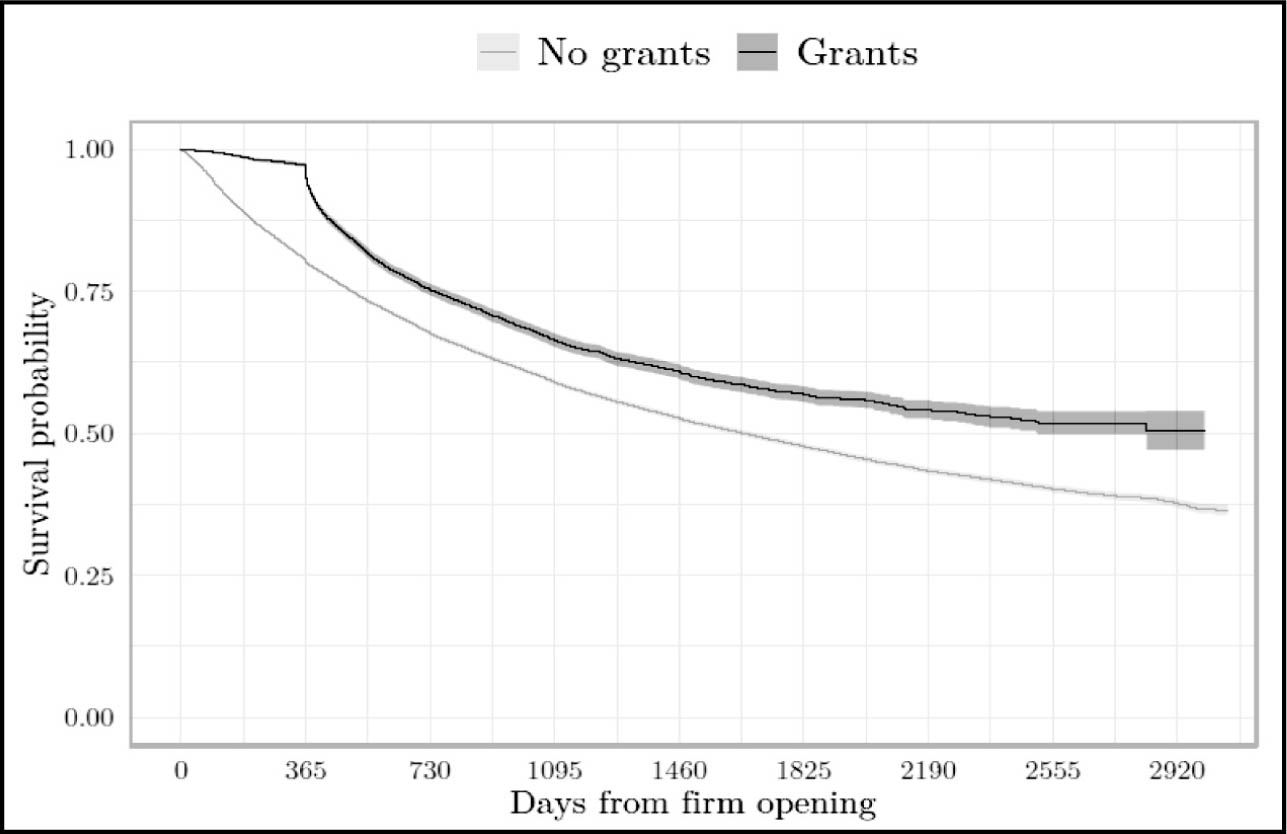
Figure 6
Kaplan–Meier firm survival estimates.
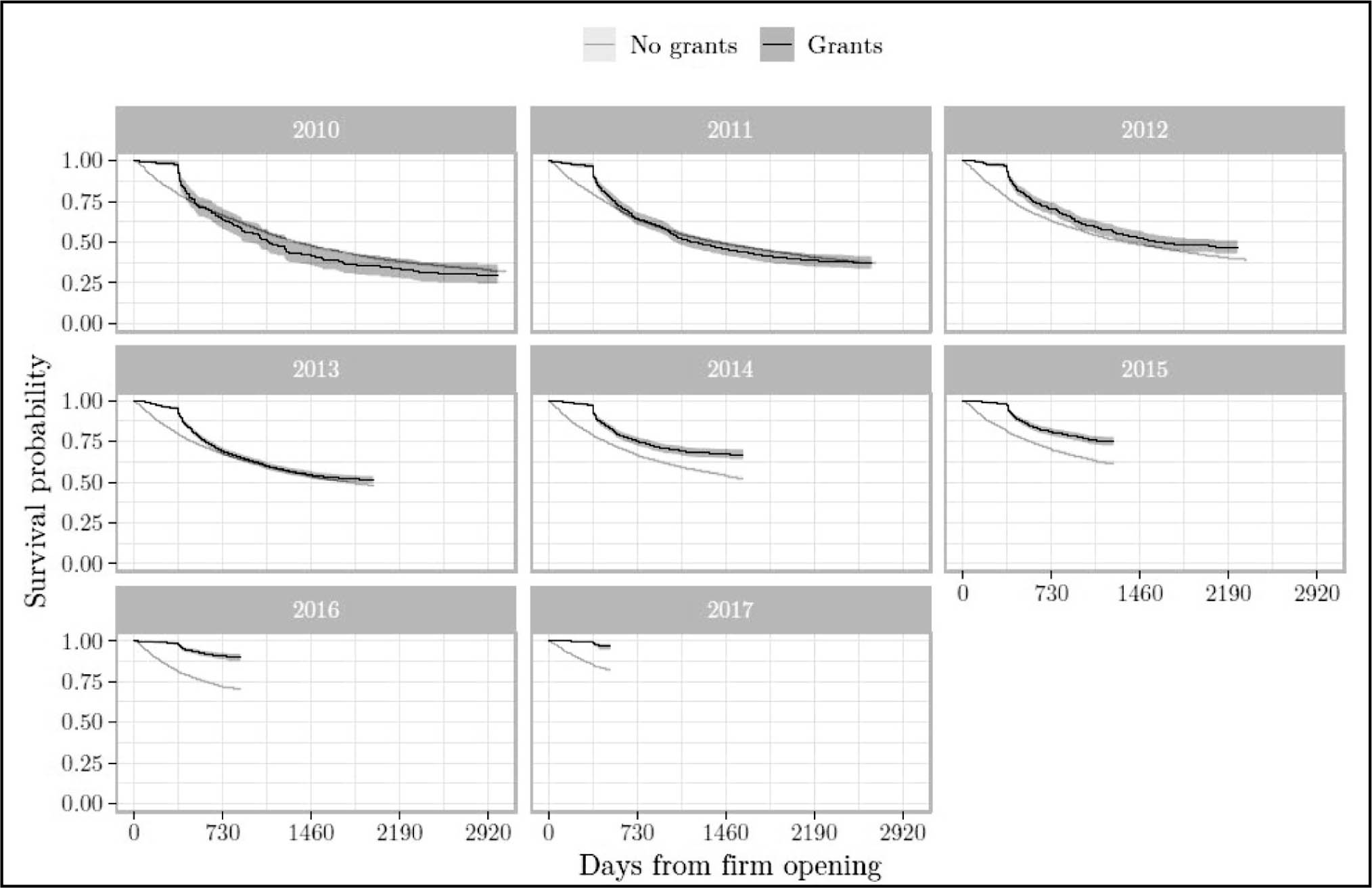
Figure 7
Kaplan–Meier firm survival estimates by years.
Table 5
Regression results for limited liability firms
| Employees (at least) | N | |||||
|---|---|---|---|---|---|---|
| Sales | Employment | One | Two | Survival | ||
| (1) | (2) | (3) | (4) | (5) | ||
| Time horizon | ||||||
| End of firm registration year (t) | −9,467*** (1,173) | −0.023 (0.070) | 0.332*** (0.006) | −0.040*** (0.006) | 46,336 | |
| 1 year later (t+1) | −36,214*** (5,217) | −0.436*** (0.097) | 0.217*** (0.007) | −0.074*** (0.010) | −0.018*** (0.006) | 34,300 |
| 2 years later (t+2) | −35,921*** (5,946) | −0.579*** (0.131) | 0.136*** (0.010) | −0.045*** (0.012) | −0.037*** (0.009) | 24,804 |
Note: Models 1 and 2 are OLS regression estimates, while Models 3–5 are marginal effects from probit regressions. All estimates include NACE 2-digit industry dummies, county of firm headquarters, year of firm registration, type of a firm's legal form, number of months a firm was officially open during the year (all dummies), the value of capital owner registered, and other types of grants as covariates [used in Srhoj et al. (2021, 2019)]. Standard errors clustered at NACE 2-digit level are in the parenthesis. Sample sizes of probit regressions on survival are 37,625 (t+1) and 30,330 (t+2).
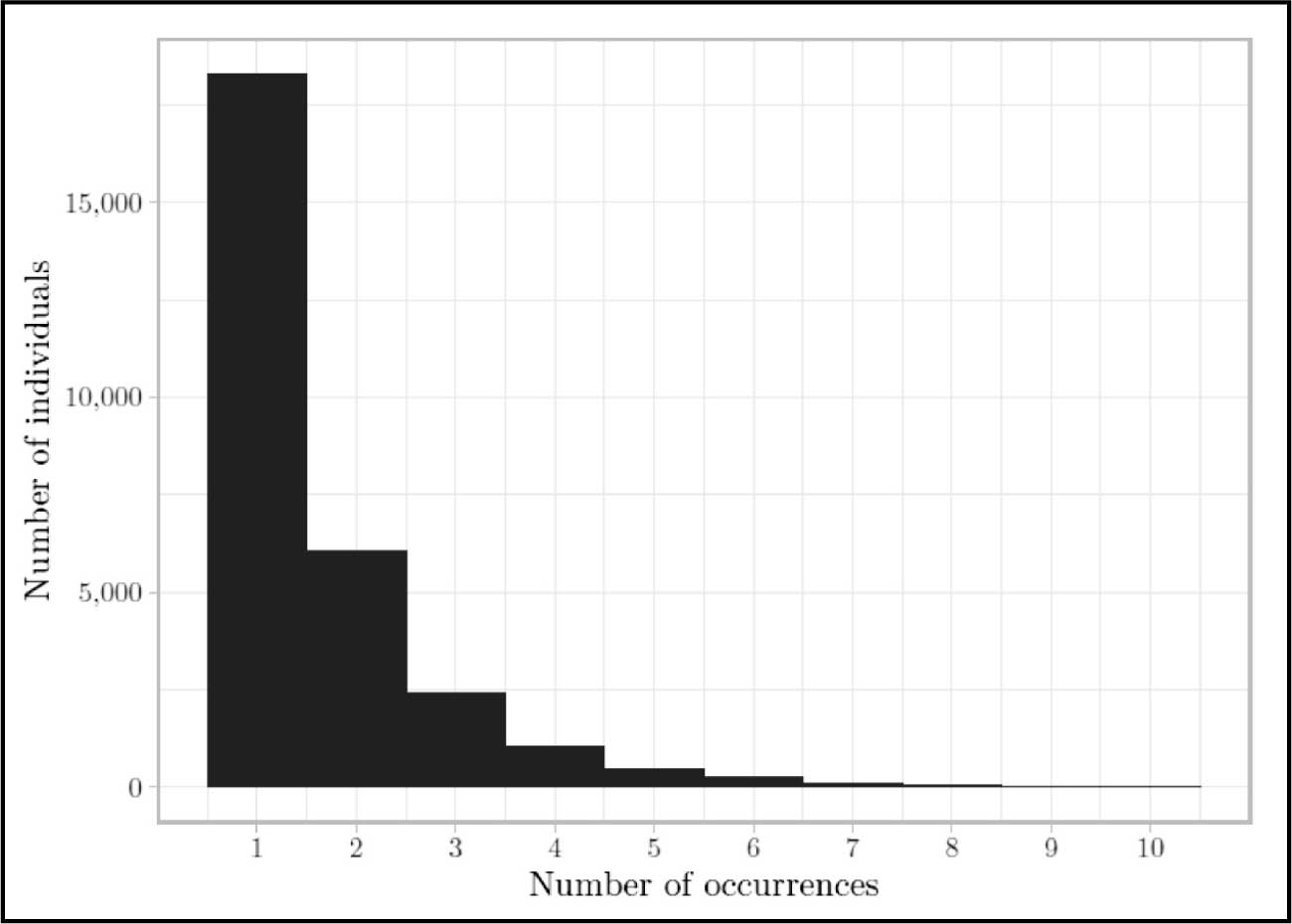
Figure A1
Number of appearances of individuals in the entrepreneurial sample.
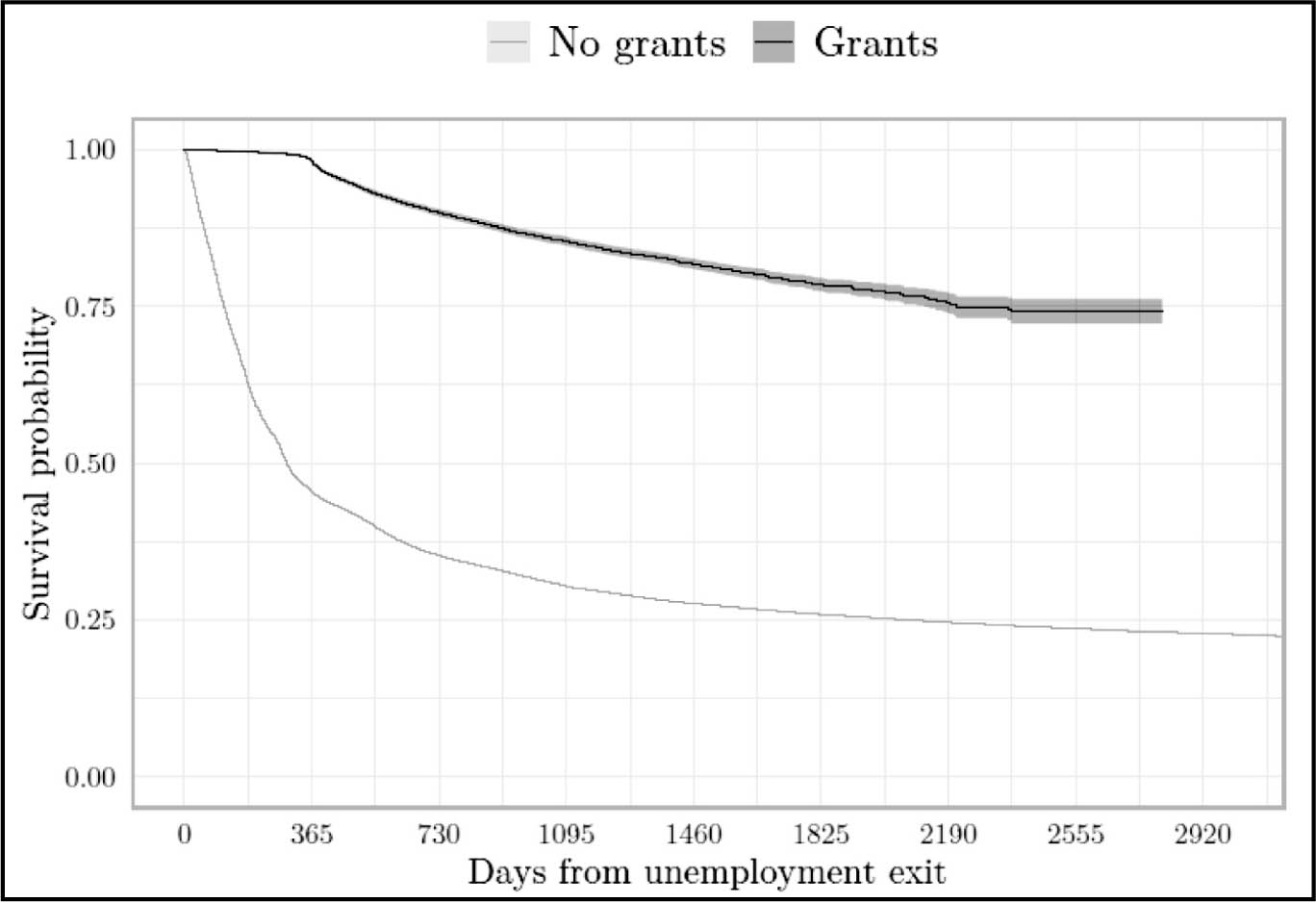
Figure A2
Kaplan–Meier estimates of employment survival: full sample.
Table A1
Results, unemployment re-entry: full sample
| Sample mean | Full sample | N | ||||
|---|---|---|---|---|---|---|
| (1) | (2) | (3) | (4) | |||
| Not unemployed after | ||||||
| 6 months | 0.617 | 0.297*** (0.002) | 0.273*** (0.002) | 0.052*** (0.003) | 0.013 (0.013) | 1,497,186 |
| 12 months | 0.428 | 0.474*** (0.003) | 0.448*** (0.003) | 0.112*** (0.004) | 0.095*** (0.015) | 1,424,800 |
| 18 months | 0.371 | 0.471*** (0.003) | 0.445*** (0.003) | 0.103*** (0.005) | 0.077*** (0.017) | 1,338,826 |
| 24 months | 0.314 | 0.490*** (0.004) | 0.464*** (0.004) | 0.111*** (0.005) | 0.104*** (0.018) | 1,255,829 |
| 36 months | 0.251 | 0.442*** (0.005) | 0.419*** (0.005) | 0.087*** (0.006) | 0.112*** (0.020) | 1,066,772 |
| Individual-based covariates | No | Yes | Yes | Yes | – | |
| Episode-based covariates | No | No | Yes | Yes | – | |
| Individual fixed-effects | No | No | No | Yes | – | |
Note: The full sample consists of all unemployment episodes from January 1, 2009, until November 23, 2017, and finishing in employment. Individual-based covariates are gender, age, education, tenure, all discretized according to Table 2. Episode-based covariates include duration of the episode, reason for entering unemployment, reason of exiting unemployment, reason of employment exit, NACE 1-digit industry sector, year of entering unemployment, and year of exiting unemployment, all dummies discretized according to Table 2. Standard errors clustered at the individual level are in the parenthesis.
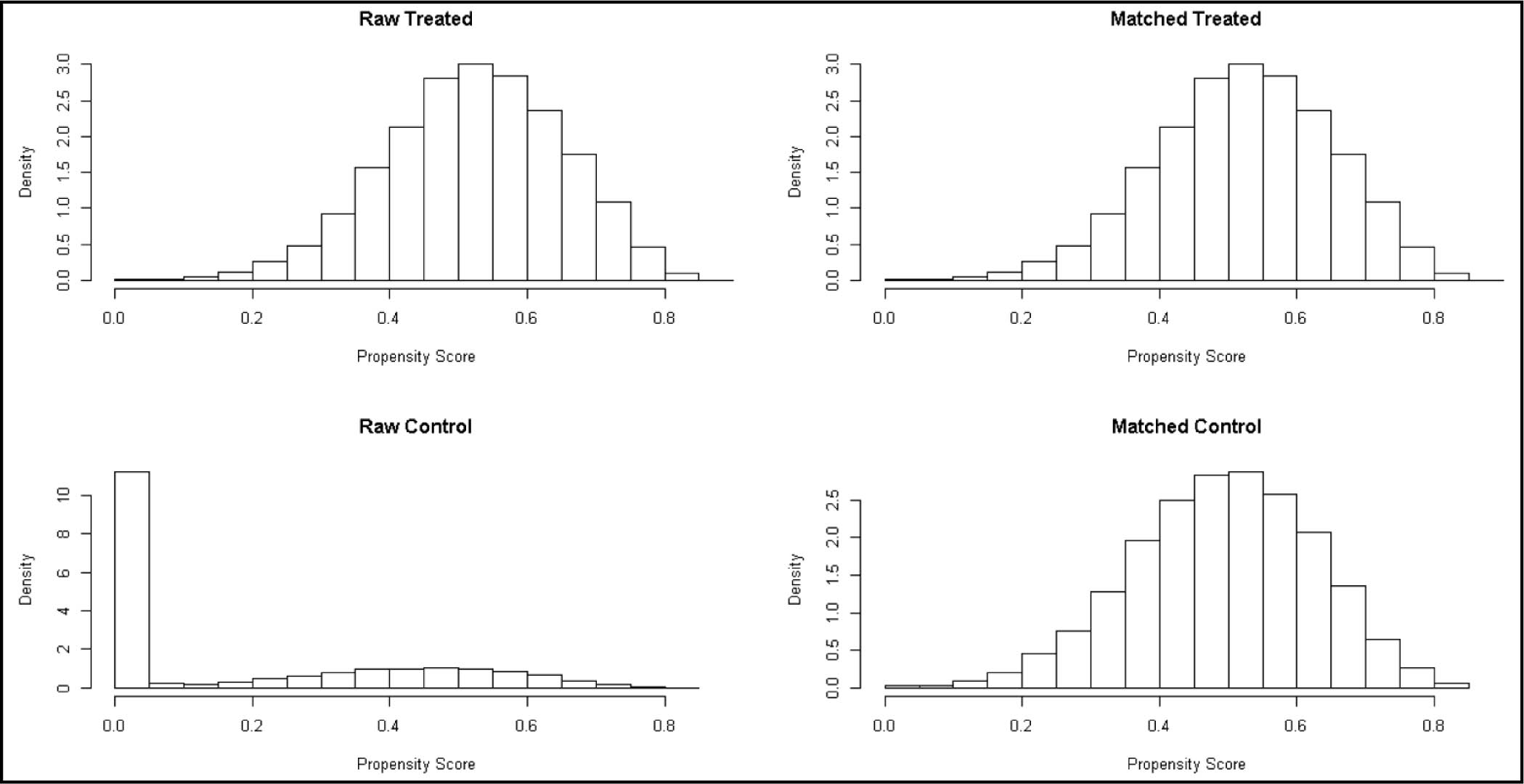
Figure A3
Overlap of propensity scores before and after nearest neighbor matching.
Table A2
Nearest neighbor matching and linear model
| Matching | Linear model | |||||
|---|---|---|---|---|---|---|
| Sample mean | (1) | N | Sample mean | (2) | N | |
| Not employed after | ||||||
| 6 months | 0.877 | 0.010** (0.005) | 21,404 | 0.768 | 0.023*** (0.003) | 48,259 |
| 12 months | 0.775 | 0.055*** (0.006) | 21,404 | 0.652 | 0.066*** (0.004) | 45,692 |
| 18 months | 0.673 | 0.066*** (0.007) | 21,404 | 0.577 | 0.052*** (0.005) | 43,406 |
| 24 months | 0.576 | 0.095*** (0.007) | 21,404 | 0.515 | 0.057*** (0.005) | 40,508 |
| 36 months | 0.405 | 0.058*** (0.007) | 21,404 | 0.416 | 0.020*** (0.006) | 34,530 |
Notes: Estimates in the column “Matching” represent the average treatment effect on the treated obtained by the nearest neighbor matching. The selection equation is solved with a probit model containing covariates as in Table 3. Individual-based covariates are gender, age, education, tenure, all discretized according to Table 2. Episode-based covariates include duration of the episode, reason of unemployment entry, reason of unemployment exit, reason of employment exit, NACE 1-digit industry sector, year of unemployment entry, and year of unemployment exit. “Linear model” estimates are obtained from Model 3 given in Table 3.
Table A3
Results, unemployment re-entry: episodes by individuals with at least two appearances in the dataset
| Sample mean | (1) | (2) | (3) | (4) | N | |
|---|---|---|---|---|---|---|
| Panel A: Full sample | ||||||
| Not unemployed after | ||||||
| 6 months | 0.550 | 0.348*** (0.004) | 0.319*** (0.004) | 0.087*** (0.006) | 0.013 (0.012) | 1,127,780 |
| 12 months | 0.325 | 0.541*** (0.005) | 0.513*** (0.005) | 0.166*** (0.007) | 0.095*** (0.013) | 1,073,749 |
| 18 months | 0.262 | 0.497*** (0.006) | 0.471*** (0.006) | 0.135*** (0.009) | 0.077*** (0.015) | 1,011,130 |
| 24 months | 0.200 | 0.494*** (0.007) | 0.471*** (0.007) | 0.143*** (0.010) | 0.104*** (0.016) | 946,819 |
| 36 months | 0.135 | 0.393*** (0.009) | 0.375*** (0.009) | 0.111*** (0.011) | 0.112*** (0.018) | 802,001 |
| Individual-based covariates | No | Yes | Yes | Yes | – | |
| Episode-based covariates | No | No | Yes | Yes | – | |
| Individual fixed-effects | No | No | No | Yes | – | |
| Panel B: Entrepreneurial sample | ||||||
| Not unemployed after | ||||||
| 6 months | 0.671 | 0.269*** (0.006) | 0.261*** (0.006) | 0.065*** (0.006) | 0.020* (0.012) | 30,436 |
| 12 months | 0.503 | 0.424*** (0.006) | 0.417*** (0.006) | 0.132*** (0.007) | 0.086*** (0.014) | 29,021 |
| 18 months | 0.407 | 0.410*** (0.007) | 0.401*** (0.008) | 0.100*** (0.009) | 0.064*** (0.016) | 27,565 |
| 24 months | 0.330 | 0.421*** (0.008) | 0.414*** (0.008) | 0.107*** (0.010) | 0.080*** (0.017) | 25,855 |
| 36 months | 0.217 | 0.348*** (0.010) | 0.343*** (0.010) | 0.076*** (0.012) | 0.073*** (0.019) | 22,228 |
| Individual-based covariates | No | Yes | Yes | Yes | – | |
| Episode-based covariates | No | No | Yes | Yes | – | |
| Individual fixed-effects | No | No | No | Yes | – | |
Note: The full sample consists of all unemployment episodes from January 1, 2009, until November 23, 2017, and finishing in employment. The entrepreneurial sample is a subset of a full sample containing all episodes of individuals who exited unemployment due to entrepreneurial reasons at least once. Individual-based covariates are gender, age, education, tenure, all discretized according to Table 2. Episode-based covariates include duration of the episode, reason of entering unemployment, reason of exiting unemployment, reason of employment exit, NACE 1-digit industry sector, year of entering unemployment, and year of exiting unemployment, all dummies discretized according to Table 2. Standard errors clustered at the individual level are in the parenthesis.
Table A4
Heterogeneous effects: COX PH model with the most comprehensive specification
| Full sample | Entrepreneurial sample | |||||
|---|---|---|---|---|---|---|
| Hazard ratio | Hazard ratio low | Hazard ratio high | Hazard ratio | Hazard ratio low | Hazard ratio high | |
| (1) | (2) | (3) | (4) | (5) | (6) | |
| Age (years) | ||||||
| ≤20 | 0.645 | 0.518 | 0.803 | 0.870 | 0.672 | 1.127 |
| 20–30 | 0.426 | 0.389 | 0.466 | 0.611 | 0.550 | 0.679 |
| 30–40 | 0.434 | 0.397 | 0.475 | 0.662 | 0.596 | 0.737 |
| 40–50 | 0.450 | 0.405 | 0.501 | 0.594 | 0.524 | 0.673 |
| ≥50 | 0.533 | 0.459 | 0.619 | 0.718 | 0.599 | 0.860 |
| Gender | ||||||
| Female | 0.474 | 0.440 | 0.510 | 0.670 | 0.615 | 0.730 |
| Male | 0.438 | 0.409 | 0.469 | 0.621 | 0.573 | 0.673 |
| Education | ||||||
| Elementary or less | 0.608 | 0.515 | 0.717 | 0.742 | 0.613 | 0.899 |
| High school | 0.450 | 0.424 | 0.477 | 0.622 | 0.581 | 0.666 |
| University or more | 0.399 | 0.354 | 0.449 | 0.655 | 0.568 | 0.755 |
| Potential tenure | ||||||
| ≤2 years | 0.431 | 0.368 | 0.504 | 0.635 | 0.529 | 0.764 |
| 2–5 years | 0.430 | 0.369 | 0.502 | 0.654 | 0.545 | 0.783 |
| 5–10 years | 0.429 | 0.383 | 0.480 | 0.651 | 0.569 | 0.744 |
| 10–20 years | 0.431 | 0.394 | 0.471 | 0.604 | 0.544 | 0.670 |
| ≥20 years | 0.510 | 0.454 | 0.573 | 0.670 | 0.584 | 0.769 |
| Not applicable | 0.532 | 0.454 | 0.624 | 0.751 | 0.620 | 0.909 |
| Unemployment duration | ||||||
| ≤30 days | 0.150 | 0.071 | 0.315 | 0.260 | 0.122 | 0.553 |
| 30–90 days | 0.356 | 0.314 | 0.404 | 0.514 | 0.444 | 0.594 |
| 90–180 days | 0.382 | 0.342 | 0.426 | 0.513 | 0.452 | 0.581 |
| 180 days–1 year | 0.455 | 0.415 | 0.499 | 0.649 | 0.582 | 0.725 |
| 1–2 years | 0.551 | 0.494 | 0.614 | 0.796 | 0.696 | 0.911 |
| 2–3 years | 0.636 | 0.523 | 0.773 | 0.853 | 0.665 | 1.095 |
| ≥3 years | 0.576 | 0.443 | 0.748 | 0.820 | 0.574 | 1.173 |
| Status before unemployment | ||||||
| Working | 0.446 | 0.419 | 0.473 | 0.641 | 0.597 | 0.688 |
| Education | 0.613 | 0.507 | 0.741 | 0.853 | 0.674 | 1.078 |
| Inactivity | 0.400 | 0.361 | 0.443 | 0.583 | 0.515 | 0.660 |
| Vocational training | 0.592 | 0.324 | 1.083 | 1.390 | 0.592 | 3.260 |
| Other | 0.416 | 0.269 | 0.641 | 0.423 | 0.260 | 0.688 |
| Employment exit reason | ||||||
| Not applicable | 0.440 | 0.403 | 0.480 | 0.614 | 0.553 | 0.682 |
| Expiration of contract | 0.472 | 0.427 | 0.521 | 0.659 | 0.586 | 0.741 |
| Expiration of seasonal contract | 0.458 | 0.327 | 0.640 | 0.703 | 0.480 | 1.029 |
| Dismissal (econ., tech., and org. reasons) | 0.501 | 0.456 | 0.551 | 0.684 | 0.612 | 0.764 |
| Dismissal | 0.687 | 0.486 | 0.971 | 0.989 | 0.640 | 1.529 |
| Worker resigned | 0.407 | 0.286 | 0.580 | 0.539 | 0.343 | 0.845 |
| Consensual resignation | 0.339 | 0.271 | 0.424 | 0.516 | 0.395 | 0.674 |
| Firm closure | 0.358 | 0.249 | 0.515 | 0.366 | 0.246 | 0.545 |
| Other | 0.387 | 0.106 | 1.414 | 0.358 | 0.022 | 5.809 |
| Year of exit | ||||||
| 2010 | 0.535 | 0.415 | 0.691 | 1.079 | 0.780 | 1.494 |
| 2011 | 0.606 | 0.527 | 0.697 | 0.847 | 0.717 | 1.000 |
| 2012 | 0.500 | 0.430 | 0.581 | 0.692 | 0.582 | 0.822 |
| 2013 | 0.461 | 0.422 | 0.503 | 0.705 | 0.628 | 0.791 |
| 2014 | 0.508 | 0.448 | 0.577 | 0.691 | 0.598 | 0.798 |
| 2015 | 0.451 | 0.386 | 0.526 | 0.577 | 0.483 | 0.688 |
| 2016 | 0.189 | 0.144 | 0.248 | 0.292 | 0.217 | 0.393 |
| 2017 | 0.023 | 0.006 | 0.091 | 0.037 | 0.009 | 0.151 |
Note: The full sample consists of all unemployment episodes from January 1, 2009, until November 23, 2017, and finishing in employment. The entrepreneurial sample is a subset of a full sample containing all episodes of individuals who exited unemployment due to entrepreneurial reasons at least once. All estimates include individual-based covariates are gender, age, education, tenure; and episode-based covariates include duration of the episode, reason of entering unemployment, reason exiting unemployment, reason of employment exit, NACE 1-digit industry sector, year of entering unemployment, and year of exiting unemployment, all dummies discretized according to Table 2 (excluding a covariate we use to partition the dataset). Hazard ratio low and hazard ratio high represents the 95% confidence interval.
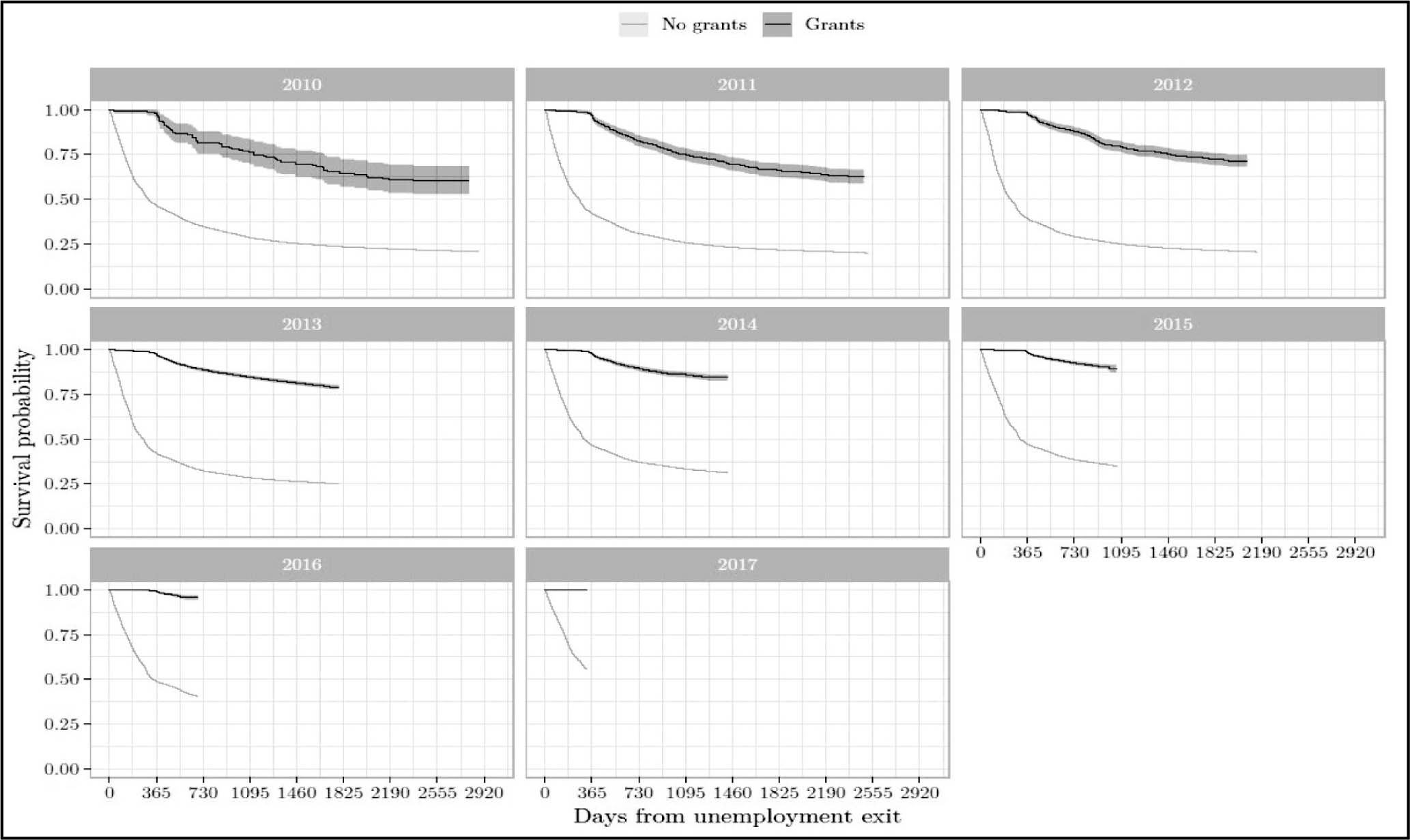
Figure A4
Kaplan–Meier estimates of employment survival by years.
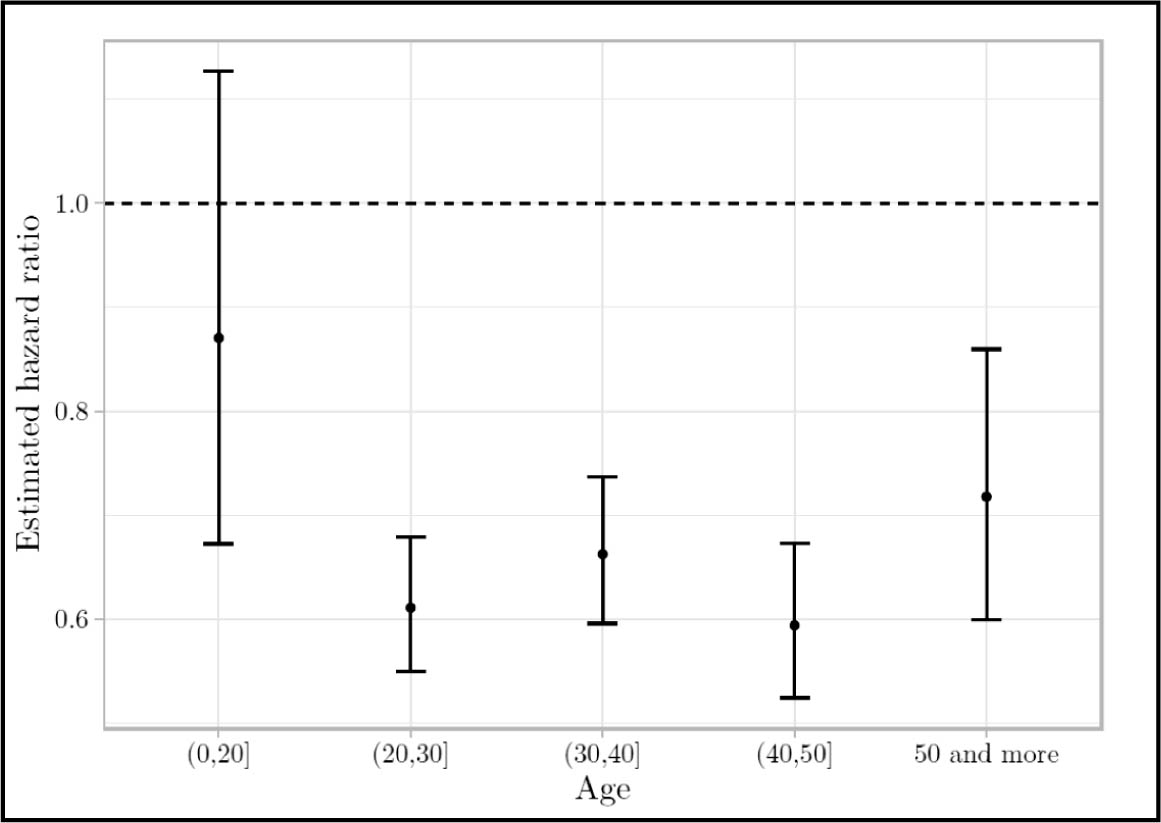
Figure A5
Heterogeneous effects: age.
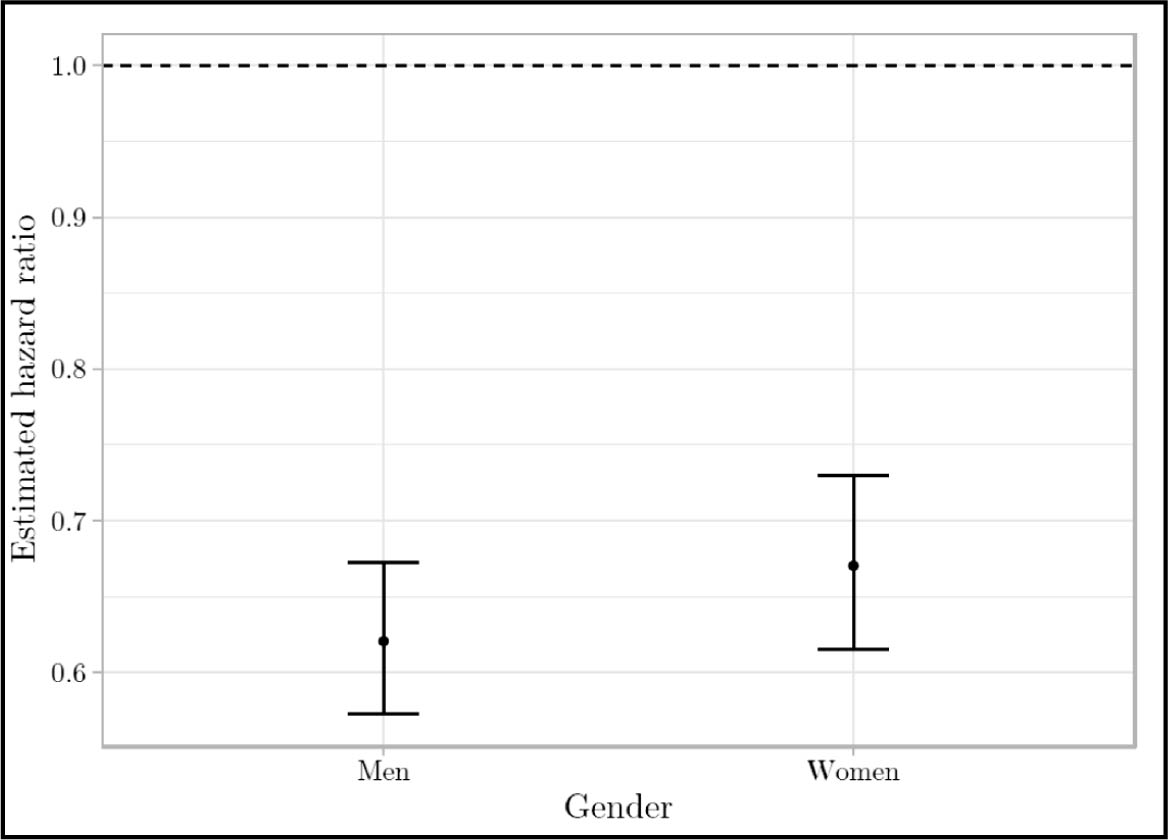
Figure A6
Heterogeneous effects: gender.
Table A5
OLS and Cox proportional hazard estimates of firm survival (unlimited liability firms)
| Dependent variable (method) | |||||||
|---|---|---|---|---|---|---|---|
| Firms survive (OLS) | Survival (COX PH) | ||||||
| 6 months | 12 months | 18 months | 24 months | 36 months | Coefficient | Hazard ratio | |
| Grant received | |||||||
| 0.089*** (0.006) | 0.148*** (0.007) | 0.069*** (0.009) | 0.049*** (0.010) | 0.015 (0.013) | −0.272*** (0.021) | 0.762 [0.696, 0.835] | |
| Observations | 61,241 | 56,384 | 51,758 | 48,029 | 40,997 | 61,953 | |
| R2 | 0.030 | 0.045 | 0.036 | 0.042 | 0.047 | 0.054 | |
Note: The first five columns present the OLS estimate of the received grant effect on the corresponding indicator of firm survival (with an associated sample truncation). The sixth and seventh columns present results of the estimation of the Cox proportional hazard model of the received grant effect on survival probability (the sixth column is coefficient, while the seventh is hazard ratio). All estimates include dummies for the NACE 2-digit industry sector of the firm, dummies for the county of the firm's headquarters, and dummies for the year of the firm opening. Parentheses contain standard errors clustered at the NACE 2-digit level, while brackets contain a 95% confidence interval of hazard ratio (last column).
Table A6
Descriptive statistics of limited liability firms
| Grant | No grant | |||||
|---|---|---|---|---|---|---|
| M | Median | SD | M | Median | SD | |
| Registered capita (in euro) | 1,444 | 1.333 | 7,178 | 6,166 | 2,667 | 29,202 |
| Sales (in euro) | ||||||
| t | 13,225 | 5,245 | 27,698 | 26,134 | 5,383 | 56,868 |
| t+1 | 35,641 | 16,234 | 71,016 | 103,409 | 24,615 | 522,825 |
| t+2 | 45,859 | 19,620 | 108,306 | 137,826 | 28,229 | 816,707 |
| Number of employees | ||||||
| t | 1.321 | 1.000 | 1.230 | 1.341 | 1.000 | 2.689 |
| t+1 | 1.529 | 1.000 | 1.629 | 2.201 | 1.000 | 6.154 |
| t+2 | 1.633 | 1.000 | 1.784 | 2.618 | 1.000 | 9.596 |
| At least one employee | ||||||
| t | 0.917 | 0.542 | ||||
| t+1 | 0.906 | 0.649 | ||||
| t+2 | 0.843 | 0.664 | ||||
| At least two employees | ||||||
| t | 0.234 | 0.259 | ||||
| t+1 | 0.301 | 0.369 | ||||
| t+2 | 0.363 | 0.406 | ||||
| Firm survives | ||||||
| t+1 | 0.883 | 0.915 | ||||
| t+2 | 0.759 | 0.824 | ||||
| Year of firm registration | ||||||
| 2010 | 0.005 | 0.106 | ||||
| 2011 | 0.023 | 0.108 | ||||
| 2012 | 0.033 | 0.115 | ||||
| 2013 | 0.369 | 0.171 | ||||
| 2014 | 0.137 | 0.164 | ||||
| 2015 | 0.223 | 0.151 | ||||
| 2016 | 0.210 | 0.186 | ||||
| Sample size | 4,154 | 42,182 | ||||
[i] Note: The sample consists of all new limited liability firms registered from January 1, 2010, until December 31, 2016. For brevity, we do not show NACE 2-digit industry dummies, dummies for the county of the firm's headquarters, dummies for types of firm legal forms, and dummies for the number of months that a firm was officially open.