
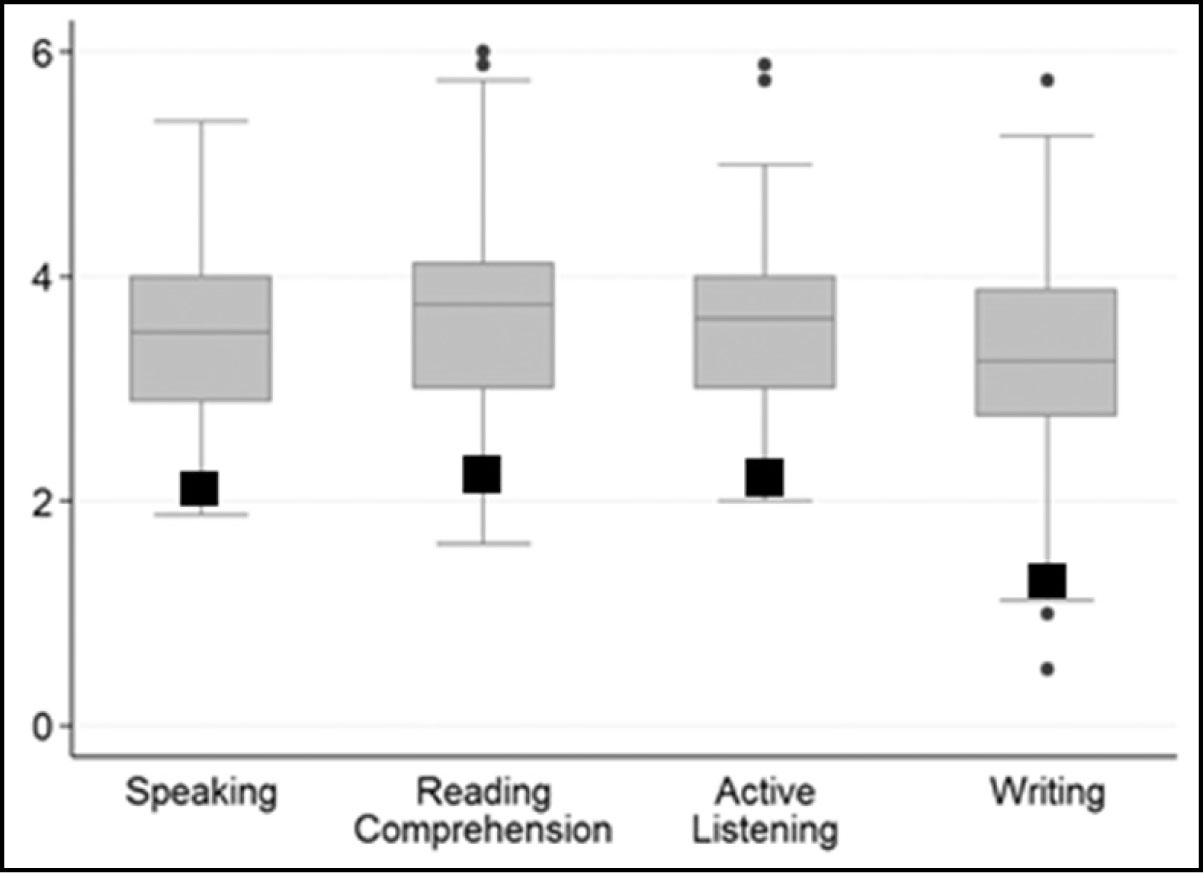
Figure 1
Expert judgments for skills needed among maids and housekeeping cleaners (black squares) relative to all jobs (box plots).
Notes: The figure compares the skill requirements for maids and household cleaners (marked as black squares) to the distribution of skill requirements for other jobs in data from the O*NET database. The gray boxes represent 50% of the values of each variable, from the first to the third quartiles, and the horizontal line in the box shows the median. The whiskers mark the mini and maxi of the variable, and outliers are marked with black dots.
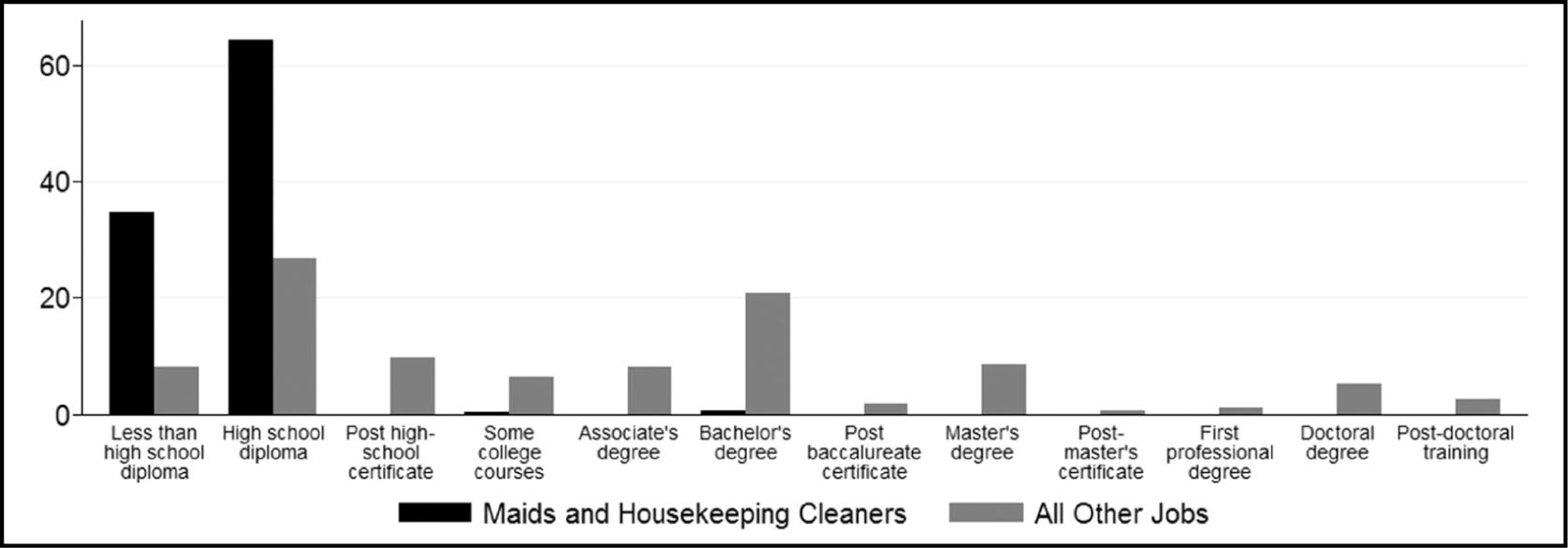
Figure 2
Distribution of educational requirements for maids and housekeeping cleaners compared to all other jobs in the U.S. labor market.
Note: The figure shows the distribution of educational requirements as reported in the O*NET database (www.onet.com).
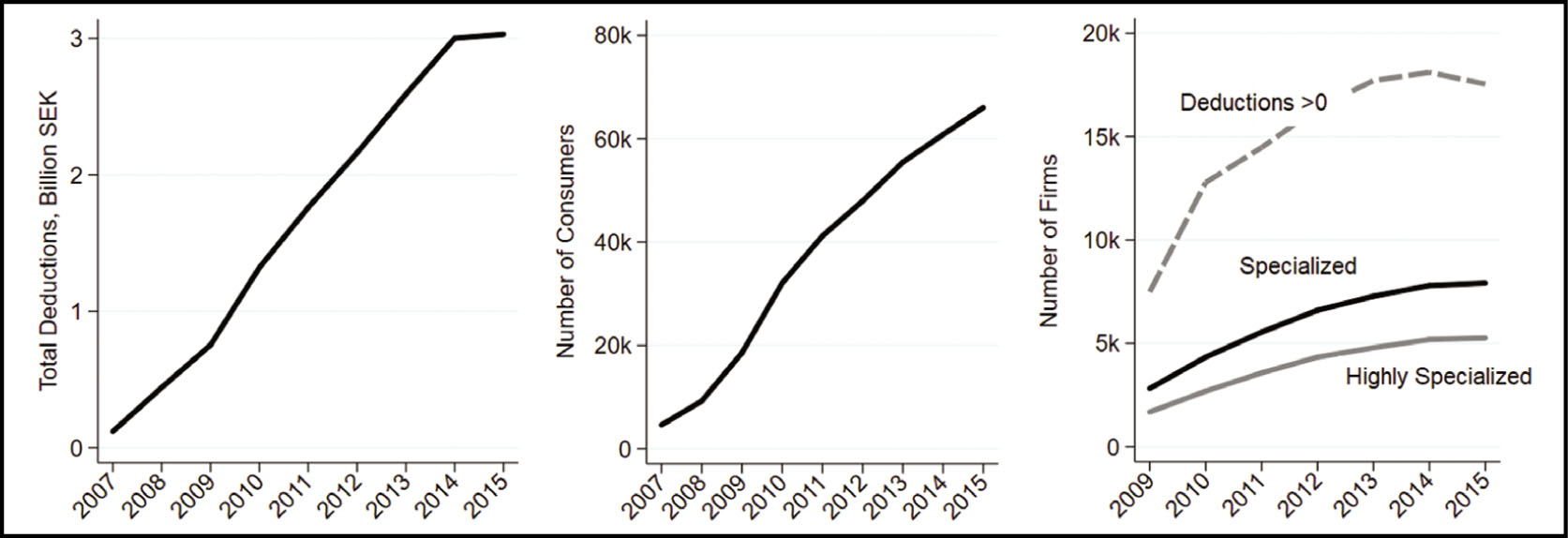
Figure 3
Total annual tax-deductions, number of consumers, and number of subsidized firms.
Notes: The figure shows time trends in the total tax-deductions (left), the number of consumers with non-zero deductions (center) and the number of firms in three categories of specialization (as defined in Section 4).
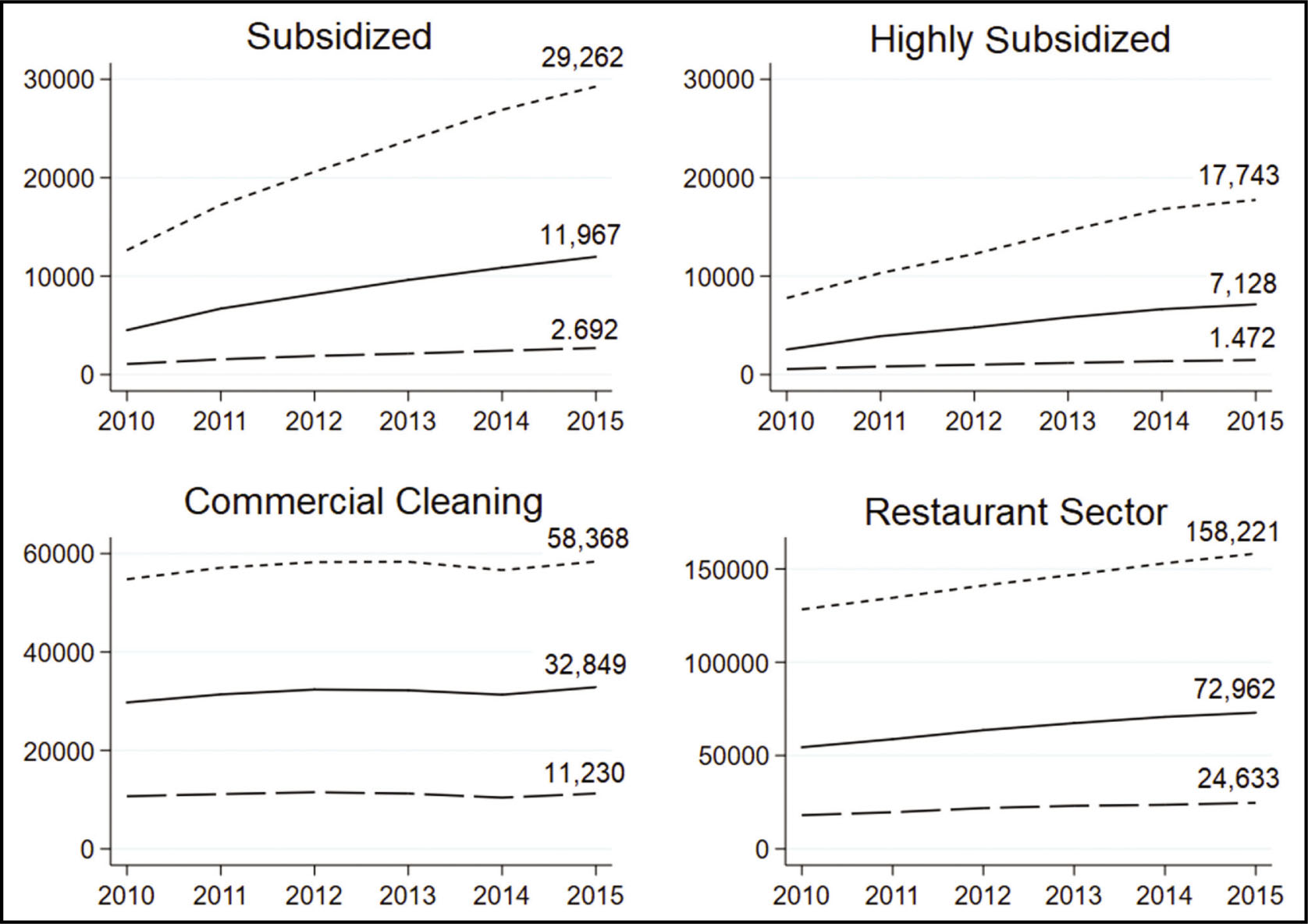
Figure 4
Employment numbers.
Notes: The figure shows annual counts of people whose annual labor earnings from a specific sector surpass three thresholds for total yearly labor earnings. Subsidized and highly subsidized firms are defined in Section 4. All income data are from Swedish tax records and cover all sources of annual earnings above 11 USD.
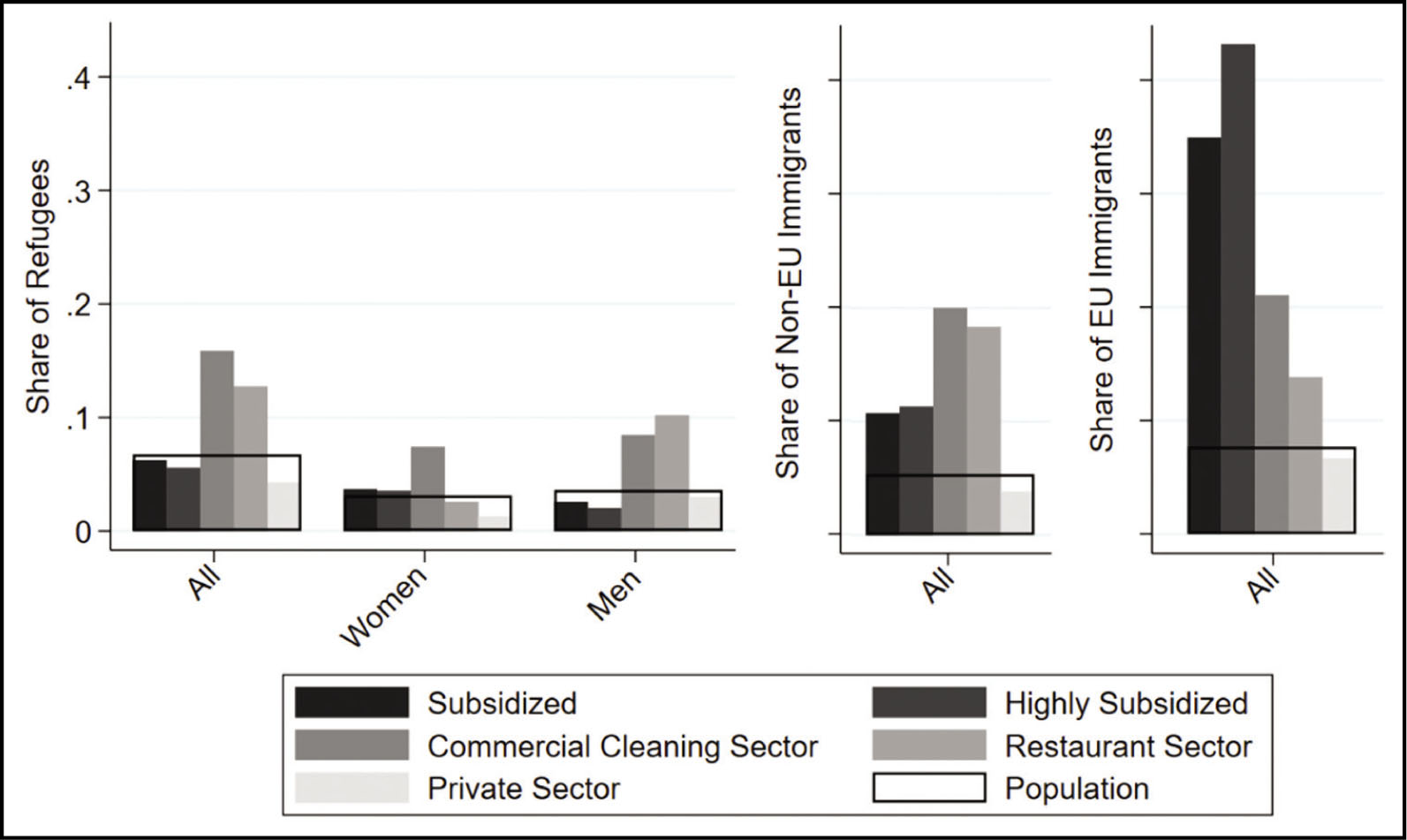
Figure 5
Shares of refugees, EU immigrants and non-EU immigrants across sectors.
Notes: The figure shows the shares of people with different immigration backgrounds among people whose annual income from the sector exceeds 6 monthly wages for an average cleaner.
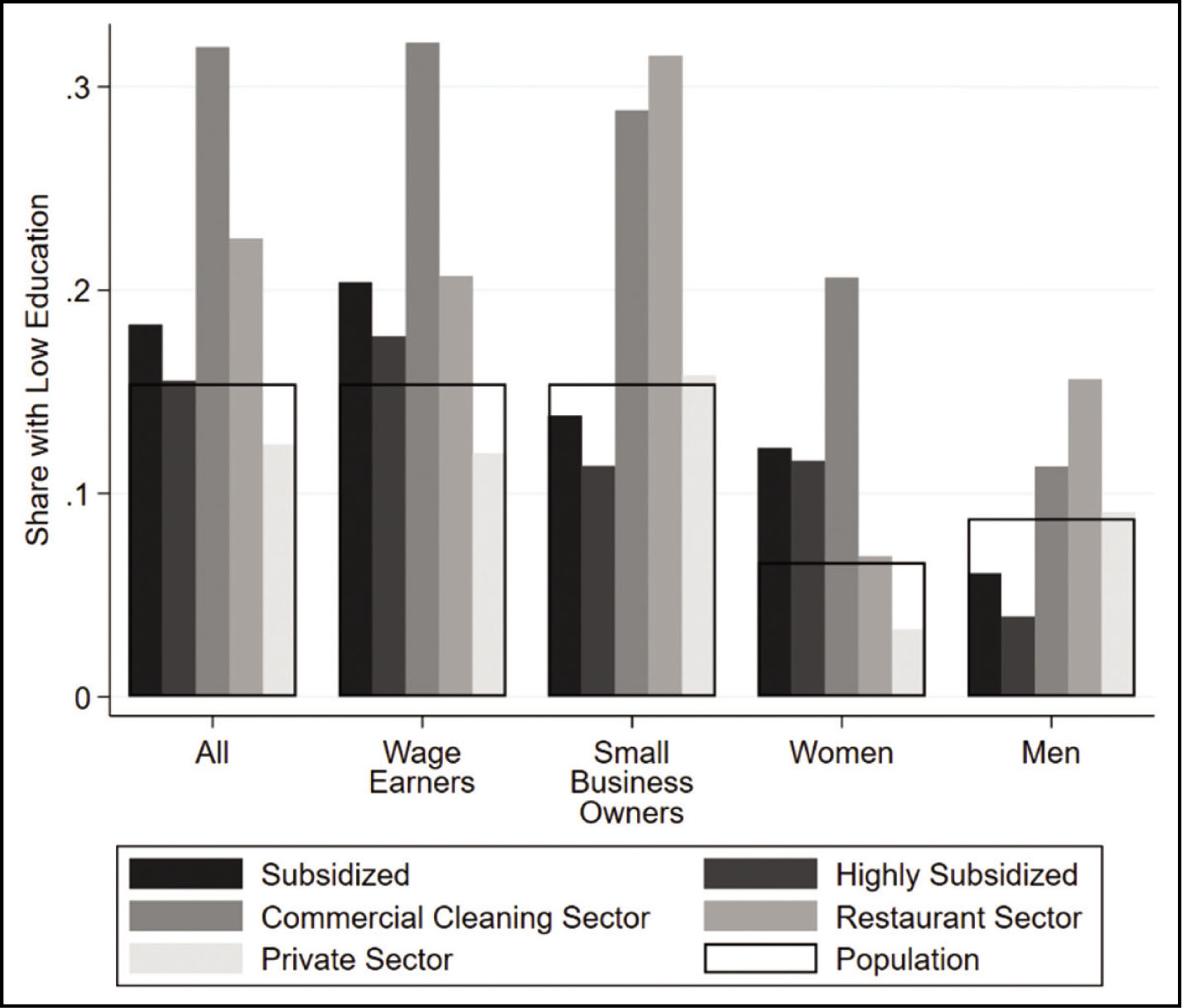
Figure 6
Share of employed with low education.
Notes: The figure shows the shares of people with a low level of education among those with an annual income from the sector that exceeds 6 monthly wages for an average cleaner.
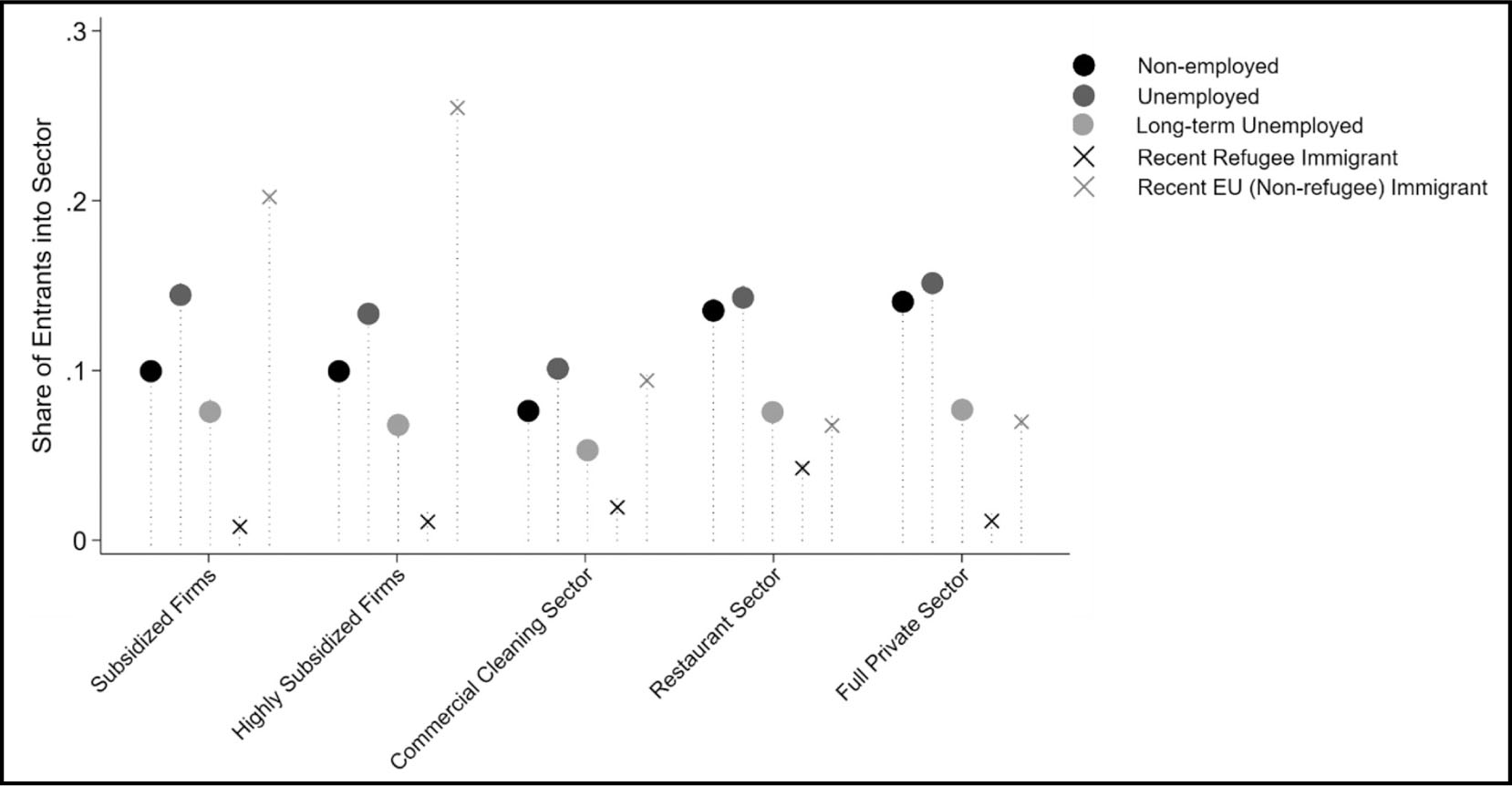
Figure 7
Profile of previous labor market statuses of sector entrants.
Notes: The figure shows the labor market and immigration statuses of entrants into sectors in 2011–2015. Non-employment and unemployment are measured in the year prior to entry. Long-term unemployment is defined as unemployment in the year prior to entry, and either unemployment or non-employment before that. Recent immigration is defined as immigration in the two years before entry. The definition of recent immigration, i.e. within the last two years, over-rides the labor market status.
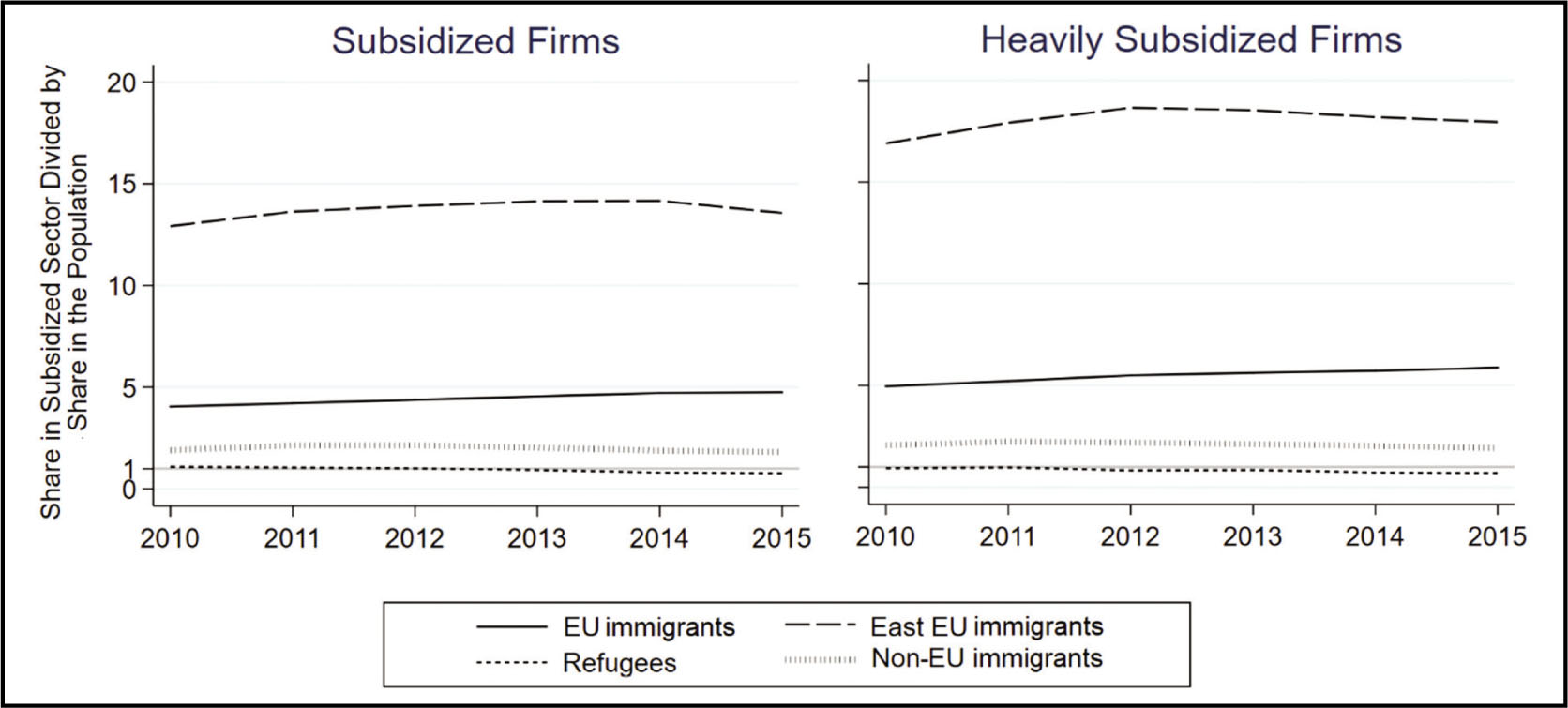
Figure 8
Ratios of employment shares to population shares for immigrant groups.
Notes: The figure shows time trends in the ratio between the employment share and population share of immigrant groups. Population shares are for the full Swedish population of permanent residents aged 18–65.
Table 1
Composition of employees by the manager's country of origin for subsidized firms
| Employees | Owner/Manager (% of firm-year observations) | ||||
|---|---|---|---|---|---|
| EU immigrants (32%) | Eastern European immigrants (23%) | Refugees (5%) | Non-EU immigrants (8%) | Swedish born (55%) | |
| EU immigrants | 0.77 | 0.91 | 0.34 | 0.10 | 0.23 |
| Eastern European immigrants | 0.68 | 0.88 | 0.16 | 0.06 | 0.16 |
| Refugees | 0.03 | 0.02 | 0.24 | 0.13 | 0.05 |
| Non-EU immigrants | 0.06 | 0.02 | 0.29 | 0.57 | 0.10 |
| Swedish born | 0.14 | 0.04 | 0.15 | 0.20 | 0.62 |
| Low-educated | 0.14 | 0.11 | 0.22 | 0.25 | 0.22 |
[i] Notes: The table shows the shares of employees by immigrant groups and education in firms subsidized under the Swedish policy for promoting domestic services. The owner/manager is identified in administrative data for CEOs, personal ID codes for the owners of sole proprietorships, and data on business income from the firm (detailed in footnotes). A person counts as an employee if the firm is their largest source of labor income in that year.
Table W1
Assumptions about the sub-components in the price of domestic services.
| Percentage | Amount per 100 SEK of the price charged to the consumer, where of the tax-deduction is 50 SEK | |
|---|---|---|
| Price charged to the consumer | 100 | |
| where of Value Added Tax | 20% | 20 |
| Remaining amount of net sales | 80 | |
| whereof profit | 10% | 8 |
| whereof non-labor costs | 10% | 8 |
| Remaining amount of labor costs | 64 | |
| where of social contributions | 30% + 5% | 16.6 |
| Remaining wage amount | 47.4 | |
| Tax-deduction relative to the wage bill | 50 kr/47.4 kr = 1–05 | |
| Tax-deduction relative to net sales | 50 kr/80 kr = 0.625 |
[i] Source: Skatteverket 2011, Appendix 5, p. 161.
Table W2
Distribution of 1-digit occupations across sectors (%)
| Subsidized firms | Highly subsidized firms | Commercial cleaning | Restaurant sector | Private sector | ||
|---|---|---|---|---|---|---|
| 0 | Armed Forces occupations | 0.06 | 0.06 | 0 | 0.06 | 0.02 |
| 1 | Managers, senior officials, legislators | 3.63 | 3.23 | 2.79 | 7.01 | 7.62 |
| 2 | Professionals | 1.48 | 1.47 | 1.16 | 0.95 | 15.45 |
| 3 | Technicians and associate professionals | 1.4 | 1.06 | 1.16 | 2.56 | 16.11 |
| 4 | Clerks | 2.66 | 2.27 | 2.34 | 1.91 | 8.99 |
| 5 | Service and sales workers | 7.96 | 7.53 | 8.03 | 37.72 | 16.86 |
| 6 | Skilled agricultural, fishery, forestry workers | 3.94 | 1.92 | 0.23 | 0.14 | 3.27 |
| 7 | Craft and related trades workers | 2.59 | 1.62 | 1.1 | 0.74 | 15.2 |
| 8 | Plant and machine operators and assemblers | 0.81 | 0.49 | 1.09 | 0.54 | 10.98 |
| 9 | Elementary occupations | 75.49 | 80.36 | 82.1 | 48.36 | 5.49 |
[i] Source: LISA register data for 2015. Occupation is measured in the Swedish Salary Statistics (Lönestrukturstatistiken), which is a mandatory survey to firms. The survey covers all large private firms, a large share of the medium-size firms, and 2% random sample of small firms (1–9 employees).
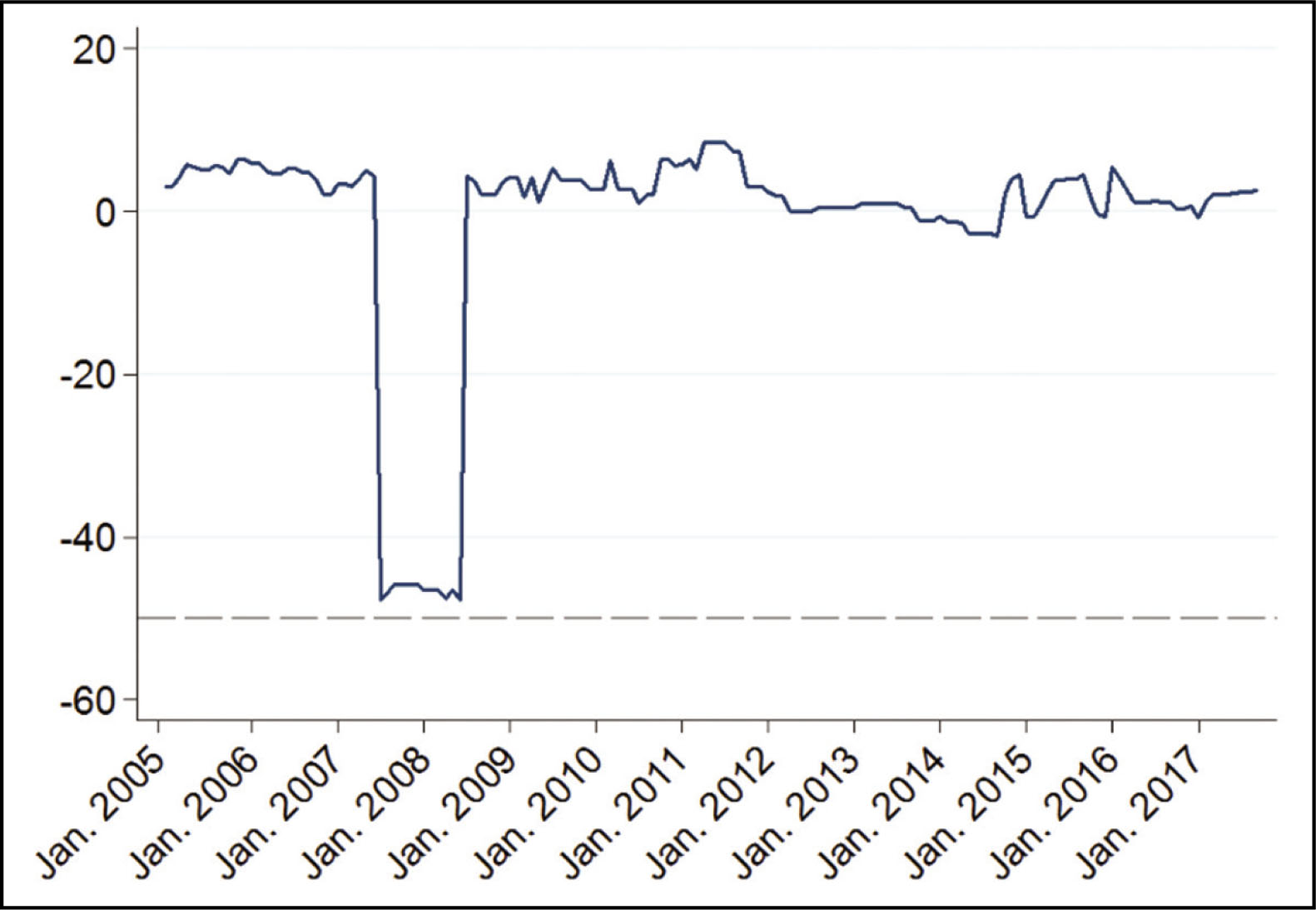
Figure W1
Percentage change in the hourly price of domestic cleaning services compared to the same month in the previous calendar year.
Source: The Swedish Central Bank.
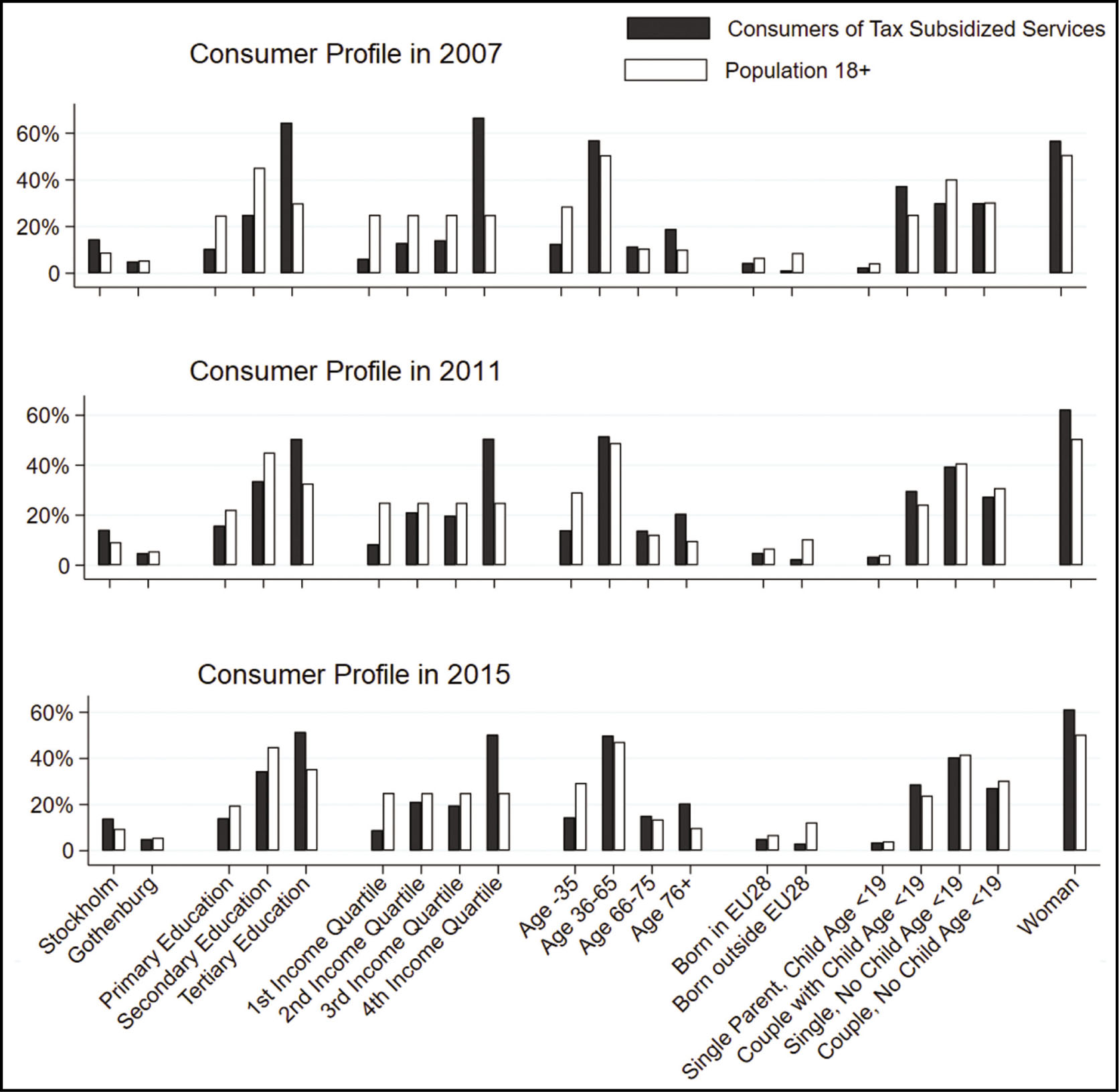
Figure W2
Demographic Profile of Consumers of Subsidized Services Compared to the Population.
Notes: The figure is based on a complete record of all consumers of tax subsidized services from the Swedish tax agency in 2010–2015. Population data comes from the administrative records of Statistics Sweden and are linked to consumers via the mandatory personal ID code.
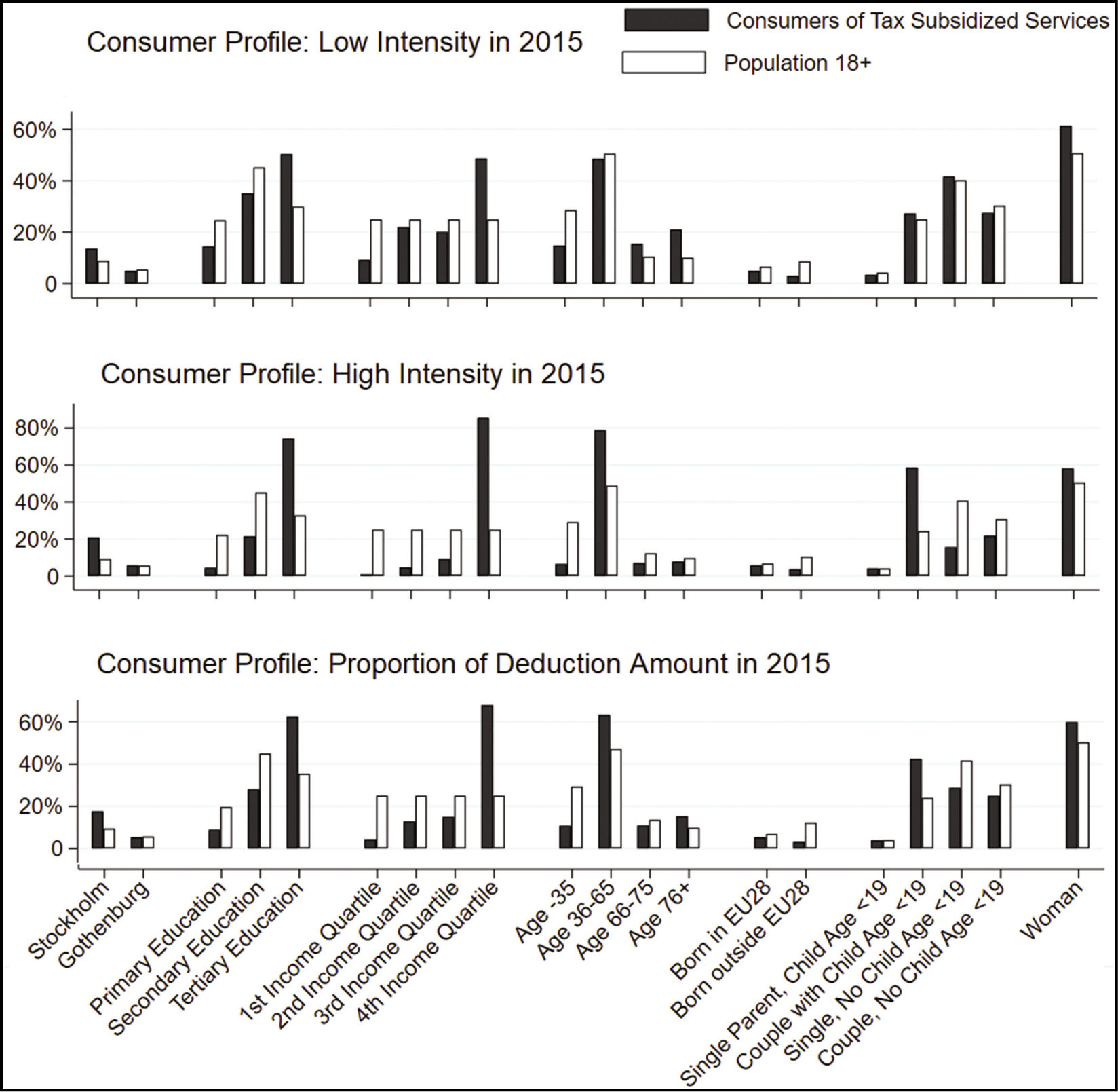
Figure W3
Demographic Profile of Consumers of Subsidized Services Compared to the Population, and for Low- and High-Intensity Consumers.
Notes: See notes to Figure W2. The proportion of the deduction amount is computed by summarizing the total deductions for consumers in a specific category and dividing that amount with the total dedications made in 2015.
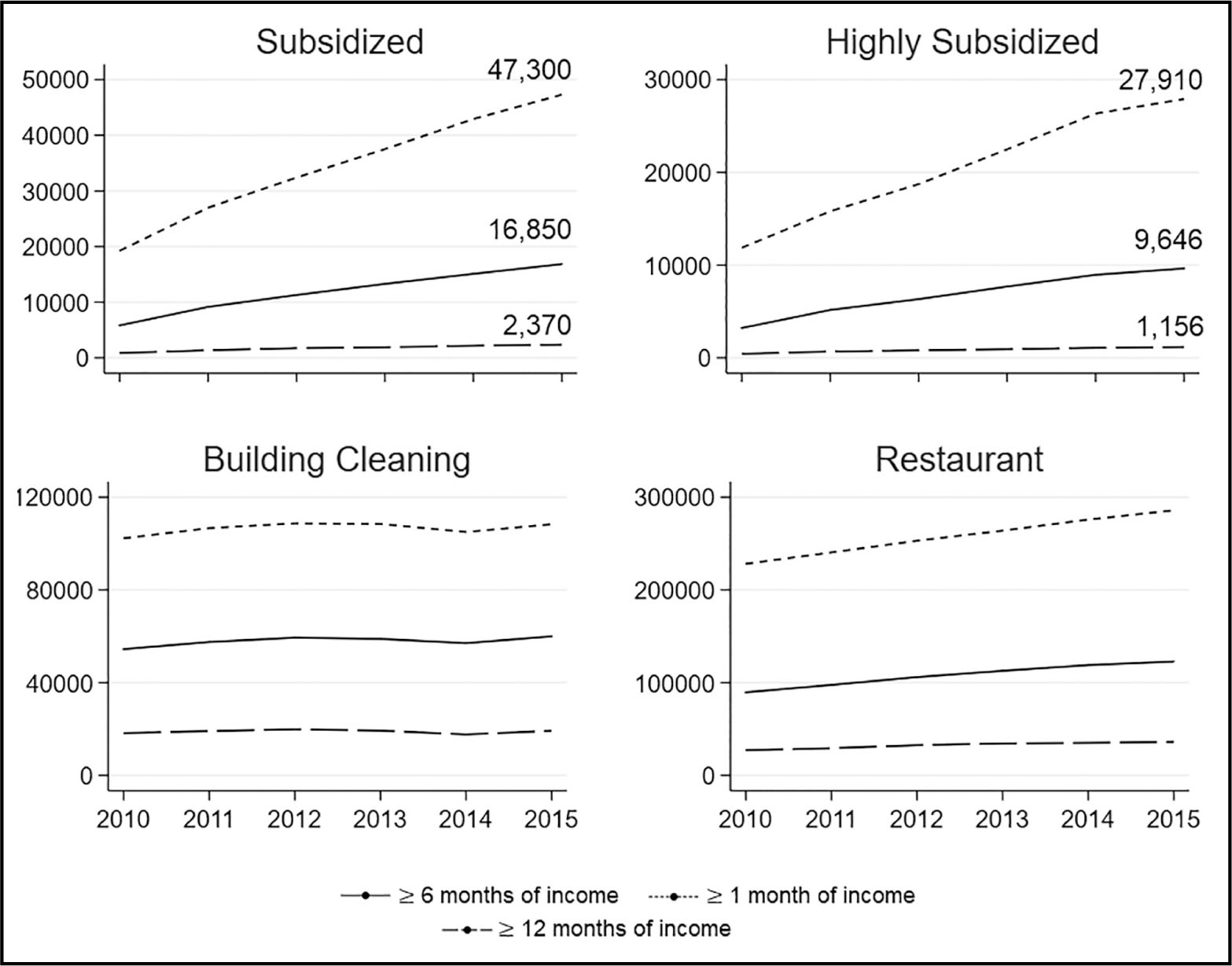
Figure W4
Number of wage earners.
Notes: The figure shows annual counts of people in three categories of wage earnings (see legend). The definition of subsidized and highly subsidized firms is presented in Section 4. All income data is from Tax Records and cover all sources of annual earnings above 11 USD.
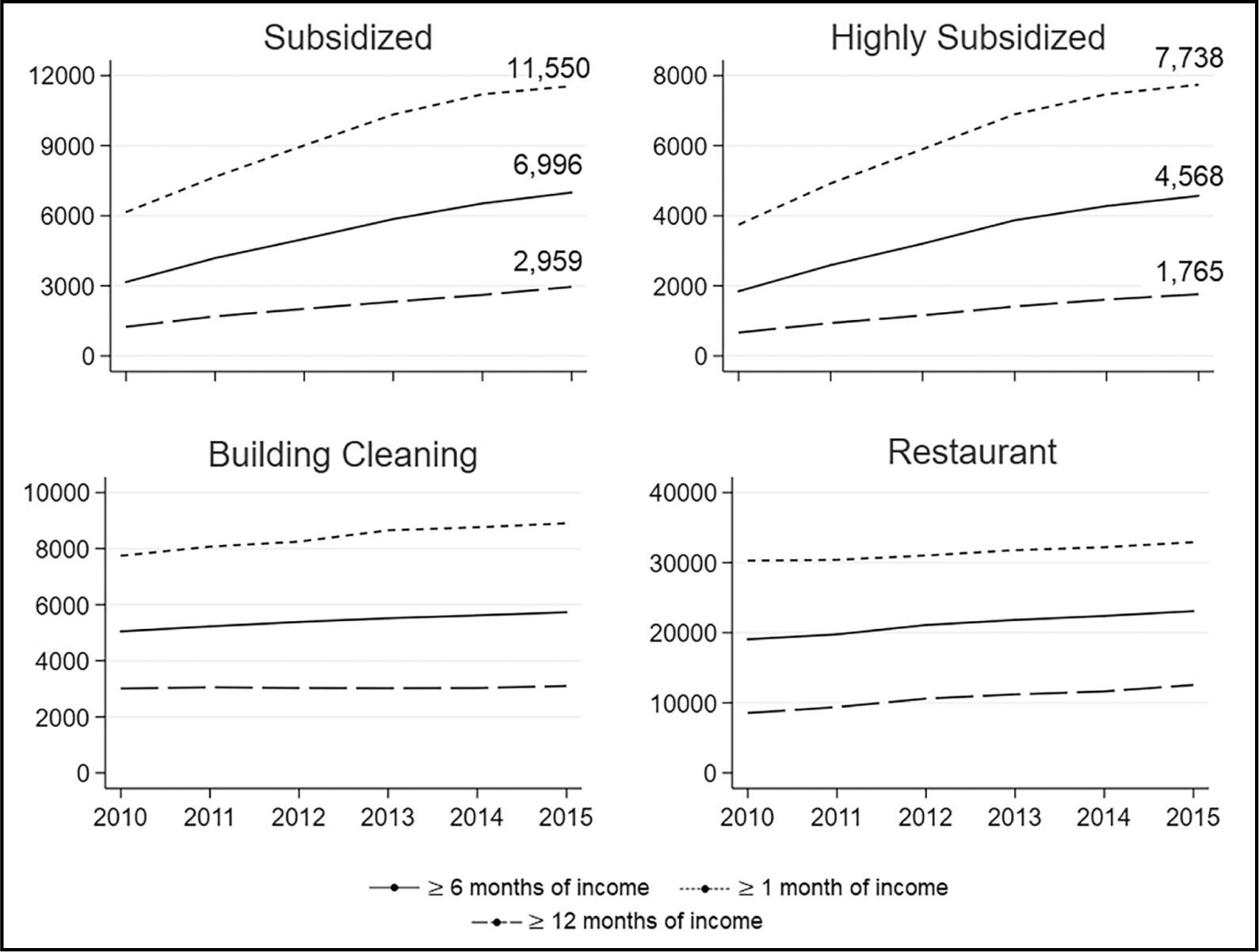
Figure W5
Number of small business owners.
Notes: The figure shows annual counts of people in three categories of total annual earnings of business income (see legend). The definition of subsidized and highly subsidized firms is presented in Section 4. All income data is from Tax Records and cover all sources of annual earnings above 11 USD.
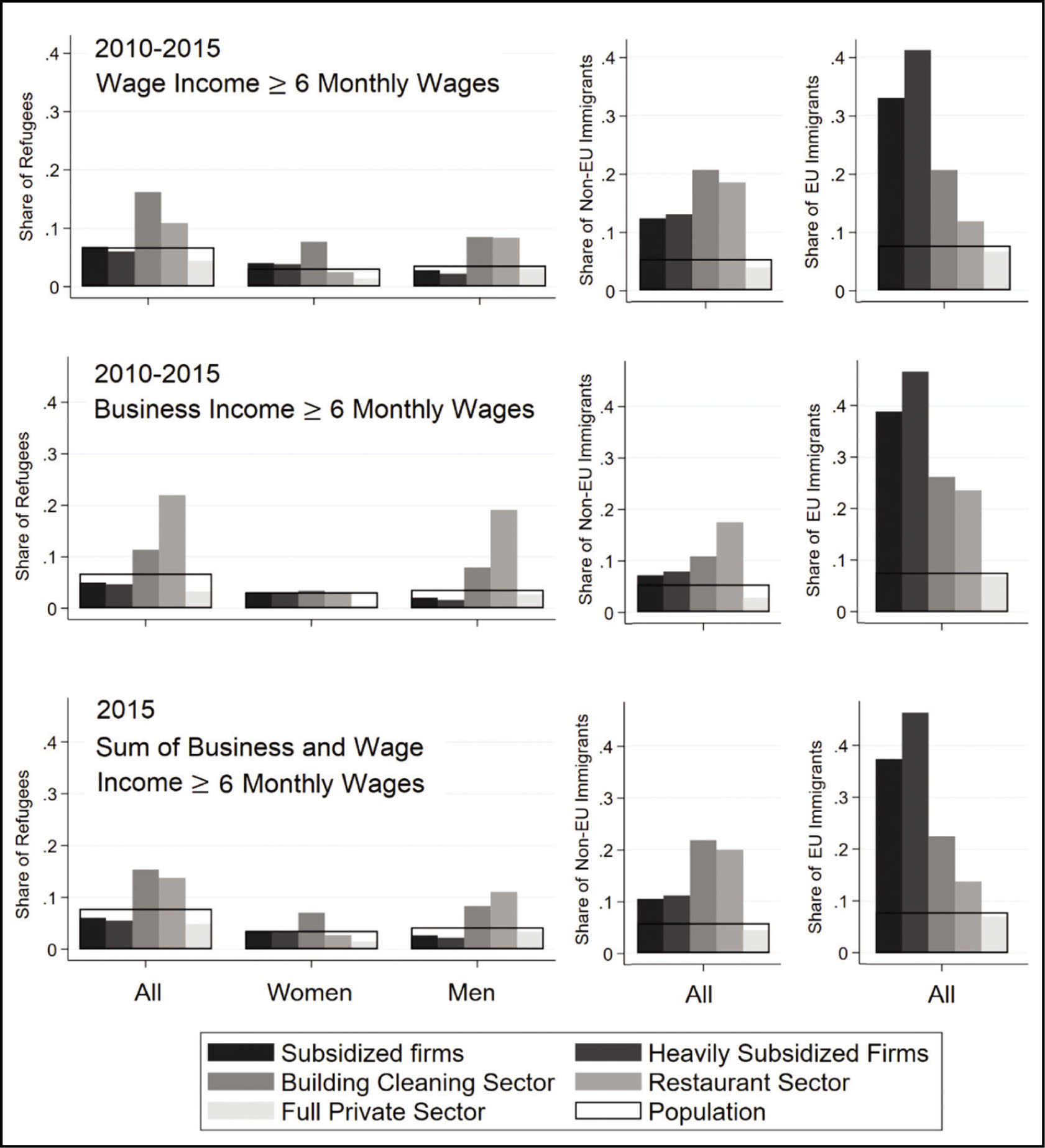
Figure W6
Composition of immigrants in 2015, and among wage earners and small businessowners.
Notes: See notes for Figure 5.
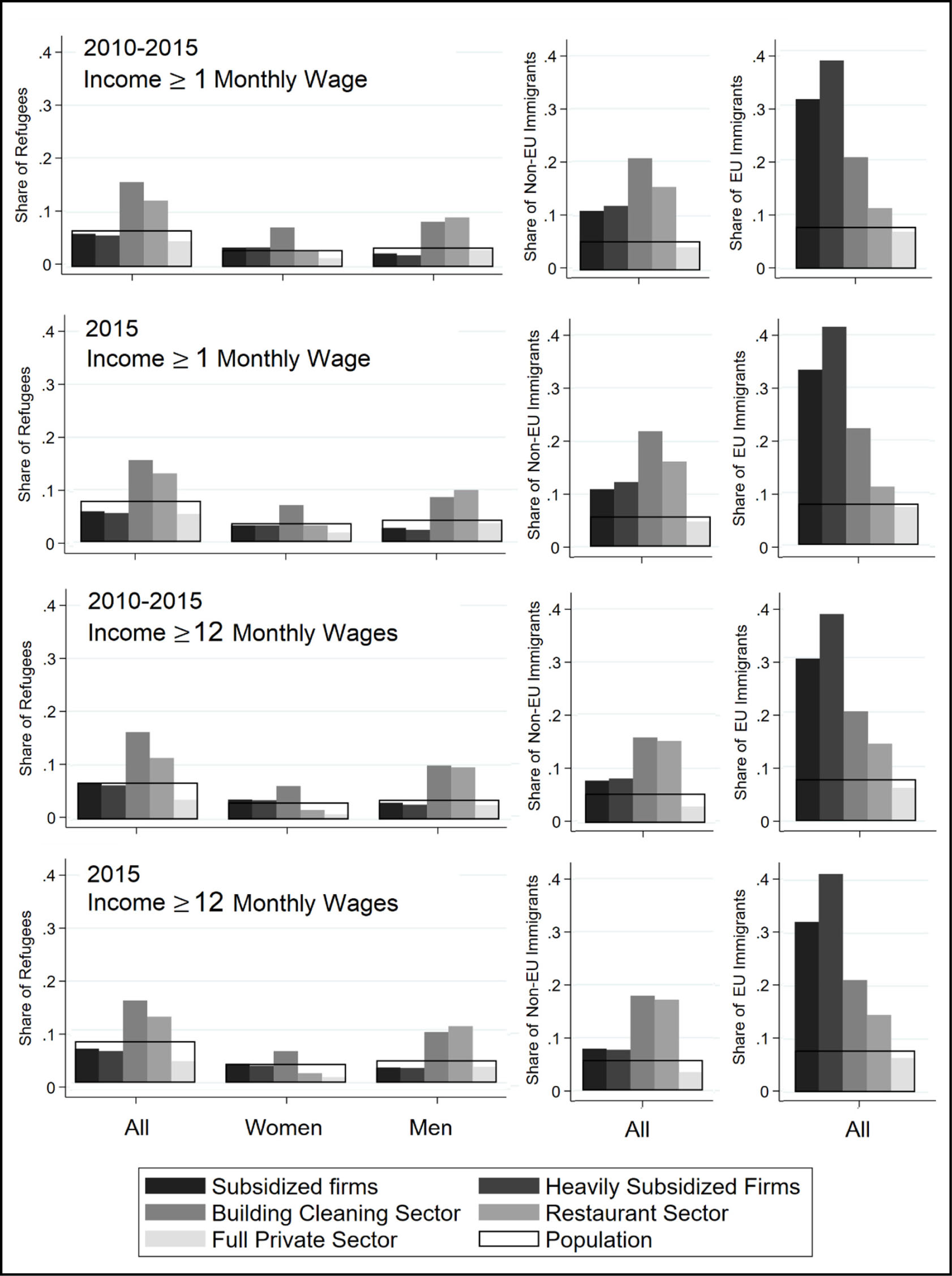
Figure W7
Composition of immigrants across sectors at two alternative income thresholds for employment.
Notes: See notes for Figure 5.
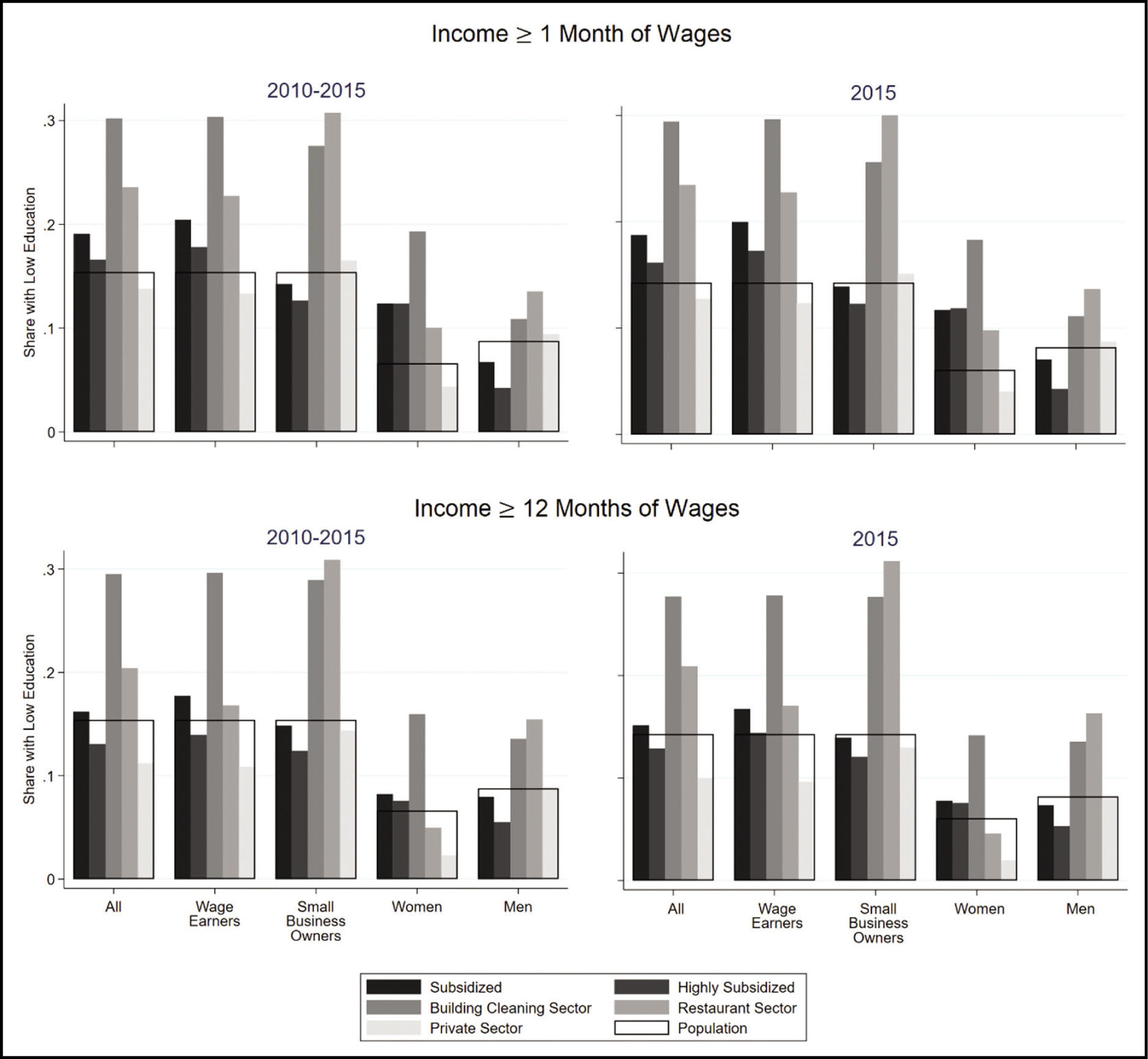
Figure W8
Share with low education for two alternative income thresholds for employment.
Notes: See notes for Figure 6.
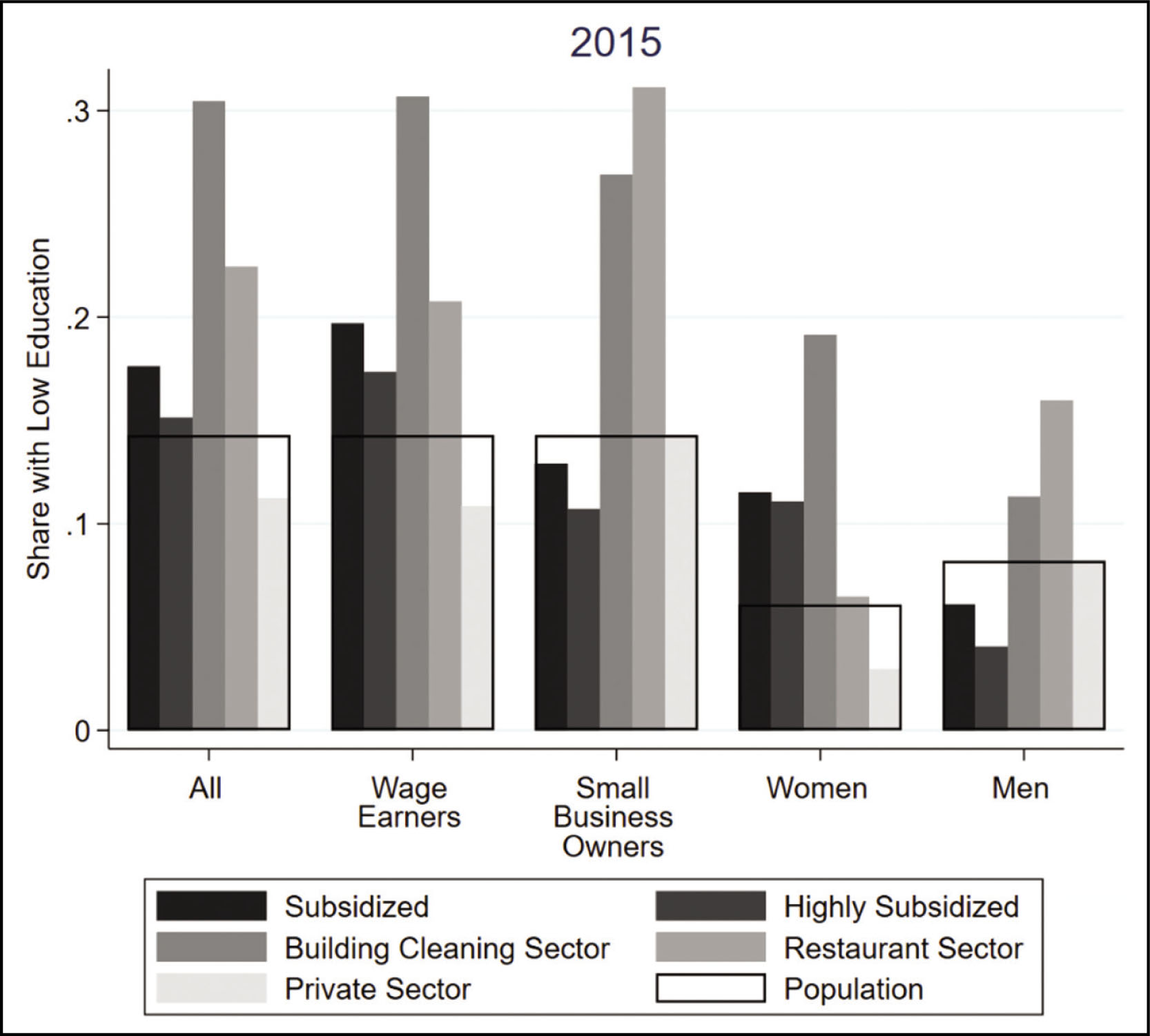
Figure W9
Share with low education in 2015.
Notes: See notes for Figure 6.
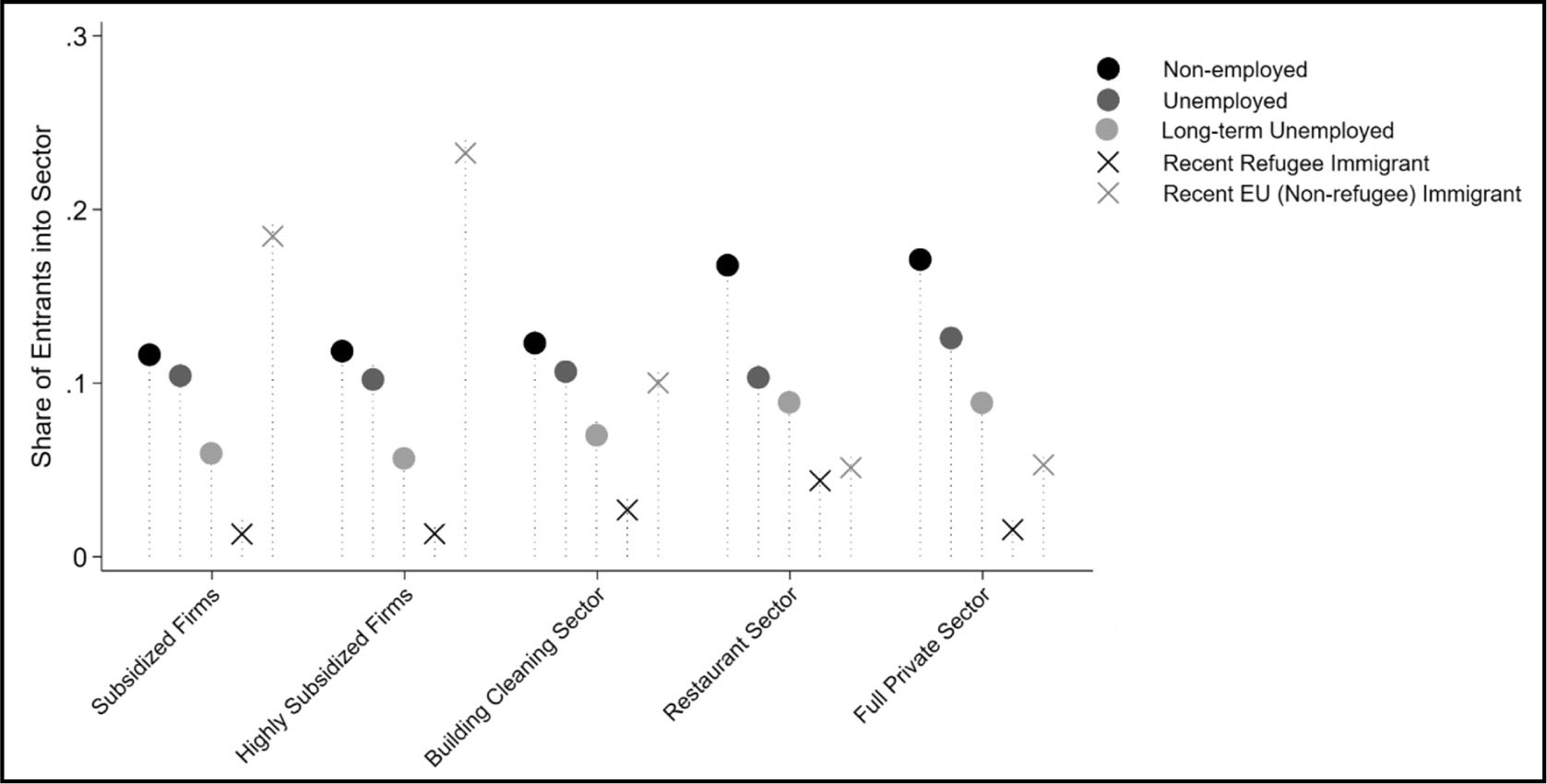
Figure W10
Profile of previous labor market statuses of sector entrants, lower income threshold for defining sector entrants.
Notes: See notes to Figure 7. A sector entrant is defined as having zero income from the sector in the previous year and at least 1 monthly wage for a median cleaning job in the current year. Labor market statuses are observed the year prior to entry.
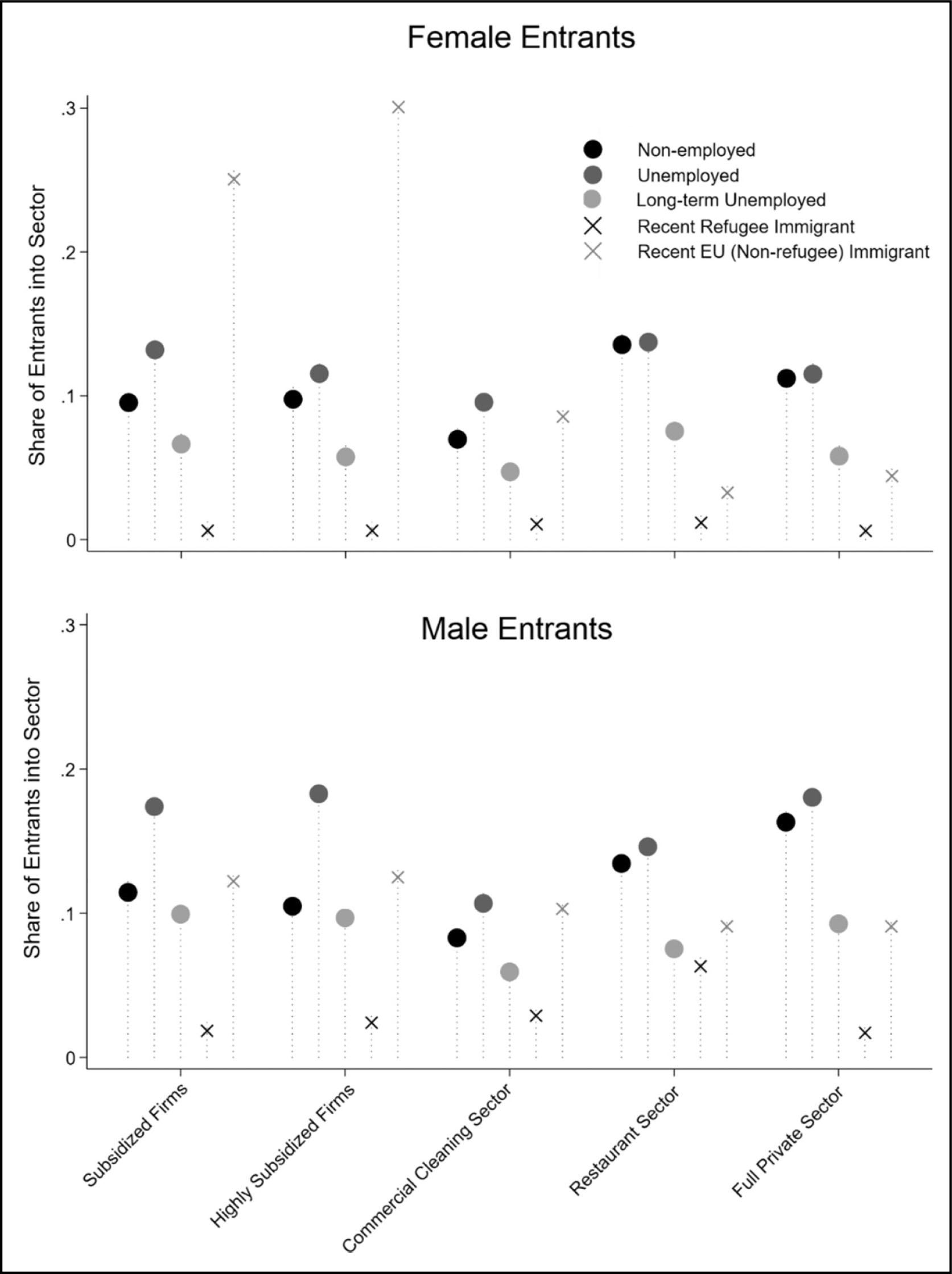
Figure W11
Profile of previous labor market statuses of sector entrants by sex at birth.
Notes: See notes for Figure 7.
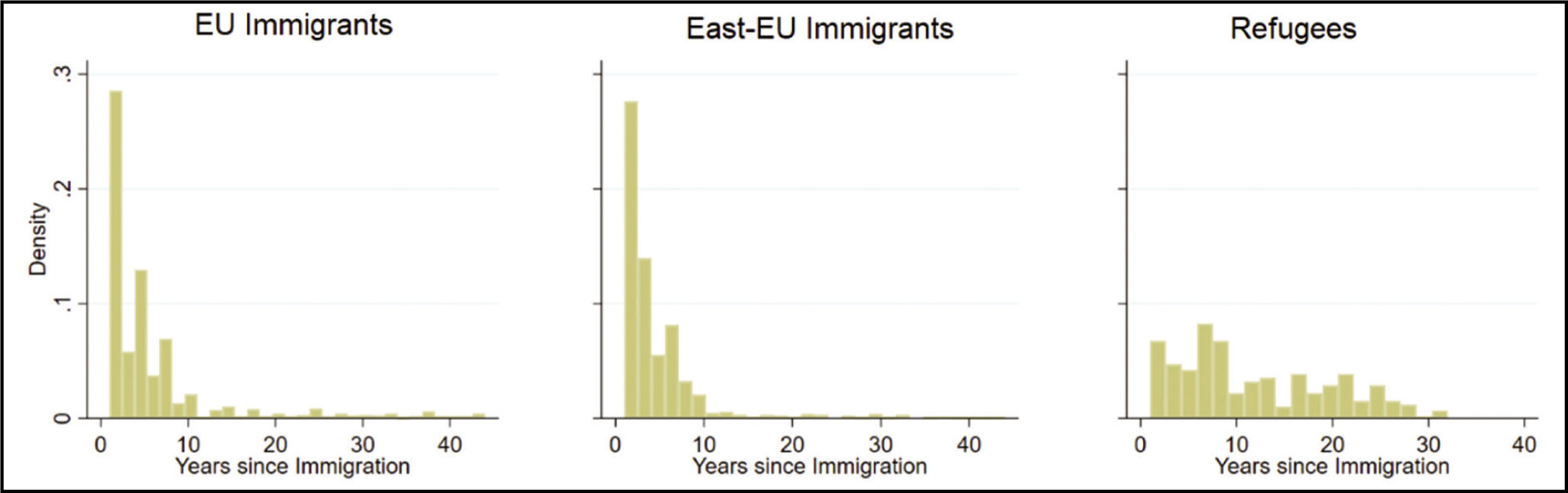
Figure W12
Distributions of years since immigration at the entry year into the subsidized sector, with entry defined as going from 0 to 6 months of wage income.
Notes: Data for 2010–2015.
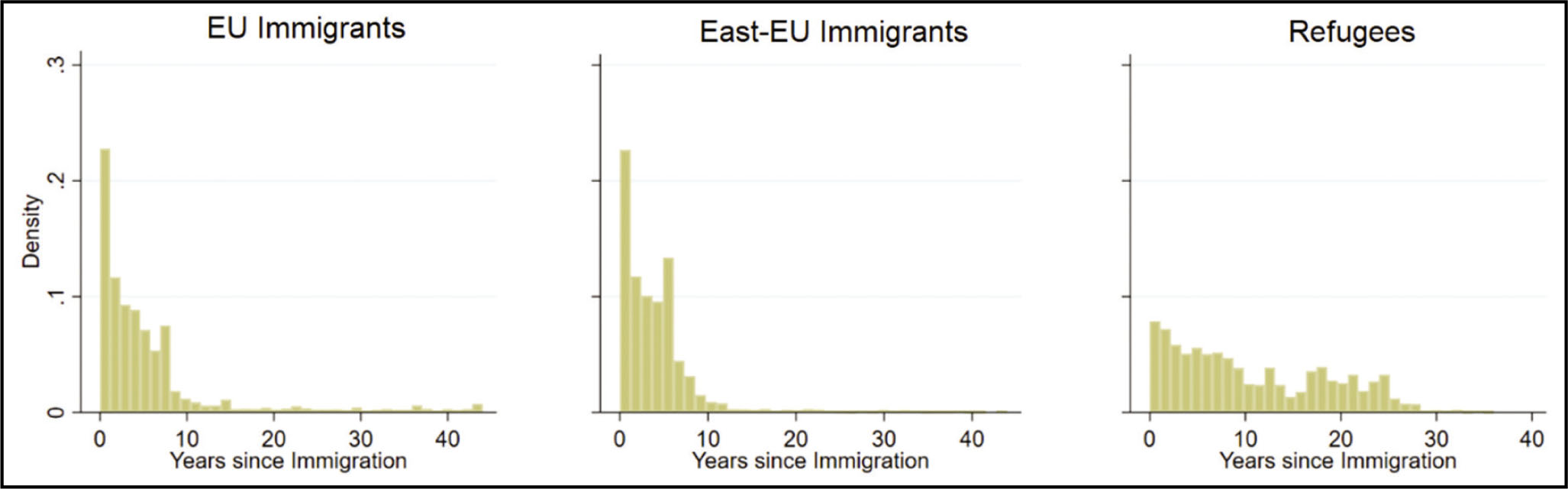
Figure W13
Distributions of years since immigration at the entry year into the subsidized sector, with entry defined as going from 0 to 1 months of wage income.
Notes: Data for 2010–2015.
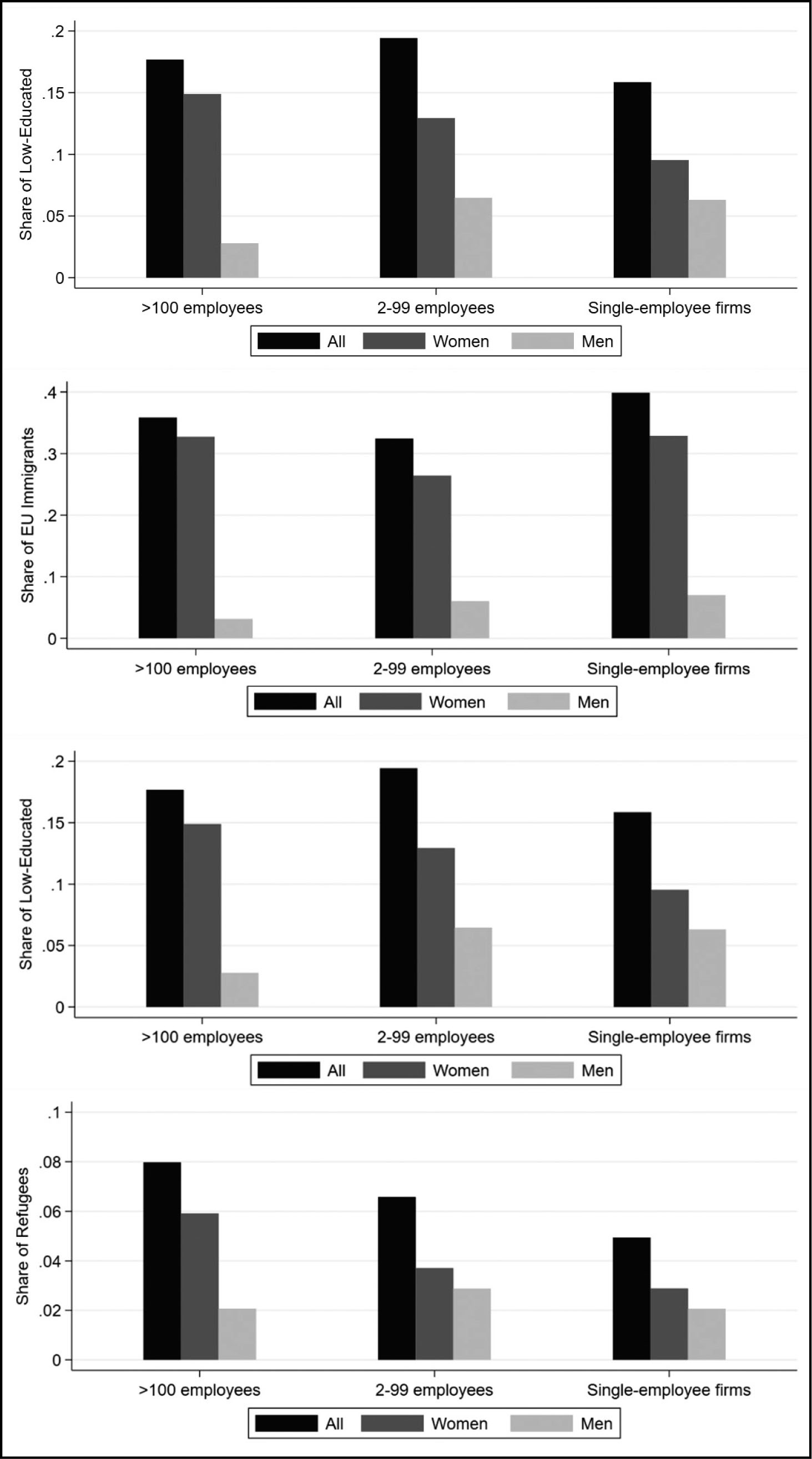
Figure W14
Shares of EU immigrants, people with low education, and refugee immigrants in subsidized domestic service firms, divided by firm size.
Notes: Firm size is calculated as the sum of people who have a firm as their main source of labor earnings in a calendar year. This variable is missing for 2% of the main dataset. A cutoff for large firms is set at 100 employees. 10.3% of the workers in the main sample work in firms above this size-threshold.