
Table 1
Descriptive statistics for women aged 20–49 years in 2016 (treated group – women with one or two children; control group – childless women)
| Socioeconomic variables | Partnered women | Single women | ||
|---|---|---|---|---|
| Control (%) | Treated (%) | Control (%) | Treated (%) | |
| Labor market status: employed | 82 | 73 | 61 | 68 |
| Labor market status: unemployed | 4 | 4 | 8 | 7 |
| Labor market status: inactive | 14 | 23 | 31 | 25 |
| Age: 20–29 years | 24 | 18 | 61 | 23 |
| Age: 30–39 years | 20 | 51 | 20 | 45 |
| Age: 40–49 years | 56 | 31 | 19 | 32 |
| Place of residence: city with | 35 | 28 | 34 | 32 |
| >100,000 inhabitants | ||||
| Place of residence: city with | 19 | 19 | 16 | 21 |
| 20,000–100,000 inhabitants | ||||
| Place of residence: city with <20,000 inhabitants | 11 | 12 | 11 | 13 |
| Place of residence: rural area | 35 | 42 | 39 | 34 |
| Educational level: tertiary | 40 | 45 | 44 | 32 |
| Educational level: secondary | 34 | 34 | 40 | 40 |
| Educational level: basic vocational or lower | 26 | 21 | 16 | 29 |
| Student status | 5 | 2 | 26 | 3 |
| Labor market status of partner: employed | 89 | 93 | - | - |
| Labor market status of partner: unemployed | 3 | 3 | - | - |
| Labor market status of partner: inactive | 8 | 4 | - | - |
| Educational level of partner: tertiary | 26 | 30 | - | - |
| Educational level of partner: secondary | 34 | 35 | - | - |
| Educational level of partner: basic vocational or lower | 40 | 35 | - | - |
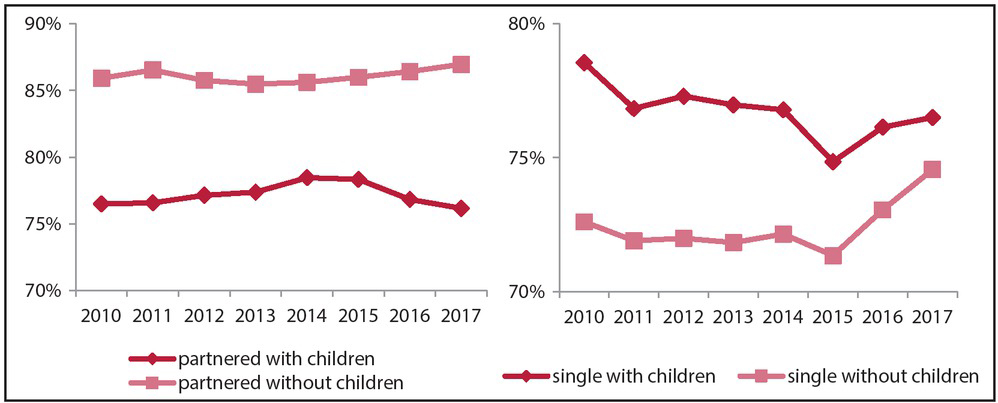
Figure 1
Labor force participation rates of women aged 20–49 years with a partner (left) and without a partner (right) differentiated by the presence of children.
Note: 2017: only for the first half of the year.
Source: Own calculations based on Polish Labor Force Survey data.
Table 2
Placebo tests for main difference-in-differences specification
| Socioeconomic variables | Partnered women | Single women |
|---|---|---|
| (A) Regression for 2010–2017 with all potential placebo/treatment effects | ||
| Group effect (γ) | –0.055*** | 0.005 |
| Placebo treatment effect (θ) - 2010/2011 | –0.012* | –0.002 |
| Placebo treatment effect (θ) – 2011/2012 | –0.005 | –0.004 |
| Placebo treatment effect (θ) – 2012/2013 | –0.000 | 0.002 |
| Placebo treatment effect (θ) – 2013/2014 | 0.007 | –0.003 |
| Placebo treatment effect (θ) – 2014/2015 | 0.008 | 0.001 |
| Placebo treatment effect (θ) – 2015/2016 | –0.007 | –0.014 |
| Treatment effect (θ) – 2016/2017 | –0.023*** | –0.023* |
| Observations | 300,792 | 174,872 |
| R-squared | 0.119 | 0.316 |
| (B) Regression for 2009–2016 as in main specification | ||
| Group effect (γ) | –0.051*** | 0.013** |
| Placebo treatment effect (θ) – 2015/2016 | –0.007 | –0.012 |
| Observations | 293,428 | 170,532 |
| R-squared | 0.120 | 0.310 |
| (C) Regression for 2008–2015 as in main specification | ||
| Group effect (γ) | –0.049*** | 0.011* |
| Placebo treatment effect (θ) – 2014/2015 | 0.007 | 0.008 |
| Observations | 282,988 | 165,472 |
| R-squared | 0.122 | 0.301 |
| (D) Regression for 2007–2014 as in main specification | ||
| Group effect (γ) | –0.045*** | 0.003 |
| Placebo treatment effect (θ) – 2013/2014 | 0.005 | 0.012 |
| Observations | 269,835 | 158,947 |
| R-squared | 0.124 | 0.292 |
Table 3
The effect of child benefits on labor force participation of mothers, for women aged 20–49 years with one or two children
| Socioeconomic variables | Partnered women | Single women |
|---|---|---|
| Group effect (γ) | –0.057*** | 0.002 |
| Treatment effect (θ) | –0.021*** | –0.020*** |
| Observations | 300,792 | 174,872 |
| R-squared | 0.119 | 0.316 |
[i] The coefficients of partnered women and single women have significance levels of 0.000, and 0.008 respectively.
Note: The coefficients of all covariates are provided in Table A1 in the Appendix. Robust standard errors were computed. Significance levels: ***0.01, **0.05, and *0.1.
Source: Own calculations based on Polish Labor Force Survey data.
Table 4
The dynamics of the effect of child benefits on labor force participation of mothers (women aged 20–49 years with one or two children)
| Socioeconomic variables | Partnered women | Single women |
|---|---|---|
| Treatment effect in the 2nd half of 2016 (θ2016) | –0.016** | –0.017 |
| Treatment effect in the 1st half of 2017 (θ2017) | –0.026*** | –0.023** |
| Observations | 300,792 | 174,872 |
| R-squared | 0.119 | 0.316 |
[i] The coefficients of partnered women have significance levels of 0.023 and 0.001 for Q2 2016 and Q12017 respectively. The coefficients of single women have significance levels of 0.119 and 0.048 for Q2 2016 and Q12017 respectively.
Note: The coefficients of all covariates are available upon request. Robust standard errors were computed. Significance levels: ***0.01, **0.05, and *0.1.
Source: Own calculations based on Polish Labor Force Survey data.
Table 5
Heterogeneous treatment effects for partnered women (treated group - women with one or two children, control group - childless women)
| Model | estimated coefficient |
|---|---|
| Model with interactions for educational level | |
| (Educational level – base: tertiary) | |
| Treatment effect for tertiary education | –0.009 |
| Difference in treatment effect for secondary education | –0.023** |
| Difference in treatment effect for basic vocational or lower education | –0.036** |
| Model with interactions for place of residence | |
| (Place of residence – base: city with >100,000 inhabitants) | |
| Treatment effect for cities with >100,000inhabitants | –0.004 |
| Difference in treatment effect for cities with 20,000–100,000 inhabitants | –0.051*** |
| Difference in treatment effect for cities with <20,000 inhabitants | –0.011 |
| Difference in treatment effect for rural areas | –0.013 |
| Model with interactions for age | |
| (Age – base: 30–39 years) | |
| Treatment effect for age 30–39 years | –0.010 |
| Difference in treatment effect for age 20–29 years | –0.034*** |
| Difference in treatment effect for age 40–49 years | –0.012 |
| Model with interactions for number of children | |
| (Number of children – base: two) | |
| Treatment effect for mothers of two children | –0.024*** |
| Difference in treatment effect for mothers of one child | 0.006 |
| Model with interactions for age of the youngest child | |
| (Age of the youngest child – base: 7–12 years) | |
| Treatment effect for mothers of children aged 7–12 years | –0.040*** |
| Difference in treatment effect for mothers of children aged 0–1 years | 0.071*** |
| Difference in treatment effect for mothers of children aged 2–3 years | –0.000 |
| Difference in treatment effect for mothers of children aged 4–6 years | 0.021** |
| Difference in treatment effect for mothers of children aged 13–17 years | 0.012 |
Table 6
The effect of child benefits on labor force participation of mothers with two children, separately for partnered and single women
| Socioeconomic variables | Partnered women | Single women |
|---|---|---|
| Treatment effect in the 2nd half of 2016 (θ2016) | –0.018*** | –0.053*** |
| Treatment effect in the 1st half of 2017 (θ2017) | –0.030*** | –0.040*** |
| Observations | 184,820 | 145,496 |
| R-squared | 0.122 | 0.340 |
Table 7
The effect of child benefits on labor market withdrawal rates, separately for partnered and single women (women aged 20–49 years with one or two children)
| Socioeconomic variables | Partnered women | Single women |
|---|---|---|
| Treatment effect (θ) | 0.018*** | 0.03*** |
| Observations | 47,740 | 21,230 |
| R-squared | 0.028 | 0.045 |
Table 8
The effect of child benefits on labor market withdrawal rates, separately for partnered and single women (women aged 20–49 years with one or two children)
| Socioeconomic variables | Partnered women | Single women |
|---|---|---|
| Treatment effect (θ) | 0.016** | 0.07 |
| Observations | 10,310 | 6,322 |
| R-squared | 0.02 | 0.045 |
Table 9
Balancing t-test of differences in means of covariates between the control and treated groups, 2015
| Socioeconomic variables | Raw | With weighted covariates | ||||
|---|---|---|---|---|---|---|
| Control | Treated | Difference | Control | Treated | Difference | |
| Unemployed (share among active) | 0.057 | 0.084 | 0.027*** | 0.102 | 0.090 | -0.012 |
| Age: 20-24 years | 0.023 | 0.010 | -0.013*** | 0.011 | 0.011 | 0.000 |
| Age: 25-29 years | 0.118 | 0.068 | -0.050*** | 0.072 | 0.073 | 0.001 |
| Age: 30-34 years | 0.212 | 0.230 | 0.018** | 0.241 | 0.239 | -0.002 |
| Age: 35-39 years | 0.218 | 0.366 | 0.149*** | 0.350 | 0.371 | 0.021 |
| Age: 40-44 years | 0.250 | 0.244 | -0.006 | 0.240 | 0.226 | -0.014 |
| Age: 45-49 years | 0.179 | 0.081 | -0.098*** | 0.086 | 0.081 | -0.005 |
| Level of education: high | 0.448 | 0.454 | 0.006 | 0.444 | 0.447 | 0.003 |
| Level of education: medium | 0.345 | 0.338 | -0.008 | 0.345 | 0.342 | -0.003 |
| Level of education: low | 0.206 | 0.208 | 0.002 | 0.211 | 0.211 | 0.000 |
| Age of the youngest child: 0-3 years | 0.190 | 0.236 | 0.046*** | 0.231 | 0.246 | 0.015 |
| Age of the youngest child: 4-6 years | 0.178 | 0.246 | 0.068*** | 0.244 | 0.241 | -0.003 |
| Age of the youngest child: 7-17 years | 0.633 | 0.518 | -0.114*** | 0.525 | 0.513 | -0.012 |
| Main source of household income: contract work | 0.750 | 0.704 | -0.046*** | 0.698 | 0.701 | 0.003 |
| Main source of household income: own agricultural farm | 0.070 | 0.085 | 0.015*** | 0.097 | 0.092 | -0.005 |
| Main source of household income: self-employment | 0.117 | 0.135 | 0.018*** | 0.121 | 0.127 | 0.006 |
| Main source of household income: other | 0.063 | 0.076 | 0.013*** | 0.084 | 0.081 | -0.004 |
| Presence of the partner in the household | 0.816 | 0.853 | 0.037*** | 0.844 | 0.853 | 0.010 |
| Place of residence: large city | 0.278 | 0.254 | -0.024*** | 0.229 | 0.234 | 0.005 |
| Place of residence: medium city | 0.200 | 0.176 | -0.024*** | 0.180 | 0.175 | -0.005 |
| Place of residence: small city | 0.136 | 0.127 | -0.009 | 0.135 | 0.137 | 0.001 |
| Place of residence: rural area | 0.386 | 0.444 | 0.057*** | 0.456 | 0.455 | -0.001 |
| Number of observations | 3,007 | 2,309 | - | 3,007 | 2,309 | - |
Table 10
The impact of child benefits on labor market withdrawal rates – results from a difference-in-differences estimation with kernel propensity score matching
| Socioeconomic variables | Partnered women | Single women |
|---|---|---|
| Treatment effect (θ) | 0.022*** | 0.014*** |
| Observations | 10,310 | 6,311 |
Table 11
The effect of child benefits on employment of mothers, separately for partnered and single women, aged 20–49 years, with one or two children
| Socioeconomic variables | Partnered women | Single women |
|---|---|---|
| Treatment effect in the 2nd half of 2016 (θ2016) | –0.020*** | –0.002 |
| Treatment effect in the 1st half of 2017 (θ2017) | –0.029*** | –0.036*** |
| Observations | 299,662 | 129,506 |
| R-squared | 0.116 | 0.277 |
Table A1
The effect of child benefits on labor force participation of mothers, for women aged 20–49 years with one or two children: full set of estimated coefficients
| Socioeconomic variables | Partnered women | Single women | |
|---|---|---|---|
| Group effect (γ) | –0.057*** | 0.002 | |
| Treatment effect (θ) | –0.021*** | –0.020*** | |
| Half year - base: 2nd half of 2015 | 1st half of 2010 | 0.017*** | 0.071*** |
| 2nd half of 2010 | 0.011*** | 0.059*** | |
| 1st half of 2011 | 0.013*** | 0.049*** | |
| 2nd half of 2011 | 0.010** | 0.048*** | |
| 1st half of 2012 | 0.010** | 0.051*** | |
| 2nd half of 2012 | 0.007 | 0.040*** | |
| 1st half of 2013 | 0.000 | 0.042*** | |
| 2nd half of 2013 | 0.003 | 0.028*** | |
| 1st half of 2014 | 0.007 | 0.036*** | |
| 2nd half of 2014 | 0.005 | 0.018*** | |
| 1st half of 2015 | 0.002 | 0.012** | |
| 1st half of 2016 | –0.004 | 0.019*** | |
| 2nd half of 2016 | –0.003 | 0.017*** | |
| 1st half of 2017 | 0.000 | 0.025*** | |
| Quarter – base: 1st or 3rd | 2nd quarter | –0.002 | 0.001 |
| 4th quarter | 0.002 | –0.001 | |
| Age - base: 30–39 years | 20–29 | –0.087*** | –0.026*** |
| 40–49 | –0.013*** | 0.004 | |
| Place of residence - base: city with | City with <100,000 inhabitants | –0.013*** | 0.007*** |
| >100,000 inhabitants | Rural areas | –0.015*** | 0.006** |
| Educational level - base: tertiary | Secondary | –0.146*** | –0.148*** |
| Basic vocational or lower | –0.235*** | –0.322*** | |
| Number of children - base: two | One child | 0.024*** | 0.048*** |
| Age of the youngest child - base: | 0–1 years | –0.214*** | –0.319*** |
| 7–12 years | 2–3 years | –0.161*** | –0.201*** |
| 4–6 years | –0.051*** | –0.050*** | |
| 13–17 years | 0.046*** | 0.023*** | |
| Student status | –0.094*** | –0.496*** | |
| Voivodeships - base: Zachodniopomorskie | Dolnośląskie | 0.043*** | 0.050*** |
| Kujawsko–Pomorskie | 0.043*** | 0.034*** | |
| Lubelskie | 0.077*** | –0.012** | |
| Lubuskie | 0.049*** | 0.002 | |
| Łódzkie | 0.078*** | 0.048*** | |
| Małopolskie | 0.039*** | 0.019*** | |
| Mazowieckie | 0.056*** | 0.058*** | |
| Opolskie | 0.026*** | 0.025*** | |
| Podkarpackie | 0.055*** | –0.002 | |
| Podlaskie | 0.078*** | 0.006 | |
| Pomorskie | 0.011** | 0.041*** | |
| Śląskie | 0.015*** | 0.050*** | |
| Świętokrzyskie | 0.054*** | 0.012* | |
| Warmińsko–Mazurskie | 0.022*** | –0.029*** | |
| Wielkopolskie | 0.028*** | 0.056*** | |
| Labor market status of partner - base: employed | Unemployed | –0.001 | |
| Inactive | –0.076*** | ||
| Educational level of partner - base: tertiary | Secondary | –0.003 | |
| Basic vocational or lower | –0.020*** | ||
| Constant | 0.991*** | 0.920*** | |
| Observations | 300,792 | 174,872 | |
| R-squared | 0.119 | 0.316 |
Table A2
Heterogeneous treatment effects for single women (treated group - women with one or two children, control group - childless women)
| Model | estimated coefficient |
|---|---|
| Model with interactions for educational level | |
| (Educational level – base: tertiary) | |
| Treatment effect for tertiary education | –0.008 |
| Difference in treatment effect for secondary education | –0.013 |
| Difference in treatment effect for basic vocational or lower education | –0.013 |
| Model with interactions for place of residence | |
| (Place of residence – base: city with >100,000inhabitants) | |
| Treatment effect for cities with >100,000inhabitants | –0.008 |
| Difference in treatment effect for cities with 20,000–100,000inhabitants | –0.001 |
| Difference in treatment effect for cities with <20,000inhabitants | –0.024 |
| Difference in treatment effect for rural areas | –0.016 |
| Model with interactions for age | |
| (Age – base: 30–39 years) | |
| Treatment effect for age 30–39 years | –0.011 |
| Difference in treatment effect for age 20–29 years | –0.006 |
| Difference in treatment effect for age 40–49 years | –0.008 |
| Model with interactions for number of children | |
| (Number of children – base: two) | |
| Treatment effect for mothers of two children | –0.048*** |
| Difference in treatment effect for mothers of one child | 0.040** |
| Model with interactions for age of the youngest child | |
| (Age of the youngest child – base: 7–12 years) | |
| Treatment effect for mothers of children aged 7–12 years | –0.036*** |
| Difference in treatment effect for mothers of children aged 0–1 years | 0.067** |
| Difference in treatment effect for mothers of children aged 2–3 years | –0.005 |
| Difference in treatment effect for mothers of children aged 4–6 years | 0.023 |
| Difference in treatment effect for mothers of children aged 13–17 years | 0.025 |