
Table 1
Distribution of contract type for new hires in 2012
| Type of contract | Permanent contract with a trial period (%) | Permanent contract without a trial period (%) | Temporary contract (%) |
|---|---|---|---|
| % of new hires | 37.6 | 41.7 | 20.7 |
[i] Notes: Limited to individuals hired by the firm in the previous year, giving an observation count of 2,397. The sample is limited to 2012, and it comes from the Survey of Working Life (see Section 4.1 for details on this nationally representative survey).
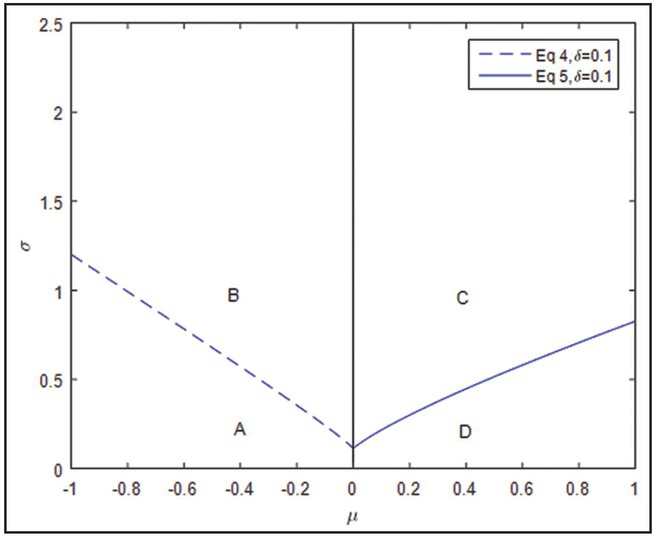
Figure 1
Theoretical prediction of trial period policy impact on whether to hire.
Notes: Area A represents μ-σ combinations such that the applicant will not be hired whether or not trial periods are available; applicants in area B will be hired only when trial periods are available and then will be hired with a trial period; applicants in area C will be hired regardless of trial period legislation and hired on a trial period when available; and applicants in area D will always be hired and never with a trial period. A value of 0.5 is used for the cost of using trial periods, and the discount rate is δ = 0.1.
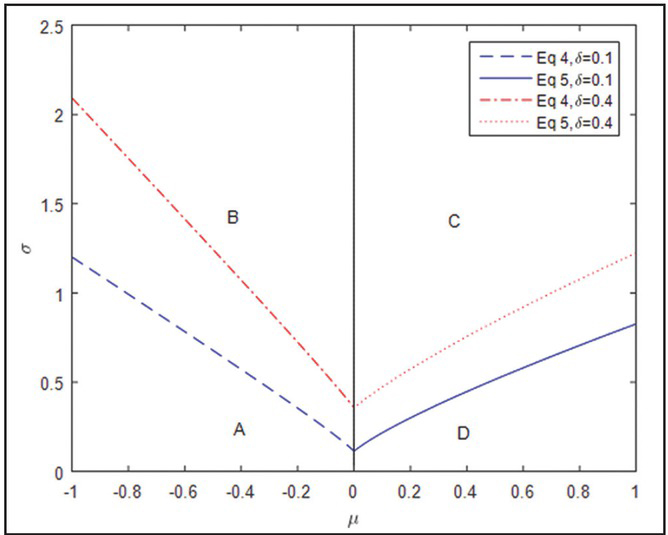
Figure 2
Theoretical prediction of trial period policy, heterogeneous effects.
Notes: This figure shows how the effects of trial period policy differ for firms with different discount rates. The blue lines (dashed and solid) denote a discount rate of 0.1, and the red lines (dash-dotted and dotted) denote a discount rate of 0.4. See further notes in Figure 1.
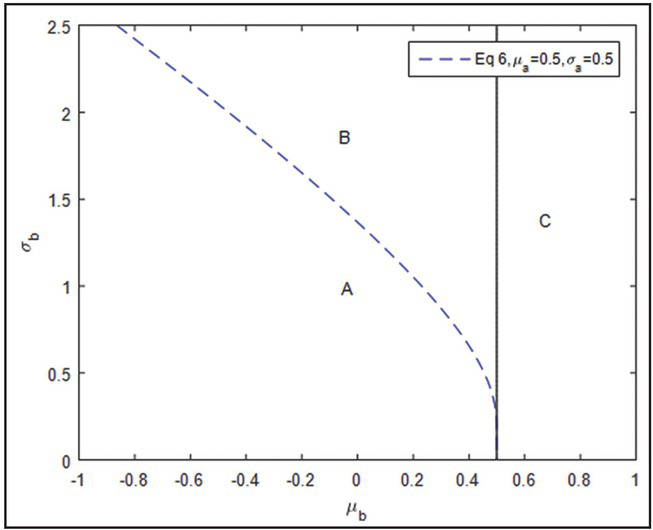
Figure 3
Substitution toward riskier applicants with trial periods.
Notes: This figure compares applicant a, with expected profitability of 0.5 and a standard deviation of profitability of 0.5, with applicant b, whose μ and σ are plotted on the two axes. Area A gives the μ-σ combinations for applicant b such that applicant a is hired regardless of whether trial periods are available; area B gives the combination such that applicant a is hired when trial periods are not available and applicant b is hired when trial periods are available; and area C gives the combinations such that applicant b is hired regardless of whether trial periods are available. The equation comes from the theoretical model in Section 3.2. A value of 0.5 is used for the cost of using trial periods, and the discount rate is δ = 0.1.
Table 2
Distribution of employment and hiring over firm sizes
| Firm size category | Firms with 0–14 employees | Firms with 15–19 employees | Firms with 20–24 employees | Firms with 25+ employees |
|---|---|---|---|---|
| Average employment (employee–firm matches) | 570,100 | 80,500 | 59,400 | 1,363,000 |
| % of total employment | 27.5% | 3.9% | 2.9% | 65.8% |
| Average number of firms employing in a month | 135,734 | 4,803 | 2,723 | 9,278 |
| % of total firm months | 89.0% | 3.1% | 1.8% | 6.1% |
| Count of all hires | 6,611,700 | 799,500 | 590,900 | 8,796,100 |
| % of all hires | 39.4% | 4.8% | 3.5% | 52.4% |
| Count of new hires | 3,948,500 | 512,100 | 381,200 | 5,439,200 |
| % of new hires | 38.4% | 5.0% | 3.7% | 52.9% |
Table 3
Descriptive statistics for treatment and control firms by period
| Firms with 15–19 employees | Firms with 20–24 employees | |||||
|---|---|---|---|---|---|---|
| Period relative to policy changes | Pre | Between | Post | Pre | Between | Post |
| Average number of firms employing each month | 4,884 | 4,710 | 4,753 | 2,754 | 2,648 | 2,733 |
| Average firm size | 16.8 | 16.8 | 16.8 | 21.8 | 21.8 | 21.8 |
| % of firms with multiple plants | 13.8% | 13.7% | 13.3% | 17.7% | 18.0% | 16.8% |
| % of firm months hiring anyone | 60.6% | 54.0% | 55.7% | 67.6% | 61.4% | 62.8% |
| % of firm months hiring a nonseasonal employee | 49.1% | 42.2% | 44.2% | 56.4% | 49.2% | 51.1% |
| % of firm months hiring a new employee | 47.3% | 40.0% | 42.3% | 52.7% | 46.8% | 49.1% |
| Average number of new hires per firm month | 1.1 | 0.9 | 0.9 | 1.4 | 1.2 | 1.2 |
| Among firm months that hired a new employee | ||||||
| Average number of new hires | 2.2 | 2.2 | 2.1 | 2.5 | 2.5 | 2.4 |
| 25th percentile of number of hires | 1 | 1 | 1 | 1 | 1 | 1 |
| 50th percentile of number of hires | 1 | 1 | 1 | 2 | 1 | 1 |
| 75th percentile of number of hires | 2 | 2 | 2 | 3 | 3 | 3 |
| Among new hires,% who | ||||||
| Stayed with the firm for 5+ months | 45.1% | 47.1% | 49.1% | 45.3% | 46.5% | 49.3% |
| Received benefit income in previous year | 17.1% | 18.1% | 20.1% | 17.2% | 18.3% | 19.6% |
| Received jobseeker benefit income in previous year | 10.2% | 12.2% | 13.2% | 10.2% | 12.2% | 12.7% |
| Had not worked in the past year | 23.4% | 25.3% | 27.6% | 23.1% | 25.0% | 26.7% |
| Arrived in New Zealand on a visa in the past 2 years | 16.2% | 19.0% | 20.3% | 16.4% | 20.0% | 20.8% |
| Are <25 years old | 43.1% | 40.3% | 42.3% | 41.3% | 38.9% | 40.1% |
| Are Maori or Pasifika and <25 years old | 10.2% | 8.7% | 9.2% | 10.3% | 8.8% | 9.1% |
| Left education in the previous year | 12.6% | 11.1% | 11.2% | 12.6% | 11.1% | 10.9% |
| Had a job elsewhere the previous month | 51.4% | 47.3% | 47.6% | 51.6% | 47.6% | 48.3% |
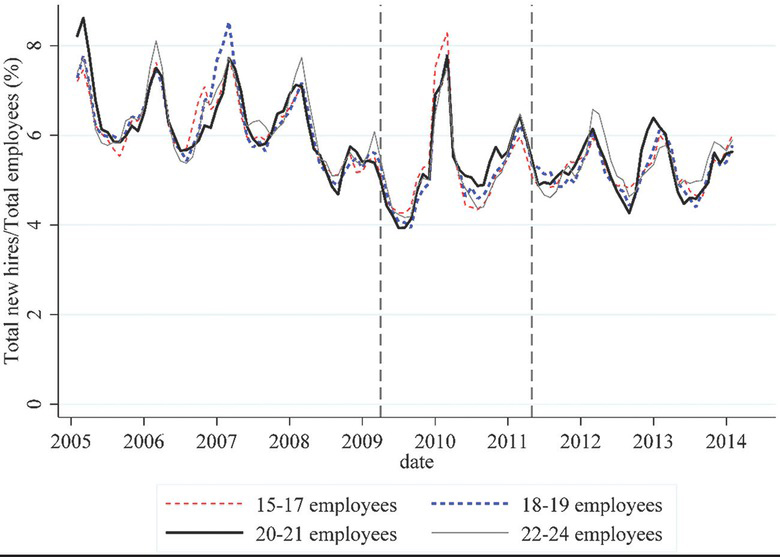
Figure 4
New hires as a percentage of total employees by firm size.
Notes: Values are 3-month moving averages. Vertical gray lines indicate the policy changes.
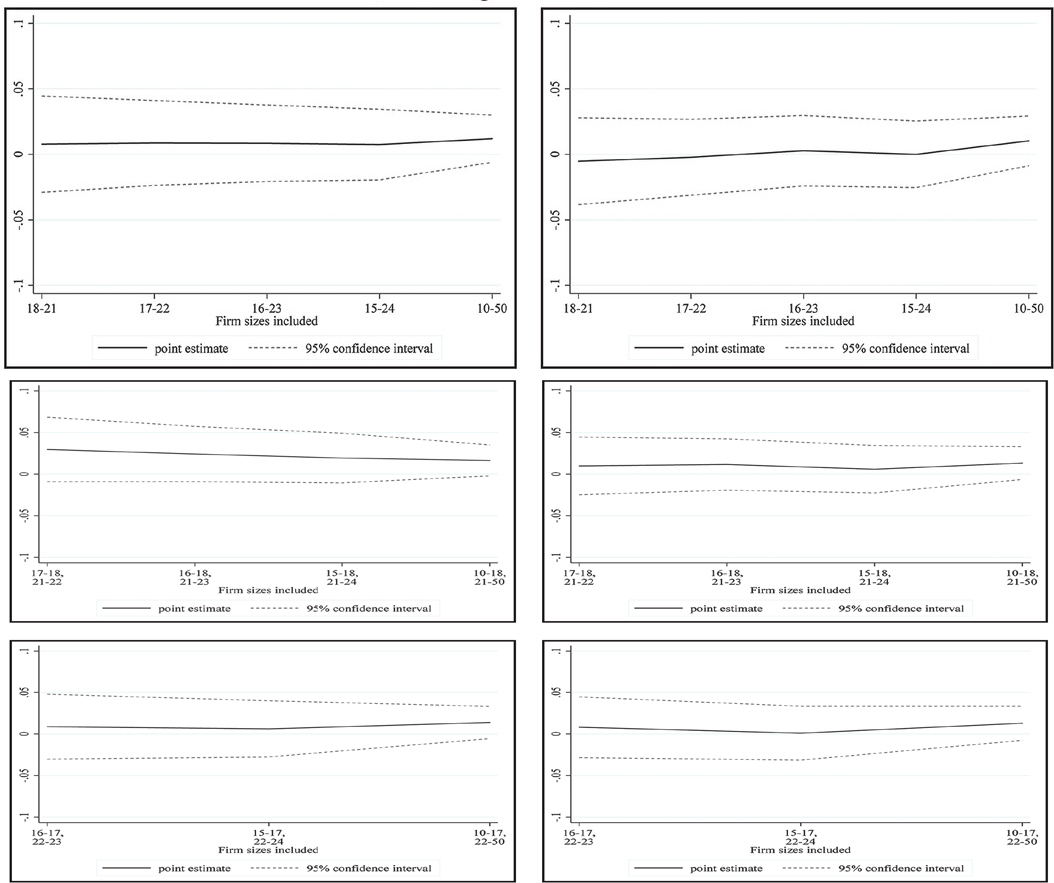
Figure 5
Policy effect on the number of new hires, varying firm sizes included. Panel A1: Policy effect, no cutout. Panel A2: Placebo test, no cutout. Panel B1: Policy effect, excluding firms sized 19–20. Panel B2: Placebo test, excluding firms sized 19–20. Panel C1: Policy effect, excluding firms sized 18–21 Panel C2: Placebo test, excluding firms sized 18–21.
Notes: The figure plots estimated policy effects and their 95% confidence intervals (left-hand panels) and placebo policy effects and their 95% confidence intervals (right-hand panels), varying the range of firm sizes in the sample. The policy effect is the coefficient on between * small firm from the corresponding specifications in Table A1 in Appendix. The placebo tests plot the coefficients on post * small firm. See Table A1 in Appendix for details.
Table 4
Policy effect for very small firms
| Negative binomial regression | |
|---|---|
| Dependent variable: Number of new hires | |
| Between * size 1–4 | -0.003 |
| (0.016) | |
| Between * size 5–9 | 0.015 |
| (0.016) | |
| Between * size 10–14 | 0.017 |
| (0.016) | |
| Between * size 15–19 | 0.003 |
| (0.017) | |
| Between * size 25–29 | 0.015 |
| (0.020) | |
| Post * size 1–4 | -0.013 |
| (0.014) | |
| Post * size 5–9 | -0.005 |
| (0.015) | |
| Post * size 10–14 | -0.014 |
| (0.015) | |
| Post * size 15–19 | -0.004 |
| (0.015) | |
| Post * size 25–29 | -0.028 |
| (0.018) | |
| Observations | 15,423,435 |
| % of nonzero hires | 15.9% |
[i] Notes: The table presents results from a negative binomial regression at the firm-month level of the number of hires, similar to Table A1 in Appendix, but expanding the firm size sample to 1–29 employees. The regression also includes firm size category fixed effects, month-in-year fixed effects, log firm size and level 1 industry fixed effects. Standard errors, in parentheses, are robust and clustered at the firm level.
Table 5
Heterogeneous policy effects, with various interaction variables
| Dependent variable: No. of new hires | Proportion of jobs in lvl 2 industry | Proportion of jobs in lvl 2 industry with | Proportion of jobs in lvl 2 industry | Proportion of jobs in lvl 2 industry | Seasonality of lvl 2 industry (proportion of max to min hires in a season, March 2005– February 2009) | Firm growth in employment over |
|---|---|---|---|---|---|---|
| interaction variable | using a trial period (0–1) | no employer-funded training (0–1) | with a permanent contract (0–1) | lasting 5+ months, 2005–2008 (0–1) | previous 12 months (decimal) | |
| Between * small firm | 0.135 | 0.070 | 0.273 | –0.008 | –0.060* | –0.025* |
| * interaction variable | ||||||
| (0.139) | (0.105) | (0.276) | (0.107) | (0.031) | (0.013) | |
| Post * small firm * interaction | 0.163 | 0.040 | 0.492* | 0.078 | –0.088*** | 0.000 |
| variable | ||||||
| (0.138) | (0.101) | (0.259) | (0.101) | (0.030) | (0.014) | |
| Between * small firm | –0.021 | –0.040 | –0.238 | 0.011 | 0.097* | 0.004 |
| (0.035) | (0.079) | (0.249) | (0.053) | (0.051) | (0.014) | |
| Post * small firm | –0.036 | –0.030 | –0.443* | –0.038 | 0.131*** | –0.003 |
| (0.034) | (0.074) | (0.235) | (0.051) | (0.048) | (0.014) | |
| Between * interaction variable | –0.570*** | –0.214** | –0.960*** | –0.338*** | 0.077*** | 0.039*** |
| (0.113) | (0.086) | (0.238) | (0.094) | (0.026) | (0.010) | |
| Post * interaction variable | 0.038 | 0.091 | 0.151 | 0.002 | –0.014 | 0.041*** |
| (0.115) | (0.083) | (0.231) | (0.089) | (0.025) | (0.012) | |
| Small firm * interaction variable | –0.185** | –0.125* | –0.274 | –0.051 | 0.053*** | 0.008 |
| (0.089) | (0.068) | (0.170) | (0.067) | (0.019) | (0.007) | |
| Interaction variable | –15.960** | 5.130** | –6.534** | –2.339** | 0.567** | 0.040*** |
| (7.516) | (2.351) | (3.114) | (1.124) | (0.273) | (0.006) | |
| Small firm | 0.028 | 0.077 | 0.233 | 0.011 | –0.092*** | –0.013 |
| (0.024) | (0.050) | (0.154) | (0.034) | (0.031) | (0.012) | |
| Observations | 817,449 | 826,206 | 826,206 | 835,338 | 834,972 | 716,514 |
| Mean of interaction variable | 0.234 | 0.729 | 0.913 | 0.513 | 1.444 | 0.129 |
| Standard deviation of interaction | 0.081 | 0.115 | 0.050 | 0.124 | 0.410 | 0.826 |
| variable |
[i] Notes: This table replicates and presents key coefficients from our baseline regression from Table A1 in Appendix for firms sized 15–24, and also includes a different interaction variable in each column to look for heterogeneous effects of trial period policy. The sample period is from January 2005 to March 2014. The first column measures trial period use using the 2012 Survey of Working Life (SOWL) while the second and third columns use the 2008 SOWL only. The last four columns use administrative data to form the interaction variable. In constructing the seasonality of level 2 industries, we sum the total number of a season’s hires over March 2005-February 2009, and take the ratio of the season with most hires to the season with least hires. A firm has a “recent unfilled separation” if its size is less than it was in any of the previous 3 months. Firm growth in employment over the previous 12 months is calculated up to the last month’s firm size. Standard errors, in parentheses, are robust and clustered at the firm level.
The bold variable highlights the policy estimate of interest, in this table and in subsequent tables.
***p < 0.01, **p < 0.05, *p < 0.10.
Table 6
Policy effect on the probability a new hire was a disadvantaged jobseeker
| Dependent variable: Indicator for hire type | Beneficiary in past year | Jobseeker beneficiary in past year | Not worked in past year | Recent migrant | Under 25 years old | Maori or Pasifika under 25 | Education leaver |
|---|---|---|---|---|---|---|---|
| Between * small firm | 0.003 | 0.003 | 0.004 | –0.003 | –0.003 | –0.000 | –0.001 |
| (0.003) | (0.002) | (0.003) | (0.004) | (0.004) | (0.002) | (0.002) | |
| Post * small firm | 0.005 | 0.003 | 0.005* | –0.001 | 0.003 | 0.001 | 0.002 |
| (0.003) | (0.002) | (0.003) | (0.004) | (0.004) | (0.002) | (0.002) | |
| Small firm | –0.001 | –0.001 | –0.003 | –0.004 | 0.003 | –0.002 | 0.000 |
| (0.002) | (0.002) | (0.003) | (0.003) | (0.003) | (0.002) | (0.002) | |
| Firm size (ln) | –0.002 | 0.001 | –0.002 | 0.009 | 0.004 | –0.004 | 0.002 |
| (0.007) | (0.006) | (0.008) | (0.010) | (0.009) | (0.006) | (0.005) | |
| Plant size (ln) | –0.002 | 0.000 | 0.004* | 0.001 | 0.013*** | 0.009*** | –0.004*** |
| (0.002) | (0.002) | (0.002) | (0.003) | (0.003) | (0.002) | (0.001) | |
| Month-in-year fixed effects | Yes | Yes | Yes | Yes | Yes | Yes | Yes |
| Calendar month * 3-digit industry fixed effects | Yes | Yes | Yes | Yes | Yes | Yes | Yes |
| Observations | 893,292 | 893,292 | 893,292 | 893,292 | 890,352 | 890,352 | 770,415 |
| % hires of given type | 18.2 | 11.4 | 24.9 | 18.2 | 41.6 | 9.7 | 12.1 |
| R-Squared | 0.030 | 0.031 | 0.035 | 0.092 | 0.122 | 0.027 | 0.010 |
[i] Notes: This table presents the coefficients from linear probability regressions at the hire level where the dependent variable is an indicator for the hire being a particular type of disadvantaged jobseeker, as described in the column header. Recent migrants are those who had their visa stamped in the past 2 years. Hires are included only if the firms are of size 15–24 and the employee had not worked for the firm in the previous 5 years. The sample period is from January 2005 to March 2014 (December 2012 in the final column). Age is missing for a small proportion of individuals, which causes the lower observation count in columns 5 and 6. Small firms are those with fewer than 20 employees, which were eligible to use trial periods after the first policy change. Between and Post refer to the time periods relative to the two policy changes. A dummy for the plant having zero employment is also included. Standard errors, in parentheses, are robust and clustered at the firm level.
The bold variable highlights the policy estimate of interest, in this table and in subsequent tables.
***p < 0.01, *p< 0.10.
Table 7
Policy effect on the distribution of employment duration of new hires
| Dependent variable: Indicator for employment lasting at least | 2 months | 2 months | 5 months | 12 months | 24 months |
|---|---|---|---|---|---|
| Between * small firm | 0.003 | 0.002 | -0.002 | -0.001 | -0.002 |
| (0.002) | (0.002) | (0.003) | (0.002) | (0.002) | |
| Post * small firm | 0.007** | 0.006** | 0.000 | -0.003 | -0.001 |
| (0.003) | (0.003) | (0.004) | (0.003) | (0.003) | |
| Small firm | -0.001 | -0.003 | -0.003 | -0.001 | -0.002 |
| (0.002) | (0.002) | (0.002) | (0.002) | (0.002) | |
| Firm size (ln) | 0.026*** | 0.014** | 0.029*** | 0.025*** | 0.015*** |
| (0.006) | (0.006) | (0.008) | (0.007) | (0.005) | |
| Plant size (ln) | -0.015*** | -0.013*** | -0.019*** | -0.009*** | -0.005*** |
| (0.001) | (0.001) | (0.002) | (0.001) | (0.001) | |
| Age | 0.013*** | 0.018*** | 0.015*** | 0.012*** | |
| (0.000) | (0.000) | (0.000) | (0.000) | ||
| Age squared (per 100) | -0.015*** | -0.020*** | -0.016*** | -0.012*** | |
| (0.000) | (0.000) | (0.000) | (0.000) | ||
| Female | 0.007*** | 0.006*** | -0.006*** | -0.011*** | |
| (0.001) | (0.001) | (0.001) | (0.001) | ||
| On jobseeker benefit in previous year | -0.026*** | -0.071*** | -0.070*** | -0.051*** | |
| (0.002) | (0.002) | (0.002) | (0.001) | ||
| On sole parent benefit in previous year | -0.027*** | -0.051*** | -0.053*** | -0.040*** | |
| (0.003) | (0.003) | (0.003) | (0.002) | ||
| On supported living benefit in previous year | -0.056*** | -0.090*** | -0.082*** | -0.056*** | |
| (0.005) | (0.006) | (0.004) | (0.003) | ||
| On other benefit type in previous year | -0.031*** | -0.055*** | -0.055*** | -0.035*** | |
| (0.003) | (0.004) | (0.003) | (0.002) | ||
| Recent migrant | 0.001 | -0.033*** | -0.040*** | -0.032*** | |
| (0.002) | (0.002) | (0.002) | (0.001) | ||
| No wage or salary income in previous year | 0.017*** | 0.041*** | 0.045*** | 0.034*** | |
| (0.001) | (0.002) | (0.001) | (0.001) | ||
| Worked at a different firm the previous month | 0.015*** | 0.046*** | 0.055*** | 0.040*** | |
| (0.001) | (0.001) | (0.001) | (0.001) | ||
| Maori | -0.012*** | -0.028*** | -0.027*** | -0.020*** | |
| (0.001) | (0.002) | (0.001) | (0.001) | ||
| Pasifika | -0.009*** | -0.016*** | -0.015*** | -0.007*** | |
| (0.002) | (0.002) | (0.002) | (0.002) | ||
| Asian | 0.004* | 0.007*** | -0.002 | -0.005*** | |
| (0.002) | (0.002) | (0.002) | (0.002) | ||
| Other ethnicity | -0.006*** | -0.012*** | -0.010*** | -0.008*** | |
| (0.002) | (0.002) | (0.002) | (0.002) | ||
| Education leaver (in past year) | 0.021*** | 0.027*** | 0.021*** | 0.009*** | |
| (0.001) | (0.002) | (0.002) | (0.001) | ||
| Month-in-year fixed effects | Yes | Yes | Yes | Yes | Yes |
| Calendar month * lvl 3 industry fixed effects | Yes | Yes | Yes | Yes | Yes |
| Observations | 723,084 | 671,073 | 671,073 | 671,073 | 671,073 |
| % of hires of given type | 76.8% | 77.8% | 48.3% | 26.0% | 14.2% |
| R-squared | 0.118 | 0.125 | 0.146 | 0.123 | 0.099 |
[i] Notes: This table presents the coefficients from linear probability regressions at the hire level where the dependent variable is an indicator for employment lasting at least a given length of time, as described in the column header. Hires are included only if the firm is of size 15–24 and the employee had not worked for the firm in the previous 5 years. The sample period is from January 2005 to April 2012. Small firms are those with fewer than 20 employees, which were eligible to use trial periods after the first policy change. Between and Post refer to the time periods relative to the two policy changes at the date of hire. A dummy for the plant having zero employment is also included. Standard errors, in parentheses, are robust and clustered at the individual level. The bold variable highlights the policy estimate of interest, in this table and in subsequent tables.
***p < 0.01, **p < 0.05, *p < 0.10..
Table 8
Policy effect on long-term hires and employees moving between firms
| Dependent variable | New hires who lasted 5+ months | New hires who were employed elsewhere previous month |
|---|---|---|
| Between * small firm | 0.006 | -0.002 |
| (0.015) | (0.017) | |
| Post * small firm | 0.006 | -0.003 |
| (0.014) | (0.015) | |
| Small firm | -0.013 | -0.016 |
| (0.012) | (0.013) | |
| Firm size (ln) | 1.000*** | 0.948*** |
| (0.037) | (0.041) | |
| Month-in-year fixed effects | Yes | Yes |
| Calendar month * lvl 3 industry fixed effects | Yes | Yes |
| Observations | 835,362 | 835,362 |
| % of nonzero hires of given type | 30.1% | 29.8% |
[i] Notes: This table presents the coefficients from negative binomial regressions at the firm-month level where the dependent variable is the firm’s number of hires as described in each column header. New hires are those who had not worked for the firm in the previous 5 years. The sample period is from January 2005 to March 2014, and firms included are those sized 15–24. Small firms are those with fewer than 20 employees, which were eligible to use trial periods after the first policy change. Between and Post refer to the time periods relative to the two policy changes. Standard errors, in parentheses, are robust and clustered at the firm level.
The bold variable highlights the policy estimate of interest, in this table and in subsequent tables.
***p < 0.01.
Table 9
Substitution between trial periods and temporary contracts
| Dependent variable | On temporary contract, 2012 | On temporary contract, 2012 | On trial period, 2012 | On trial period, 2012 | On temporary contract, 2008 | On temporary contract, 2008 |
|---|---|---|---|---|---|---|
| Predicted probability of temporary contract from 2008 data, parsimonious | 1.156*** | –1.436*** | ||||
| (0.220) | (0.223) | |||||
| Predicted probability of temporary contract from 2008 data, full controls | 1.364*** | –1.230*** | ||||
| Predicted probability of trial period from 2012 data, parsimonious | (0.151) | (0.147) | –0.270** | |||
| Predicted probability of trial period from 2012 data, full controls | (0.135) | –0.521*** | ||||
| (0.086) | ||||||
| Year | 2012 | 2012 | 2012 | 2012 | 2008 | 2008 |
| Observations | 2,397 | 2,385 | 2,397 | 2,385 | 1,686 | 1,686 |
| R-Squared | 0.014 | 0.043 | 0.015 | 0.025 | 0.003 | 0.023 |
| Mean of dependent variable | 0.207 | 0.207 | 0.376 | 0.375 | 0.200 | 0.200 |
[i] Notes: This table presents results from OLS regressions at the job level, exploring how being on different contract types correlates with the predicted probability of being hired on a certain contract type from a separate survey year. The dependent variable in each column is given in the column header. Predicted probabilities use the individual characteristics and job characteristics of each observation in the sample, and use the model of Table A8 in Appendix for the prediction. The sample is limited to those hired in the previous year. Standard errors, in parentheses, are robust.
***p < 0.01, **p< 0.05.
Table A1
Policy effect on the number of new hires, varying firm sizes included
| Dependent variable | Number of new hires | ||||
|---|---|---|---|---|---|
| Firm sizes included: | 18–21 | 17–22 | 16–23 | 15–24 | 10–50 |
| Between * small firm | 0.008 | 0.009 | 0.009 | 0.008 | 0.012 |
| (0.019) | (0.017) | (0.015) | (0.014) | (0.009) | |
| Post * small firm | -0.005 | -0.002 | 0.003 | 0.000 | 0.010 |
| (0.017) | (0.015) | (0.014) | (0.013) | (0.010) | |
| Small firm | -0.014 | -0.000 | -0.018 | -0.014 | -0.016* |
| (0.016) | (0.013) | (0.012) | (0.011) | (0.009) | |
| Observations | 314,637 | 478,503 | 650,934 | 835,362 | 2,495,838 |
| Firm sizes included: | 17–18, 21–22 | 16–18, 21–23 | 15–18, 21–24 | 10–18, 21–50 | |
| Between * small firm | 0.030 | 0.024 | 0.019 | 0.016* | |
| (0.020) | (0.017) | (0.015) | (0.010) | ||
| Post * small firm | 0.010 | 0.012 | 0.006 | 0.013 | |
| (0.018) | (0.016) | (0.015) | (0.010) | ||
| Small firm | 0.032 | -0.032 | -0.020 | -0.019* | |
| (0.028) | (0.019) | (0.016) | (0.010) | ||
| Observations | 322,119 | 494,553 | 678,978 | 2,339,457 | |
| Firm sizes included: | 16–17, 22–23 | 15–17, 22–24 | 10–17, 22–50 | ||
| Between * small firm | 0.009 | 0.006 | 0.014 | ||
| (0.020) | (0.017) | (0.010) | |||
| Post * small firm | 0.008 | 0.001 | 0.013 | ||
| (0.019) | (0.017) | (0.010) | |||
| Small firm | -0.126*** | -0.043* | -0.022* | ||
| (0.039) | (0.025) | (0.012) | |||
| Observations | 336,297 | 520,725 | 2,181,201 | ||
[i] Notes: This table presents the coefficients from negative binomial regressions at the firm-month level where the dependent variable is the firm’s number of new hires. New hires are those who had not worked for the firm in the previous 5 years. All regressions also control for log firm size, month-in-year fixed effects, and calendar month * level 3 industry fixed effects. The sample period is from January 2005 to March 2014. Small firms are those with fewer than 20 employees at the start of the month, which were eligible to use trial periods after the first policy change. Between and Post refer to the time periods relative to the two policy changes. Standard errors, in parentheses, are robust and clustered at the firm level.
The bold variable highlights the policy estimate of interest, in this table and in subsequent tables.
***p < 0.01, *p < 0.10.
Table A2
Test for parallel trends in the pre-announcement period
| Dependent variable | Number of new hires |
|---|---|
| Time trend * small firm | 0.0002 |
| (0.0005) | |
| Time trend | -0.0087 |
| (0.0054) | |
| Small firm | -0.0143 |
| (0.0181) | |
| Log of firm size | 0.9632*** |
| (0.0448) | |
| Calendar month * level 3 industry fixed effects | Yes |
| Observations | 359,046 |
[i] Notes: This table presents coefficients from negative binomial regressions at the firm-month level for firms with 15–24 employees, as in Table A2 in Appendix, but limits the sample period from January 2005 to November 2008, includes a linear time trend, and interacts the linear time trend with the small firm indicator. Standard errors, in parentheses, are robust and clustered at the firm level.
The bold variable highlights the policy estimate of interest, in this table and in subsequent tables.
***p < 0.01.
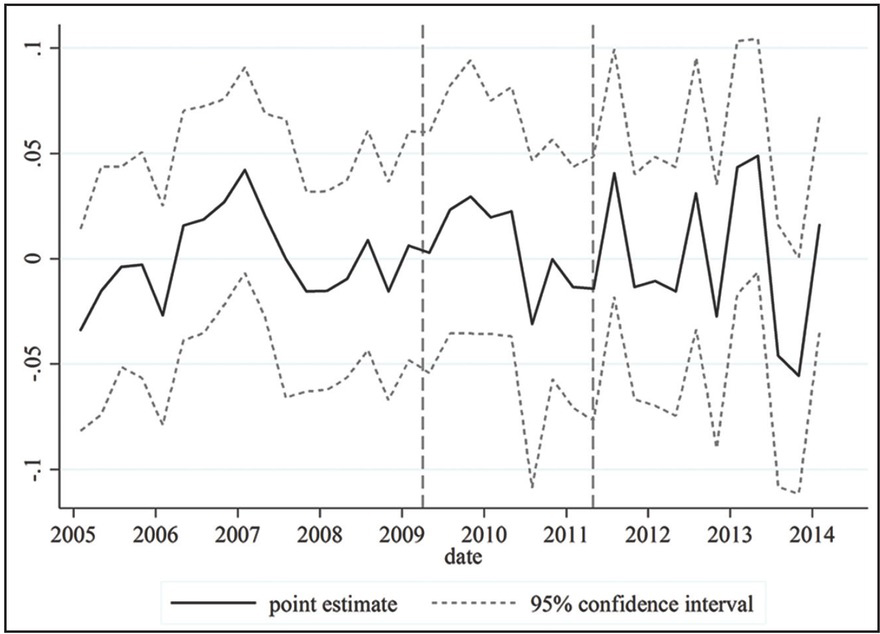
Figure 6
Time-varying estimate of policy effect on number of new hires.
Notes: This figure plots the point estimate and 95% confidence interval of the coefficient on date*small firm in a regression that replicates column 4 in Panel A of Table A1 in Appendix, but allows the difference between small and large firms to vary each 3-month period.
Table A3
Policy effect on the total number of new hires, robustness checks
| Robustness check | Excluding anomalous industries | Excluding firm months with extremely high hiring | Measuring firm size excluding all working proprietors | Interact small firm with GDP | OLS regression | OLS regression | OLS regression |
|---|---|---|---|---|---|---|---|
| Dependent variable | Number of new hires | Number of new hires | Number of new hires | Number of new hires | Dummy for any new hires | Log (new hires +1) | Percentage change in employment (%) |
| Between * small firm | 0.018 | 0.012 | 0.005 | 0.016 | 0.006 | 0.019*** | –0.093 |
| (0.015) | (0.012) | (0.012) | (0.017) | (0.004) | (0.005) | (0.093) | |
| Post * small firm | 0.006 | 0.001 | 0.002 | 0.010 | 0.004 | 0.013*** | 0.021 |
| (0.014) | (0.011) | (0.012) | (0.024) | (0.004) | (0.005) | (0.083) | |
| Small firm | –0.021* | 0.001 | –0.008 | 0.023 | –0.002 | –0.011*** | –0.045 |
| (0.012) | (0.009) | (0.010) | (0.082) | (0.003) | (0.004) | (0.083) | |
| Firm size (ln) | 0.952*** | 1.023*** | 0.941*** | 0.930*** | 0.258*** | 0.359*** | –0.360 |
| (0.036) | (0.028) | (0.030) | (0.034) | (0.009) | (0.011) | (0.236) | |
| Month-in-year fixed effects | Yes | Yes | Yes | Yes | Yes | Yes | Yes |
| Calendar month * 3-digit industry fixed effects | Yes | Yes | Yes | Yes | Yes | Yes | Yes |
| Small firm*quarterly GDP interaction Observations | 781,725 | 827,883 | 810,189 | Yes 835,362 | 835,362 | 835,362 | 824,547 |
| % with nonzero-dependent variable | 45.8% | 46.1% | 61.6% | 46.6% | 46.6% | 46.6% | 62.6% |
[i] Notes: The first four columns of this table present the coefficients from negative binomial regressions at the firm-month level where the dependent variable is the firm’s number of hires who had not worked for the firm in the previous 5 years. For firms sized 15–24 only. Columns 5–7 change the estimation method to OLS, with the dependent variable described in the column headers. The regressions replicate those in the fourth column in Panel A of Table A1 in Appendix except as noted in the column headers. The dropped industries in column 1 are central government administration and school education. Firm months whose number of hires is more than half their start-of-month employment are dropped in column 2. Standard errors, in parentheses, are robust and clustered at the firm level.
The bold variable highlights the policy estimate of interest, in this table and in subsequent tables.
***p < 0.01, *p< 0.10.
Table A4
Policy effect on the probability a new hire was a disadvantaged jobseeker, varying firm-size band
| Dependent variable: Indicator for hire type | Beneficiary in past year | Jobseeker beneficiary in past year | Not worked in past year | Recent migrant | Under 25 years old | Maori or Pasifika under 25 | Education leaver |
|---|---|---|---|---|---|---|---|
| Firms sized 18–21 | |||||||
| Between * small firm | 0.001 | 0.004 | 0.004 | 0.005 | –0.005 | –0.007* | –0.004 |
| (0.004) | (0.004) | (0.005) | (0.006) | (0.005) | (0.003) | (0.003) | |
| Post * small firm | 0.001 | 0.003 | 0.002 | 0.006 | –0.009* | –0.006** | 0.004 |
| (0.004) | (0.003) | (0.004) | (0.006) | (0.005) | (0.003) | (0.003) | |
| Small firm | 0.001 | –0.002 | 0.003 | –0.009* | 0.011** | 0.001 | 0.003 |
| (0.004) | (0.003) | (0.005) | (0.005) | (0.005) | (0.003) | (0.003) | |
| Observations | 350,265 | 350,265 | 350,265 | 350,265 | 349,173 | 349,173 | 302,172 |
| Firms sized 10–50 | |||||||
| Between * small firm | 0.005** | 0.004** | –0.001 | 0.001 | 0.001 | 0.002 | 0.001 |
| (0.002) | (0.002) | (0.002) | (0.003) | (0.003) | (0.002) | (0.001) | |
| Post * small firm | 0.001 | –0.000 | 0.004* | 0.004 | 0.002 | –0.001 | 0.003** |
| (0.002) | (0.002) | (0.002) | (0.004) | (0.003) | (0.002) | (0.001) | |
| Small firm | –0.001 | –0.000 | 0.002 | –0.002 | 0.002 | –0.002 | –0.000 |
| (0.002) | (0.001) | (0.002) | (0.003) | (0.002) | (0.002) | (0.001) | |
| Observations | 2,728,668 | 2,728,668 | 2,728,668 | 2,728,668 | 2,719,995 | 2,719,995 | 2,352,420 |
| Firms sized 15–24, excluding 19–20 | |||||||
| Between * small firm | 0.005 | 0.004 | 0.002 | –0.006 | –0.002 | 0.002 | –0.000 |
| (0.003) | (0.003) | (0.004) | (0.005) | (0.004) | (0.003) | (0.002) | |
| Post * small firm | 0.005 | 0.003 | 0.006* | –0.003 | 0.006 | 0.003 | –0.000 |
| (0.003) | (0.003) | (0.003) | (0.005) | (0.004) | (0.002) | (0.002) | |
| Small firm | –0.003 | –0.000 | –0.005 | –0.001 | –0.000 | –0.003 | –0.001 |
| (0.003) | (0.003) | (0.004) | (0.005) | (0.004) | (0.003) | (0.003) | |
| Observations | 718,575 | 718,575 | 718,575 | 718,575 | 716,181 | 716,181 | 619,950 |
| Firms sized 10–50, excluding 18–21 | |||||||
| Between * small firm | 0.005** | 0.004** | –0.002 | 0.001 | 0.002 | 0.004** | 0.002 |
| (0.002) | (0.002) | (0.002) | (0.004) | (0.003) | (0.002) | (0.001) | |
| Post * small firm | 0.001 | –0.001 | 0.004** | 0.004 | 0.003 | –0.001 | 0.004** |
| (0.003) | (0.002) | (0.002) | (0.004) | (0.003) | (0.002) | (0.001) | |
| Small firm | –0.001 | –0.001 | 0.004** | –0.001 | 0.001 | –0.002 | –0.001 |
| (0.003) | (0.002) | (0.003) | (0.004) | (0.003) | (0.002) | (0.001) | |
| Observations | 2,378,403 | 2,378,403 | 2,378,403 | 2,378,403 | 2,370,822 | 2,370,822 | 2,050,248 |
[i] Notes: This table presents key coefficients from linear probability regressions at the hire level where the dependent variable is an indicator for the hire being a particular type of disadvantaged jobseeker, as described in the column header. The panelsof the table replicate Table 6 for different samples of firm size. See the notes to Table 6 for further details and to see the additional controls included. Standard errors, in parentheses, are robust and clustered at the firm level.
The bold variable highlights the policy estimate of interest, in this table and in subsequent tables.
**p < 0.05, *p< 0.10.
Table A5
Heterogeneous policy effects on the probability a new hire was a disadvantaged jobseeker
| Dependent variable: Indicator for hire type | Beneficiary in past year | Jobseeker beneficiary in past year | Not worked in past year | Recent mi-grant | Under 25 years old | Maori or Pasifika under 25 years old | Education leaver |
|---|---|---|---|---|---|---|---|
| Panel A: Trial period use, employee training, permanent contract use, and long-term jobs | |||||||
| Between * small firm * proportion of | 0.019 | 0.023 | –0.058** | –0.028 | 0.001 | –0.008 | –0.046** |
| jobs starting on trial period | (0.023) | (0.019) | (0.026) | (0.022) | (0.028) | (0.018) | (0.020) |
| Post * small firm * proportion of jobs | 0.048** | 0.046*** | –0.023 | –0.075*** | –0.012 | 0.010 | –0.022 |
| starting on trial period | (0.021) | (0.017) | (0.023) | (0.020) | (0.025) | (0.016) | (0.022) |
| Observations | 873,837 | 873,837 | 873,837 | 873,837 | 870,972 | 873,837 | 754,212 |
| Mean proportion of jobs in industry on a trial period | 0.225 | 0.225 | 0.225 | 0.225 | 0.225 | 0.225 | 0.224 |
| Between * small firm * proportion of | –0.005 | –0.007 | –0.002 | –0.062*** | 0.034 | 0.004 | –0.012 |
| jobs with no training | (0.017) | (0.014) | (0.019) | (0.017) | (0.021) | (0.013) | (0.015) |
| Post * small firm * proportion of jobs with | –0.004 | 0.002 | –0.006 | –0.042*** | 0.020 | –0.002 | –0.001 |
| no employer-funded training | (0.016) | (0.013) | (0.018) | (0.015) | (0.019) | (0.012) | (0.017) |
| Observations | 884,805 | 884,805 | 884,805 | 884,805 | 881,901 | 884,805 | 763,449 |
| Mean proportion of jobs with no employer-funded training | 0.744 | 0.744 | 0.744 | 0.744 | 0.744 | 0.744 | 0.743 |
| Between * small firm * proportion of | 0.059 | 0.084** | 0.031 | 0.185*** | –0.035 | 0.019 | –0.086** |
| jobs starting on permanent contract | (0.041) | (0.034) | (0.046) | (0.040) | (0.051) | (0.032) | (0.035) |
| Post * small firm * proportion of jobs | 0.089** | 0.062** | –0.010 | 0.094*** | –0.039 | 0.055** | –0.076** |
| starting on permanent contract | (0.036) | (0.029) | (0.040) | (0.035) | (0.044) | (0.027) | (0.038) |
| Observations | 884,805 | 884,805 | 884,805 | 884,805 | 881,901 | 884,805 | 763,449 |
| Mean proportion of jobs starting on permanent contract | 0.891 | 0.891 | 0.891 | 0.891 | 0.891 | 0.891 | 0.891 |
| Between * small firm * proportion of | 0.033** | 0.041*** | –0.008 | 0.053*** | –0.020 | 0.013 | –0.013 |
| jobs lasting 5+ months | (0.015) | (0.012) | (0.017) | (0.014) | (0.018) | (0.011) | (0.013) |
| Post * small firm * proportion of jobs | 0.045*** | 0.031*** | 0.011 | 0.013 | –0.029* | 0.019* | –0.018 |
| lasting 5+ months | (0.013) | (0.011) | (0.015) | (0.013) | (0.016) | (0.010) | (0.014) |
| Observations | 893,259 | 893,259 | 893,259 | 893,259 | 890,319 | 893,259 | 770,415 |
| Mean proportion of jobs lasting 5+ months | 0.448 | 0.448 | 0.448 | 0.448 | 0.448 | 0.448 | 0.449 |
| Panel B: Seasonality and firm growth | |||||||
| Between * small firm * seasonality of | –0.003 | –0.007* | 0.001 | –0.001 | –0.000 | –0.001 | 0.006 |
| industry | (0.005) | (0.004) | (0.005) | (0.004) | (0.006) | (0.004) | (0.004) |
| Post * small firm * seasonality of industry | –0.010** | –0.008** | 0.002 | 0.009** | –0.002 | –0.005* | 0.008** |
| (0.004) | (0.003) | (0.005) | (0.004) | (0.005) | (0.003) | (0.004) | |
| Observations | 893,040 | 893,040 | 893,040 | 893,040 | 890,100 | 893,040 | 770,241 |
| Mean seasonality of industry | 1.578 | 1.578 | 1.578 | 1.578 | 1.578 | 1.578 | 1.578 |
| Standard deviation of seasonality of industry | 0.472 | 0.472 | 0.472 | 0.472 | 0.472 | 0.472 | 0.472 |
| Between * small firm * firm growth over | –0.000 | –0.001 | 0.005** | –0.003* | –0.001 | –0.001 | –0.000 |
| previous 12 months | (0.002) | (0.002) | (0.002) | (0.002) | (0.002) | (0.001) | (0.002) |
| Post * small firm * recent firm growth | 0.005** | 0.003* | 0.004* | –0.001 | 0.003 | –0.000 | 0.001 |
| (0.002) | (0.002) | (0.002) | (0.002) | (0.003) | (0.002) | (0.002) | |
| Observations | 720,147 | 720,147 | 720,147 | 720,147 | 717,873 | 720,147 | 605,694 |
| Mean firm growth over previous 12 months | 0.198 | 0.198 | 0.198 | 0.198 | 0.198 | 0.198 | 0.195 |
| Standard deviation of Firm growth over previous 12 months | 1.386 | 1.386 | 1.386 | 1.386 | 1.382 | 1.386 | 1.417 |
[i] Notes: This table presents key coefficients from linear probability regressions at the hire level where the dependent variable is an indicator for the hire being a particulartypeof disadvantaged jobseeker, as described in column headers. Regressions are the same as those in Table 6, except each panel includes the interaction of the policy effect and placebo effect with a modifying variable. The modifying variables in the first five panels are at the level 2 industry level. See Table 5 for further descriptions of the modifying variables, and Table 6 for definitions of hire types. Hires are included only if the firm is of size 15-24 and the employee had not worked for the firm in the previous 5 years. The sample period is from January 2005 to March 2014 (December 2013 in the final column). Standard errors, in parentheses, are robust and clustered at the firm level.
The bold variable highlights the policy estimate of interest, in this table and in subsequent tables.
***p < 0.01, **p < 0.05, *p < 0.10.
Table A6
Policy effect on the distribution of employment duration of rehires
| Dependent variable: Indicator for employment lasting at least | 2 months | 5 months | 12 months | 24 months |
|---|---|---|---|---|
| Between * small firm | 0.002 | -0.002 | -0.001 | -0.002 |
| (0.002) | (0.003) | (0.002) | (0.002) | |
| Post * small firm | 0.006** | 0.000 | -0.003 | -0.001 |
| (0.003) | (0.004) | (0.003) | (0.003) | |
| Small firm | -0.003 | -0.003 | -0.001 | -0.002 |
| (0.002) | (0.002) | (0.002) | (0.002) | |
| Employee demographic controls | Yes | Yes | Yes | Yes |
| Month-in-year fixed effects | Yes | Yes | Yes | Yes |
| Calendar month * level 3 industry fixed effects | Yes | Yes | Yes | Yes |
| Observations | 390,963 | 390,963 | 390,963 | 390,963 |
| % hires of given type | 61.9% | 35.1% | 15.3% | 8.4% |
| R-squared | 0.121 | 0.181 | 0.077 | 0.061 |
[i] Notes: This table presents key coefficients from linear probability regressions at the hire level where the dependent variable is an indicator for employment lasting at least a given length of time, as described in the column header. Hires are included only if the firm is of size 15–24 and the employee had worked for the firm in the previous 5 years. The table replicates Table 7 with the same covariates in each column, but observations are individuals who had previously been employed by the same firm rather than the converse. Standard errors, in parentheses, are robust and clustered at the individual level.
The bold variable highlights the policy estimate of interest, in this table and in subsequent tables.
**p < 0.05.
Table A7
Policy effect on the distribution of employment duration of different hire types
| Dependent variable: Indicator for employment lasting at least: | 2 months | 5 months | 12 months | 24 months |
|---|---|---|---|---|
| Panel A: Beneficiaries, jobseekers, nonworkers, and migrants | ||||
| Recent beneficiary hires | ||||
| Between * small firm | -0.002 | -0.002 | -0.001 | -0.001 |
| (0.005) | (0.006) | (0.005) | (0.004) | |
| Post * small firm | 0.006 | -0.008 | -0.012* | -0.005 |
| (0.007) | (0.008) | (0.007) | (0.005) | |
| Small firm | -0.002 | 0.004 | 0.005 | 0.002 |
| (0.005) | (0.006) | (0.005) | (0.003) | |
| Observations | 129,507 | 129,507 | 129,507 | 129,507 |
| Recent jobseeker hires | ||||
| Between * small firm | -0.001 | -0.004 | 0.004 | 0.003 |
| (0.007) | (0.008) | (0.006) | (0.005) | |
| Post * small firm | 0.002 | -0.013 | -0.010 | -0.008 |
| (0.008) | (0.010) | (0.008) | (0.006) | |
| Small firm | 0.005 | 0.009 | 0.006 | 0.007 |
| (0.006) | (0.007) | (0.006) | (0.004) | |
| Observations | 80,904 | 80,904 | 80,904 | 80,904 |
| Recent nonworking hires | ||||
| Between * small firm | -0.000 | -0.003 | -0.002 | -0.002 |
| (0.005) | (0.006) | (0.005) | (0.004) | |
| Post * small firm | 0.010 | 0.001 | -0.009 | -0.005 |
| (0.006) | (0.007) | (0.007) | (0.005) | |
| Small firm | -0.002 | -0.006 | 0.003 | 0.000 |
| (0.004) | (0.005) | (0.005) | (0.004) | |
| Observations | 147,909 | 147,909 | 147,909 | 147,909 |
| Recent migrant hires | ||||
| Between * small firm | 0.004 | 0.003 | -0.007 | -0.005 |
| (0.006) | (0.008) | (0.006) | (0.005) | |
| Post * small firm | -0.002 | -0.015 | -0.018** | -0.013** |
| (0.008) | (0.010) | (0.008) | (0.007) | |
| Small firm | 0.002 | 0.008 | 0.012** | 0.009** |
| (0.006) | (0.007) | (0.006) | (0.005) | |
| Observations | 84,780 | 84,780 | 84,780 | 84,780 |
| Panel B: Youth, young Māori and Pasifika, and education-leaver hires | ||||
| Young (under 25 years) hires | ||||
| Between * small firm | 0.007* | -0.001 | 0.001 | -0.002 |
| (0.004) | (0.004) | (0.004) | (0.003) | |
| Post * small firm | 0.005 | -0.003 | -0.005 | -0.005 |
| (0.005) | (0.006) | (0.005) | (0.004) | |
| Small firm | -0.005 | -0.001 | -0.003 | 0.000 |
| (0.003) | (0.004) | (0.003) | (0.002) | |
| Observations | 274,461 | 274,461 | 274,461 | 274,461 |
| Young Māori and Pasifika hires | ||||
| Between * small firm | 0.007 | -0.003 | -0.000 | 0.004 |
| (0.008) | (0.009) | (0.007) | (0.005) | |
| Post * small firm | -0.005 | -0.014 | -0.009 | -0.009 |
| (0.010) | (0.012) | (0.009) | (0.007) | |
| Small firm | 0.004 | 0.003 | -0.006 | 0.001 |
| (0.007) | (0.008) | (0.006) | (0.004) | |
| Observations | 70,128 | 70,128 | 70,128 | 70,128 |
| Recent education-leaver hires | ||||
| Between * small firm | 0.004 | -0.004 | 0.004 | -0.001 |
| (0.006) | (0.008) | (0.007) | (0.006) | |
| Post * small firm | 0.003 | -0.013 | -0.013 | -0.001 |
| (0.008) | (0.010) | (0.009) | (0.007) | |
| Small firm | -0.008 | 0.006 | 0.004 | -0.001 |
| (0.006) | (0.007) | (0.006) | (0.005) | |
| Observations | 87,813 | 87,813 | 87,813 | 87,813 |
[i] Notes: The panels of this table present key coefficients from linear probability regressions at the hire level where the dependent variable is an indicator for employment lasting at least a given length of time, as described in the column header. This table replicates Table 7, but only for the columns with more extensive controls, and regressions are limited to new hires at firms sized 15–24 of the types described in italics in the panel headers. Standard errors, in parentheses, are robust and clustered at the individual level.
The bold variable highlights the policy estimate of interest, in this table and in subsequent tables.
**p < 0.05, *p < 0.10.
Table A8
Predicting temporary contracts and trial period jobs
| Dependent variable | On temporary contract, 2008 | On temporary contract, 2008 | On trial period, 2012 | On trial period, 2012 |
|---|---|---|---|---|
| Aged 50+ years | 0.037 | 0.022 | -0.078*** | -0.067** |
| (0.028) | (0.026) | (0.026) | (0.026) | |
| Aged 15–24 years | 0.065*** | 0.083*** | -0.025 | -0.050** |
| (0.025) | (0.026) | (0.024) | (0.025) | |
| Male | -0.028 | -0.035 | 0.027 | 0.005 |
| (0.019) | (0.022) | (0.020) | (0.023) | |
| Degree or higher qualification | 0.066** | 0.045 | -0.182*** | -0.117*** |
| (0.032) | (0.032) | (0.025) | (0.029) | |
| School qualification | 0.003 | 0.016 | -0.011 | -0.019 |
| (0.026) | (0.026) | (0.027) | (0.027) | |
| No qualification | 0.011 | -0.004 | -0.052* | -0.071** |
| (0.027) | (0.026) | (0.030) | (0.029) | |
| Does not know qualification | 0.064 | 0.133 | -0.084 | -0.082 |
| (0.126) | (0.137) | (0.139) | (0.133) | |
| Professional occupation | -0.005 | -0.085** | ||
| (0.037) | (0.043) | |||
| Technicians and trade | 0.048 | 0.055 | ||
| (0.050) | (0.045) | |||
| Community and personnel | 0.015 | -0.003 | ||
| service | (0.040) | (0.048) | ||
| Clerical and admin | 0.030 | -0.040 | ||
| (0.040) | (0.045) | |||
| Sales workers | 0.118** | -0.001 | ||
| (0.054) | (0.046) | |||
| Machinery operators and | 0.051 | 0.004 | ||
| drivers | (0.056) | (0.055) | ||
| Laborers | 0.087** | -0.035 | ||
| (0.041) | (0.042) | |||
| Other occupation | – | 0.080 (0.317) | ||
| Ethnicity fixed effects | Yes | Yes | Yes | Yes |
| Level 1 industry fixed effects | No | Yes | No | Yes |
| Observations | 1,686 | 1,680 | 2,409 | 2,406 |
| Mean of dependent variable | 0.200 | 0.201 | 0.376 | 0.376 |
[i] Notes: This table presents average marginal effects from logit regressions at the job level, predicting whether a new job uses a temporary contract in the first two columns, or a trial period in the last two columns. The sample is limited to those hired in the last year. Columns 1 and 2 use the 2008 Survey of Working Life (SOWL) only, while columns 3 and 4 use the 2012 SOWL only. Ethnicity fixed effects are self-reported and control for being Maori/Pasifika, Asian, other, or European. In the case of multiple reported ethnicities, ethnicity is prioritized in the order of the previous paragraph. The omitted category for qualification level is subdegree tertiary qualifications. The omitted category for occupation is managers. Level 1 industries group firms into 20 broad industries. Standard errors, in parentheses, are calculated using the delta method.
***p < 0.01, **p < 0.05, *p < 0.10.