
Table 1
Summary of empirical findings on the impact of PMR and EPL reforms on (un)employment
| Studies | Data | Dependent variable | Definition: PMR and EPL | Methodology | Endogeneity tests | Results |
|---|---|---|---|---|---|---|
| Boerietal. (2000) | 19 OECD countries, 1982-1995 | Nonagricultural employment rate | EPL: OECD indicator for permanent and temporary workers PMR: OECD economy-wide index | Step 1: reduced-form model for EPL; step 2: country-specific effect; step 3: bivariate correlation between the unexplained country-specific effects and the PMR index | – | Countries with restrictive PMR tend to have lower employment rates in the nonagricultural business sector. EPL has a negative impact on employment rate (90% significance) |
| Nicoletti et al (2001) | 20 OECD countries, 1982-1998 | Employment rate | PMR: OECD sectoral index | Reduced-form models estimated with fixed and random effects | – | Anticompetitive PMR has significant negative effects on nonagricultural employment rate. In some countries, the product market regulatory environment may account for up to 3 PP of deviations of the employment rate from the OECD average |
| Baker et al (2002) | 20 OECO countries, 1960-1999 | Unemployment rate | EPL: OECD indicator | Feasible generalized least squares | Do not consider EPL as endogenous. Control for the endogeneity of ALMPs by instrumenting it using countries' average ALMP value over the period 1985-1999 | No argument in favor of labor market deregulation since nearly all the change in structural unemployment rates was accounted for by country-specific effects not by institutional factors |
| Belot and Van Ours (2004) | 17 OECD countries, 1960-1999 | Unemployment rate | EPL: index based on three subindexes (protection of open-ended contracts, fixed-term contracts, and temporary work agencies), own computation, scale of 0-1 | FE regressions taking interactions between labor market institutions into account | – | No clear causal relationship between employment protection and unemployment rate. Estimating the regression with fixed effect made the coefficient of employment protection statistically insignificant |
| Nicoletti and Scarpetta (2005) | 20 OECD countries, 1980-2002 | Nonagricultural employment rate | EPL: OECD indicator for permanent and temporary workers PMR: OECD sectoral index | Fixed effect: regression | – | Significant employment gains can be obtained by deregulating product markets in overly regulated countries. EPL has a negative impact on employment rate but this impact is not significant in all specifications, particularly when they control for outliers and add country fixed effects |
| Bassanini and Duval (2006a) | 20 OECD countries, 1982-2003 | Unemployment rate | EPL: OECD indicator for permanent and temporary workers PMR: OECD sectoral index | Feasible GSL with fixed and random effects | IV estimation using lagged institutional variables (2-year lag) PMR and EPL coefficients become statistically insignificant | PMR raise aggregates unemployment. EPL effect on unemployment is statistically insignificant |
| Berger and Danninger (2007) | 27OECD countries, 1980-2004 | Employment growth rate | EPL: OECD indicator for permanent and temporary workers PMR: OECD economy-wide index | Time series panel techniques with fixed and random effects, IV and GMM | GMM based on Arellano and Bond (1991) with a four-lag structure Same result as other specifications but coefficients become not statistically significant | Lower levels of product and labor market regulator foster employment growth |
| Fiori et al (2007) | 20 OECO countries, 1980-2002 | Nonagricul- tural employ- ment rate | EPL: OECD indicator for permanent and tempo- rary workers PMR: OECD sectoral index | Feasible GLS | Control function approach of Rivers and Vuong (1988) finds that there is no endog- eneity and thus GLS results are consistent | Anticompetitive PMR has a negative impact on employment rate Tight labor market regulation tends to reduce employment |
| Griffith et al. (2007) | 14 OECO countries, 1986-2000 | Unemploy- ment rate | PMR: captures changes in the extent of competition using a measure of the average level of firm profitability+2 indicators based on an opinion sur- vey and 1 reported by the Fraser Institute | Fixed-effect regression | Two-stage estimation approach: first, the impact of PMR and LMR on profitability, and then, the impact of profitability on the unemployment rate | Increased competition reduces unemployment |
| Kugler and Pica (2008) | Italian Social Security employer- employee panel data, 1986-1995 | Accession or separation between worker and firm | EPL: dummy variable which takes the value of 1 after 1990 (after the reform) and a dummy variable which takes the value of 1 if the worker is employed in a small firm | Difference-in-difference approach by comparing worker and job flows in small and large firms before and after the reform | Use the 1990 reform on workers and job flows (increasing dismissal costs for small firms) as a natural experiment | The increase in dismissal costs decreased accession and separation rates for workers in small relative to large firms. Negligible impact on net employment |
| Amable et al. (2011) | 18 OECD countries, 1930-2004 | Jobless, inactivity and unemploy- ment | EPL: model the evolution of the OECD index using EPL index from the FRDB Social Reforms: Data- base as well as country dummies and time trends as regressors PMR: OECD index (economy wide and sectoral) | Limited dependent variable model with country dum- mies + fixed-effect vector decomposition | IV estimation using lagged institutional variables Finds that there is no endogeneity | Regressions on joblessness show a negative impact of PMR and a positive impact of EPL on employment. Regression using sectoral PMR index shows not statistically significant impact on joblessness Specifications for inactivity and unemployment show that the model specification fits more satisfactorily the inactivity rather than the unemployment component of joblessness. Unemployment equation: PMR always positive and statistically significant (economy-wide index) and EPL negative but not statistically significant |
| De Serres et al. (2012) | 21 OECD countries, 1985-2007 | Unemploy- ment rate | EPL: OECD indicator on regular contracts + share of workers with fixed- term contracts PMR: OECD sectoral index | Dynamic unemployment equation taking the per- sistence of unemployment into account estimated using FE LSDV estimator + NLS estimator | Difference GMM: The impact of EPL on regular contracts remains positive and significant. However, the impact of PMR becomes negative and insignificant | Easing of EPL on regular contracts reduces the persistence of unemployment (statistically significant only in half of the specifications including the one based on diff-GMM) More competition-friendly PMR can reduce structural unemployment but the impact is not robust to different specifications |
| Malk (2013) | Micro- data from labor force survey for Es- tonia and Lithuania, 2007-2011 | Worker flows out from em- ployment and into employ- ment | EPL: dummy variable which takes the value of 1 after the reform and a dummy variable which takes the value of 1 if the worker is in Estonia | Difference-in-difference approach by comparing labor flows in Lithuania and Estonia before and after the reform | Analyze the Estonian reform in mid-2009 decreasing EPL (for all workers) and use Lithuania as a control | Labor flows out of and into employment increased in Estonia relative to Lithuania. Statistically significant only for flows out of employment |
| Bordon et al. (2016) | 30 OECD countries, 1980-2013 | Variation in the employ- ment rate (from 1 to 5 years) | EPL: OECD indicator on regular contracts PMR: OECD sectoral index | Define two reform variables (for PMR and EPL) which take the value of 1 when the index drop by more than 2 standard deviations of the change in the indicator overall observations; esti- mation using local projections techniques | AIPW method that esti- mates the treatment effects of reforms while controlling for potential selection bias The positive effect of reforms remains ever after controlling for endogeneity | Structural reforms have a lagged but positive impact on employment Both labor and product market reforms increase employment rates by about a little over 1% pain: over 5 years |
| Gal and Hijzen (2016) | 10 regulat- ed indus- tries in 18 advanced economies, 1998-2013 | Employment based on the firm-level da- tabase Orbis | PMR OECD sectoral index | Impulse response function using the local projection method | Instrumental variables | Product market reforms have positive effects on employment and their effects increase overtime |
[i] AIPW, augmented inverse probability weighting; ALMP, active labor market policies; EPL, employment protection legislation; FE, fixed effects; FRDB, Fondazione Rodolfo Debenedetti; GMM, generalized method of moments; GLS, generalized least squares; IV, instrumental variables; LMR, labor market regulations; LSDV, least-square dummy variable; NLS, nonlinear least square; PMR, product market regulation; pp, percentage points.
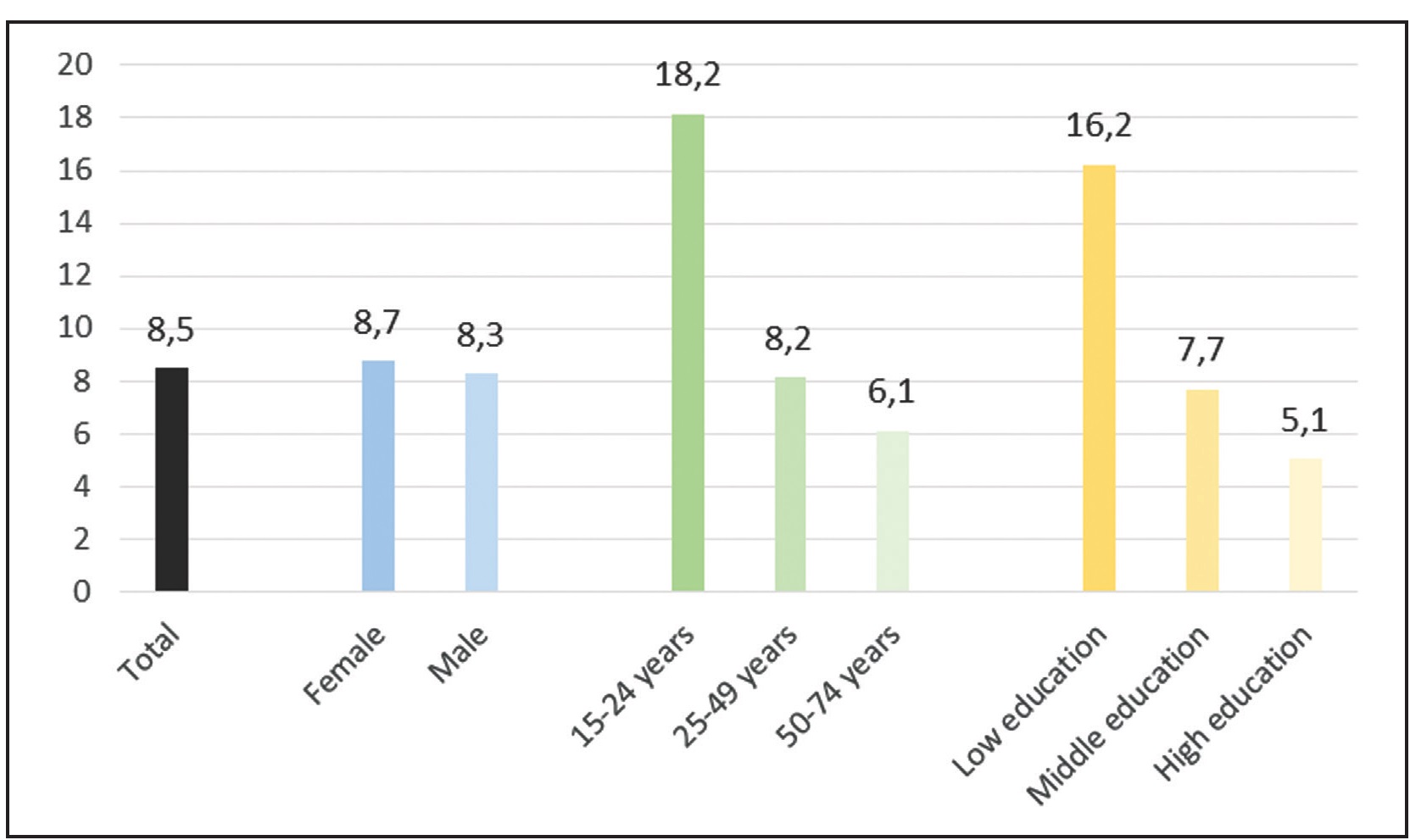
Figure 1
Unemployment rate for different types of workers (2016, average of the 24 considered European countries, in the percentage of the corresponding labor force aged 15–74 years).
Source: EC.
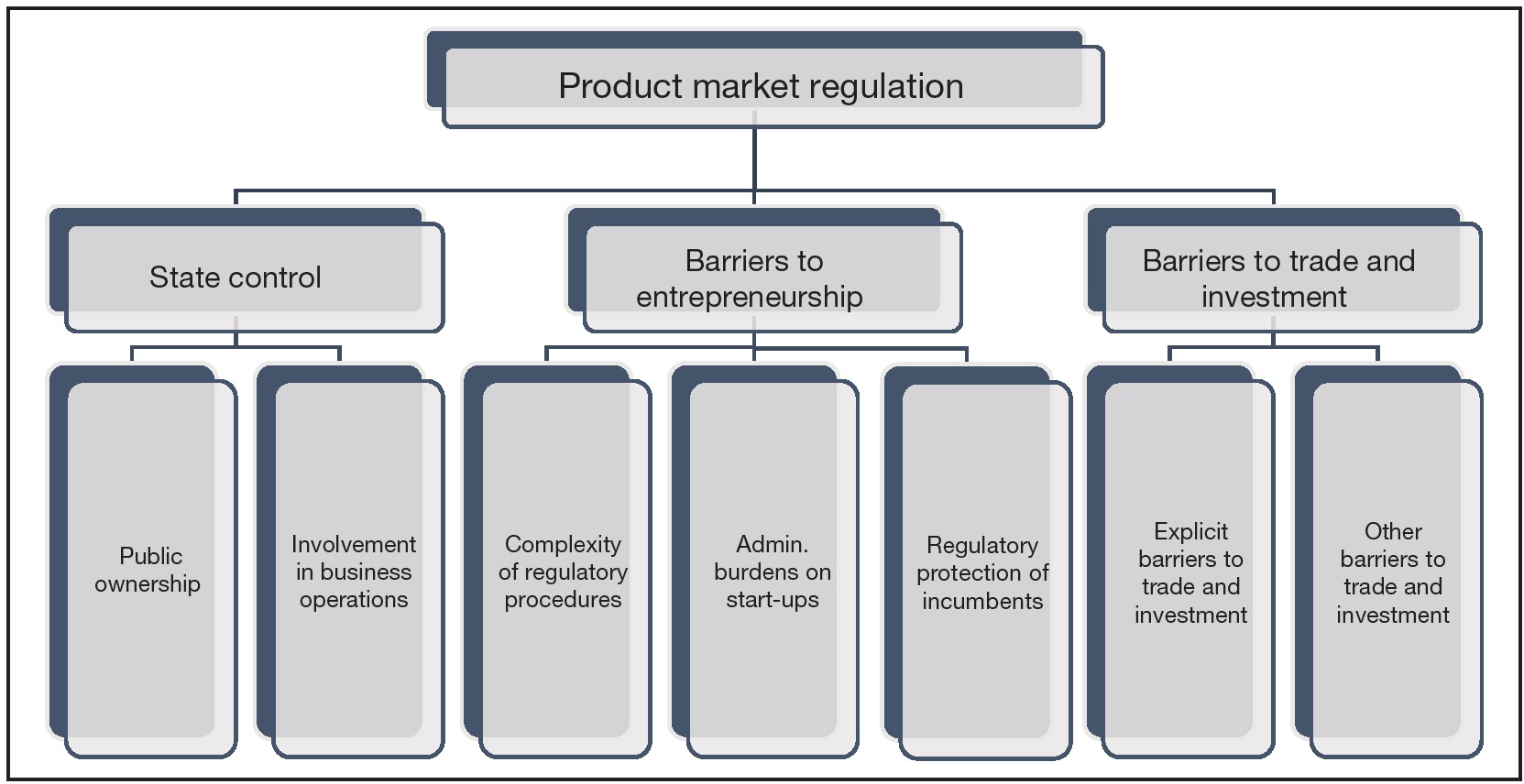
Figure 2
PMR indicator – OECD definition.
Source: OECD. EPL, employment protection legislation.
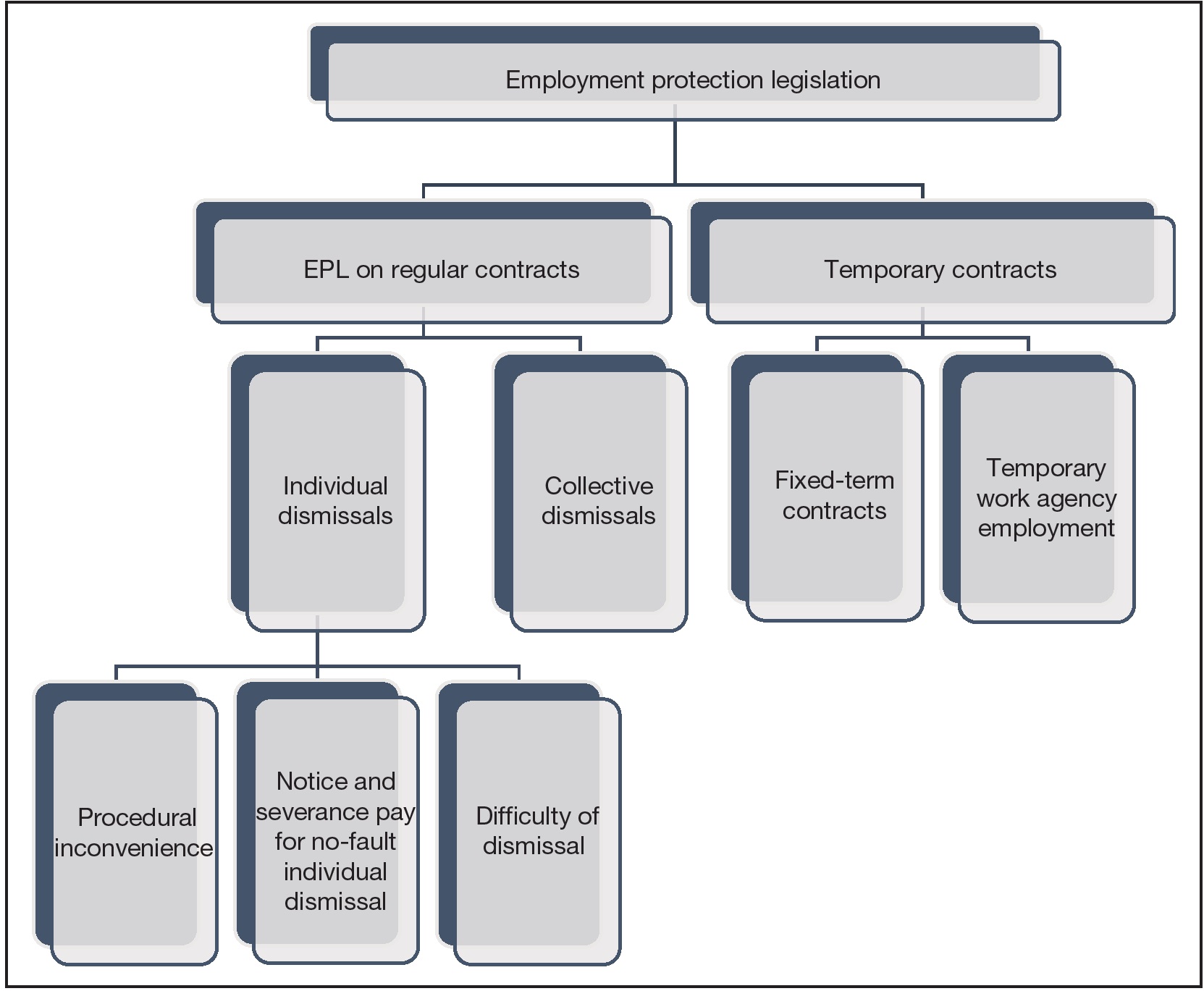
Figure 3
EPL indicator – OECD definition.
Source: OECD. PMR, product market regulation.
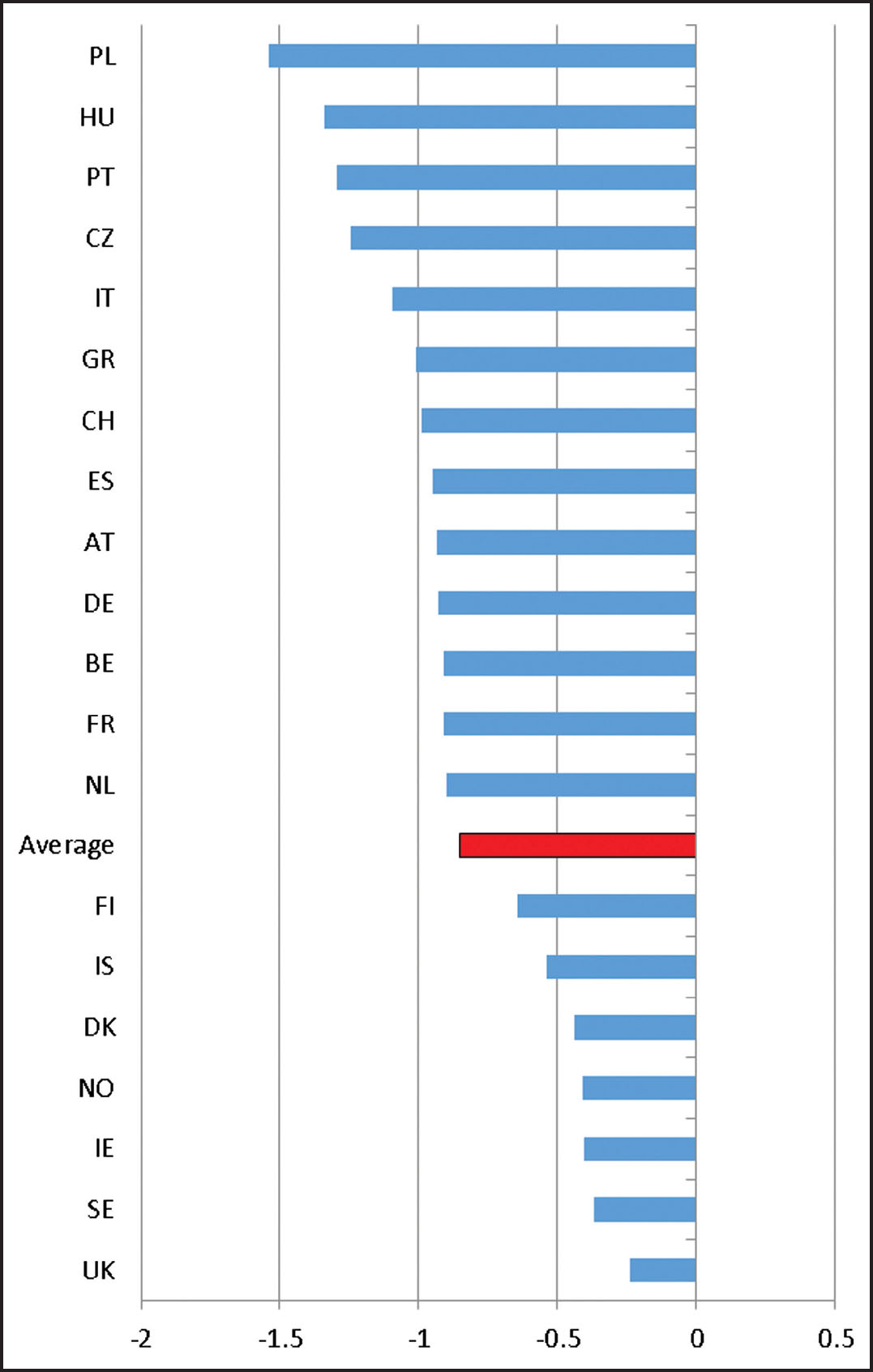
Figure 4
Product market reforms between 1998 and 2013 (change in the PMR OECD index).
Note: Luxembourg, Slovak Republic, Estonia, and Slovenia are not presented in the graph because data are not available at the beginning of the period.
Source: OECD. PMR, product market regulation.
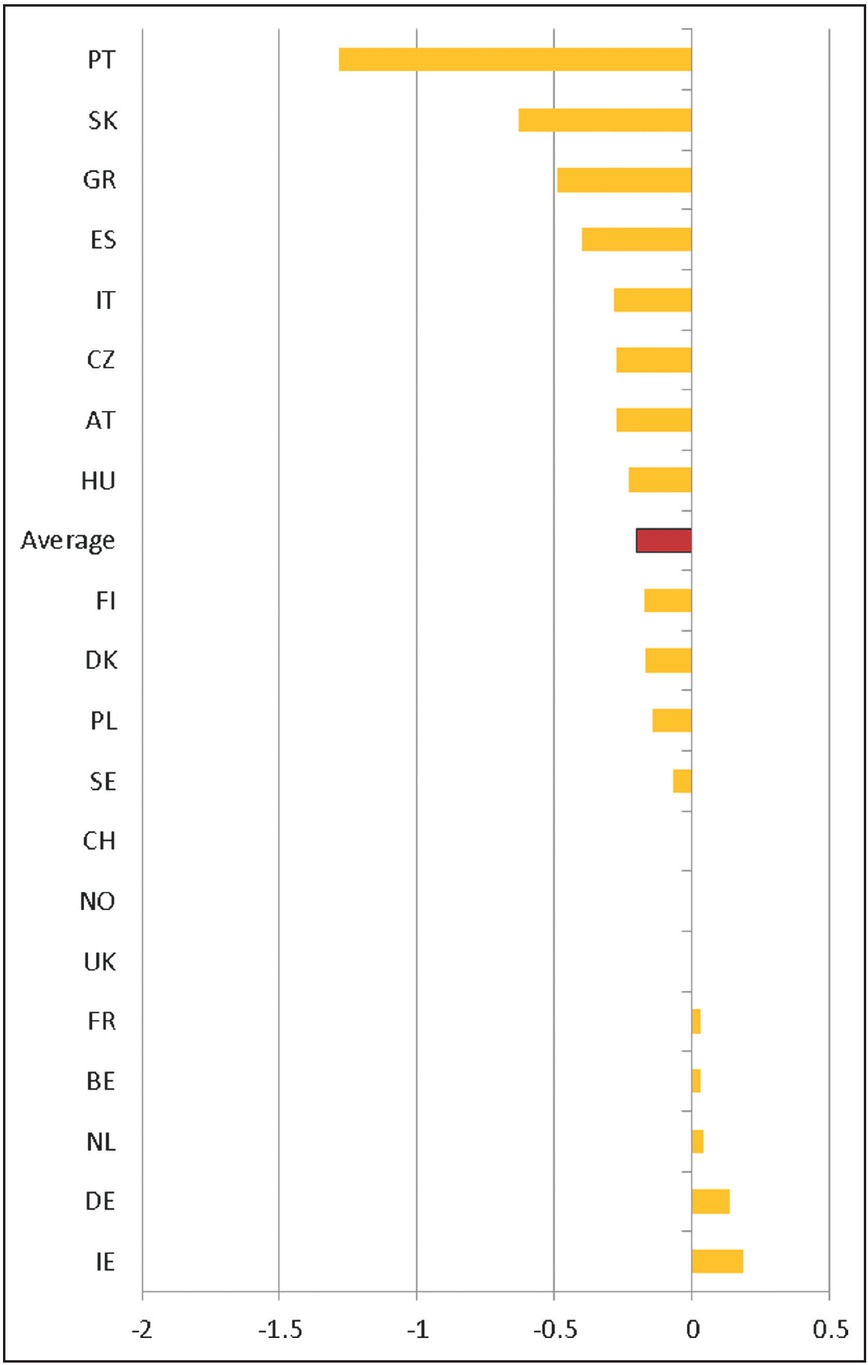
Figure 5
Labor market reforms between 1998 and 2013 (change in the EPL OECD index).
Note: Estonia, Luxembourg, Slovenia, and Iceland are not presented in the graph since data on their EPL are available only over the period 2003–2013.
Source: OECD. EPL, employment protection legislation.
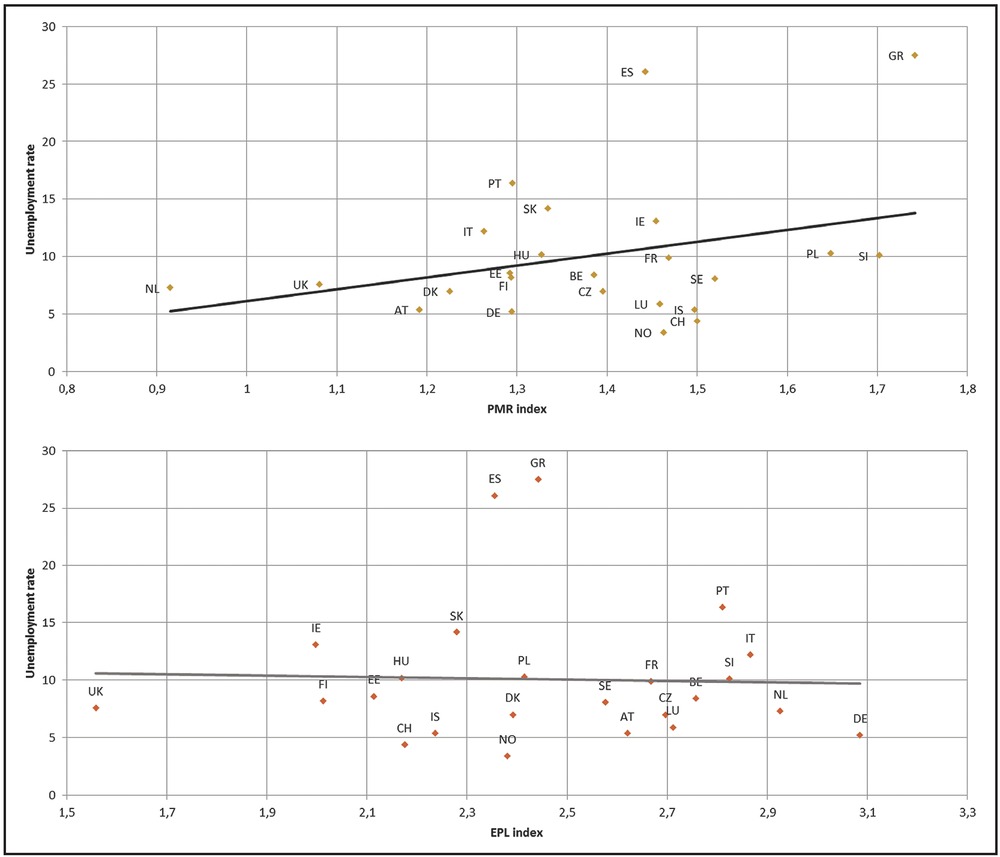
Figure 6
Relationship between unemployment rate and regulatory indices (2013).
Source: EC, OECD.
Table 2
Impact of EPL and PMR on the unemployment rate
| (1) | (2) | (3) | (4) | (5) | (6) | |
|---|---|---|---|---|---|---|
| Employment protection | 0.97* | -1.37*** | -6.56*** | -6.36*** | -5.96** | -6.68** |
| (0.52) | (0.37) | (1.30) | (2.06) | (2.57) | (2.75) | |
| PMR | 3.38*** | 6.05*** | 3.45*** | 3.97*** | 3.29*** | 3.89*** |
| (0.93) | (0.57) | (0.93) | (1.19) | (1.01) | (1.18) | |
| Estimator | OLS | OLS | FE | IV-FE | IV-FE | IV-FE |
| Control variables | Yes | Yes | Yes | Yes | Yes | Yes |
| Country fixed effects | No | No | Yes | Yes | Yes | Yes |
| Year fixed effects | No | Yes | Yes | Yes | Yes | Yes |
| PMR endogeneity | No | No | No | Yes | No | Yes |
| EPL endogeneity | No | No | No | No | Yes | Yes |
| Adjusted R2 | 0.83 | 0.88 | 0.35 | 0.39 | 0.44 | 0.45 |
| Number of observations | 317 | 317 | 317 | 281 | 279 | 277 |
| Weak identification test | – | – | – | 327.17 | 137.34 | 69.02 |
| Overidentification test | – | – | – | 0.30 | 0.84 | 0.60 |
| Endogeneity test | – | – | – | 0.19 | 0.95 | 0.42 |
[i] Note: (Standard errors), **significant at 95%, ***significant at 99%.
EPL, employment protection legislation; PMR, product market regulation.
Table 3
Robustness checks of the impact of EPL and PMR on the unemployment rate
| Baseline regression | Excluding PT, GR, ES, and IT | Baseline regression with interaction term | Excluding PT, GR, ES, and IT and adding interaction term | |
|---|---|---|---|---|
| Employment protection | -6.56*** | 4.21*** | -5.91*** | 4.18*** |
| (1.30) | (1.59) | (1.34) | (1.61) | |
| PMR | 3.45*** | 2.83*** | 3.53*** | 2.82*** |
| (0.93) | (0.78) | (0.93) | (0.78) | |
| EPL × PMR | 6.68** | -0.60 | ||
| (3.36) | (4.59) | |||
| Estimator | FE | FE | FE | FE |
| Country fixed effects | Yes | Yes | Yes | Yes |
| Year fixed effects | Yes | Yes | Yes | Yes |
| Adjusted R2 | 0.35 | 0.28 | 0.36 | 0.28 |
| Number of observations | 317 | 254 | 317 | 254 |
[i] Note: (Standard errors), **significant at 95%, ***significant at 99%.
EPL, employment protection legislation; ES, Spain; GR, Greece; IT, Italy; PMR, product market regulation; PT, Portugal..
Table 4
Impact of different types of PMR on the unemployment rate
| (1) | (2) | (3) | (4) | (5) | (6) | (7) | (8) | (9) | (10) | (11) | (12) | |||
|---|---|---|---|---|---|---|---|---|---|---|---|---|---|---|
| Employment protection | 1.39* | -0.60 | -6.16*** | -5.85*** | -6.30* | -7.67* | 0.15 | -1.98*** | -6.21*** | -6.12*** | -7.20*** | -8.32* | ||
| (0.54) | (0.67) | (1.23) | (1.92) | (2.36) | (2.52) | (0.50) | (0.27) | (1.24) | (1.89) | (2.37) | (2.52) | |||
| PMR | ||||||||||||||
| 1) State control | -0.14 (0.64) | 0.67 (0.46) | -1.74* (0.54) | -2.87* (0.76) | -1.48** (0.61) | -2.35* (0.75) | ||||||||
| a) Public ownership | 0.25 | -0.31 | -0.14 | -0.64 | 0.12 | -0.30 | ||||||||
| (0.25) | (0.30) | (0.39) | (0.43) | (0.38) | (0.48) | |||||||||
| b) Price controls and C&C | 0.34 | 0.88** | -2.20*** | -2.78*** | -2.06*** | -2.58*** | ||||||||
| (0.62) | (0.45) | (0.46) | (0.67) | (0.54) | (0.68) | |||||||||
| 2) Barriers to entrepreneurship | 3.15*** | 4.64*** | 3.91*** | 4.68*** | 3.16*** | 3.97*** | ||||||||
| (0.40) | (0.45) | (0.72) | (1.04) | (0.83) | (0.98) | |||||||||
| a) Regulatory and admin opacity | 1 18*** | 1 14*** | 1 43*** | 1 64*** | 1 15*** | 1 33*** | ||||||||
| (0.15) | (0.15) | (0.29) | (0.46) | (0.32) | (0.43) | |||||||||
| b) Administrative burdens on startups | 2.92*** | 3.26*** | 2.24*** | 2.80*** | 1.72*** | 2.31*** | ||||||||
| (0.34) | (0.31) | (0.56) | (0.66) | (0.62) | (0.67) | |||||||||
| c) Barriers to competition | -2.80*** | -0.58* | 0.48 | 0.75 | 0.71 | 0.92 | ||||||||
| (0.51) | (0.31) | (0.57) | (0.65) | (0.50) | (0.65) | |||||||||
| 3) Barriers to trade and investment | -0.46 | 0.80 | 1.53* | 2.33* | 1.75* | 2.52* | ||||||||
| (0.75) | (1.07) | (0.47) | (0.94) | (0.60) | (0.89) | |||||||||
| a) Barriers to FDI | -0.45 | -0.74 | 1.89* | 1.64 | 1.55 | 1.83 | ||||||||
| (0.90) | (0.87) | (1.10) | (1.36) | (1.00) | (1.36) | |||||||||
| b) Regulatory barriers | 0.40 | 1.12** | 0.29 | 0.84 | 0.44 | 0.85 | ||||||||
| (0.39) | (0.47) | (0.38) | (0.58) | (0.38) | (0.54) | |||||||||
| Estimator | OLS | OLS | FE | IV-FE | IV-FE | IV-FE | OLS | OLS | FE | IV-FE | IV-FE | IV-FE | ||
| Control variables | Yes | Yes | Yes | Yes | Yes | Yes | Yes | Yes | Yes | Yes | Yes | Yes | ||
| Country fixed effects | No | No | Yes | Yes | Yes | Yes | No | No | Yes | Yes | Yes | Yes | ||
| Year fixed effects | No | Yes | Yes | Yes | Yes | Yes | No | Yes | Yes | Yes | Yes | Yes | ||
| PMR endogeneity | No | No | No | Yes | No | Yes | No | No | No | Yes | No | Yes | ||
| EPL endogeneity | No | No | No | No | Yes | Yes | No | No | No | No | Yes | Yes | ||
| Adjusted R2 | 0.83 | 0.88 | 0.43 | 0.45 | 0.50 | 0.48 | 0.87 | 0.90 | 0.45 | 0.48 | 0.52 | 0.51 | ||
| Number of observations | 317 | 317 | 317 | 281 | 279 | 277 | 317 | 317 | 317 | 281 | 279 | 277 | ||
| Weak identification test | – | – | – | 63.52 | 141.91 | 33.44 | – | – | – | 20.19 | 137.33 | 14.46 | ||
| Overidentification test | – | – | – | 0.14 | 0.86 | 0.17 | – | – | – | 0.35 | 0.88 | 0.45 | ||
| Endogeneity test | – | – | – | 0.34 | 0.72 | 0.37 | – | – | – | 0.52 | 0.47 | 0.29 |
[i] Note: (Standard errors), *significant at 90%, "significant at 95%, ***significant at 99%.
C&C, command and control; EPL, employment protection legislation; PMR, product market regulation.
Table 5
Impact of different types of EPL on the unemployment rate
| (1) | (2) | (3) | (4) | (5) | (6) | |
|---|---|---|---|---|---|---|
| Employment protection | ||||||
| 1) Individual dismissals | -0.00 | -1.14*** | -8.52*** | -8.30*** | -10.09*** | -10.27*** |
| (0.29) | (0.28) | (1.22) | (1.72) | (2.13) | (2.25) | |
| 2) Collective dismissals | 1.31*** | 0.20 | 1.62** | 1.77** | 3.10*** | 3.08*** |
| (0.28) | (0.14) | (0.73) | (0.87) | (1.03) | (1.03) | |
| 3) Temporary employment | 0.48*** | 0.47*** | -1.22*** | -1.49*** | -1.60*** | -1.54*** |
| (0.17) | (0.16) | (0.35) | (0.48) | (0.59) | (0.59) | |
| PMR | 2.50*** | 5.25*** | 3.02*** | 2.87*** | 2.22** | 2.73** |
| (0.82) | (0.63) | (0.92) | (1.11) | (1.04) | (1.18) | |
| Estimator | OLS | OLS | FE | IV-FE | IV-FE | IV-FE |
| Control variables | Yes | Yes | Yes | Yes | Yes | Yes |
| Country fixed effects | No | No | Yes | Yes | Yes | Yes |
| Year fixed effects | No | Yes | Yes | Yes | Yes | Yes |
| PMR endogeneity | No | No | No | Yes | No | Yes |
| EPL endogeneity | No | No | No | No | Yes | Yes |
| Adjusted R2 | 0.84 | 0.88 | 0.41 | 0.47 | 0.50 | 0.50 |
| Number of observations | 312 | 312 | 312 | 278 | 274 | 274 |
| Weak identification test | – | – | – | 282.12 | 25.66 | 24.57 |
| Overidentification test | – | – | – | 0.27 | 0.46 | 0.43 |
| Endogeneity test | – | – | – | 0.27 | 0.18 | 0.26 |
[i] Note: (Standard errors), **significant at 95%, ***significant at 99%.
EPL, employment protection legislation; PMR, product market regulation.
Table 6
Impact of PMR and EPL on unemployment rate for different types of workers using FE regressions
| Gender | Age | Education | ||||||
|---|---|---|---|---|---|---|---|---|
| Female | Male | 15-24(Y) | 25-49 (M) | 50-74 (0) | Low | Middle | High | |
| Employment protection | -7.02*** | -6.08*** | -12.80*** | -6.91*** | -6.09*** | -5.84*** | -6.33*** | -5.84*** |
| (1.29) | (1.37) | (2.74) | (1.24) | (0.99) | (1.81) | (1.41) | (0.73) | |
| PMR | 3.76*** | 3.26*** | 4.42** | 3.19*** | 2.54*** | 5.05*** | 3.50*** | 1.32*** |
| (0.92) | (0.98) | (1.96) | (0.89) | (0.71) | (1.29) | (1.00) | (0.52) | |
| Estimator | FE | FE | FE | FE | FE | FE | FE | FE |
| Control variables | Yes | Yes | Yes | Yes | Yes | Yes | Yes | Yes |
| Country fixed effects | Yes | Yes | Yes | Yes | Yes | Yes | Yes | Yes |
| Year fixed effects | Yes | Yes | Yes | Yes | Yes | Yes | Yes | Yes |
| Adjusted R2 | 0.30 | 0.40 | 0.39 | 0.38 | 0.41 | 0.44 | 0.37 | 0.44 |
| Number of observations | 317 | 317 | 317 | 317 | 317 | 314 | 314 | 314 |
| |Coeff| EPL statistically different | F=M | M=F | Y>M* andY>0** | M<Y*and M=O | O<Y**and O=M | L=M and L=H | M=L and M=H | H=L and H=M |
| |Coeff| PMR statistically different | F=M | M=F | Y=M and Y=O | M=Y and M=O | O=Y and O=M | L=M and L>H*** | M=L and M>H* | H<L***and H<M* |
[i] Note: (Standard errors), *significant at 90%, **significant at 95%, ***significant at 99%.
EPL, employment protection legislation; PMR, product market regulation.
Y = younger workers, M = middle aged workers, O = older workers.
Table 7
Relationship between the absolute values of the coefficients: Are they statistically different for different types of workers?
| Gender | Age | Education | ||||||
|---|---|---|---|---|---|---|---|---|
| Female | Male | 15-24(Y) | 25-49 (M) | 50-74 (0) | Low | Middle | High | |
| EPL | F=M | M=F | Y>M* and Y>0** | M<Y* and M=O | 0<Y** and 0=M | L=M and L=H | M=L and M=H | H=L and H=M |
| Individual dismissals | F=M | M=F | Y>M*** and Y>0*** | M<Y*** and M=O | 0<Y*** and 0=M | L=M and L=H | M=LandM>H** | H=LandH<M** |
| Collective dismissals | F=M | M=F | Y=M and Y=O | M=YandM=O | 0=Y and O=M | L=M and L=H | M=LandM>H** | H=LandH<M** |
| Temporary employment | F=M | M=F | Y=M and Y=O | M=YandM=O | 0=Y and O=M | L>M* and L>H** | M<L*andM=H | H<L**andH=M |
| PMR | F=M | M=F | Y=M and Y=O | M=YandM=O | O=Y and O=M | L=M and L>H*** | M=LandM>H* | H<L***andH<M* |
| State controls | F<M* | M>F* | Y=MandY>0* | M=YandM=O | 0<Y* and 0=M | L=M and L=H | M=LandM>H** | H=LandH<M** |
| Barriers to entrepreneurship | F=M | M=F | Y=M and Y=O | M=YandM=O | O=Y and O=M | L>M*andL>H*** | M<L*andM>H*** | H<L***andH<M*** |
| Barriers to trade and investment | F=M | M=F | Y=MandY>0* | M=YandM=O | 0<Y*and0=M | L=M and L=H | M=LandM>H** | H=LandH<M** |
[i] Note: (Standard errors), *significant at 90%, "significant at 95%, """significant at 99%.
EPL, employment protection legislation; PMR, product market regulation.
Y = younger workers, M = middle aged workers, 0 = older workers.
Table S1
Instrumental variable estimations using different lagged values
| Testing PMR endogeneity | Testing EPL endogeneity | Testing PMR and EPL endogeneity | |||||||||||||
|---|---|---|---|---|---|---|---|---|---|---|---|---|---|---|---|
| Lag 1 | Lag 2 | Lag 3 | Lag 4 | Lag 5 | Lag 1 | Lag 2 | Lag 3 | Lag 4 | Lag 5 | Lag 1 | Lag 2 | Lag 3 | Lag 4 | Lag 5 | |
| Employment protection | -6.74***- | 6.36***- | 6.35***- | 6.80***- | 7.53***- | 6.43***- | 5.96** | -6.55** | -7.26** | -8.24** | -7.13***- | 6.68** | -7.25** | -8.24** | -9.47** |
| (1.90) | (2.06) | (2.18) | (2.30) | (2.46) | (2.38) | (2.57) | (3.18) | (3.43) | (3.56) | (2.61) | (2.75) | (3.31) | (3.63) | (3.73) | |
| PMR | 414*** | 3 97*** | 4 25*** | 4 28*** | 4 25** | 3 14*** | 3 29*** | 3 50*** | 3 10*** | 2 68** | 4 25*** | 3 89*** | 4 24*** | 417*** | 444** |
| (1.12) | (1.19) | (1.33) | (1.48) | (1.73) | (0.97) | (1.01) | (1.06) | (1.15) | (1.26) | (1.17) | (1.18) | (1.33) | (1.48) | (1.80) | |
| Estimator | IV-FE | IV-FE | IV-FE | IV-FE | IV-FE | IV-FE | IV-FE | IV-FE | IV-FE | IV-FE | IV-FE | IV-FE | IV-FE | IV-FE | IV-FE |
| Control variables | Yes | Yes | Yes | Yes | Yes | Yes | Yes | Yes | Yes | Yes | Yes | Yes | Yes | Yes | Yes |
| PMR endogeneity | Yes | Yes | Yes | Yes | Yes | No | No | No | No | No | Yes | Yes | Yes | Yes | Yes |
| EPL endogeneity | No | No | No | No | No | Yes | Yes | Yes | Yes | Yes | Yes | Yes | Yes | Yes | Yes |
| Adjusted R2 | 0.39 | 0.39 | 0.39 | 0.40 | 0.41 | 0.41 | 0.44 | 0.44 | 0.45 | 0.46 | 0.41 | 0.45 | 0.44 | 0.46 | 0.47 |
| Number of observations | 299 | 281 | 263 | 242 | 221 | 298 | 279 | 260 | 238 | 216 | 297 | 277 | 257 | 234 | 211 |
| Weak identification test | 80.1 | 327.2 | 178.8 | 99.4 | 56.3 | 37.1 | 137.3 | 92.0 | 56.2 | 40.6 | 42.6 | 69.0 | 44.4 | 26.1 | 16.6 |
| Overidentification test | - | 0.30 | 0.24 | 0.16 | 0.16 | - | 0.84 | 0.18 | 0.31 | 0.50 | - | 0.60 | 0.27 | 0.37 | 0.54 |
| Endogeneity test | 0.20 | 0.19 | 0.17 | 0.22 | 0.34 | 0.99 | 0.95 | 0.31 | 0.45 | 0.66 | 0.33 | 0.42 | 0.81 | 0.96 | 0.94 |
[i] Note: (Standard errors), *significant at 90%, **significant at 95%, ***significant at 99%.
EPL, employment protection legislation; PMR, product market regulation.
Table S2
Descriptive statistics
| Number of observations | Mean | Standard deviation | Minimum | Maximum | Average variation over the period | |
|---|---|---|---|---|---|---|
| Unemployment rate | ||||||
| Total | 384 | 7.9 | 4.2 | 1.8 | 27.5 | |
| By gender | ||||||
| Female | 384 | 8.5 | 4.8 | 2.2 | 31.4 | |
| Male | 384 | 7.5 | 4.2 | 1.3 | 25.6 | |
| By age (years) | ||||||
| 15–24 | 384 | 17.9 | 9.6 | 4.3 | 58.3 | |
| 25–49 | 384 | 7.1 | 4.0 | 1.3 | 27.8 | |
| 50–74 | 373 | 5.5 | 3.2 | 0.8 | 20.3 | |
| By level of education | ||||||
| Low education | 379 | 13.7 | 8.8 | 2.5 | 53.3 | |
| Middle education | 376 | 7.9 | 4.7 | 1.4 | 31.2 | |
| High education | 369 | 4.4 | 2.6 | 1.2 | 20.4 | |
| EPL | ||||||
| Total | 344 | 2.6 | 0.5 | 1.6 | 4.1 | -0.06 |
| Individual dismissals | 344 | 2.4 | 0.7 | 1.0 | 4.6 | -0.08 |
| Collective dismissals | 344 | 3.2 | 0.7 | 1.6 | 5.1 | -0.03 |
| Temporary employment | 338 | 1.7 | 1.0 | 0.3 | 4.8 | -0.07 |
| PMR | ||||||
| Total | 354 | 1.8 | 0.4 | 0.9 | 3.2 | -0.29 |
| State control | 354 | 2.6 | 0.6 | 1.2 | 4.2 | -0.32 |
| Public ownership | 354 | 3.0 | 0.8 | 1.1 | 5.0 | -0.23 |
| Price controls and command and | 359 | 2.1 | 0.9 | 0.9 | 4.8 | -0.41 |
| control | ||||||
| Barriers to entrepreneurship | 354 | 2.2 | 0.5 | 1.1 | 3.4 | -0.36 |
| Regulatory and administrative opacity | 354 | 2.5 | 0.9 | 0.4 | 4.5 | -0.44 |
| Administrative burdens on startups | 359 | 2.4 | 0.7 | 1.1 | 4.1 | -0.29 |
| Barriers to competition | 354 | 1.6 | 0.6 | 0.6 | 3.0 | -0.36 |
| Barriers to trade and investments | 359 | 0.6 | 0.5 | 0.1 | 3.1 | -0.18 |
| Barriers to FDI, tariffs, and discriminatory | 359 | 0.3 | 0.3 | 0.0 | 1.6 | -0.09 |
| procedures | ||||||
| Regulatory barriers | 359 | 1.0 | 0.8 | 0.2 | 4.7 | -0.27 |
| Control variables | ||||||
| Net replacement rate | 352 | 39.7 | 14.7 | 10.9 | 74.0 | |
| Union density | 375 | 35.1 | 22.2 | 6.5 | 99.1 | |
| GDP gap (%) | 382 | 0.0 | 1.8 | -10.6 | 9.3 | |
| Inflation | 376 | 2.8 | 2.3 | -1.7 | 16.3 | |
| Labor productivity growth | 384 | 1.4 | 2.4 | -6.4 | 11.4 |
[i] EPL, employment protection legislation; PMR, product market regulation.
Table S3
Excluding PT, GR, ES, and IT as robustness check
| (1) | (2) | (1') | (2') | (1'') | (2'') | (1''') | (2''') | |
|---|---|---|---|---|---|---|---|---|
| Employment protection | -6.56*** (1.30) | 4.21*** (1.59) | -6.16*** (1.23) | 3.35** (1.49) | -6.21*** (1.24) | 2.76* (1.56) | ||
| 1) Individual dismissals | -8.52*** (1.22) | -0.70 (1.48) | ||||||
| 2) Collective dismissals | 1.62** (0.73) | 4.65*** (0.77) | ||||||
| 3) Temporary employment | -1.22*** (0.35) | -0.51 (0.55) | ||||||
| PMR | 3.45*** (0.93) | 2.83*** (0.78) | 3.02*** (0.92) | 2.82*** (0.78) | ||||
| 1) State control | -1.74*** (0.54) | -1.54*** (0.46) | ||||||
| a) Public ownership | -0.14(0.39) | -0.08(0.32) | ||||||
| b) Price controls and C&C | -2.20*** (0.46) | -1.63*** (0.44) | ||||||
| 2) Barriers to entrepreneurship | 3.91*** (0.72) | 3.21*** (0.64) | ||||||
| a) Regulatory and admin opacity | 1.43*** (0.29) | 1.29*** (0.24) | ||||||
| b) Administrative burdens on startups | 2.24*** (0.56) | 1.88*** (0.58) | ||||||
| c) Barriers to competition | 0.48 (0.57) | -0.68 (0.56) | ||||||
| 3) Barriers to trade and investment | 1.53*** (0.47) | 1.34*** (0.39) | ||||||
| a) Barriers to FDI | 1.89* (1.10) | 0.82 (0.92) | ||||||
| b) Regulatory barriers | 0.29 (0.38) | 0.71** (0.34) | ||||||
| Estimator | FE | FE | FE | FE | FE | FE | FE | FE |
| Adjusted R2 | 0.35 | 0.28 | 0.41 | 0.33 | 0.43 | 0.38 | 0.45 | 0.42 |
| Number of observations | 317 | 254 | 312 | 249 | 317 | 254 | 317 | 254 |
[i] Notes: (standard errors), *significant at 90%, ** significant at 95%, ***significant at 99%. Regressions (1) are baseline regressions; regressions (2) are estimations excluding Portugal, Greece, Spain, and Italy.
PMR, product market regulation.