
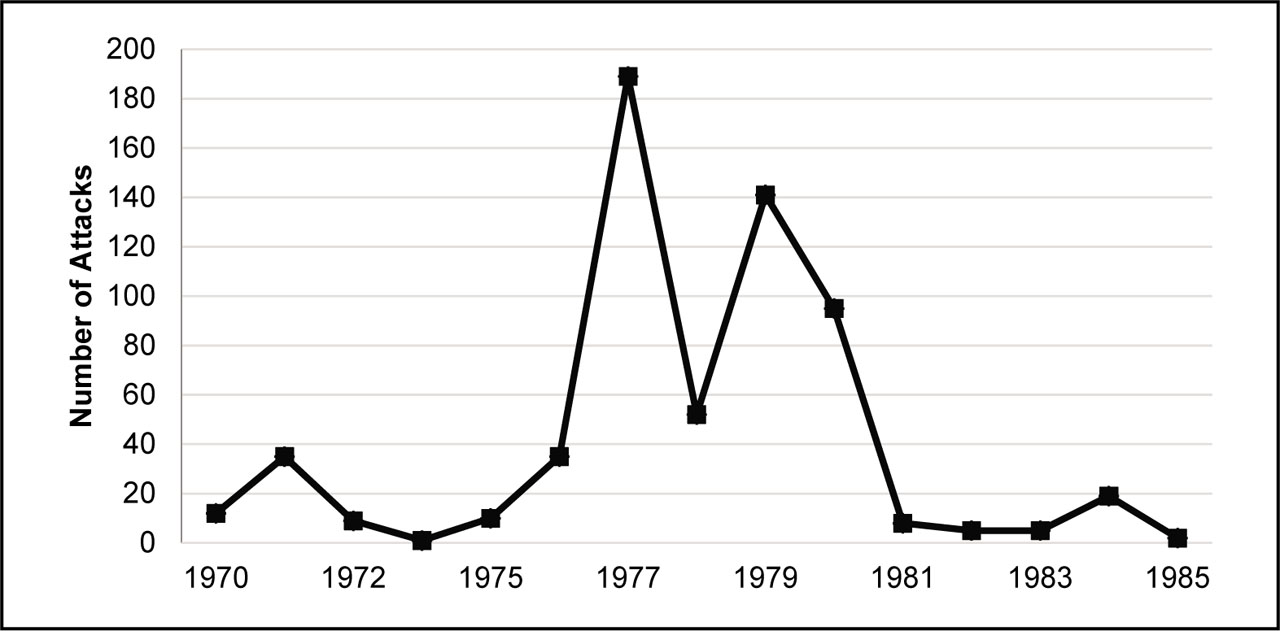
Figure 1
Number of terrorist attacks in Turkey (1970–1985).
Source: National Consortium for the Study of Terrorism and Responses to Terrorism (START), 2016. Global Terrorism Database [GTD from 1970 to 1991]. Retrieved from https://www.start.umd.edu/Gtd.
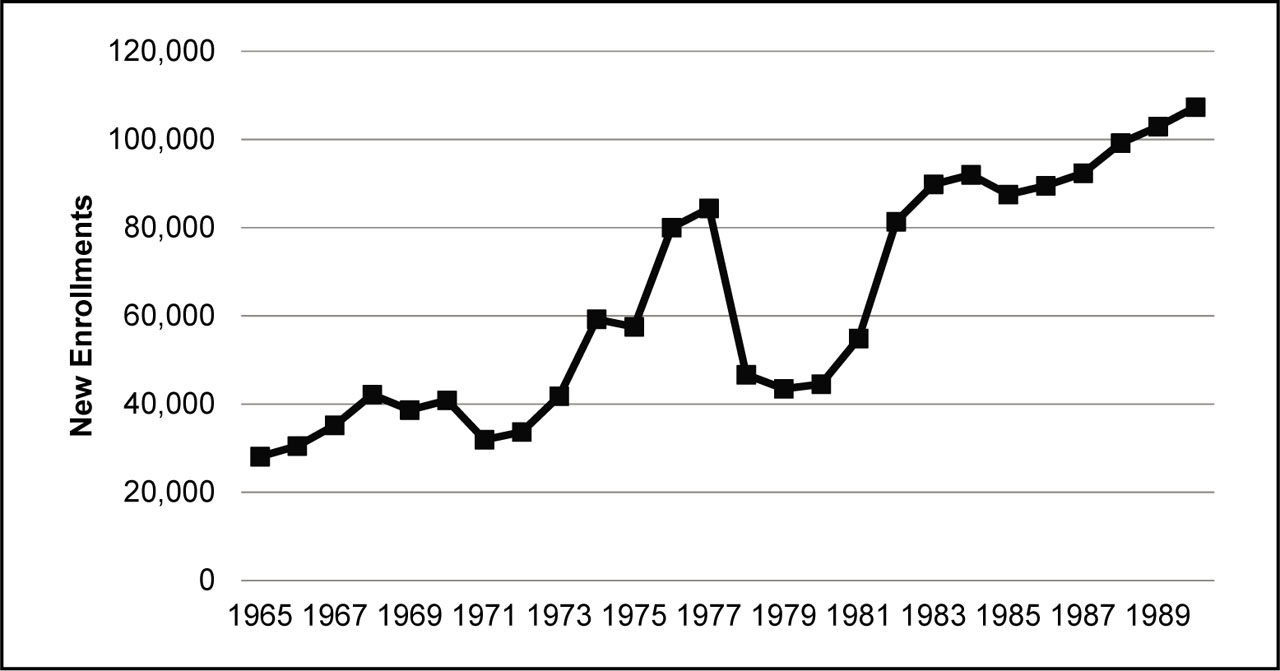
Figure 2
New enrollments in all higher-education institutions in Turkey (1965–1990).
Source: Authors’ calculations based on National Education Statistics compiled by and Academic Year Higher Education Statistics compiled by OSYM.
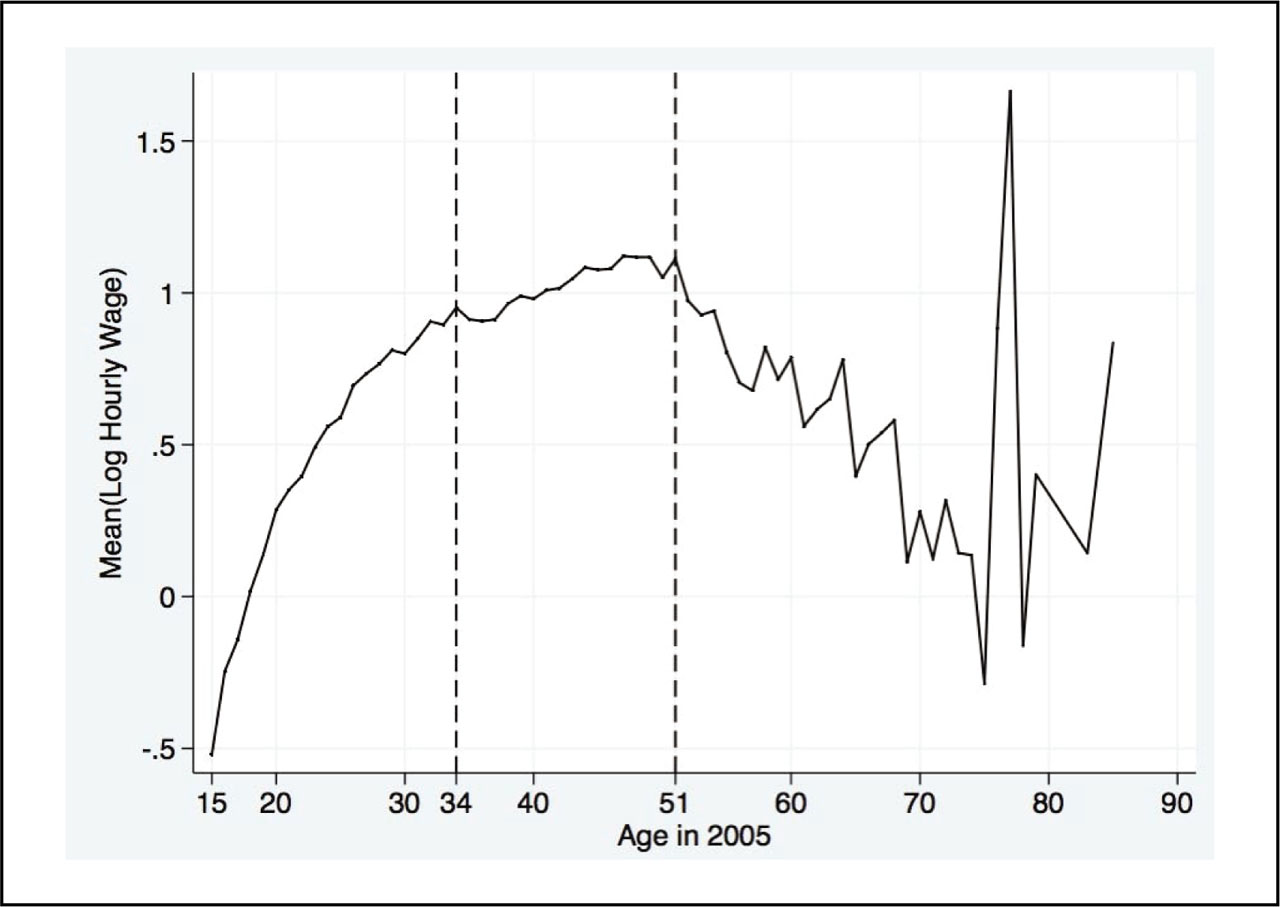
Figure 3
Average log hourly wages for men by age.
Source: Authors’ calculations based on the 2005 Turkish HLFS.
Table 1
Average hours worked in the main bob by educational attainment in the sample of wage earners in Turkey
| Educational attainment | # of observations | Mean |
|---|---|---|
| No schooling | 3,305 | 55.3 |
| Primary school (5 years) | 26,065 | 55.5 |
| Elementary school (8 years) | 11,046 | 54.9 |
| High school | 19,498 | 51.8 |
| Post-secondary degree | 13,396 | 44.1 |
[i] Source: Authors’ calculations based on the 2005 HLFS. Observations are weighted using the sampling weights so that the results are nationally representative.
Table 2
Descriptive statistics for individuals of age 34–51
| Variables | Mean |
|---|---|
| Primary or elementary sch. grad. rate | 0.63 |
| High sch. grad. rate | 0.14 |
| Post-secondary sch. grad. rate | 0.08 |
| Years of schooling | 6.36 |
| Labor force participation | 0.58 |
| Employment rate | 0.54 |
| Sample size | 115,410 |
[i] Observations are weighted using the sampling weights so that the results are nationally representative.
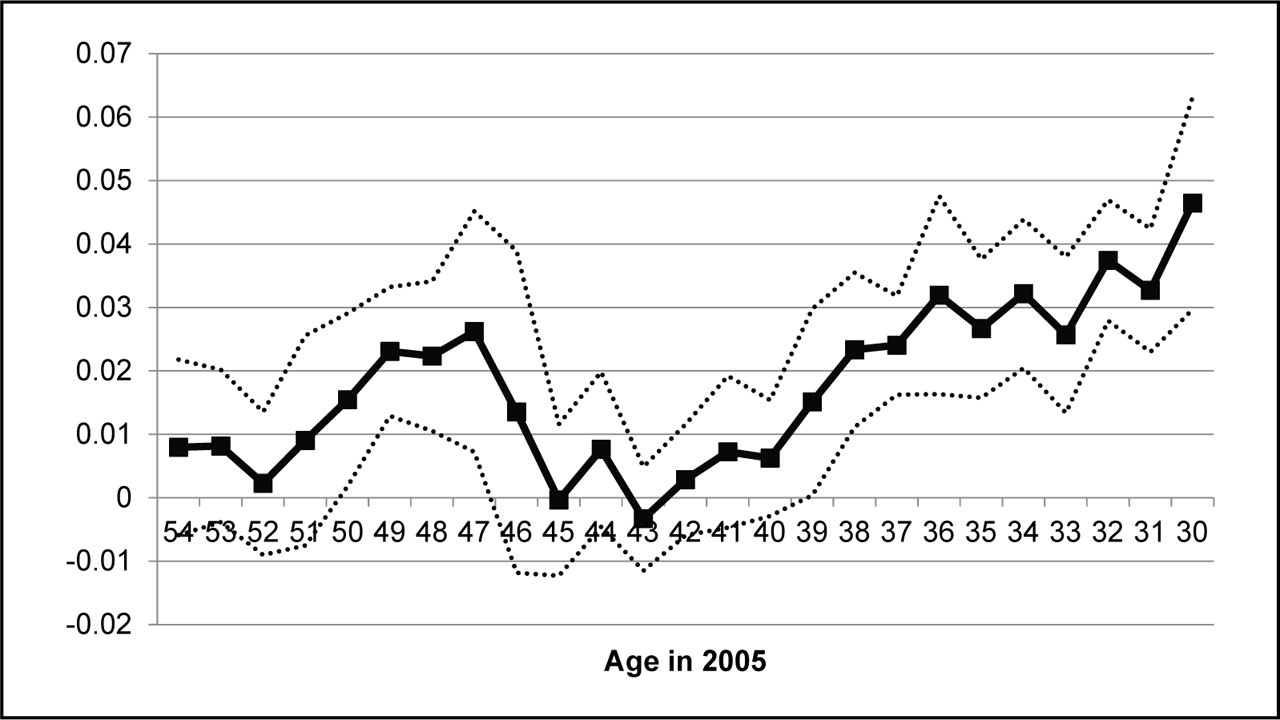
Figure 4
Coefficients of age dummies – Probability of completing post-secondary education.
The specification includes region of residence, urban/rural, and gender dummies. Age 55 is the omitted age category. Observations are weighted using the sampling weights so that the results are nationally representative. Dashed lines indicate the 95-percent confidence interval based on standard errors clustered at region level.
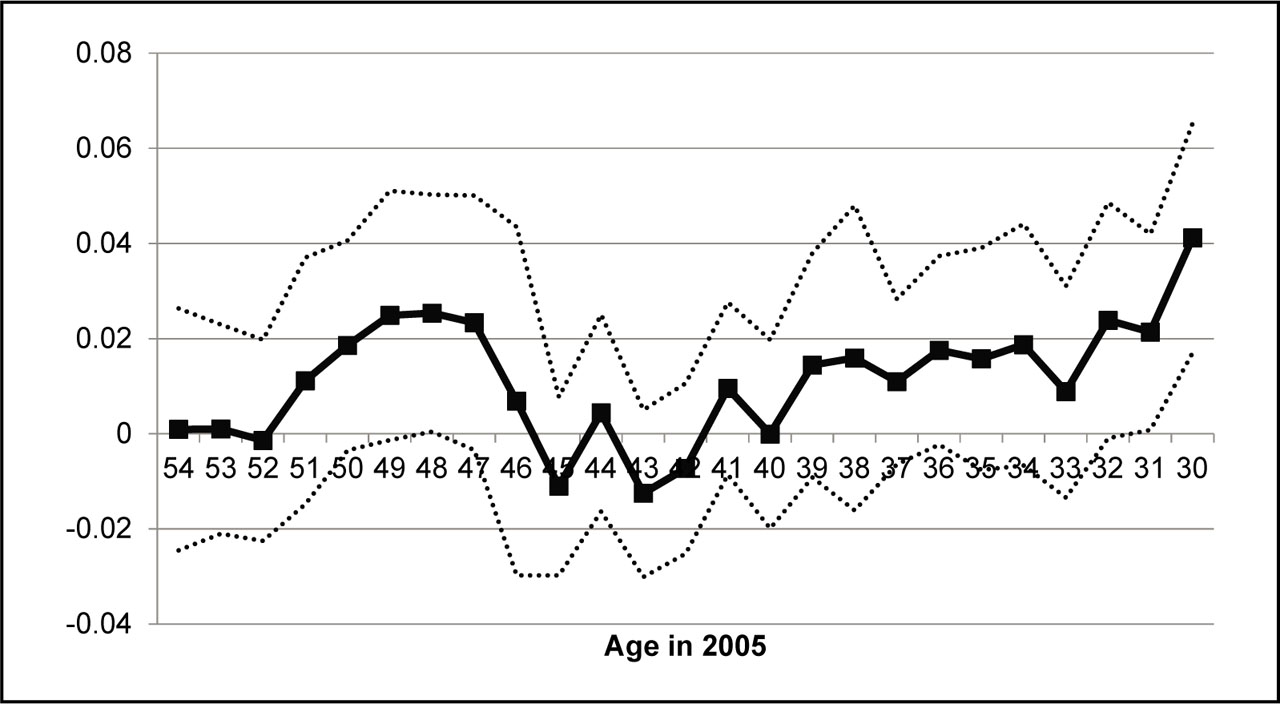
Figure 5
Coefficients of age dummies – Probability of completing post-secondary education (men).
The specification includes region of residence and urban/rural dummies. Age 55 is the omitted age category. Observations are weighted using the sampling weights so that the results are nationally representative. Dashed lines indicate the 95-percent confidence interval based on standard errors clustered at region level.
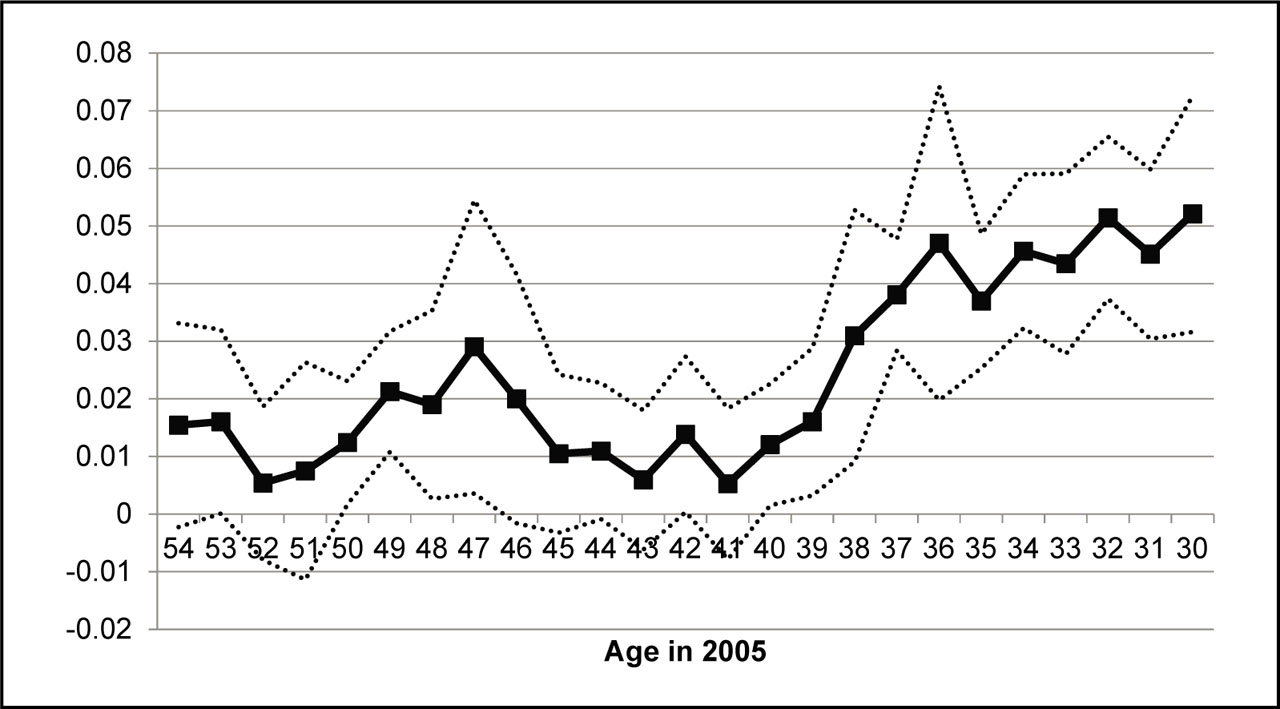
Figure 6
Coefficients of age dummies – Probability of completing post-secondary education (women).
The specification includes region of residence and urban/rural dummies. Age 55 is the omitted age category. Observations are weighted using the sampling weights so that the results are nationally representative. Dashed lines indicate the 95-percent confidence interval based on standard errors clustered at region level.
Table 3
Difference in the probability of graduation between the 40–45 and 46–51 age groups
| Dependent variable | |||
|---|---|---|---|
| Post-secondary | High school | Primary/Elementary | |
| Degree==1 | Degree==1 | Degree==1 | |
| Otherwise==0 | Otherwise==0 | Otherwise==0 | |
| [1] | [2] | [3] | |
| Age 40–45 | −0.0148*** (0.0051) | 0.0450*** (0.0027) | 0.0325*** (0.0092) |
| # of obs. | 74,903 | 74,903 | 74,903 |
| R2 | 0.0364 | 0.0375 | 0.0524 |
The specification includes 26 NUTS2 region of residence, urban/rural and gender dummies. Observations are weighted using the sampling weights so that the results are nationally representative. Standard errors, clustered at region level, are reported in parentheses.
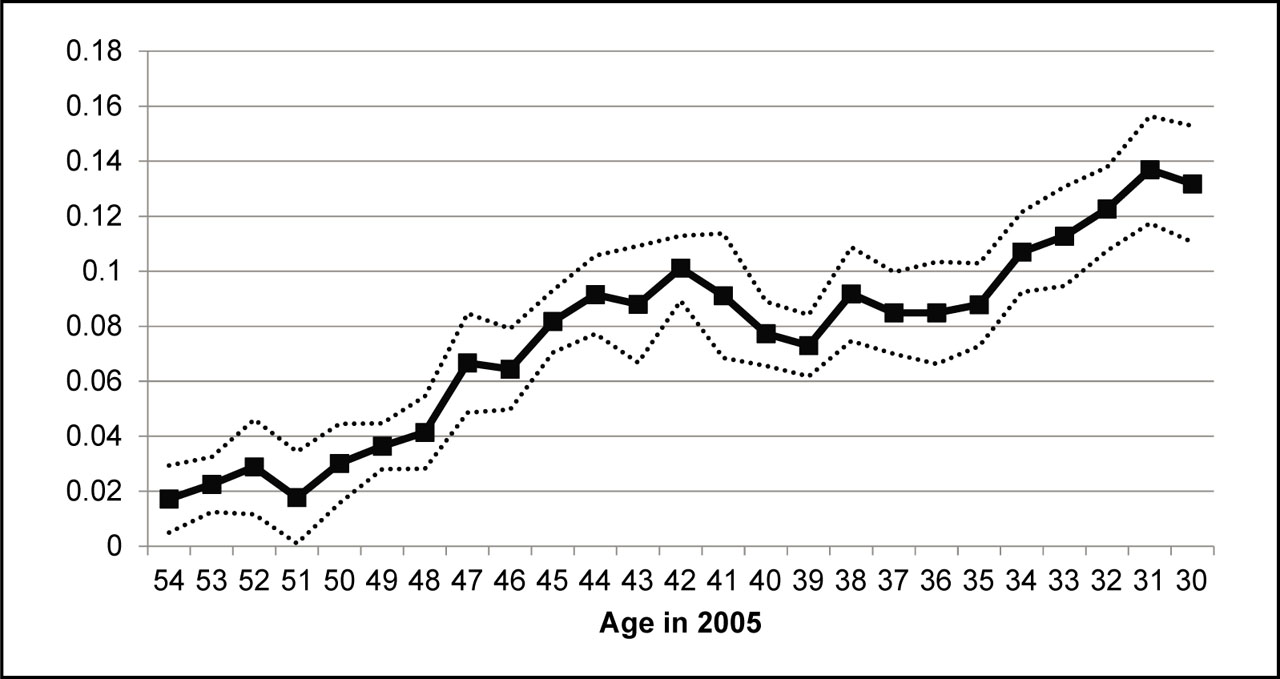
Figure 7
Coefficients of age dummies – Probability of high school graduation.
The specification includes region of residence, urban/rural, and gender dummies. Age 55 is the omitted age category. Observations are weighted using the sampling weights so that the results are nationally representative. Dashed lines indicate the 95-percent confidence interval based on standard errors clustered at region level.
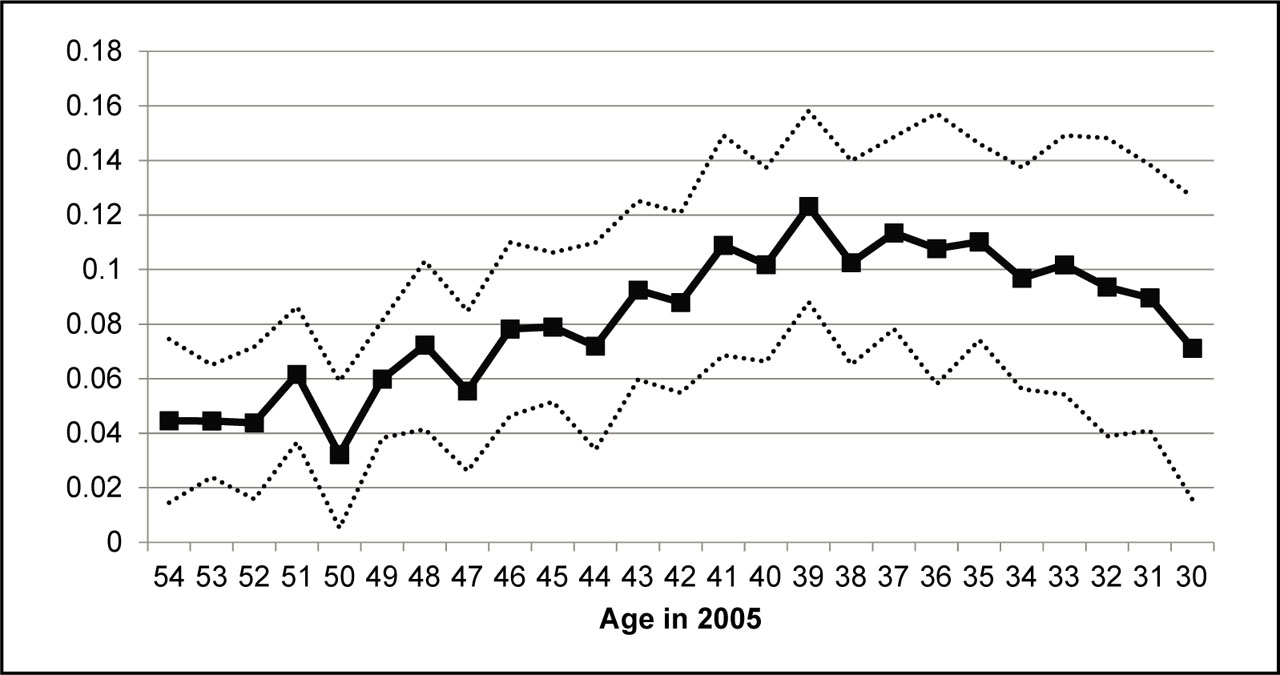
Figure 8
Coefficients of age dummies – Probability of graduation from elementary/primary school.
The specification includes region of residence, urban/rural, and gender dummies. Age 55 is the omitted age category. Observations are weighted using the sampling weights so that the results are nationally representative. Dashed lines indicate the 95-percent confidence interval based on standard errors clustered at region level.
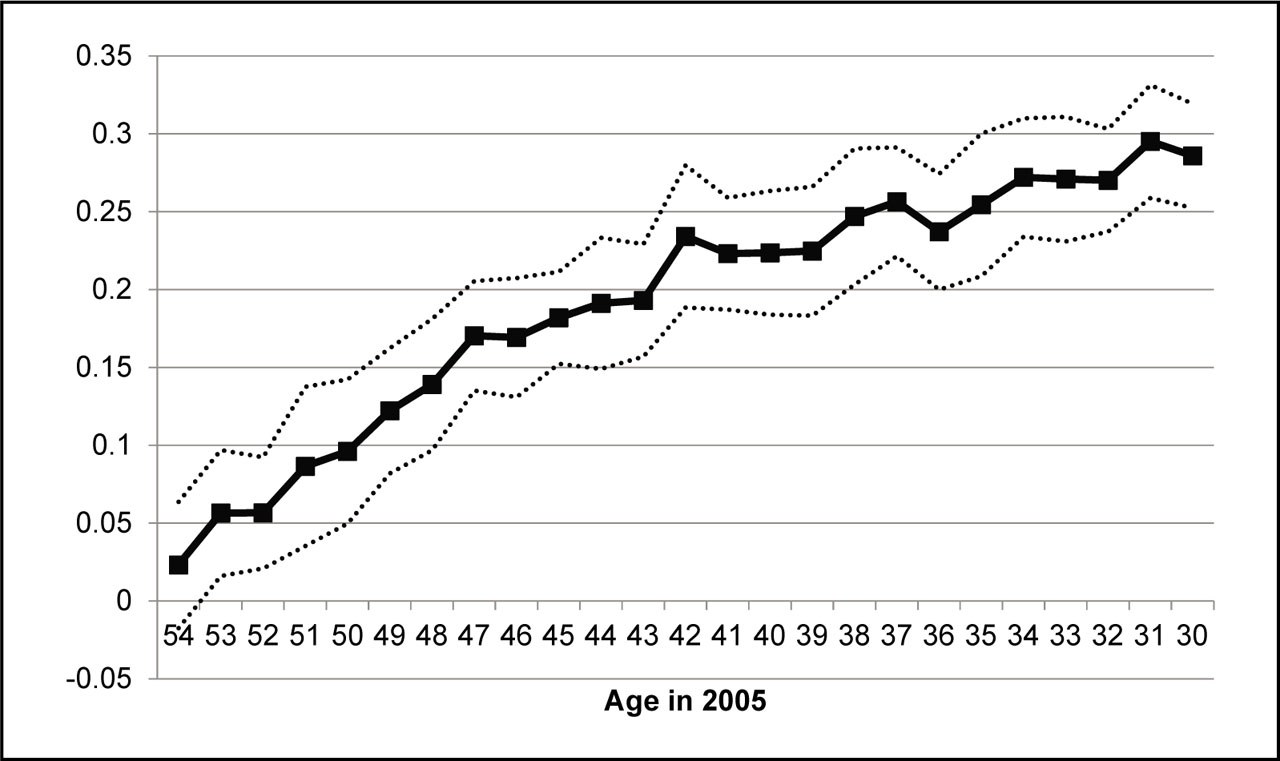
Figure 9
Coefficients of age dummies – Probability of wage employment.
The specification includes region of residence, urban/rural, and gender dummies. Age 55 is the omitted age category. Observations are weighted using the sampling weights so that the results are nationally representative. Dashed lines indicate the 95-percent confidence interval based on standard errors clustered at region level.
Table 4
The effect of the turmoil on the probability of completing post-secondary education
| Dependent variable: Post-secondary degree==1; Otherwise==0 | ||||||
|---|---|---|---|---|---|---|
| Total | Men | Women | ||||
| [1] | [2] | [1] | [2] | [1] | [2] | |
| Age 40–45 | −0.0587*** (0.0075) | −0.0084** (0.0034) | −0.0664*** (0.0114) | −0.0102 (0.0065) | −0.0147 (0.0247) | −0.0031 (0.0053) |
| # of obs. | 18,730 | 18,852 | 15,827 | 12,798 | 2,903 | 6,054 |
| R2 | 0.0476 | 0.0570 | 0.0298 | 0.0474 | 0.0780 | 0.1077 |
Region of residence and urban/rural dummies are included in all regressions. A gender dummy is also included for the total sample estimations. Columns [1] and [2] in each of the three separate regressions present results for wage earners and non-wage earners, respectively. Observations are weighted using the sampling weights so that the results are nationally representative. Standard errors, clustered at region level, are reported in parentheses.
Table 5
Comparisons of age groups for male wage earners
| [1] | [2] | [3] | [4] | [5] | |
|---|---|---|---|---|---|
| Age 34–39 | 10,774 | 1.023 | 8.363 | 0.166 | 0.228 |
| Age 40–45 | 10,105 | 1.002 | 8.198 | 0.142 | 0.243 |
| Age 46–51 | 5,722 | 1.037 | 8.475 | 0.211 | 0.195 |
[i] Columns [1] - number of observations; Column [2] - mean log hourly wage, Column [3] - mean years of schooling; Column [4] - mean post-secondary attainment rate; Column [5] - mean high school completion rate. Observations are weighted using the sampling weights so that the results are nationally representative.
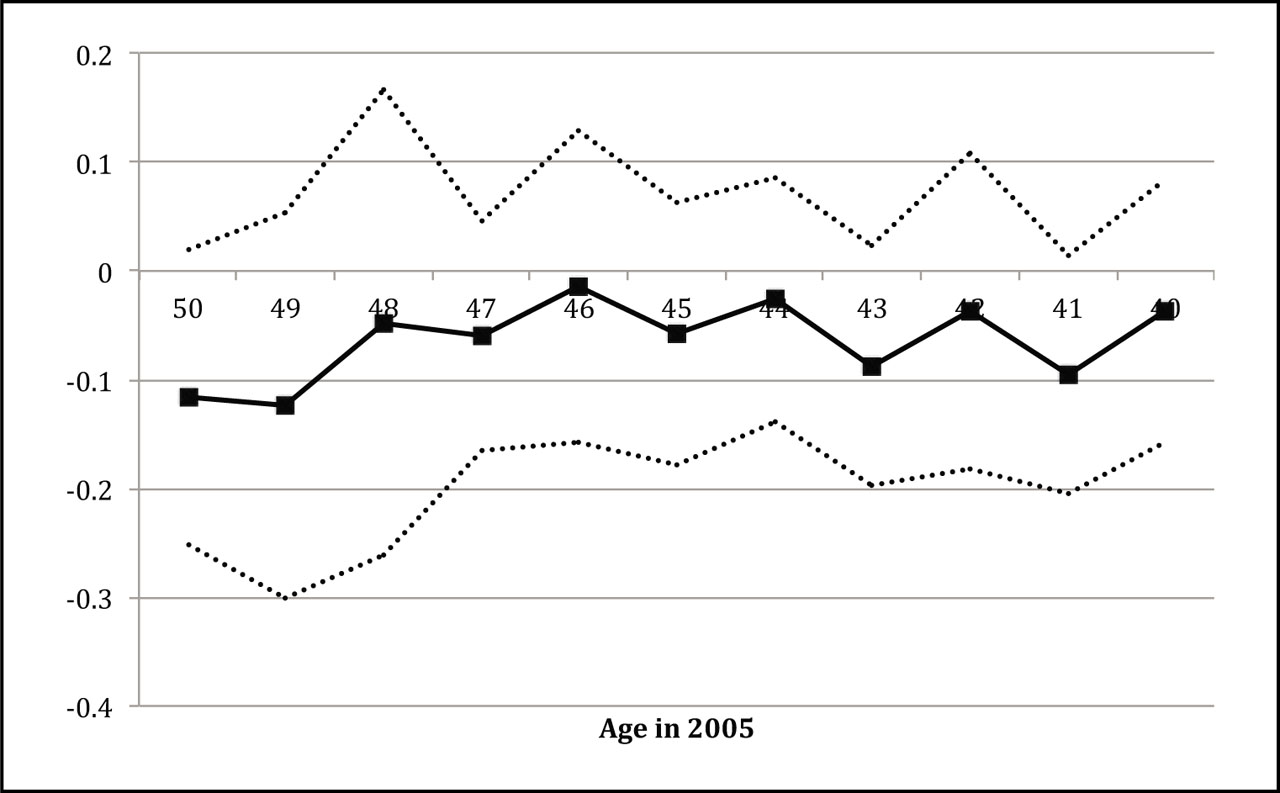
Figure 10
Coefficients of age dummies – Log hourly wages for male wage earners having only a high school degree.
The sample includes male wage earners aged 40–51 having only high school degree. Log hourly wage is standardized to experience 26 years. The specification includes region of residence and urban/rural dummies. Age 51 is the omitted age category. Observations are weighted using the sampling weights so that the results are nationally representative. Dashed lines indicate the 95-percent confidence interval based on standard errors clustered at region level.
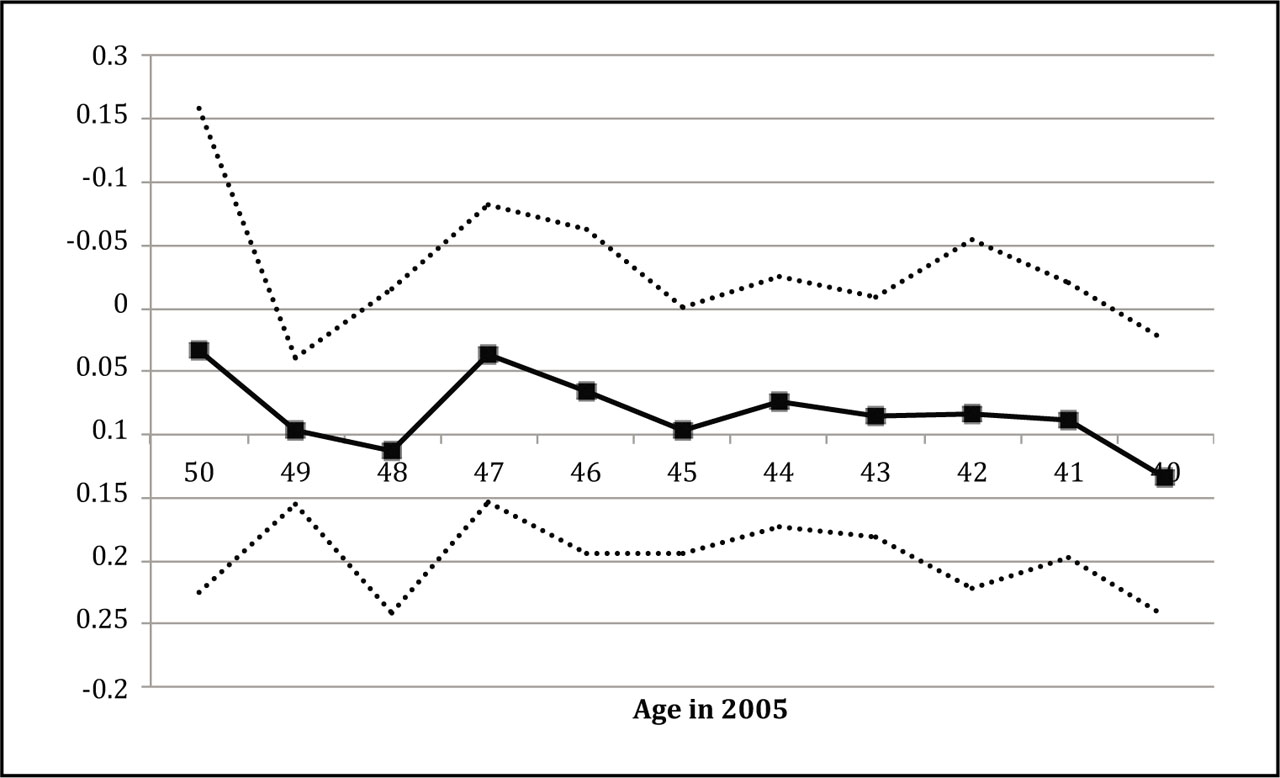
Figure 11
Coefficients of age dummies – Log hourly wages for male wage earners having only a postsecondary degree.
The sample includes male wage earners aged 40–51 having only post-secondary degree. Log hourly wage is standardized to experience 26 years. The specification includes region of residence and urban/rural dummies. Age 51 is the omitted age category. Observations are weighted using the sampling weights so that the results are nationally representative. Dashed lines indicate the 95-percent confidence interval based on standard errors clustered at region level.
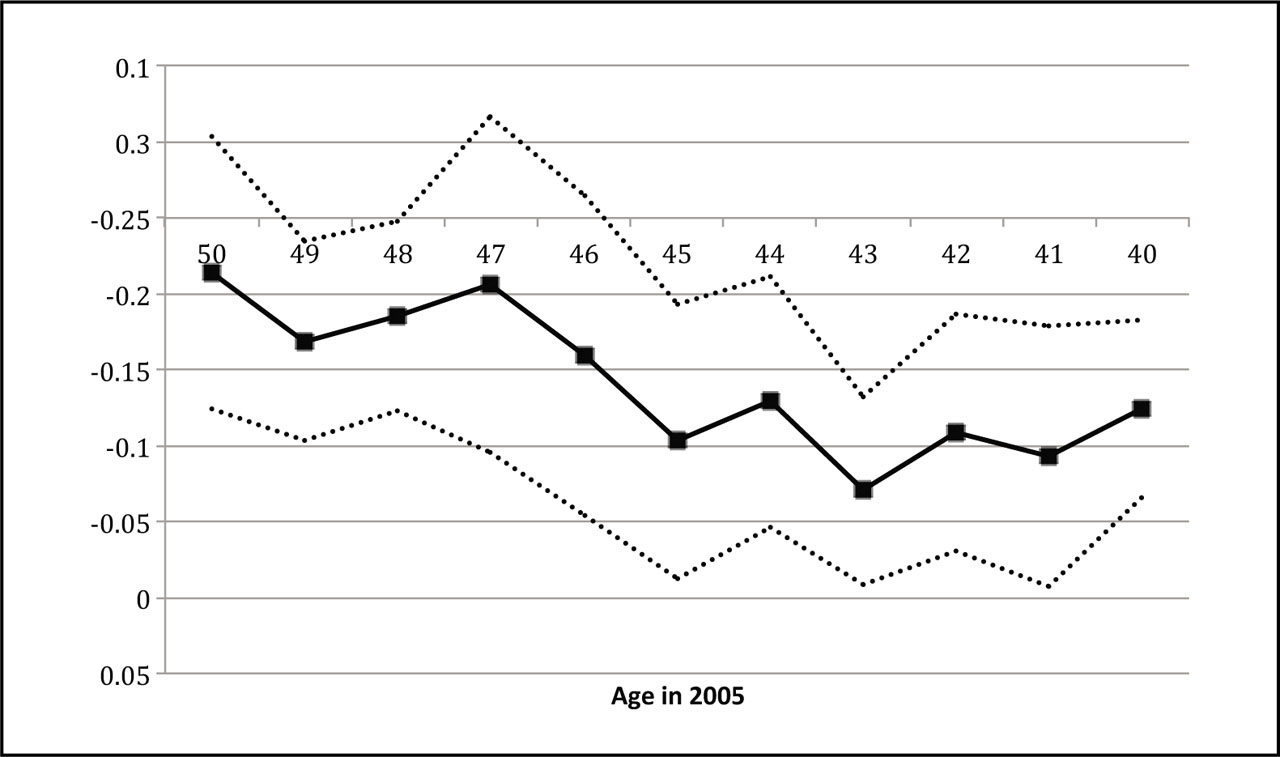
Figure 12
Coefficients of age dummies – Log hourly wages for men with at least a high school degree.
The sample includes male wage earners aged 40–51 with at least a high school degree. Log hourly wage is standardized to experience 26 years. The specification includes region of residence and urban/rural dummies. Age 51 is the omitted age category. Observations are weighted using the sampling weights so that the results are nationally representative. Dashed lines indicate the 95-percent confidence interval based on standard errors clustered at region level.
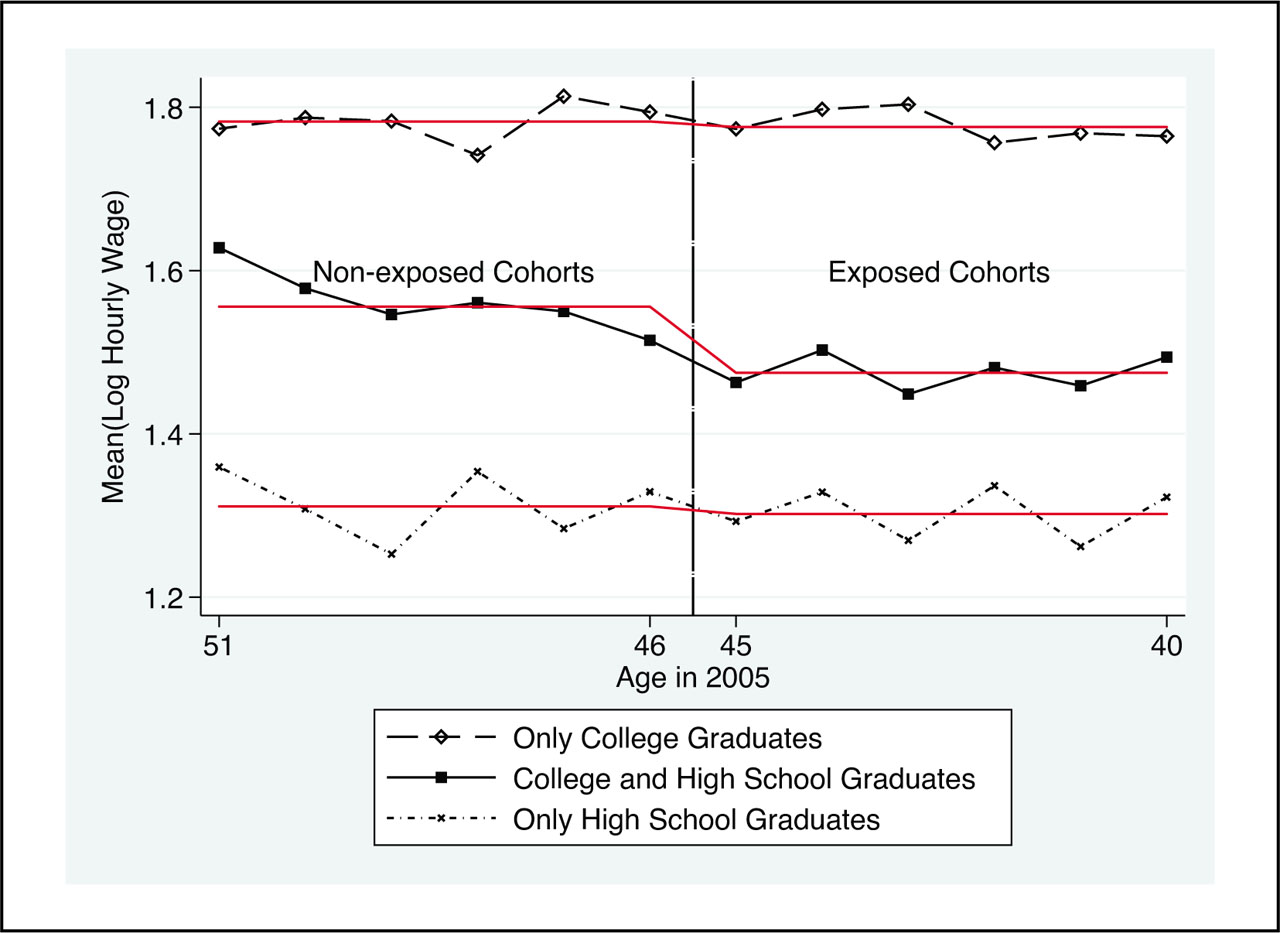
Figure 13
Average log hourly wages for men by age.
Source: Authors’ calculations based on the 2005 Turkish HLFS. The red lines indicate the average log hourly wages for exposed and non-exposed individuals for the corresponding educational level.
Table 6
The effect of the turmoil on the probability of completing post-secondary education and wage
| Dependent variable | ||||||
|---|---|---|---|---|---|---|
| Post-secondary degree | Log hourly wage | |||||
| [1] | [2] | [3] | [4] | [5] | [6] | |
| Instrument (zi) | −0.1507*** (0.0214) | −0.1518*** (0.0211) | −0.1502*** (0.0207) | −0.0873*** (0.0160) | −0.0879*** (0.0159) | −0.0859*** (0.0154) |
| Region of residence | No | Yes | Yes | No | Yes | Yes |
| Urban/rural status | No | No | Yes | No | No | Yes |
| # of observations | 6,309 | 6,309 | 6,309 | 6,309 | 6,309 | 6,309 |
Table 7
OLS and 2SLS estimates of the returns to college
| Dependent variable: Log hourly wage | |||
|---|---|---|---|
| [1] | [2] | [3] | |
| Panel A: Just-identified models | |||
| OLS | 0.5022*** (0.0320) | 0.5062*** (0.0304) | 0.5025*** (0.0311) |
| 2SLS | 0.5795*** (0.0965) | 0.5790*** (0.0935) | 0.5716*** (0.0935) |
| F-statistic (first stage) | 139.54 | 142.56 | 140.13 |
| Panel B: Over-identified models | |||
| 2SLS | 0.5688*** (0.0887) | 0.5659*** (0.0855) | 0.5588*** (0.0841) |
| LIML | 0.5704*** (0.0908) | 0.5676*** (0.0880) | 0.5605*** (0.0865) |
| F-statistic (first stage) | 25.01 | 25.51 | 25.15 |
| p-value Hansen's test | 0.87 | 0.80 | 0.80 |
| Region of residence | No | Yes | Yes |
| Urban/rural status | No | No | Yes |
| # of observations | 6,309 | 6,309 | 6,309 |
The sample includes male wage earners aged 40–51. In just-identified models, a dummy for individuals of age 40–45 is used as instrument. In over-identified models, six age dummies in the 40–45 age group are used as instruments. Observations are weighted using the sampling weights so that the results are nationally representative. Standard errors, clustered at region level, are reported in parentheses.
Table 8
Fuzzy RDD estimates of the returns to college
Table 9
OLS and 2SLS estimates of the returns to college with adjusted missing wages
| Dependent variable: Log hourly wage | ||
|---|---|---|
| With missing values | Adjusted for missing values | |
| Panel A: Just-identified models | ||
| OLS | 0.5025*** (0.0311) | 0.5037*** (0.0310) |
| 2SLS | 0.5716*** (0.0935) | 0.5744*** (0.0935) |
| F-statistic (first stage) | 140.13 | 139.44 |
| Panel B: Over-identified models | ||
| 2SLS | 0.5588*** (0.0841) | 0.5601*** (0.0837) |
| LIML | 0.5605*** (0.0865) | 0.5618*** (0.0861) |
| F-statistic (first stage) | 25.15 | 25.04 |
| p-value Hansen's test | 0.80 | 0.80 |
| Region of residence | Yes | Yes |
| Urban/rural status | Yes | Yes |
| # of observations | 6,309 | 6,309 |
The sample includes male wage earners aged 40–51. In just-identified models, a dummy for individuals of age 40–45 is used as instrument. In over-identified models, six age dummies in the 40–45 age group are used as instruments. Observations are weighted using the sampling weights so that the results are nationally representative. Standard errors, clustered at region level, are reported in parentheses.
Table 10
OLS and 2SLS estimates of the returns to college with different samples
| Dependent variable: Log hourly wage | ||||
|---|---|---|---|---|
| 40–45 | 41–45 | 42–45 | 43–45 | |
| 46–51 | 47–51 | 47–50 | 47–49 | |
| [1] | [2] | [3] | [4] | |
| Panel A: Just-identified models | ||||
| OLS | 0.5025*** (0.0311) | 0.5145*** (0.0333) | 0.5152*** (0.0367) | 0.5105*** (0.0342) |
| 2SLS | 0.5716*** (0.0935) | 0.5148*** (0.0690) | 0.4698*** (0.0802) | 0.4855*** (0.1016) |
| F-statistic (first stage) | 140.13 | 181.59 | 144.01 | 94.10 |
| Panel B: Over-identified models | ||||
| 2SLS | 0.5588*** (0.0841) | 0.5078*** (0.0716) | 0.4774*** (0.0827) | 0.5039*** (0.1032) |
| LIML | 0.5605*** (0.0865) | 0.5076*** (0.0731) | 0.4767*** (0.0840) | 0.5037*** (0.1053) |
| F-statistic (first stage) | 25.15 | 37.43 | 36.65 | 31.97 |
| p-value Hansen's test | 0.80 | 0.72 | 0.71 | 0.61 |
| Region of residence | Yes | Yes | Yes | Yes |
| Urban/rural status | Yes | Yes | Yes | Yes |
| # of observations | 6,309 | 5,042 | 4,093 | 3,088 |
The sample includes male wage earners of age 40–51. In just-identified models, a dummy for individuals of age 40–45 is used as instrument. In over-identified models, six age dummies in the 40–45 age group are used as instruments. Observations are weighted using the sampling weights so that the results are nationally representative. Standard errors, clustered at region level, are reported in parentheses.
Table 11
OLS and 2SLS estimates of the returns to college using more HLFS waves
| Dependent variable: Log hourly wage | ||
|---|---|---|
| 2005 | 2005–2008 | |
| Panel A: Just-identified models | ||
| OLS | 0.5025*** (0.0311) | 0.5380*** (0.0305) |
| 2SLS | 0.5716*** (0.0935) | 0.5644*** (0.0801) |
| F-statistic (first stage) | 140.13 | 301.03 |
| Panel B: Over-identified models | ||
| 2SLS | 0.5588*** (0.0841) | 0.5950*** (0.0883) |
| LIML | 0.5605*** (0.0865) | 0.5957*** (0.0895) |
| F-statistic (first stage) | 25.15 | 55.62 |
| p-value Hansen's test | 0.80 | 0.85 |
| Region of residence | Yes | Yes |
| Urban/rural status | Yes | Yes |
| # of observations | 6,309 | 21,717 |
The sample includes male wage earners of age 40–51. In just-identified models, a dummy for individuals of age 40–45 is used as instrument. In over-identified models, six age dummies in the 40–45 age group are used as instruments. As the vector of covariates, 26 NUTS2-level region-of-residence dummies and an urban/rural dummy are used. Additionally, survey-year dummies are used in the regressions using multiple HLFS waves. Observations are weighted using the sampling weights so that the results are nationally representative. Standard errors, clustered at region level, are reported in parentheses.
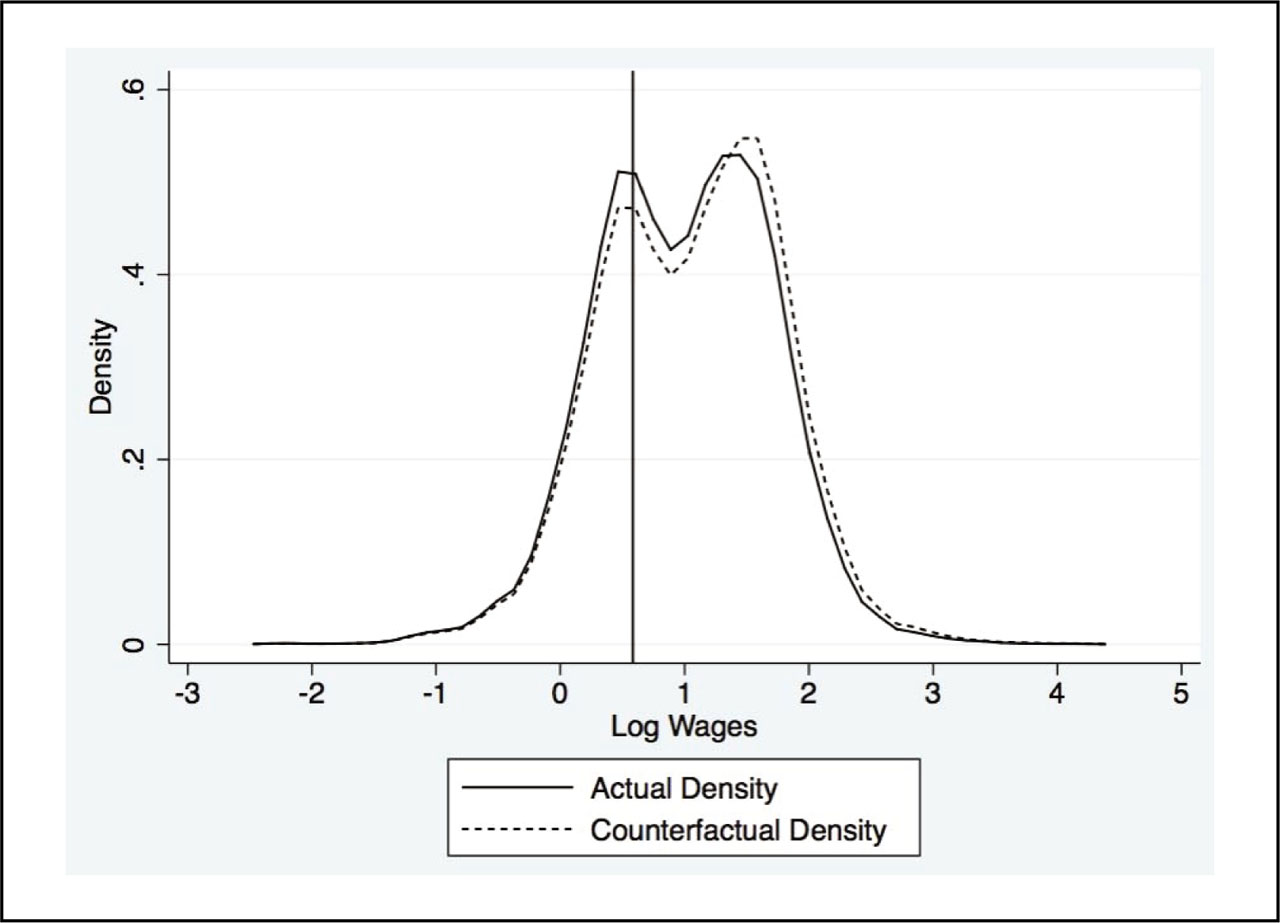
Figure 14
Actual and counterfactual density of log wages for male individuals in the 40–45 age group.
The sample includes male wage earners of age 40–51. Observations are weighted using the sampling weights so that the results are nationally representative.
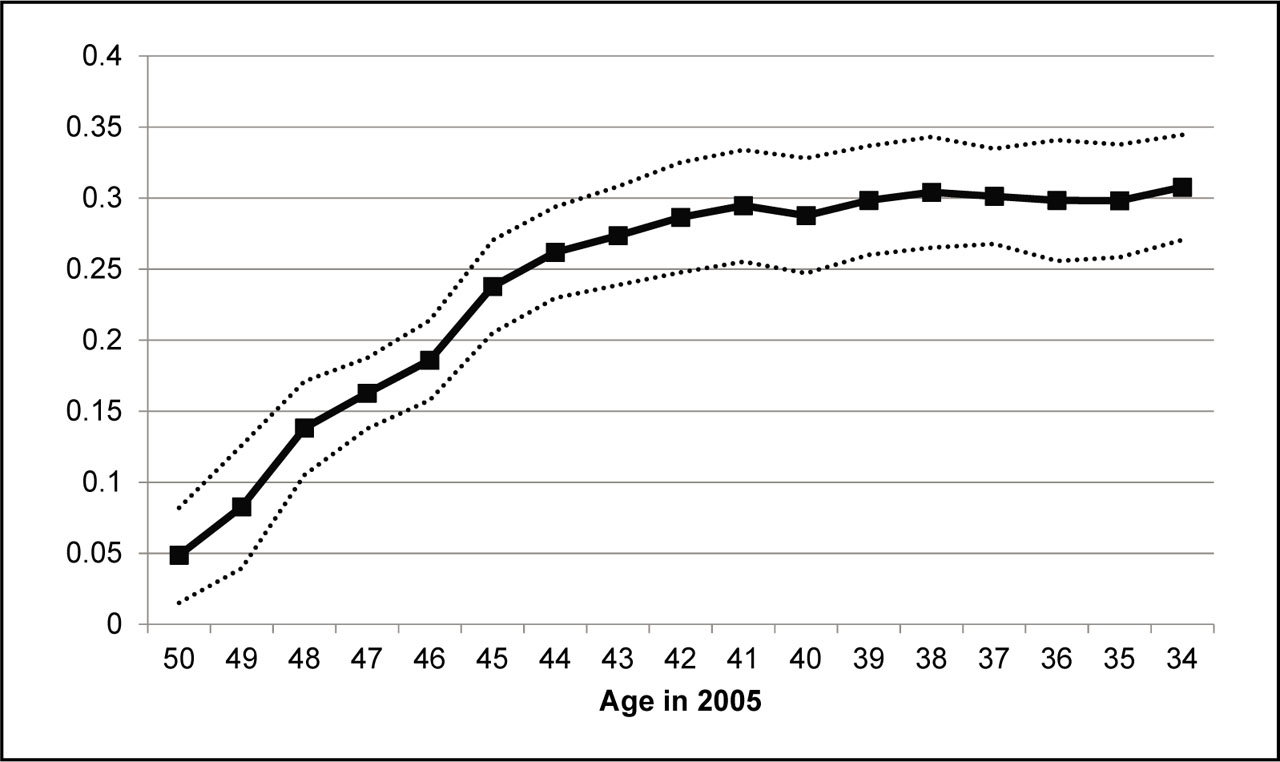
Figure 15
Coefficients of age dummies – Probability of being in the labor force.
The specification includes region of residence and urban/rural dummies. Age 51 is the omitted age category. Observations are weighted using the sampling weights so that the results are nationally representative. Dashed lines indicate the 95-percent confidence interval based on standard errors clustered at region level.
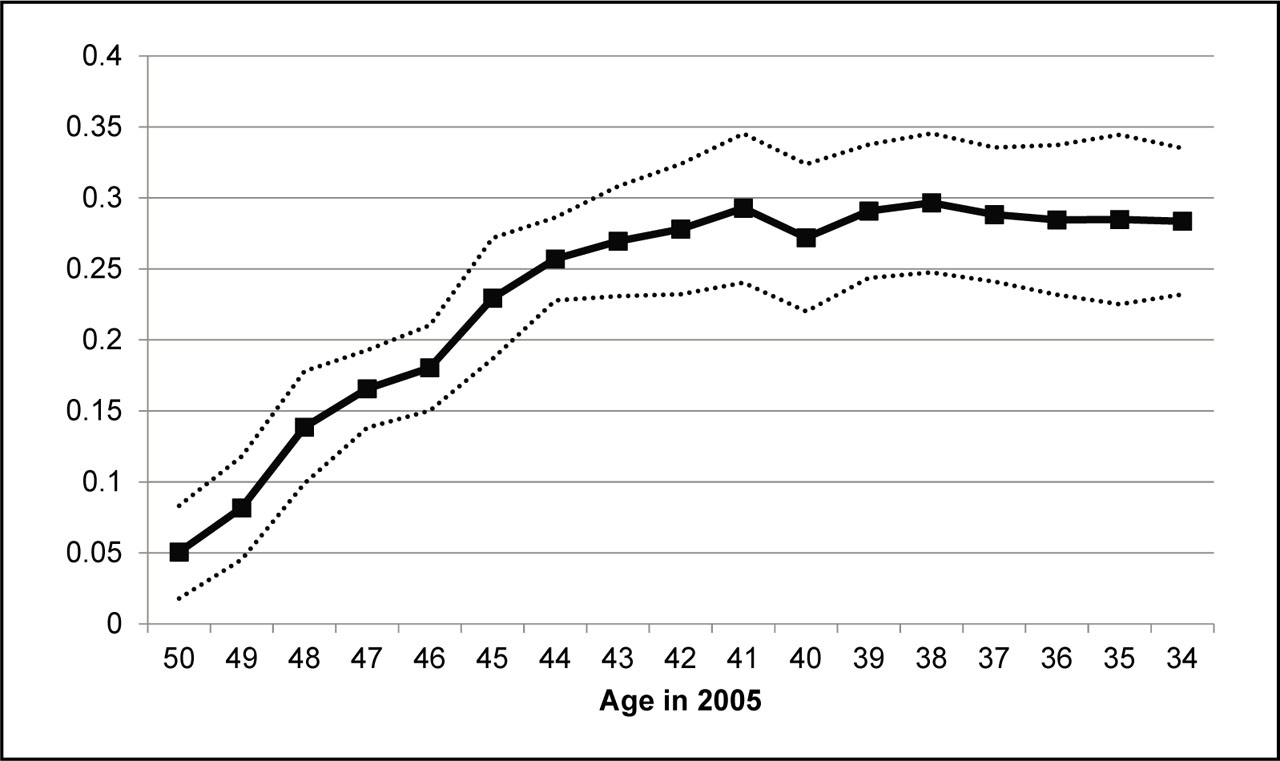
Figure 16
Coefficients of age dummies – Probability of being employed.
The specification includes region of residence and urban/rural dummies. Age 51 is the omitted age category. Observations are weighted using the sampling weights so that the results are nationally representative. Dashed lines indicate the 95-percent confidence interval based on standard errors clustered at region level.
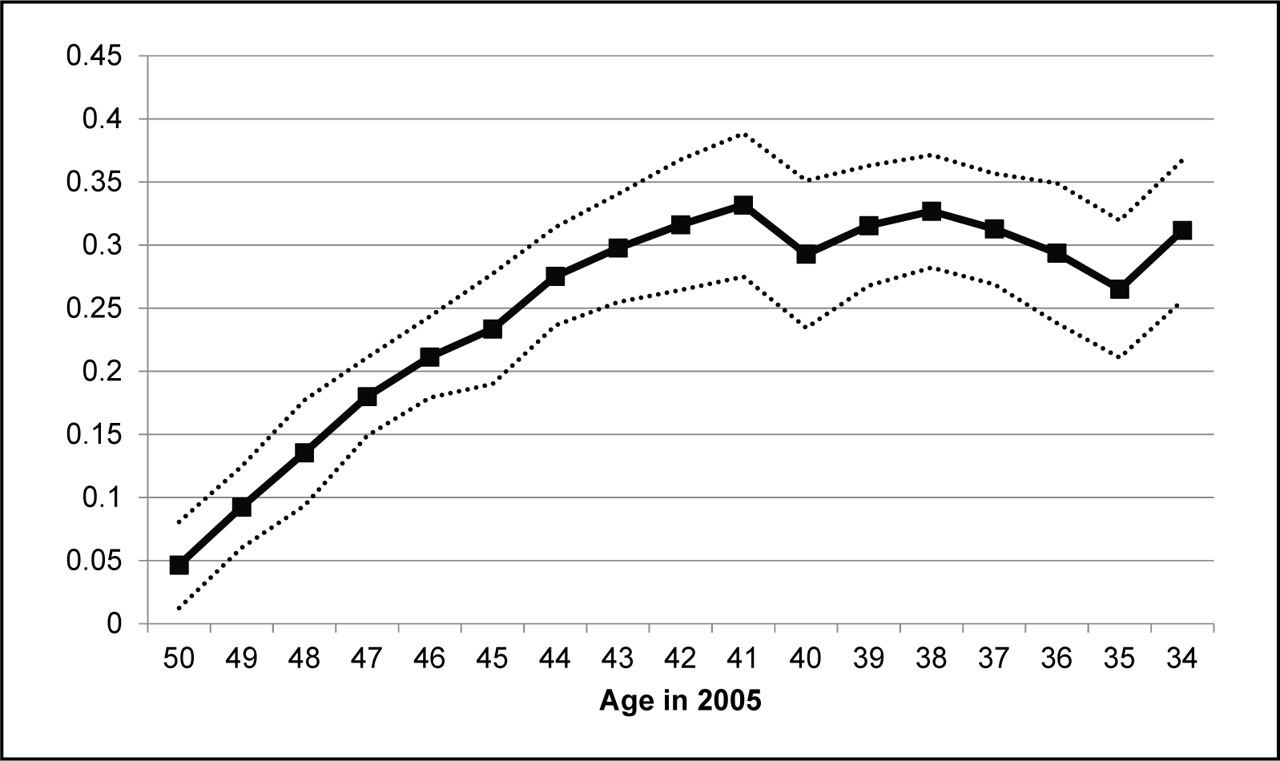
Figure 17
Coefficients of age dummies – Probability of being formally employed.
The specification includes region of residence and urban/rural dummies. Age 51 is the omitted age category. Observations are weighted using the sampling weights so that the results are nationally representative. Dashed lines indicate the 95-percent confidence interval based on standard errors clustered at region level.
Table 12
Classification of occupations and their percentages in age groups
| ISCO-88 codes | Classification | Percentage in age group | ||
|---|---|---|---|---|
| 34–39 | 40–45 | 46–51 | ||
| 12, 21, 22, 23, 24 | Corp. managers and professionals (1.53<log wage<2.07) | 13.73 | 12.00 | 18.68 |
| 31, 32, 33, 34, 41, 42 | Technicians, assoc. professionals & clerks (1.29<log wage<1.45) | 15.12 | 17.39 | 16.66 |
| 11, 13, 51, 72, 81 | Average wage earners (0.92<log wage<1.10) | 20.32 | 20.72 | 18.40 |
| 71, 73, 82, 83, 91 | Between min. wage & av. wage (0.69<log wage<0.87) | 33.29 | 34.37 | 31.28 |
| 52, 61, 62, 74, 92, 93 | Approx. less than min. wage (log wage<0.61) | 17.54 | 15.52 | 14.98 |
[i] Log (hourly) wages in this table are the means in the corresponding broadly-defined occupation group.