
Table 1
Descriptive Statistics (means) of Selected Variables
| Non-Displaced | Displaced | |
|---|---|---|
| Total Earningsa,b | $3,564.65 | $2,218.23 |
| Hours Workedb | 15.99 | 21.38 |
| Employed | 56.03% | 55.29% |
| Age | 19.11 | 18.77 |
| Female | 54.90% | 49.93% |
| Whitec | 51.73% | 36.51% |
| Responsible for Own Household | 15.17% | 15.13% |
| Education | ||
| < High School | 15.39% | 13.86% |
| High School Degree/GED | 23.97% | 29.79% |
| Some College/Associates Degree | 57.76% | 56.12% |
| High School Plus Another Degree (not college) | 0.12% | - |
| Bachelor's Degree | 2.51% | 0.23% |
| Master's Degree | 0.25% | - |
| Currently Smoke | 12.72% | 21.77% |
| Number Cigarettes/Day | 7.55 | 8.80 |
| Currently Drink Alcohol | 48.58% | 46.50% |
| Drink at Least Several Times/Month | 52.48% | 50.43% |
| Number Drinks/Session | 3.58 | 3.65 |
| Ever Used Marijuana | 40.17% | 45.98% |
| Number of Uses of Marijuana previous 12 Monthsd | 12.61 | 14.33 |
| Ever Used Amphetamines, Cocaine, Barbiturates, or Tranquilizers | 15.81% | 15.95% |
| Ever Used Pain Relievers/Narcotics | 30.32% | 34.43% |
| Number of Uses of Pain Relievers/Narcotics previous | 5.34 | 6.17 |
| 12 Monthsd | ||
| Total Number of Individuals | 2,288 | 747 |
Notes: Sample includes individuals who respond to at least two surveys. Displaced workers must respond to the survey prior to job loss. All calculations are means/proportions of selected variables. All years are used in the calculations. However, calculations only use the first observation in which an individual is observed.
Table 2
Displacement's Effect on Labor Market Outcomes
| Earnings | Log Earnings | Employed | |
|---|---|---|---|
| Panel A: Average Annual Effect | |||
| After | −4,285.556*** (733.586) | −0.754*** (0.144) | −0.134*** (0.020) |
| R2 | 0.17 | 0.16 | 0.08 |
| N | 10,816 | 8,460 | 10,816 |
| # Individuals | 3,039 | 2,863 | 3,039 |
| Panel B: Event History | |||
| At least t-6 | 2,083.255* (1,242.017) | −0.213 (0.286) | −0.018 (0.041) |
| t-4 | 1,721.573** (773.122) | 0.364 (0.233) | −0.023 (0.027) |
| t | −2,745.970*** (624.354) | −0.743*** (0.166) | −0.167*** (0.023) |
| t+2 | −4,545.250*** (957.543) | −0.635*** (0.209) | −0.106*** (0.027) |
| t+4 | −7,065.855*** (1,407.884) | −0.482* (0.260) | −0.070** (0.033) |
| At least t+6 | −8,929.685*** (2,181.589) | −0.399 (0.315) | −0.130*** (0.045) |
| R2 | 0.17 | 0.17 | 0.09 |
| N | 10,816 | 8,460 | 10,816 |
| # Individuals | 3,039 | 2,863 | 3,039 |
The data come from the 2005–2019 waves of the TAS from the PSID. The sample includes individuals who respond to at least two surveys. Displaced workers must respond to the survey prior to job loss. Standard errors clustered at the individual level shown in parentheses. The dependent variables are noted in the column headings. Additional independent variables include age, age squared, and dummy variables for calendar year. The coefficients in panel B are estimated relative to period t-2.
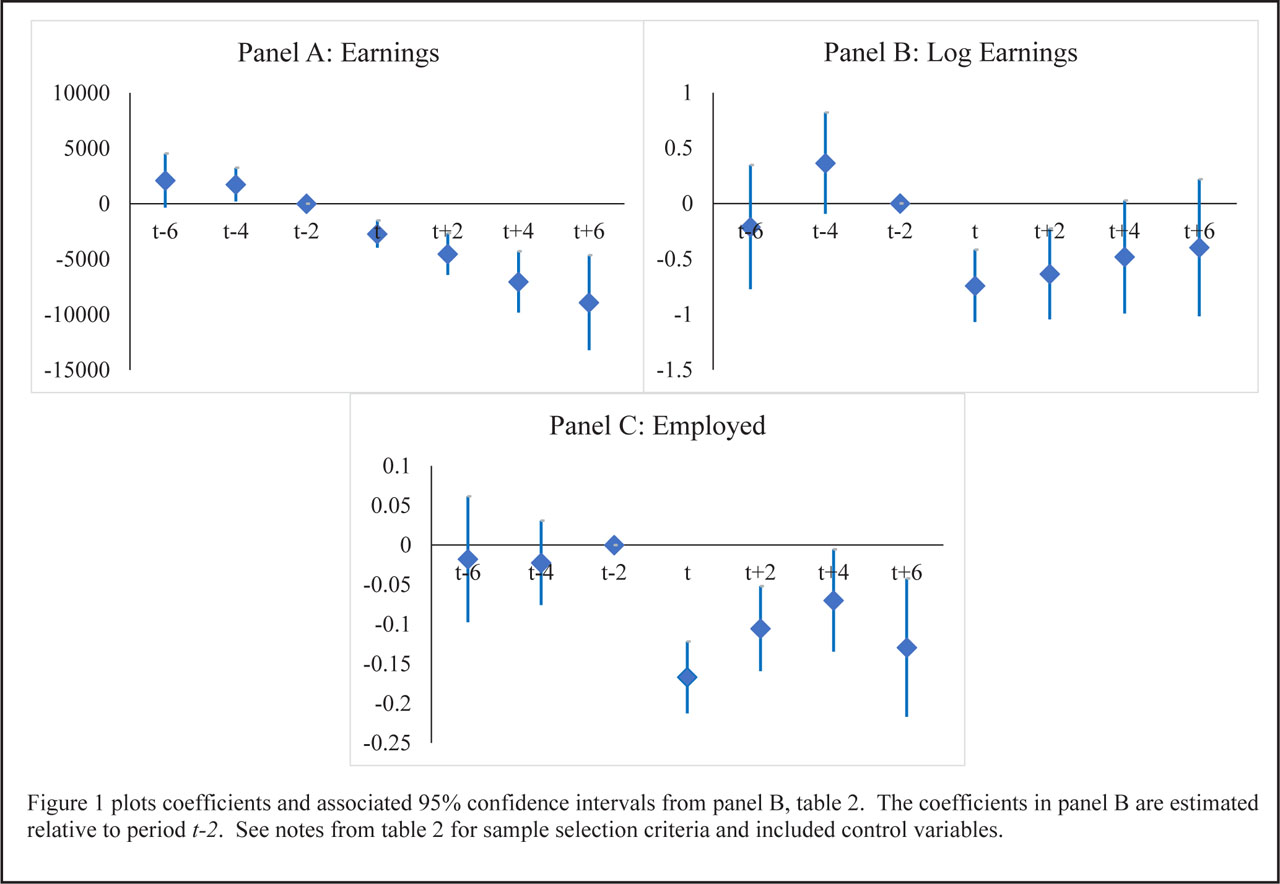
Figure 1
Displacement's Effect on Labor Market Outcomes.
Table 3
Displacement's Effect on Substance Use
| Panel A: Extensive Margin | |||||
|---|---|---|---|---|---|
| Currently Smokes | Currently Drinks | Ever Use Marijuana | Ever Used Other Drugs | Ever Used Pain Relievers/Narcotics | |
| After | 0.032** (0.013) | 0.031* (0.018) | −0.016 (0.015) | 0.010 (0.014) | −0.003 (0.037) |
| R2 | 0.00 | 0.11 | 0.06 | 0.03 | 0.06 |
| N | 10,790 | 10,781 | 10,759 | 10,759 | 4,486 |
| # People | 3,039 | 3,039 | 3,039 | 3,039 | 2,004 |
| Avg. Pre-Job Loss | 0.22 | 0.55 | 0.47 | 0.18 | 0.40 |
| Panel B: Intensive Margin | |||||
|---|---|---|---|---|---|
| # Cigarettes per Day | Drinks Several Times per Month | # Drinks per Session | # Times used Marijuana past 12 Months | # Times used Pain Relievers/Narcotics past 12 Months | |
| After | 0.341 (0.551) | −0.030 (0.026) | 0.463*** (0.128) | 1.967** (0.827) | −2.167 (1.879) |
| R2 | 0.02 | 0.05 | 0.03 | 0.03 | 0.04 |
| N | 1,721 | 6,883 | 6,825 | 5,320 | 1,419 |
| # People | 748 | 2,516 | 2,509 | 2,019 | 978 |
| Avg. Pre-Job Loss | 8.20 | 0.56 | 3.48 | 14.13 | 6.34 |
The data come from the 2005–2019 waves of the TAS from the PSID. The sample includes individuals who respond to at least two surveys. Displaced workers must respond to the survey prior to job loss. Standard errors clustered at the individual level shown in parentheses. The dependent variables are noted in the column headings. Additional independent variables include age, age squared, and dummy variables for calendar year.
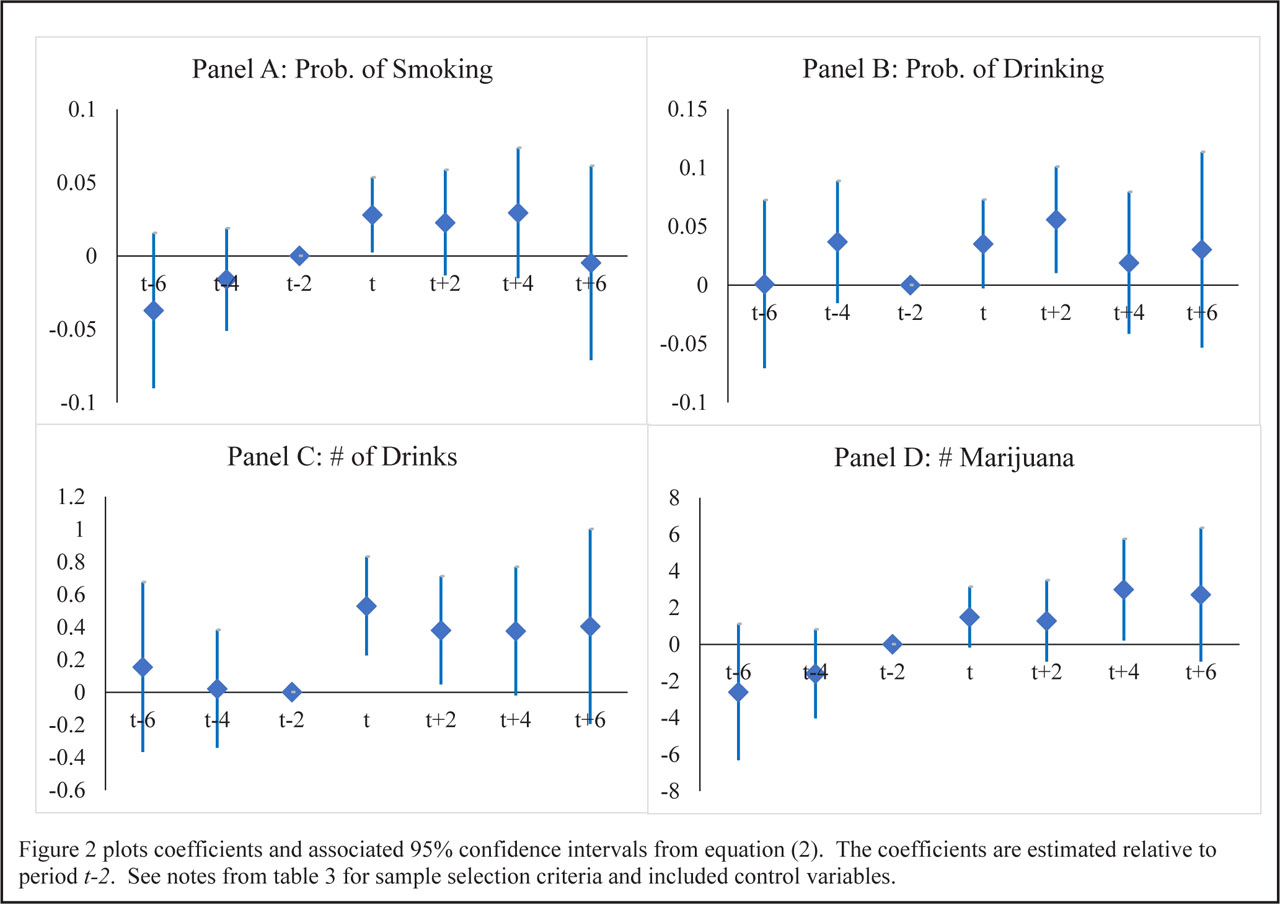
Figure 2
Displacement's Effect on Substance Use.
Table 4
Displacement's Effect on Substance Use by Type of Support – Extensive Margin
| Cigarettes | Alcohol | Marijuana | Other Drugs | Pain Relievers/Narcotics | |
|---|---|---|---|---|---|
| Panel A: Parental Support | |||||
| After | 0.045** (0.019) | 0.035 (0.023) | 0.016 (0.020) | 0.031 (0.019) | 0.054 (0.054) |
| R2 | 0.01 | 0.11 | 0.07 | 0.03 | 0.06 |
| N | 9,221 | 9,212 | 9,191 | 9,191 | 4,084 |
| # Individuals | 2,656 | 2,656 | 2,656 | 2,656 | 1,843 |
| Panel B: Government Support | |||||
| After | 0.084** (0.036) | −0.016 (0.048) | −0.043 (0.040) | 0.073* (0.038) | −0.068 (0.116) |
| R2 | 0.01 | 0.11 | 0.07 | 0.03 | 0.06 |
| N | 8,138 | 8,131 | 8,111 | 8,111 | 3,786 |
| # Individuals | 2,388 | 2,388 | 2,388 | 2,388 | 1,728 |
| Panel C: Own Support | |||||
| After | 0.030** (0.014) | 0.040** (0.020) | 0.006 (0.017) | 0.023 (0.016) | −0.018 (0.039) |
| R2 | 0.00 | 0.11 | 0.07 | 0.03 | 0.06 |
| N | 10,084 | 10,076 | 10,053 | 10,053 | 4,313 |
| # Individuals | 2,857 | 2,857 | 2,857 | 2,857 | 1,935 |
The data come from the 2005–2019 waves of the TAS from the PSID. The sample includes individuals who respond to at least two surveys. Displaced workers must respond to the survey prior to job loss. Standard errors clustered at the individual level shown in parentheses. The dependent variables are noted in the column headings. Additional independent variables include age, age squared, and dummy variables for calendar year. Parental support is parents/relatives helping to pay for tuition, rent, mortgage, other expenses not defined, or providing a personal loan. Government support includes SSI, TANF, or UI. Own support includes savings/checking accounts, stocks, mutual funds, investment trusts, money market accounts, government bonds, or certificates of deposits.
Table 5
Displacement's Effect on Substance Use by Type of Support – Intensive Margin
| # Cigarettes | Drinks Several Times per Month | # Drinks per Session | # Times Used Marijuana in Previous 12 Months | # Times Used Pain Relievers in Previous 12 Months | |
|---|---|---|---|---|---|
| Panel A: Parental Support | |||||
| After | 0.614 (0.834) | −0.067* (0.035) | 0.214 (0.152) | 3.147*** (1.129) | −1.313 (2.667) |
| R2 | 0.03 | 0.05 | 0.04 | 0.03 | 0.04 |
| N | 1,359 | 5,958 | 5,908 | 4,544 | 1,291 |
| # Individuals | 608 | 2,190 | 2,184 | 1,749 | 894 |
| Panel B: Government Support | |||||
| After | 0.539 (1.009) | 0.066 (0.060) | 0.679** (0.334) | 2.389 (1.615) | −3.034 (2.231) |
| R2 | 0.03 | 0.06 | 0.03 | 0.02 | 0.05 |
| N | 1,097 | 5,181 | 5,135 | 3,877 | 1,180 |
| # Individuals | 506 | 1,941 | 1,934 | 1,543 | 829 |
| Panel C: Own Support | |||||
| After | 0.034 (0.636) | −0.036 (0.028) | 0.324** (0.135) | 2.324** (0.903) | −2.030 (2.136) |
| R2 | 0.02 | 0.05 | 0.03 | 0.03 | 0.04 |
| N | 1,503 | 6,508 | 6,455 | 4,937 | 1,363 |
| # Individuals | 661 | 2,368 | 2,362 | 1,882 | 939 |
The data come from the 2005–2019 waves of the TAS from the PSID. The sample includes individuals who respond to at least two surveys. Displaced workers must respond to the survey prior to job loss. Standard errors clustered at the individual level shown in parentheses. The dependent variables are noted in the column headings. Additional independent variables include age, age squared, and dummy variables for calendar year. See table 4 and text for descriptions of types of support.
Table 6
Displacement's Effect on Substance Use - Declining Economic Activity
| Panel A: Extensive Margin | ||||
|---|---|---|---|---|
| Currently Smokes | Currently Drinks | Ever Use Marijuana | Ever Use Other Drugs | |
| After | 0.032 (0.027) | 0.052 (0.034) | 0.018 (0.029) | 0.040 (0.029) |
| R2 | 0.00 | 0.11 | 0.07 | 0.03 |
| N | 8,585 | 8,577 | 8,559 | 8,559 |
| # Individuals | 2,492 | 2,492 | 2,492 | 2,492 |
| Panel B: Intensive Margin | ||||
|---|---|---|---|---|
| # Cigarettes per Day | Drinks Several Times per Month | # Drinks per Session | # Times used Marijuana past 12 Months | |
| After | 1.000 (0.949) | −0.077* (0.046) | 0.597*** (0.230) | 0.344 (1.426) |
| R2 | 0.03 | 0.06 | 0.03 | 0.02 |
| N | 1,225 | 5,503 | 5,460 | 4,115 |
| # Individuals | 551 | 2,041 | 2,035 | 1,620 |
The data come from the 2005–2019 waves of the TAS from the PSID. The sample includes individuals who respond to at least two surveys. Displaced workers must respond to the survey prior to job loss. Standard errors clustered at the individual level shown in parentheses. The dependent variables are noted in the column headings. Additional independent variables include age, age squared, and dummy variables for calendar year. The treatment group is limited to those who experience an increase in their state's unemployment rate between the period before job loss and the year of displacement.
Table 7
Heterogeneity by Gender
| Panel A: Substance Use at Extensive Margin | |||||
|---|---|---|---|---|---|
| Cigarettes | Alcohol | Marijuana | Other Drugs | Pain Relievers | |
| Men | 0.041** (0.020) | 0.004 (0.023) | −0.054*** (0.020) | 0.043** (0.019) | 0.062 (0.052) |
| Women | 0.023 (0.015) | 0.057** (0.025) | 0.023 (0.021) | −0.024 (0.019) | −0.055 (0.048) |
| R2 | 0.00 | 0.11 | 0.07 | 0.03 | 0.06 |
| N | 10,790 | 10,781 | 10,759 | 10,759 | 4,845 |
| # Individuals | 3,039 | 3,039 | 3,039 | 3,039 | 2,194 |
| Sig. Different | No | No | 1% | 1% | 10% |
| Men Avg. | 0.275 | 0.595 | 0.567 | 0.208 | 0.319 |
| Women Avg. | 0.173 | 0.499 | 0.388 | 0.164 | 0.459 |
| Panel B: Substance Use at Intensive Margin | |||||
|---|---|---|---|---|---|
| Number Cigarettes | Drinks Several Times per Month | # Drinks per Session | # Times used Marijuana | # Times used Pain Relievers | |
| Men | 0.058 (0.755) | −0.023 (0.035) | 0.635*** (0.187) | 2.400** (1.097) | 2.252 (3.118) |
| Women | 0.748 (0.584) | −0.038 (0.037) | 0.263* (0.152) | 1.354 (1.123) | −4.685** (2.158) |
| R2 | 0.02 | 0.05 | 0.03 | 0.03 | 0.05 |
| N | 1,721 | 6,883 | 6,825 | 5,320 | 1,595 |
| # Individuals | 748 | 2,516 | 2,509 | 2,019 | 1,095 |
| Sig. Different | No | No | No | No | 10% |
| Men Avg. | 8.601 | 0.634 | 3.827 | 16.889 | 3.566 |
| Women Avg. | 7.598 | 0.472 | 3.091 | 10.350 | 7.799 |
The data come from the 2005–2019 waves of the TAS from the PSID. The sample includes individuals who respond to at least two surveys. Displaced workers must respond to the survey prior to job loss. Standard errors clustered at the individual level shown in parentheses. The dependent variables are noted in the column headings. Additional independent variables include age, age squared, and dummy variables for calendar year.
Table 8
Heterogeneity by Race
| Panel A: Substance Use at Extensive Margin | |||||
|---|---|---|---|---|---|
| Cigarettes | Alcohol | Marijuana | Other Drugs | Pain Relievers | |
| Non-White | 0.053*** (0.015) | 0.045** (0.022) | −0.020 (0.020) | −0.010 (0.016) | −0.052 (0.045) |
| White | −0.005 (0.021) | 0.006 (0.027) | −0.009 (0.021) | 0.042* (0.024) | 0.094 (0.057) |
| R2 | 0.01 | 0.11 | 0.06 | 0.03 | 0.06 |
| N | 10,783 | 10,774 | 10,751 | 10,751 | 4,844 |
| # Individuals | 3,036 | 3,036 | 3,036 | 3,036 | 2,193 |
| Sig. Different | 5% | No | No | 10% | 5% |
| White Avg. | 0.298 | 0.677 | 0.532 | 0.360 | 0.384 |
| Non-White Avg. | 0.175 | 0.466 | 0.442 | 0.080 | 0.407 |
| Panel B: Substance use at Intensive Margin | |||||
|---|---|---|---|---|---|
| Number Cigarettes | Drinks Several Times per Month | # Drinks per Session | # Times used Marijuana | # Times used Pain Relievers | |
| Non-White | 0.635 (0.768) | −0.004 (0.038) | 0.669*** (0.160) | 2.621** (1.042) | −4.053* (2.203) |
| White | 0.059 (0.668) | −0.060* (0.033) | 0.209 (0.187) | 1.057 (1.228) | 0.626 (3.093) |
| R2 | 0.02 | 0.05 | 0.03 | 0.03 | 0.05 |
| N | 1,717 | 6,878 | 6,820 | 5,317 | 1,595 |
| # Individuals | 747 | 2,514 | 2,507 | 2,018 | 1,095 |
| Sig. Different | No | No | 10% | No | No |
| White Avg. | 9.589 | 0.628 | 4.088 | 13.941 | 3.566 |
| Non-White Avg. | 6.739 | 0.495 | 2.945 | 14.307 | 7.799 |
The data come from the 2005–2019 waves of the TAS from the PSID. The sample includes individuals who respond to at least two surveys. Displaced workers must respond to the survey prior to job loss. Standard errors clustered at the individual level shown in parentheses. The dependent variables are noted in the column headings. Additional independent variables include age, age squared, and dummy variables for calendar year.
Table 9
Heterogeneity by Living Arrangements
| Panel A: Substance Use at Extensive Margin | |||||
|---|---|---|---|---|---|
| Cigarettes | Alcohol | Marijuana | Other Drugs | Pain Relievers | |
| With Others | 0.025 (0.015) | 0.058*** (0.022) | −0.020 (0.020) | 0.035** (0.017) | 0.104** (0.051) |
| On Own | 0.040** (0.020) | −0.003 (0.026) | −0.011 (0.021) | −0.021 (0.021) | −0.112** (0.047) |
| R2 | 0.00 | 0.11 | 0.06 | 0.03 | 0.06 |
| N | 10,790 | 10,781 | 10,759 | 10,759 | 4,845 |
| # Individuals | 3,039 | 3,039 | 3,039 | 3,039 | 2,194 |
| Sig. Different | No | 10% | No | 5% | 1% |
| On Own Avg. | 0.245 | 0.573 | 0.498 | 0.203 | 0.464 |
| With Others Avg. | 0.199 | 0.518 | 0.452 | 0.167 | 0.333 |
| Panel B: Substance Use at Intensive Margin | |||||
|---|---|---|---|---|---|
| Number Cigarettes | Drinks Several Times per Month | # Drinks per Session | # Times used Marijuana | # Times used Pain Relievers | |
| With Others | 0.769 (0.720) | −0.046 (0.034) | 0.457*** (0.155) | 1.582 (1.144) | −1.253 (3.352) |
| On Own | −0.054 (0.696) | −0.012 (0.038) | 0.470** (0.194) | 2.382** (1.094) | −2.548 (1.971) |
| R2 | 0.02 | 0.05 | 0.03 | 0.03 | 0.04 |
| N | 1,721 | 6,883 | 6,825 | 5,320 | 1,595 |
| # Individuals | 748 | 2,516 | 2,509 | 2,019 | 1,095 |
| Sig. Different | No | No | No | No | No |
| On Own Avg. | 8.969 | 0.545 | 3.536 | 13.332 | 6.609 |
| With Others Avg. | 7.246 | 0.571 | 3.413 | 15.010 | 5.957 |
The data come from the 2005–2019 waves of the TAS from the PSID. The sample includes individuals who respond to at least two surveys. Displaced workers must respond to the survey prior to job loss. Standard errors clustered at the individual level shown in parentheses. The dependent variables are noted in the column headings. Additional independent variables include age, age squared, and dummy variables for calendar year. Living on own is defined as being a head of household or a spouse of the head of household during the survey of the reported job loss. Living with others is defined as living with friends or relatives at the time of job loss.
Appendix A-1
Displacement's Effect on Substance Use
| Prob. of Smoking | Prob. of Drinking | # Drinks per Session | # Times Used Marijuana | |
|---|---|---|---|---|
| ≤t-6 | −0.037 (0.027) | 0.001 (0.037) | 0.155 (0.266) | −2.604 (1.893) |
| t-4 | −0.016 (0.018) | 0.037 (0.027) | 0.021 (0.184) | −1.606 (1.239) |
| t | 0.028** (0.013) | 0.035* (0.019) | 0.529*** (0.155) | 1.486* (0.844) |
| t+2 | 0.023 (0.018) | 0.056** (0.023) | 0.380** (0.169) | 1.283 (1.131) |
| t+4 | 0.029 (0.023) | 0.019 (0.031) | 0.376* (0.201) | 2.987** (1.413) |
| ≥t+6 | −0.005 (0.034) | 0.030 (0.042) | 0.404 (0.305) | 2.708 (1.861) |
| R2 | 0.00 | 0.11 | 0.03 | 0.03 |
| N | 10,790 | 10,781 | 6,825 | 5,320 |
| # Ind. | 3,039 | 3,039 | 2,509 | 2,019 |
The data come from the 2005–2019 waves of the TAS from the PSID. The sample includes individuals who respond to at least two surveys. Displaced workers must respond to the survey prior to job loss. Standard errors clustered at the individual level shown in parentheses. The dependent variables are noted in the column headings. Additional independent variables include age, age squared, and dummy variables for calendar year. Estimates come from equation (2). Coefficients are relative to period t-2.
Appendix Table B-1
The Effect of Substance Use on Employment
| Smoking | Drinking | Marijuana | Other Drugs | Pain Relievers | |
|---|---|---|---|---|---|
| Panel A: Substance User at t = 0 | |||||
| After | −0.178*** (0.039) | −0.107*** (0.024) | −0.122*** (0.026) | −0.158*** (0.040) | −0.182** (0.071) |
| R2 | 0.09 | 0.09 | 0.09 | 0.09 | 0.02 |
| N | 8,536 | 9,809 | 9,475 | 8,458 | 4,002 |
| # Individuals | 2,484 | 2,796 | 2,719 | 2,463 | 1,800 |
| Panel B: Not Substance User at t = 0 | |||||
| After | −0.117*** (0.023) | −0.186*** (0.036) | −0.147*** (0.030) | −0.126*** (0.023) | −0.141*** (0.049) |
| R2 | 0.09 | 0.09 | 0.09 | 0.09 | 0.03 |
| N | 10,023 | 8,750 | 9,076 | 10,093 | 4,268 |
| # Individuals | 2,845 | 2,533 | 2,608 | 2,864 | 1,911 |
The data come from the 2005–2019 waves of the TAS from the PSID. The sample includes individuals who respond to at least two surveys. Displaced workers must respond to the survey prior to job loss. Standard errors clustered at the individual level shown in parentheses. The dependent variable equals one if the respondent is employed and zero otherwise. Additional independent variables include age, age squared, and dummy variables for calendar year. Panel A limits the treatment group to those who are substance users at the time of the reported job loss. Panel B limits the treatment group to those who are not current substance users at the time of job loss. The substance in question is in the column headings.
Appendix Table B-2
The Effect of Substance Use on Employment
| Smoking | Drinking | Marijuana | Other Drugs | Pain Reliever | |
|---|---|---|---|---|---|
| Panel A: Non-users in t – 2 & Users in t = 0 | |||||
| After | −0.194** (0.084) | −0.088** (0.043) | −0.146** (0.057) | −0.118* (0.061) | −0.171 (0.106) |
| R2 | 0.09 | 0.09 | 0.09 | 0.09 | 0.02 |
| N | 7,962 | 8,325 | 8,100 | 8,056 | 3,809 |
| # Individuals | 2,345 | 2,443 | 2,376 | 2,370 | 1,729 |
| Panel B: Non-users in t – 2 & t = 0 | |||||
| After | −0.111*** (0.024) | −0.176*** (0.040) | −0.128*** (0.031) | −0.130*** (0.024) | −0.145** (0.057) |
| R2 | 0.09 | 0.09 | 0.09 | 0.09 | 0.02 |
| N | 9,857 | 8,512 | 8,869 | 9,855 | 4,031 |
| # Individuals | 2,806 | 2,474 | 2,557 | 2,808 | 1,815 |
The data come from the 2005–2019 waves of the TAS from the PSID. The sample includes individuals who respond to at least two surveys. Displaced workers must respond to the survey prior to job loss. Standard errors clustered at the individual level shown in parentheses. The dependent variable equals one if the respondent is employed and zero otherwise. Additional independent variables include age, age squared, and dummy variables for calendar year. Panel A limits the treatment group to those who started using substances between the survey before job loss and the survey of the reported job loss. Panel B limits the treatment group to those who remained non-users during the survey before job loss and the survey of job loss. The substance in question is in the column headings.
Appendix Table C-1
Displacement's Effect on Labor Market Outcome - Heterogeneity
| Log Earnings | Real Earnings | Employed | |
|---|---|---|---|
| Panel A: Gender | |||
| Men | −0.816*** (0.184) | −2,988.339*** (983.679) | −0.108*** (0.028) |
| Women | −0.694*** (0.200) | −5573.236*** (867.409) | −0.161*** (0.028) |
| R2 | 0.16 | 0.17 | 0.08 |
| N | 8,460 | 10,816 | 10,816 |
| # Individuals | 2,863 | 3,039 | 3,039 |
| Sig. Different | No | 5% | No |
| Panel B: Race | |||
| Non-White | −0.946*** (0.178) | −5,958.624*** (785.528) | −0.151*** (0.025) |
| White | −0.492** (0.212) | −1481.940 (1177.504) | −0.108*** (0.031) |
| R2 | 0.17 | 0.17 | 0.08 |
| N | 8,453 | 10,807 | 10,807 |
| # Individuals | 2,861 | 3,036 | 3,036 |
| Sig. Different | 10% | 1% | No |
| Panel C: Living Arrangements | |||
| With Others | −0.984*** (0.184) | −5,054.904*** (795.454) | −0.086*** (0.026) |
| On Own | −0.506** (0.202) | −3360.716*** (1094.889) | −0.193*** (0.030) |
| R2 | 0.17 | 0.17 | 0.09 |
| N | 8,460 | 10,816 | 10,816 |
| # Individuals | 2,863 | 3,039 | 3,039 |
| Sig. Different | 10% | No | 1% |
The data come from the 2005–2019 waves of the TAS from the PSID. The sample includes individuals who respond to at least two surveys. Displaced workers must respond to the survey prior to job loss. Standard errors clustered at the individual level shown in parentheses. The dependent variables are noted in the column headings. Additional independent variables include age, age squared, and dummy variables for calendar year. Living on own is defined as being a head of household or a spouse of the head of household during the survey of the reported job loss. Living with others is defined as living with friends or relatives at the time of job loss.
Appendix Table D-1
Heterogeneity - Relative Differences
| # Cigarettes | # Drinks | Marijuana | Pain Relievers | |
|---|---|---|---|---|
| Panel A: Gender | ||||
| Men | −0.058 (0.206) | 0.306*** (0.100) | 0.431 (0.349) | −0.089 (0.638) |
| Women | −0.076 (0.145) | 0.106* (0.062) | 0.332 (0.507) | −0.645 (0.475) |
| R2 | 0.04 | 0.02 | 0.04 | 0.06 |
| N | 1,263 | 4,730 | 2,773 | 318 |
| # Individuals | 458 | 1,496 | 896 | 211 |
| Sig. Different | No | 10% | No | No |
| Panel B: Race | ||||
| Non-White | −0.064 (0.147) | 0.296*** (0.081) | 0.154 (0.311) | −0.285 (0.423) |
| White | −0.063 (0.231) | 0.117 (0.091) | 0.735 (0.559) | −0.777 (0.718) |
| R2 | 0.04 | 0.02 | 0.04 | 0.06 |
| N | 1,259 | 4,726 | 2,773 | 318 |
| # Individuals | 457 | 1,495 | 896 | 211 |
| Sig. Different | No | No | No | No |
| Panel C: Living Arrangements | ||||
| With Others | 0.104 (0.220) | 0.212*** (0.071) | 0.282 (0.365) | −0.422* (0.254) |
| On Own | −0.230 (0.152) | 0.216** (0.104) | 0.502 (0.461) | −0.478 (0.780) |
| R2 | 0.04 | 0.02 | 0.04 | 0.06 |
| N | 1,263 | 4,730 | 2,773 | 318 |
| # Individuals | 458 | 1,496 | 896 | 211 |
| Sig. Different | No | No | No | No |
The data come from the 2005–2019 waves of the TAS from the PSID. The sample includes individuals who respond to at least two surveys. Displaced workers must respond to the survey prior to job loss. Standard errors clustered at the individual level shown in parentheses. The dependent variables are noted in the column headings. Additional independent variables include age, age squared, and dummy variables for calendar year.
Appendix E-1
Displacement's Effect on Living Arrangements
| On Own | Transition | |
|---|---|---|
| After | −0.024 (0.015) | −0.017 (0.013) |
| R2 | 0.42 | 0.09 |
| N | 10,816 | 10,816 |
| # Individuals | 3,039 | 3,039 |
The data come from the 2005–2019 waves of the TAS from the PSID. The sample includes individuals who respond to at least two surveys. Displaced workers must respond to the survey prior to job loss. Standard errors clustered at the individual level shown in parentheses. The dependent variables are noted in the column headings. Additional independent variables include age, age squared, and dummy variables for calendar year.
Appendix E-2
Non-Random Attrition
| Employed | Current Smoke | Current Drink | Marijuana | Other Drug | Pain Reliever | |
|---|---|---|---|---|---|---|
| Attrite | 0.006 (0.010) | 0.008 (0.016) | −0.015 (0.012) | 0.002 (0.013) | 0.005 (0.014) | 0.000 (0.000) |
| R2 | 0.68 | 0.68 | 0.69 | 0.69 | 0.69 | 1.00 |
| N | 5,725 | 5,718 | 5,716 | 5,707 | 5,707 | 884 |
| # Individuals | 1,417 | 1,417 | 1,417 | 1,417 | 1,417 | 573 |
The data come from the 2005–2017 waves of the TAS from the PSID. The sample includes individuals who respond to at least two surveys. Displaced workers must respond to the survey prior to job loss. Standard errors clustered at the individual level shown in parentheses. The dependent variable equals one if the individual attrites from the sample in the following period. The main independent variable of interest in each regression is indicated in the column. Additional independent variables include age, age squared, and dummy variables for calendar year.
Appendix E-3
Displacement's Effect on Attrition
| Attrite | |
|---|---|
| After | 0.008 (0.016) |
| R2 | 0.68 |
| N | 5,725 |
| # Individuals | 1,417 |
The data come from the 2005–2017 waves of the TAS from the PSID. The sample includes individuals who respond to at least two surveys. Displaced workers must respond to the survey prior to job loss. Standard errors clustered at the individual level shown in parentheses. The dependent variable is noted in the column heading. Additional independent variables include age, age squared, and dummy variables for calendar year.
Appendix Table F-1
Substance Use's Effect on Displacement
| Panel A: Extensive Margin | |||||
|---|---|---|---|---|---|
| Current Smoke | Current Drink | Ever Used Marijuana | Ever Used Other Drugs | Ever Used Pain Relievers/Narcotics | |
| Job Loss | 0.010 (0.022) | −0.012 (0.013) | 0.014 (0.014) | 0.009 (0.017) | −0.029 (0.026) |
| R2 | 0.01 | 0.01 | 0.01 | 0.01 | 0.00 |
| N | 7,768 | 7,761 | 7,755 | 7,755 | 2,510 |
| # Individuals | 3,038 | 3,037 | 3,038 | 3,038 | 1,793 |
| Panel B: Intensive Margin | |||||
|---|---|---|---|---|---|
| # Cigarettes Smoked per Day | Drink Several Times per Month | # Drinks per Session | # Times Used Marijuana in Past 12 Months | # Times Used Pain Relievers in Past 12 Month | |
| Job Loss | −0.001 (0.003) | −0.008 (0.015) | −0.005 (0.003) | 0.000 (0.001) | 0.000 (0.004) |
| R2 | 0.01 | 0.01 | 0.01 | 0.01 | 0.02 |
| N | 1,263 | 4,782 | 4,741 | 3,631 | 920 |
| # Individuals | 658 | 2,191 | 2,179 | 1,754 | 761 |
The data come from the 2005–2019 waves of the TAS from the PSID. The sample includes individuals who respond to at least two surveys. Displaced workers must respond to the survey prior to job loss. Standard errors clustered at the individual level shown in parentheses. The dependent variables are noted in the column headings. Additional independent variables include age, age squared, and dummy variables for calendar year.
Appendix Table F-2
Sensitivity Analysis - Labor Market Outcomes
| Earnings | Log Earnings | Employed | |
|---|---|---|---|
| Panel A: Displaced Main Job | |||
| After | −6,673.086*** (849.543) | −0.863*** (0.245) | −0.406*** (0.033) |
| R2 | 0.17 | 0.16 | 0.10 |
| N | 10,816 | 8,460 | 10,816 |
| # Individuals | 3,039 | 2,863 | 3,039 |
| Panel B: Employed at Baseline | |||
| After | −4,616.058*** (949.157) | −0.860*** (0.196) | −0.141*** (0.022) |
| R2 | 0.23 | 0.14 | 0.12 |
| N | 5,781 | 4,914 | 5,781 |
| # Individuals | 1,695 | 1,655 | 1,695 |
| Panel C: Works at Least 25 Hours at Baseline | |||
| After | −4,896.733*** (1,456.795) | −0.836*** (0.203) | −0.179*** (0.030) |
| R2 | 0.12 | 0.17 | 0.07 |
| N | 4,005 | 3,589 | 4,005 |
| # Individuals | 989 | 986 | 989 |
| Panel D: Displaced Workers Present between t–2 and t+2 | |||
| After | −4,993.206*** (848.074) | −0.886*** (0.167) | −0.117*** (0.024) |
| R2 | 0.17 | 0.17 | 0.08 |
| N | 10,004 | 7,802 | 10,004 |
| # Individuals | 2,787 | 2,617 | 2,787 |
The data come from the 2005–2019 waves of the TAS from the PSID. The sample includes individuals who respond to at least two surveys. Displaced workers must respond to the survey prior to job loss. Standard errors clustered at the individual level shown in parentheses. The dependent variables are noted in the column headings. Additional independent variables include age, age squared, and dummy variables for calendar year.
Appendix Table F-3
Sensitivity Analysis - Substance Use: Extensive Margin
| Currently Smokes | Currently Drinks | Ever Use Marijuana | Ever Use Other Drugs | Ever Use Pain Relievers | |
|---|---|---|---|---|---|
| Panel A: Displaced from Main Job | |||||
| After | 0.032 (0.022) | −0.020 (0.027) | −0.075*** (0.025) | −0.011 (0.021) | 0.065 (0.068) |
| R2 | 0.00 | 0.11 | 0.07 | 0.03 | 0.06 |
| N | 10,790 | 10,781 | 10,759 | 10,759 | 4,486 |
| # Individuals | 3,039 | 3,039 | 3,039 | 3,039 | 2,004 |
| Panel B: Employed at Baseline Interview | |||||
| After | 0.040** (0.017) | 0.025 (0.025) | −0.031 (0.020) | 0.014 (0.020) | 0.057 (0.046) |
| R2 | 0.00 | 0.09 | 0.06 | 0.03 | 0.06 |
| N | 5,767 | 5,763 | 5,758 | 5,758 | 2,523 |
| # Individuals | 1,695 | 1,695 | 1,695 | 1,695 | 1,147 |
| Panel C: Worked at Least 25 Hours per Week at Baseline Interview | |||||
| After | 0.049** (0.020) | 0.020 (0.026) | −0.012 (0.023) | 0.012 (0.024) | 0.032 (0.070) |
| R2 | 0.01 | 0.07 | 0.06 | 0.04 | 0.05 |
| N | 3,999 | 3,996 | 3,994 | 3,994 | 1,098 |
| # Individuals | 989 | 989 | 989 | 989 | 475 |
| Panel D: Displaced Workers Present between t – 2 and t + 2 | |||||
| After | 0.028* (0.015) | 0.019 (0.021) | −0.034** (0.017) | −0.001 (0.017) | 0.043 (0.055) |
| R2 | 0.00 | 0.11 | 0.06 | 0.03 | 0.06 |
| N | 9,979 | 9,970 | 9,950 | 9,950 | 4,132 |
| # Individuals | 2,787 | 2,787 | 2,787 | 2,787 | 1,849 |
The data come from the 2005–2019 waves of the TAS from the PSID. The sample includes individuals who respond to at least two surveys. Displaced workers must respond to the survey prior to job loss. Standard errors clustered at the individual level shown in parentheses. The dependent variables are noted in the column headings. Additional independent variables include age, age squared, and dummy variables for calendar year.
Appendix Table F-4
Sensitivity Analysis - Substance Use: Intensive Margin
| # Cigarettes Smoked per Day | Drinks Several Times per Month | # Drinks Consumed per Session | # Times Used Marijuana past 12 Months | # Times used Pain Relievers/Narcotics past 12 Months | |
|---|---|---|---|---|---|
| Panel A: Displaced from Main Job | |||||
| After | 1.503* (0.841) | −0.036 (0.046) | 0.785*** (0.230) | 1.287 (1.371) | −1.451 (2.836) |
| R2 | 0.03 | 0.05 | 0.03 | 0.02 | 0.04 |
| N | 1,721 | 6,883 | 6,825 | 5,320 | 1,419 |
| # Individuals | 748 | 2,516 | 2,509 | 2,019 | 978 |
| Panel B: Employed at Baseline Interview | |||||
| After | 0.412 (0.623) | −0.016 (0.035) | 0.560*** (0.172) | 1.396 (1.134) | −4.750 (3.226) |
| R2 | 0.05 | 0.05 | 0.03 | 0.03 | 0.05 |
| N | 918 | 3,790 | 3,762 | 2,868 | 765 |
| # Individuals | 411 | 1,432 | 1,429 | 1,111 | 545 |
| Panel C: Worked at Least 25 Hours per Week at Baseline Interview | |||||
| After | −0.084 (0.701) | 0.008 (0.039) | 0.669*** (0.210) | 0.652 (1.171) | −3.729 (2.969) |
| R2 | 0.03 | 0.03 | 0.04 | 0.02 | 0.13 |
| N | 758 | 2,805 | 2,785 | 2,186 | 417 |
| # Individuals | 310 | 885 | 887 | 714 | 286 |
| Panel D: Displaced Workers Present from t – 2 and t + 2 | |||||
| After | 0.589 (0.665) | −0.055* (0.031) | 0.454*** (0.151) | 0.824 (0.950) | −1.635 (2.576) |
| R2 | 0.03 | 0.05 | 0.03 | 0.02 | 0.04 |
| N | 1,539 | 6,362 | 6,307 | 4,883 | 1,315 |
| # Individuals | 665 | 2,299 | 2,292 | 1,834 | 901 |
The data come from the 2005–2019 waves of the TAS from the PSID. The sample includes individuals who respond to at least two surveys. Displaced workers must respond to the survey prior to job loss. Standard errors clustered at the individual level shown in parentheses. The dependent variables are noted in the column headings. Additional independent variables include age, age squared, and dummy variables for calendar year.
Appendix Table G-1
Displacement's Effect on Labor Market Outcomes
| Earnings | Log Earnings | Employed | |
|---|---|---|---|
| After | −3,635.597*** (1,339.037) | −0.274 (0.262) | −0.137*** (0.040) |
| R2 | 0.17 | 0.18 | 0.09 |
| N | 8,422 | 6,505 | 8,422 |
| # Individuals | 2,463 | 2,297 | 2,463 |
The data come from the 2005–2019 waves of the TAS from the PSID. The sample includes individuals who respond to at least two surveys. Displaced workers must respond to the survey prior to job loss. Standard errors clustered at the individual level shown in parentheses. The dependent variables are noted in the column headings. Additional independent variables include age, age squared, and dummy variables for calendar year. The treatment group is limited to those displaced through plant closure only.
Appendix Table G-2
Displacement's Effect on Substance Use
| Panel A: Extensive Margin | |||||
|---|---|---|---|---|---|
| Currently Smokes | Currently Drinks | Ever Used Marijuana | Ever Used Other Drugs | Ever Used Pain Relievers/Narcotics | |
| After | 0.002 (0.024) | 0.047 (0.032) | −0.041 (0.030) | −0.023 (0.024) | −0.039 (0.072) |
| R2 | 0.00 | 0.11 | 0.07 | 0.02 | 0.06 |
| N | 8,403 | 8,395 | 8,374 | 8,374 | 3,907 |
| # Individuals | 2,463 | 2,463 | 2,463 | 2,463 | 1,779 |
| Panel B: Intensive Margin | |||||
|---|---|---|---|---|---|
| # Cigarettes Smoked Per Day | Drinks Several Times per Month | # Drinks per Session | # Times Used Marijuana in Past 12 Months | # Times Used Pain Relievers Past 12 Months | |
| After | 0.047 (0.841) | −0.026 (0.046) | 0.137 (0.237) | 1.770 (1.694) | −5.535* (2.913) |
| R2 | 0.03 | 0.06 | 0.03 | 0.02 | 0.04 |
| N | 1,156 | 5,363 | 5,319 | 3,991 | 1,221 |
| # Individuals | 531 | 2,010 | 2,003 | 1,580 | 860 |
The data come from the 2005–2019 waves of the TAS from the PSID. The sample includes individuals who respond to at least two surveys. Displaced workers must respond to the survey prior to job loss. Standard errors clustered at the individual level shown in parentheses. The dependent variables are noted in the column headings. Additional independent variables include age, age squared, and dummy variables for calendar year. The treatment group is limited to those displaced through plant closure only.
Appendix Table G-3
Heterogeneity by Gender
| Panel A: Labor Market Outcomes | |||||
| Log Earnings | Real | Employed | |||
| Men | −0.908** (0.368) | −3,174.104 (2,223.554) | −0.077 (0.055) | ||
| Women | 0.225 (0.354) | −4002.388*** (1513.980) | −0.184*** (0.054) | ||
| R2 | 0.18 | 0.17 | 0.09 | ||
| N | 6,505 | 8,422 | 8,422 | ||
| # Individuals | 2,297 | 2,463 | 2,463 | ||
| Sig. Different | 5% | No | No | ||
| Panel B: Substance Use at Extensive Margin | |||||
| Currently Smokes | Currently Drinks | Ever Used Marijuana | Ever Used Other Drugs | Ever Used Pain Relievers/Narcotics | |
| Men | −0.001 (0.036) | 0.008 (0.041) | −0.061 (0.039) | −0.022 (0.041) | 0.047 (0.099) |
| Women | 0.004 (0.031) | 0.078* (0.045) | −0.024 (0.042) | −0.024 (0.028) | −0.099 (0.098) |
| R2 | 0.00 | 0.11 | 0.07 | 0.02 | 0.06 |
| N | 8,403 | 8,395 | 8,374 | 8,374 | 3,907 |
| # Individuals | 2,463 | 2,463 | 2,463 | 2,463 | 1,779 |
| Sig. Different | No | No | No | No | No |
| Panel C: Substance Use at Intensive Margin | |||||
| # Cigarettes Smoked Per Day | Drinks Several Times per Month | # Drinks per Session | # Times Used Marijuana in Past 12 Months | # Times Used Pain Relievers Past 12 Months | |
| Men | 0.667 (1.294) | −0.054 (0.064) | 0.624* (0.365) | 2.149 (2.545) | −7.610** (3.573) |
| Women | −0.743 (0.807) | 0.002 (0.065) | −0.347 (0.265) | 1.382 (2.152) | −4.688 (3.749) |
| R2 | 0.03 | 0.06 | 0.04 | 0.02 | 0.04 |
| N | 1,156 | 5,363 | 5,319 | 3,991 | 1,221 |
| # Individuals | 531 | 2,010 | 2,003 | 1,580 | 860 |
| Sig. Different | No | No | 5% | No | No |
The data come from the 2005–2019 waves of the TAS from the PSID. The sample includes individuals who respond to at least two surveys. Displaced workers must respond to the survey prior to job loss. Standard errors clustered at the individual level shown in parentheses. The dependent variables are noted in the column headings. Additional independent variables include age, age squared, and dummy variables for calendar year. The treatment group is limited to those displaced through plant closure only.
Appendix Table G-4
Heterogeneity by Race
| Panel A: Labor Market Outcomes | |||||
| Log Earnings | Real Earnings | Employed | |||
| Non-White | −0.504 (0.334) | −6,288.925*** (1,392.415) | −0.145*** (0.052) | ||
| White | −0.050 (0.406) | 546.915 (2510.808) | −0.125** (0.058) | ||
| R2 | 0.18 | 0.17 | 0.09 | ||
| N | 6,501 | 8,416 | 8,416 | ||
| # Individuals | 2,296 | 2,461 | 2,461 | ||
| Sig. Different | No | 5% | No | ||
| Panel B: Substance Use at Extensive Margin | |||||
| Currently Smokes | Currently Drinks | Ever Used Marijuana | Ever Used Other Drugs | Ever Used Pain Relievers/Narcotics | |
| Non-White | 0.038 (0.030) | 0.048 (0.041) | −0.049 (0.040) | −0.018 (0.031) | −0.082 (0.085) |
| White | −0.060 (0.037) | 0.048 (0.047) | −0.034 (0.041) | −0.041 (0.038) | 0.060 (0.129) |
| R2 | 0.00 | 0.11 | 0.07 | 0.02 | 0.06 |
| N | 8,398 | 8,390 | 8,369 | 8,369 | 3,906 |
| # Individuals | 2,461 | 2,461 | 2,461 | 2,461 | 1,778 |
| Sig. Different | 5% | No | No | No | No |
| Panel C: Substance Use at Intensive Margin | |||||
| # Cigarettes Smoked Per Day | Drinks Several Times per Month | # Drinks per Session | # Times Used Marijuana in Past 12 Months | # Times Used Pain Relievers Past 12 Months | |
| Non-White | −0.013 (1.351) | −0.012 (0.067) | 0.468 (0.325) | 5.123** (2.483) | −5.342 (4.714) |
| White | 0.223 (1.032) | −0.039 (0.063) | −0.294 (0.318) | −2.184 (1.988) | −5.776** (2.575) |
| R2 | 0.03 | 0.06 | 0.04 | 0.03 | 0.04 |
| N | 1,152 | 5,359 | 5,315 | 3,988 | 1,221 |
| # Individuals | 530 | 2,009 | 2,002 | 1,579 | 860 |
| Sig. Different | No | No | 10% | 5% | No |
The data come from the 2005–2019 waves of the TAS from the PSID. The sample includes individuals who respond to at least two surveys. Displaced workers must respond to the survey prior to job loss. Standard errors clustered at the individual level shown in parentheses. The dependent variables are noted in the column headings. Additional independent variables include age, age squared, and dummy variables for calendar year. The treatment group is limited to those displaced through plant closure only.
Appendix Table G-5
Heterogeneity by Living Arrangements
| Panel A: Labor Market Outcomes | |||||
| Log Earnings | Real Earnings | Employed | |||
| With Others | −0.838** (0.338) | −5,882.592*** (1,195.762) | −0.127*** (0.047) | ||
| On Own | 0.669* (0.385) | 201.614 (2794.817) | −0.153** (0.069) | ||
| R2 | 0.18 | 0.17 | 0.09 | ||
| N | 6,505 | 8,422 | 8,422 | ||
| # Individuals | 2,297 | 2,463 | 2,463 | ||
| Sig. Different | 1% | 5% | No | ||
| Panel B: Substance Use at Extensive Margin | |||||
| Currently Smokes | Currently Drinks | Ever Used Marijuana | Ever Used Other Drugs | Ever Used Pain Relievers/Narcotics | |
| With Others | 0.004 (0.028) | 0.053 (0.040) | −0.072** (0.034) | 0.003 (0.030) | 0.068 (0.101) |
| On Own | −0.001 (0.042) | 0.036 (0.049) | 0.012 (0.054) | −0.067* (0.040) | −0.161* (0.097) |
| R2 | 0.00 | 0.11 | 0.07 | 0.02 | 0.06 |
| N | 8,403 | 8,395 | 8,374 | 8,374 | 3,907 |
| # Individuals | 2,463 | 2,463 | 2,463 | 2,463 | 1,779 |
| Sig. Different | No | No | No | No | 10% |
| Panel C: Substance Use at Intensive Margin | |||||
| # Cigarettes Smoked Per Day | Drinks Several Times per Month | # Drinks per Session | # Times Used Marijuana in Past 12 Months | # Times Used Pain Relievers Past 12 Months | |
| With Others | 0.879 (1.199) | −0.067 (0.059) | 0.084 (0.268) | 1.696 (2.148) | −0.860 (1.539) |
| On Own | −1.190 (0.795) | 0.041 (0.068) | 0.225 (0.431) | 1.901 (2.649) | −13.398** (5.556) |
| R2 | 0.03 | 0.06 | 0.03 | 0.02 | 0.05 |
| N | 1,156 | 5,363 | 5,319 | 3,991 | 1,221 |
| # Individuals | 531 | 2,010 | 2,003 | 1,580 | 860 |
| Sig. Different | No | No | No | No | 5% |
The data come from the 2005–2019 waves of the TAS from the PSID. The sample includes individuals who respond to at least two surveys. Displaced workers must respond to the survey prior to job loss. Standard errors clustered at the individual level shown in parentheses. The dependent variables are noted in the column headings. Additional independent variables include age, age squared, and dummy variables for calendar year. The treatment group is limited to those displaced through plant closure only.
Appendix Table H-1
Descriptive Statistics (means) of Selected Variables
| Non-Displaced (matched) | Displaced (matched) | |
|---|---|---|
| Total Earningsa,b | $3,094.56 | $2,214.53 |
| Hours Workedb | 18.43 | 21.14 |
| Employed | 54.13% | 55.35% |
| Age | 18.93 | 18.78 |
| Female | 53.59% | 50.20% |
| Whitec | 35.86% | 36.40% |
| Responsible for Own Household | 15.02% | 14.88% |
| Education | ||
| < High School | 13.86% | 13.69% |
| High School Degree/GED | 23.41% | 29.700% |
| Some College/Associates Degree | 61.14% | 56.38% |
| Bachelor's Degree | 1.36% | 0.23% |
| Master's Degree | 0.23% | - |
| Currently Smoke | 18.94% | 21.65% |
| Number Cigarettes/Day | 8.49 | 8.72 |
| Currently Drink Alcohol | 44.25% | 46.55% |
| Drink at Least Several Times/Month | 50.15% | 50.29% |
| Number Drinks/Session | 3.71 | 3.64 |
| Ever Used Marijuana | 43.55% | 46.07% |
| Number of Uses of Marijuana previous 12 Monthsd | 11.82 | 14.4 |
| Ever Used Amphetamines, Cocaine, Barbiturates, or Tranquilizers | 16.42% | 15.86% |
| Ever Used Pain Relievers/Narcotics | 27.93% | 34.43% |
| Number of Uses of Pain Relievers/Narcotics previous | 9.39 | 6.17 |
| 12 Monthsd | ||
| Total Number of Individuals | 739 | 739 |
Notes: Sample is the matched treatment and control units. See main text for description of matching procedure. All years are used in the calculations. However, calculations only use the first observation in which an individual is observed.
Appendix Table H-2
Displacement's Effect on Labor Market Outcomes
| Earnings | Log Earnings | Employed | |
|---|---|---|---|
| After | −1,991.898*** (663.265) | −0.647*** (0.138) | −0.112*** (0.020) |
| R2 | 0.20 | 0.15 | 0.08 |
| N | 6,043 | 4,760 | 6,043 |
| # Individuals | 1,307 | 1,263 | 1,307 |
The data come from the 2005–2019 waves of the TAS from the PSID. The sample includes individuals who respond to at least two surveys. Displaced workers must respond to the survey prior to job loss. Standard errors clustered at the individual level shown in parentheses. The dependent variables are noted in the column headings. Additional independent variables include age, age squared, and dummy variables for calendar year. See the main text for a description of the matching estimator.
Appendix Table H-3
Displacement's Effect on Substance Use
| Panel A: Substance Use at Extensive Margin | |||||
|---|---|---|---|---|---|
| Current Smokes | Current Drink | Ever Used Marijuana | Ever Used Other Drugs | Ever Used Pain Reliever/Narcotics | |
| After | 0.024* (0.013) | 0.020 (0.018) | 0.002 (0.015) | 0.024* (0.014) | −0.007 (0.030) |
| R2 | 0.00 | 0.10 | 0.05 | 0.02 | 0.07 |
| N | 6,034 | 6,028 | 6,015 | 6,015 | 1,883 |
| # Individuals | 1,307 | 1,307 | 1,307 | 1,307 | 695 |
| Panel B: Substance Use at Intensive Margin | |||||
|---|---|---|---|---|---|
| # Cigarettes Smoked per Day | Drinks Several Times per Month | # Drinks per Session | # Times Used Marijuana Past 12 Months | # Times Used Pain Relievers Past 12 Months | |
| After | 0.462 (0.548) | −0.002 (0.024) | 0.389*** (0.116) | 1.097 (0.756) | −1.776 (1.153) |
| R2 | 0.03 | 0.03 | 0.03 | 0.03 | 0.04 |
| N | 1,285 | 3,773 | 3,741 | 3,183 | 646 |
| # Individuals | 432 | 1,114 | 1,114 | 942 | 361 |
The data come from the 2005–2019 waves of the TAS from the PSID. The sample includes individuals who respond to at least two surveys. Displaced workers must respond to the survey prior to job loss. Standard errors clustered at the individual level shown in parentheses. The dependent variables are noted in the column headings. Additional independent variables include age, age squared, and dummy variables for calendar year. See the main text for a description of the matching estimator.
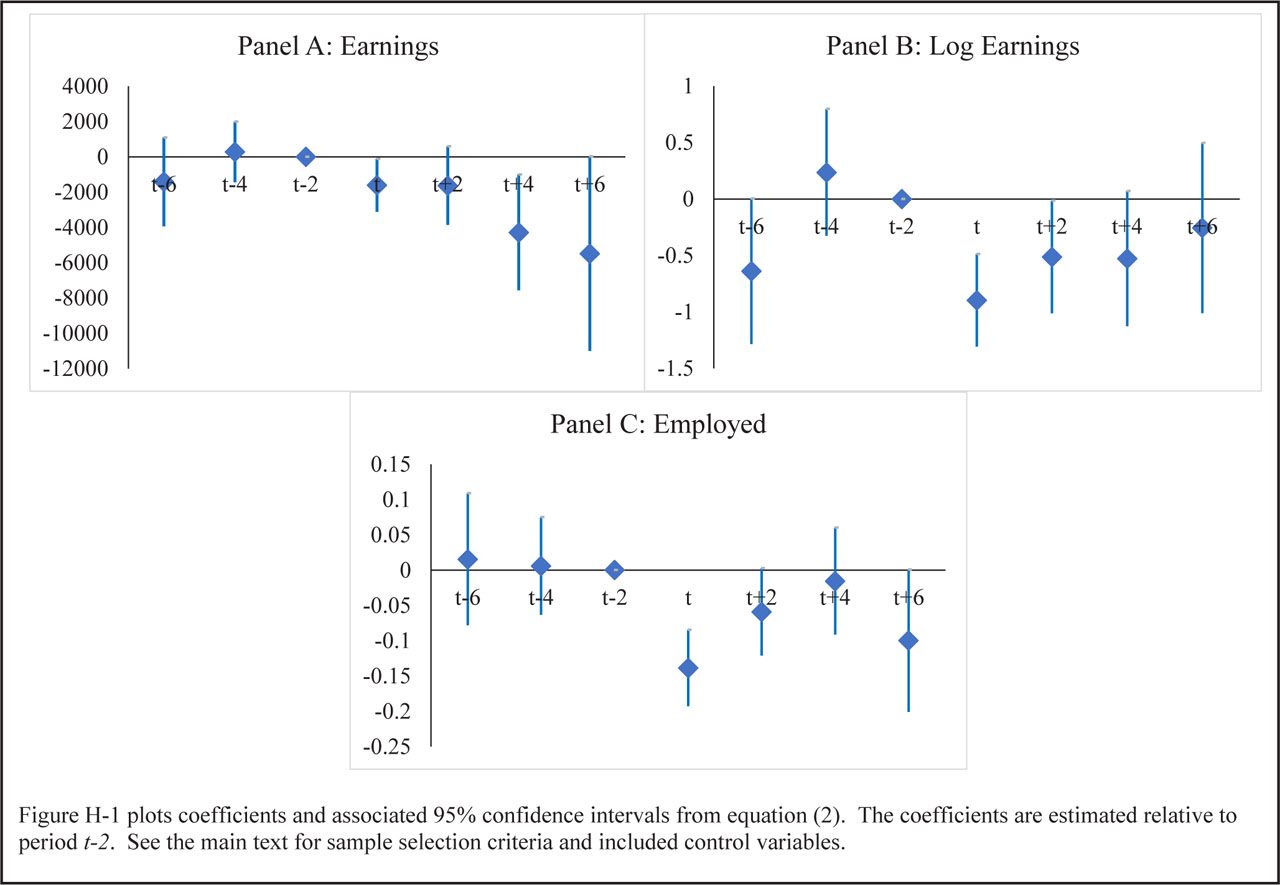
Figure H-1
Event History Analysis – Labor Market Outcomes.
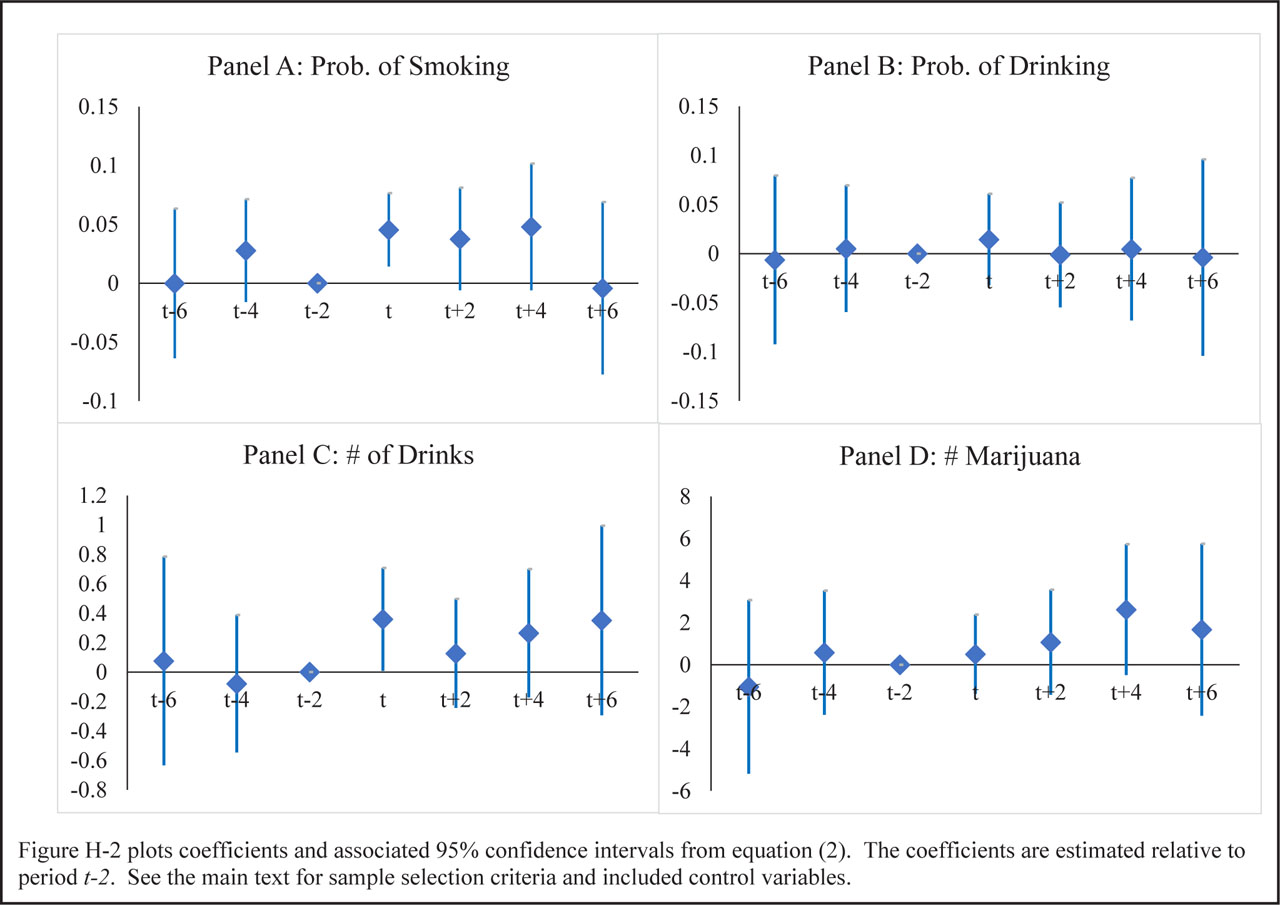
Figure H-2
Event History – Substance Use.