
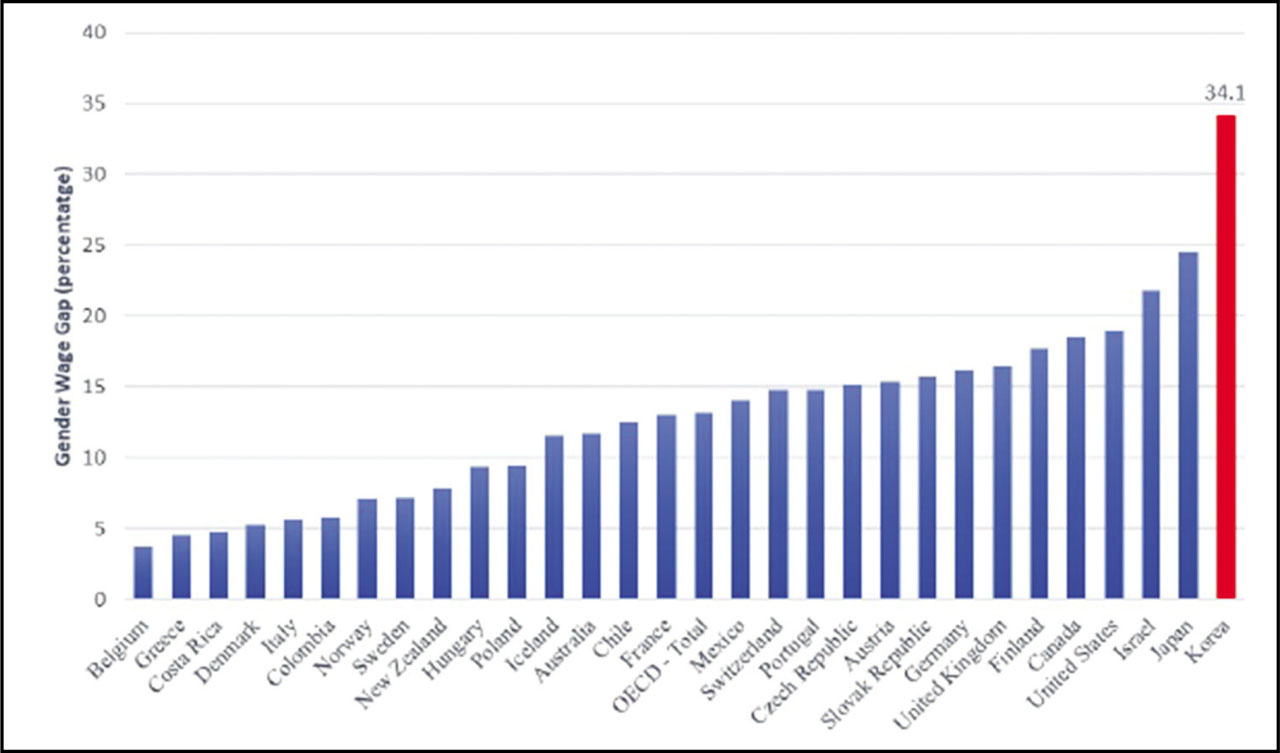
Figure 1
Gender Wage Gap in OECD Countries, 2018.
Source: OECD Database.
Notes: This figure shows the 2018 or latest gender wage gaps in OECD countries. The gender wage gap is defined as the difference between median earnings of full-time male and female workers. OECD, Organisation for Economic Co-operation and Development.
Table 1
Descriptive statistics
| Korean Labor and Income Panel Study | ||||
|---|---|---|---|---|
| 1998 | 2020 | |||
| Male | Female | Male | Female | |
| Age | 36.52 (8.73) | 33.56 (10.03) | 42.06 (10.65) | 40.39 (11.40) |
| Education | ||||
| Bachelor's degree | 0.24 (0.43) | 0.16 (0.37) | 0.40 (0.49) | 0.34 (0.48) |
| Advanced degree | 0.04 (0.21) | 0.01 (0.11) | 0.06 (0.23) | 0.05 (0.21) |
| Hours worked per month | 225.70 (55.39) | 214.15 (56.56) | 184.23 (33.74) | 177.58 (25.61) |
| Tenure | 6.41 (6.64) | 4.14 (5.01) | 9.09 (8.66) | 7.16 (6.86) |
| Union | 0.63 (0.48) | 0.59 (0.49) | 0.13 (0.34) | 0.11 (0.31) |
| Professional job | 0.12 (0.33) | 0.18 (0.38) | 0.21 (0.40) | 0.24 (0.43) |
| Married | 0.75 (0.44) | 0.52 (0.50) | 0.56 (0.50) | 0.50 (0.50) |
| Children | 0.72 (0.45) | 0.55 (0.50) | 0.54 (0.50) | 0.55 (0.50) |
| Log real monthly wages | 7.43 (0.46) | 6.97 (0.48) | 7.99 (0.45) | 7.68 (0.37) |
| No. of observations | 1,559 | 874 | 2,036 | 1,354 |
[i] Notes: Data are from the KLIPS in 1998 and 2020. The sample is restricted to full-time workers between the ages of 20 and 59 and those who are nonfarm, nonmilitary, wage, and salaried workers. Advanced degree includes master's and doctorate degrees. Professional jobs include science professionals, computer-related professionals, engineering science professionals, health and medical professionals, teaching professionals, administration, business and finance professionals, legal, social welfare, and religion professionals, and culture, arts, and broadcasting professionals in the 5th Korean Standard Classification of Occupations (KSCO). Monthly wages are adjusted to prices in 2015. Standard deviations are in parentheses.
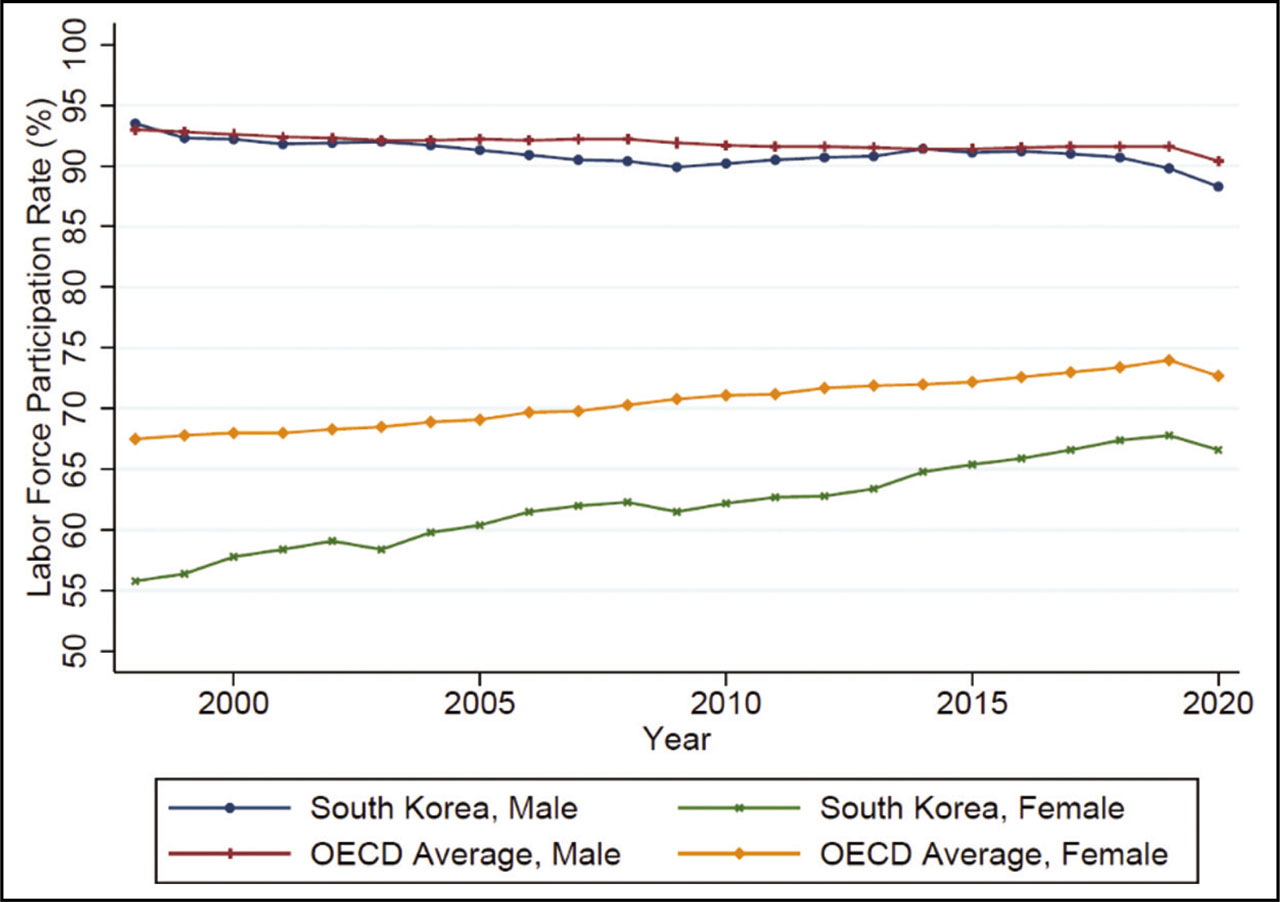
Figure 2
Labor Force Participation Rate (%).
Source: OECD.Stat.
Notes: Sample includes male and female workers aged 25–54 from 1998 to 2020. OECD, Organisation for Economic Co-operation and Development.
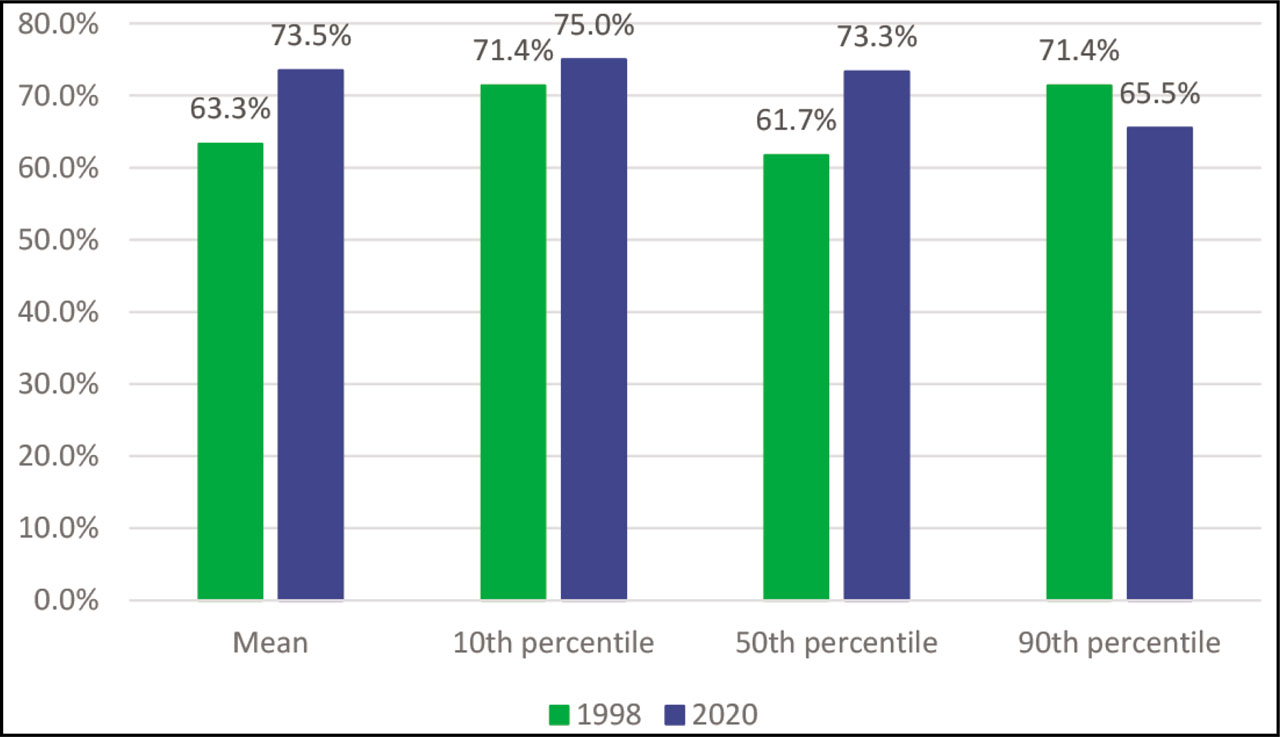
Figure 3
Female/Male Log Monthly Wage Ratios, Full-Time Workers.
Source: KLIPS.
Notes: Sample includes full-time male and female workers aged 20–59 years. They are non-farm, nonmilitary, and salaried workers. Each bar indicates exp(A), where A is the female mean log monthly wage, 10th, 50th, or 90th percentile log monthly wage minus the corresponding male log monthly wage for the year. KLIPS, Korean Labor and Income Panel Survey.
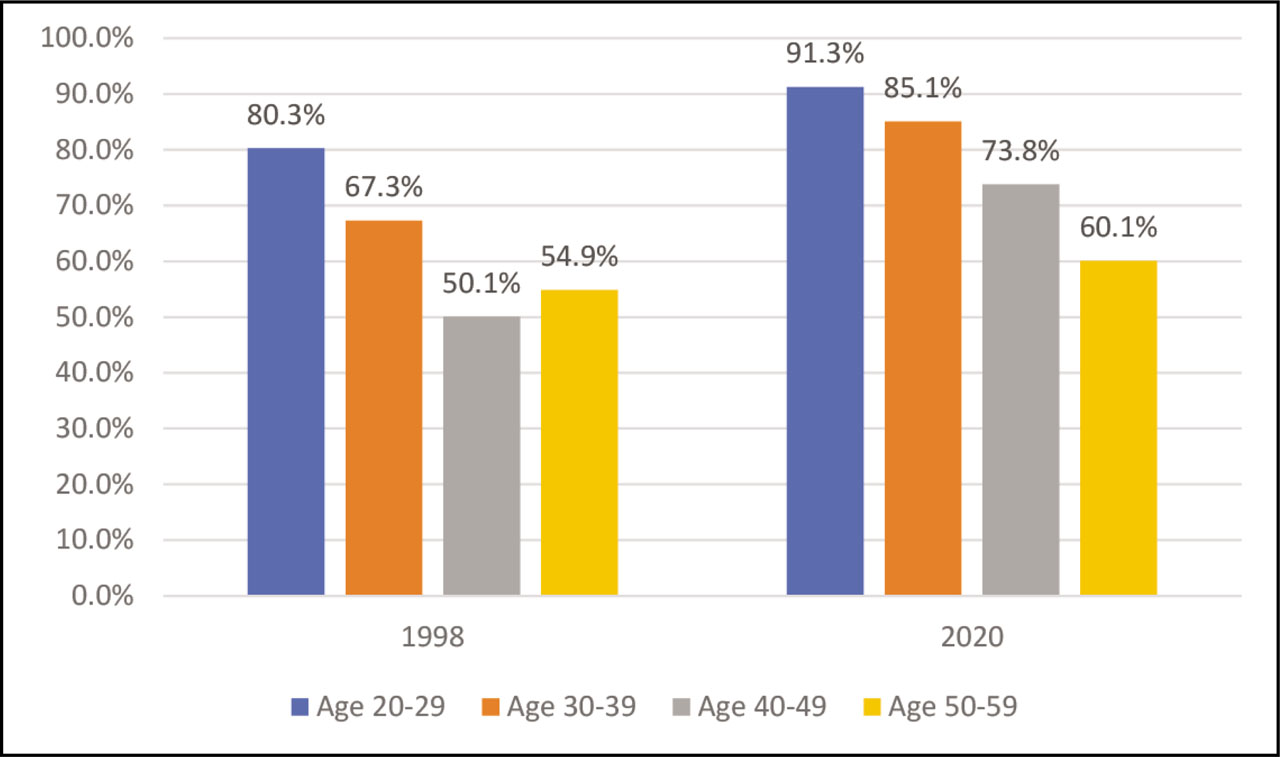
Figure 4
Gender Log Monthly Wage Gaps by Age Cohort, 1998 and 2020.
Source: KLIPS.
Notes: Each bar indicates exp(A), where A is the female mean log monthly wage minus the corresponding male log monthly wage for each age group and year. KLIPS, Korean Labor and Income Panel Survey.
Table 2
Share of marital status for full-time workers by age cohort (%)
| Age cohort | 1998 | 2020 | ||
|---|---|---|---|---|
| Male | Female | Male | Female | |
| 20–29 | 25.07 | 13.59 | 10.65 | 10.29 |
| 30–39 | 84.59 | 84.38 | 60.87 | 62.12 |
| 40–49 | 96.23 | 82.29 | 81.64 | 80.65 |
| 50–59 | 95.00 | 73.53 | 83.96 | 75.78 |
[i] Notes: Sample includes full-time male and female workers aged 20–59 years in 1998 and 2020. They are nonfarm, nonmilitary, and salaried workers. Entries indicate the ratio of married male or female workers to full-time male or female workers for each age group and year.
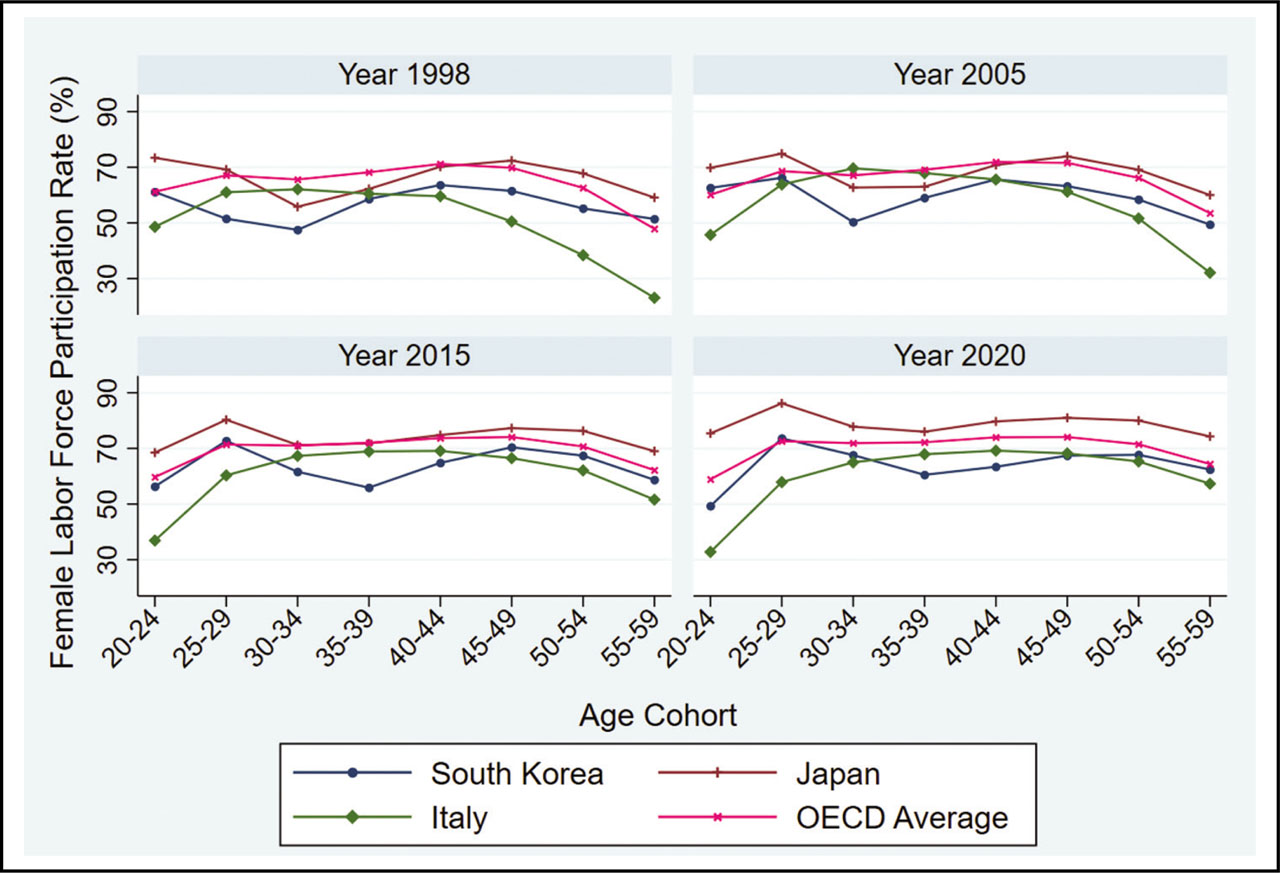
Figure 5
Female Labor Force Participation Rate by Age Cohort (%).
Source: OECD.Stat.
Notes: Sample data indicate female labor force participation rates by age cohort 20–59 for South Korea, Japan, Italy, and OECD in 1998, 2005, 2015, and 2020. OECD, Organisation for Economic Co-operation and Development.
Table 3
Decomposition of the gender wage gaps
| Variables | 1998 | 2020 | ||
|---|---|---|---|---|
| Log points | Percent of gender gap explained | Log points | Percent of gender gap explained | |
| Age | 0.1216 | 29.08 | 0.0171 | 5.06 |
| Education | 0.0162 | 3.88 | 0.0043 | 1.28 |
| Tenure | 0.0717 | 17.15 | 0.0326 | 9.66 |
| Hours of work | −0.0148 | −3.54 | 0.0135 | 4.01 |
| Unionization | −0.0001 | −0.02 | 0.0001 | 0.02 |
| Business size | 0.0187 | 4.47 | 0.0302 | 8.96 |
| Industry | −0.0220 | −5.27 | 0.0190 | 5.61 |
| Occupation | 0.0109 | 2.60 | −0.0054 | −1.60 |
| Total explained | 0.2021 | 48.34 | 0.1114 | 33.00 |
| Total unexplained | 0.2160 | 51.66 | 0.2262 | 67.00 |
| Total wage gap | 0.4181 | 100.00 | 0.3377 | 100.00 |
[i] Source: KLIPS.
[ii] Notes: Sample includes full-time male and female workers aged 20–59 in 1998 and 2020. They are nonfarm, nonmilitary, and salaried workers.
[iii] KLIPS, Korean Labor and Income Panel Survey.
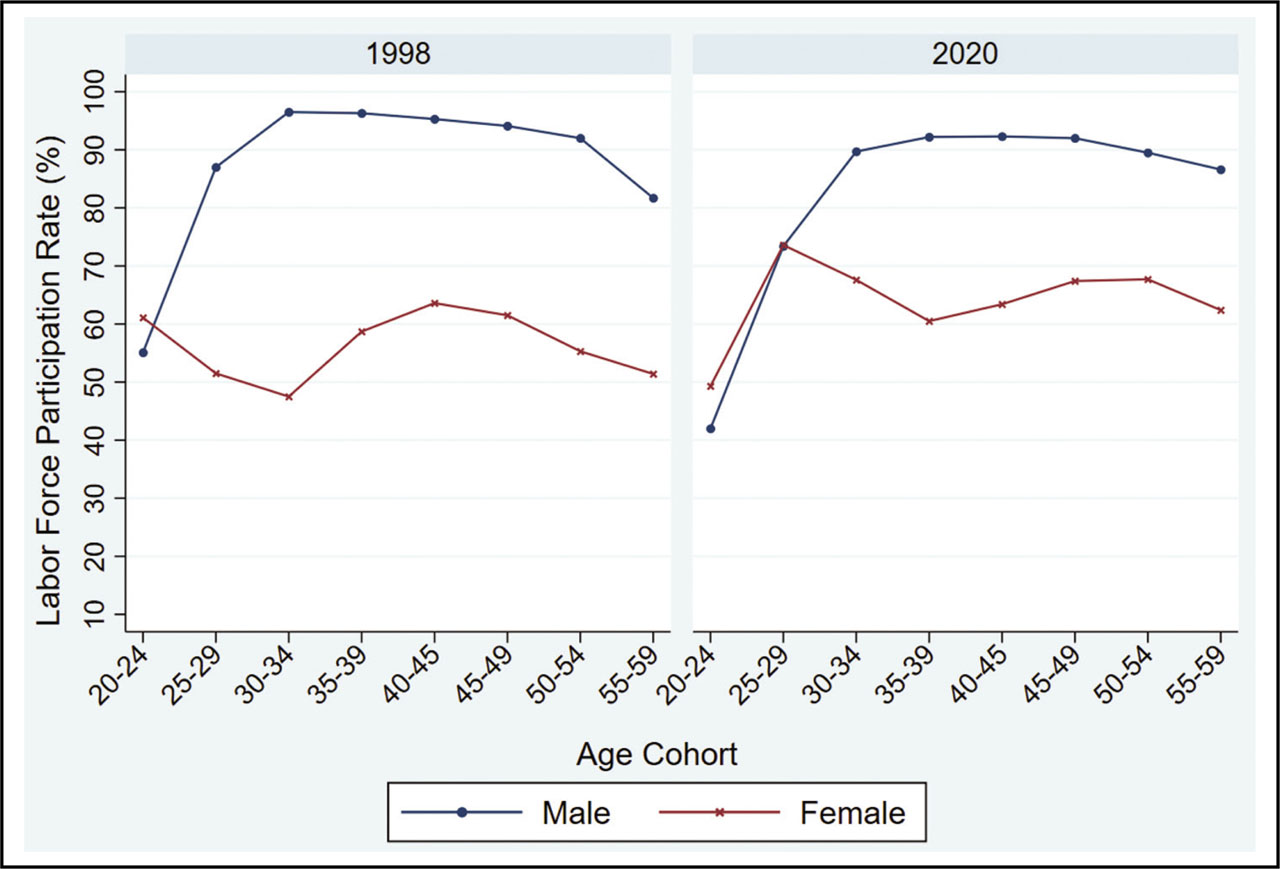
Figure 6
Male and Female Labor Force Participation Rates by Age Cohort (%).
Source: KOSIS.
Notes: Sample data indicate male and female labor force participation rates by age cohort 20–59 for South Korea in 1998 and 2020. KOSIS, Korean Statistical Information Service.
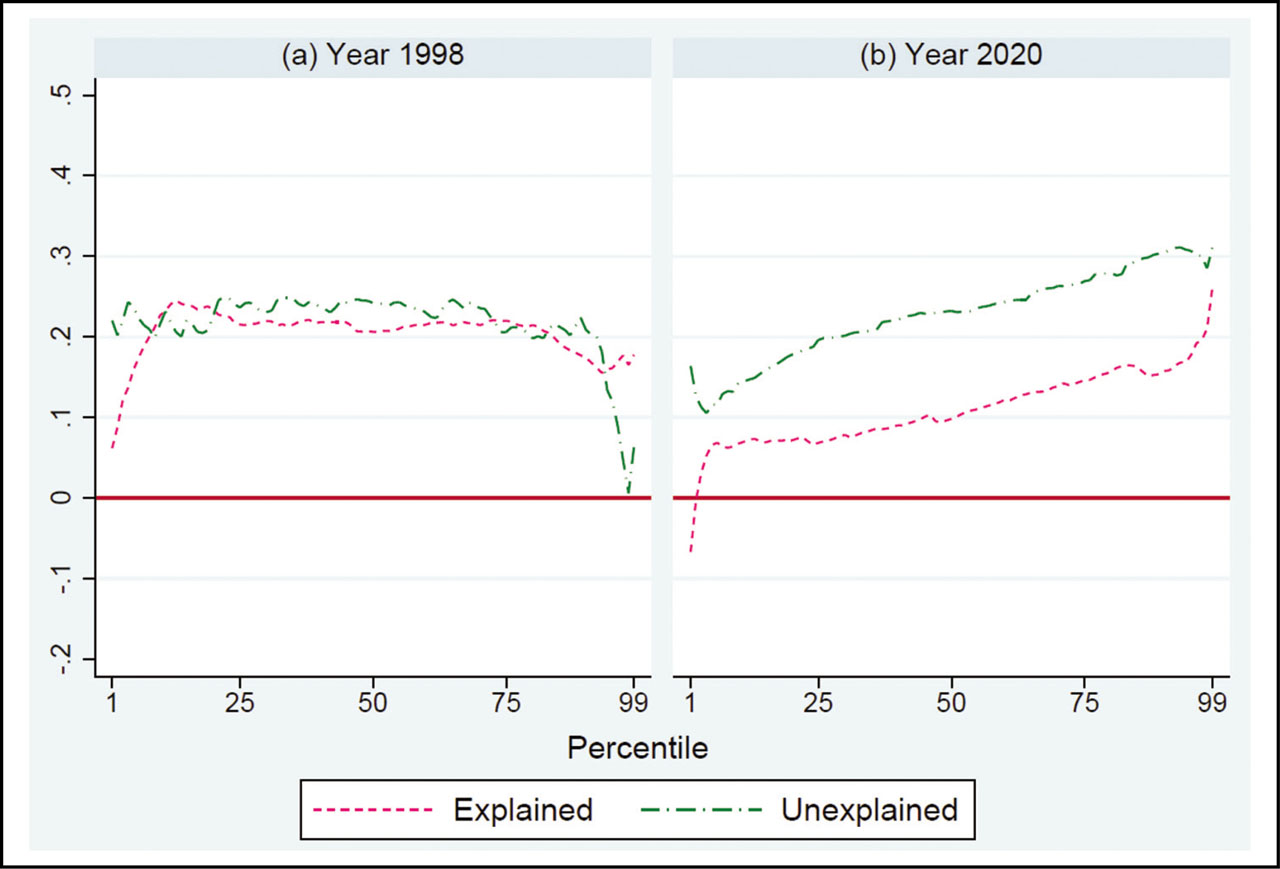
Figure 7
Quantile Decomposition of the Gender Wage Gap.
Source: KLIPS.
Notes: Sample includes full-time male and female workers aged 20–59 in 1998 and 2020. They are nonfarm, nonmilitary, and salaried workers. For (A) and (B), the red dashed lines plot the explained wage gap, and the green dotted lines show the unexplained wage gap. KLIPS, Korean Labor and Income Panel Survey.
Table 4
Average effects of marriage on labor market outcomes
| Log Monthly Wage (1) | Log Hourly Wage (2) | Log Hours of Work (3) | Labor Supply (4) | |
|---|---|---|---|---|
| Female | −0.151*** (0.006) | −0.158*** (0.007) | −0.046*** (0.004) | 0.062*** (0.005) |
| Married | 0.141*** (0.011) | 0.173*** (0.012) | 0.013* (0.007) | 0.436*** (0.015) |
| Female × Married | −0.089*** (0.017) | −0.117*** (0.018) | −0.006 (0.010) | −0.463*** (0.019) |
| Constant | 2.409*** (0.225) | 1.597*** (0.235) | 5.283*** (0.122) | 0.431*** (0.015) |
| Observations | 15,068 | 13,742 | 13,744 | 41,670 |
| R2 | 0.430 | 0.521 | 0.196 | 0.024 |
Source: KLIPS.
Notes: Sample data for the average effects of marriage on log monthly wage, log hourly wage, and log hours of work include full-time male and female workers aged 20–59. They are nonfarm, nonmilitary, and salaried workers. Married males and females in my sample consider only those who were married after 2000. The average effects of marriage on monthly wage, hourly wage, and working hours are estimated conditional on employment. For specifications (1)–(3), the full set of controls includes a quadratic in age, education, tenure with current workplace, union, year dummy, industry dummy, and occupation dummy. The effect of marriage on labor supply is estimated unconditional on employment status. In specification (4), the control includes year dummy. Standard errors in parentheses are clustered at the individual level.
Significance levels:
KLIPS, Korean Labor and Income Panel Survey.
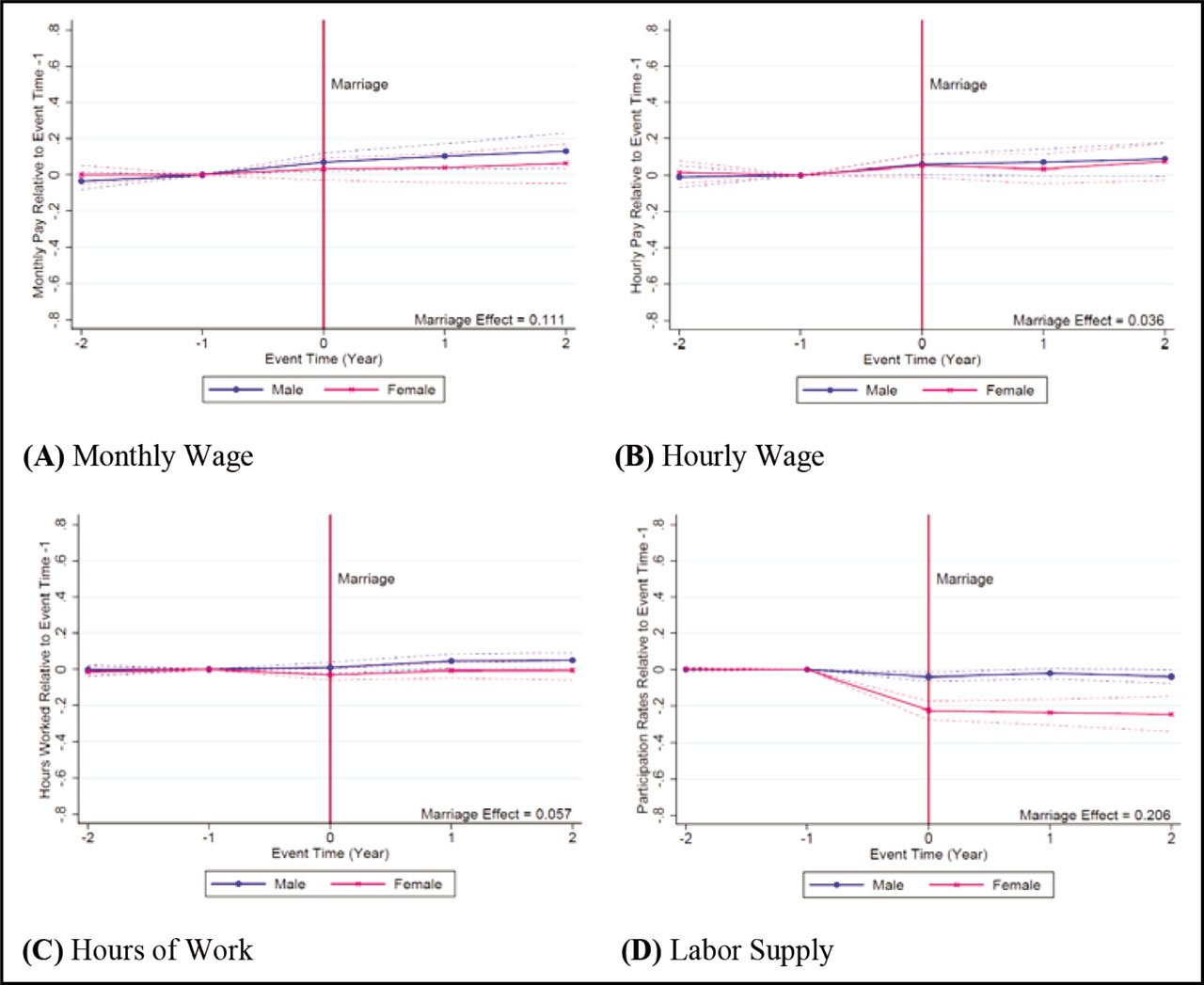
Figure 8
Impacts of Marriage.
Source: KLIPS.
Notes: Sample includes males and females who got married at any time after 2000. The marriage effect for each panel shows the percentage difference of the labor market outcome for females than for males and is estimated at event time 2 from Eq. (10). The results for monthly wages, hourly wage, and hours of work are estimated conditional on employment. The result for the labor supply is estimated unconditional on employment status. Thin dashed lines indicate 95% confidence intervals (CIs) based on robust standard errors. KLIPS, Korean Labor and Income Panel Survey.
Table 5
Average effects of children on labor market outcomes
| Log monthly wage (1) | Log hourly wage (2) | Log hours of work (3) | Labor supply (4) | |
|---|---|---|---|---|
| Female | −0.180*** (0.006) | −0.191*** (0.006) | −0.046*** (0.003) | 0.029*** (0.004) |
| Children | 0.160*** (0.005) | 0.172*** (0.006) | 0.016*** (0.003) | 0.374*** (0.004) |
| Female × Children | −0.238*** (0.007) | −0.238*** (0.008) | −0.041*** (0.004) | −0.490*** (0.006) |
| Constant | 2.154*** (0.116) | 1.544*** (0.122) | 5.448*** (0.062) | 0.420*** (0.007) |
| Observations | 39,821 | 35,802 | 35,807 | 112,205 |
| R2 | 0.598 | 0.647 | 0.174 | 0.131 |
Source: KLIPS.
Notes: Sample data for the average effects of children on log monthly wage, log hourly wage, and log hours of work include full-time male and female workers aged 20–59 years. They are nonfarm, nonmilitary, and salaried workers. In my sample, males and females with children include only those who experienced childbirth after 2000. The average effects of children on monthly wage, hourly wage, and working hours are estimated conditional on employment. For specifications (1)–(3), the full set of controls includes a quadratic in age, education, tenure with current workplace, union, year dummy, industry dummy, and occupation dummy. The average effect of children on labor supply is estimated unconditional on employment status. In specification (4), the control includes year dummy. Standard errors in parentheses are clustered at the individual level.
Significance levels:
KLIPS, Korean Labor and Income Panel Survey.
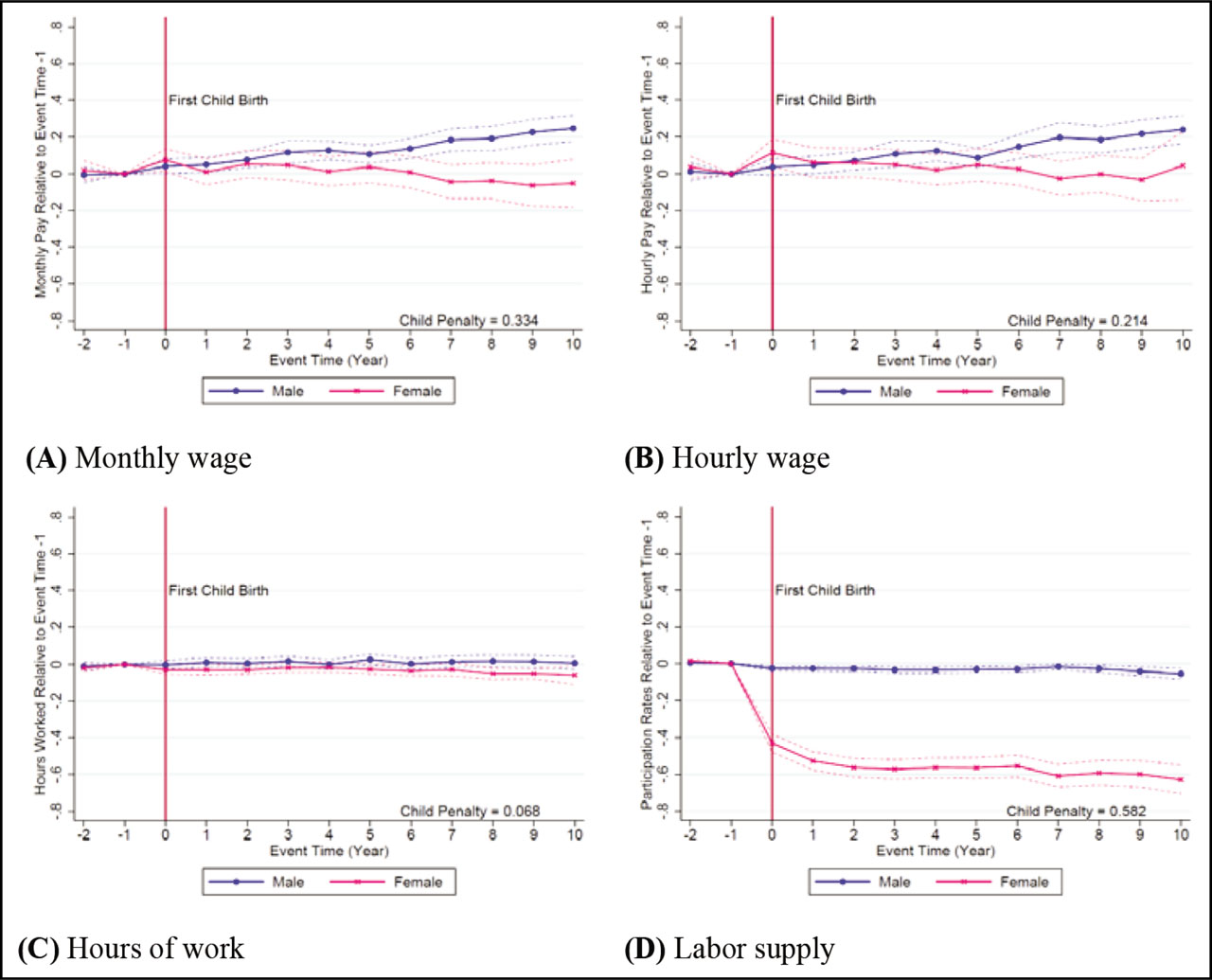
Figure 9
Impacts of Children.
Source: KLIPS.
Notes: Sample includes males and females who have their first childbirth at any time after 2000. The child penalty for each panel shows the percentage difference of the labor market outcome for females compared to males and is estimated at event time 10 from Eq. (10). The results for monthly wages, hourly wages, and hours of work are estimated conditional on employment. The result for the labor supply is estimated unconditional on employment status. Thin dashed lines indicate 95% CIs based on robust standard errors. CIs, confidence intervals; KLIPS, Korean Labor and Income Panel Survey.
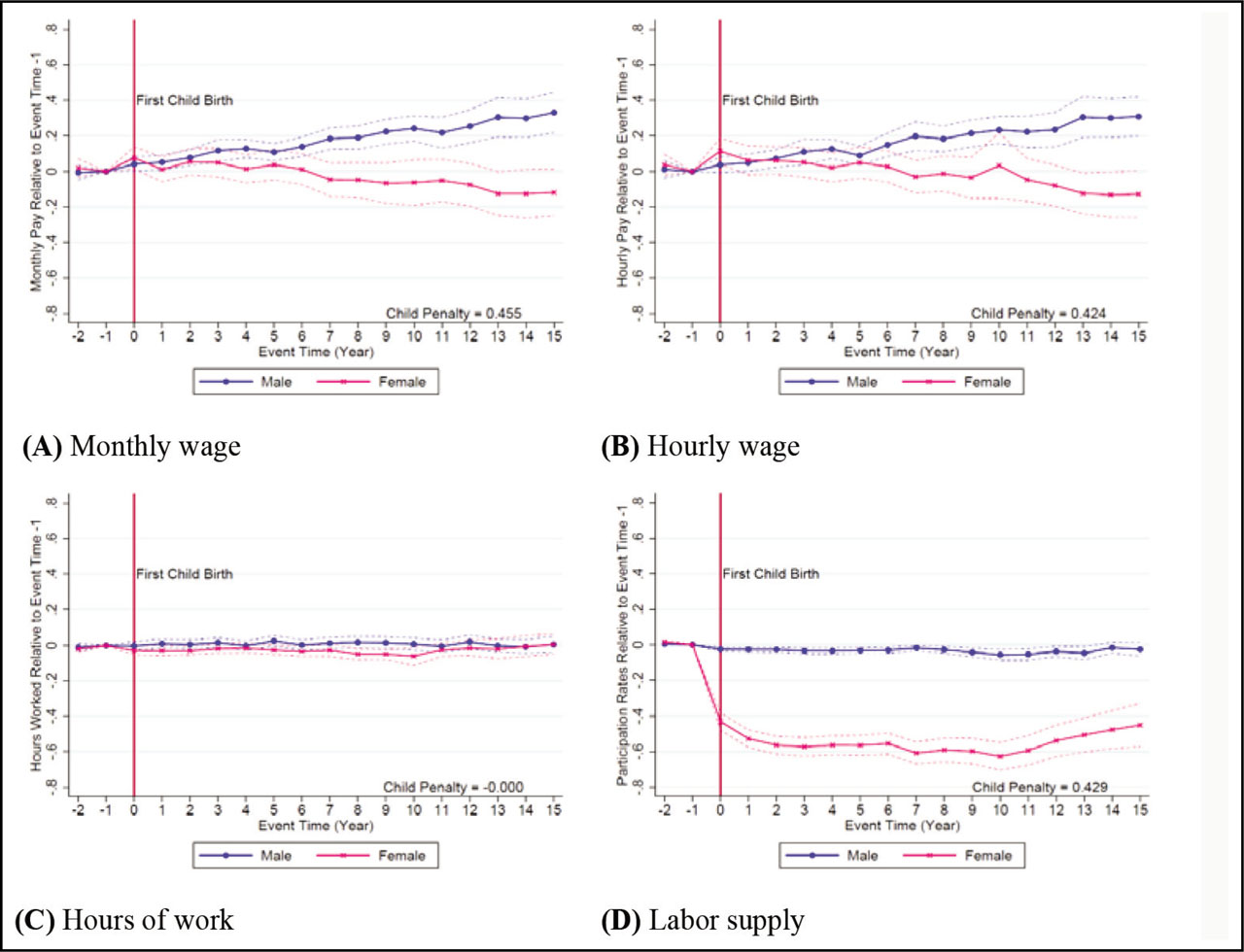
Figure A1
Impacts of Children in the Long Run.
Source: KLIPS.
Notes: This figure was created in the same way as Figure 9, but expands the event time to include 15 years after first childbirth. The child penalty for each panel shows the percentage difference of the labor market outcome for females compared to males and is estimated at event time 15 from Eq. (10). The results for the monthly wages, hourly wages, and hours of work are estimated conditional on employment. The result for the labor supply is estimated unconditional on employment status. Thin dashed lines indicate 95% CIs based on robust standard errors. CIs, confidence intervals; KLIPS, Korean Labor and Income Panel Survey.
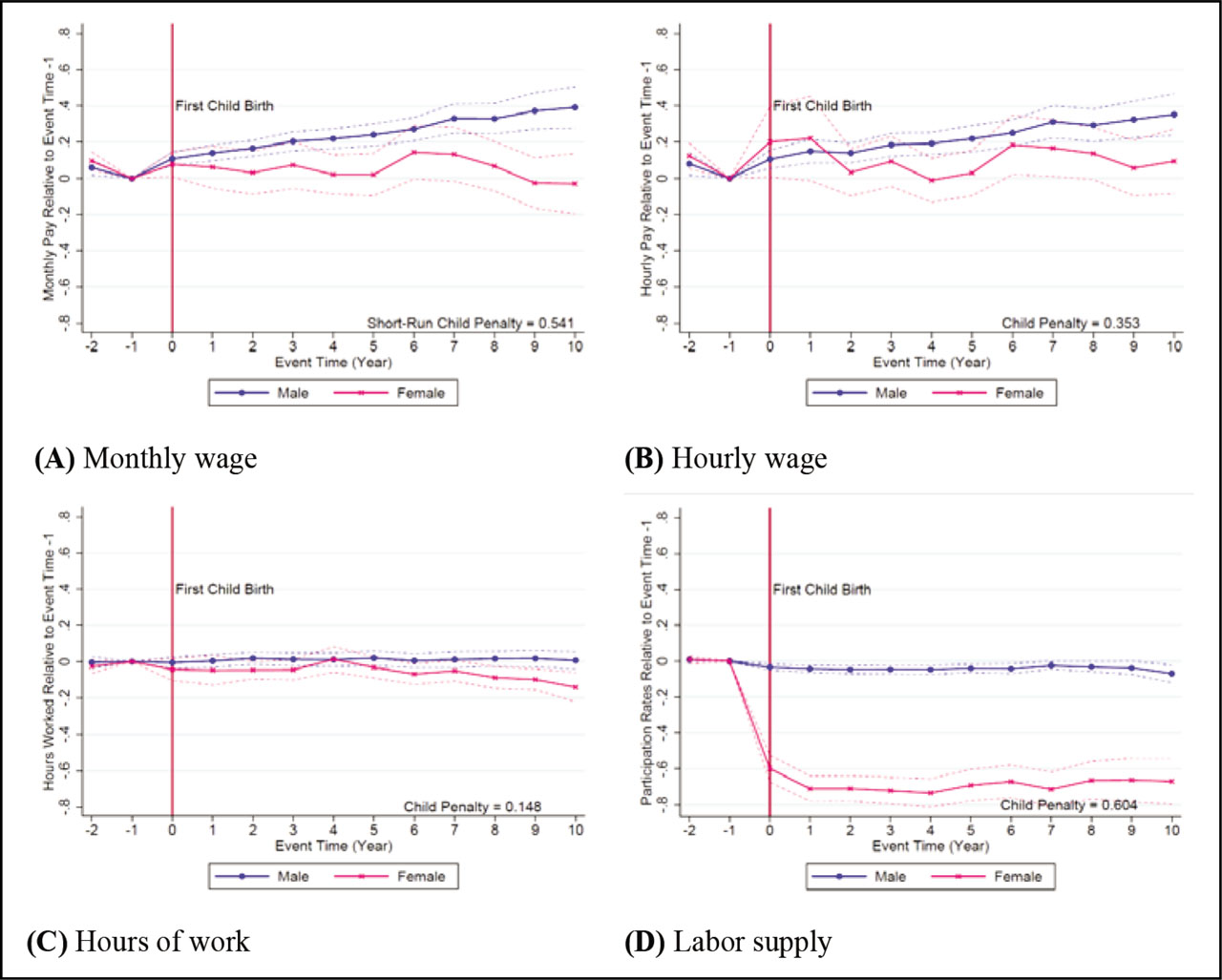
Figure A2
Impact of Children Below the 50th Percentile of the Wage Distribution.
Source: KLIPS.
Notes: This figure was created in the same way as Figure 9, but focuses only on those males and females whose monthly wages are below the 50th percentile of the wage distribution 1 year before marriage (t = −1). The child penalty for each panel shows the percentage difference of the labor market outcome for females compared to males and is estimated at event time 10 from Eq. (10). The results for the monthly wages, hourly wages, and hours of work are estimated conditional on employment. The result for the labor supply is estimated unconditional on employment status. Thin dashed lines indicate 95% CIs based on robust standard errors. CIs, confidence intervals; KLIPS, Korean Labor and Income Panel Survey.
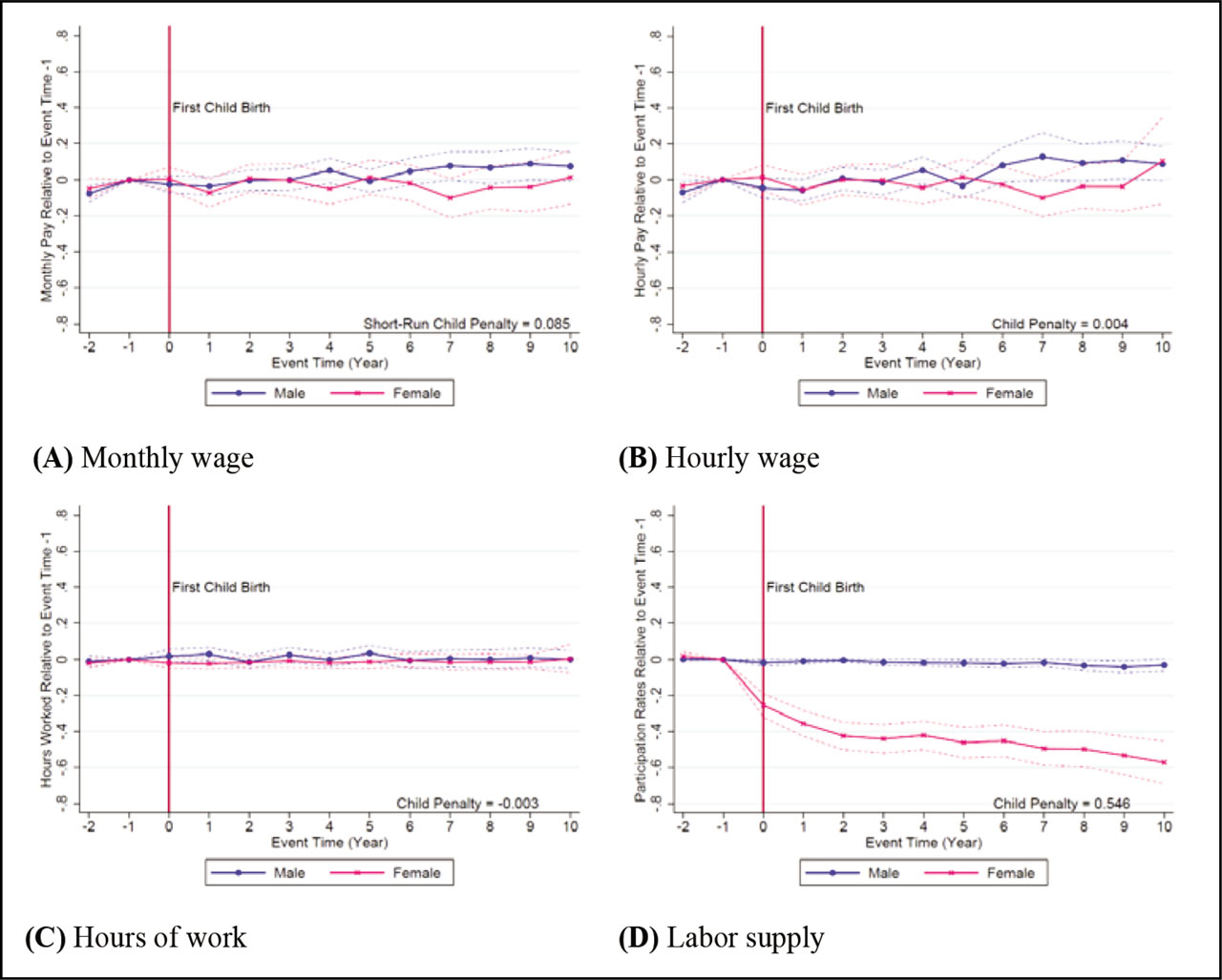
Figure A3
Impact of Children Above the 50th Percentile of the Wage Distribution.
Source: KLIPS.
Notes: This figure was created in the same way as Figure 9, but focuses only on those males and females whose monthly wages are above the 50th percentile of the wage distribution 1 year before marriage (t = −1). The child penalty for each panel shows the percentage difference of the labor market outcome for females compared to males and is estimated at event time 10 from Eq. (10). The results for the monthly wages, hourly wages, and hours of work are estimated conditional on employment. The result for the labor supply is estimated unconditional on employment status. Thin dashed lines indicate 95% CIs based on robust standard errors. CIs, confidence intervals; KLIPS, Korean Labor and Income Panel Survey.
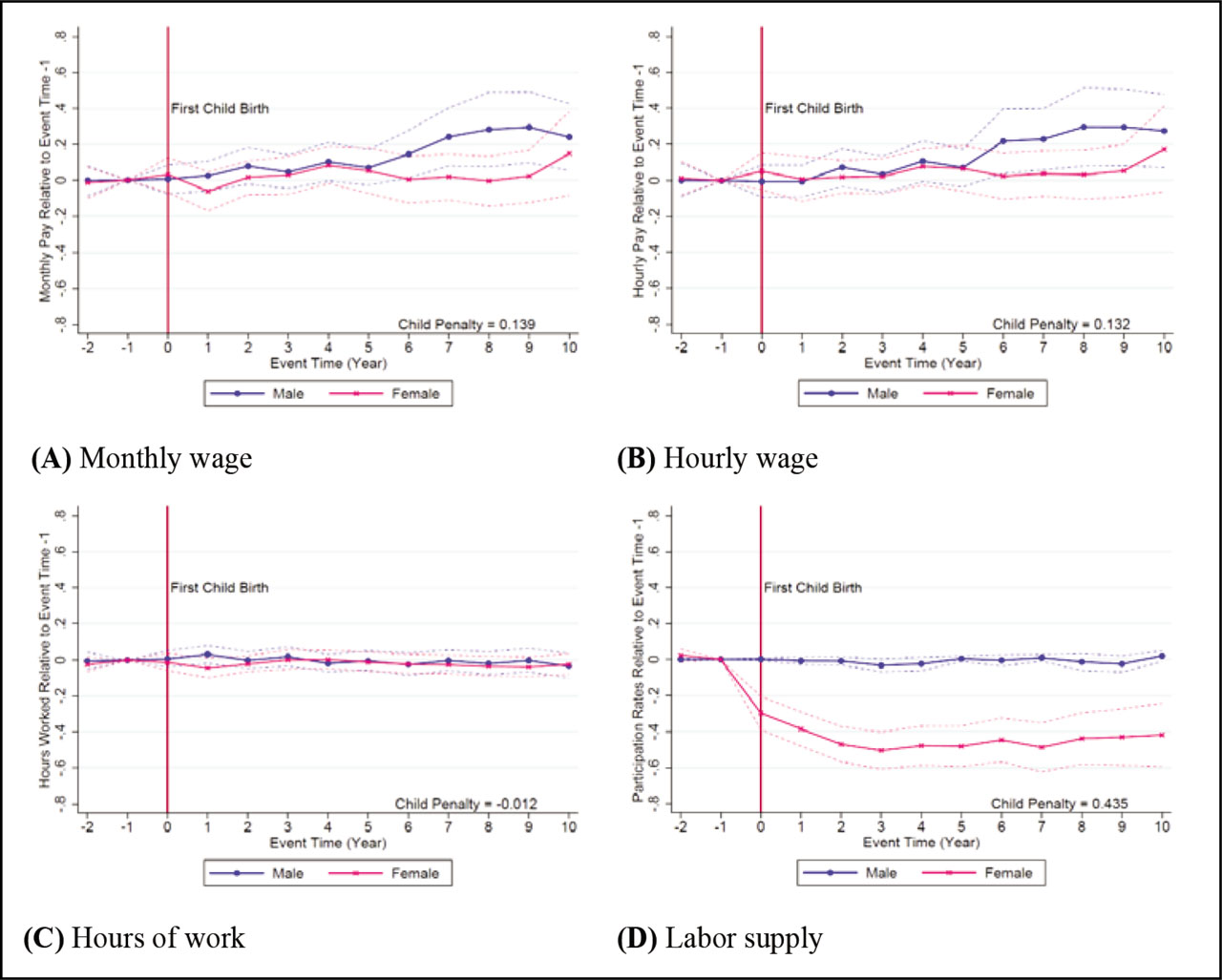
Figure A4
Impact of Children in Professional Occupations.
Source: KLIPS.
Notes: This figure was created in the same way as Figure 9, but focuses only on those males and females who work in professional occupations. Professional jobs include science professionals, computer-related professionals, engineering science professionals, health and medical professionals, teaching professionals, administration, business, and finance professionals, legal, social welfare, and religion professionals, and culture, arts, and broadcasting professionals in the 5th KSCO. The child penalty for each panel shows the percentage difference of the labor market outcome for females compared to males and is estimated at event time 10 from Eq. (10). The results for the monthly wages, hourly wages, and hours of work are estimated conditional on employment. The result for the labor supply is estimated unconditional on employment status. Thin dashed lines indicate 95% CIs based on robust standard errors. CIs, confidence intervals; KLIPS, Korean Labor and Income Panel Survey.
Table A1
Share of full-time male and female workers at wage distribution percentile (%)
| Percentile | 1998 | 2020 | ||
|---|---|---|---|---|
| Male | Female | Male | Female | |
| Below 10th percentile | 26.72 | 73.28 | 31.65 | 68.35 |
| Below 50th percentile | 46.86 | 53.14 | 39.63 | 60.37 |
| Above 90th percentile | 87.22 | 12.78 | 89.32 | 10.68 |
[i] Notes: Sample includes full-time male and female workers aged 20–59 in 1998 and 2020. They are nonfarm, nonmilitary, and salaried workers. Entries indicate the shares of full-time male and female workers who earn below the 10th percentile, below the 50th percentile, and above the 90th percentile of the total wage distribution.
Table A2
Share of marital status for full-time workers at wage distribution percentile (%)
| Percentile | 1998 | 2020 | ||
|---|---|---|---|---|
| Male | Female | Male | Female | |
| Below 10th percentile | 54.55 | 64.64 | 36.81 | 67.05 |
| Below 50th percentile | 57.84 | 48.85 | 44.70 | 60.65 |
| Above 90th percentile | 95.26 | 88.24 | 94.57 | 84.42 |
[i] Notes: Sample includes full-time male and female workers aged 20–59 in 1998 and 2020. They are nonfarm, nonmilitary, and salaried workers. Entries indicate the shares of full-time male and female workers who earn below the 10th percentile, below the 50th percentile, and above the 90th percentile of the total wage distribution.
Table A3
Share of full-time male and female workers by age cohort (%)
| Age cohort | 1998 | 2020 | ||
|---|---|---|---|---|
| Male | Female | Male | Female | |
| 20–29 | 49.28 | 50.72 | 42.58 | 57.42 |
| 30–39 | 74.34 | 25.66 | 62.91 | 37.09 |
| 40–49 | 65.90 | 34.10 | 65.90 | 34.10 |
| 50–59 | 70.18 | 29.82 | 59.67 | 40.33 |
[i] Notes: Sample includes full-time male and female workers aged 20–59 in 1998 and 2020. They are nonfarm, nonmilitary, and salaried workers. Entries indicate the shares of male and female workers among full-time workers for each age group and year.
Table A4
Log monthly wage and share of males and females by size of establishment
| No. of workers | 1998 | 2020 | ||||||
|---|---|---|---|---|---|---|---|---|
| Male | Female | Male | Female | |||||
| Log monthly wage | Share of full-time male workers (%) | Log monthly wage | Share of full-time female workers (%) | Log monthly wage | Share of full-time male workers (%) | Log monthly wage | Share of full-time female workers (%) | |
| 1–4 | 7.17 (0.40) | 49.62 | 6.77 (0.42) | 50.83 | 7.59 (0.41) | 45.28 | 7.48 (0.31) | 54.72 |
| 5–9 | 7.29 (0.34) | 56.82 | 6.90 (0.37) | 43.18 | 7.75 (0.43) | 49.52 | 7.57 (0.26) | 50.48 |
| 10–29 | 7.38 (0.42) | 62.19 | 6.85 (0.33) | 37.81 | 7.95 (0.31) | 57.19 | 7.58 (0.27) | 42.81 |
| 30–49 | 7.35 (0.45) | 70.39 | 6.89 (0.33) | 29.61 | 7.97 (0.40) | 66.66 | 7.68 (0.33) | 33.34 |
| 50–69 | 7.39 (0.45) | 70.09 | 6.95 (0.52) | 29.91 | 8.03 (0.35) | 53.25 | 7.70 (0.30) | 46.75 |
| 70–99 | 7.40 (0.42) | 72.86 | 6.86 (0.27) | 27.14 | 7.91 (0.39) | 55.68 | 7.80 (0.36) | 44.32 |
| 100–299 | 7.39 (0.51) | 74.07 | 7.03 (0.46) | 25.93 | 8.11 (0.33) | 47.65 | 7.78 (0.30) | 52.35 |
| 300–499 | 7.54 (0.43) | 66.27 | 6.98 (0.30) | 33.73 | 8.15 (0.28) | 58.16 | 7.78 (0.18) | 41.84 |
| 500–999 | 7.50 (0.38) | 67.55 | 7.19 (0.37) | 32.45 | 8.32 (0.43) | 65.16 | 7.72 (0.29) | 34.84 |
| over 1,000 | 7.65 (0.41) | 69.82 | 7.12 (0.56) | 30.18 | 8.33 (0.43) | 65.03 | 7.90 (0.50) | 34.97 |
[i] Source: KLIPS.
[ii] Notes: Sample includes full-time male and female workers aged 20–59 years. They are nonfarm, nonmilitary, and salaried workers. The size of the establishment is categorized into 10 sectors, based on the number of workers: 1–4, 5–9, 10–29, 30–49, 50–69, 70–99, 100–299, 300–499, 500–999, and over 1,000. Standard deviations are in parentheses.
[iii] KLIPS, Korean Labor and Income Panel Survey.
Table A5
Share of full-time male and female workers in professional jobs (%)
| 1998 | 2020 | |||
|---|---|---|---|---|
| Male | Female | Male | Female | |
| Professional jobs | 55.83 | 44.17 | 50.67 | 49.33 |
| Male professional jobs | 62.41 | 37.59 | 58.81 | 41.19 |
[i] Source: KLIPS.
[ii] Notes: Sample includes full-time male and female workers aged 20–59 years in 1998 and 2020. Each entry indicates the share of full-time male and female workers in each category. Professional jobs include science professionals, computer-related professionals, engineering science professionals, health and medical professionals, teaching professionals, administration, business and finance professionals, legal, social welfare, and religion professionals, and culture, arts, and broadcasting professionals in the 5th KSCO. Male professional jobs are professional jobs excluding teaching professionals. KLIPS, Korean Labor and Income Panel Survey.