
Table 1
Descriptive statistics
| First wave of COVID-19 | Second wave of COVID-19 | |||||||
|---|---|---|---|---|---|---|---|---|
| Mean | Std. Dev. | Min | Max | Mean | Std. Dev. | Min | Max | |
| Panel (A) Women cohabiting with a partner during the first and second waves of COVID-19a | ||||||||
| Age | 44.79 | 9.12 | 26 | 64 | 45.04 | 9.22 | 26 | 65 |
| Have a degree | 0.48 | 0.50 | 0 | 1 | 0.44 | 0.50 | 0 | 1 |
| North | 0.57 | 0.50 | 0 | 1 | 0.56 | 0.50 | 0 | 1 |
| Centre | 0.19 | 0.39 | 0 | 1 | 0.19 | 0.39 | 0 | 1 |
| South | 0.24 | 0.43 | 0 | 1 | 0.25 | 0.43 | 0 | 1 |
| Have children | 0.67 | 0.47 | 0 | 1 | 0.66 | 0.47 | 0 | 1 |
| Have children aged 0–5 years | 0.20 | 0.40 | 0 | 1 | 0.20 | 0.40 | 0 | 1 |
| Have children aged 6–10 years | 0.21 | 0.41 | 0 | 1 | 0.21 | 0.41 | 0 | 1 |
| Women's hours of paid work | 22.89 | 15.75 | 0 | 50 | 25.21 | 15.50 | 0 | 50 |
| Working at the usual workplace | 0.21 | 0.41 | 0 | 1 | 0.59 | 0.49 | 0 | 1 |
| Working from home | 0.45 | 0.50 | 0 | 1 | 0.25 | 0.43 | 0 | 1 |
| Not working or other | 0.34 | 0.47 | 0 | 1 | 0.16 | 0.37 | 0 | 1 |
| Panel (B) Women with children cohabiting with a partner during the first and second waves of COVID-19b | ||||||||
| Age | 45.60 | 8.57 | 26 | 64 | 45.50 | 8.63 | 26 | 64 |
| Have a degree | 0.49 | 0.50 | 0 | 1 | 0.46 | 0.50 | 0 | 1 |
| North | 0.55 | 0.50 | 0 | 1 | 0.54 | 0.50 | 0 | 1 |
| Centre | 0.18 | 0.38 | 0 | 1 | 0.19 | 0.39 | 0 | 1 |
| South | 0.27 | 0.44 | 0 | 1 | 0.27 | 0.45 | 0 | 1 |
| Have children aged 0–5 years | 0.30 | 0.46 | 0 | 1 | 0.30 | 0.46 | 0 | 1 |
| Have children aged 6–10 years | 0.31 | 0.46 | 0 | 1 | 0.33 | 0.47 | 0 | 1 |
| Women's hours of paid work | 22.53 | 15.29 | 0 | 50 | 24.61 | 15.05 | 0 | 50 |
| Working at the usual workplace | 0.22 | 0.42 | 0 | 1 | 0.60 | 0.49 | 0 | 1 |
| Working from home | 0.44 | 0.50 | 0 | 1 | 0.24 | 0.43 | 0 | 1 |
| Not working or other | 0.34 | 0.47 | 0 | 1 | 0.16 | 0.37 | 0 | 1 |
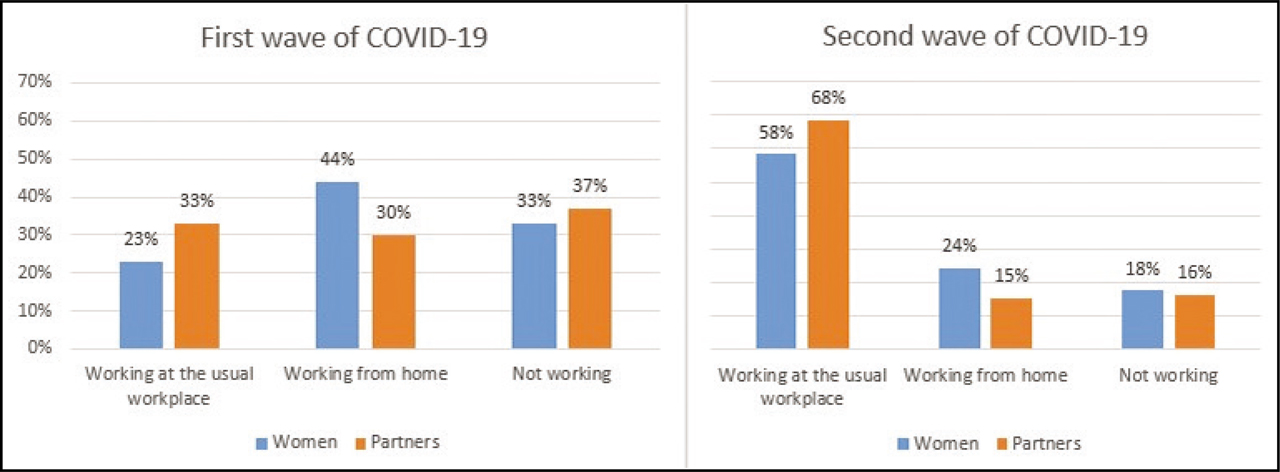
Figure 1
Working arrangements during the first and second waves of COVID-19.
Notes: Percentage of working women and their partners by working arrangement in April and November 2020.
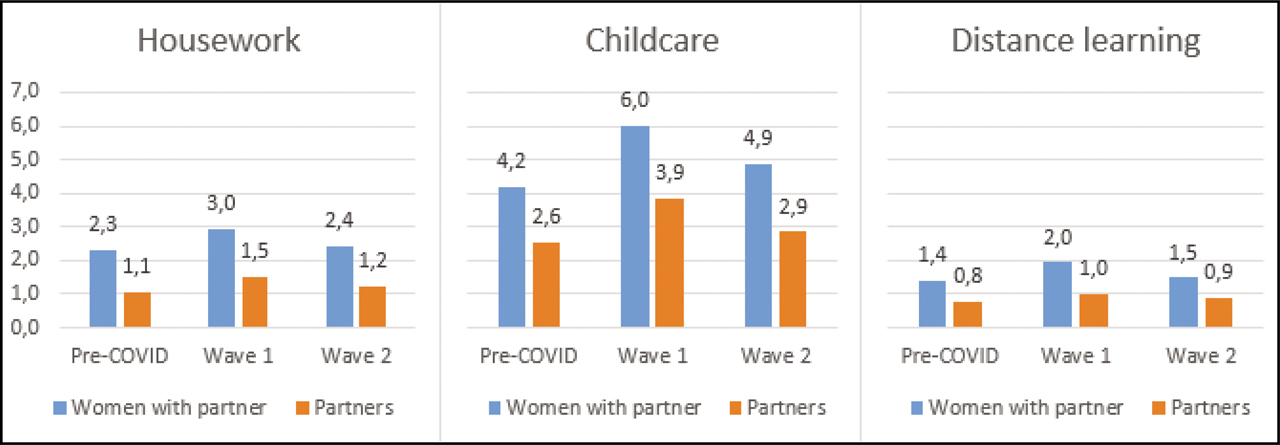
Figure 2
Hours of housework, childcare, and devoted to children's distance learning before the emergency, during the first and second waves of COVID-19.
Notes: The sample in the first panel is made up of women cohabiting with a partner. The sample in the second and third panels is made up of women with children cohabiting with a partner.
Table 2
Hours of housework and childcare during the first and second waves of COVID-19
| Partners working at the usual workplace | Partners working from home | Partners not working | |
|---|---|---|---|
| Panel (A) Men and women's hours of housework during the first wave of COVID-19 by working arrangementa | |||
| Women working at the usual workplace | Women 3.14 | Women 2.47 | Women 2.30 |
| Partners 2.19 | Partners 2 | Partners 1.33 | |
| Difference 0.95*** | Difference 0.47 | Difference 0.96*** | |
| N = 42 | N = 15 | N = 27 | |
| Women working from home | Women 2.52 | Women 3.03 | Women 2.96 |
| Partners 1.26 | Partners 1.57 | Partners 1.57 | |
| Difference 1.26*** | Difference 1.46*** | Difference 1.38*** | |
| N = 50 | N = 87 | N = 47 | |
| Women not working | Women 4.03 | Women 2.38 | Women 3.30 |
| Partners 1.46 | Partners 1.38 | Partners 1.54 | |
| Difference 2.57*** | Difference 1 | Difference 1.75*** | |
| N = 35 | N = 21 | N = 81 | |
| Panel (B) Men and women's hours of housework during the second wave of COVID-19 by working arrangementb | |||
| Women working at the usual workplace | Women 2.31 | Women 2.92 | Women 2.35 |
| Partners 1.17 | Partners 1.40 | Partners 1.52 | |
| Difference 1.14*** | Difference 1.52*** | Difference 0.84** | |
| N = 241 | N = 25 | N = 31 | |
| Women working from home | Women 2.56 | Women 2.82 | Women 1.91 |
| Partners 0.75 | Partners 1.43 | Partners 1.30 | |
| Difference 1.81*** | Difference 1.39*** | Difference 0.61** | |
| N = 57 | N = 44 | N = 23 | |
| Women not working | Women 2.53 | Women 1 | Women 2.68 |
| Partners 1.04 | Partners 3.37 | Partners 1.43 | |
| Difference 1.49*** | Difference −2.37 | Difference 1.25*** | |
| N = 47 | N = 8 | N = 28 | |
| Panel (C) Men and women's hours of childcare during the first wave of COVID-19 by working arrangementc | |||
| Women working at the usual workplace | Women 4.34 | Women 2.5 | Women 3.38 |
| Partners 3.91 | Partners 2.25 | Partners 2.67 | |
| Difference 0.44 | Difference 0.25 | Difference 0.71* | |
| N = 32 | N = 8 | N = 21 | |
| Women working from home | Women 2.87 | Women 5.91 | Women 6.87 |
| Partners 1.72 | Partners 4.40 | Partners 5.27 | |
| Difference 1.16** | Difference 1.51* | Difference 1.6*** | |
| N = 32 | N = 57 | N = 30 | |
| Women not working | Women 8.23 | Women 10.92 | Women 6.65 |
| Partners 3.46 | Partners 7.15 | Partners 4.74 | |
| Difference 4.77*** | Difference 3.77** | Difference 1.91*** | |
| N = 26 | N = 13 | N = 54 | |
| Panel (D) Men and women's hours of childcare during the second wave of COVID-19 by working arrangementd | |||
| Women working at the usual workplace | Women 3.59 | Women 4.56 | Women 3,.3 |
| Partners 2.18 | Partners 3.44 | Partners 3,.4 | |
| Difference 1.41*** | Difference 1.12** | Difference −0.1 | |
| N = 162 | N = 16 | N = 20 | |
| Women working from home | Women 5.85 | Women 5.86 | Women 5 |
| Partners 2.92 | Partners 4.03 | Partners 4.46 | |
| Difference 2.92*** | Difference 1.83*** | Difference 0.54 | |
| N = 39 | N = 29 | N = 13 | |
| Women not working | Women 8.90 | Women 13.2 | Women 5.58 |
| Partners 2.86 | Partners 6.4 | Partners 3.63 | |
| Difference 6.03*** | Difference 6.8 | Difference 0.98* | |
| N = 29 | N = 5 | N = 19 | |
Notes:
Table 3
Multivariate regression model of hours spent on housework by women and their partners during the first and second waves of COVID-19
| (1) | (2) | (3) | (4) | |
|---|---|---|---|---|
| Hours spent on housework by women during the lockdown | Hours spent on housework by partners during the lockdown | Hours spent on housework by women during the second wave of COVID-19 | Hours spent on housework by partners during the second wave of COVID-19 | |
| Women's age | 0.001 (0.011) | −0.032*** (0.012) | 0.009 (0.009) | −0.026*** (0.009) |
| Women having a degree | 0.085 (0.189) | 0.144 (0.196) | −0.129 (0.155) | −0.041 (0.157) |
| Women having children | 0.428* (0.233) | 0.000 (0.242) | 0.404** (0.185) | 0.254 (0.188) |
| Having children aged 0–5 years | 0.178 (0.268) | 0.167 (0.278) | −0.138 (0.218) | −0.142 (0.221) |
| Having children aged 6–10 years | 0.041 (0.245) | 0.188 (0.255) | 0.160 (0.200) | −0.074 (0.203) |
| Centre | −0.047 (0.235) | −0.010 (0.244) | −0.043 (0.196) | 0.162 (0.198) |
| South | 1.135*** (0.221) | 0.045 (0.229) | 0.875*** (0.178) | 0.304* (0.181) |
| Women's hours of paid work | 0.002 (0.007) | −0.004 (0.007) | −0.014** (0.007) | 0.005 (0.007) |
| Women working from home | 0.045 (0.247) | −0.418 (0.256) | 0.040 (0.190) | −0.350* (0.193) |
| Women not working | 0.583** (0.280) | −0.507* (0.291) | −0.297 (0.300) | 0.168 (0.304) |
| Partner working from home | −0.297 (0.238) | −0.043 (0.247) | 0.285 (0.221) | 0.707*** (0.224) |
| Partner not working | −0.198 (0.221) | −0.048 (0.229) | −0.202 (0.212) | 0.469** (0.215) |
| Constant | 2.209*** (0.614) | 3.351*** (0.637) | 1.976*** (0.490) | 1.917*** (0.497) |
| Observations | 405 | 405 | 504 | 504 |
| R-squared | 0.115 | 0.047 | 0.092 | 0.047 |
Notes:
Coefficient estimates from OLS regressions. The sample is made up of women cohabiting with a partner. The baseline category for working arrangements is “working at the usual workplace.” During the lockdown, the average hours spent on housework by women are 3.01 and the average hours spent on housework by men are 1.57. During the second wave of COVID-19, the average hours spent on housework by women are 2.42 and the average hours spent on housework by men are 1.22. Standard errors in parentheses.
Table 4
Multivariate regression model of hours spent on childcare by women and their partners during the first and second waves of COVID-19
| (1) | (2) | (3) | (4) | |
|---|---|---|---|---|
| Hours spent on childcare by women during the lockdown | Hours spent on childcare by partners during the lockdown | Hours spent on childcare by women during the second wave of COVID-19 | Hours spent on childcare by partners during the second wave of COVID-19 | |
| Women's age | −0.033 (0.053) | −0.069 (0.052) | −0.093** (0.040) | −0.083** (0.033) |
| Women having a degree | 0.443 (0.728) | 0.037 (0.721) | 0.621 (0.549) | 0.473 (0.451) |
| Having children aged 0–5 years | 4.041*** (0.933) | 2.648*** (0.924) | 3.784*** (0.700) | 1.611*** (0.575) |
| Having children aged 6–10 years | 2.165*** (0.806) | 0.978 (0.799) | −0.114 (0.604) | −0.116 (0.496) |
| Centre | −1.366 (0.928) | −1.810* (0.919) | −0.155 (0.698) | −0.455 (0.574) |
| South | 1.431* (0.819) | 0.583 (0.811) | 0.720 (0.622) | 0.847* (0.511) |
| Women's hours of paid work | −0.012 (0.026) | −0.013 (0.025) | −0.019 (0.025) | 0.020 (0.020) |
| Women working from home | 0.590 (0.945) | −0.058 (0.936) | 1.444** (0.676) | 0.482 (0.556) |
| Women not working | 2.635** (1.045) | 0.218 (1.036) | 3.079*** (1.075) | 0.713 (0.884) |
| Partner working from home | 0.802 (0.935) | 1.291 (0.927) | 0.469 (0.793) | 1.192* (0.651) |
| Partner not working | 0.856 (0.830) | 1.512* (0.823) | −0.397 (0.761) | 1.640*** (0.626) |
| Constant | 3.641 (2.927) | 5.548* (2.901) | 7.149*** (2.149) | 4.660*** (1.766) |
| Observations | 273 | 273 | 332 | 332 |
| R-squared | 0.222 | 0.126 | 0.285 | 0.147 |
Notes:
Coefficient estimates from OLS regressions. The sample is made up of women with children cohabiting with a partner. The baseline category for working arrangements is “working at the usual workplace.” During the lockdown, the average hours spent on childcare by women are 5.79 and the average hours spent on childcare by men are 4.04. During the second wave of COVID-19, the average hours spent on childcare by women are 4.86 and the average hours spent on childcare by men are 2.86. Standard errors in parentheses.
Table 5
Multivariate regression model of hours spent on helping children in distance learning by women and their partners during the first and second waves of COVID-19
| (1) | (2) | (3) | (4) | |
|---|---|---|---|---|
| Hours spent on distance learning by women during the lockdown | Hours spent on distance learning by partners during the lockdown | Hours spent on distance learning by women during the second wave of COVID-19 | Hours spent on distance learning by partners during the second wave of COVID-19 | |
| Women's age | −0.003 (0.018) | −0.026 (0.016) | −0.038*** (0.015) | −0.038*** (0.013) |
| Women having a degree | −0.005 (0.247) | 0.042 (0.221) | −0.005 (0.203) | 0.143 (0.175) |
| Having children aged 0–5 years | −0.025 (0.317) | −0.020 (0.284) | −0.027 (0.258) | −0.058 (0.223) |
| Having children aged 6–10 years | 1.719*** (0.274) | 0.511** (0.245) | 0.705*** (0.223) | 0.204 (0.192) |
| Centre | 0.141 (0.315) | 0.172 (0.282) | −0.211 (0.258) | −0.138 (0.222) |
| South | 0.497* (0.278) | 0.464* (0.249) | 0.384* (0.230) | 0.111 (0.198) |
| Women's hours of paid work | 0.001 (0.009) | 0.001 (0.008) | −0.024*** | −0.001 (0.008) |
| (0.009) | ||||
| Women working from home | −0.372 (0.321) | −0.609** (0.287) | −0.208 (0.250) | −0.346 (0.215) |
| Women not working | 0.224 (0.355) | −0.632** (0.318) | −0.648 (0.397) | −0.444 (0.342) |
| Partner working from home | 0.510 (0.317) | 0.471* (0.284) | 0.298 (0.293) | 0.387 (0.252) |
| Partner not working | 0.249 (0.282) | 0.227 (0.253) | 0.284 (0.281) | 0.520** (0.242) |
| Constant | 1.184 (0.994) | 2.128** (0.890) | 3.606*** (0.794) | 2.538*** (0.684) |
| Observations | 273 | 273 | 332 | 332 |
| R-squared | 0.179 | 0.083 | 0.117 | 0.075 |
Notes:
Coefficient estimates from OLS regressions. The sample is made up of women with children cohabiting with a partner. The baseline category for working arrangements is “working at the usual workplace.” Children's distance learning is included in childcare. During the lockdown, the average hours spent on children's distance learning by women are 1.90 and the average hours spent by men are 1.05. During the second wave of COVID-19, the average hours spent on children's distance learning by women are 1.50 and the average hours spent by men are 0.88. Standard errors in parentheses.
Table 6
Multivariate regression model of gender gaps in the daily hours of housework, childcare, and children's distance learning during the second wave of COVID-19
| (1) | (2) | (3) | |
|---|---|---|---|
| Gap in hours of housework | Gap in hours of childcare | Gap in hours of children's distance learning | |
| Women's age | 0.031*** (0.010) | −0.077*** (0.024) | −0.011 (0.009) |
| Women having a degree | −0.084 (0.186) | 0.108 (0.426) | −0.099 (0.165) |
| Women having children | 0.271 (0.186) | ||
| Center | −0.174 (0.235) | 0.236 (0.546) | −0.055 (0.211) |
| South | 0.605*** (0.212) | 0.018 (0.483) | 0.232 (0.187) |
| Women working from home | 0.433* (0.227) | 1.164** (0.523) | 0.199 (0.202) |
| Women not working | 0.111 (0.252) | 3.736*** (0.595) | 0.466** (0.231) |
| Partner working from home | −0.409 (0.265) | −0.577 (0.619) | −0.050 (0.240) |
| Partner not working | −0.657** (0.255) | −2.175*** (0.595) | −0.221 (0.230) |
| Constant | −0.430 (0.477) | 4.945*** (1.161) | 1.037** (0.450) |
| Observations | 504 | 332 | 332 |
| R-squared | 0.063 | 0.169 | 0.026 |
Notes:
Coefficient estimates from OLS regressions. The sample is made up of women cohabiting with a partner in the first column and women with children cohabiting with a partner in the second and third columns. The baseline category for working arrangements is “working at the usual workplace.” The average gaps in the daily hours of housework, childcare, and distance learning are 1.20, 2.00, and 0.62, respectively. Standard errors in parentheses.
Table A1
Multivariate regression model of hours spent on housework by women and their partners during the first and second waves of COVID-19 (sample restricted to women with children)
| (1) | (2) | (3) | (4) | |
|---|---|---|---|---|
| Hours spent on housework by women during the lockdown | Hours spent on housework by partners during the lockdown | Hours spent on housework by women during the second wave of COVID-19 | Hours spent on housework by partners during the second wave of COVID-19 | |
| Women's age | −0.005 (0.017) | −0.016 (0.018) | 0.017 (0.015) | −0.024 (0.015) |
| Women having a degree | 0.230 (0.238) | 0.077 (0.245) | −0.167 (0.201) | −0.077 (0.206) |
| Having children aged 0–5 years | 0.075 (0.306) | 0.341 (0.315) | –0.059 (0.257) | −0.101 (0.262) |
| Having children age 6–10 years | −0.038 (0.264) | 0.276 (0.272) | 0.198 (0.221) | −0.076 (0.226) |
| Centre | −0.130 (0.304) | −0.304 (0.313) | 0.104 (0.256) | 0.112 (0.262) |
| South | 1.088*** (0.268) | −0.215 (0.276) | 0.791*** (0.228) | 0.155 (0.233) |
| Women's hours of paid work | 0.003 (0.008) | −0.001 (0.009) | −0.015 (0.009) | 0.006 (0.009) |
| Women working from home | 0.152 (0.310) | −0.590* (0.319) | 0.249 (0.248) | −0.316 (0.253) |
| Women not working | 0.694** (0.343) | −0.532 (0.353) | −0.225 (0.394) | 0.032 (0.403) |
| Partner working from home | −0.243 (0.306) | −0.027 (0.315) | 0.367 (0.291) | 0.775*** (0.297) |
| Partner not working | −0.388 (0.272) | −0.207 (0.280) | −0.182 (0.279) | 0.554* (0.285) |
| Constant | 2.878*** (0.959) | 2.786*** (0.987) | 1.917** (0.788) | 2.103*** (0.805) |
| Observations | 273 | 273 | 332 | 332 |
| R-squared | 0.103 | 0.050 | 0.069 | 0.036 |