
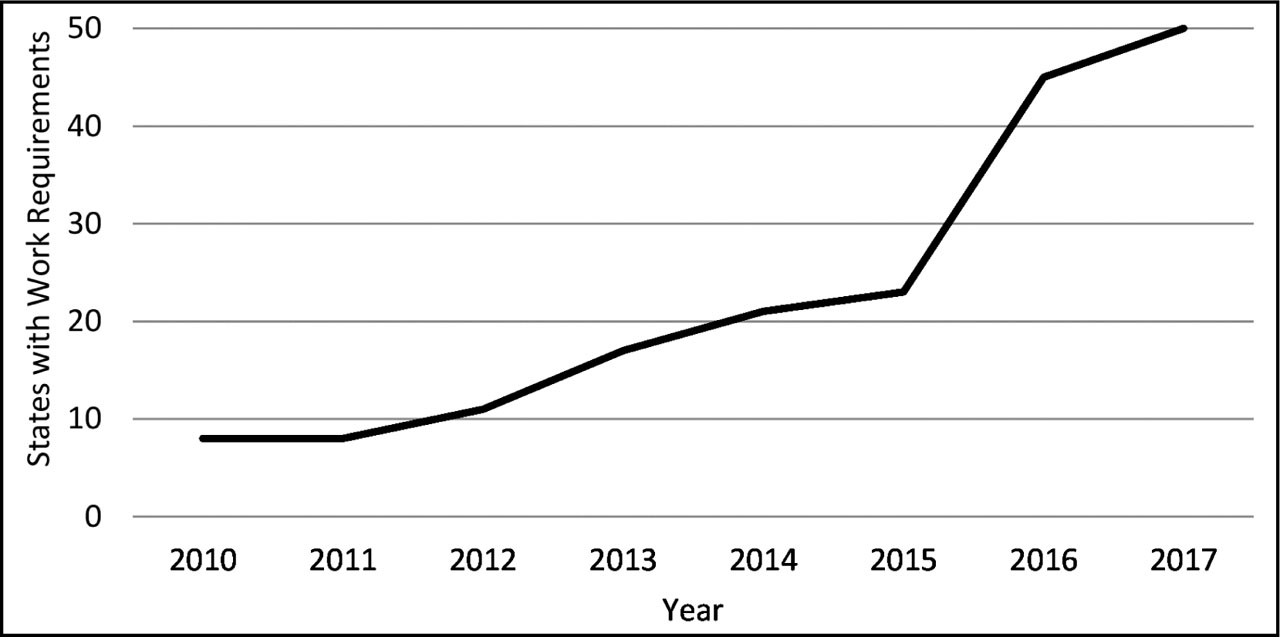
Figure 1
States with work requirements by year.
Notes: Data are from USDA correspondence to states regarding their work requirement waivers.
Table 1
Regression results – overall effects
| (1) | (2) | (3) | (4) | |
|---|---|---|---|---|
| SSI applications per 10K | SSI recipients per 10K | SNAP rate | SSI rate | |
| Panel A: Main Results | ||||
| Any work requirement | −0.002 (0.510) | 0.333 (0.241) | −0.000 (0.001) | −0.004 (0.003) |
| Observations | 408 | 408 | 408 | 408 |
| Within R-squared | 0.625 | 0.426 | 0.068 | 0.234 |
| Standard R-squared | 0.967 | 0.915 | 0.852 | 0.743 |
| Mean | 33.43 | 11.19 | 0.13 | 0.02 |
| % Change from mean | 0.0% | 3.0% | 0.0% | −20.0% |
| Partial Eta-squared | 0.000 | 0.007 | 0.008 | 0.000 |
| 90% Conf. interval | 0 – 0.019 | 0 – 0.028 | 0 – 0.030 | 0 – 0.006 |
| Panel B: Including State-Level Controls | ||||
| Any work requirement | −0.201 (0.500) | 0.173 (0.185) | 0.000 (0.001) | −0.002 (0.003) |
| Observations | 400 | 400 | 400 | 400 |
| Within R-squared | 0.700 | 0.552 | 0.110 | 0.329 |
| Standard R-squared | 0.974 | 0.938 | 0.858 | 0.774 |
| % Change from mean | −0.6% | 1.5% | 0.0% | −10.0% |
| Partial Eta-squared | 0.001 | 0.004 | 0.003 | 0.000 |
| 90% Conf. interval | 0 – 0.013 | 0 – 0.022 | 0 – 0.020 | 0 – 0.007 |
[i] Notes: Underlying data come from the SAMWD and CPS (2010–2017). Each column within each panel represents a separate regression. Outcomes in Columns 1 and 2 are measured per 10,000 population; Outcomes in Columns 3 and 4 are rates. All regressions include state and year fixed effects. In Panel B, state-level controls are added, including TANF caseload, unemployment rate, state minimum wage, poverty ratio, high school completion rates, Medicaid expansions, fractions of the population that are White, Black, Hispanic, of prime age, and female; Governor’s political party affiliation, “Must Access” PDMP, medical cannabis dispensary access, and recreational cannabis dispensary access. The first panel includes 408 state-years, while the lower panel includes 400 state-years because the District of Columbia does not have a Governor. Standard errors are clustered at the state level and reported in parentheses.
[ii] ***p < 0.01, **p < 0.05, *p < 0.1.
Table 2
Regression results – rates among those with self-reported disabilities or low income
| (1) | (2) | (3) | (4) | |
|---|---|---|---|---|
| SNAP rate – difficulty | SNAP rate – low income | SSI rate – difficulty | SSI rate – low income | |
| Panel A: Main Results | ||||
| Any work requirement | −0.001 (0.008) | 0.004 (0.004) | −0.013 (0.011) | −0.007 (0.011) |
| Observations | 408 | 408 | 408 | 408 |
| Within R-squared | 0.072 | 0.018 | 0.102 | 0.106 |
| Standard R-squared | 0.372 | 0.518 | 0.489 | 0.569 |
| Mean | 0.29 | 0.32 | 0.22 | 0.06 |
| % Change from mean | −0.3% | 1.3% | −5.9% | −11.7% |
| Partial Eta-squared | 0.003 | 0.001 | 0.000 | 0.002 |
| 90% Conf. interval | 0 – 0.019 | 0 – 0.014 | 0 – 0.004 | 0 – 0.017 |
| Panel B: Including State-Level Controls | ||||
| Any work requirement | 0.002 (0.008) | 0.005 (0.004) | −0.007 (0.012) | −0.002 (0.010) |
| Observations | 400 | 400 | 400 | 400 |
| Within R-squared | 0.124 | 0.067 | 0.167 | 0.179 |
| Standard R-squared | 0.410 | 0.542 | 0.526 | 0.606 |
| % Change from mean | 0.7% | 1.6% | −3.2% | −3.3% |
| Partial Eta-squared | 0.001 | 0.000 | 0.000 | 0.003 |
| 90% Conf. interval | 0 – 0.013 | 0 – 0.007 | 0 – 0.007 | 0 – 0.022 |
[i] Notes: Underlying data come from the SAMWD and CPS (2010–2017). Each column in each panel represents a separate regression. Difficulty refers to those with self-reported disabilities and Low Income refers to self-reported income <150% of the FPL. All regressions include state and year fixed effects. In Panel B, state-level controls are added, including TANF caseload, unemployment rate, state minimum wage, poverty ratio, high school completion rates, Medicaid expansions, fractions of the population that are White, Black, Hispanic, of prime age, and female; Governor’s political party affiliation, “Must Access” PDMP, medical cannabis dispensary access, and recreational cannabis dispensary access. The first panel includes 408 state-years, while the lower panel includes 400 state-years because the District of Columbia does not have a Governor. Standard errors are clustered at the state level and reported in parentheses.
[ii] ***p < 0.01, **p < 0.05, *p < 0.1.
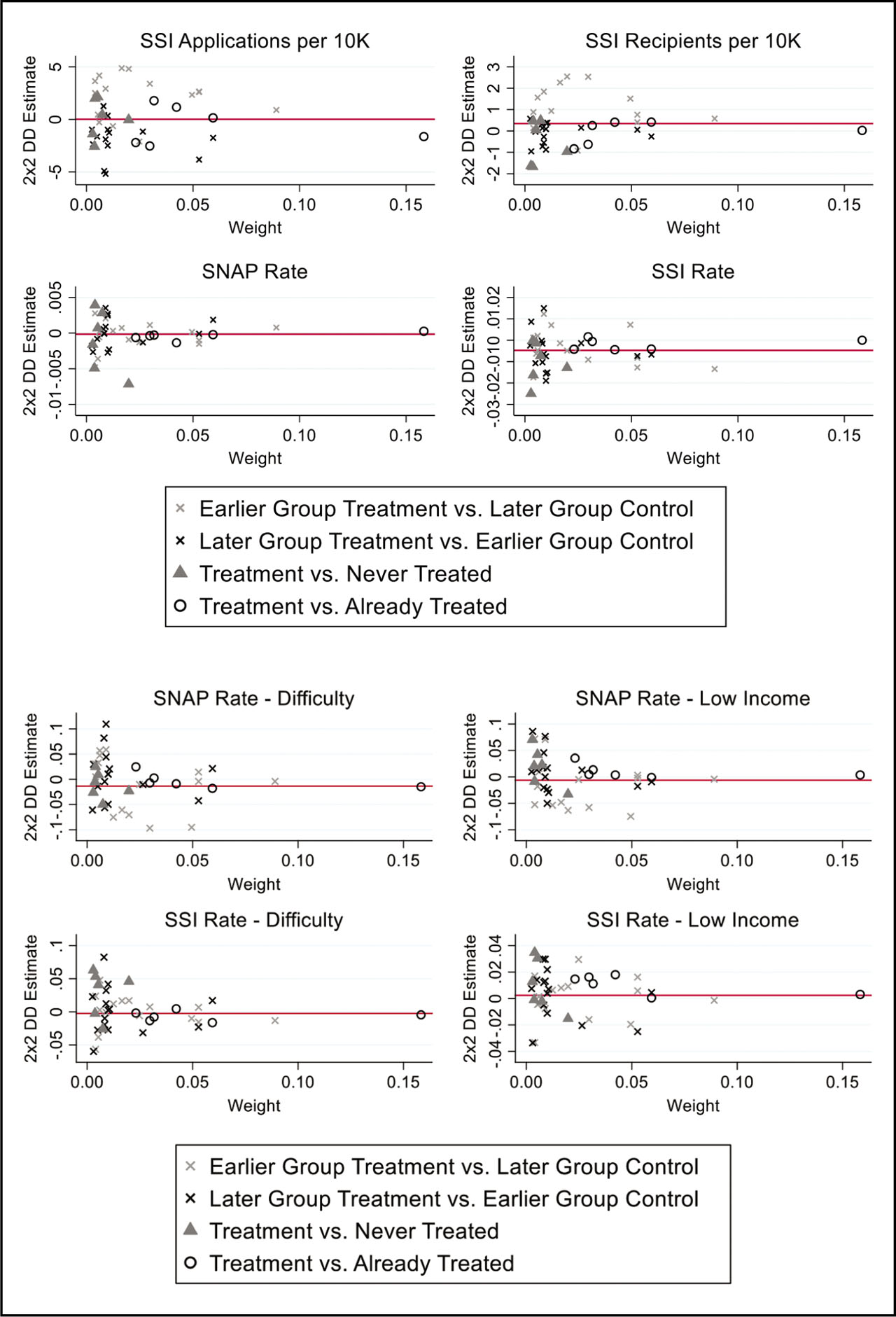
Figure 2
Decomposition of DID results. Panel A: Decomposition of overall results. Panel B: Decomposition of results for those with self-reported disabilities or low income.
Notes: Decomposition based on Goodman-Bacon (2021).
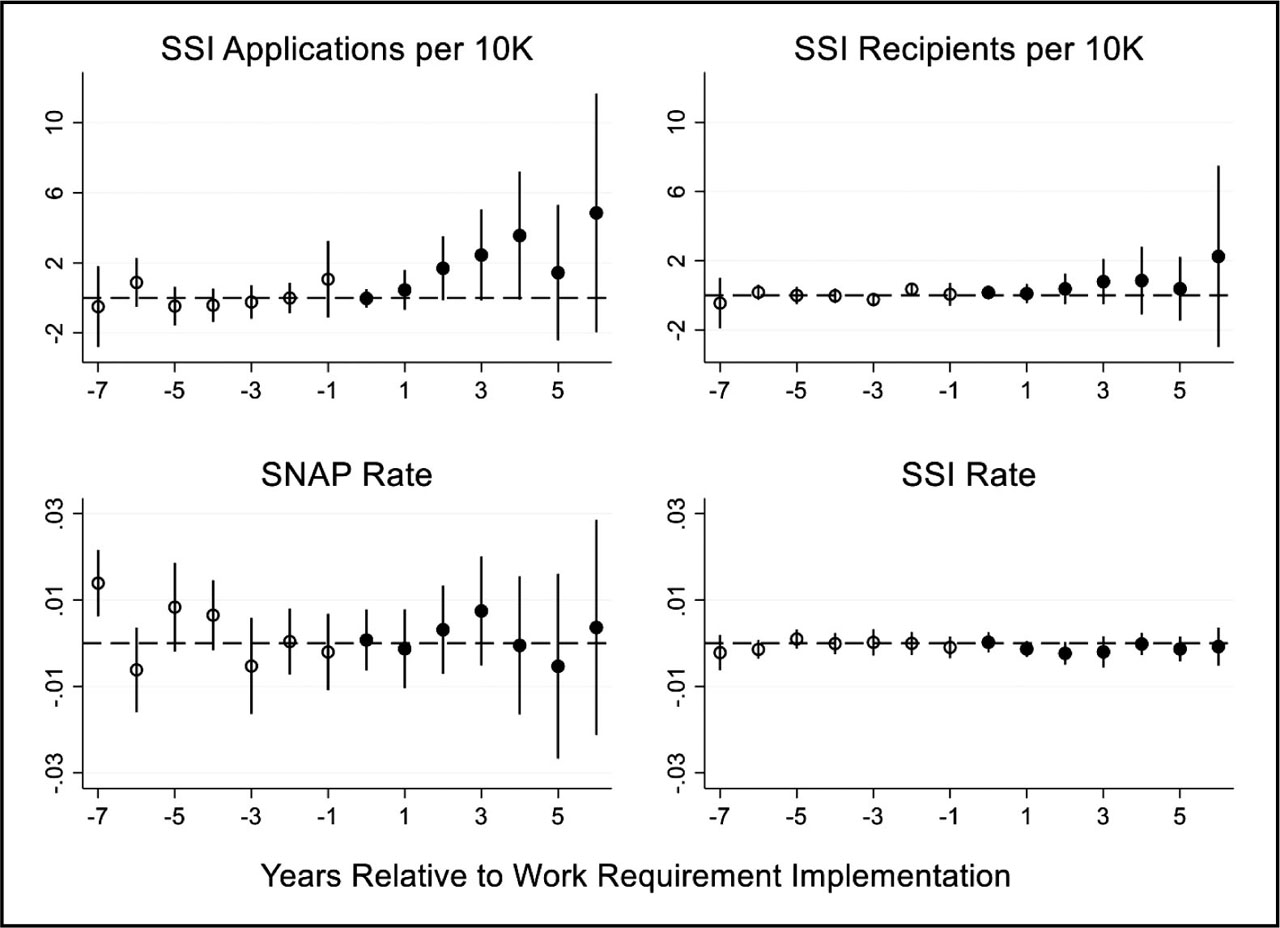
Figure 3
Event studies – Overall effects.
Notes: Average Treatment Effects on the Treated (ATT) are graphed by year relative to work requirement implementation. ATTs are calculated by running event studies separately for each group as defined by year of work requirement implementation. Leads and lags are then averaged, weighting by the share of states in each group. Virginia and West Virginia gained and reversed work requirements during the sample period and are omitted from the event study analysis. Outcomes are measured per 10,000 population in the first two graphs and are rates in the second two graphs. Underlying regressions control for state and year fixed effects with standard errors clustered at the state level.
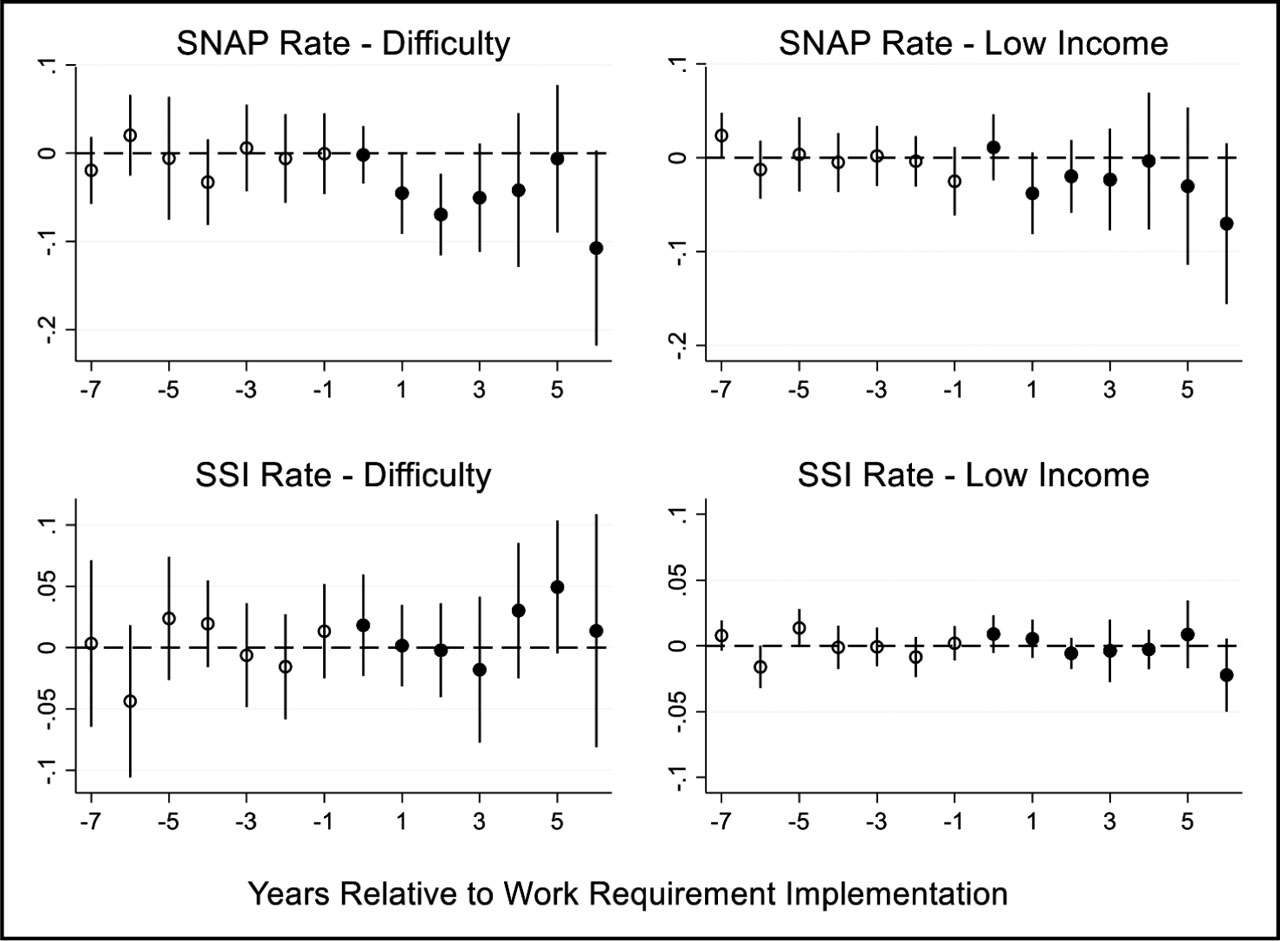
Figure 4
Event studies for SSA recipients.
Notes: Average Treatment Effects on the Treated (ATT) are graphed by year relative to work requirement implementation. ATTs are calculated by running event studies separately for each group as defined by year of work requirement implementation. Leads and lags are then averaged, weighting by the share of states in each group. Virginia and West Virginia gained and reversed work requirements during the sample period and are omitted from the event study analysis. Underlying regressions control for state and year fixed effects with standard errors clustered at the state level.
Table 3
Average treatment effects from Callaway and Sant’Anna (2021) analysis
| (1) | (2) | (3) | (4) | |
|---|---|---|---|---|
| SSI applications per 10K | SSI recipients per 10K | SNAP rate | SSI rate | |
| Any work requirement | 1.339* (0.806) | 0.460 −0.499 | 0.001 −0.004 | −0.001 (0.001) |
| Mean | 33.43 | 11.19 | 0.13 | 0.02 |
| % Change from mean | 4.0% | 4.1% | 0.8% | 5.0% |
| SNAP | SNAP | SSI | SSI | |
| Rate – Difficulty | Rate – Low Income | Rate – Difficulty | Rate – Low Income | |
| Any work requirement | −0.037* (0.019) | −0.016 (0.018) | 0.010 (0.018) | 0.001 (0.006) |
| Mean | 0.29 | 0.32 | 0.22 | 0.06 |
| % Change from mean | 12.8% | 5.0% | 4.5% | 1.7% |
| Observations | 384 | 384 | 384 | 384 |
[i] Notes: Average Treatment Effects on the Treated (ATT) are calculated by running event studies separately for each group as defined by year of work requirement implementation. Leads and lags are then averaged, weighting by the share of states in each group. Virginia and West Virginia gained and reversed work requirements during the sample period and are omitted from the event study analysis. Underlying regressions control for state and year fixed effects with standard errors clustered at the state level.
| Data | URL |
|---|---|
| USDA correspondence | Timothy Harris, Illinois State University. fharr1@ilstu.edu |
| SSA State Agency Monthly Workload Data | https://www.ssa.gov/disability/data/ssa-sa-mowl.htm |
| Current Population Survey | www.ipums.org |
| University of Kentucky Center for Poverty Research Data | http://ukcpr.org/resources/national-welfare-data |
| Medicaid Expansion | https://www.kff.org/health-reform/state-indicator/state-activity-around-expanding-medicaid-under-the-affordable-care-act/?currentTimeframe=0&sortModel=%7B%22colId%22:%22Location%22,%22sort%22:%22asc%22%7D. |
| Prescription Drug Monitoring Programs | www.pdaps.org |
| Medical and recreational cannabis access | Powell, David; Rosalie Liccardo Pacula; Mireille Jacobson (2018). Do Medical Marijuana Laws Reduce Addictions and Deaths Related to Pain Killers? Journal of Health Economics, 58:29–42 |
| www.pdaps.org | |
| www.procon.org |
Table A1
State and year information on work requirements
| Work requirements added by year | |
| Pre-2010 | Colorado, Delaware, Nebraska, New York, North Dakota, South Dakota, Texas, West Virginia |
| 2011 | None |
| 2012 | New Hampshire, Utah, Vermont, Wyoming |
| 2013 | Iowa, Kansas, Minnesota, Ohio, Oklahoma, Virginia |
| 2014 | Hawaii, Maine, Montana, Wisconsin |
| 2015 | Indiana, Louisiana, Washington |
| 2016 | Alabama, Alaska, Arkansas, Arizona, Connecticut, Florida, Georgia, Idaho, Kentucky, Maryland, Mississippi, Massachusetts, Missouri, New Jersey, New Mexico, North Carolina, Oregon, Pennsylvania, South Carolina, Tennessee, Virginia, West Virginia |
| 2017 | California, District of Columbia, Illinois, Michigan |
| Work requirements reversed by year | |
| 2012 | West Virginia |
| 2014 | Virginia |
[i] Source: USDA correspondence to states
Table A2
Descriptive statistics overall and by work requirement status – control variables
| FULL SAMPLE (N = 408) | NO WR (N = 225) | WR (N = 183) | NO WR V. WR | ||||
|---|---|---|---|---|---|---|---|
| Mean | Std. | Mean | Std. | Mean | Std. | p-Value | |
| TANF cases per 1,000 | 4.42 | 3.05 | 4.99 | 3.72 | 2.81 | 2.90 | <0.001 |
| Medicaid expansion | 0.28 | 0.45 | 0.19 | 0.39 | 0.40 | 0.49 | 0.683 |
| Unemployment rate | 6.34 | 2.16 | 7.64 | 1.78 | 4.74 | 1.38 | <0.001 |
| State minimum wage | 7.66 | 0.96 | 7.58 | 7.76 | 1.07 | 1.06 | 0.064 |
| Poverty ratio | 0.14 | 0.03 | 0.15 | 0.12 | 0.03 | 0.03 | <0.001 |
| Fraction white | 0.69 | 0.16 | 0.67 | 0.71 | 0.16 | 0.15 | 0.012 |
| Fraction black | 0.11 | 0.11 | 0.13 | 0.09 | 0.09 | 0.09 | <0.001 |
| Fraction hispanic | 0.11 | 0.10 | 0.12 | 0.11 | 0.10 | 0.10 | 0.598 |
| Fraction prime age adults | 0.40 | 0.02 | 0.40 | 0.39 | 0.02 | 0.02 | <0.001 |
| Fraction with high school diploma | 0.68 | 0.03 | 0.68 | 0.69 | 0.03 | 0.03 | <0.001 |
| Sex ratio (female to male) | 0.51 | 0.01 | 0.51 | 0.51 | 0.01 | 0.01 | <0.001 |
| Medical cannabis dispensary | 0.26 | 0.44 | 0.24 | 0.03 | 0.28 | 0.03 | 0.374 |
| Recreational cannabis dispensary | 0.03 | 0.18 | 0.00 | 0.00 | 0.07 | 0.02 | <0.001 |
| “Must Access” PDMP | 0.17 | 0.38 | 0.12 | 0.02 | 0.25 | 0.03 | 0.001 |
[i] Notes: Data cover the period from 1/1/2010 through 12/31/2017. p-values are from two-sided t-tests for continuous measures and from chi-squared tests for dichotomous measures.
Table A3
Comparing outcomes for state-years with and without work requirements
| FULL SAMPLE | NO WR | WR | NO WR V. WR | ||||
|---|---|---|---|---|---|---|---|
| Mean | Std. | Mean | Std. | Mean | Std. | p-Value | |
| SSI applications per 10,000 | 33.43 | 13.97 | 38.10 | 0.98 | 27.69 | 0.78 | <0.001 |
| SSI recipients per 10,000 | 11.19 | 3.84 | 12.20 | 0.29 | 9.95 | 0.20 | <0.001 |
| SNAP recipiency | 0.13 | 0.04 | 0.14 | 0.00 | 0.12 | 0.00 | <0.001 |
| SNAP recipiency – difficulty | 0.29 | 0.09 | 0.31 | 0.01 | 0.27 | 0.01 | <0.001 |
| SNAP recipiency – low Income | 0.32 | 0.08 | 0.34 | 0.01 | 0.29 | 0.01 | <0.001 |
| SSI recipiency | 0.02 | 0.01 | 0.02 | 0.00 | 0.02 | 0.00 | 0.002 |
| SSI recipiency – difficulty | 0.22 | 0.07 | 0.23 | 0.00 | 0.20 | 0.00 | <0.001 |
| SSI recipiency – low income | 0.06 | 0.03 | 0.07 | 0.00 | 0.06 | 0.00 | 0.276 |
[i] Notes: Data cover the period from 1/1/2010 through 12/31/2017. SSI applications per 10,000 population and SSI recipients per 10,000 population are based on the SAMWD data. SNAP and SSI recipiencies are from the CPS. All population measures are for the whole population. p-values are from two-sided t-tests.
Table A4
Averaged coefficients by period from Callaway and Sant’Anna (2021) event studies
| Period | (1) | (2) | (3) | (4) | (5) | (6) | (7) | (8) |
|---|---|---|---|---|---|---|---|---|
| SSI applications per 10K | SSI recipients per 10K | SNAP rate | SSI rate | SNAP rate - difficulty | SNAP rate - low income | SSI rate - difficulty | SSI rate - low income | |
| −7 | −0.496 (1.176) | −0.451 (0.743) | 0.014*** (0.004) | −0.002 (0.002) | −0.020 (0.193) | 0.0234* (0.012) | 0.003 (0.035) | 0.008 (0.006) |
| −6 | 0.883 (0.711) | 0.174 (0.223) | −0.006 (0.005) | –0.001 (0.001) | 0.020 (0.023) | −0.013 (0.016) | −0.044 (0.032) | −0.016 (0.008) |
| −5 | −0.467 (0.561) | −0.005 (0.252) | 0.008 (0.005) | 0.001 (0.001) | −0.006 (0.036) | 0.004 (0.020) | 0.024 (0.026) | 0.014 (0.007) |
| −4 | −0.414 (0.482) | −0.032 (0.217) | 0.007 (0.004) | 0.000 (0.001) | −0.033 (0.025) | −0.005 (0.016) | 0.020 (0.018) | −0.001 (0.008) |
| −3 | −0.233 (0.486) | −0.242 (0.199) | −0.005 (0.006) | 0.000 (0.002) | 0.006 (0.025) | 0.002 (0.016) | −0.006 (0.022) | −0.001 (0.007) |
| −2 | −0.004 (0.442) | 0.353** (0.179) | 0.000 (0.004) | 0.000 (0.001) | −0.006 (0.026) | −0.004 (0.014) | −0.016 (0.022) | −0.009 (0.008) |
| −1 | 1.068 (1.112) | 0.062 (0.334) | −0.002 (0.005) | −0.001 (0.001) | −0.001 (0.023) | −0.025 (0.019) | 0.013 (0.020) | 0.002 (0.007) |
| 0 | −0.027 (0.272) | 0.161 (0.150) | 0.001 (0.004) | 0.000 (0.001) | −0.002 (0.017) | 0.011 (0.018) | 0.018 (0.021) | 0.009 (0.007) |
| 1 | 0.459 (0.579) | 0.102 (0.280) | −0.001 (0.005) | −0.001 (0.001) | −0.045* (0.024) | −0.039* (0.022) | 0.002 (0.017) | 0.005 (0.007) |
| 2 | 1.693* (0.930) | 0.375 (0.446) | 0.003 (0.005) | −0.002* (0.001) | −0.070*** (0.024) | −0.020 (0.020) | −0.002 (0.020) | −0.006 (0.006) |
| 3 | 2.451* (1.325) | 0.791 (0.662) | 0.007 (0.006) | −0.002 (0.002) | −0.050 (0.031) | −0.023 (0.028) | −0.018 (0.030) | −0.004 (0.012) |
| 4 | 3.560* (1.861) | 0.851 (0.995) | 0.000 (0.008) | 0.000 (0.001) | −0.042 (0.044) | −0.003 (0.037) | 0.030 (0.028) | −0.003 (0.008) |
| 5 | 1.444 (1.970) | 0.383 (0.940) | −0.005 (0.011) | −0.001 (0.001) | −0.006 (0.043) | −0.030 (0.043) | 0.049* (0.028) | 0.009 (0.013) |
| 6 | 4.854 (3.471) | 2.248 (2.673) | 0.004 (0.013) | −0.001 (0.002) | −0.108* (0.056) | −0.070 (0.043) | 0.014 (0.048) | −0.022 (0.014) |
Notes: Underlying data come from the SAMWD and CPS (2010–2017). Outcomes in Columns 1 and 2 are measured per 10,000 population; Outcomes in Columns 3–8 are rates. All regressions include state and year fixed effects. Average Treatment Effects on the Treated (ATT) are measured by Period (year) relative to the period in which work requirements were implemented (Period = 0). ATTs are calculated by running event studies separately for each group as defined by year of work requirement implementation. Leads and lags are then averaged, weighting by the share of states in each group. Standard errors clustered at the state level and reported in parentheses.
Table A5
Weighted treatment – overall samples
| Variables | (1) | (2) | (3) | (4) |
|---|---|---|---|---|
| SSI applications per 10K | SSI recipients per 10K | SNAP recipiency | SSI recipiency | |
| Any work requirement | −0.002 (0.545) | 0.333 (0.258) | −0.005 (0.003) | −0.000 (0.001) |
| Weighted by counties affected | −1.125 (1.304) | −0.271 (0.497) | −0.013* (0.007) | −0.001 (0.001) |
| Weighted by ABAWD population | −1.985 (3.245) | 0.311 (1.242) | −0.037** (0.018) | −0.002 (0.004) |
| Weighted by non-exempted ABAWD population | −2.300 (3.090) | 0.444 (1.237) | −0.041** (0.019) | −0.003 (0.004) |
Notes: Underlying data come from the SAMWD and CPS (2010–2017). Each cell represents a separate regression. Outcomes in Columns 1 and 2 are measured per 10,000 population; Outcomes in Columns 3 and 4 are rates. All regressions include state and year fixed effects. Standard errors clustered at the state level and reported in parentheses.
Table A6
Weighted treatment – subgroups
| Variables | (1) | (2) | (3) | (4) |
|---|---|---|---|---|
| SNAP rate - difficulty | SNAP rate - low income | SSI rate - difficulty | SSI rate - low income | |
| Any work requirement | −0.013 (0.012) | −0.007 (0.011) | −0.001 (0.009) | 0.004 (0.005) |
| Weighted by counties affected | −0.030 (0.025) | −0.015 (0.027) | −0.010 (0.020) | 0.006 (0.011) |
| Weighted by ABAWD population | −0.081 (0.069) | −0.054 (0.067) | −0.019 (0.049) | 0.013 (0.028) |
| Weighted by non-exempted ABAWD population | −0.091 (0.075) | −0.067 (0.069) | −0.029 (0.052) | 0.001 (0.029) |
[i] Notes: Underlying data come from the SAMWD and CPS (2010–2017). Each cell represents a separate regression. Outcomes in Columns 1 and 2 are measured per 10,000 population; Outcomes in Columns 3 and 4 are rates. All regressions include state and year fixed effects. Standard errors clustered at the state level and reported in parentheses.
[ii] ***p < 0.01, **p < 0.05, *p < 0.1.
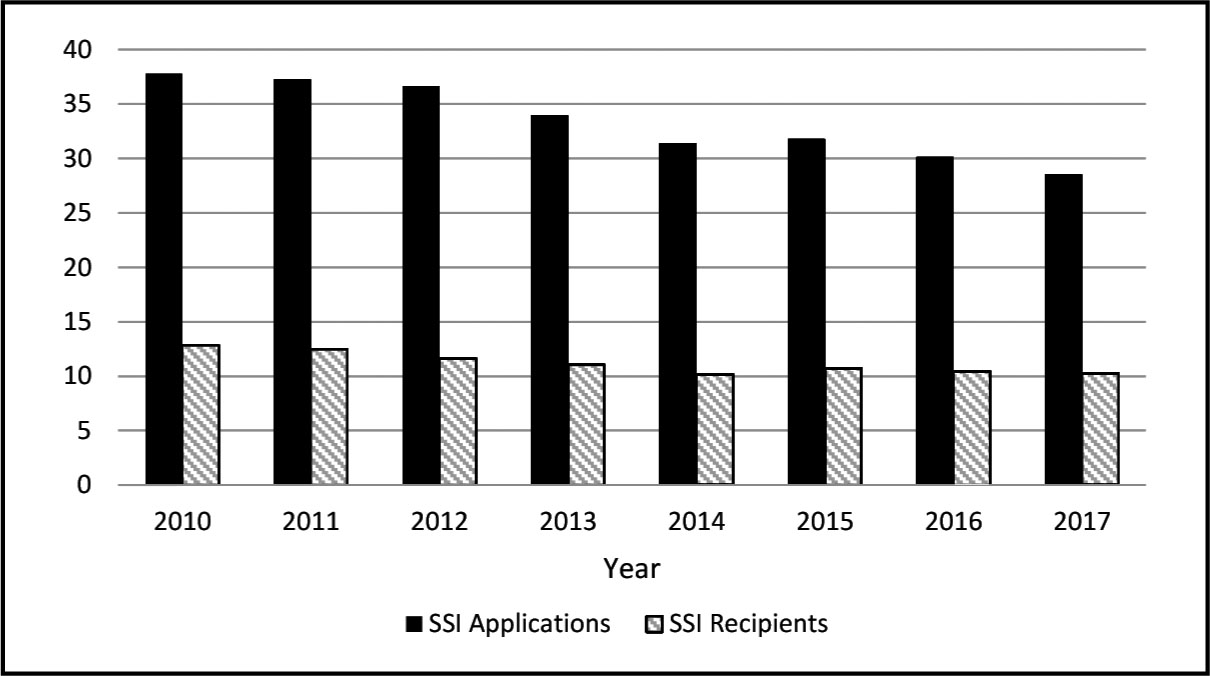
Figure A1
SSA applications and recipients per 10,000 population by year.
Notes: Data are from the SAMWD.
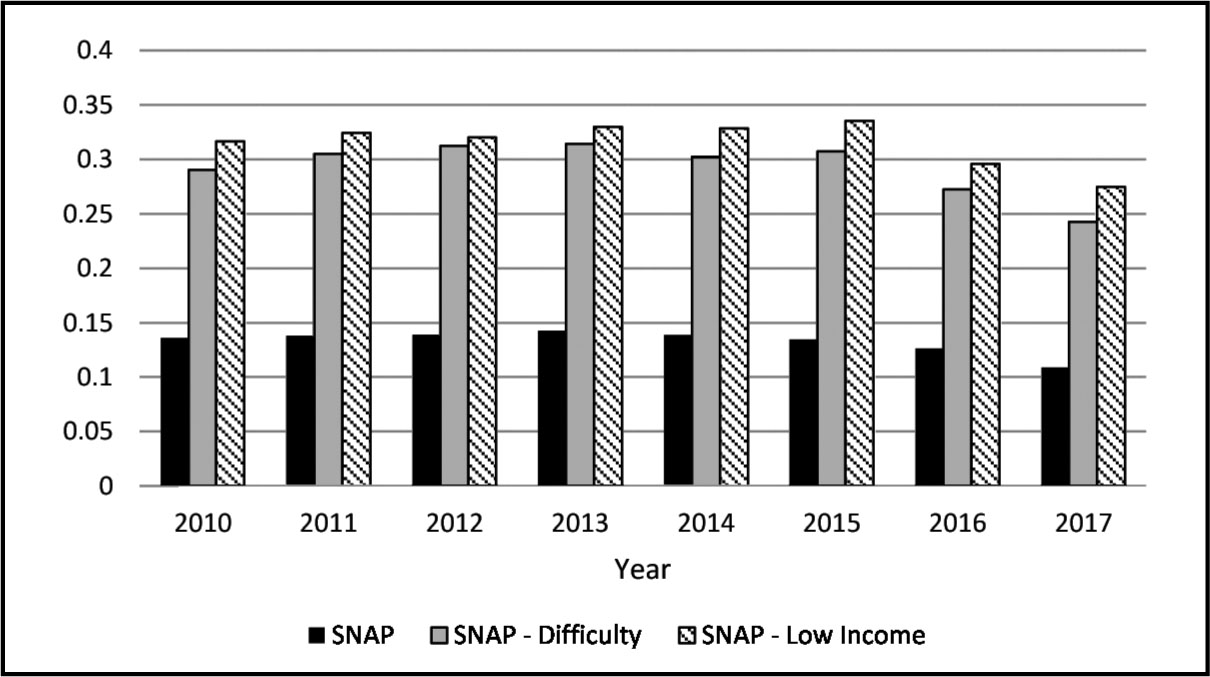
Figure A2
Probability of SNAP recipiency over time.
Notes: Data are from the CPS. SNAP – Difficulty includes all individuals reporting a disability based on the six-part monthly difficulty question and the annual work limitation question. SNAP – Low income includes individuals earning <150% of the federal poverty line.
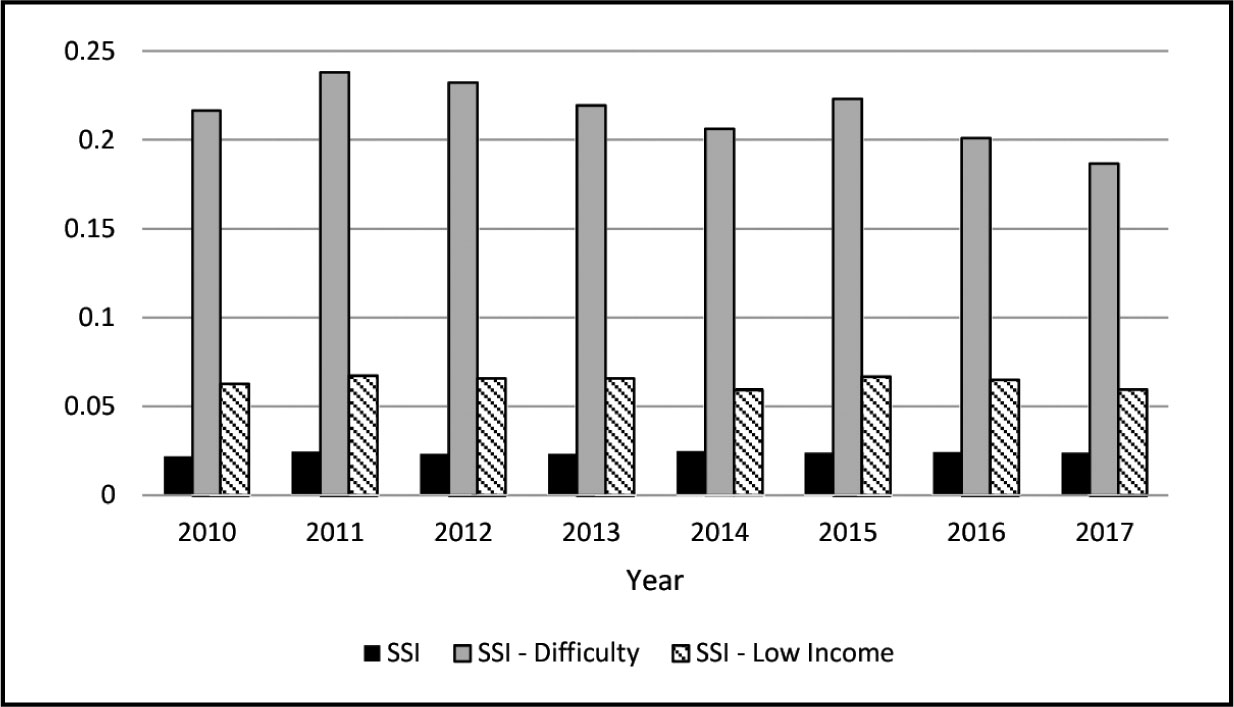
Figure A3
Probability of SSI recipiency over time.
Notes: Data are from the CPS. SSI – Difficulty includes all individuals reporting a disability based on the six-part monthly difficulty question and the annual work limitation question. SSI – Low income includes individuals earning <150% of the federal poverty line.
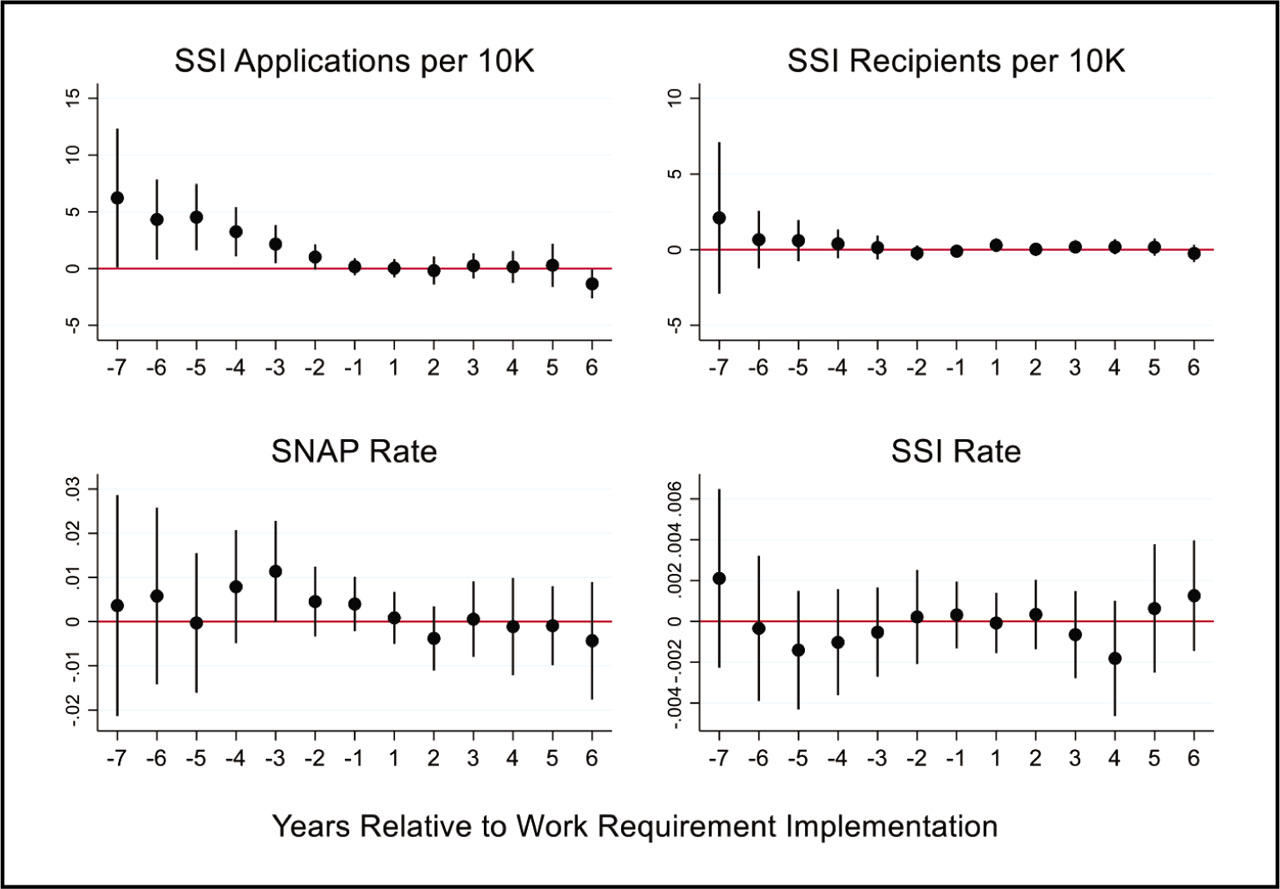
Figure A4
Event studies.
Notes: Event studies are run including the full range of leads and lags available in the data and state and year fixed effects. Policy implementation occurs at time t = 0. Virginia and West Virginia gained and reversed work requirements during the sample period and are omitted from the event study analysis. Standard errors are clustered at the state-level. 95% confidence intervals are reported.
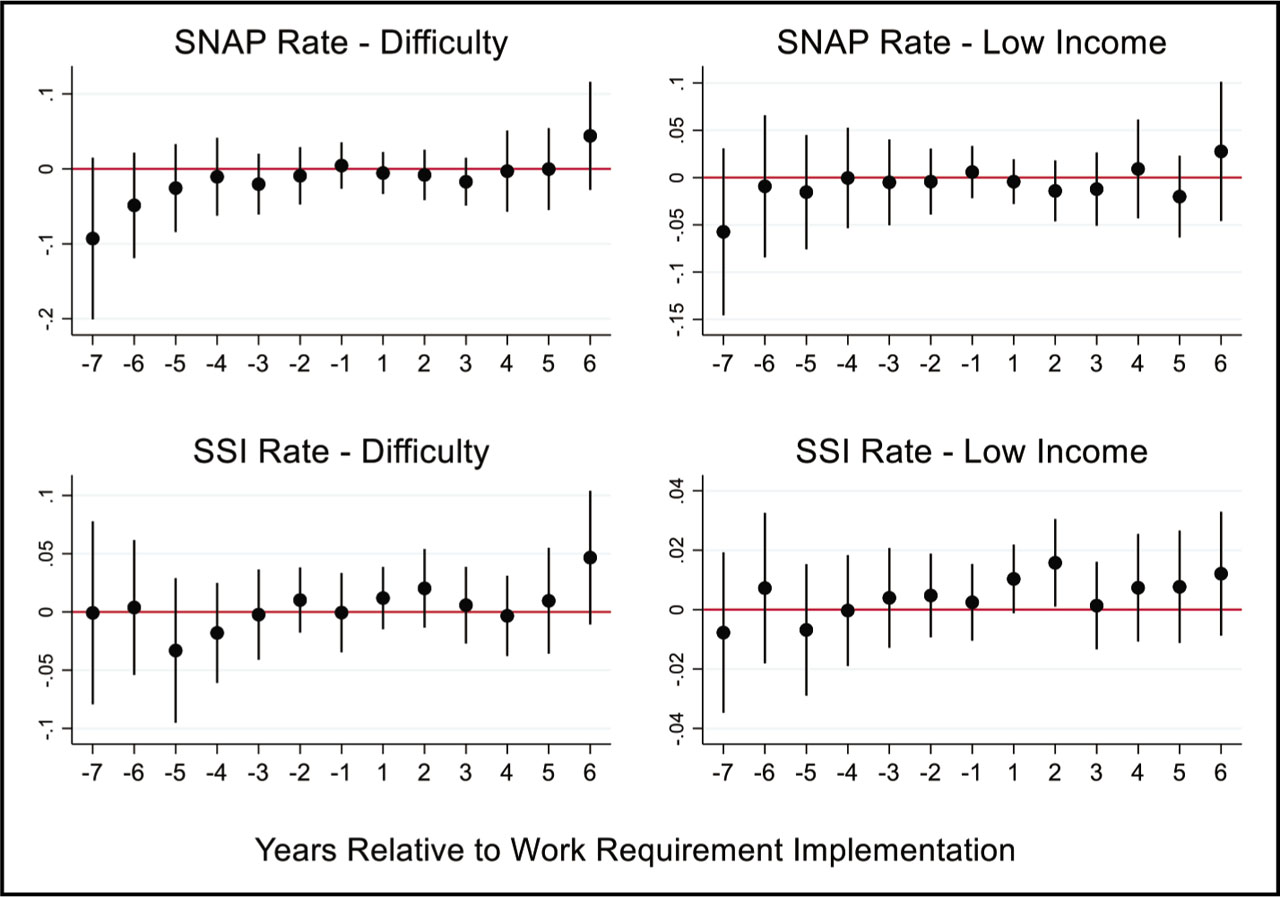
Figure A5
Event studies – Difficulty or low income.
Notes: Event studies are run including the full range of leads and lags available in the data and state and year fixed effects. Policy implementation occurs at time t = 0. Virginia and West Virginia gained and reversed work requirements during the sample period and are omitted from the event study analysis. Standard errors are clustered at the state-level. 95% confidence intervals are reported.
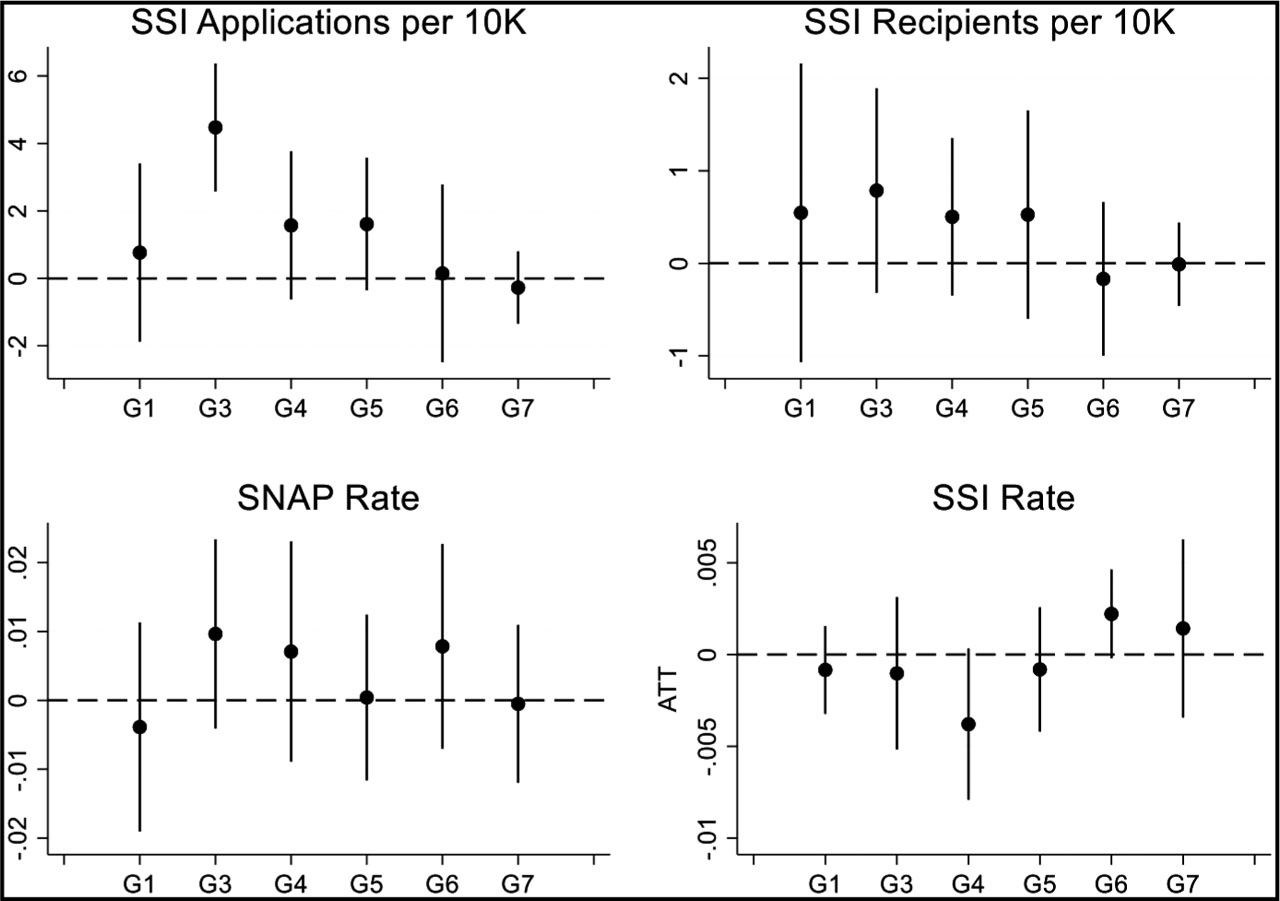
Figure A6
ATT by treatment group – Overall.
Notes: Average Treatment Effects on the Treated (ATT) are graphed treatment group, as defined by the year the work requirement was implemented. ATTs are calculated by running event studies separately for each group as defined by year of work requirement implementation. Leads and lags are then averaged, weighting by the share of states in each group, before being aggregated to calculate the group-specific treatment effect. Virginia and West Virginia gained and reversed work requirements during the sample period and are omitted from the event study analysis. Underlying regressions control for state and year fixed effects with standard errors clustered at the state level.
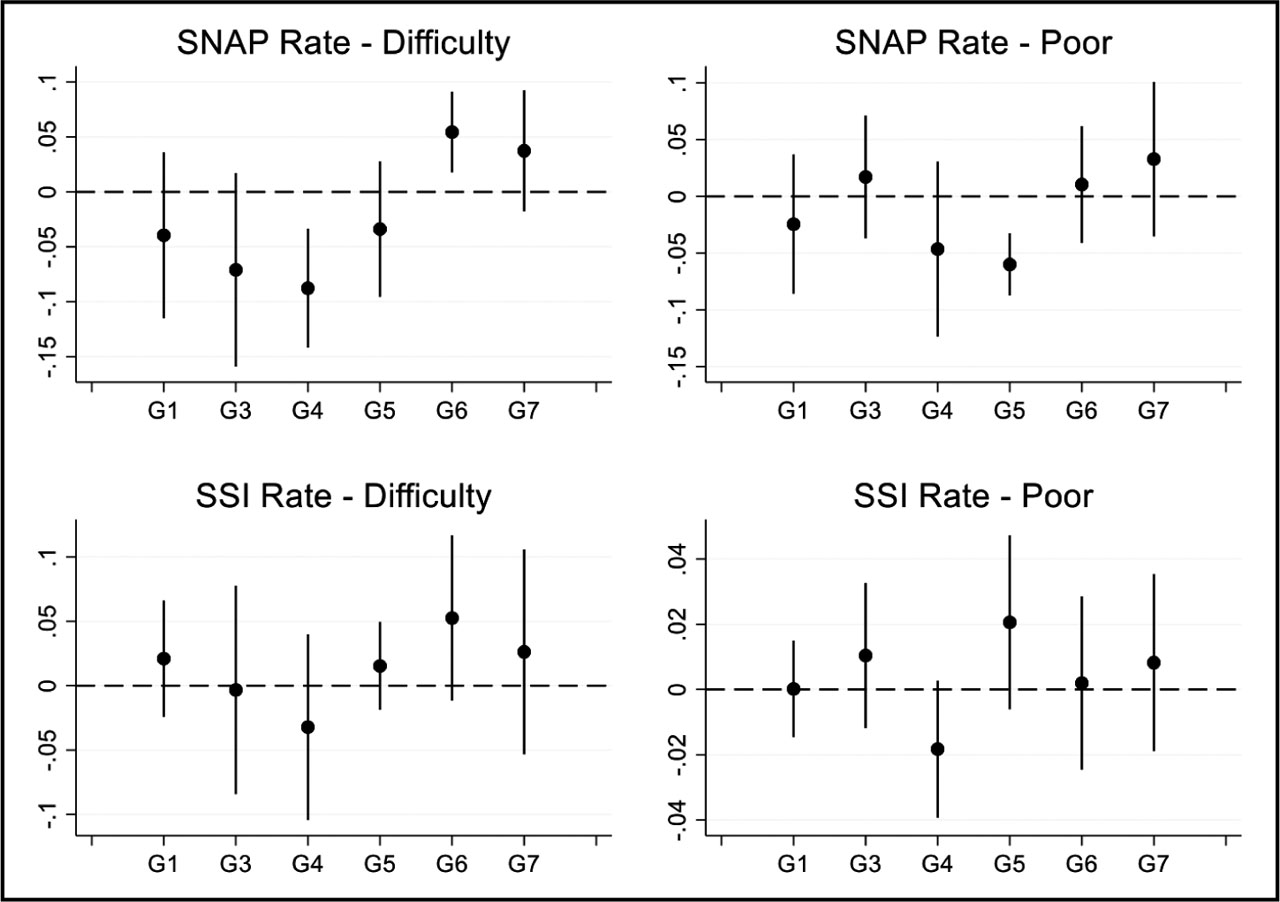
Figure A7
ATT by treatment group – Overall.
Notes: Average Treatment Effects on the Treated (ATT) are graphed treatment group, as defined by the year the work requirement was implemented. ATTs are calculated by running event studies separately for each group as defined by year of work requirement implementation. Leads and lags are then averaged, weighting by the share of states in each group, before being aggregated to calculate the group-specific treatment effect. Virginia and West Virginia gained and reversed work requirements during the sample period and are omitted from the event study analysis. Underlying regressions control for state and year fixed effects with standard errors clustered at the state level.