
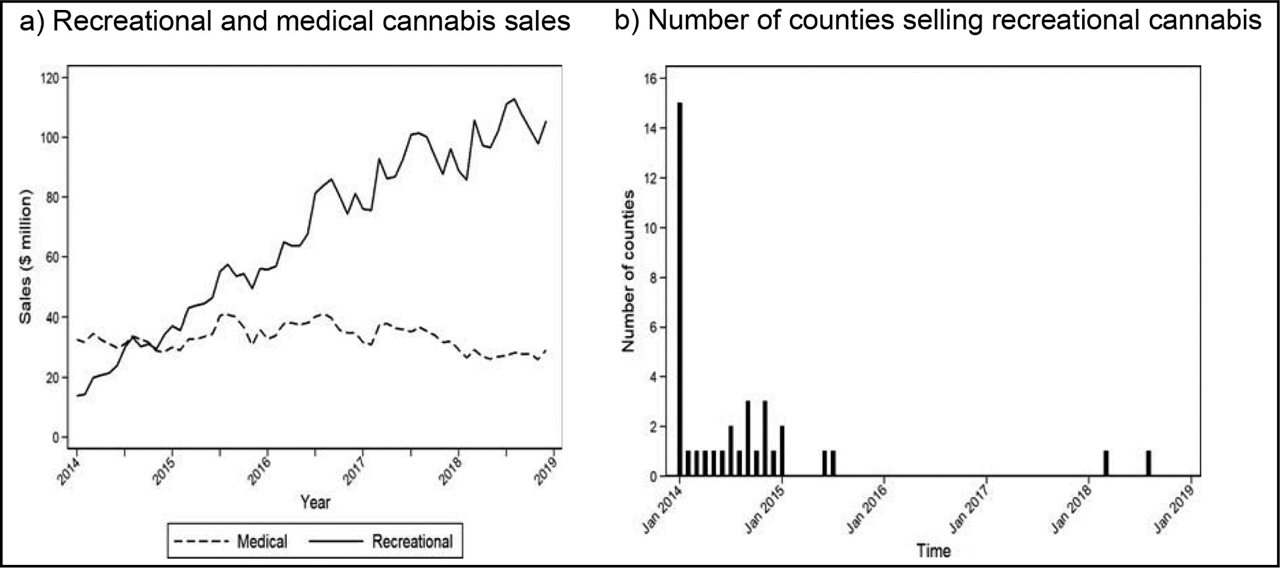
Figure 1
Cannabis sales in Colorado counties, by year.
Notes: (A) Sales of medical and recreational cannabis. Data were obtained from the Colorado Department of Revenue and are in U.S. dollars. (B) The number of new counties selling cannabis, based on sales data obtained from the Colorado Department of Revenue.
Table 1
County-level summary statistics
| Mean | SD | Min | Max | N | |
|---|---|---|---|---|---|
| Panel A: monthly | |||||
| Unemployment rate (%) | 5.23 | 2.77 | 1.1 | 17.4 | 6,144 |
| Labor force | 44,682 | 90,397 | 273 | 417,717 | 6,144 |
| Unemployed | 2,268 | 5,017 | 7 | 33,083 | 6,144 |
| All industry employees | 37,909 | 84,671 | 195 | 524,919 | 6,144 |
| Construction employees | 2,720 | 5,099 | 14 | 24,163 | 4,992 |
| Manufacturing sector employees | 2,929 | 5,427 | 10 | 21,436 | 4,512 |
| Natural resource and mining employees | 802 | 1,821 | 8 | 13,120 | 5,088 |
| Service-providing employees | 26,692 | 62,824 | 81 | 401,921 | 6,144 |
| Amount of recreational sales | 629,296 | 2,712,311 | 0 | 35,343,772 | 6,144 |
| Number of medical patients | 1,622 | 3,568 | 2 | 20,976 | 6,144 |
| Panel B: quarterly | |||||
| All industry wages | 749.06 | 200.83 | 410 | 2,102 | 2,048 |
| Construction wages | 881.75 | 227.47 | 415 | 2,489 | 1,664 |
| Manufacturing wages | 844.94 | 339.17 | 310 | 2,650 | 1,504 |
| Natural resource and mining wages | 1,071.30 | 641.53 | 376 | 6,475 | 1,696 |
| Service-providing wages | 684.91 | 216.46 | 294 | 2,619 | 2,048 |
[i] Notes: The data cover the period from 2011 to 2018. Our monthly sample includes 6,144 county–month observations, while our quarterly sample includes 2,048 county–quarter observations. Subindustry measures are based on fewer observations due to BLS suppression of county-level information for confidentiality reasons.
[ii] BLS, U.S. Bureau of Labor Statistics; Min, minimum; Max, maximum; SD, standard deviation.
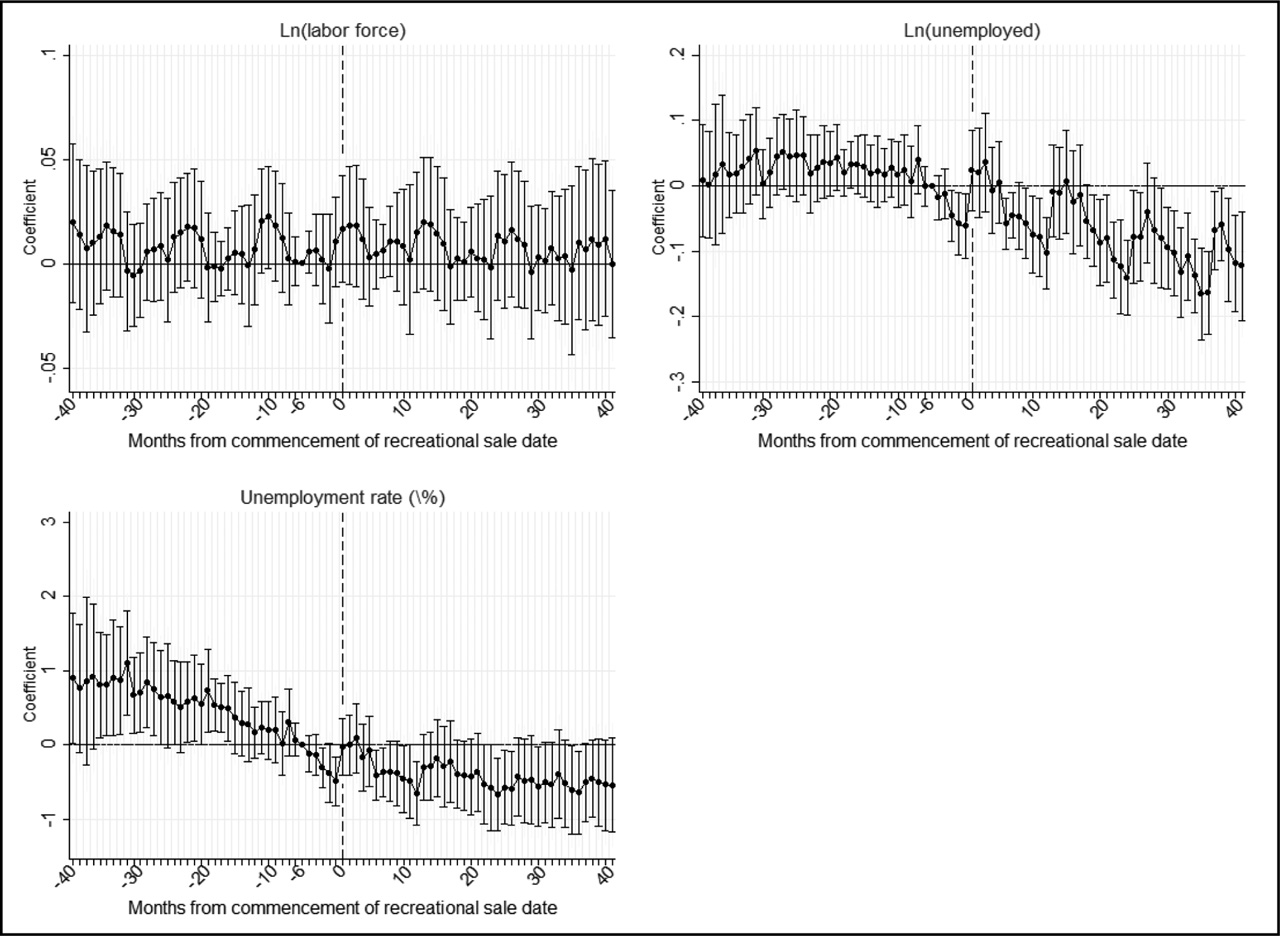
Figure 2
Effect of recreational cannabis entry on the unemployment rate, Ln(labor force) and Ln(unemployed) – event study.
Notes: The points represent the τk coefficient estimates from the estimation of Eq. (3), omitting τ−6. The bars extending from each point represent a 95% confidence interval calculated from the standard errors that are clustered at the county level. There are no standard error bars for the relative half-year k = −6 as the plot reflects that zero is imposed rather than estimated. The x-axis denotes time with respect to the commencement of the sale. Period 0 is when the sale begins. All regressions include county, month, and year fixed effects. Standard errors are clustered at the county level and are reported in parentheses.
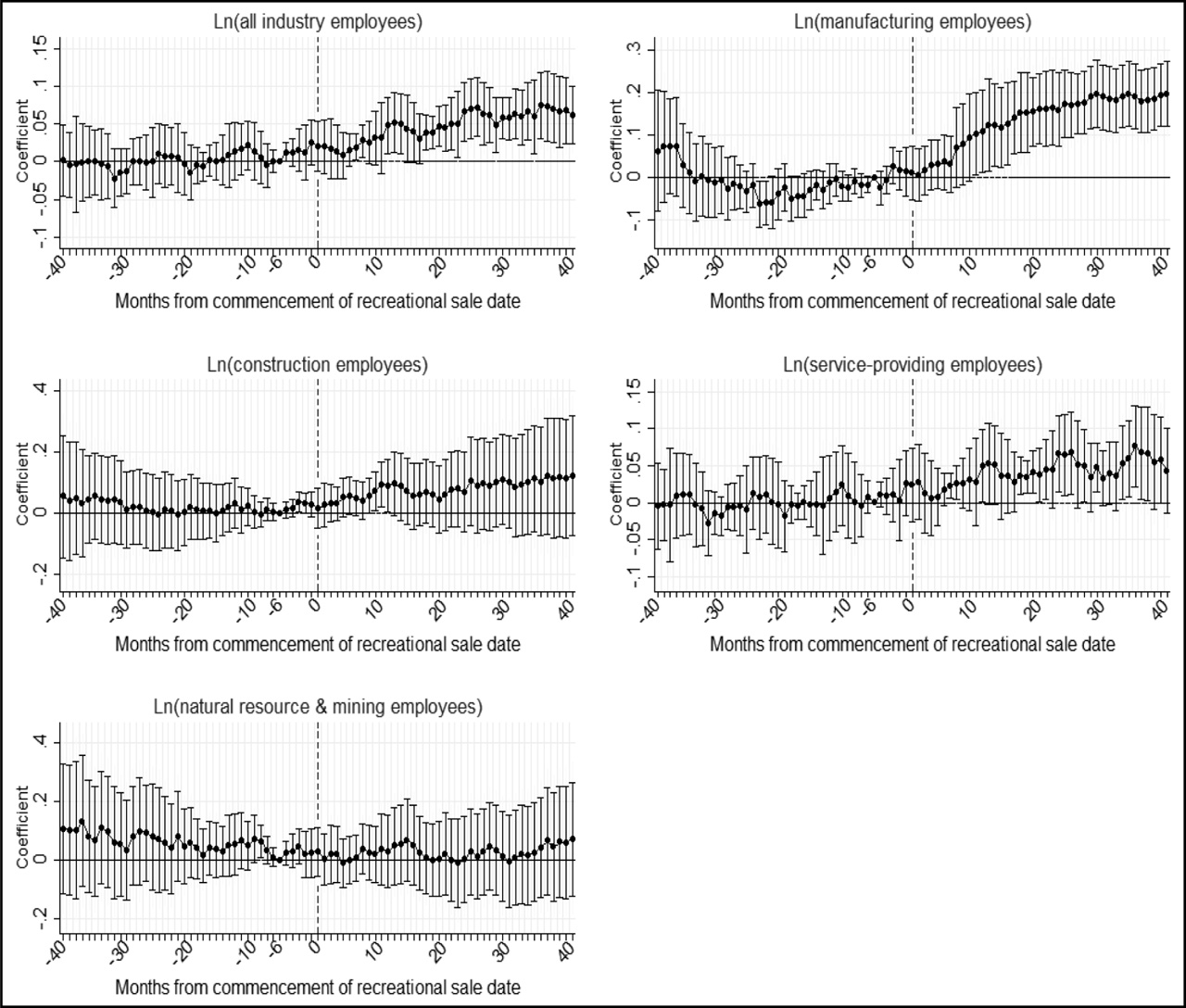
Figure 3
Effect of recreational cannabis entry on Ln(employees), by industry – event study.
Notes: The points represent the τk coefficient estimates from the estimation of Eq. (3), omitting τ−6. The bars extending from each point represent a 95% confidence interval calculated from the standard errors that are clustered at the county level. There are no standard error bars for the relative half-year k = −6 as the plot reflects that zero is imposed rather than estimated. The x-axis denotes time with respect to the commencement of the sale. Period 0 is when the sale begins. All regressions include county, month, and year fixed effects. Standard errors are clustered at the county level and are reported in parentheses.
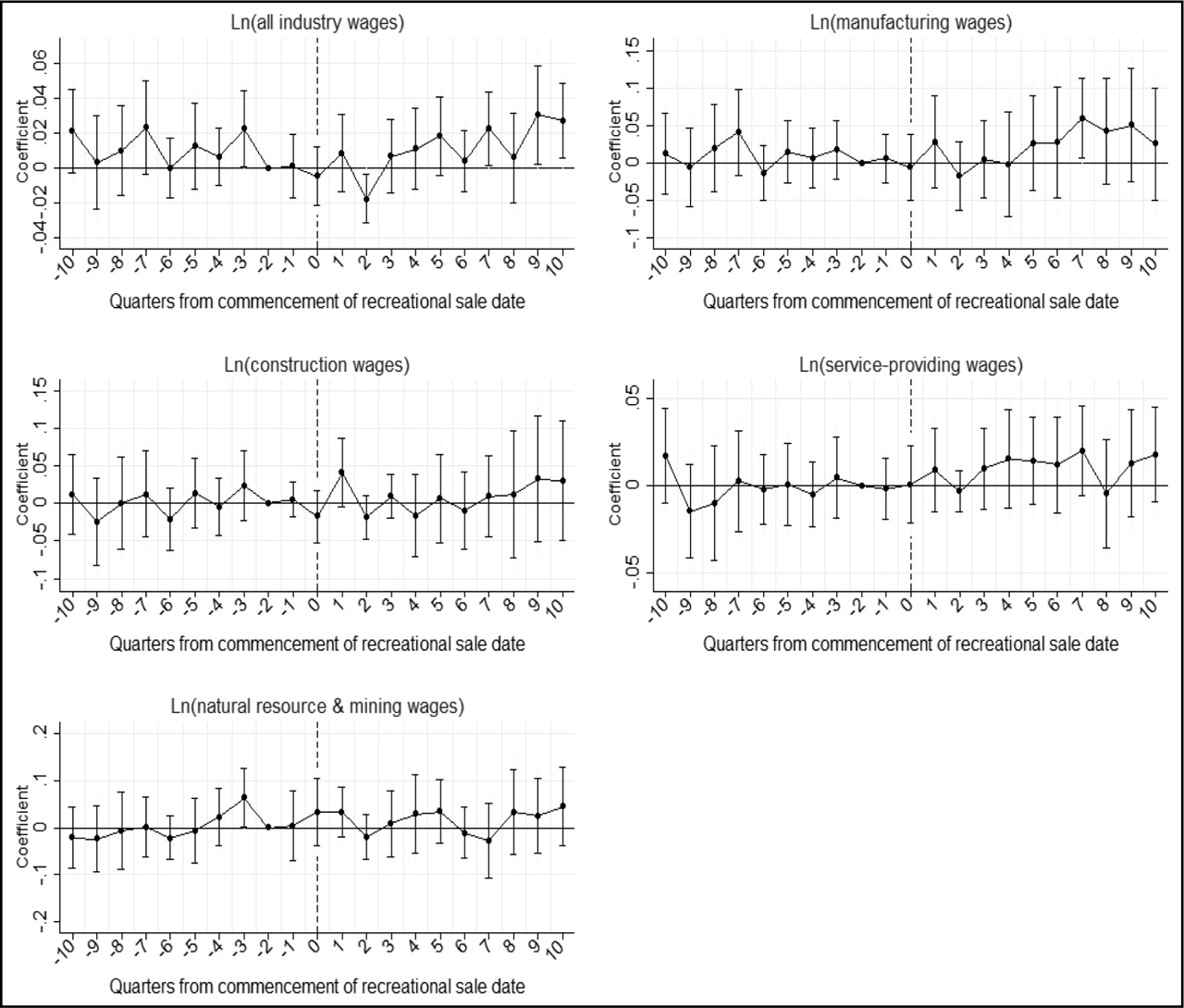
Figure 4
Effect of recreational cannabis entry on Ln(wage), by industry – event study.
Notes: The points represent the τk coefficient estimates from the estimation of Eq. (3), omitting τ−2. The bars extending from each point represent a 95% confidence interval calculated from the standard errors that are clustered at the county level. There are no standard error bars for the relative half-year k = −2 as the plot reflects that zero is imposed rather than estimated. The x-axis denotes time with respect to the commencement of the sale. Period 0 is when the sale begins. All regressions include county, month, and year fixed effects. Standard errors are clustered at the county level and are reported in parentheses.
Table 2
Effect of preexisting county-level economic conditions on dispensary entry
| Dependent variable=Rcmy | 6-month change | 1-year change |
|---|---|---|
| Pop change | 0.000* (0.0000) | 0.000 (0.0000) |
| Unrate change | 0.013* (0.0050) | 0.039* (0.0191) |
| Ln(labor force change) | −0.049 (0.0497) | −0.379 (0.3405) |
| Ln(Unemp change) | 0.021 (0.0256) | −0.005 (0.0554) |
| Ln(All Emp change) | 0.007 (0.0345) | −0.032 (0.1537) |
| Ln(Cons Emp change) | 0.022 (0.0478) | 0.026 (0.0593) |
| Ln(Manu Emp change) | 0.097 (0.0839) | 0.149 (0.0926) |
| Ln(NR Emp change) | 0.028 (0.0381) | 0.030 (0.0874) |
| Ln(Service Emp change) | −0.002 (0.0186) | −0.122 (0.1650) |
| Ln(All wage change) | 0.053 (0.0549) | 0.084 (0.1125) |
| Ln(Cons wage change) | 0.022 (0.0473) | 0.019 (0.080) |
| Ln(Manu wage change) | −0.009 (0.0407) | −0.028 (0.0875) |
| Ln(NR wage change) | −0.011 (0.019) | −0.100 (0.0697) |
| Ln(Service wage change) | −0.024 (0.0310) | −0.001 (0.1016) |
Notes: Each cell indicates a separate regression of dispensary entry in county c at month/quarter m and year y on the preexisting trends in the labor market outcome variables used in our study. Columns 1 and 2 show results with 6-month and 1-year changes of each labor market variable, respectively. All regressions include county, month, and year fixed effects. Standard errors are clustered at the county level and are reported in parentheses.
Cons, construction; Emp, employment; Manu, manufacturing; NR, natural resources; Unemp, unemployment; Unrate, unemployment rate.
Table 3
Effect of recreational dispensary entry and sales on the unemployment rate (Unrate), Ln(labor force), and Ln(unemployed) – regression analysis
| Unrate | Ln(labor force) | Ln(unemp) | |
|---|---|---|---|
| (1) | (2) | (3) | |
| Panel A: start of sales | |||
| Recreational sale | −0.684** (0.2522) | 0.001 (0.0115) | −0.068** (0.0194) |
| Ln(number of medical patients) | −0.621* (0.2692) | −0.006 (0.0126) | −0.025 (0.0249) |
| Linear combination | |||
| Coefficient | −0.407* | 0.008 | −0.068** |
| SE | (0.2264) | (0.0125) | (0.0238) |
| Weighted linear combination | |||
| Coefficient | −0.339 | 0.008 | −0.060* |
| SE | (0.2433) | (0.0133) | (0.0243) |
| R2 | 0.881 | 0.999 | |
| Observations | 6,144 | 6,144 | 6,144 |
| Panel B: amount of sales | |||
| $0 < sales ≤ $500,000 | −0.727** (0.2803) | 0.003 (0.0109) | −0.058** (0.0223) |
| Sales > $500,000 | −0.630** (0.2641) | −0.001 (0.0144) | −0.081** (0.0245) |
| Ln(number of medical patients) | −0.613** (0.2724) | −0.006 (0.0128) | −0.027 (0.0261) |
| R2 | 0.882 | 0.999 | 0.995 |
| Observations | 6,144 | 6,144 | 6,144 |
Notes: Panel A uses a {0,1} any sales as the treatment variable, while Panel B compares counties with sales between $0 and $500,000 or sales >$500,000 with counties with zero sales. All regressions include county, month, and year fixed effects. Each column represents a separate regression. Below each column in Panel A, we report the average and weighted average of the τk coefficients from the event study, including only the τk coefficients for the periods post-dispensary entry. Standard errors are clustered at the county level and are reported in parentheses.
SE, standard error.
Table 4
The effect of recreational dispensary entry and sales on employment – regression analysis
| Ln(All) | Ln(Cons) | Ln(Manu) | Ln(NR) | Ln(Service) | |
|---|---|---|---|---|---|
| (1) | (2) | (3) | (4) | (5) | |
| Panel A: start of sales | |||||
| Recreational sale | 0.044** (0.0151) | 0.058 (0.0546) | 0.129** (0.0352) | −0.015 (0.0665) | 0.038* (0.0153) |
| Ln(number of medical patients) | −0.022 (0.0144) | −0.175+ (0.0914) | −0.187** (0.0597) | 0.172 (0.1163) | −0.026 (0.0183) |
| Linear combination | |||||
| Coefficient | 0.047* | 0.080 | 0.134** | 0.028 | 0.042* |
| SE | (0.0145) | (0.0542) | (0.0333) | (0.0563) | (0.0188) |
| Weighted linear combination | |||||
| Coefficient | 0.054** | 0.086 | 0.142** | 0.046 | 0.044* |
| SE | (0.0154) | (0.0657) | (0.0328) | (0.0642) | (0.0204) |
| R2 | 0.998 | 0.989 | 0.996 | 0.970 | 0.988 |
| Observations | 6,144 | 4,608 | 3,936 | 4,608 | 6,144 |
| Panel B: amount of sales | |||||
| $0 < sales ≤ $500,000 | 0.029+ (0.0155) | 0.054 (0.0486) | 0.147** (0.0379) | −0.031 (0.0659) | 0.025 (0.0173) |
| Sales >$500,000 | 0.063** (0.0177) | 0.062 (0.0662) | 0.108** (0.0370) | 0.003 (0.0804) | 0.056** (0.0169) |
| Ln(number of medical patients) | −0.019 (0.0149) | −0.174+ (0.0918) | −0.192** (0.0582) | 0.175 (0.1168) | −0.024 (0.0180) |
| R2 | 0.998 | 0.989 | 0.996 | 0.970 | 0.998 |
| Observations | 6,144 | 4,608 | 3,936 | 4,608 | 6,144 |
Notes: Panel A uses a {0,1} any sales as the treatment variable, while Panel B compares counties with sales between $0 and $500,000 or sales >$500,000 with counties with zero sales. All regressions include county, month, and year fixed effects. Each column represents a separate regression. The industry subsectors are Construction, Manufacturing, Natural Resources and Mining, and Service. Below each column in Panel A, we report the average and weighted average of the τk coefficients from the event study, including only the τk coefficients for the periods post-dispensary entry. Standard errors are clustered at the county level and are reported in parentheses.
SE, standard error.
Table 5
The effect of recreational dispensary entry and sales on wages – regression analysis
| Ln(All) | Ln(Cons) | Ln(Manu) | Ln(NR) | Ln(Service) | |
|---|---|---|---|---|---|
| (1) | (2) | (3) | (4) | (5) | |
| Panel A: start of sales | |||||
| Recreational sale | 0.001 (0.0100) | 0.008 (0.0264) | 0.010 (0.0192) | 0.025 (0.0316) | 0.004 (0.0126) |
| Ln(number of medical patients) | 0.003 (0.0112) | −0.082+ (0.0466) | −0.035 (0.0268) | 0.063+ (0.0337) | 0.002 (0.0175) |
| Linear combination | |||||
| Coefficient | 0.011 | 0.009 | 0.022 | 0.019 | 0.008 |
| SE | (0.0076) | (0.0239) | (0.0265) | (0.0269) | (0.0093) |
| Weighted linear combination | |||||
| Coefficient | 0.013 | 0.017 | 0.022 | 0.026 | 0.004 |
| SE | (0.0092) | (0.0314) | (0.0298) | (0.0323) | (0.0105) |
| R2 | 0.937 | 0.777 | 0.932 | 0.909 | 0.925 |
| Observations | 2,048 | 1,536 | 1,312 | 1,536 | 2,048 |
| Panel B: amount of sales | |||||
| $0 < sales ≤ $500,000 | 0.006 (0.0106) | 0.009 (0.0254) | 0.026 (0.0248) | 0.029 (0.0293) | 0.010 (0.0138) |
| Sales > $500,000 | −0.006 (0.0116) | 0.007 (0.0331) | −0.010 (0.0190) | 0.022 (0.0376) | −0.003 (0.0132) |
| Ln(number of medical patients) | 0.002 (0.0109) | −0.082+ (0.0467) | −0.039 (0.0276) | 0.063+ (0.0334) | 0.001 (0.0172) |
| R2 | 0.937 | 0.777 | 0.933 | 0.909 | 0.925 |
| Observations | 2,048 | 1,536 | 1,312 | 1,536 | 2,048 |
Notes: Panel A uses a {0,1} any sales as the treatment variable, while Panel B compares counties with sales between $0 and $500,000 or sales >$500,000 with counties with zero sales. All regressions include county, month, and year fixed effects. Each column represents a separate regression. The industry subsectors are Construction (Cons), Manufacturing (Manu), Natural Resources and Mining (NR), and Service. Below each column in Panel A, we report the average and weighted average of the τk coefficients from the event study, including only the τk coefficients for the periods post-dispensary entry. Standard errors are clustered at the county level and are reported in parentheses.
Table 6
The effect of recreational dispensary entry and sales on the Unemployment Rate (Unrate), Ln(labor force), and Ln(unemployed) – regression analysis
| Unrate | Ln(labor force) | Ln(unemp) | |
|---|---|---|---|
| (1) | (2) | (3) | |
| Panel A: amount of sales | |||
| Recreational sale | −0.689* (0.2745) | −0.002 (0.0131) | −0.073** (0.0210) |
| Recreational sale=1 × < 50km not-sellingmy=1 | 0.014 (0.3418) | 0.010 (0.0132) | 0.015 (0.0369) |
| Ln(number of medical patients) | −0.622* (0.2704) | −0.006 (0.0126) | −0.026 (0.0255) |
| R2 | 0.881 | 0.999 | 0.995 |
| Observations | 6,144 | 6,144 | 6,144 |
| Month FE | |||
| Year FE | |||
| County FE | |||
Notes: Table reports the τk coefficients for k ≥ 0 from the event study regressions. Each column represents a separate regression. Below the table, we report the average and weighted average of the τk coefficients from the event study, including only the τk coefficients for the periods post-dispensary entry. Standard errors are clustered at the county level and reported in parentheses.
FE, fixed effect.
Table 7
The effect of recreational dispensary entry and sales on employment – regression analysis
| All | Cons | Manu | NR | Service | |
|---|---|---|---|---|---|
| (1) | (2) | (3) | (4) | (5) | |
| Panel A: amount of sales | |||||
| Recreational sale | 0.048** (0.0172) | 0.064 (0.0599) | 0.139** (0.0407) | −0.021 (0.0750) | 0.043* (0.0167) |
| Recreational sale=1 × < 50km not–sellingmy=1 | −0.012 (0.0202) | −0.019 (0.0630) | −0.037 (0.0487) | 0.021 (0.0995) | −0.013 (0.0228) |
| Ln(number of medical patients) | −0.022 (0.0144) | −0.176+ (0.0906) | −0.186** (0.0609) | 0.170 (0.1154) | −0.026 (0.0180) |
| R2 | 0.998 | 0.989 | 0.996 | 0.970 | 0.998 |
| Observations | 6,144 | 4,608 | 3,936 | 4,608 | 6,144 |
| Month FE | |||||
| Year FE | |||||
| County FE | |||||
Notes: Table reports the τk coefficients for k ≥ 0 from the event study regressions. Each column represents a separate regression. Below the table, we report the average and weighted average of the τk coefficients from the event study, including only the τk coefficients for the periods post-dispensary entry. Standard errors are clustered at the county level and are reported in parentheses. The industry subsectors are Construction (Cons), Manufacturing (Manu), Natural Resources and Mining (NR), and Service.
FE, fixed effect.
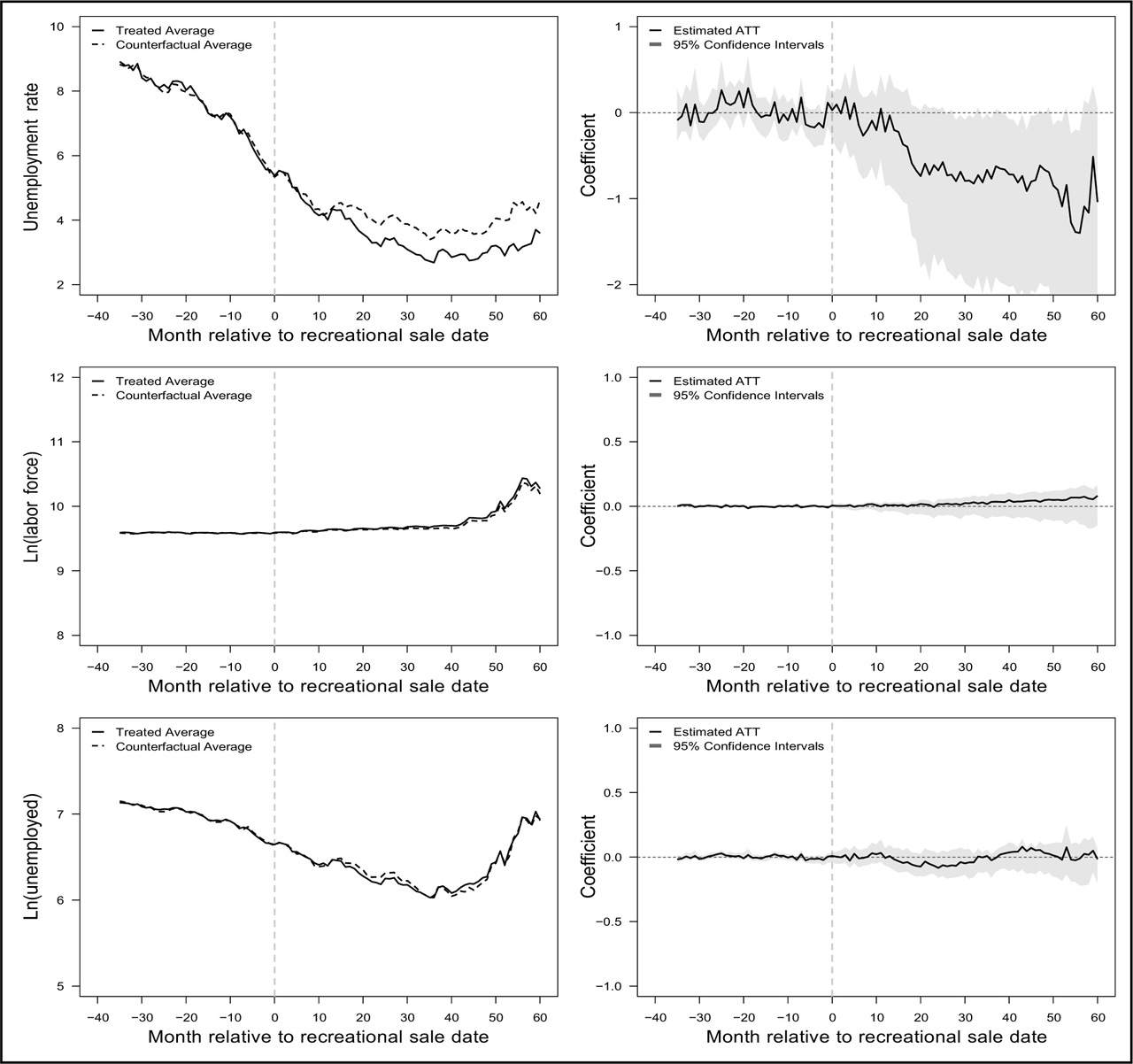
Figure 5
The effect of recreational dispensary entry on the unemployment rate, Ln(labor force), and Ln(unemployed) – GSC.
Notes: This figure shows the estimates for the main GSC results with the same set of controls as in the DID estimations. The x-axis denotes time with respect to the commencement of the sale. Period 0 is when dispensaries start selling. The path of counties where recreational sale started and counterfactuals are on the left column. The right column shows the difference between the two from the column in terms of months relative to the dispensary sale starting. The standard errors are bootstrapped, and in the mean squared prediction error (MSPE), there is an optimal number of unobserved factors (r*) selected from the model. DID, difference-in-differences; GSC, generalized synthetic control.
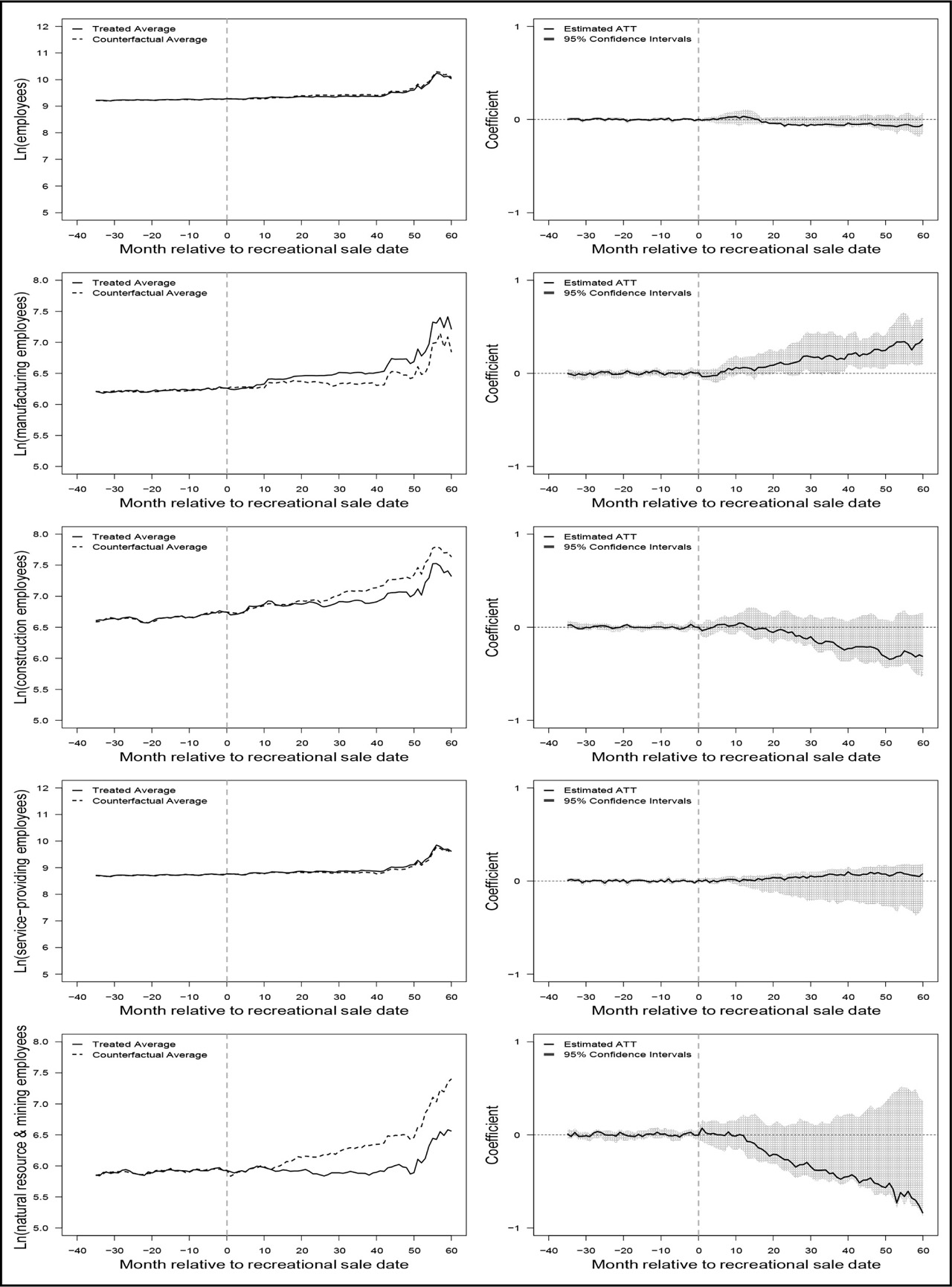
Figure 6
The effect of recreational dispensary entry on employment – GSC.
Notes: This figure shows the estimates for the main GSC results with the same set of controls as in the DID estimations. The x-axis denotes time with respect to the commencement of the sale. Period 0 is when dispensaries start selling. The path of counties where recreational sale started and counterfactuals are shown on the left column. The right column shows the difference between the two from the column in terms of months relative to the dispensary sale starting. The standard errors are bootstrapped, and in the mean squared prediction error (MSPE), there is an optimal number of unobserved factors (r*) selected from the model. DID, difference-in-differences; GSC, generalized synthetic control.
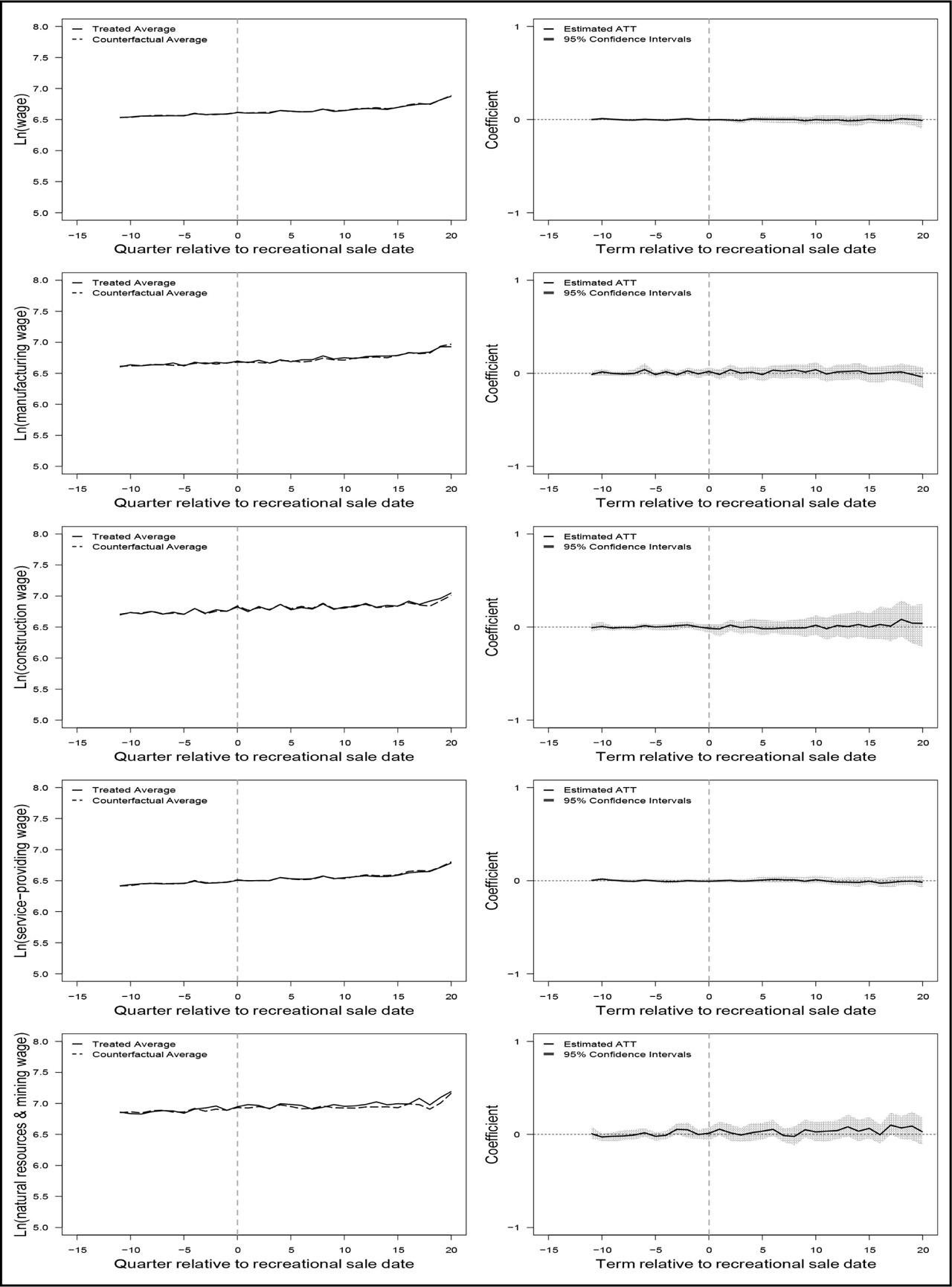
Figure 7
The effect of recreational dispensary entry on wages – GSC.
Notes: This figure shows the estimates for the main GSC results with the same set of controls as in the DID estimations. The x-axis denotes time with respect to the commencement of the sale. Period 0 is when dispensaries start selling. The path of counties where recreational sale started and counterfactuals are shown on the left column. The right column shows the difference between the two from the column in terms of quarters relative to the dispensary sale starting. The standard errors are bootstrapped, and in the mean squared prediction error (MSPE), there is an optimal number of unobserved factors (r*) selected from the model. DID, difference-in-differences; GSC, generalized synthetic control.
Table 8
The effect of recreational dispensary entry and sales on wages – regression analysis
| All | Cons | Manu | NR | Service | |
|---|---|---|---|---|---|
| (1) | (2) | (3) | (4) | (5) | |
| Panel A: amount of sales | |||||
| Recreational sale | 0.002 (0.0114) | 0.018 (0.0269) | 0.007 (0.0229) | 0.041 (0.0326) | 0.002 (0.0136) |
| Recreational sale=1 × <50km not-sellingmy=1 | −0.004 (0.0114) | −0.035 (0.0363) | 0.014 (0.0385) | −0.051* (0.0227) | 0.006 (0.0140) |
| Ln(number of medical patients) | 0.004 (0.0113) | −0.084+ (0.0459) | −0.035 (0.0271) | 0.066+ (0.0340) | 0.002 (0.0173) |
| R2 | 0.937 | 0.778 | 0.932 | 0.910 | 0.925 |
| Observations | 2,048 | 1,536 | 1,312 | 1,536 | 2,048 |
| Quarter FE | |||||
| Year FE | |||||
| County FE | |||||
Notes: Table reports the τk coefficients for k ≥0 from the event study regressions. Each column represents a separate regression. Below the table, we report the average and weighted average of the τk coefficients from the event study, including only the τk coefficients for the periods post-dispensary entry. Standard errors are clustered at the county level and reported in parentheses. The industry subsectors are Construction (Cons), Manufacturing (Manu), Natural Resources and Mining (NR), and Service.
FE, fixed effect.
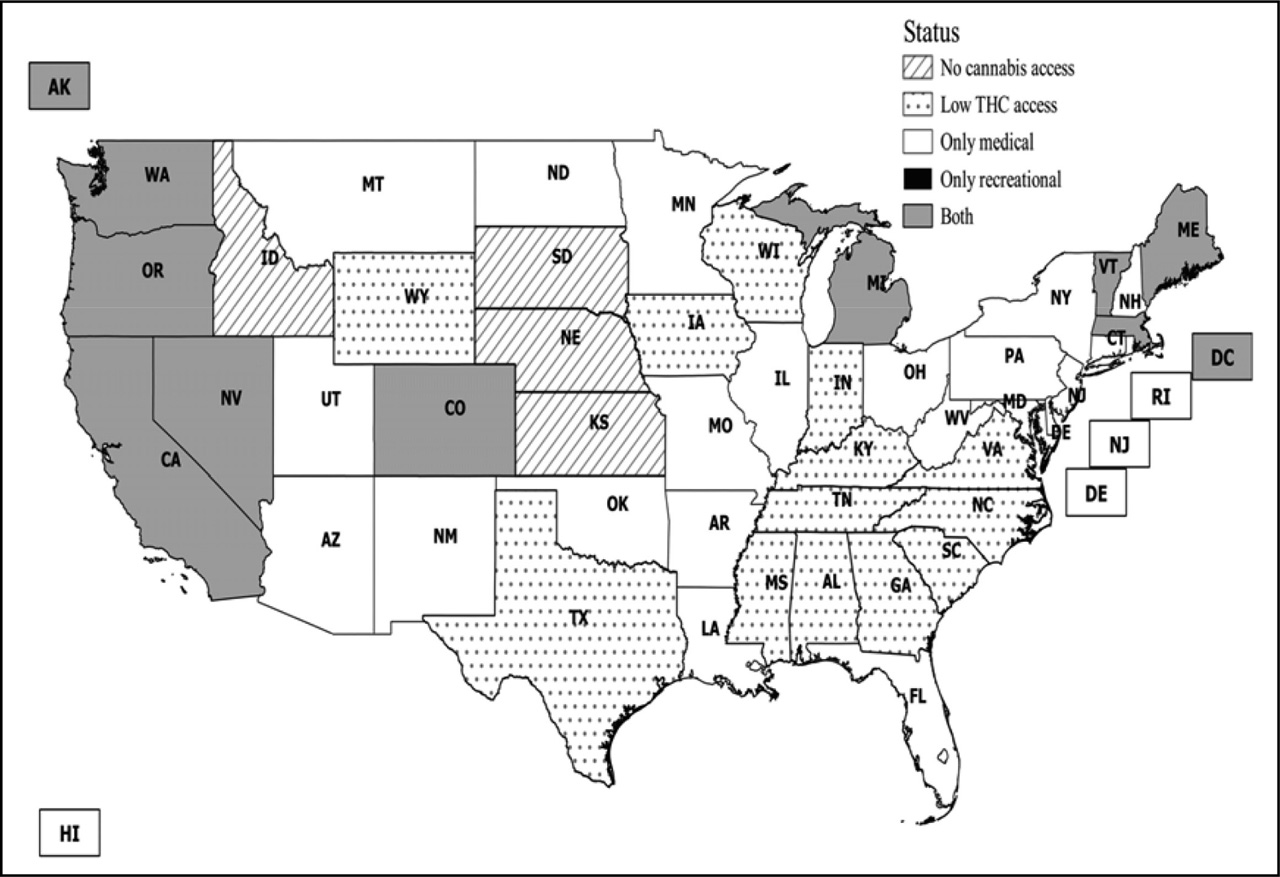
Figure A1
State Cannabis Laws in 2018.
Note: Data were obtained from the National Conference of State Legislatures.
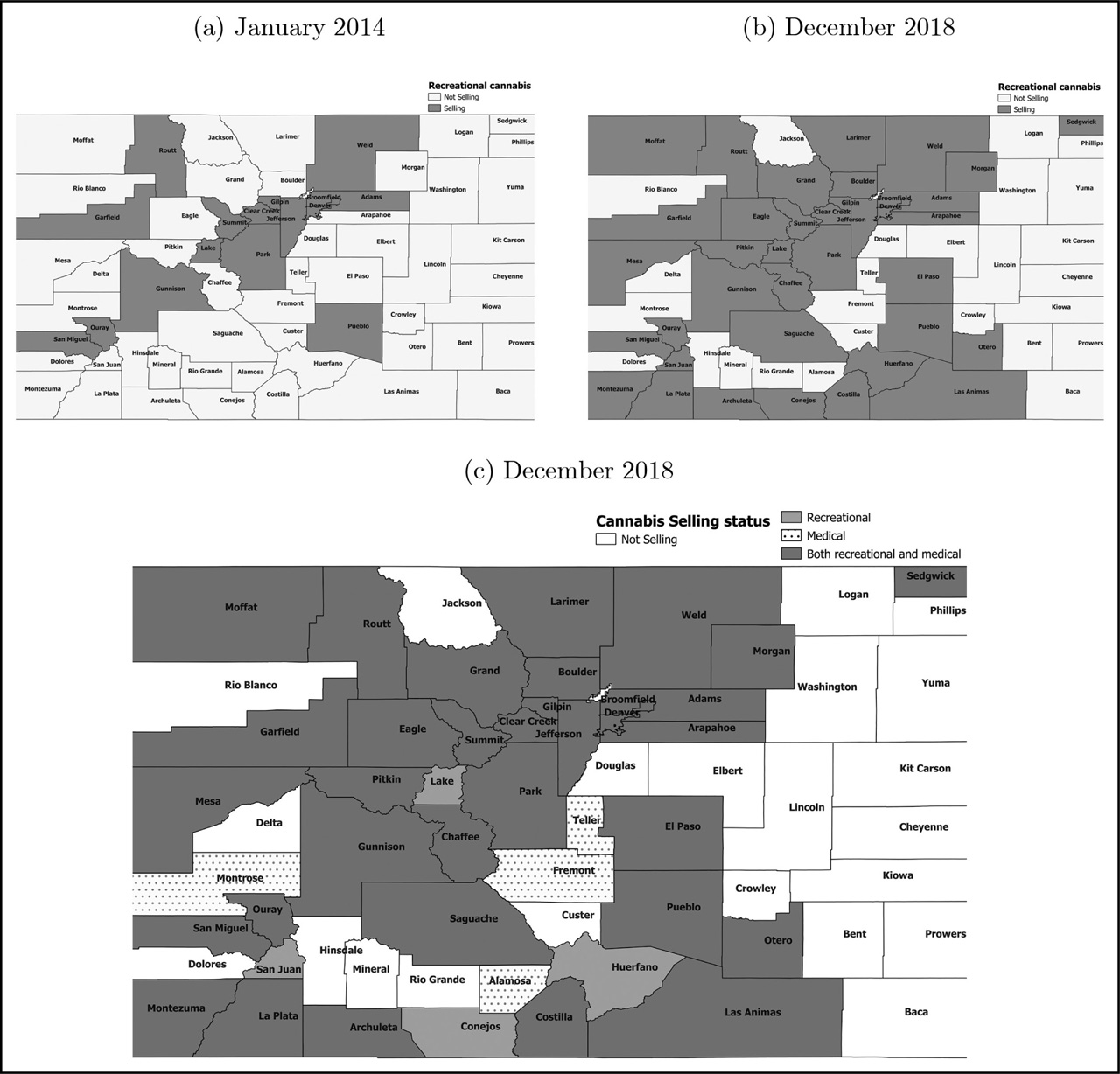
Figure A2
Counties with cannabis-selling dispensaries.
Note: The underlying data were obtained from the Colorado Department of Revenue.
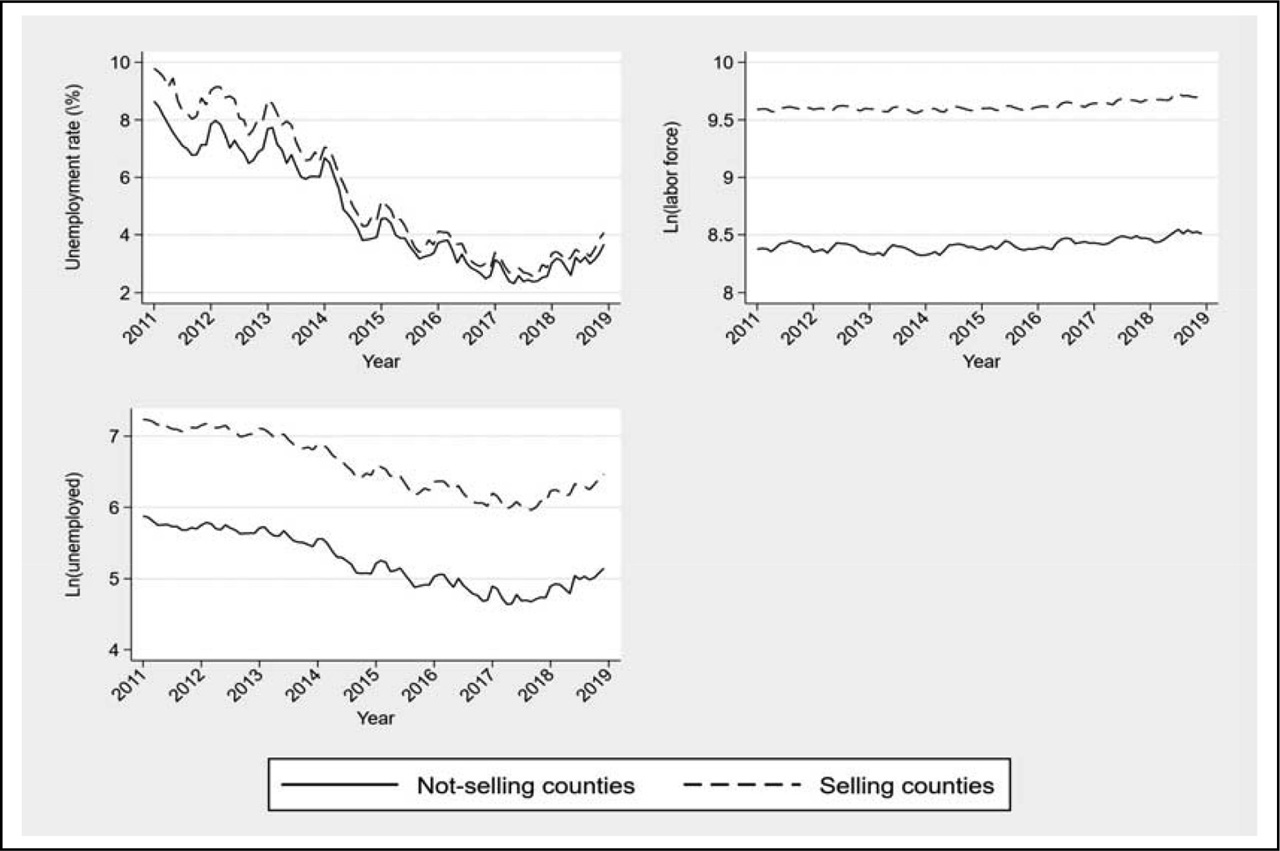
Figure A3
Unemployment rate, Ln(labor force), and Ln(unemployed) over time.
Note: The underlying data were obtained from the Local Area Unemployment Statistics.
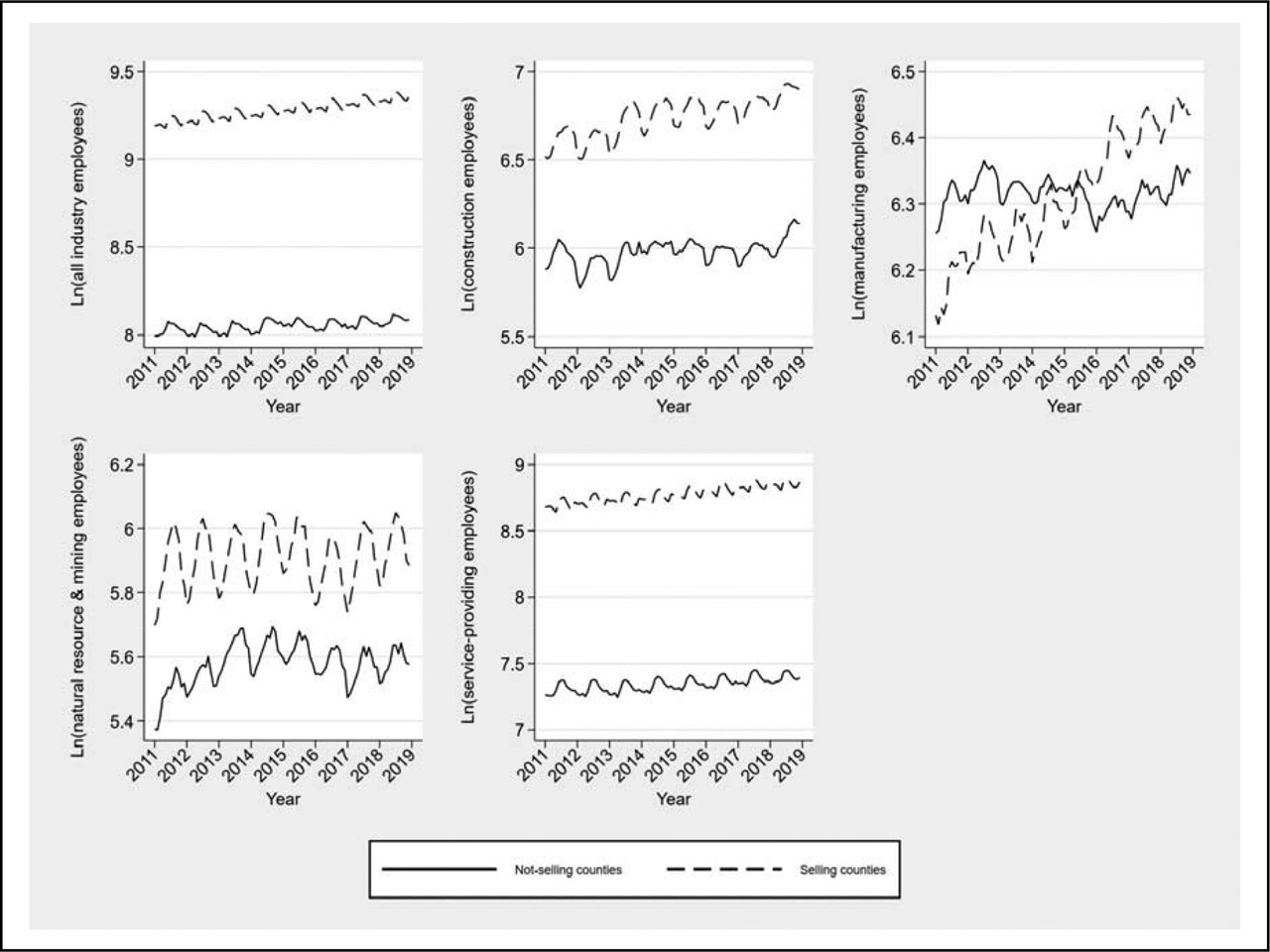
Figure A4
Ln(employees) over time.
Note: The underlying data were obtained from the Quarterly Census of Employment and Wages.
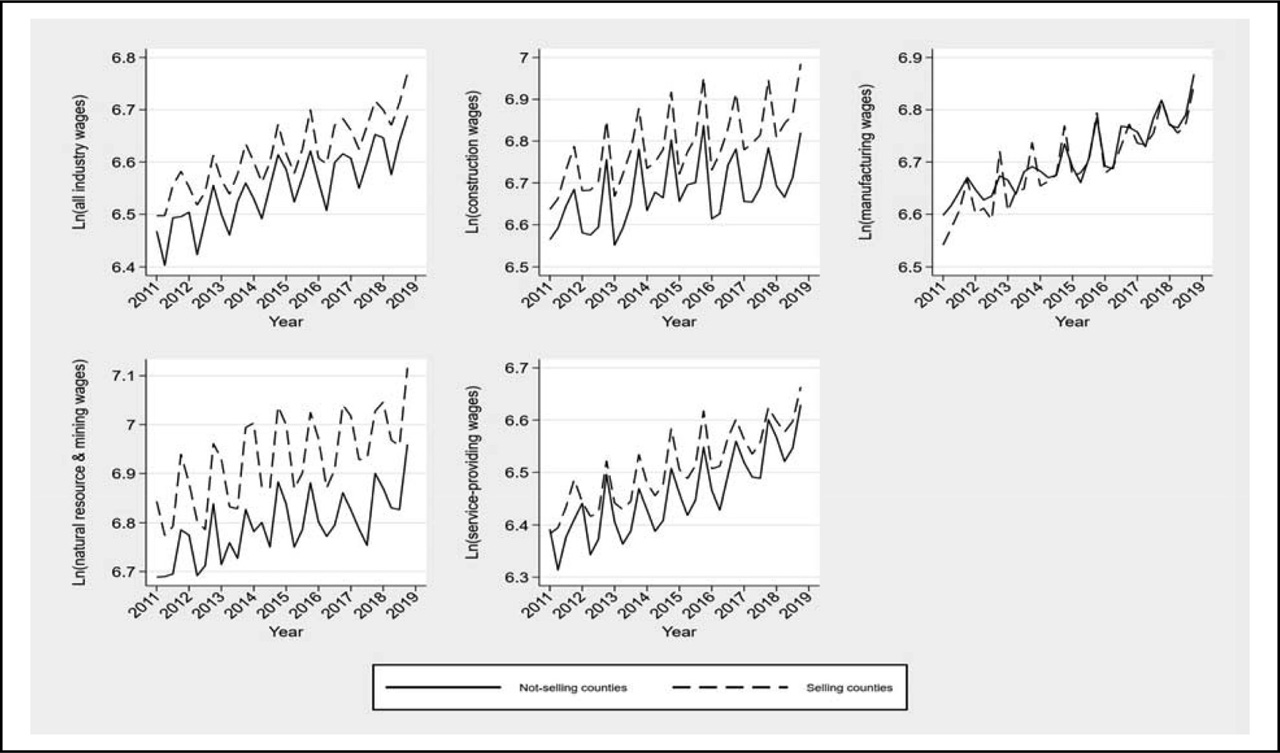
Figure A5
Ln(wages) over time.
Note: The underlying data were obtained from the Quarterly Census of Employment and Wages.
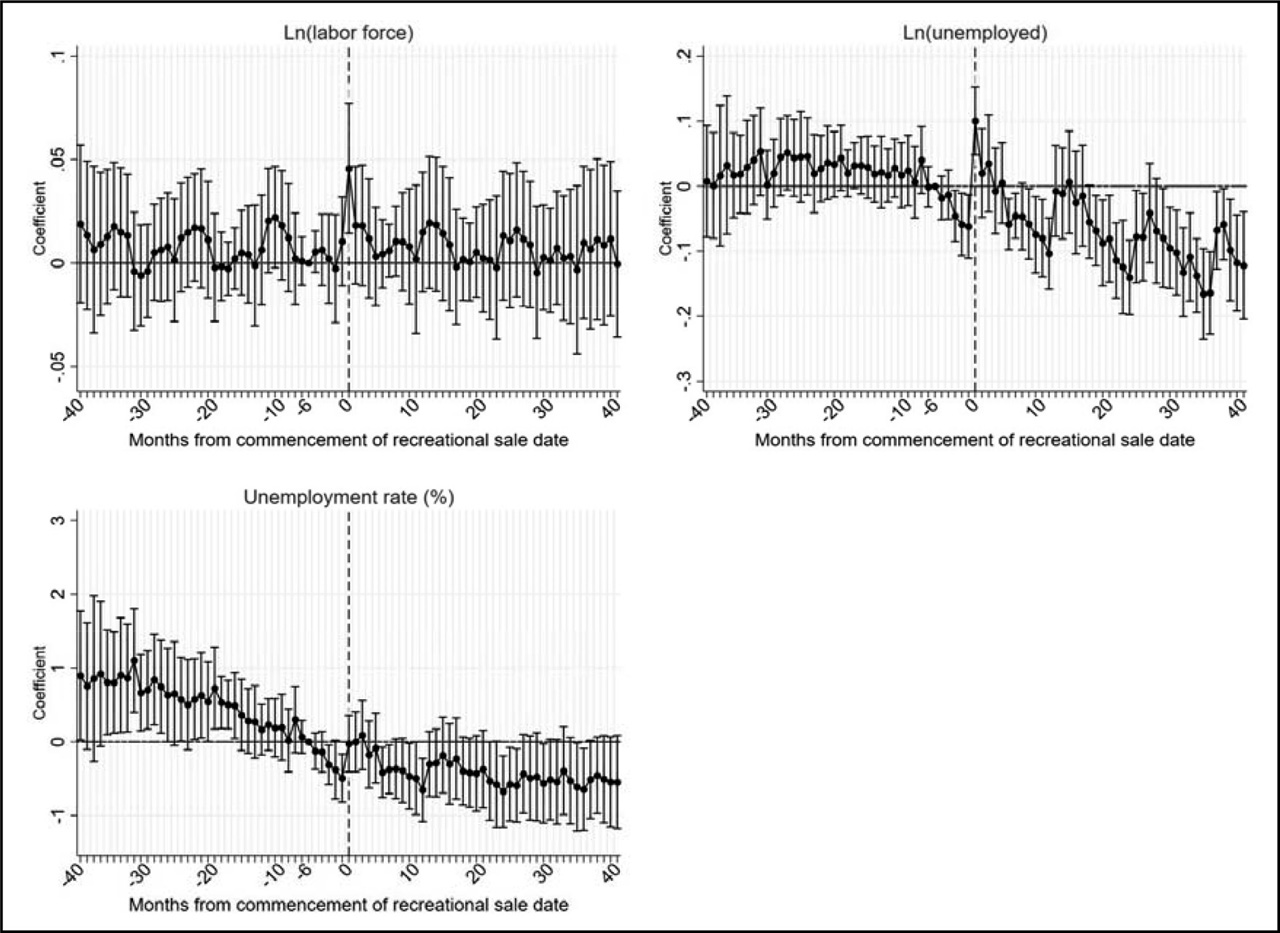
Figure A6
Effect of recreational cannabis entry on the unemployment rate, Ln(labor force), and Ln(unemployed) – event study.
Notes: The points represent the τk coefficient estimates from the estimation of Eq. (3), omitting τ−6. The bars extending from each point represent a 95% confidence interval calculated from the standard errors that are clustered at the county level. There are no standard error bars for the relative half-year k = −6 as the plot reflects that zero is imposed rather than estimated. The x-axis denotes time with respect to the commencement of the sale. Period 0 is when the sale begins. All regressions include county, month, and year fixed effects. Standard errors are clustered at the county level and reported in parentheses.
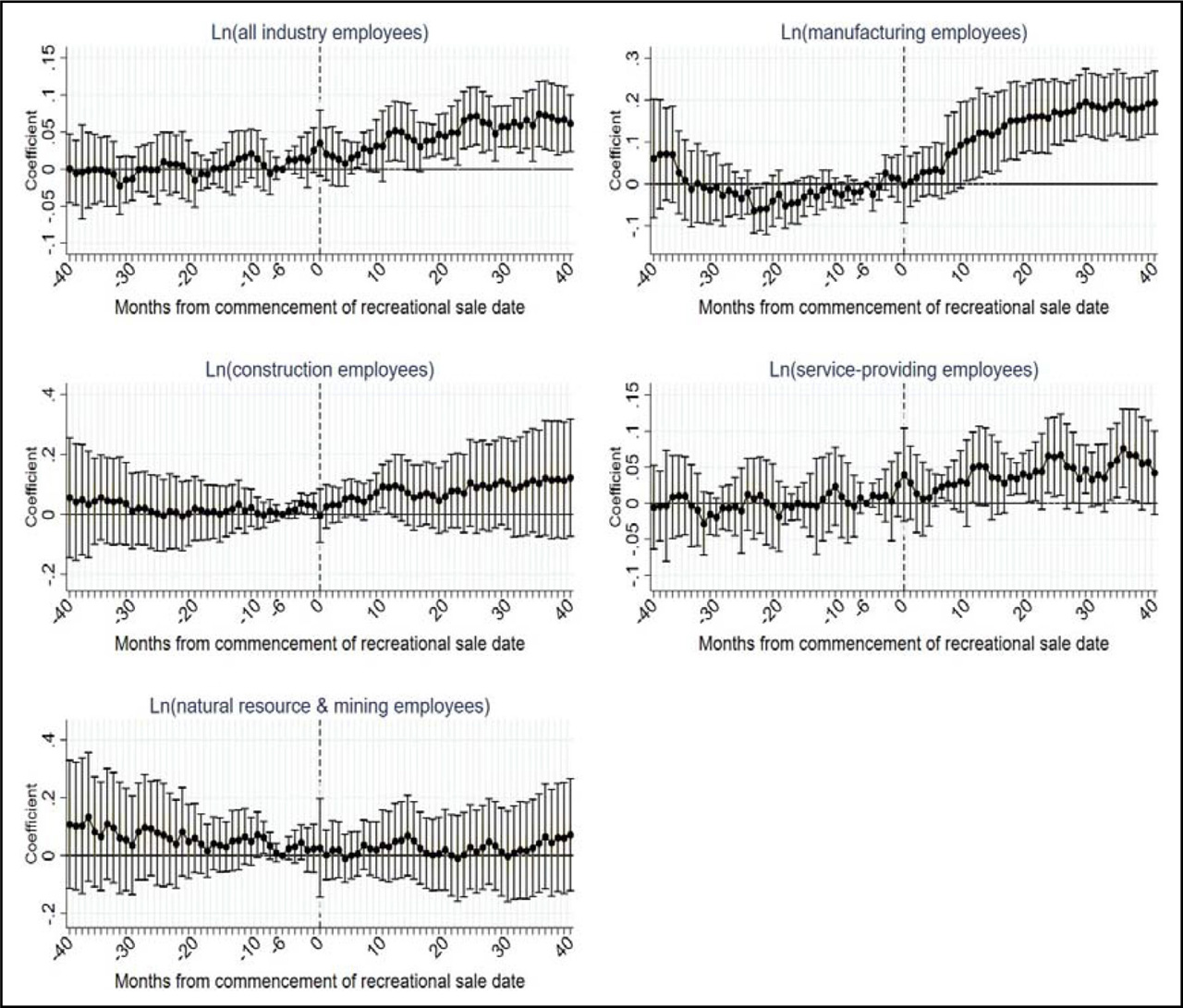
Figure A7
Effect of recreational cannabis entry on Ln(employees) by industry – event study.
Notes: The points represent the τk coefficient estimates from the estimation of Eq. (3), omitting τ−6. The bars extending from each point represent a 95% confidence interval calculated from the standard errors that are clustered at the county level. There are no standard error bars for the relative half-year k = −6 as the plot reflects that zero is imposed rather than estimated. The x-axis denotes time with respect to the commencement of the sale. Period 0 is when the sale begins. All regressions include county, month, and year fixed effects. Standard errors are clustered at the county level and reported in parentheses.
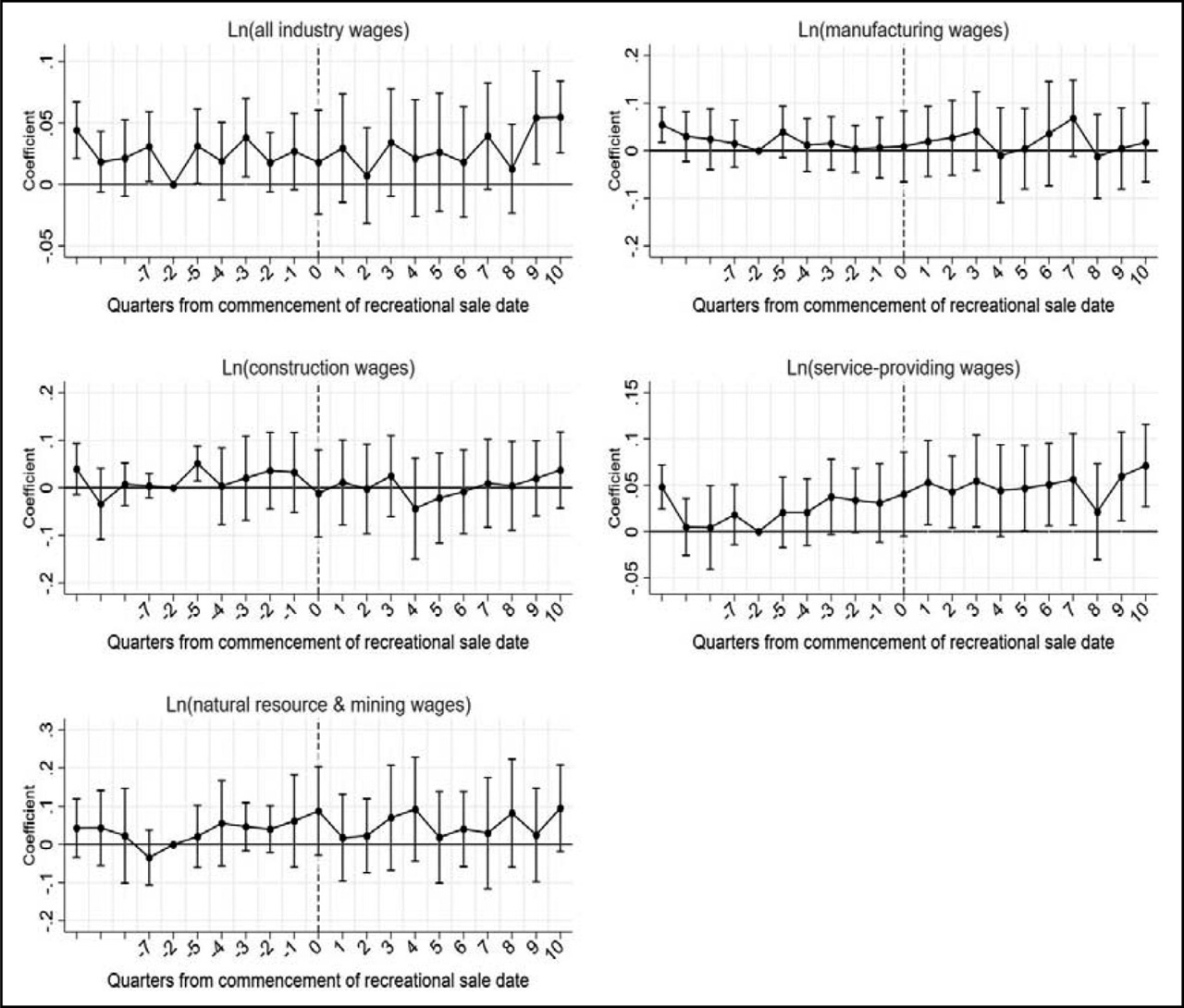
Figure A8
Effect of recreational cannabis entry on Ln(wage) by industry – event study.
Notes: The points represent the τk coefficient estimates from the estimation of Eq. (3), omitting τ−2. The bars extending from each point represent a 95% confidence interval calculated from the standard errors that are clustered at the county level. There are no standard error bars for the relative half-year k = −2 as the plot reflects that zero is imposed rather than estimated. The x-axis denotes time with respect to the commencement of the sale. Period 0 is when the sale begins. All regressions include county, month, and year fixed effects. Standard errors are clustered at the county level and reported in parentheses.
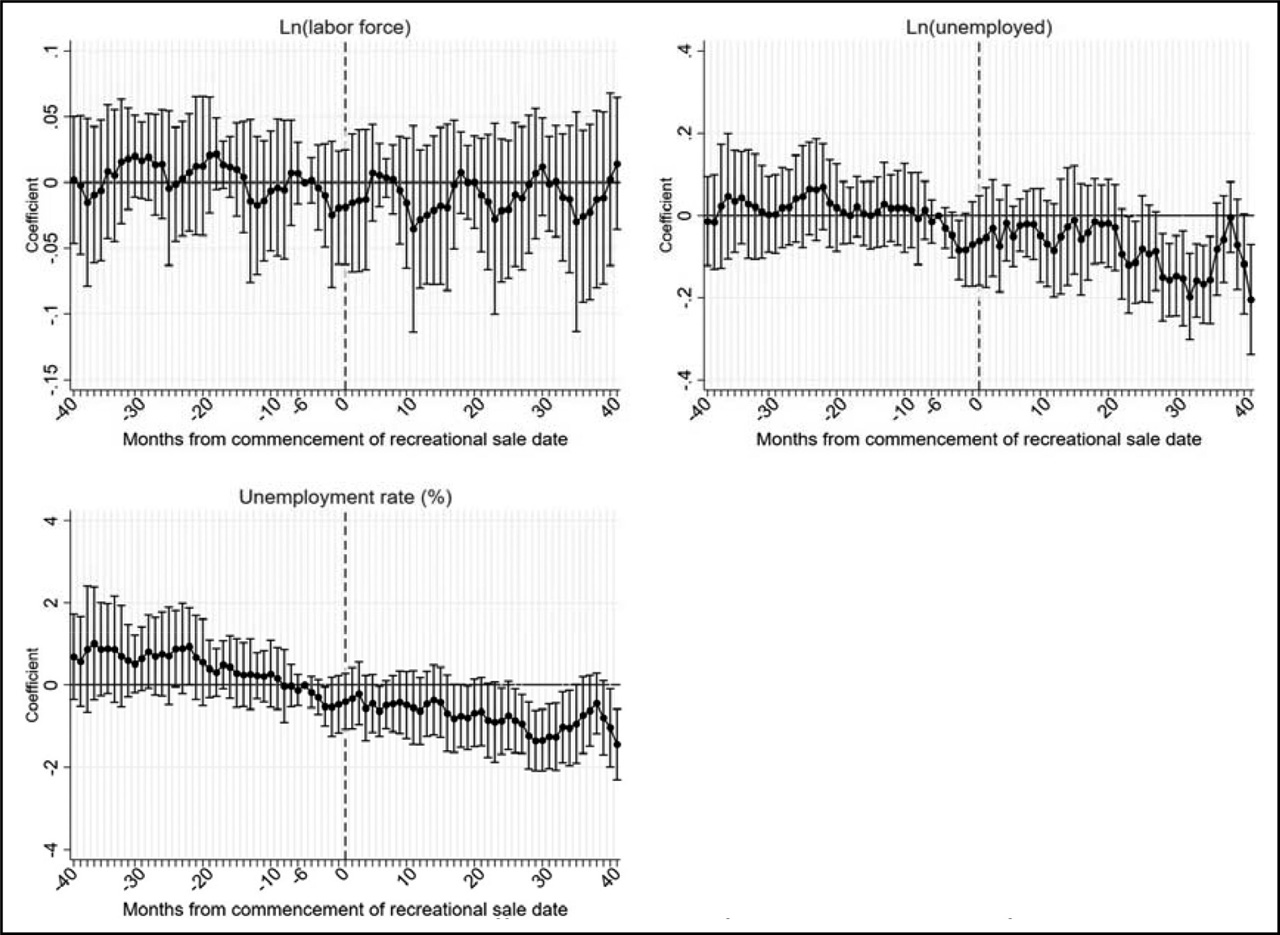
Figure A9
Effect of recreational cannabis entry on the unemployment rate, Ln(labor force), and Ln(unemployed) – event study.
Notes: The points represent the τk coefficient estimates from the estimation of Eq. (3), omitting τ−6. The bars extending from each point represent a 95% confidence interval calculated from the standard errors that are clustered at the county level. There are no standard error bars for the relative half-year k = −6 as the plot reflects that zero is imposed rather than estimated. The x-axis denotes time with respect to the commencement of the sale. Period 0 is when the sale begins. All regressions include county, month, and year fixed effects. Standard errors are clustered at the county level and reported in parentheses.
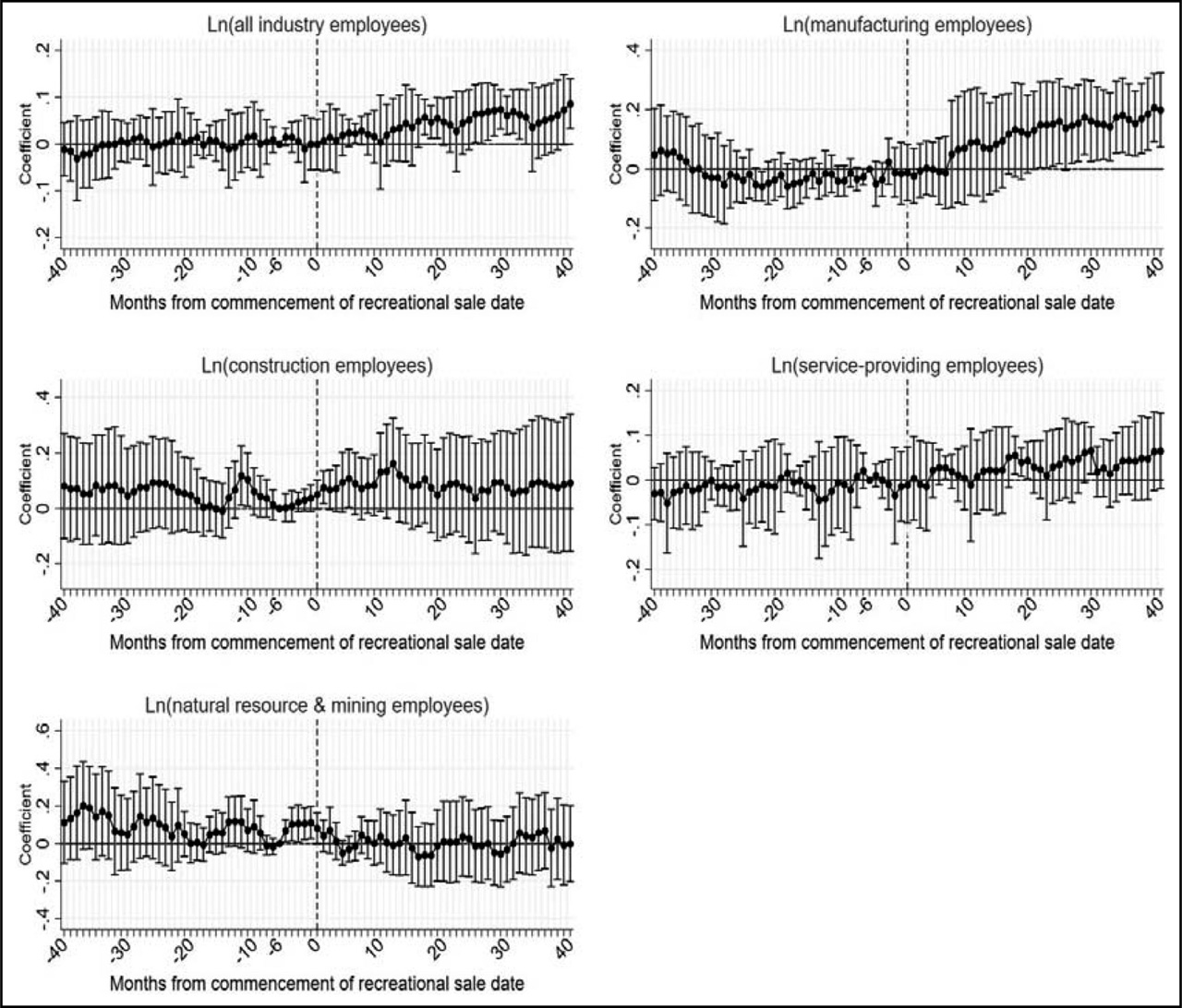
Figure A10
Effect of recreational cannabis entry on Ln(employees) by industry – event study.
Notes: The points represent the τk coefficient estimates from the estimation of Eq. (3), omitting τ−6. The bars extending from each point represent a 95% confidence interval calculated from the standard errors that are clustered at the county level. There are no standard error bars for the relative half-year k = −6 as the plot reflects that zero is imposed rather than estimated. The x-axis denotes time with respect to the commencement of the sale. Period 0 is when the sale begins. All regressions include county, month, and year fixed effects. Standard errors are clustered at the county level and reported in parentheses.
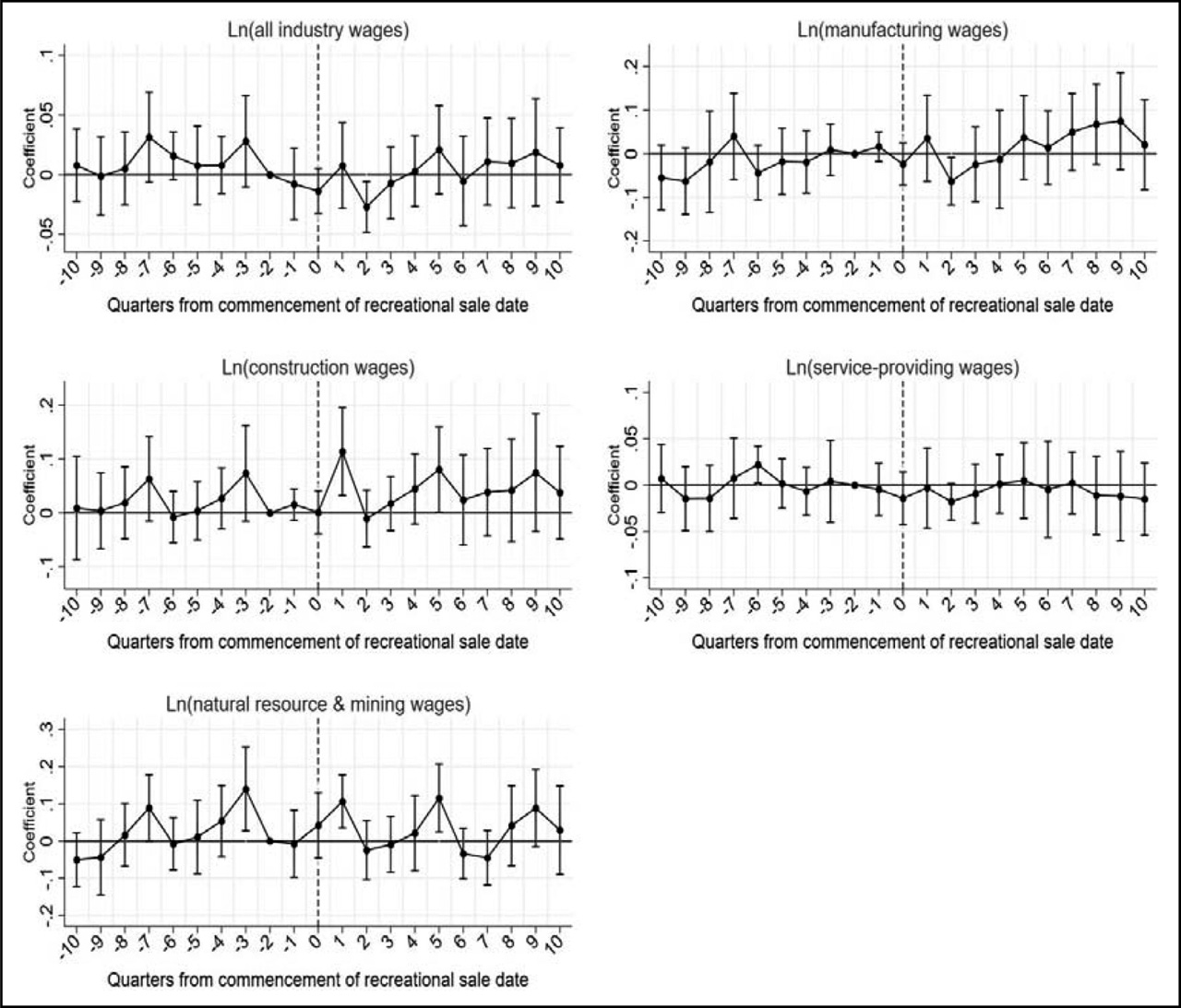
Figure A11
Effect of recreational cannabis entry on Ln(wage) by industry – event study.
Notes: The points represent the τk coefficient estimates from the estimation of Eq. (3), omitting τ−2. The bars extending from each point represent a 95% confidence interval calculated from the standard errors that are clustered at the county level. There are no standard error bars for the relative half-year k = −2 as the plot reflects that zero is imposed rather than estimated. The x-axis denotes time with respect to the commencement of the sale. Period 0 is when the sale begins. All regressions include county, month, and year fixed effects. Standard errors are clustered at the county level and reported in parentheses.
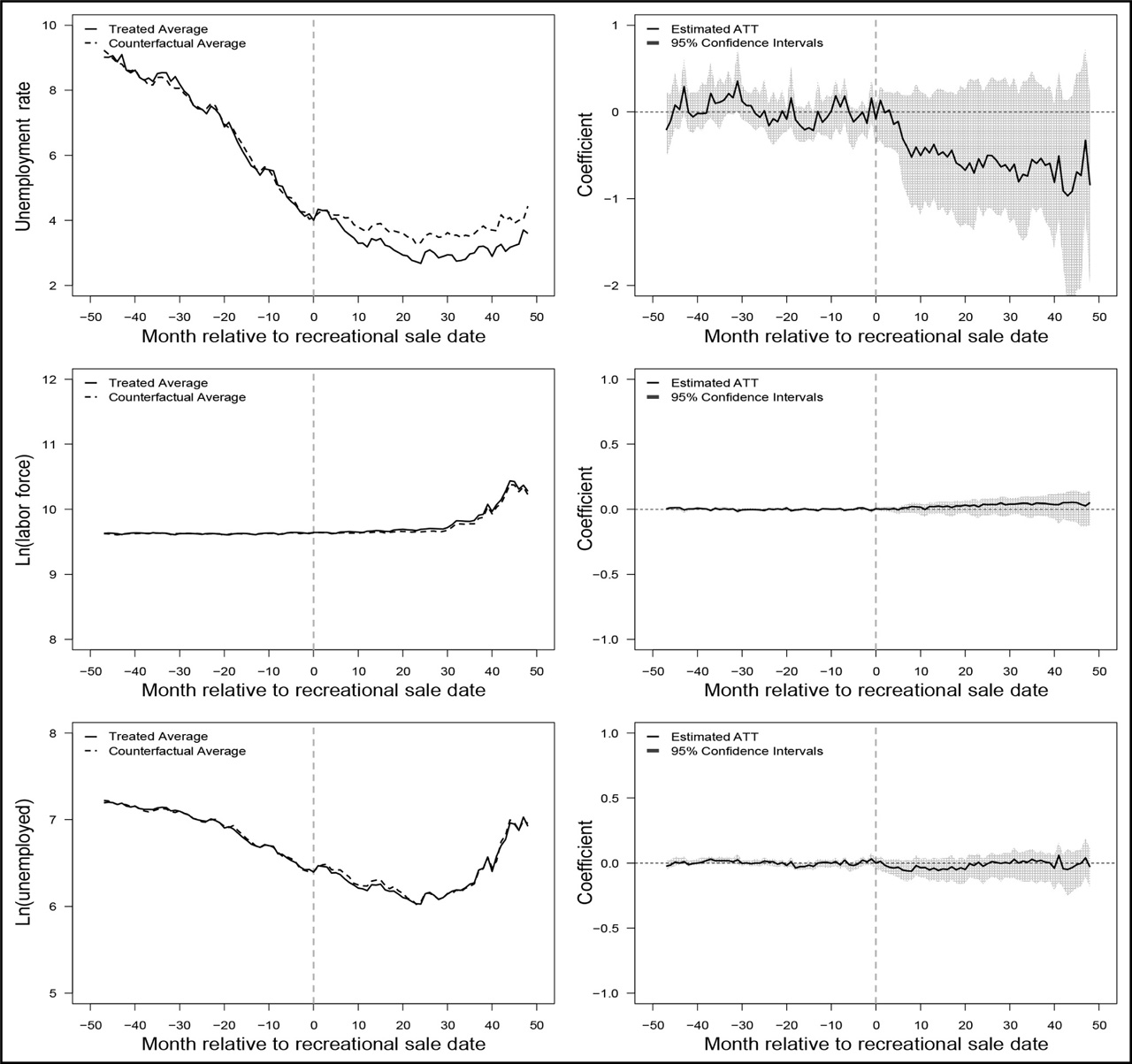
Figure A12
The effect of recreational dispensary entry on the unemployment rate, Ln(labor force), and Ln(unemployed) – GSC.
Notes: This figure shows the estimates for the main GSC results with the same set of controls as in the DID estimations. The x-axis denotes time with respect to the commencement of the sale. Period 0 is 1 year after dispensaries started selling. The path of counties where recreational sale started and counterfactuals are shown on the left column. The right column shows the difference between the two from the column in terms of months relative to the dispensary sale starting. The standard errors are bootstrapped, and in the mean squared prediction error (MSPE), there is an optimal number of unobserved factors (r*) selected from the model. DID, difference-in-differences; GSC, generalized synthetic control.
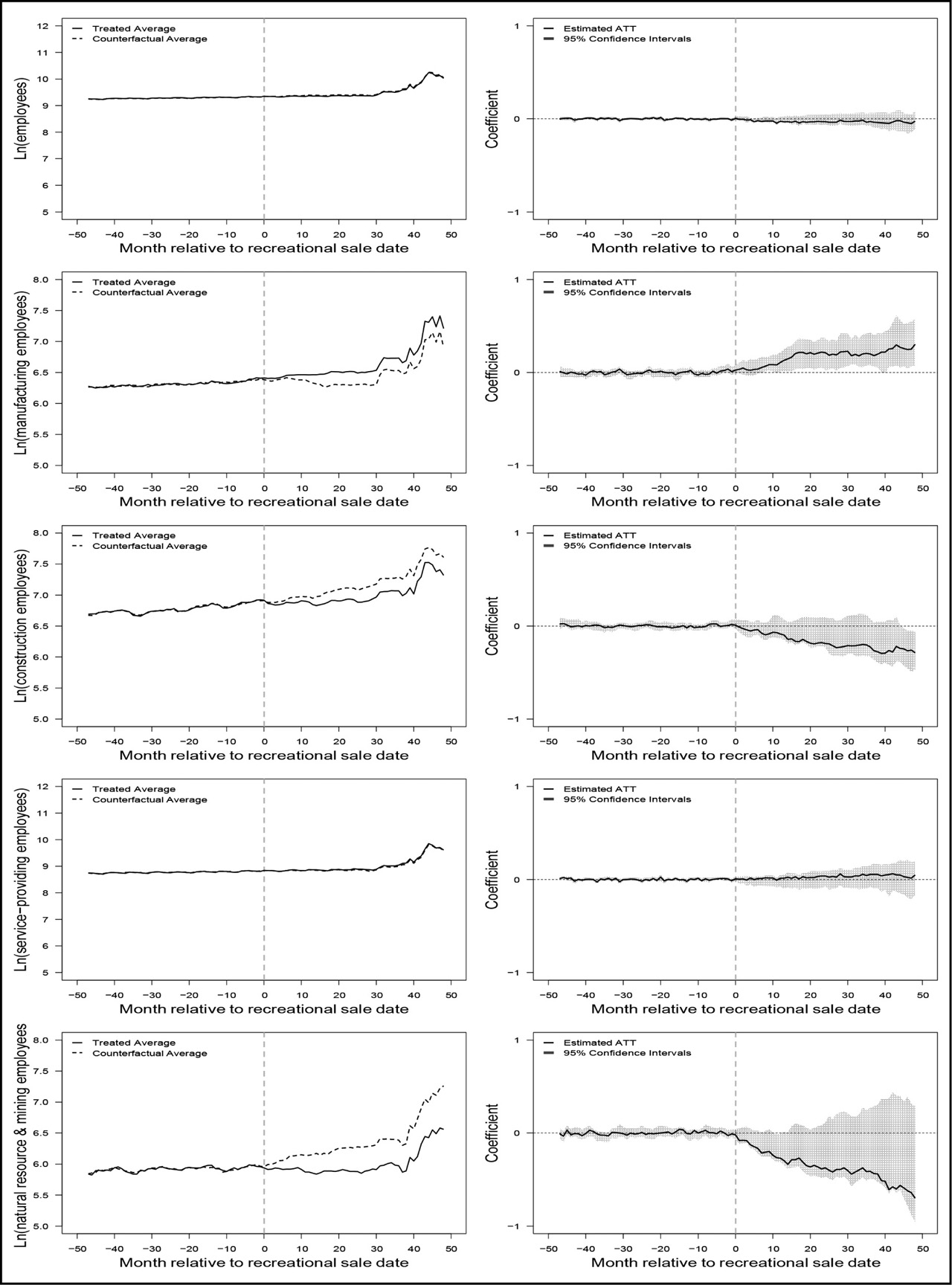
Figure A13
The effect of recreational dispensary entry on employment – GSC.
Notes: This figure shows the estimates for the main GSC results with the same set of controls as in the DID estimations. The x-axis denotes time with respect to the commencement of the sale. Period 0 is 1 year after dispensaries started selling. The path of counties where recreational sale started and counterfactuals are on the left column. The right column shows the difference between the two from the column in terms of months relative to the dispensary sale starting. The standard errors are bootstrapped, and in the mean squared prediction error s(MSPE), there is an optimal number of unobserved factors (r*) selected from the model. DID, difference-in-differences; GSC, generalized synthetic control.
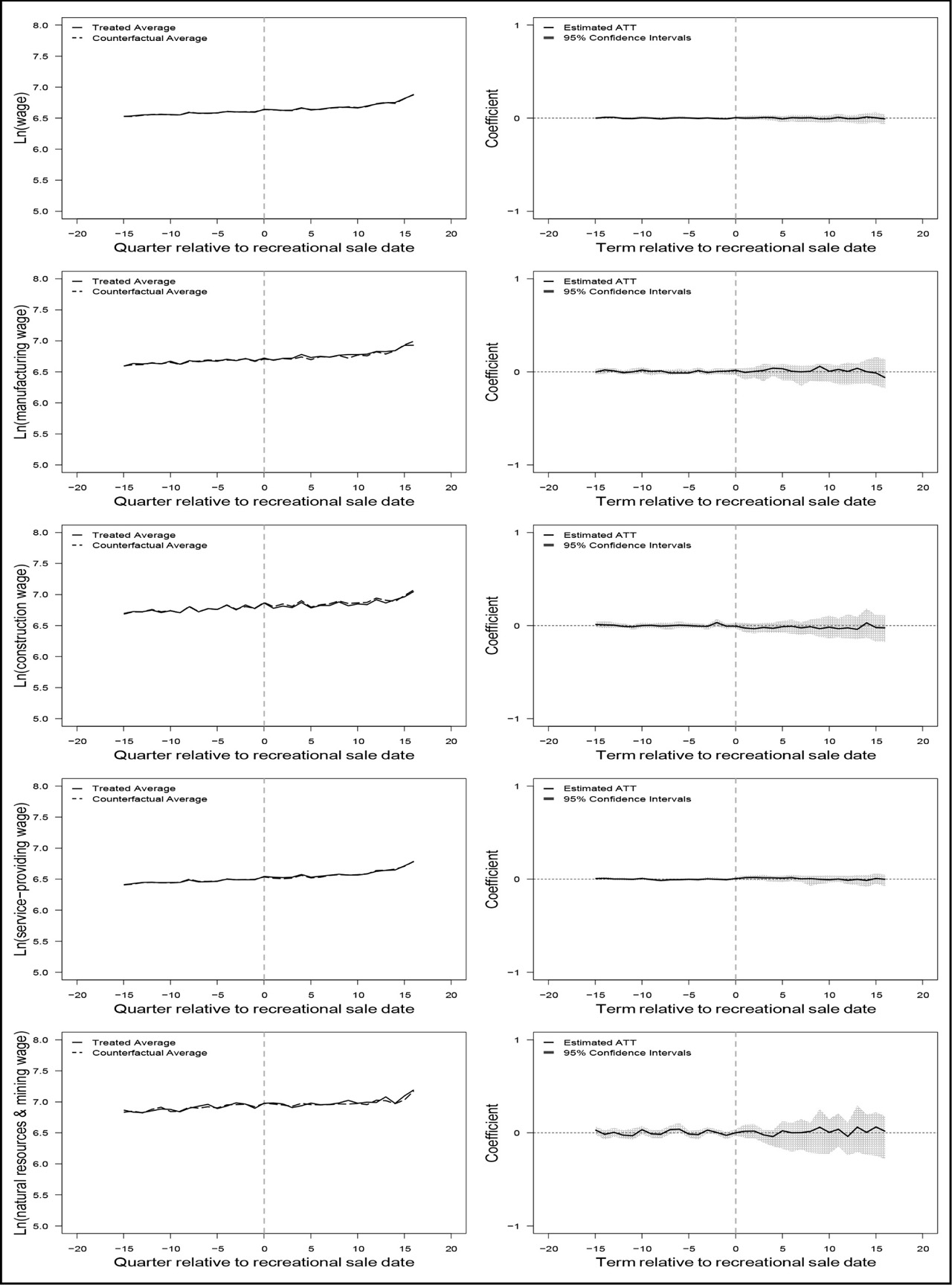
Figure A14
The effect of recreational dispensary entry on wages – GSC.
Notes: This figure shows the estimates for the main GSC results with the same set of controls as in the DID estimations. The x-axis denotes time with respect to the commencement of the sale. Period 0 is 1 year after dispensaries started selling. The path of counties where recreational sale started and counterfactuals are on the left column. The right column shows the difference between the two from the column in terms of quarter relative to the dispensary sale starting. The standard errors are bootstrapped, and in the mean squared prediction error (MSPE), there is an optimal number of unobserved factors (r*) selected from the model. DID, difference-in-differences; GSC, generalized synthetic control.
Table A1
Sources for our variable of interest
| Variable type | Source | Chronology |
|---|---|---|
| Unemployed, Labor force, and Unemployment rate (2011–2018) | Local Area Unemployment Statistics (LAUS) |  |
| Employees and wages (2011–2018) | Quarterly Census of Employment and Wages (QCEW) |  |
| Recreational cannabis sales (2014–2018) | Colorado Department of Revenue (CDOR) |  |
| Medical cannabis patients (2011–2018) | Colorado Department of Public Health and Environment (CDPHE) |  |
| Population (2011–2018) | United States Census Bureau |  |
[i] Notes: All variables are monthly, except average wage, which is quarterly.
Table A2
Descriptive statistics by treatment status
| All counties | Selling | Not selling | Differences | |||||
|---|---|---|---|---|---|---|---|---|
| Before | After | Before | After | Diff | Diff | Diff | ||
| (1) | (2) | (3) | (4) | (5) | (6) = (3)–(2) | (7) = (5)–(4) | (8) = (6)–(7) | |
| Panel A: monthly | ||||||||
| Unemployment rate, % | 5.23 | 7.86 | 3.59 | 7.09 | 3.49 | −4.268** | −3.605** | −0.663** |
| 6,144 | 1,604 | 1,948 | 972 | 1,620 | ||||
| Ln(labor force) | 9.11 | 9.48 | 9.74 | 8.38 | 8.43 | 0.258** | 0.048 | 0.21** |
| 6,144 | 1,604 | 1,948 | 972 | 1,620 | ||||
| Ln(unemployed) | 6.02 | 6.89 | 6.35 | 5.68 | 4.99 | −0.539** | −0.691** | 0.152** |
| 6,144 | 1,604 | 1,948 | 972 | 1,620 | ||||
| Ln(all industry employees) | 8.76 | 9.11 | 9.42 | 8.03 | 8.07 | 0.318** | 0.035 | 0.282** |
| 6,144 | 1,604 | 1,948 | 972 | 1,620 | ||||
| Ln(construction employees) | 6.51 | 6.50 | 6.94 | 5.94 | 6.01 | 0.436** | 0.072 | 0.364** |
| 4,608 | 1,416 | 1,752 | 540 | 900 | ||||
| Ln(manufacturing sector employees) | 6.31 | 6.06 | 6.53 | 6.32 | 6.31 | 0.470** | −0.007 | 0.477** |
| 3,936 | 1,281 | 1,503 | 432 | 720 | ||||
| Ln(natural resource and mining employees) | 5.78 | 5.86 | 5.96 | 5.55 | 5.59 | 0.105 | 0.046 | 0.059** |
| 4,608 | 1,274 | 1,510 | 684 | 1,140 | ||||
| Ln(service-providing employees) | 8.17 | 8.58 | 8.93 | 7.31 | 7.36 | 0.349** | 0.056 | 0.293** |
| 6,144 | 1,604 | 1,948 | 972 | 1,620 | ||||
| Panel B: quarterly | ||||||||
| Ln(all industry wages) | 6.59 | 6.55 | 6.67 | 6.49 | 6.59 | 0.119** | 0.097** | 0.021** |
| 2,048 | 527 | 657 | 324 | 540 | ||||
| Ln(construction wages) | 6.76 | 6.73 | 6.84 | 6.63 | 6.71 | 0.116** | 0.075* | 0.041** |
| 1,536 | 466 | 590 | 180 | 300 | ||||
| Ln(manufacturing wages) | 6.70 | 6.62 | 6.76 | 6.65 | 6.74 | 0.137** | 0.091+ | 0.046** |
| 1,312 | 421 | 507 | 144 | 240 | ||||
| Ln(natural resource and mining wages) | 6.87 | 6.86 | 6.98 | 6.74 | 6.82 | 0.119** | 0.081+ | 0.038** |
| 1,536 | 419 | 509 | 228 | 380 | ||||
| Ln(service-providing wages) | 6.49 | 6.44 | 6.57 | 6.40 | 6.50 | 0.125** | 0.098** | 0.027** |
| 2,048 | 527 | 657 | 324 | 540 | ||||
Notes: The row after each variable represents the number of observations for the respective variable by column. Columns (2) and (3) report means for selling counties, before and after they started selling. Columns (4) and (5) report means for not-selling counties, before and after 2014. Columns (6) and (7) report differences in means from a two-sided t-test. Column (8) tests the statistical significance of the difference in the differences between selling counties, μ1 in Column (6), and not-selling counties, μ2 in Column (7) by using a t-test. For the t-test in Column (8), we obtain μ1 using unadjusted regressions of outcomes on a dummy variable for the start of sale for selling counties and obtain μ2 using unadjusted regressions of outcomes on a dummy variable for post-2014 for not-selling counties. We then calculate a t-statistic for the null hypothesis μ1 − μ2 = 0 by using the pooled variance and number of observations of the two groups.
Table A3
Event study estimates post-dispensary entry periods
| Unrate | Ln(labor force) | Ln(unemp) | |
|---|---|---|---|
| (1) | (2) | (3) | |
| event0:treat | −0.026 | 0.017 | 0.024 |
| event1:treat | −0.001 | 0.018 | 0.020 |
| event2:treat | 0.090 | 0.018 | 0.035 |
| event3:treat | −0.173 | 0.012 | −0.007 |
| event4:treat | −0.085 | 0.003 | 0.005 |
| event5:treat | −0.414* | 0.004 | −0.058** |
| event6:treat | −0.373* | 0.006 | −0.046* |
| event7:treat | −0.365+ | 0.011 | −0.046+ |
| event8:treat | −0.388+ | 0.010 | −0.057* |
| event9:treat | −0.466* | 0.008 | −0.074* |
| event10:treat | −0.493* | 0.002 | −0.079** |
| event11:treat | −0.652** | 0.015 | −0.103** |
| event12:treat | −0.300 | 0.020 | −0.008 |
| event13:treat | −0.285 | 0.019 | −0.011 |
| event14:treat | −0.181 | 0.015 | 0.006 |
| event15:treat | −0.299 | 0.009 | −0.025 |
| event16:treat | −0.227 | −0.002 | −0.015 |
| event17:treat | −0.397+ | 0.002 | −0.055+ |
| event18:treat | −0.420+ | 0.001 | −0.068* |
| event19:treat | −0.429+ | 0.005 | −0.087* |
| event20:treat | −0.370 | 0.003 | −0.080* |
| event21:treat | −0.532* | 0.002 | −0.114** |
| event22:treat | −0.578+ | −0.002 | −0.124** |
| event23:treat | −0.674** | 0.013 | −0.140** |
| event24:treat | −0.575* | 0.011 | −0.078* |
| event25:treat | −0.592* | 0.016 | −0.078* |
| event26:treat | −0.434 | 0.012 | −0.041 |
| event27:treat | −0.489+ | 0.009 | −0.069+ |
| event28:treat | −0.473 | −0.004 | −0.080* |
| event29:treat | −0.563* | 0.003 | −0.095** |
| event30:treat | −0.511+ | 0.001 | −0.102** |
| event31:treat | −0.542+ | 0.007 | −0.132** |
| event32:treat | −0.393 | 0.003 | −0.108** |
| event33:treat | −0.527+ | 0.003 | −0.137** |
| event34:treat | −0.612* | −0.003 | −0.165** |
| event35:treat | −0.647* | 0.010 | −0.164** |
| event36:treat | −0.510+ | 0.006 | −0.069* |
| event37:treat | −0.454+ | 0.011 | −0.059* |
| event38:treat | −0.506+ | 0.009 | −0.098* |
| event39:treat | −0.544+ | 0.012 | −0.118** |
| event40:treat | −0.545+ | −0.000 | −0.122** |
| event>40:treat | −0.129 | 0.009 | −0.035 |
| Linear combination | |||
| Coefficient | −0.407* | 0.008 | −0.068** |
| SE | 0.2264 | 0.0125 | 0.0238 |
| Weighted linear combination | |||
| Coefficient | −0.339 | 0.008 | −0.060* |
| SE | 0.2433 | 0.0133 | 0.0243 |
| R2 | 0.887 | 0.999 | 0.995 |
| Observations | 6,144 | 6,144 | 6,144 |
Notes: Table reports the τk coefficients for k ≥ 0 from the event study regressions. Each column represents a separate regression. Below the table, we report the average and weighted average of the τk coefficients from the event study, including only the τk coefficients for periods post-dispensary entry. All regressions include month, year, and county fixed effects. Standard errors are clustered at the county level and reported in parentheses.
FE, fixed effect; SE, standard error; Unrate, unemployment rate.
Table A4
Event study estimates post-dispensary entry periods for employees, by industry
| All | Cons | Manu | NR | Service | |
|---|---|---|---|---|---|
| (1) | (2) | (3) | (4) | (5) | |
| event0:treat | 0.020 | 0.017 | 0.010 | 0.028 | 0.024 |
| event1:treat | 0.020 | 0.027 | 0.006 | 0.003 | 0.028 |
| event2:treat | 0.017 | 0.033 | 0.016 | 0.020 | 0.013 |
| event3:treat | 0.013 | 0.032 | 0.029 | 0.020 | 0.006 |
| event4:treat | 0.008 | 0.052+ | 0.030 | −0.010 | 0.008 |
| event5:treat | 0.015 | 0.058+ | 0.036 | 0.001 | 0.018 |
| event6:treat | 0.019* | 0.050+ | 0.030 | 0.006 | 0.023** |
| event7:treat | 0.028* | 0.042 | 0.070 | 0.037 | 0.027* |
| event8:treat | 0.025+ | 0.057* | 0.077 | 0.025 | 0.026 |
| event9:treat | 0.031+ | 0.073* | 0.093+ | 0.020 | 0.031 |
| event10:treat | 0.031 | 0.093* | 0.103* | 0.036 | 0.028 |
| event11:treat | 0.048* | 0.090* | 0.108* | 0.030 | 0.050* |
| event12:treat | 0.052* | 0.096+ | 0.123* | 0.049 | 0.052+ |
| event13:treat | 0.051* | 0.088 | 0.123* | 0.053 | 0.051+ |
| event14:treat | 0.044+ | 0.072 | 0.117* | 0.069 | 0.036 |
| event15:treat | 0.039+ | 0.056 | 0.126* | 0.051 | 0.036 |
| event16:treat | 0.030+ | 0.063 | 0.140** | 0.025 | 0.028 |
| event17:treat | 0.039** | 0.071 | 0.152** | 0.008 | 0.037** |
| event18:treat | 0.039** | 0.063 | 0.152** | 0.002 | 0.035** |
| event19:treat | 0.047** | 0.046 | 0.154** | 0.006 | 0.041** |
| event20:treat | 0.044** | 0.060 | 0.160** | 0.020 | 0.038* |
| event21:treat | 0.050** | 0.079 | 0.161** | 0.001 | 0.045* |
| event22:treat | 0.049* | 0.080 | 0.163** | −0.010 | 0.045+ |
| event23:treat | 0.066** | 0.070 | 0.158** | 0.002 | 0.066* |
| event24:treat | 0.070** | 0.106 | 0.173** | 0.029 | 0.064* |
| event25:treat | 0.072** | 0.090 | 0.169** | 0.013 | 0.067* |
| event26:treat | 0.063** | 0.098 | 0.172** | 0.029 | 0.051+ |
| event27:treat | 0.062** | 0.089 | 0.175** | 0.048 | 0.050* |
| event28:treat | 0.048* | 0.101 | 0.188** | 0.034 | 0.034 |
| event29:treat | 0.057** | 0.112 | 0.197** | 0.012 | 0.047** |
| event30:treat | 0.057** | 0.102 | 0.188** | −0.003 | 0.033+ |
| event31:treat | 0.063** | 0.085 | 0.185** | 0.009 | 0.040+ |
| event32:treat | 0.059** | 0.093 | 0.180** | 0.019 | 0.036 |
| event33:treat | 0.067** | 0.103 | 0.189** | 0.017 | 0.054* |
| event34:treat | 0.059* | 0.114 | 0.197** | 0.027 | 0.060* |
| event35:treat | 0.074** | 0.103 | 0.189** | 0.042 | 0.077** |
| event36:treat | 0.073** | 0.122 | 0.179** | 0.065 | 0.067* |
| event37:treat | 0.070** | 0.115 | 0.180** | 0.044 | 0.067* |
| event38:treat | 0.066** | 0.117 | 0.184** | 0.062 | 0.055+ |
| event39:treat | 0.067** | 0.113 | 0.193** | 0.060 | 0.057+ |
| event40:treat | 0.062** | 0.123 | 0.195** | 0.071 | 0.043 |
| event>40:treat | 0.076** | 0.107 | 0.171** | 0.105 | 0.054+ |
| Linear combination | |||||
| Coefficient | 0.047* | 0.080 | 0.134** | 0.028 | 0.042* |
| SE | 0.0145 | 0.0542 | 0.0333 | 0.0563 | 0.0188 |
| Weighted linear combination | |||||
| Coefficient | 0.054** | 0.086 | 0.142** | 0.046 | 0.044* |
| SE | 0.0154 | 0.0657 | 0.0328 | 0.0642 | 0.0204 |
| R2 | 0.998 | 0.989 | 0.996 | 0.970 | 0.998 |
| Observations | 6,144 | 4,608 | 3,936 | 4,608 | 6,144 |
Notes: Table reports the τk coefficients for k ≥ 0 from the event study regressions. Each column represents a separate regression. The industry subsectors are Construction (Cons), Manufacturing (Manu), Natural Resources and Mining (NR), and Service. Below the table, we report the average and weighted average of the τk coefficients from the event study, including only the τk coefficients for the periods post-dispensary entry. All regressions include month, year, and county fixed effects. Standard errors are clustered at the county level and reported in parentheses.
FE, fixed effect; SE, standard error.
Table A5
Event study estimates post-dispensary entry periods for wages, by industry
| All | Cons | Manu | NR | Service | |
|---|---|---|---|---|---|
| (1) | (2) | (3) | (4) | (5) | |
| event0:treat | −0.005 | −0.017 | −0.006 | 0.033 | 0.000 |
| event1:treat | 0.008 | 0.041+ | 0.028 | 0.033 | 0.009 |
| event2:treat | −0.018* | −0.018 | −0.018 | −0.020 | −0.003 |
| event3:treat | 0.007 | 0.010 | 0.005 | 0.008 | 0.010 |
| event4:treat | 0.011 | −0.016 | −0.002 | 0.029 | 0.015 |
| event5:treat | 0.018 | 0.007 | 0.026 | 0.034 | 0.014 |
| event6:treat | 0.004 | −0.010 | 0.027 | −0.011 | 0.012 |
| event7:treat | 0.023* | 0.010 | 0.059* | −0.027 | 0.020 |
| event8:treat | 0.006 | 0.012 | 0.042 | 0.034 | −0.005 |
| event9:treat | 0.030* | 0.033 | 0.051 | 0.025 | 0.013 |
| event10:treat | 0.027* | 0.030 | 0.026 | 0.045 | 0.017 |
| event>10:treat | 0.018 | 0.029 | 0.023 | 0.039 | −0.004 |
| Linear combination | |||||
| Coefficient | 0.011 | 0.009 | 0.022 | 0.019 | 0.008 |
| SE | 0.0076 | 0.0239 | 0.0265 | 0.0269 | 0.0093 |
| Weighted linear combination | |||||
| Coefficient | 0.013 | 0.017 | 0.022 | 0.026 | 0.004 |
| SE | 0.0092 | 0.0314 | 0.0298 | 0.0323 | 0.0105 |
| R2 | 0.938 | 0.780 | 0.933 | 0.910 | 0.925 |
| Observations | 2,048 | 1,536 | 1,312 | 1,536 | 2,048 |
Notes: Table reports the τk coefficients for k ≥0 from the event study regressions. Each column represents a separate regression. The industry subsectors are Construction (Cons), Manufacturing (Manu), Natural Resources and Mining (NR), and Service. Below the table, we report the average and weighted average of the τk coefficients from the event study, including only the τk coefficients for the periods post-dispensary entry. All regressions include month, year, and county fixed effects. Standard errors are clustered at the county level and reported in parentheses.
FE, fixed effect; SE, standard error.
Table A6
The effect of recreational dispensary entry and sales on the unemployment rate, Ln(labor force), and Ln(unemployed) – regression analysis
| Unrate | Ln(labor force) | Ln(unemp) | |
|---|---|---|---|
| (1) | (2) | (3) | |
| Panel A: start of sales | |||
| Recreational sale | −0.718** (0.2428) | −0.014 (0.0105) | −0.078** (0.0200) |
| Ln(number of medical patients) | −0.607* (0.2714) | 0.001 (0.0111) | −0.021 (0.0250) |
| Ln(population) | 1.158 (2.4361) | 0.531** (0.1261) | 0.338+ (0.1900) |
| R2 | 0.882 | 0.999 | 0.995 |
| Observations | 6,144 | 6,144 | 6,144 |
| Panel B: amount of sales | |||
| $0 < sales ≤$500,000 (0.2720) | −0.752** (0.0099) | −0.009 (0.0224) | −0.066** |
| Sales >$500,000 (0.2515) | −0.669** (0.0125) | −0.021 (0.0251) | −0.094** |
| Ln(number of medical patients) | −0.601** (0.2737) | 0.000 (0.0108) | −0.023 (0.0260) |
| Ln(population) | 1.069 (2.4483) | 0.543** (0.1276) | 0.369+ (0.1872) |
| R2 | 0.882 | 0.999 | 0.995 |
| Observations | 6,144 | 6,144 | 6,144 |
Notes: Panel A uses a {0,1} any sales as the treatment variable, while Panel B compares counties with sales between $0 and $500,000 or sales >$500,000 with counties with zero sales. Each column represents a separate regression. All regressions include month, year, and county fixed effects. Standard errors are clustered at the county level and reported in parentheses.
Unrate, unemployment rate.
Table A7
The effect of recreational dispensary entry and sales on employment – regression analysis
| All | Cons | Manu | NR | Service | |
|---|---|---|---|---|---|
| (1) | (2) | (3) | (4) | (5) | |
| Panel A: start of sales | |||||
| Recreational sale | 0.016 (0.0120) | 0.020 (0.0633) | 0.113** (0.0396) | −0.066 (0.0712) | 0.014 (0.0132) |
| Ln(number of medical patients) | −0.010 (0.0128) | −0.130 (0.0904) | −0.166** (0.0541) | 0.205 (0.1224) | −0.015 (0.0158) |
| Ln(population) | 0.953** (0.1578) | 1.993+ (1.0110) | 0.732 (0.5178) | 1.576 (1.0049) | 0.834** (0.1491) |
| R2 | 0.998 | 0.989 | 0.996 | 0.970 | 0.998 |
| Observations | 6,144 | 4,608 | 3,936 | 4,608 | 6,144 |
| Panel B: amount of sales | |||||
| $0 < sales ≤$500,000 | 0.007 (0.0138) | 0.022 (0.0550) | 0.133** (0.0403) | −0.074 (0.0693) | 0.006 (0.0159) |
| Sales >$500,000 | 0.029** (0.0136) | 0.017 (0.0757) | 0.086+ (0.0434) | −0.057 (0.0860) | 0.026+ (0.0142) |
| Ln(number of medical patients) | −0.009 (0.0132) | −0.130 (0.0901) | −0.171** (0.0522) | 0.206+ (0.1222) | −0.014 (0.0159) |
| Ln(population) | 0.930** (0.1612) | 1.996+ (1.0238) | 0.777 (0.5181) | 1.561 (1.0195) | 0.813** (0.1507) |
| R2 | 0.998 | 0.989 | 0.996 | 0.970 | 0.998 |
| Observations | 6,144 | 4,608 | 3,936 | 4,608 | 6,144 |
Notes: Panel A uses a {0,1} any sales as the treatment variable, while Panel B compares counties with sales between $0 and $500,000 or sales >$500,000 with counties with zero sales. Each column represents a separate regression. The industry subsectors are Construction (Cons), Manufacturing (Manu), Natural Resources and Mining (NR), and Service. All regressions include month, year, and county fixed effects. Standard errors are clustered at the county level and reported in parentheses.
Table A8
The effect of recreational dispensary entry and sales on wages – regression analysis
| All | Cons | Manu | NR | Service | |
|---|---|---|---|---|---|
| (1) | (2) | (3) | (4) | (5) | |
| Panel A: start of sales | |||||
| Recreational sale | −0.005 (0.0093) | 0.001 (0.0290) | 0.019 (0.0192) | 0.037 (0.0347) | −0.004 (0.0116) |
| Ln(number of medical patients) | 0.006 (0.0118) | −0.074 (0.0452) | −0.046 (0.0282) | 0.055 (0.0343) | 0.006 (0.0193) |
| Ln(population) | 0.191 (0.1207) | 0.359 (0.4475) | −0.391 (0.2890) | −0.368 (0.2931) | 0.291+ (0.1620) |
| R2 | 0.937 | 0.778 | 0.933 | 0.910 | 0.926 |
| Observations | 2,048 | 1,536 | 1,312 | 1,536 | 2,048 |
| Panel B: amount of sales | |||||
| $0 < sales ≤$500,000 | 0.001 (0.0100) | 0.003 (0.0273) | 0.032 (0.0245) | 0.038 (0.0318) | 0.002 (0.0127) |
| Sales >$500,000 | −0.014 (0.0108) | −0.001 (0.0364) | 0.000 (0.0173) | 0.036 (0.0420) | −0.014 (0.0125) |
| Ln(number of medical patients) | 0.005 (0.0114) | −0.074 (0.0453) | −0.049+ (0.0281) | 0.055 (0.0341) | 0.005 (0.0189) |
| Ln(population) | 0.208+ (0.1213) | 0.362 (0.4527) | −0.358 (0.2822) | −0.366 (0.2991) | 0.310+ (0.1615) |
| R2 | 0.937 | 0.778 | 0.933 | 0.910 | 0.926 |
| Observations | 2,048 | 1,536 | 1,312 | 1,536 | 2,048 |
Notes: Panel A uses a {0,1} any sales as the treatment variable, while Panel B compares counties with sales between $0 and $500,000 or sales >$500,000 with counties with zero sales. Each column represents a separate regression. The industry subsectors are Construction (Cons), Manufacturing (Manu), Natural Resources and Mining (NR), and Service. All regressions include quarter, year, and county fixed effects. Standard errors are clustered at the county level and reported in parentheses.
Table A9
The effect of recreational dispensary entry and sales on the unemployment rate (Unrate), Ln(labor force), and Ln(unemployed) – regression analysis
| Unrate | Ln(labor force) | Ln(unemp) | |
|---|---|---|---|
| (1) | (2) | (3) | |
| Panel A: start of sales | |||
| Recreational sale | −0.693** (0.2522) | 0.002 (0.0116) | −0.070** (0.0195) |
| Ln(number of medical patients) | −0.588* (0.2675) | −0.009 (0.0127) | −0.021 (0.0252) |
| R2 | 0.915 | 0.999 | 0.996 |
| Observations | 6,144 | 6,144 | 6,144 |
| Panel B: amount of sales | |||
| $0 < sales ≤$500,000 | −0.807** (0.2798) | 0.006 (0.0111) | −0.070** (0.0214) |
| Sales >$500,000 | −0.552** (0.2653) | −0.003 (0.0144) | −0.070** (0.0244) |
| Ln(number of medical patients) | −0.568** (0.2727) | −0.009 (0.0127) | −0.021 (0.0259) |
| R2 | 0.915 | 0.999 | 0.996 |
| Observations | 6,144 | 6,144 | 6,144 |
Notes: Panel A uses a {0,1} any sales as the treatment variable, while Panel B compares counties with sales between $0 and $500,000 or sales >$500,000 with counties with zero sales. Each column represents a separate regression. All regressions include month, year, county, and month x county fixed effects. Standard errors are clustered at the county level and reported in parentheses.
Table A10
The effect of recreational dispensary entry and sales on employment – regression analysis
| All | Cons | Manu | NR | Service | |
|---|---|---|---|---|---|
| (1) | (2) | (3) | (4) | (5) | |
| Panel A: start of sales | |||||
| Recreational sale | 0.045** (0.0152) | 0.056 (0.0551) | 0.131** (0.0357) | −0.018 (0.0673) | 0.040* (0.0153) |
| Ln(number of medical patients) | −0.026+ (0.0142) | −0.171+ (0.0917) | −0.186** (0.0604) | 0.170 (0.1165) | −0.031+ (0.0179) |
| R2 | 0.999 | 0.989 | 0.996 | 0.973 | 0.999 |
| Observations | 6,144 | 4,608 | 3,936 | 4,608 | 6,144 |
| Panel B: amount of sales | |||||
| $0 < sales ≤$500,000 | 0.035** (0.0158) | 0.050 (0.0493) | 0.156** (0.0394) | −0.035 (0.0675) | 0.034+ (0.0173) |
| Sales >$500,000 | 0.057** (0.0176) | 0.062 (0.0670) | 0.103** (0.0366) | 0.000 (0.0814) | 0.046** (0.0166) |
| Ln(number of medical patients) | −0.024 (0.0147) | −0.171+ (0.0922) | −0.192** (0.0581) | 0.173 (0.1169) | −0.030+ (0.0179) |
| R2 | 0.999 | 0.989 | 0.996 | 0.973 | 0.999 |
| Observations | 6,144 | 4,608 | 3,936 | 4,608 | 6,144 |
Notes: Panel A uses a {0,1} any sales as the treatment variable, while Panel B compares counties with sales between $0 and $500,000 or sales >$500,000 with counties with zero sales. Each column represents a separate regression. The industry subsectors are Construction (Cons), Manufacturing (Manu), Natural Resources and Mining (NR), and Service. All regressions include month, year, county, and month x county fixed effects. Standard errors are clustered at the county level and reported in parentheses.
Table A11
The effect of recreational dispensary entry and sales on wages – regression analysis
| All | Cons | Manu | NR | Service | |
|---|---|---|---|---|---|
| (1) | (2) | (3) | (4) | (5) | |
| Panel A: start of sales | |||||
| Recreational sale | −0.000 (0.0100) | 0.006 (0.0264) | 0.007 (0.0189) | 0.023 (0.0319) | 0.004 (0.0125) |
| Ln(number of medical patients) | 0.004 (0.0109) | −0.082+ (0.0470) | −0.036 (0.0262) | 0.056+ (0.0320) | 0.004 (0.0170) |
| R2 | 0.956 | 0.817 | 0.950 | 0.941 | 0.951 |
| Observations | 2,048 | 1,536 | 1,312 | 1,536 | 2,048 |
| Panel B: amount of sales | |||||
| $0 < sales ≤ $500,000 | 0.004 (0.0107) | 0.004 (0.0253) | 0.021 (0.0247) | 0.025 (0.0300) | 0.009 (0.0141) |
| Sales > $500,000 | −0.007 (0.0119) | 0.009 (0.0332) | −0.011 (0.0187) | 0.020 (0.0376) | −0.002 (0.0131) |
| Ln(number of medical patients) | 0.003 (0.0106) | −0.082+ (0.0470) | −0.040 (0.0270) | 0.055+ (0.0317) | 0.003 (0.0168) |
| R2 | 0.956 | 0.817 | 0.951 | 0.941 | 0.951 |
| Observations | 2,048 | 1,536 | 1,312 | 1,536 | 2,048 |
Notes: Panel A uses a {0,1} any sales as the treatment variable, while Panel B compares counties with sales between $0 and $500,000 or sales >$500,000 with counties with zero sales. Each column represents a separate regression. The industry subsectors are Construction (Cons), Manufacturing (Manu), Natural Resources and Mining (NR), and Service. All regressions include quarter, year, county, and quarter x county fixed effects. Standard errors are clustered at the county level and reported in parentheses.
Table A12
The effect of recreational dispensary entry and sales on the unemployment rate (Unrate), Ln(labor force), and Ln(unemployed) – regression analysis
| Unrate | Ln(labor force) | Ln(unemp) | |
|---|---|---|---|
| (1) | (2) | (3) | |
| Panel A: start of sales | |||
| Recreational sale | −0.230 (0.1384) | 0.003 (0.0066) | −0.038* (0.0174) |
| Ln(number of medical patients) | −0.550** (0.2050) | 0.005 (0.0071) | −0.063* (0.0300) |
| R2 | 0.923 | 0.999 | 0.996 |
| Observations | 6,144 | 6,144 | 6,144 |
| Panel B: amount of sales | |||
| $0 < sales ≤ $500,000 | −0.207 (0.1517) | 0.002 (0.0069) | −0.026 (0.0203) |
| Sales > $500,000 | −0.301** (0.1427) | 0.007 (0.0077) | −0.077** (0.0223) |
| Ln(number of medical patients) | −0.555** (0.2072) | 0.005 (0.0073) | −0.066** (0.0309) |
| R2 | 0.923 | 0.999 | 0.996 |
| Observations | 6,144 | 6,144 | 6,144 |
Notes: Panel A uses a {0,1} any sales as the treatment variable, while Panel B compares counties with sales between $0 and $500,000 or sales >$500,000 with counties with zero sales. Each column represents a separate regression. All regressions include month, year, county, fixed effects and a county-level time trend. Standard errors are clustered at the county level and reported in parentheses.
Table A13
The effect of recreational dispensary entry and sales on employment – regression analysis
| All | Cons | Manu | NR | Service | |
|---|---|---|---|---|---|
| (1) | (2) | (3) | (4) | (5) | |
| Panel A: start of sales | |||||
| Recreational sale | −0.001 (0.0097) | 0.022 (0.0332) | 0.040 (0.0545) | 0.031 (0.0441) | 0.001 (0.0097) |
| Ln(number of medical patients) | 0.024* (0.0095) | −0.011 (0.0520) | −0.028 (0.0504) | 0.085 (0.0955) | 0.035** (0.0102) |
| R2 | 0.999 | 0.993 | 0.997 | 0.981 | 0.998 |
| Observations | 6,144 | 4,608 | 3,936 | 4,608 | 6,144 |
| Panel B: amount of sales | |||||
| $0 < sales ≤ $500,000 | −0.007 (0.0106) | 0.019 (0.0341) | 0.040 (0.0590) | 0.037 (0.0453) | 0.006 (0.0113) |
| Sales > $500,000 | 0.017+ (0.0099) | 0.032 (0.0348) | 0.043 (0.0453) | −0.016 (0.0560) | −0.025** (0.0120) |
| Ln(number of medical patients) | 0.026** (0.0101) | −0.010 (0.0521) | 0.028 (0.0494) | 0.086 (0.0955) | 0.037** (0.0106) |
| R2 | 0.999 | 0.993 | 0.997 | 0.981 | 0.998 |
| Observations | 6,144 | 4,608 | 3,936 | 4,608 | 6,144 |
Notes: Panel A uses a {0,1} any sales as the treatment variable, while Panel B compares counties with sales between $0 and $500,000 or sales >$500,000 with counties with zero sales. Each column represents a separate regression. The industry subsectors are Construction (Cons), Manufacturing (Manu), Natural Resources and Mining (NR), and Service. All regressions include month, year, county, fixed effects and a county-level time trend. Standard errors are clustered at the county level and reported in parentheses.
Table A14
The effect of recreational dispensary entry and sales on wages – regression analysis
| All | Cons | Manu | NR | Service | |
|---|---|---|---|---|---|
| (1) | (2) | (3) | (4) | (5) | |
| Panel A: start of sales | |||||
| Recreational sale | −0.005 (0.0094) | −0.018 (0.0161) | −0.006 (0.0189) | 0.003 (0.0241) | 0.017* (0.0076) |
| Ln(number of medical patients) | −0.002 (0.0098) | 0.010 (0.0284) | −0.061+ (0.0329) | 0.010 (0.0511) | −0.007 (0.0153) |
| R2 | 0.946 | 0.844 | 0.950 | 0.926 | 0.936 |
| Observations | 2,048 | 1,536 | 1,312 | 1,536 | 2,048 |
| Panel B: amount of sales | |||||
| $0 < sales ≤ $500,000 | −0.002 (0.0096) | −0.013 (0.0179) | −0.003 (0.0192) | 0.007 (0.0236) | 0.019** (0.0081) |
| Sales > $500,000 | −0.013 (0.0111) | −0.033+ (0.0179) | −0.015 (0.0219) | −0.015 (0.0337) | 0.011 (0.0075) |
| Ln(number of medical patients) | −0.002 (0.0097) | 0.008 (0.0288) | −0.062+ (0.0329) | 0.009 (0.0504) | −0.008 (0.0153) |
| R2 | 0.946 | 0.844 | 0.950 | 0.926 | 0.936 |
| Observations | 2,048 | 1,536 | 1,312 | 1,536 | 2,048 |
Notes: Panel A uses a {0,1} any sales as the treatment variable, while Panel B compares counties with sales between $0 and $500,000 or sales >$500,000 with counties with zero sales. Each column represents a separate regression. The industry subsectors are Construction (Cons), Manufacturing (Manu), Natural Resources and Mining (NR), and Service. All regressions include quarter, year, county, fixed effects and a county-level time trend. Standard errors are clustered at the county level and reported in parentheses.
Table A15
The effect of recreational dispensary entry on the unemployment rate (Unrate), Ln(labor force), and Ln(unemployed) – regression analysis
| Unrate | Ln(labor force) | Ln(unemp) | |
|---|---|---|---|
| (1) | (2) | (3) | |
| Panel A: start of sales | |||
| Recreational sale | −0.688** (0.2548) | 0.000 (0.0116) | −0.069** (0.0197) |
| Ln(number of medical patients) | −0.618* (0.2703) | −0.006 (0.0127) | −0.025 (0.0250) |
| R2 | 0.881 | 0.999 | 0.995 |
| Observations | 6,048 | 6,048 | 6,048 |
| Panel B: amount of sales | |||
| $0 < sales ≤ $500,000 | −0.729** (0.2809) | 0.003 (0.0109) | −0.058** (0.0223) |
| Sales > $500,000 | −0.634** (0.2693) | −0.003 (0.0146) | −0.083** (0.0253) |
| Ln(number of medical patients) | −0.610** (0.2736) | −0.006 (0.0128) | −0.027 (0.0263) |
| R2 | 0.881 | 0.999 | 0.995 |
| Observations | 6,048 | 6,048 | 6,048 |
Notes: Panel A uses a {0,1} any sales as the treatment variable, while Panel B compares counties with sales between $0 and $500,000 or sales >$500,000 with counties with zero sales. Each column represents a separate regression omitting Denver. All regressions include month, year, and county fixed effects. Standard errors are clustered at the county level and reported in parentheses.
Table A16
The effect of recreational dispensary entry on employment – regression analysis
| All | Cons | Manu | NR | Service | |
|---|---|---|---|---|---|
| (1) | (2) | (3) | (4) | (5) | |
| Panel A: start of sales | |||||
| Recreational sale | 0.043** (0.0152) | 0.054 (0.0552) | 0.131** (0.0360) | −0.019 (0.0674) | 0.037* (0.0155) |
| Ln(number of medical patients) | −0.022 (0.0143) | −0.175+ (0.0918) | −0.190** (0.0606) | 0.170 (0.1178) | −0.026 (0.0183) |
| R2 | 0.998 | 0.988 | 0.995 | 0.965 | 0.998 |
| Observations | 6,048 | 4,512 | 3,840 | 4,512 | 6,048 |
| Panel B: amount of sales | |||||
| $0 < sales ≤ $500,000 | 0.029+ (0.0155) | 0.053 (0.0489) | 0.148** (0.0381) | −0.032 (0.0661) | 0.025 (0.0173) |
| Sales > $500,000 | 0.062** (0.0181) | 0.055 (0.0677) | 0.110** (0.0387) | −0.003 (0.0829) | 0.054** (0.0172) |
| Ln(number of medical patients) | −0.019 (0.0149) | −0.175+ (0.0921) | −0.195** (0.0593) | 0.173 (0.1182) | −0.024 (0.0181) |
| R2 | 0.998 | 0.988 | 0.995 | 0.965 | 0.998 |
| Observations | 6,048 | 4,512 | 3,840 | 4,512 | 6,048 |
Notes: Panel A uses a {0,1} any sales as the treatment variable, while Panel B compares counties with sales between $0 and $500,000 or sales >$500,000 with counties with zero sales. Each column represents a separate regression omitting Denver. The industry subsectors are Construction (Cons), Manufacturing (Manu), Natural Resources and Mining (NR), and Service. All regressions include month, year, and county fixed effects. Standard errors are clustered at the county level and reported in parentheses.
Table A17
The effect of recreational dispensary entry on wages – regression analysis
| All | Cons | Manu | NR | Service | |
|---|---|---|---|---|---|
| (1) | (2) | (3) | (4) | (5) | |
| Panel A: start of sales | |||||
| Recreational sale | 0.001 (0.0101) | 0.007 (0.0265) | 0.010 (0.0197) | 0.028 (0.0318) | 0.004 (0.0127) |
| Ln(number of medical patients) | 0.004 (0.0113) | −0.081+ (0.0469) | −0.036 (0.0271) | 0.061+ (0.0341) | 0.002 (0.0176) |
| R2 | 0.932 | 0.768 | 0.932 | 0.900 | 0.919 |
| Observations | 2,016 | 1,504 | 1,280 | 1,504 | 2,016 |
| Panel B: amount of sales | |||||
| $0 < sales ≤ $500,000 | 0.006 (0.0106) | 0.008 (0.0254) | 0.025 (0.0249) | 0.029 (0.0294) | 0.009 (0.0139) |
| Sales > $500,000 | −0.007 (0.0119) | 0.006 (0.0338) | −0.012 (0.0196) | 0.026 (0.0384) | −0.004 (0.0134) |
| Ln(number of medical patients) | 0.002 (0.0109) | −0.081+ (0.0469) | −0.041 (0.0280) | 0.061+ (0.0339) | 0.001 (0.0173) |
| R2 | 0.932 | 0.768 | 0.932 | 0.900 | 0.919 |
| Observations | 2,016 | 1,504 | 1,280 | 1,504 | 2,016 |
Notes: Panel A uses a {0,1} any sales as the treatment variable, while Panel B compares counties with sales between $0 and $500,000 or sales >$500,000 with counties with zero sales. Each column represents a separate regression omitting Denver. The industry subsectors are Construction (Cons), Manufacturing (Manu), Natural Resources and Mining (NR), and Service. All regressions include quarter, year, and county fixed effects. Standard errors are clustered at the county level and reported in parentheses.
Table A18
The effect of recreational dispensary entry and sales on the unemployment rate (Unrate), Ln(labor force), and Ln(unemployed) – regression analysis
| Unrate | Ln(labor force) | Ln(unemp) | |
|---|---|---|---|
| (1) | (2) | (3) | |
| Panel A: start of sales | |||
| Recreational sale | −0.648* (0.2546) | 0.005 (0.0110) | −0.064** (0.0195) |
| Ln(number of medical patients) | −0.543* (0.2664) | 0.002 (0.0100) | −0.018 (0.0251) |
| R2 | 0.880 | 0.999 | 0.995 |
| Observations | 6,048 | 6,048 | 6,048 |
| Panel B: amount of sales | |||
| $0 < sales ≤ $500,000 | −0.713** (0.2831) | 0.004 (0.0108) | −0.056** (0.0225) |
| Sales > $500,000 | −0.561** (0.2626) | 0.006 (0.0130) | −0.076** (0.0251) |
| Ln(number of medical patients) | −0.526+ (0.2690) | 0.002 (0.0101) | −0.020 (0.0267) |
| R2 | 0.880 | 0.999 | 0.995 |
| Observations | 6,048 | 6,048 | 6,048 |
Notes: Panel A uses a {0,1} any sales as the treatment variable, while Panel B compares counties with sales between $0 and $500,000 or sales >$500,000 with counties with zero sales. Each column represents a separate regression omitting Las Animas. All regressions include month, year, and county fixed effects. Standard errors are clustered at the county level and reported in parentheses.
Table A19
The effect of recreational dispensary entry and sales on employment – regression analysis
| All | Cons | Manu | NR | Service | |
|---|---|---|---|---|---|
| (1) | (2) | (3) | (4) | (5) | |
| Panel A: start of sales | |||||
| Recreational sale | 0.047** (0.0151) | 0.077 (0.0532) | 0.147** (0.0319) | 0.001 (0.0653) | 0.039* (0.0156) |
| Ln(number of medical patients) | −0.016 (0.0142) | −0.120 (0.0828) | −0.139** (0.0446) | 0.213+ (0.1140) | −0.025 (0.0190) |
| R2 | 0.998 | 0.989 | 0.996 | 0.970 | 0.998 |
| Observations | 6,048 | 4,512 | 3,840 | 4,512 | 6,048 |
| Panel B: amount of sales | |||||
| $0 < sales ≤ $500,000 | 0.030+ (0.0156) | 0.063 (0.0485) | 0.158** (0.0361) | −0.026 (0.0655) | 0.025 (0.0175) |
| Sales > $500,000 | 0.070** (0.0172) | 0.091 (0.0629) | 0.133** (0.0322) | 0.032 (0.0777) | 0.058** (0.0173) |
| Ln(number of medical patients) | −0.012 (0.0142) | −0.117 (0.0828) | −0.144** (0.0437) | 0.222+ (0.1129) | −0.021 (0.0186) |
| R2 | 0.998 | 0.989 | 0.996 | 0.970 | 0.998 |
| Observations | 6,048 | 4,512 | 3,840 | 4,512 | 6,048 |
Notes: Panel A uses a {0,1} any sales as the treatment variable, while Panel B compares counties with sales between $0 and $500,000 or sales >$500,000 with counties with zero sales. Each column represents a separate regression omitting Las Animas. The industry subsectors are Construction (Cons), Manufacturing (Manu), Natural Resources and Mining (NR), and Service. All regressions include month, year, and county fixed effects. Standard errors are clustered at the county level and reported in parentheses.
Table A20
The effect of recreational dispensary entry and sales on wages – regression analysis
| All | Cons | Manu | NR | Service | |
|---|---|---|---|---|---|
| (1) | (2) | (3) | (4) | (5) | |
| Panel A: start of sales | |||||
| Recreational sale | 0.003 (0.0100) | 0.009 (0.0261) | 0.014 (0.0193) | 0.031 (0.0315) | 0.005 (0.0128) |
| Ln(number of medical patients) | 0.007 (0.0110) | −0.078 (0.0504) | −0.035 (0.0285) | 0.077* (0.0334) | 0.004 (0.0181) |
| R2 | 0.938 | 0.777 | 0.935 | 0.911 | 0.925 |
| Observations | 2,016 | 1,504 | 1,280 | 1,504 | 2,016 |
| Panel B: amount of sales | |||||
| $0 < sales ≤ $500,000 | 0.007 (0.0107) | 0.010 (0.0253) | 0.030 (0.0247) | 0.031 (0.0295) | 0.010 (0.0140) |
| Sales > $500,000 | −0.003 (0.0116) | 0.009 (0.0334) | −0.008 (0.0197) | 0.031 (0.0376) | −0.002 (0.0136) |
| Ln(number of medical patients) | 0.006 (0.0108) | −0.078 (0.0507) | −0.042 (0.0299) | 0.077** (0.0329) | 0.002 (0.0180) |
| R2 | 0.938 | 0.777 | 0.935 | 0.911 | 0.925 |
| Observations | 2,016 | 1,504 | 1,280 | 1,504 | 2,016 |
Notes: Panel A uses a {0,1} any sales as the treatment variable, while Panel B compares counties with sales between $0 and $500,000 or sales >$500,000 with counties with zero sales. Each column represents a separate regression omitting Las Animas. The industry subsectors are Construction (Cons), Manufacturing (Manu), Natural Resources and Mining (NR), and Service. All regressions include quarter, year, and county fixed effects. Standard errors are clustered at the county level and reported in parentheses.
Table A21
The effect of recreational dispensary entry and sales on the unemployment rate (Unrate), Ln(labor force), and Ln(unemployed) – regression analysis
| Unrate | Ln(labor force) | Ln(unemp) | |
|---|---|---|---|
| (1) | (2) | (3) | |
| Amount of sales | |||
| $0 < sales ≤ $250,000 | −0.705* (0.2983) | −0.002 (0.0115) | −0.045 (0.0291) |
| $250,000 < sales ≤ $500,000 | −0.781* (0.3365) | 0.015 (0.0132) | −0.089** (0.0296) |
| Sales > $500,000 | −0.634* (0.2675) | −0.000 (0.0145) | −0.084** (0.0251) |
| Ln(number of medical patients) | −0.622* (0.2787) | −0.004 (0.0130) | −0.032 (0.0285) |
| R2 | 0.882 | 0.999 | 0.995 |
| Observations | 6,144 | 6,144 | 6,144 |
Notes: Each column represents a separate regression. The omitted sales category is sales = $0. Each column represents a separate regression. All regressions include month, year, and county fixed effects. Standard errors are clustered at the county level and reported in parentheses.
FE, fixed effect.
Table A22
The effect of recreational dispensary entry and sales on employment – regression analysis
| All | Cons | Manu | NR | Service | |
|---|---|---|---|---|---|
| (1) | (2) | (3) | (4) | (5) | |
| Amount of sales | |||||
| $0 < sales ≤ $250,000 | 0.018 (0.0155) | 0.048 (0.0504) | 0.141** (0.0383) | −0.044 (0.0648) | 0.013 (0.0175) |
| $250,000 < sales ≤ $500,000 | 0.055** (0.0199) | 0.068 (0.0502) | 0.166** (0.0498) | −0.003 (0.0920) | 0.053* (0.0234) |
| Sales > $500,000 | 0.065** (0.0178) | 0.064 (0.0667) | 0.110** (0.0377) | 0.005 (0.0806) | 0.058** (0.0172) |
| Ln(number of medical patients) | −0.015 (0.0146) | −0.171+ (0.0918) | −0.187** (0.0600) | 0.180 (0.1154) | −0.019 (0.0171) |
| R2 | 0.998 | 0.989 | 0.996 | 0.970 | 0.998 |
| Observations | 6,144 | 4,608 | 3,936 | 4,608 | 6,144 |
Notes: The industry subsectors are Construction (Cons), Manufacturing (Manu), Natural Resources and Mining (NR), and Service. Each column represents a separate regression. The omitted sales category is sales = $0. Each column represents a separate regression. All regressions include month, year, and county fixed effects. Standard errors are clustered at the county level and reported in parentheses.
FE, fixed effect.
Table A23
The effect of recreational dispensary entry and sales on wages – regression analysis
| All | Cons | Manu | NR | Service | |
|---|---|---|---|---|---|
| (1) | (2) | (3) | (4) | (5) | |
| Panel A: amount of sales | |||||
| $0 < sales ≤ $250,000 | 0.006 (0.0108) | 0.002 (0.0253) | 0.015 (0.0232) | 0.029 (0.0311) | 0.008 (0.0140) |
| $250,000 < sales ≤ $500,000 | 0.005 (0.0125) | 0.021 (0.0301) | 0.050 (0.0341) | 0.028 (0.0425) | 0.012 (0.0158) |
| Sales > $500,000 | −0.007 (0.0116) | 0.009 (0.0334) | −0.007 (0.0198) | 0.022 (0.0379) | −0.003 (0.0134) |
| Ln(number of medical patients) | 0.002 (0.0107) | −0.078 (0.0479) | −0.031 (0.0258) | 0.062+ (0.0324) | 0.001 (0.0176) |
| R2 | 0.937 | 0.777 | 0.933 | 0.909 | 0.925 |
| Observations | 2,048 | 1,536 | 1,312 | 1,536 | 2,048 |
Notes: The industry subsectors are Construction (Cons), Manufacturing (Manu), Natural Resources and Mining (NR), and Service. Each column represents a separate regression. The omitted sales category is sales = $0. Each column represents a separate regression. All regressions include quarter, year, and county fixed effects. Standard errors are clustered at the county level and reported in parentheses.
FE, fixed effect.
Table A24
The effect of recreational dispensary entry and sales on the unemployment rate (Unrate), Ln(labor force), and Ln(unemployed) – regression analysis
| Unrate | Ln(labor force) | Ln(unemp) | |
|---|---|---|---|
| (1) | (2) | (3) | |
| Panel A: start of sales | |||
| Recreational sale | −0.425 (0.2868) | 0.007 (0.0136) | −0.067** (0.0216) |
| Ln(number of medical patients) | −0.505+ (0.2580) | 0.001 (0.0107) | −0.026 (0.0253) |
| R2 | 0.876 | 0.999 | 0.996 |
| Observations | 4,512 | 4,512 | 4,512 |
| Panel B: amount of sales | |||
| $0 < sales ≤ $500,000 | −0.230 (0.2756) | 0.008 (0.0126) | −0.042 (0.0279) |
| Sales > $500,000 | −0.564+ (0.3091) | 0.007 (0.0156) | −0.084** (0.0252) |
| Ln(number of medical patients) | −0.528** (0.2551) | 0.001 (0.0107) | −0.029 (0.0272) |
| R2 | 0.877 | 0.999 | 0.996 |
| Observations | 4512 | 4512 | 4512 |
Notes: Panel A uses a {0,1} any sales as the treatment variable, while Panel B compares counties with sales between $0 and $500,000 or sales >$500,000 with counties with zero sales. Each column represents a separate regression. All regressions include month, year, and county fixed effects. Standard errors are clustered at the county level and reported in parentheses.
Table A25
The effect of recreational dispensary entry and sales on employment – regression analysis
| All | Cons | Manu | NR | Service | |
|---|---|---|---|---|---|
| (1) | (2) | (3) | (4) | (5) | |
| Panel A: start of sales | |||||
| Recreational sale | 0.050* (0.0222) | 0.101+ (0.0579) | 0.180** (0.0380) | 0.078 (0.0876) | 0.037+ (0.0207) |
| Ln(number of medical patients) | −0.016 (0.0160) | −0.123 (0.0969) | −0.121* (0.0458) | 0.299* (0.1385) | −0.027 (0.0206) |
| R2 | 0.998 | 0.990 | 0.998 | 0.969 | 0.998 |
| Observations | 4,512 | 3,264 | 2,592 | 3,264 | 4,512 |
| Panel B: amount of sales | |||||
| $0 < sales ≤ $500,000 | 0.016 (0.0252) | 0.078 (0.0494) | 0.203** (0.0525) | 0.027 (0.1017) | 0.002 (0.0262) |
| Sales > $500,000 | 0.074** (0.0220) | 0.114+ (0.0648) | 0.170** (0.0362) | 0.101 (0.0924) | 0.061** (0.0199) |
| Ln(number of medical patients) | −0.012 (0.0148) | −0.124 (0.0965) | −0.122** (0.0441) | 0.301** (0.1376) | −0.023 (0.0191) |
| R2 | 0.998 | 0.990 | 0.998 | 0.969 | 0.998 |
| Observations | 4,512 | 3,264 | 2,592 | 3,264 | 4,512 |
Notes: Panel A uses a {0,1} any sales as the treatment variable, while Panel B compares counties with sales between $0 and $500,000 or sales >$500,000 with counties with zero sales. Each column represents a separate regression The industry subsectors are Construction (Cons), Manufacturing (Manu), Natural Resources and Mining (NR), and Service. Fixed effects (FEs) pertain to both the panels. Standard errors are clustered at the county level and reported in parentheses.
Table A26
The effect of recreational dispensary entry and sales on wages – regression analysis
| All | Cons | Manu | NR | Service | |
|---|---|---|---|---|---|
| (1) | (2) | (3) | (4) | (5) | |
| Panel A: start of sales | |||||
| Recreational sale | 0.004 (0.0136) | −0.009 (0.0301) | −0.009 (0.0312) | 0.042 (0.0413) | 0.021 (0.0158) |
| Ln(number of medical patients) | 0.003 (0.0120) | −0.120+ (0.0658) | −0.040+ (0.0196) | 0.079+ (0.0436) | 0.006 (0.0213) |
| R2 | 0.927 | 0.770 | 0.950 | 0.907 | 0.911 |
| Observations | 1,504 | 1,088 | 864 | 1,088 | 1,504 |
| Panel B: amount of sales | |||||
| $0 < sales ≤ $500,000 | 0.012 (0.0153) | −0.028 (0.0338) | 0.012 (0.0595) | 0.036 (0.0412) | 0.038** (0.0172) |
| Sales > $500,000 | −0.001 (0.0150) | 0.002 (0.0345) | −0.019 (0.0234) | 0.045 (0.0449) | 0.009 (0.0163) |
| Ln(number of medical patients) | 0.002 (0.0119) | −0.121+ (0.0651) | −0.041** (0.0196) | 0.079+ (0.0434) | 0.004 (0.0206) |
| R2 | 0.927 | 0.771 | 0.951 | 0.907 | 0.911 |
| Observations | 1,504 | 1,088 | 864 | 1,088 | 1,504 |
Notes: Panel A uses a {0,1} any sales as the treatment variable, while Panel B compares counties with sales between $0 and $500,000 or sales >$500,000 with counties with zero sales. Each column represents a separate regression The industry subsectors are Construction (Cons), Manufacturing (Manu), Natural Resources and Mining (NR), and Service. All regressions include quarter, year, and county fixed effects. Standard errors are clustered at the county level and reported in parentheses.
Table A27
The effect of recreational dispensary entry and sales on the unemployment rate (Unrate), Ln(labor force), and Ln(unemployed) – regression analysis
| Unrate | Ln(labor force) | Ln(unemp) | |
|---|---|---|---|
| (1) | (2) | (3) | |
| Panel A: start of sales | |||
| Recreational sale | −1.129** (0.3478) | −0.013 (0.0159) | −0.079* (0.0334) |
| Ln(number of medical patients) | −0.416 (0.3879) | −0.012 (0.0179) | −0.003 (0.0397) |
| R2 | 0.886 | 0.999 | 0.994 |
| Observations | 4,224 | 4,224 | 4,224 |
| Panel B: amount of sales | |||
| $0 < sales ≤ $500,000 | −1.245** (0.3743) | −0.006 (0.0150) | −0.077** (0.0344) |
| Sales > $500,000 | −0.895** (0.3789) | −0.028 (0.0225) | −0.081 (0.0498) |
| Ln(number of medical patients) | −0.419 (0.3888) | −0.011 (0.0175) | −0.003 (0.0396) |
| R2 | 0.886 | 0.999 | 0.994 |
| Observations | 4,224 | 4,224 | 4,224 |
Notes: Panel A uses a {0,1} any sales as the treatment variable, while Panel B compares counties with sales between $0 and $500,000 or sales >$500,000 with counties with zero sales. Each column represents a separate regression. All regressions include month, year, and county fixed effects. Standard errors are clustered at the county level and reported in parentheses.
Table A28
The effect of recreational dispensary entry and sales on employment – regression analysis
| All | Cons | Manu | NR | Service | |
|---|---|---|---|---|---|
| (1) | (2) | (3) | (4) | (5) | |
| Panel A: start of sales | |||||
| Recreational sale | 0.042* (0.0173) | 0.031 (0.0831) | 0.113* (0.0520) | −0.079 (0.0803) | 0.041* (0.0188) |
| Ln(number of medical patients) | −0.026 (0.0161) | −0.282* (0.1329) | −0.144 (0.1006) | 0.124 (0.1086) | −0.025 (0.0223) |
| R2 | 0.998 | 0.979 | 0.992 | 0.953 | 0.997 |
| Observations | 4,224 | 2,784 | 2,496 | 3,168 | 4,224 |
| Panel B: amount of sales | |||||
| $0 < sales ≤ $500,000 | 0.042** (0.0163) | 0.056 (0.0734) | 0.141** (0.0462) | −0.055 (0.0787) | 0.044** (0.0201) |
| Sales > $500,000 | 0.043+ (0.0244) | −0.005 (0.1138) | 0.053 (0.0626) | −0.126 (0.1007) | 0.037+ (0.0209) |
| Ln(number of medical patients) | −0.026 (0.0161) | −0.283** (0.1280) | −0.146 (0.0919) | 0.124 (0.1059) | −0.025 (0.0224) |
| R2 | 0.998 | 0.979 | 0.993 | 0.953 | 0.997 |
| Observations | 4,224 | 2,784 | 2,496 | 3,168 | 4,224 |
Notes: Panel A uses a {0,1} any sales as the treatment variable, while Panel B compares counties with sales between $0 and $500,000 or sales >$500,000 with counties with zero sales. Each column represents a separate regression. The industry subsectors are Construction (Cons), Manufacturing (Manu), Natural Resources and Mining (NR), and Service. All regressions include month, year, and county fixed effects. Standard errors are clustered at the county level and reported in parentheses.
Table A29
The effect of recreational dispensary entry and sales on wages – regression analysis
| All | Cons | Manu | NR | Service | |
|---|---|---|---|---|---|
| (1) | (2) | (3) | (4) | (5) | |
| Panel A: start of sales | |||||
| Recreational sale | −0.004 (0.0121) | 0.022 (0.0352) | 0.032 (0.0231) | 0.018 (0.0348) | −0.014 (0.0154) |
| Ln(number of medical patients) | −0.001 (0.0133) | −0.124+ (0.0708) | −0.052 (0.0494) | 0.077+ (0.0393) | 0.003 (0.0275) |
| R2 | 0.919 | 0.724 | 0.906 | 0.902 | 0.904 |
| Observations | 1,408 | 928 | 832 | 1,056 | 1,408 |
| Panel B: amount of sales | |||||
| $0 < sales ≤ $500,000 | 0.001 (0.0127) | 0.034 (0.0282) | 0.039 (0.0245) | 0.031 (0.0327) | −0.011 (0.0166) |
| Sales > $500,000 | −0.017 (0.0129) | 0.002 (0.0569) | 0.015 (0.0292) | −0.012 (0.0436) | −0.021 (0.0154) |
| Ln(number of medical patients) | −0.001 (0.0129) | −0.124+ (0.0706) | −0.052 (0.0491) | 0.078** (0.0375) | 0.003 (0.0274) |
| R2 | 0.920 | 0.724 | 0.906 | 0.902 | 0.904 |
| Observations | 1,408 | 928 | 832 | 1,056 | 1,408 |
Notes: Panel A uses a {0,1} any sales as the treatment variable, while Panel B compares counties with sales between $0 and $500,000 or sales >$500,000 with counties with zero sales. Each column represents a separate regression The industry subsectors are Construction (Cons), Manufacturing (Manu), Natural Resources and Mining (NR), and Service. All regressions include quarter, year, and county fixed effects. Standard errors are clustered at the county level and reported in parentheses.
Table A30
The effect of recreational dispensary entry and sales on the unemployment rate (Unrate), Ln(labor force), and Ln(unemployed) – regression analysis
| Unrate | Ln(labor force) | Ln(unemp) | |
|---|---|---|---|
| (1) | (2) | (3) | |
| Panel A: Amount of sales | |||
| Recreational sale | −0.428 (0.2914) | −0.005 (0.0158) | −0.079** (0.0252) |
| Recreational sale=1 × < 60km not-sellingmy=1 | −0.403 (0.2790) | 0.009 (0.0147) | 0.017 (0.0283) |
| Ln(number of medical patients) | −0.602* (0.2738) | −0.006 (0.0126) | −0.026 (0.0255) |
| R2 | 0.882 | 0.999 | 0.995 |
| Observations | 6,144 | 6,144 | 6,144 |
Table A31
The effect of recreational dispensary entry and sales on employment – regression analysis
| All | Cons | Manu | NR | Service | |
|---|---|---|---|---|---|
| (1) | (2) | (3) | (4) | (5) | |
| Panel A: amount of sales | |||||
| Recreational sale | 0.056** (0.0204) | 0.054 (0.0719) | 0.091+ (0.0486) | 0.013 (0.0897) | 0.040* (0.0184) |
| Recreational sale=1 × < 60 km not-sellingmy=1 | −0.019 (0.0204) | 0.007 (0.0635) | 0.064 (0.0543) | −0.047 (0.0915) | −0.002 (0.0189) |
| Ln(number of medical patients) | −0.021 (0.0148) | −0.175+ (0.0910) | −0.191** (0.0581) | 0.174 (0.1161) | −0.026 (0.0183) |
| R2 | 0.998 | 0.989 | 0.996 | 0.970 | 0.998 |
| Observations | 6,144 | 4,608 | 3,936 | 4,608 | 6,144 |
Notes: Each column represents a separate regression. All regressions include month, year, and county fixed effects. Standard errors are clustered at the county level and reported in parentheses. The industry subsectors are Construction (Cons), Manufacturing (Manu), Natural Resources and Mining (NR), and Service.
FE, fixed effect.
Table A32
The effect of recreational dispensary entry and sales on wages – regression analysis
| All | Cons | Manu | NR | Service | |
|---|---|---|---|---|---|
| (1) | (2) | (3) | (4) | (5) | |
| Panel A: amount of sales | |||||
| Recreational sale | 0.010 (0.0129) | 0.037 (0.0285) | 0.000 (0.0208) | 0.049 (0.0351) | 0.009 (0.0125) |
| Recreational sale=1 × < 60 km not-sellingmy=1 | −0.015 (0.0115) | −0.049+ (0.0245) | 0.017 (0.0344) | −0.041+ (0.0231) | −0.008 (0.0114) |
| Ln(number of medical patients) | 0.004 (0.0117) | −0.082+ (0.0471) | −0.036 (0.0287) | 0.065+ (0.0345) | 0.002 (0.0177) |
| R2 | 0.937 | 0.779 | 0.932 | 0.909 | 0.925 |
| Observations | 2,048 | 1,536 | 1,312 | 1,536 | 2,048 |
Notes: Each column represents a separate regression. All regressions include quarter, year, and county fixed effects. Standard errors are clustered at the county level and reported in parentheses. The industry subsectors are Construction (Cons), Manufacturing (Manu), Natural Resources and Mining (NR), and Service.
FE, fixed effect.
Table A33
The effect of recreational dispensary entry and sales on the unemployment rate (Unrate), Ln(labor force), and Ln(unemployed) – regression analysis
| Unrate | Ln(labor force) | Ln(unemp) | |
|---|---|---|---|
| (1) | (2) | (3) | |
| Panel A: amount of sales | |||
| Recreational sale | −0.365 (0.3154) | −0.004 (0.0195) | −0.089** (0.0299) |
| Recreational sale=1 × < 70km not-sellingmy=1 | −0.430 (0.2864) | 0.006 (0.0183) | 0.028 (0.0311) |
| Ln(number of medical patients) | −0.580* (0.2774) | −0.006 (0.0132) | −0.028 (0.0258) |
| R2 | 0.882 | 0.999 | 0.995 |
| Observations | 6,144 | 6,144 | 6,144 |
Table A34
The effect of recreational dispensary entry and sales on employment – regression analysis
| All | Cons | Manu | NR | Service | |
|---|---|---|---|---|---|
| (1) | (2) | (3) | (4) | (5) | |
| Panel A: amount of sales | |||||
| Recreational sale | 0.054* (0.0223) | 0.065 (0.0754) | 0.094 (0.0700) | −0.007 (0.1125) | 0.035+ (0.0205) |
| Recreational sale=1 × < 70 km not-sellingmy=1 | −0.014 (0.0221) | −0.010 (0.0682) | 0.048 (0.0726) | −0.011 (0.1112) | 0.005 (0.0198) |
| Ln(number of medical patients) | −0.021 (0.0153) | −0.173+ (0.0946) | −0.195** (0.0648) | 0.173 (0.1135) | −0.027 (0.0184) |
| R2 | 0.998 | 0.989 | 0.996 | 0.970 | 0.998 |
| Observations | 6,144 | 4,608 | 3,936 | 4,608 | 6,144 |
Notes: Each column represents a separate regression. All regressions include month, year, and county fixed effects. Standard errors are clustered at the county level and reported in parentheses. The industry subsectors are Construction (Cons), Manufacturing (Manu), Natural Resources and Mining (NR), and Service.
FE, fixed effect.
Table A35
The effect of recreational dispensary entry and sales on wages – regression analysis
| All | Cons | Manu | NR | Service | |
|---|---|---|---|---|---|
| (1) | (2) | (3) | (4) | (5) | |
| Panel A: amount of sales | |||||
| Recreational sale | 0.003 (0.0148) | 0.036 (0.0288) | 0.007 (0.0214) | 0.043 (0.0368) | 0.006 (0.0135) |
| Recreational sale=1 × < 70 km not-sellingmy=1 | −0.004 (0.0135) | −0.039 (0.0250) | 0.004 (0.0341) | −0.024 (0.0258) | −0.003 (0.0112) |
| Ln(number of medical patients) | 0.004 (0.0113) | −0.077 (0.0476) | −0.036 (0.0306) | 0.067+ (0.0345) | 0.002 (0.0178) |
| R2 | 0.937 | 0.778 | 0.932 | 0.909 | 0.925 |
| Observations | 2,048 | 1,536 | 1,312 | 1,536 | 2,048 |
Notes: Each column represents a separate regression. All regressions include quarter, year, and county fixed effects. Standard errors are clustered at the county level and reported in parentheses. The industry subsectors are Construction (Cons), Manufacturing (Manu), Natural Resources and Mining (NR), and Service.
FE, fixed effect.
Table A36
Multiple inference – adjusted p–value
| Dependent variable | p–value | Sharpened q–values |
|---|---|---|
| Panel A: monthly | ||
| Unemployment rate | 0.009** | 0.024* |
| Ln(labor force) | 0.915 | 1 |
| Ln(unemployed) | 0.001** | 0.007** |
| Ln(all industry employees) | 0.005** | 0.019* |
| Ln(construction employees) | 0.292 | 0.638 |
| Ln(manufacturing sector employees) | 0.001** | 0.007** |
| Ln(natural resource and mining employees) | 0.823 | 1 |
| Ln(service–providing employees) | 0.015* | 0.031* |
| Panel B: quarterly | ||
| Ln(All industry wages) | 0.952 | 1 |
| Ln(Construction wages) | 0.761 | 1 |
| Ln(Manufacturing wages) | 0.594 | 1 |
| Ln(Natural resource and mining wages) | 0.424 | 0.941 |
| Ln(Service–providing wages) | 0.74 | 1 |
Panel A: p–values are from Tables 3–4.
Panel B: p–values are from Table 5.
Table A37
The effect of recreational dispensary entry – ATT from GSCM
| Unrate | Ln(labor force) | Ln(unemp) | |
|---|---|---|---|
| (1) | (2) | (3) | |
| Start of sales | |||
| Recreational sale | −0.566* (0.4191) | 0.024 (0.0334) | −0.006 (0.0332) |
| Ln(number of medical patients) | 0.018 (0.2547) | −0.010* (0.0084) | 0.043 (0.0713) |
| Observations | 6,144 | 6,144 | 6,144 |
Notes: Each column represents a separate regression with the synthetic control method. The standard errors are bootstrapped, and in the mean squared prediction error (MSPE), there is an optimal number of unobserved factors (r*) selected from the model.
ATT, average treatment effect on the treated; GSCM, generalized synthetic control method; Unrate, unemployment rate.
Table A38
The effect of recreational dispensary entry on employment – ATT from GSCM
| Ln(All) | Ln(Cons) | Ln(Manu) | Ln(NR) | Ln(Service) | |
|---|---|---|---|---|---|
| (1) | (2) | (3) | (4) | (5) | |
| Start of sales | |||||
| Recreational sale | −0.035 (0.0203) | −0.120 (0.0804) | 0.137** (0.0562) | −0.298 (0.1314) | 0.042 (0.0587) |
| Ln(number of medical patients) | 0.001 (0.0148) | −0.502 (0.2495) | 0.097 (0.1150) | −0.010 (0.0894) | 0.007 (0.0229) |
| Observations | 6,144 | 4,608 | 3,936 | 4,608 | 6,144 |
Notes: Each column represents a separate regression with the synthetic control method. The industry subsectors are Construction (Cons), Manufacturing (Manu), Natural Resource and Mining (NR), and Service. The standard errors are bootstrapped, and in the mean squared prediction error (MSPE), there is an optimal number of unobserved factors (r*) selected from the model.
ATT, average treatment effect on the treated; GSCM, generalized synthetic control method.
Table A39
The effect of recreational dispensary entry on wage – ATT from GSCM
| Ln(All) | Ln(Cons) | Ln(Manu) | Ln(NR) | Ln(Service) | |
|---|---|---|---|---|---|
| (1) | (2) | (3) | (4) | (5) | |
| Start of sales | |||||
| Recreational sale | −0.003 (0.0178) | 0.007 (0.0531) | 0.011 (0.0321) | 0.036 (0.0424) | −0.004 (0.0152) |
| Ln(number of medical patients) | −0.017 (0.0161) | 0.006 (0.1258) | −0.027 (0.0474) | 0.114** (0.0698) | −0.010 (0.0438) |
| Observations | 6144 | 4608 | 3936 | 4608 | 6144 |
Notes: Each column represents a separate regression with the synthetic control method. The industry subsectors are Construction (Cons), Manufacturing (Manu), Natural Resource and Mining (NR), and Service. The standard errors are bootstrapped, and in the mean squared prediction error (MSPE), there is an optimal number of unobserved factors (r*) selected from the model.
ATT, average treatment effect on the treated; GSCM, generalized synthetic control method.
Table A40
Event study estimates post-dispensary entry periods
| Unrate | Ln(labor force) | Ln(unemp) | |
|---|---|---|---|
| (1) | (2) | (3) | |
| event0:treat | 0.382* | 0.041* | 0.113** |
| event1:treat | 0.320+ | 0.043* | 0.093** |
| event2:treat | 0.440 | 0.041* | 0.112* |
| event3:treat | 0.179 | 0.031+ | 0.064+ |
| event4:treat | 0.192 | −0.007 | 0.025 |
| event5:treat | −0.224 | −0.003 | −0.062** |
| event6:treat | −0.283+ | 0.001 | −0.060** |
| event7:treat | −0.300 | 0.009 | −0.066* |
| event8:treat | −0.373 | 0.013 | −0.087** |
| event9:treat | −0.486* | 0.015 | −0.103** |
| event10:treat | −0.393 | 0.016 | −0.085* |
| event11:treat | −0.564* | 0.036* | −0.105** |
| event12:treat | −0.026 | 0.040+ | 0.042 |
| event13:treat | −0.119 | 0.038+ | 0.012 |
| event14:treat | 0.133 | 0.030 | 0.039 |
| event15:treat | 0.058 | 0.023 | 0.014 |
| event16:treat | 0.227 | −0.014 | 0.010 |
| event17:treat | −0.092 | −0.014 | −0.081* |
| event18:treat | −0.126 | −0.011 | −0.099** |
| event19:treat | −0.246 | −0.004 | −0.137** |
| event20:treat | −0.163 | −0.004 | −0.117** |
| event21:treat | −0.302 | −0.003 | −0.132** |
| event22:treat | −0.266 | −0.002 | −0.119** |
| event23:treat | −0.411 | 0.024 | −0.140** |
| event24:treat | −0.263 | 0.021 | −0.030 |
| event25:treat | −0.249 | 0.023 | −0.028 |
| event26:treat | 0.098 | 0.019 | 0.036 |
| event27:treat | 0.143 | 0.008 | 0.029 |
| event28:treat | 0.195 | −0.026 | −0.000 |
| event29:treat | 0.051 | −0.017 | −0.035 |
| event30:treat | 0.040 | −0.010 | −0.046 |
| event31:treat | −0.024 | −0.002 | −0.069+ |
| event32:treat | 0.050 | −0.003 | −0.058 |
| event33:treat | −0.191 | −0.003 | −0.109** |
| event34:treat | −0.341 | −0.003 | −0.157** |
| event35:treat | −0.524+ | 0.021 | −0.200** |
| event36:treat | −0.412 | 0.015 | −0.048 |
| event37:treat | −0.499+ | 0.019 | −0.079** |
| event38:treat | −0.309 | 0.015 | −0.091 |
| event39:treat | −0.266 | 0.011 | −0.096* |
| event40:treat | −0.023 | −0.024 | −0.052 |
| event>40:treat | 0.037 | −0.002 | −0.020 |
| Linear combination | |||
| Combo coefficient | −0.117 | 0.010 | −0.046* |
| Combo SE | 0.2257 | 0.0139 | 0.0212 |
| Weighted linear combination | |||
| Combo coefficient | −0.073 | 0.006 | −0.038+ |
| Combo SE | 0.2433 | 0.0148 | 0.0218 |
| R2 | 0.880 | 0.999 | 0.996 |
| Observations | 4,512 | 4,512 | 4,512 |
Notes: Table reports the τk coefficients for k ≥0 from the event study regressions. Each column represents a separate regression. Below the table, we report the average and weighted average of the τk coefficients from the event study, including only the τk coefficients for periods post-dispensary entry. All regressions include month, year, and county fixed effects. Standard errors are clustered at the county level and reported in parentheses.
FE, fixed effect; SE, standard error; Unrate, unemployment rate.