
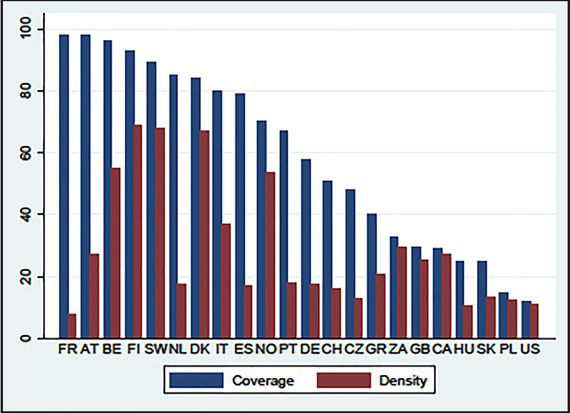
Figure 1
Collective bargaining coverage and trade union density.
Source: ILO (2013).
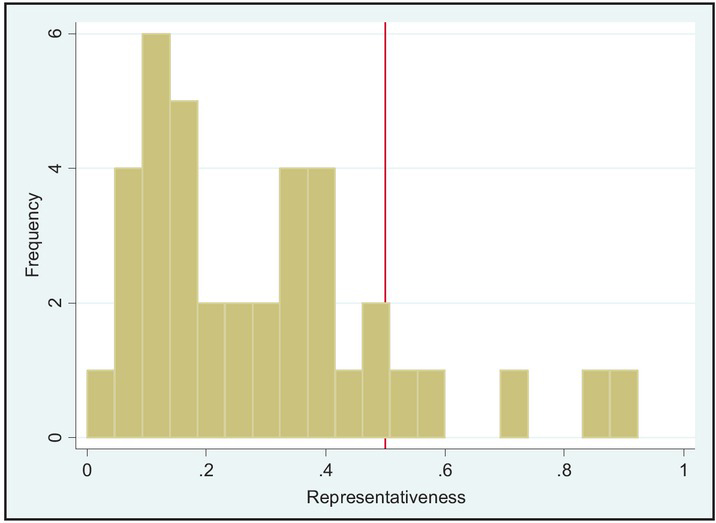
Figure 2
The representativeness of collective agreements.
Source: Ministry of Labour (DGERT) and Quadros de Pessoal, authors’ calculations. Note: The vertical axis indicates the number of agreements of each level of representativeness.
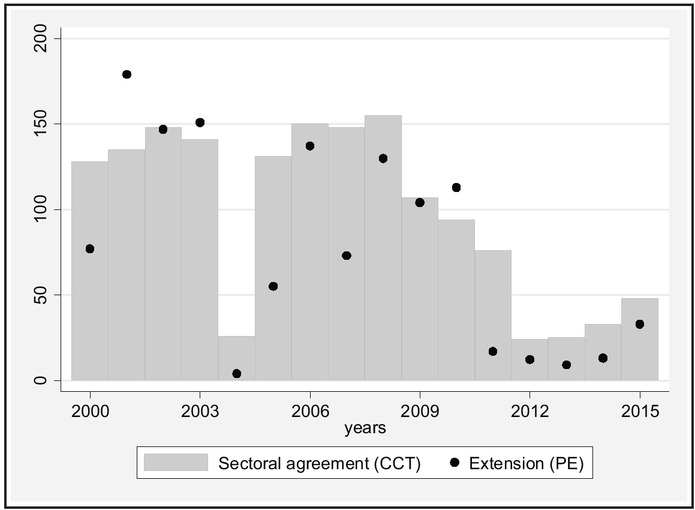
Figure 3
Number of sectoral collective agreements and extensions, 2000–2015.
Source: Ministry of Labour (DGERT), authors’ calculations. Note: The vertical axis indicates the number of agreements in each year considered.
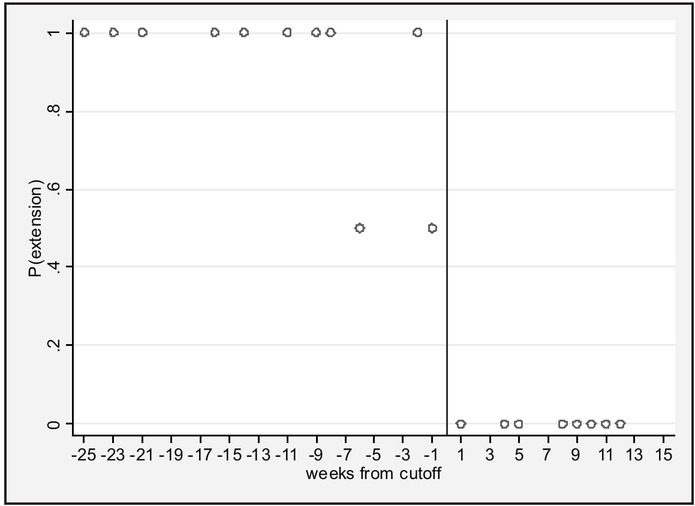
Figure 4
The probability that a collective agreement is extended.
Source: Ministry of Labour (DGERT), authors’ calculations. Weeks from March 1, 2011 (September 2010–June 2011).
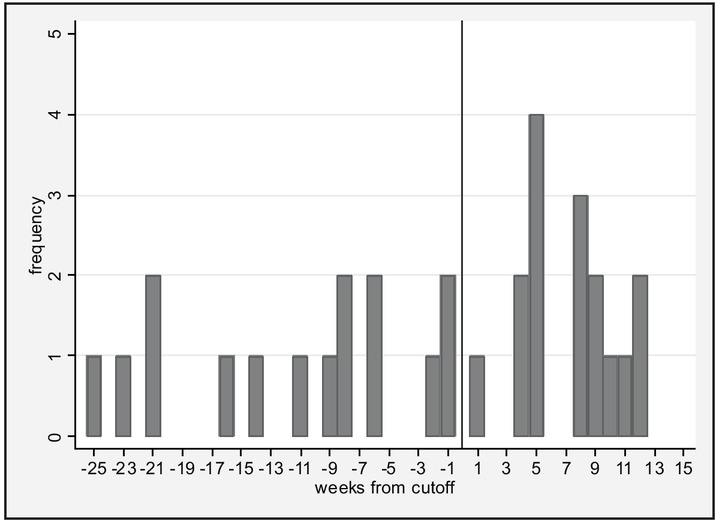
Figure 5
The number of collective agreements over time.
Source: Ministry of Labour (DGERT), authors’ calculations.
Table 1
Balancing tests
| All | Non-affiliated | Affiliated | ||||
|---|---|---|---|---|---|---|
| (1) | (2) | (3) | (4) | (3) | (4) | |
| Balancing variables | linear | quadratic | linear | quadratic | linear | quadratic |
| Representativeness, 2010 | 0.0815 | −0.0080 | 0.0923 | −0.0183 | 0.0220 | 0.0303 |
| - share of workforce in afffiliated firms | (0.1143) | (0.0574) | (0.1422) | (0.0617) | (0.0695) | (0.0510) |
| Employment growth, 2009-2010 | 0.0865 | 0.0975 | 0.0953 | 0.1045 | 0.0813 | 0.0844 |
| (0.0155) | (0.0080) | (0.0195) | (0.0106) | (0.0099) | (0.0076) | |
| *** | *** | *** | *** | *** | *** | |
| Log employment, 2010 | −0.2195 | −0.1584 | −0.4327 | −0.3626 | 0.5093 | 0.1547 |
| (0.6026) | (0.6073) | (0.6009) | (0.6273) | (0.7890) | (0.5082) | |
| Log average firm size, 2010 | −1.2418 | −1.4115 | −1.2439 | −1.3098 | −1.5805 | −1.6135 |
| - number of workers per firm | (0.3004) | (0.1840) | (0.2429) | (0.2017) | (0.2265) | (0.1765) |
| *** | *** | *** | *** | *** | *** | |
| Log average wage, 2010 | −0.0510 | −0.0812 | −0.0530 | −0.0603 | −0.1147 | −0.1120 |
| - within job title and year | (0.0870) | (0.0956) | (0.0852) | (0.0875) | (0.0901) | (0.0758) |
| Log median wage, 2010 | 0.0040 | −0.0092 | −0.0127 | −0.0059 | −0.0243 | −0.0035 |
| - within job title and year | (0.0764) | (0.0828) | (0.0775) | (0.0781) | (0.0824) | (0.0605) |
| Export intensity, 2010 | −0.4642 | −0.4553 | −0.4072 | −0.3808 | −0.5818 | −0.6151 |
| (0.0523) | (0.0494) | (0.0579) | (0.0583) | (0.0466) | (0.0264) | |
| *** | *** | *** | *** | *** | *** | |
| Log labour productivity, 2010 | 0.1753 | −0.0735 | 0.2313 | 0.0320 | −0.2217 | −0.1636 |
| (0.4604) | (0.5252) | (0.4727) | (0.5360) | (0.3814) | (0.2627) | |
[i] Notes: The estimates reported correspond to the coefficients of the extension dummy in Eq. (1). Regressions are weighted by the number of employees in 2010. Standard errors are robust and clustered by collective agreement and signature date.
*, **, *** refer to statistical significance levels of 10%, 5%, and 1%, respectively.
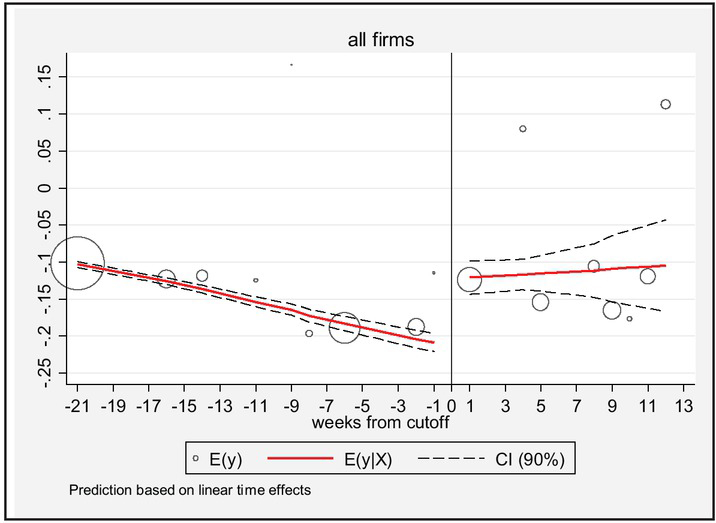
Figure 6
The overall effects of extensions on employment growth.
Notes: The figure presents the estimated change in the growth rate of employment by collective agreement publication week, as measured from the threshold date of March 1, 2011 (week 0). The results are estimated from a sharp RDD using employment weights. The size of the circles is proportional to the employment of the corresponding collective agreement(s). Standard errors are robust and clustered by collective agreement and signature date. *, **, *** refer to statistical significance levels of 10%, 5%, and 1%, respectively. Authors’ calculations based on QP and DGERT data.
Table 2
The effects of extensions, all firms
| Panel A. Employment growth (ΔE2011) | ||||
|---|---|---|---|---|
| Fuzzy | Sharp | |||
| (1) | (2) | (1) | (2) | |
| Treatment dummy | −0.0953 | −0.0500 | −0.0578 | −0.0420 |
| (0.0446) | (0.0591) | (0.0262) | (0.0262) | |
| ** | ** | |||
| Constant | −0.1042 | −0.1358 | −0.1226 | −0.1293 |
| (0.0388) | (0.0274) | (0.0313) | (0.0236) | |
| ** | *** | *** | *** | |
| Relative time effects | Linear | Quadratic | Linear | Quadratic |
| Observations | 62 | 62 | 62 | 62 |
| R-squared | 0.3976 | 0.4037 | 0.4290 | 0.4359 |
| Panel B. Employment growth (ΔE2011- ΔE2010) | ||||
|---|---|---|---|---|
| Fuzzy | Sharp | |||
| (1) | (2) | (1) | (2) | |
| Treatment dummy | −0.1574 | −0.1472 | −0.1022 | −0.1035 |
| (0.0548) | (0.0709) | (0.0301) | (0.0295) | |
| *** | ** | *** | *** | |
| Constant | −0.1950 | −0.1985 | −0.2238 | −0.1926 |
| (0.0380) | (0.0360) | (0.0279) | (0.0247) | |
| *** | *** | *** | *** | |
| Relative time effects | Linear | Quadratic | Linear | Quadratic |
| Observations | 62 | 62 | 62 | 62 |
| R-squared | 0.6579 | 0.6581 | 0.6809 | 0.6958 |
[i] Notes: Regressions are weighted by the number of employees in 2010. They include controls for log average firm size, export intensity, and affiliation status. Standard errors are robust and clustered by collective agreement and signature date.
*, **, *** refer to statistical significance levels of 10%, 5%, and 1%, respectively.
Authors’ calculations based on QP and DGERT data.
Change in employment growth, percentage points, (DE2011- DE2010), sharp RDD
Table 3
Sensitivity analysis, all firms
| Panel A. Fuzzy RDD1 | ||||||||
|---|---|---|---|---|---|---|---|---|
| Employment growth | Change in employment growth | |||||||
| Baseline | Controls | Bandwidth | Falsification | Baseline | Controls | Bandwidth | Falsification | |
| Treatment dummy | -0.0953 | -0.0511 | -0.0976 | -0.1574 | -0.1217 | -0.1540 | ||
| (0.0446) | (0.0163) | (0.0566) | (0.0548) | (0.0189) | (0.0523) | |||
| ** | *** | * | *** | *** | *** | |||
| Constant | -0.1042 | -0.0963 | -0.1078 | -0.1950 | -0.1350 | -0.1701 | ||
| (0.0388) | (0.0053) | (0.0523) | non-available | (0.0380) | (0.0123) | (0.0327) | non-available | |
| ** | *** | ** | *** | *** | *** | |||
| Relative time effects | Linear | Linear | Linear | Linear | Linear | Linear | ||
| Observations | 62 | 62 | 76 | 62 | 62 | 76 | ||
| R-squared | 0.3976 | 0.3472 | 0.4975 | 0.6579 | 0.5452 | 0.6898 | ||
| Panel B. Sharp RDD1 | ||||||||
|---|---|---|---|---|---|---|---|---|
| Employment growth | Change in employment growth | |||||||
| Baseline | Controls | Bandwidth | Falsification | Baseline | Controls | Bandwidth | Falsification | |
| Treatment dummy | -0.0578 | -0.0603 | -0.0164 | 0.0364 | -0.1022 | -0.1169 | -0.0898 | -0.0345 |
| (0.0262) | (0.0203) | (0.0264) | (0.0609) | (0.0301) | (0.0245) | (0.0210) | (0.0556) | |
| ** | *** | *** | *** | *** | ||||
| Constant | -0.1226 | -0.0891 | -0.1570 | -0.0699 | -0.2238 | -0.1352 | -0.2017 | -0.2129 |
| (0.0313) | (0.0115) | (0.0412) | (0.0649) | (0.0279) | (0.0143) | (0.0259) | (0.0541) | |
| *** | *** | *** | *** | *** | *** | *** | ||
| Relative time effects | Linear | Linear | Linear | Linear | Linear | Linear | Linear | Linear |
| Observations | 58 | 58 | 72 | 46 | 58 | 58 | 72 | 46 |
| R-squared | 0.4290 | 0.3917 | 0.5210 | 0.5057 | 0.6809 | 0.5650 | 0.7015 | 0.5902 |
| Panel C. Occupation level analysis (employment growth)2 | ||||||||
|---|---|---|---|---|---|---|---|---|
| Fuzzy RDD, Employment growth | Sharp RDD, Employment growth | |||||||
| Baseline | Controls | Bandwidth | Falsification | Baseline | Controls | Bandwidth | Falsification | |
| Treatment dummy | -0.1282 | -0.0543 | -0.1292 | -0.0558 | -0.0606 | -0.0462 | -0.0197 | |
| (0.0597) | (0.0209) | (0.0454) | (0.0282) | (0.0304) | (0.0213) | (0.0404) | ||
| ** | *** | *** | ** | ** | ** | |||
| Constant | 1.5142 | -0.0956 | -0.2796 | 1.4891 | -0.0897 | -0.2920 | -0.6206 | |
| (1.8044) | (0.0150) | (0.3563) | non-available | (1.8096) | (0.0265) | (0.3562) | (0.0827) | |
| *** | *** | *** | ||||||
| Relative time effects | Linear | Linear | Linear | Linear | Linear | Linear | Linear | |
| Observations | 3,320 | 3,320 | 4,257 | 3,048 | 3,048 | 3,985 | 2,451 | |
| R-squared | 0.0774 | 0.0205 | 0.1527 | 0.0821 | 0.0243 | 0.1646 | 0.1626 | |
[i] Regressions are weighted by the number of employees in 2010 and include controls for log average firm size, export intensity, and affiliation status unless stated
otherwise.
*, **, *** refer to statistical significance levels of 10%, 5%, and 1%, respectively.
“Controls”: affiliation status only; “bandwidth”: October 2010-August 2011; “Falsification”: placebo reform date (mid-May 2011) using agreements in post-reform period only (March 2011-August 2011).
1Standard errors are robust and clustered by collective agreement and signature date.
2Standard errors are robust and clustered by collective agreement, occupation and signature date.
Authors’ calculations based on QP and DGERT data.
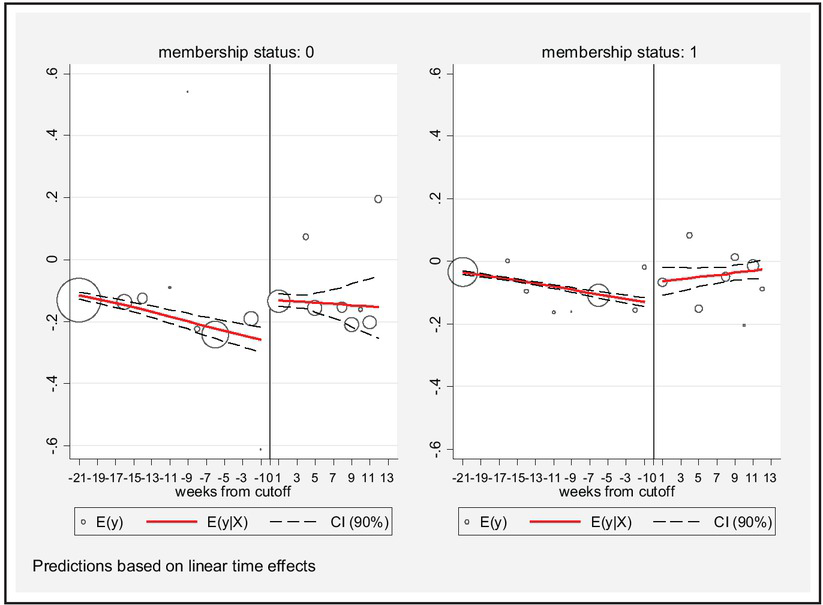
Figure 7
The effects of extensions by affiliation status.
Notes: “Membership status: 0” refers to nonaffiliated firms; “Membership status: 1” refers to affiliated firms. The figure presents the estimated change in the growth rate of employment by collective agreement publication week, as measured from the threshold date of March 1, 2011 (week 0). The results are estimated from a sharp RDD using employment weights. The size of the circles is proportional to the employment of the corresponding collective agreement(s). Standard errors are robust and clustered by collective agreement and signature date. *, **, *** refer to statistical significance levels of 10%, 5%, and 1%, respectively.
Table 4
Results by affiliation status
| Panel A. Employment growth (ΔE2011)1 | ||||||||
|---|---|---|---|---|---|---|---|---|
| Fuzzy RDD | Sharp RDD | |||||||
| Baseline | Controls | Bandwidth | Falsification | Baseline | Controls | Bandwidth | Falsification | |
| Non-affiliated firms | -0.1121 | -0.1395 | -0.1114 | -0.0536 | -0.0515 | -0.0071 | 0.0684 | |
| (0.0470) | (0.0574) | (0.0592) | (0.0329) | (0.0248) | (0.0311) | (0.1080) | ||
| ** | ** | * | ** | |||||
| Affiliated firms | 0.179 | 0.1172 | 0.0087 | -0.0980 | -0.0982 | -0.061 | -0.0280 | |
| (0.0712) | (0.0876) | (0.0962) | (0.0204) | (0.0326) | -0.0292 | (0.0336) | ||
| ** | *** | *** | ** | |||||
| Constant | -0.0544 | -0.0587 | -0.0527 | non-available | -0.0786 | -0.0975 | -0.0722 | -0.0978 |
| (0.0180) | (0.0275) | (0.0300) | (0.0156) | (0.0187) | -0.0269 | (0.1082) | ||
| ** | ** | * | *** | *** | ** | |||
| Relative time effects | linear | linear | linear | linear | linear | linear | linear | |
| Observations | 62 | 62 | 76 | 58 | 58 | 72 | 46 | |
| R-squared | 0.4157 | 0.3802 | 0.5026 | 0.4579 | 0.414 | 0.5432 | 0.5393 | |
| Panel B. Change in employment growth (ΔE2011- ΔE2010)1 | ||||||||
|---|---|---|---|---|---|---|---|---|
| Fuzzy RDD | Sharp RDD | |||||||
| Baseline | Controls | Bandwidth | Falsification | Baseline | Controls | Bandwidth | Falsification | |
| Non-affiliated firms | -0.1787 | -0.2446 | -0.1706 | -0.1222 | -0.1309 | -0.0986 | -0.0337 | |
| (0.0653) | (0.1118) | (0.0650) | (0.0428) | (0.0306) | (0.0309) | (0.0928) | ||
| ** | ** | ** | *** | *** | *** | |||
| Affiliated firms | 0.2565 | 0.1080 | 0.1798 | non-available | -0.0512 | -0.0636 | -0.0681 | -0.0216 |
| (0.0916) | (0.1877) | (0.0887) | (0.0159) | (0.0317) | (0.0272) | (0.0255) | ||
| *** | * | *** | * | ** | ||||
| Constant | -0.0710 | -0.0814 | -0.0888 | -0.0865 | -0.1283 | -0.1113 | -0.1247 | |
| (0.0163) | (0.0481) | (0.0210) | (0.0164) | (0.0181) | (0.0212) | (0.0870) | ||
| *** | *** | *** | *** | *** | ||||
| Relative time effects | linear | linear | linear | linear | linear | linear | linear | |
| Observations | 62 | 62 | 76 | 58 | 58 | 72 | 46 | |
| R-squared | 0.6650 | 0.5670 | 0.6919 | 0.6990 | 0.5762 | 0.7091 | 0.5963 | |
| Panel C. Occupation level analysis (employment growth)2 | ||||||||
|---|---|---|---|---|---|---|---|---|
| Fuzzy RDD, Employment growth | Sharp RDD, Employment growth | |||||||
| Baseline | Controls | Bandwidth | Falsification | Baseline | Controls | Bandwidth | Falsification | |
| Non-affiliated firms | -0.1736 | -0.1388 | -0.1716 | -0.0470 | -0.0524 | -0.0379 | -0.0007 | |
| (0.0802) | (0.0607) | (0.0594) | (0.0295) | (0.0290) | (0.0214) | (0.0494) | ||
| ** | ** | *** | * | * | ||||
| Affiliated firms | 0.1927 | 0.1232 | 0.0834 | -0.0934 | -0.0966 | -0.0904 | -0.0595 | |
| (0.1271) | (0.1010) | (0.0848) | (0.0522) | (0.0583) | (0.0360) | (0.0489) | ||
| * | * | ** | ||||||
| Constant | 1.4994 | -0.0597 | -0.2883 | non-available | 1.4808 | -0.0978 | -0.3074 | -0.6435 |
| (1.8100) | (0.0331) | (0.3566) | (1.8108) | (0.0254) | (0.3565) | (0.0887) | ||
| * | *** | *** | ||||||
| Relative time effects | linear | linear | linear | linear | linear | linear | linear | |
| Observations | 3,320 | 3,320 | 4,257 | 3,048 | 3,048 | 3,985 | 2,451 | |
| R-squared | 0.0779 | 0.0235 | 0.1534 | 0.0830 | 0.0256 | 0.1666 | 0.1652 | |
[i] Regressions are weighted by the number of employees in 2010 and include controls for log average firm size and export intensity unless stated otherwise. *, **, *** refer to statistical significance levels of 10%, 5%, and 1%, respectively.
“Controls”: affiliation status only; “bandwidth”: October 2010-August 2011; “Falsification”: placebo reform date (mid-May 2011) using agreements in post-reform period only (March 2011-August 2011).
1Standard errors are robust and clustered by collective agreement and signature date.
2Standard errors are robust and clustered by collective agreement, occupation and signature date.
Authors’ calculations based on QP and DGERT data.
Change in employment growth, percentage points, (AE2011-AE2010)
Table 5
| Panel A. Results on the role of representativeness by affiliation status | ||||
|---|---|---|---|---|
| Fuzzy | Sharp | |||
| (1) | (2) | (1) | (2) | |
| ΔE | ΔΔE | ΔE | ΔΔE | |
| Treatment effect * | −0.1278 | −0.1757 | −0.0822 | −0.0974 |
| non-affiliated firms | (0.0424) | (0.0621) | (0.0354) | (0.0386) |
| *** | *** | ** | ** | |
| Treatment effect * | 0.3415 | 0.3383 | −0.0780 | −0.0531 |
| affiliated firms | (0.1412) | (0.1542) | (0.0427) | (0.0454) |
| ** | ** | * | ||
| Representativeness * | −0.2729 | −0.1284 | −0.3197 | −0.0297 |
| non-affiliated firms | (0.1469) | (0.1888) | (0.1690) | (0.1893) |
| Representativeness * | * 0.1770 | 0.0388 | * 0.0805 | −0.0691 |
| affiliated firms | (0.0797) | (0.1047) | (0.0594) | (0.0769) |
| ** | ||||
| Treatment dummy * | 0.3024 | 0.1296 | 0.2443 | −0.1178 |
| non-affiliated firms * | (0.1603) | (0.2129) | (0.1706) | (0.2044) |
| representativeness | * | |||
| Treatment dummy * | −0.5177 | −0.2431 | −0.1288 | −0.0233 |
| affiliated firms * | (0.2553) | (0.2887) | (0.1087) | (0.0989) |
| representativeness | * | |||
| Affiliated firms | −0.2098 | −0.2005 | 0.0079 | −0.0016 |
| (0.0866) | (0.0741) | (0.0428) | (0.0406) | |
| ** | ** | |||
| Constant | −0.0025 | −0.0467 | −0.0265 | −0.0740 |
| (0.0390) | (0.0341) | (0.0332) | (0.0304) | |
| ** | ||||
| Relative time effects | linear | linear | linear | linear |
| Observations | 62 | 62 | 58 | 58 |
| R-squared | 0.5042 | 0.6747 | 0.5587 | 0.7248 |
| Panel B. Results on the role of retroactivity by affiliation status | ||||
|---|---|---|---|---|
| Fuzzy | Sharp | |||
| (1) | (2) | (1) | (2) | |
| ΔE | ΔΔE | ΔE | ΔΔE | |
| Treatment effect * | −0.1026 | −0.1688 | −0.0459 | −0.1100 |
| non-affiliated firms | (0.0406) | (0.0510) | (0.0300) | (0.0344) |
| ** | *** | *** | ||
| Treatment effect * | 0.1708 | 0.2452 | −0.0919 | −0.0498 |
| affiliated firms | (0.0692) | (0.0817) | (0.0237) | (0.0200) |
| ** | *** | *** | ** | |
| Treatment effect * | −0.0003 | −0.0006 | −0.0003 | −0.0005 |
| non-affiliated firms * | (0.0001) | (0.0002) | (0.0002) | (0.0003) |
| administrative delay | ** | *** | * | |
| Treatment effect * | −0.0001 | 0.0003 | −0.0001 | 0.0001 |
| affiliated firms * | (0.0002) | (0.0003) | (0.0002) | (0.0002) |
| administrative delay | ||||
| Affiliated firms | −0.0926 | −0.1715 | 0.0763 | −0.0111 |
| (0.0543) | (0.0493) | (0.0270) | (0.0282) | |
| * | *** | *** | ||
| Constant | −0.0549 | −0.0682 | −0.0785 | −0.0859 |
| (0.0191) | (0.0176) | (0.0161) | (0.0169) | |
| *** | *** | *** | *** | |
| Relative time effects | linear | linear | linear | linear |
| Observations | 62 | 62 | 58 | 58 |
| R-squared | 0.4425 | 0.7089 | 0.4730 | 0.7176 |
[i] Panel A: Regressions are weighted by the number of employees in 2010. Standard errors are robust and clustered by collective agreement and signature date.
*, **, *** refer to statistical significance levels of 10%, 5%, and 1%, respectively.
“Representativeness” is measured by the share of the workforce in affiliated firms in the total employment of the relevant sector.
Panel B: Regressions are weighted by the number of employees in 2010. Standard errors are robust and clustered by collective agreement.
*, **, *** refer to statistical significance levels of 10%, 5%, and 1%, respectively.
“Administrative delay” is defined in terms of the number of days since the entry-into-force date of the collective agreement among affiliated firms and the publication date of the extension to nonaffiliated firms.
Table 6
Results on inequality
| Panel A. Fuzzy RDD | ||||||||
|---|---|---|---|---|---|---|---|---|
| (1) | (2) | (3) | (4) | (5) | (6) | (7) | (8) | |
| Δp5 | Δ(p50-p5) | Δp10 | Δ(p50-p10) | Δp15 | Δ(p50-p15) | Δp20 | Δ(p50-p20) | |
| Treatment effect | 0.0805 | -0.0865 | 0.0695 | -0.0755 | 0.0710 | -0.0770 | 0.0289 | -0.0349 |
| (0.0373) | (0.0481) | (0.0400) | (0.0532) | (0.0566) | (0.0721) | (0.0285) | (0.0453) | |
| ** | ** | * | ||||||
| Constant | -0.0286 | 0.0501 | -0.0082 | 0.0296 | -0.0248 | 0.0463 | -0.0109 | 0.0324 |
| (0.0221) | (0.0296) | (0.0205) | (0.0297) | (0.0327) | (0.0419) | (0.0165) | (0.0259) | |
| Relative time effects | Linear | Linear | Linear | Linear | Linear | Linear | Linear | Linear |
| Observations | 62 | 62 | 62 | 62 | 62 | 62 | 62 | 62 |
| R-squared | 0.0875 | 0.1217 | 0.2290 | 0.2353 | 0.1727 | 0.1858 | 0.0644 | 0.1265 |
| Panel B. Sharp RDD | ||||||||
|---|---|---|---|---|---|---|---|---|
| (1) | (2) | (3) | (4) | (5) | (6) | (7) | (8) | |
| Δp5 | Δ(p50-p5) | Δp10 | Δ(p50-p10) | Δp15 | Δ(p50-p15) | Δp20 | Δ(p50-p20) | |
| Treatment effect | 0.0493 | -0.0476 | 0.0494 | -0.0477 | 0.0519 | -0.0502 | 0.0184 | -0.0166 |
| (0.0232) | (0.0294) | (0.0213) | (0.0306) | (0.0296) | (0.0392) | (0.0147) | (0.0242) | |
| ** | ** | * | ||||||
| Constant | -0.0310 | 0.0522 | -0.0087 | 0.0300 | -0.0266 | 0.0478 | -0.0109 | 0.0321 |
| (0.0213) | (0.0282) | (0.0185) | (0.0275) | (0.0298) | (0.0389) | (0.0155) | (0.0247) | |
| * | ||||||||
| Relative time effects | Linear | Linear | Linear | Linear | Linear | Linear | Linear | Linear |
| Observations | 58 | 58 | 58 | 58 | 58 | 58 | 58 | 58 |
| R-squared | 0.1019 | 0.1442 | 0.2675 | 0.251 | 0.217 | 0.212 | 0.0756 | 0.1275 |
[i] Results based on residuals from individual-level log base wage regression on job category dummies, collapsed by firm type (affiliated vs nonaffiliated), collective agreement, and year. Dp5 denotes the change in the 5th percentile (of the cell’s log base wage residual) between 2011 and 2010, D(p50−p5) denotes the difference between the median and the 5th percentile in 2011, and similarly for the remaining dependent variables.
Table A1
Collective agreements and extensions
| Agreement sector | Date agreement | Date extension |
|---|---|---|
| Metallurgic industry | 9/8/2010 | 12/22/2010 |
| Agriculture, fishing and forestry | 9/22/2010 | 1/10/2011 |
| Car sale | 10/8/2010 | 1/10/2011 |
| Viana do Castelo retail | 10/8/2010 | 12/29/2010 |
| Clinical analysis labs | 11/8/2010 | 2/28/2011 |
| Wine trade sector | 11/22/2010 | 2/28/2011 |
| Football clubs (players) | 12/15/2010 | 3/22/2011 |
| Cork industry, North, Office workers | 12/29/2010 | 4/26/2011 |
| Wine industry, cellars | 1/10/2011 | 4/26/2011 |
| Textile industry | 1/24/2011 | |
| Hotels and restaurants, Centre and South | 1/24/2011 | 5/23/2011 |
| Aveiro retail | 2/22/2011 | 5/23/2011 |
| Ropes industry | 2/28/2011 | |
| Chemical and pharmaceutical retail | 2/28/2011 | 5/30/2011 |
| Wood | 3/9/2011 | |
| Pharmaceutical products retail | 3/29/2011 | |
| Merchandising firms | 3/29/2011 | |
| Viseu retail | 4/8/2011 | |
| Wheat | 4/8/2011 | |
| Coffee | 4/8/2011 | |
| Driving schools | 4/8/2011 | |
| Fish preserve industry | 4/26/2011 | |
| Bread manufacturing, Lisbon | 4/26/2011 | |
| Guarda, retail | 4/29/2011 | |
| Poultry, slaughter | 5/9/2011 | |
| Farming | 5/9/2011 | |
| Meat, retail, South | 5/16/2011 | |
| Retail storehouses | 5/23/2011 | |
| Bread manufacturing | 5/23/2011 | |
| Fishing | 5/30/2011 | |
| Non-alcoholic beverages | 5/30/2011 | |
| Cement | 6/8/2011 | |
| Shoe manufacturing | 7/15/2011 | |
| Farming, Abrantes | 7/15/2011 | |
| Farming, Beja | 7/22/2011 | |
| Construction sector | 8/8/2011 | |
| Private schools | 8/16/2011 | |
| Clothing | 8/16/2011 | |
| Textile industry | 8/16/2011 |