
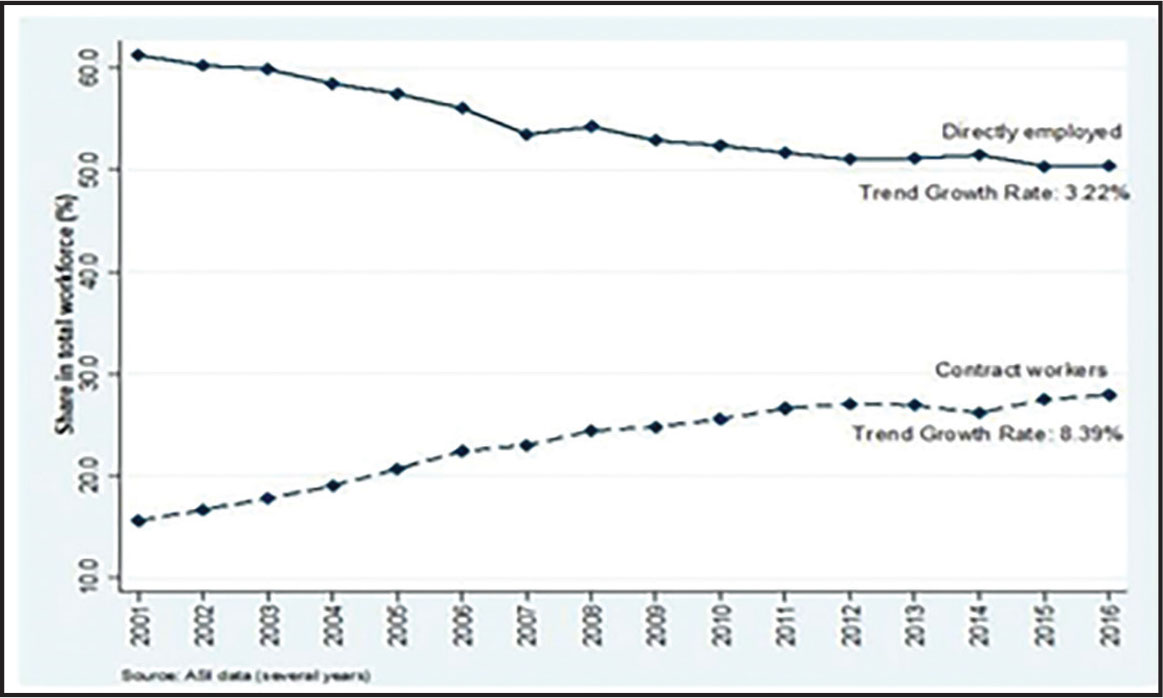
Figure 1
Change in the composition of workers in the formal manufacturing sector over time.
Notes: The variable ‘total persons engaged’ reported in ASI is classified into four categories-production workers, employees holding supervisory or managerial positions, unpaid family members/ proprietor/ coop members and other employees. Production workers are subdivided into two categories: those hired directly and those employed through contractors.
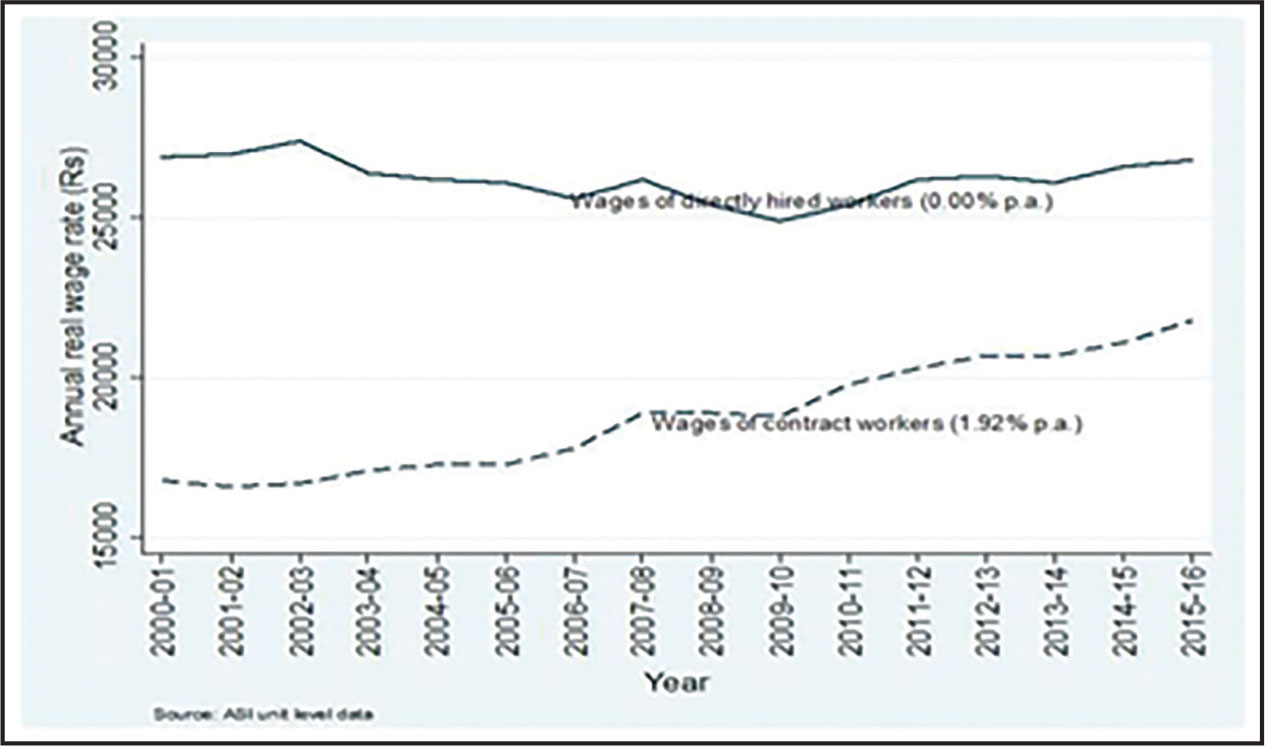
Figure 2
Changes in annual real wages for contract and directly hired workers by year.
Notes: The ASI dataset provides data on the total wage bill of the plant. Further it reports the disaggregated wage bill for each category of employee i.e. directly employed workers, contract workers and supervisory and managerial staff. The total wage bill in each category is divided by the number of employees in the respective category to arrive at the average wages.
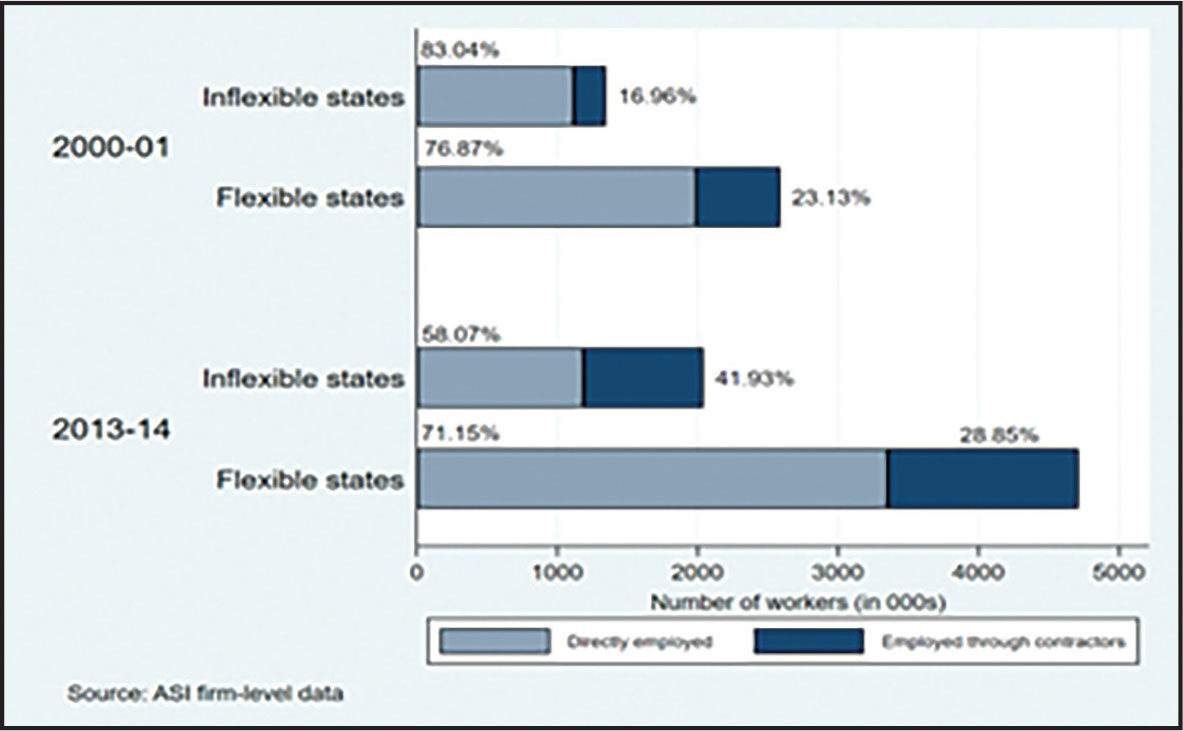
Figure 3
Share (%) of different workers across states and years.
Notes: The variable ‘total persons engaged’ reported in ASI is classified into four categories-production workers, employees holding supervisory or managerial positions, unpaid family members/ proprietor/coop members and other employees. Production workers are subdivided into two categories: those hired directly and those employed through contractors. For details on flexible and inflexible states classification, see Table A3 in the Appendix.
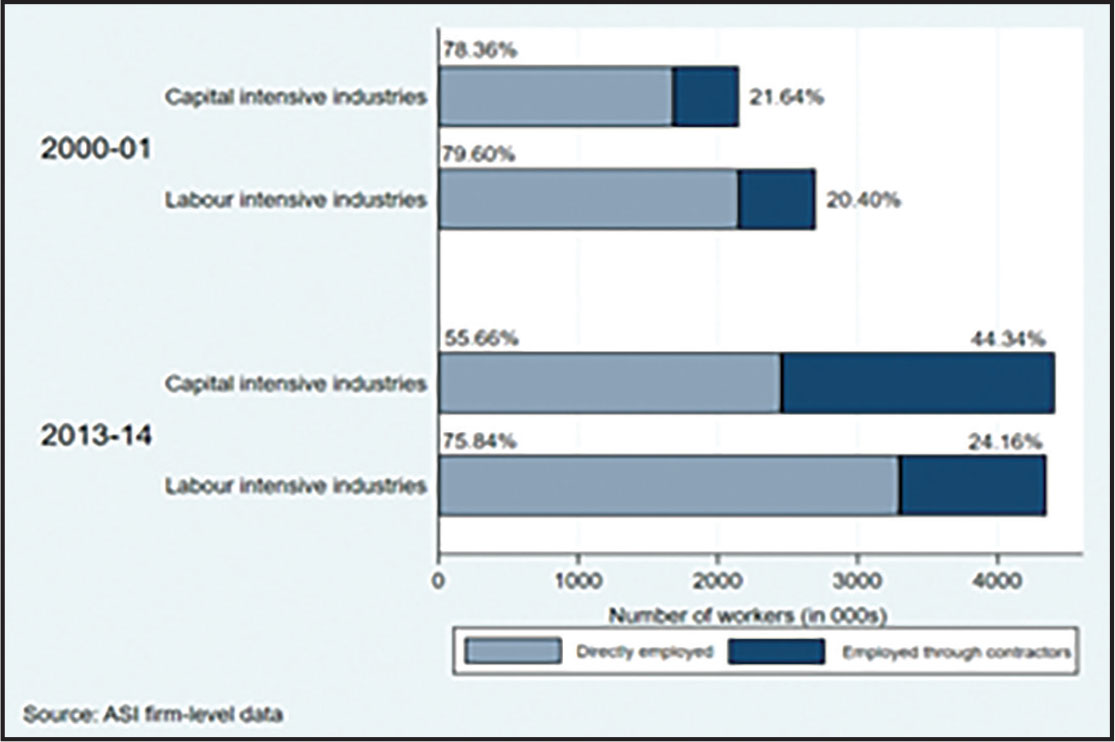
Figure 4
Share (%) of different workers across industries and years.
Notes: The variable ‘total persons engaged’ reported in ASI is classified into four categories-production workers, employees holding supervisory or managerial positions, unpaid family members/ proprietor/ coop members and other employees. Production workers are subdivided into two categories: those hired directly and those employed through contractors. For details of capital-and labour-intensive industries, see footnote 11.
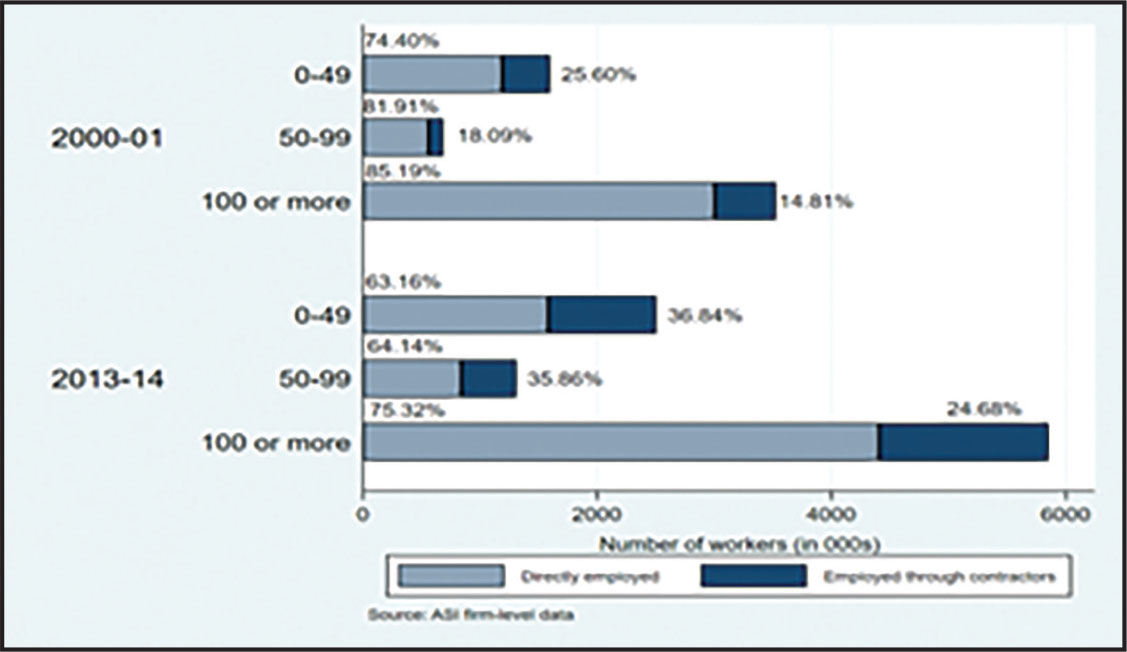
Figure 5
Share (%) of different workers across plants of different sizes.
Notes: The variable ‘total persons engaged’ reported in ASI is classified into four categories-production workers, employees holding supervisory or managerial positions, unpaid family members/ proprietor/ coop members and other employees. Production workers are subdivided into two categories: those hired directly and those employed through contractors.
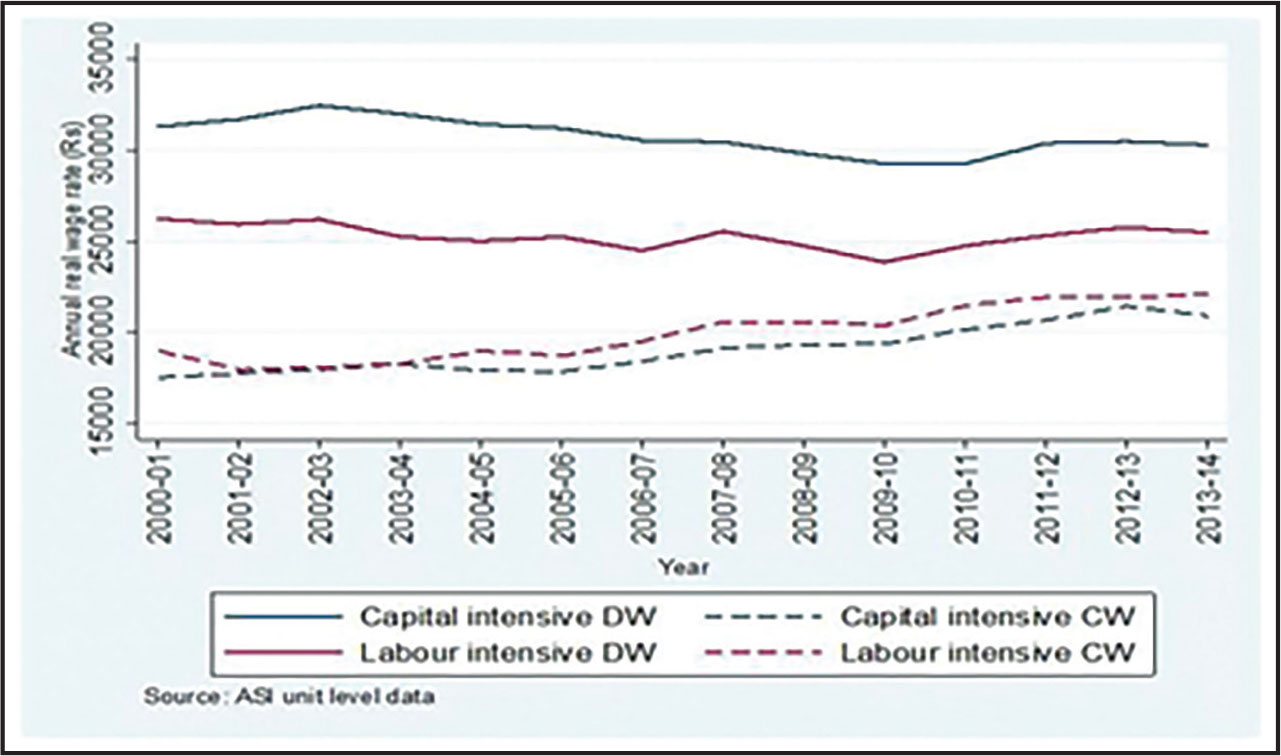
Figure 6
Real wages (in Rs) of different workers across different industries.
Notes: The ASI dataset provides data on the total wage bill of the plant. Further it reports the disaggregated wage bill for each category of employee i.e. directly employed workers, contract workers and supervisory and managerial staff. The total wage bill in each category is divided by the number of employees in the respective category to arrive at the average wages. For details of capital-and labour-intensive industries, see footnote 11.
Table 1
OLS regression results
| Category | All (1) | K-intensive (2) | L-intensive (3) | Small (4) | Medium (5) | Large (6) | Large K-intensive (7) | Large L-intensive (8) | Low CW (9) | High CW (10) |
|---|---|---|---|---|---|---|---|---|---|---|
| ln(WC/WD) | −0.067*** (0.008) | −0.097*** (0.011) | −0.054*** (0.016) | −0.092*** (0.006) | −0.162*** (0.010) | −0.218*** (0.015) | −0.224*** (0.021) | −0.196*** (0.032) | −0.073*** (0.008) | 0.002** (0.001) |
| time trend | 0.013*** (0.001) | 0.017*** (0.001) | 0.008*** (0.002) | 0.003*** (0.001) | 0.017*** (0.001) | 0.037*** (0.002) | 0.037*** (0.002) | 0.037*** (0.004) | 0.019*** (0.001) | 0.008*** (0.000) |
| LMR-GHK | −0.024*** (0.006) | −0.047*** (0.008) | −0.024** (0.011) | −0.022*** (0.005) | −0.013** (0.006) | −0.018 (0.012) | −0.020 (0.016) | −0.029 (0.024) | −0.024*** (0.006) | 0.000 (0.001) |
| Industry fixed effects | Yes | Yes | Yes | Yes | Yes | Yes | Yes | Yes | Yes | Yes |
| N | 110,238 | 46,325 | 34,985 | 36,670 | 40,760 | 32,808 | 14,545 | 10,762 | 107,781 | 2,457 |
| R-squared | 0.051 | 0.047 | 0.073 | 0.032 | 0.057 | 0.130 | 0.084 | 0.120 | 0.058 | 0.324 |
Source: ASI unit-level panel data; Note: Standard errors clustered at plant-level are given in parentheses;
The control variables include industry fixed-effects, plant-specific characteristics such as ln(age of plant in years), ln(plant's fuel intensity) and year-wise ln(state level gross enrolment ratio). For details of capital-and labour-intensive industries, see footnote 11. The dependent variable is ratio of contract workers to total workers.
Table 2
Proxy variable regression results
| Category | All (1) | K-intensive (2) | L-intensive (3) | Small (4) | Medium (5) | Large (6) | Large K-intensive (7) | Large L-intensive (8) | Low CW (9) | High CW (10) |
|---|---|---|---|---|---|---|---|---|---|---|
| time trend | 0.009*** (0.001) | 0.012*** (0.001) | 0.007*** (0.002) | 0.003*** (0.001) | 0.015*** (0.001) | 0.016*** (0.001) | 0.015*** (0.002) | 0.015*** (0.003) | 0.028*** (0.001) | 0.003*** (0.000) |
| LMR-GHK | −0.047*** (0.005) | −0.059*** (0.007) | −0.060*** (0.010) | −0.013*** (0.005) | −0.012* (0.007) | −0.082*** (0.010) | −0.061*** (0.012) | −0.164*** (0.020) | −0.043*** (0.006) | −0.001*** (0.000) |
| ln(absenteeism) | −0.005 (0.010) | −0.003 (0.012) | 0.112*** (0.023) | 0.074*** (0.012) | 0.068*** (0.015) | −0.041*** (0.016) | −0.020 (0.017) | 0.050 (0.039) | −0.013 (0.010) | 0.001* (0.001) |
| ln(min wage) | 0.109*** (0.011) | 0.112*** (0.014) | 0.013 (0.024) | 0.029*** (0.011) | 0.057*** (0.015) | 0.102*** (0.020) | 0.135*** (0.022) | −0.002 (0.045) | 0.125*** (0.011) | −0.003*** (0.001) |
| Industry fixed effects | Yes | Yes | Yes | Yes | Yes | Yes | Yes | Yes | Yes | Yes |
| N | 134,436 | 60,577 | 41,279 | 36,670 | 40,760 | 57,006 | 28,797 | 17,056 | 120,321 | 14,115 |
| R-squared | 0.077 | 0.102 | 0.072 | 0.023 | 0.039 | 0.170 | 0.207 | 0.133 | 0.086 | 0.153 |
Source: ASI unit-level panel data; Note: Standard errors clustered at plant-level are given in parentheses;
The control variables include industry fixed-effects, plant-specific characteristics such as ln(age of plant in years), ln(plant's fuel intensity) and year-wise ln(state level gross enrolment ratio). For details of capital-and labour-intensive industries, see footnote 11. The dependent variable is ratio of contract workers to total workers.
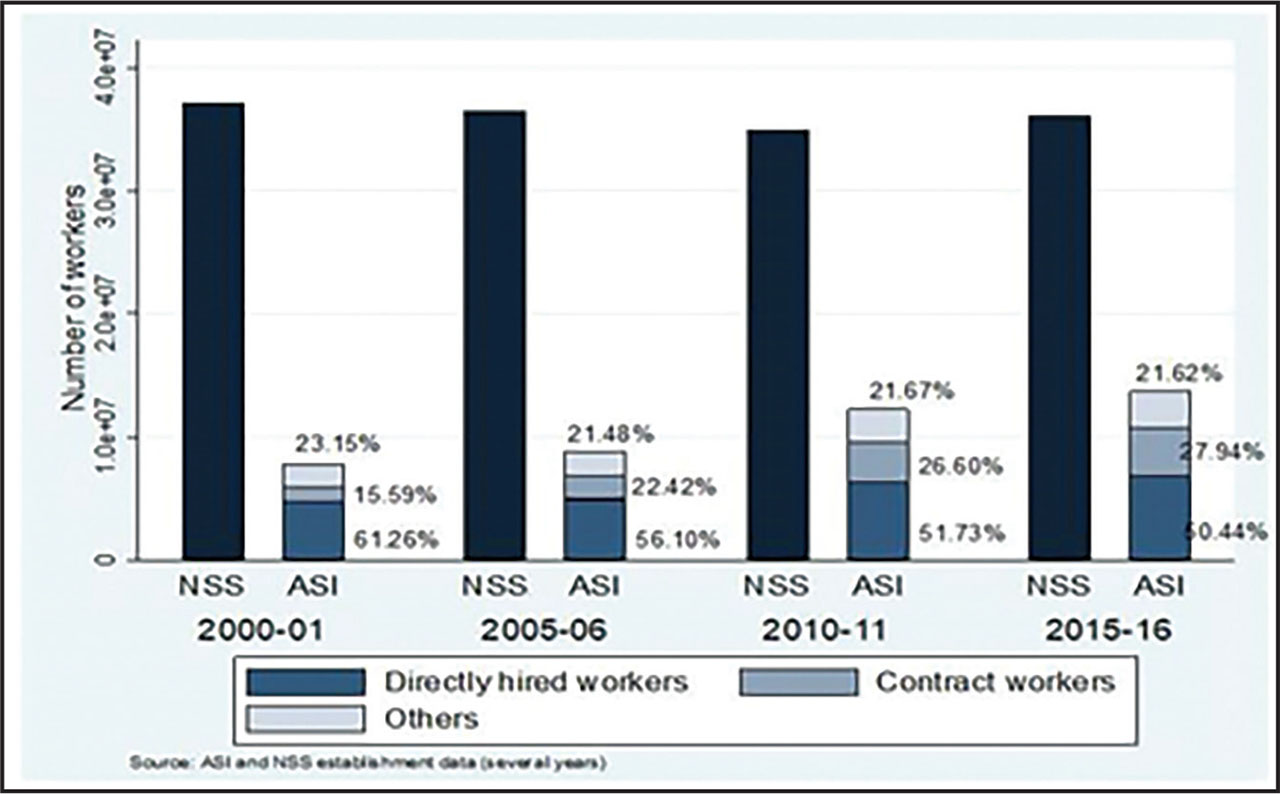
Figure A1
Distribution of Employment in the Organised and Unorganised Manufacturing Sector.
Notes: The variable ‘total persons engaged’ reported in ASI is classified into four categories-production workers, employees holding supervisory or managerial positions, unpaid family members/ proprietor/ coop members and other employees. Production workers are subdivided into two categories: those hired directly and those employed through contractors.
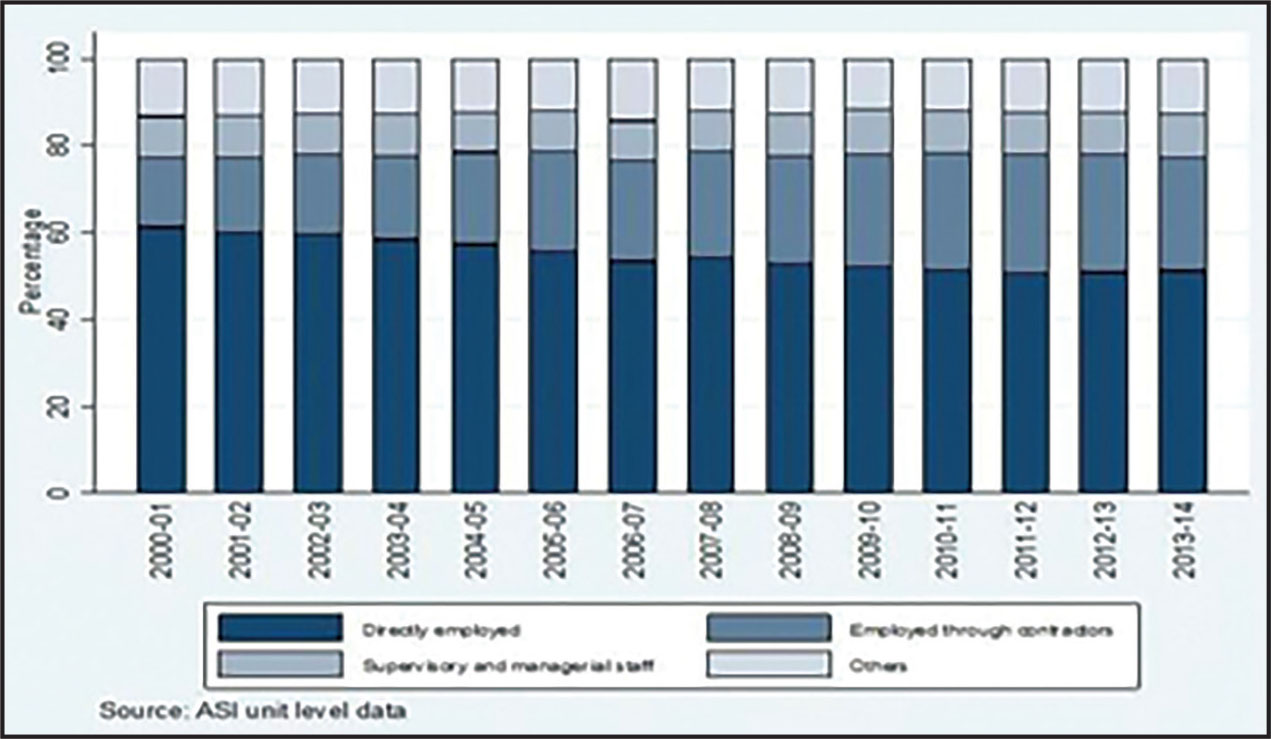
Figure A2
Composition of the workforce in organised manufacturing sector.
Notes: The variable ‘total persons engaged’ reported in ASI is classified into four categories-production workers, employees holding supervisory or managerial positions, unpaid family members/ proprietor/ coop members and other employees. Production workers are subdivided into two categories: those hired directly and those employed through contractors.
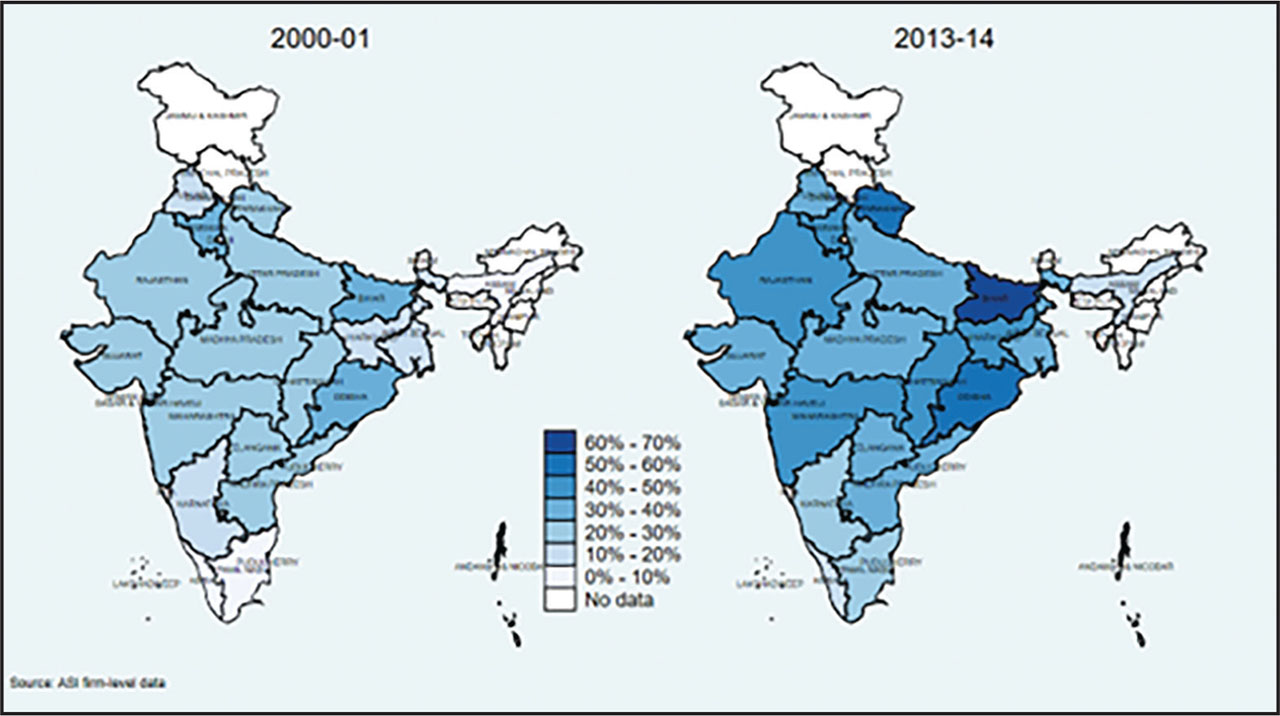
Figure A3
Share (%) of contract workers in total workers by state.
Notes: The variable ‘total persons engaged’ reported in ASI is classified into four categories-production workers, employees holding supervisory or managerial positions, unpaid family members/ proprietor/ coop members and other employees. Production workers are subdivided into two categories: those hired directly and those employed through contractors.
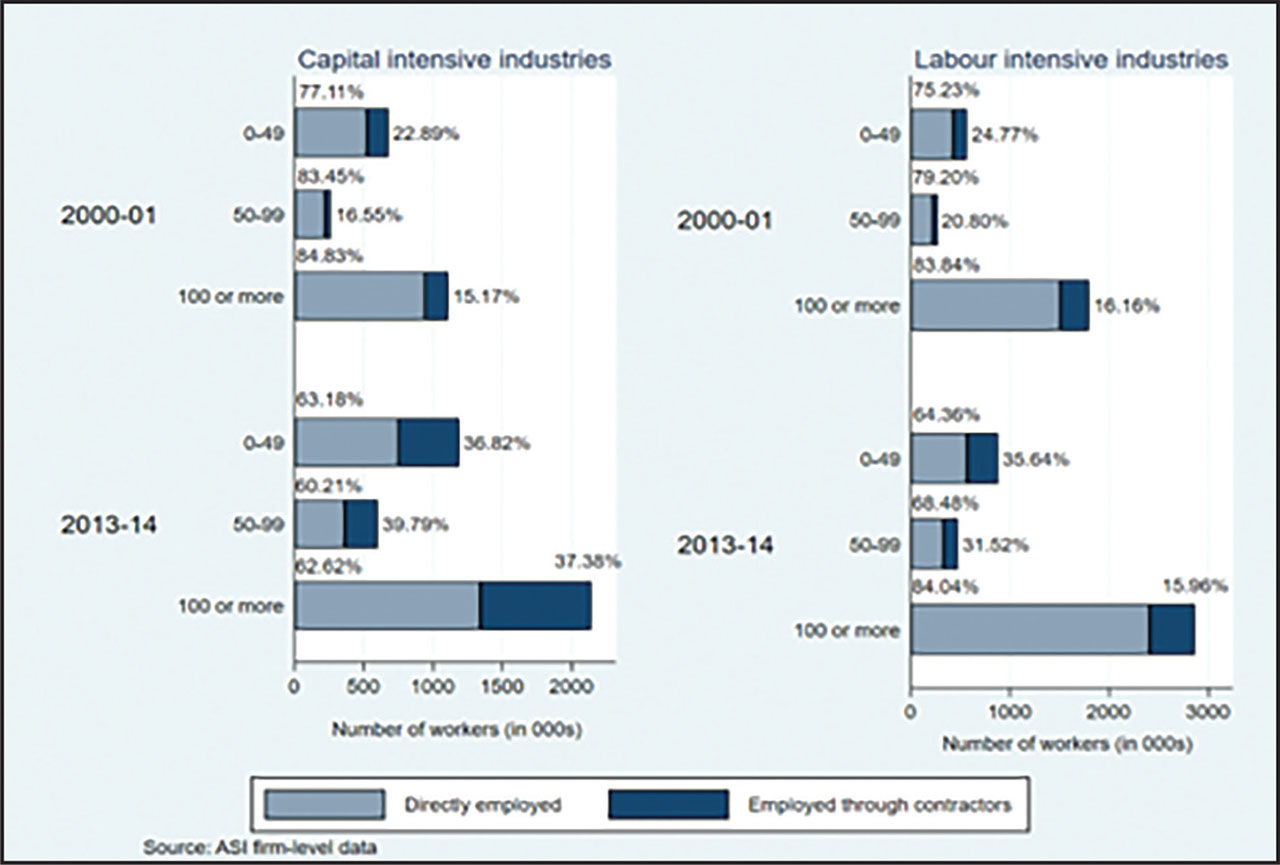
Figure A4
Share (%) of different workers across plants of different sizes and labour intensity.
Notes: The variable ‘total persons engaged’ reported in ASI is classified into four categories-production workers, employees holding supervisory or managerial positions, unpaid family members/ proprietor/ coop members and other employees. Production workers are subdivided into two categories: those hired directly and those employed through contractors. For details of capital- and labour-intensive industries, see footnote 11.
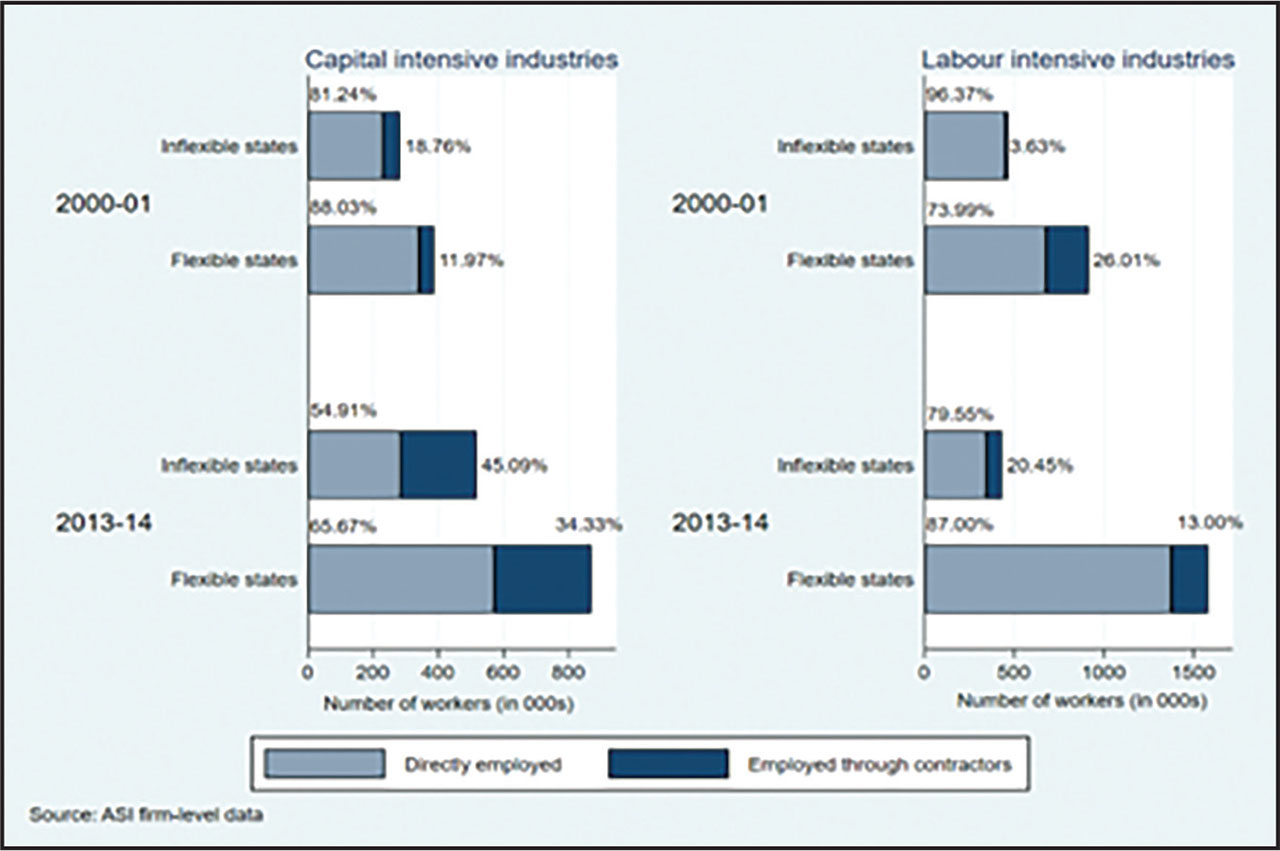
Figure A5
Share (%) of different workers across different industries and states.
Notes: The variable ‘total persons engaged’ reported in ASI is classified into four categories-production workers, employees holding supervisory or managerial positions, unpaid family members/ proprietor/ coop members and other employees. Production workers are subdivided into two categories: those hired directly, and workers employed through contractors. For details of capital-and labour-intensive industries, see footnote 11. For details on flexible and inflexible states classification, see Table A3 in the Appendix.
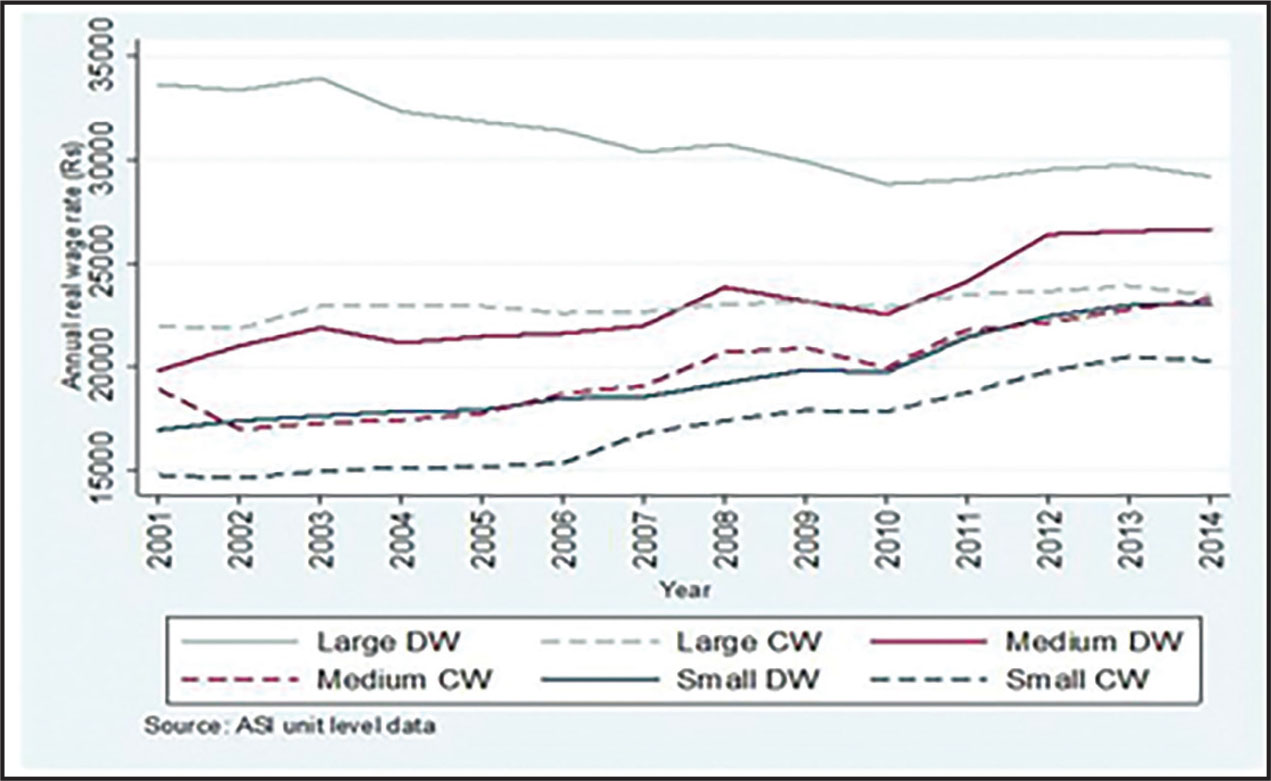
Figure A6
Real wages (in Rs) of different workers across different plant sizes.
Notes: The variable ‘total persons engaged’ reported in ASI is classified into four categories-production workers, employees holding supervisory or managerial positions, unpaid family members/ proprietor/ coop members and other employees. Production workers are subdivided into two categories: those hired directly and those employed through contractors.
Table A1
Total Employment in Manufacturing Sector (in millions)
| 2000–01 | 2005–06 | 2010–11 | 2015–16 | |
|---|---|---|---|---|
| Unorganised sector (NSS) | 37.1 | 36.44 | 34.88 | 36.04 |
| Organised sector (ASI) | 7.75 | 8.80 | 12.25 | 13.72 |
[i] Source: ASI and NSS establishment data (several years)
Table A2
Share (%) of contract workers in total workers by industry
| NIC | Industry | 2000–01 | 2013–14 |
|---|---|---|---|
| 15 | Manufacturing of food products and beverages | 21.52 | 29.45 |
| 16 | Manufacturing of tobacco products | 41.20 | 36.76 |
| 17 | Manufacturing of textiles | 10.76 | 16.28 |
| 18 | Manufacturing of wearing apparels; dressing and dyeing of fur | 6.02 | 16.91 |
| 19 | Tanning and dressing of leather; Manufacturing of luggage, handbags saddlery, harness and footwear | 19.45 | 23.00 |
| 20 | Manufacturing of wood and of products of wood and cork, except furniture; Mf of articles of straw and plaiting materials | 10.09 | 31.56 |
| 21 | Manufacturing of paper and paper products | 22.83 | 30.06 |
| 22 | Publishing, printing and reproduction of recorded media | 5.93 | 22.52 |
| 23 | Manufacturing of coke and refined petroleum products and nuclear fuel | 19.39 | 44.62 |
| 24 | Manufacturing of chemicals and chemical products | 20.60 | 42.94 |
| 25 | Manufacturing of rubber and plastic products | 14.15 | 37.63 |
| 26 | Manufacturing of other non-metallic mineral products | 34.08 | 61.47 |
| 27 | Manufacturing of basic metals | 30.13 | 45.04 |
| 28 | Manufacturing of fabricated metal products, except machinery and equipment | 29.08 | 43.17 |
| 29 | Manufacturing of machinery and equipment n.e.c. | 11.33 | 33.07 |
| 30 | Manufacturing of office, accounting and computing machinery | 42.68 | 37.24 |
| 31 | Manufacturing of electrical machinery and apparatus n.e.c. | 13.45 | 42.12 |
| 32 | Manufacturing of radio, television and communication equipment and apparatus | 9.60 | 34.68 |
| 33 | Manufacturing of medical, precision and optical instruments, watches and clocks | 5.45 | 24.58 |
| 34 | Manufacturing of motor vehicles, trailers and semi-trailers | 13.88 | 45.76 |
| 35 | Manufacturing of other transport equipment | 14.61 | 45.14 |
| 36 | Manufacturing of furniture; manufacturing n.e.c. | 16.06 | 24.35 |
[i] Source: ASI unit-level panel data
Table A3
State-wise classification of Labour Market Regulations (LMR) as per each of various studies and the final classification reported in this study
| State | BB* | AB-permission | AB-threshold | AB-composite | OECD | LMR |
|---|---|---|---|---|---|---|
| Andhra Pradesh | Flexible | 0 | 0 | 0 | Flexible | 1 |
| Assam | 0 | 0 | 0 | 0 | Inflexible | 0 |
| Bihar | 0 | 0 | 0 | 0 | Inflexible | 0 |
| Gujarat | 0* | 0 | 0 | 0 | Flexible | 0 |
| Haryana | 0 | 0 | 0 | 0 | Flexible | 0 |
| Karnataka | Flexible | Flexible | 0 | Flexible | 0 | 1 |
| Kerala | Flexible | 0 | 0 | 0 | Inflexible | 0 |
| Madhya Pradesh | 0* | 0 | 0 | 0 | 0 | 0 |
| Maharashtra | Inflexible | Inflexible | Inflexible | Inflexible | Inflexible | −1 |
| Odisha | Inflexible | Inflexible | Inflexible | Inflexible | 0 | −1 |
| Punjab | 0 | 0 | 0 | 0 | 0 | 0 |
| Rajasthan | Flexible | 0 | 0 | 0 | Flexible | 1 |
| Tamil Nadu | Flexible | Flexible | 0 | Flexible | 0 | 1 |
| Uttar Pradesh | 0 | Flexible | Flexible | Flexible | Flexible | 1 |
| West Bengal | Inflexible | Flexible | Inflexible | 0 | Inflexible | −1 |
Table A4
OLS regression results with two-way fixed effects.
| Category | All (1) | K-intensive (2) | L-intensive (3) | Small (4) | Medium (5) | Large (6) | Large K-intensive (7) | Large L-intensive (8) | Low CW (9) | High CW (10) |
|---|---|---|---|---|---|---|---|---|---|---|
| ln(WC/WD) | −0.196*** (0.009) | −0.189*** (0.014) | −0.189*** (0.020) | −0.098*** (0.006) | −0.175*** (0.012) | −0.249*** (0.016) | −0.234*** (0.027) | −0.230*** (0.038) | −0.199*** (0.009) | 0.002 (0.002) |
| Plant fixed effects | Yes | Yes | Yes | Yes | Yes | Yes | Yes | Yes | Yes | Yes |
| Year fixed effects | Yes | Yes | Yes | Yes | Yes | Yes | Yes | Yes | Yes | Yes |
| N | 116613 | 52700 | 34985 | 40411 | 42870 | 33332 | 15069 | 10762 | 114011 | 2602 |
Source: ASI unit-level panel data; Note: Standard errors clustered at plant-level are given in parentheses;
The control variables include plant and year fixed-effects, plant-specific characteristics such as ln(age of plant in years), ln(plant's fuel intensity) and year-wise ln(state level gross enrolment ratio). For details of capital-and labour-intensive industries, see footnote 11.
Table A5
Proxy variable regression results with two-way fixed effects
| Category | All (1) | K-intensive (2) | L-intensive (3) | Small (4) | Medium (5) | Large (6) | Large K-intensive (7) | Large L-intensive (8) | Low CW (9) | High CW (10) |
|---|---|---|---|---|---|---|---|---|---|---|
| ln(absenteeism) | 0.005 (0.010) | −0.012 (0.013) | 0.045** (0.020) | 0.036*** (0.009) | 0.015 (0.011) | 0.003 (0.016) | −0.007 (0.022) | 0.039 (0.034) | 0.007 (0.010) | −0.005 (0.004) |
| ln(realminwage) | 0.031** (0.013) | 0.009 (0.018) | 0.079*** (0.024) | 0.037*** (0.010) | 0.042*** (0.013) | 0.066*** (0.020) | 0.049 (0.033) | 0.061 (0.047) | 0.034*** (0.013) | −0.000 (0.005) |
| Plant fixed effects | Yes | Yes | Yes | Yes | Yes | Yes | Yes | Yes | Yes | Yes |
| Year fixed effects | Yes | Yes | Yes | Yes | Yes | Yes | Yes | Yes | Yes | Yes |
| N | 110238 | 46325 | 34985 | 36670 | 40760 | 32808 | 14545 | 10762 | 107781 | 2457 |
Source: ASI unit-level panel data; Note: Standard errors clustered at plant-level are given in parentheses;
The control variables include plant and year fixed-effects, time varying plant-specific characteristics such as ln(age of plant in years), ln(plant's fuel intensity) and year-wise ln(state level gross enrolment ratio).
Table A6
Instrumental variable regression results
| Category | All (1) | K-intensive (2) | L-intensive (3) | Small (4) | Medium (5) | Large (6) | Large K-intensive (7) | Large L-intensive (8) | Low CW (9) | High CW (10) |
|---|---|---|---|---|---|---|---|---|---|---|
| Second stage: dependent variable is ln(CW/TW) | ||||||||||
| ln(WC/WD) | 0.653*** (0.101) | 0.331*** (0.123) | −0.861** (0.412) | −1.003*** (0.238) | 0.145 (0.127) | 0.697*** (0.224) | 0.378* (0.202) | 1.015 (1.451) | 0.661*** (0.100) | −0.090 (0.107) |
| time trend | 0.010*** (0.001) | 0.015*** (0.001) | 0.010*** (0.002) | 0.000 (0.001) | 0.016*** (0.001) | 0.019*** (0.005) | 0.024*** (0.005) | 0.017 (0.024) | 0.015*** (0.001) | 0.008*** (0.001) |
| LMR-GHK | −0.060*** (0.008) | −0.067*** (0.010) | 0.033 (0.031) | 0.009 (0.011) | −0.030*** (0.010) | −0.070*** (0.019) | −0.059*** (0.022) | −0.144 (0.139) | −0.062*** (0.008) | 0.003 (0.004) |
| Industry fixed effects | Yes | Yes | Yes | Yes | Yes | Yes | Yes | Yes | Yes | Yes |
| N | 110,238 | 46,325 | 34,985 | 36,670 | 40,760 | 32,808 | 14,545 | 10,762 | 107,781 | 2,457 |
| First stage | ||||||||||
| ln(absenteeism) | −0.116*** (0.010) | −0.098*** (0.015) | −0.063*** (0. 016) | −0.080*** (0.015) | −0.085*** (0.014) | −0.115*** (0.020) | −0.133*** (0.029) | −0.039 (0.027) | −0.116*** (0.010) | −0.062 (0.065) |
| ln(min wage) | 0.088*** (0.009) | 0.110*** (0.015) | 0.034** (0.015) | −0.003 (0.013) | 0.099*** (0.013) | 0.095*** (0.019) | 0.142*** (0.030) | 0.018 (0.028) | 0.089*** (0.009) | 0.003 (0.044) |
| Industry fixed effects | Yes | Yes | Yes | Yes | Yes | Yes | Yes | Yes | Yes | Yes |
| F-statistic | 94.54 | 56.71 | 56.92 | 24.28 | 49.89 | 61.72 | 30.41 | 49.09 | 94.24 | 8.73 |
Source: ASI unit-level panel data; Note: Standard errors clustered at plant-level are given in parentheses;
the dependent variable in the second stage is ln(CW/TW). The control variables include industry-fixed effects, plant-specific characteristics such as ln(age of plant in years), ln(plant's fuel intensity) and year-wise ln(state-level gross enrolment ratio). For details of capital-and labour-intensive industries, see footnote 11.