
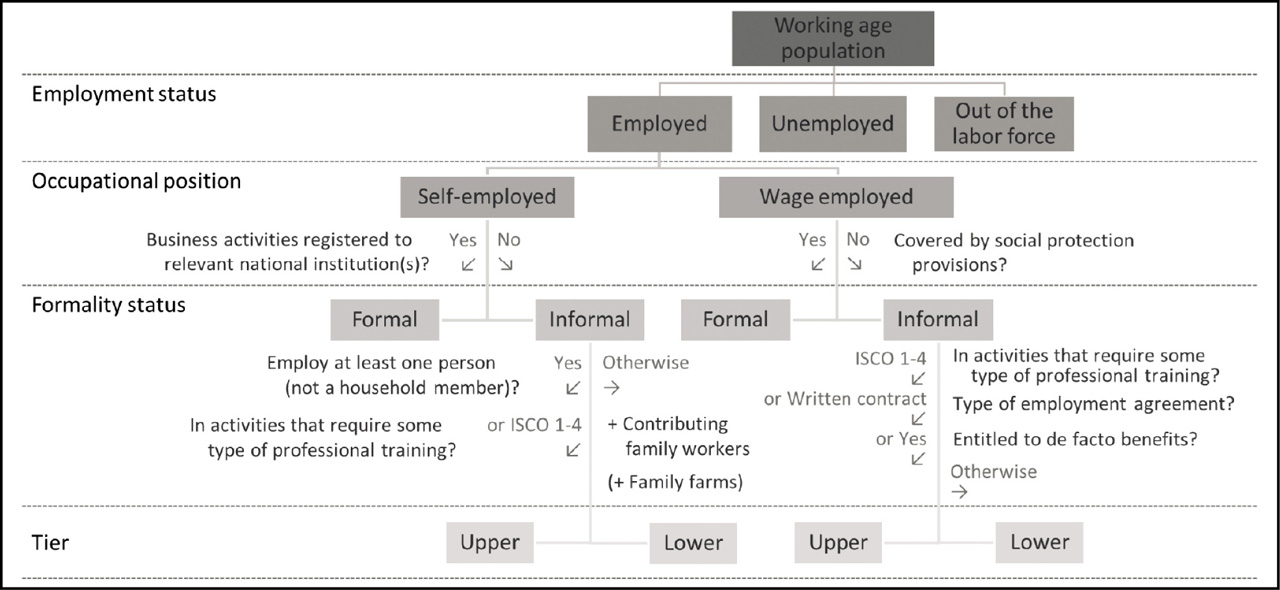
Figure 1
Work status classification.
Source: Authors’ own construct.
Table 1
Distribution of workers by work status (%)
| Ghana | South Africa | Tanzania | Uganda | |||
|---|---|---|---|---|---|---|
| a) Proportion of employment by work status | ||||||
| Wage employed | Formal | 13.2 | 56.7 | 11.7 | 11.7 | |
| Informal | Upper | 5.3 | 8.9 | 3.3 | 10.8 | |
| Lower | 18.9 | 21.4 | 28.6 | 26.0 | ||
| Self-employed | Formal | 8.9 | 4.0 | 9.1 | 3.1 | |
| Informal | Upper | 11.9 | 5.4 | 3.9 | 5.8 | |
| Lower | 41.8 | 3.7 | 43.4 | 42.6 | ||
| TOTAL | 100 | 100 | 100 | 100 | ||
| b) Proportion of formal vs. informal employment | ||||||
| Formal | 22.1 | 60.6 | 20.7 | 14.9 | ||
| Informal | Upper | 17.2 | 14.3 | 7.2 | 16.6 | |
| Lower | 60.7 | 25.1 | 72.0 | 68.6 | ||
| TOTAL | 100 | 100 | 100 | 100 | ||
| c) Proportion of upper-tier informality in informal employment | ||||||
| Upper informal in total informal employment | 22.1 | 36.4 | 9.1 | 19.4 | ||
| Upper informal in informal self-employment | 22.2 | 59.7 | 8.2 | 11.9 | ||
| Upper informal in informal wage employment | 22.0 | 29.4 | 10.5 | 29.4 | ||
[i] Note: For each country, summary statistics are compiled for the initial wave of panel study under study. Workers employed on family farms have been excluded from the analysis.
[ii] Source: Authors’ own calculations based on survey data from GSPS 2009/10, NIDS 2014/15, TZNPS 2010/11, and UNPS 2010/11.
[iii] GSPS, Ghana Socioeconomic Panel Study Survey; NIDS, National Income Dynamics Study; TZNPS, Tanzania National Panel Study; UNPS, Uganda National Panel Study.
Table 2
Transition matrices across work status groups
| WAVE t = 1 | Share of stayers | |||||||||
|---|---|---|---|---|---|---|---|---|---|---|
| Wage employed | Self-employed | |||||||||
| Formal | Informal | Formal | Informal | |||||||
| Upper | Lower | Upper | Lower | |||||||
| a) Ghana | ||||||||||
| WAVE t = 0 | Wage employed | Formal | 65.1 | 6.9 | 9.6 | 4.3 | 3.6 | 10.6 | 8.6 | |
| Informal | Upper | 33.0 | 11.8 | 23.7 | 2.5 | 3.2 | 25.8 | 0.6 | ||
| Lower | 21.7 | 5.3 | 32.2 | 7.5 | 6.4 | 26.9 | 6.1 | |||
| Self-employed | Formal | 2.1 | 3.4 | 12.1 | 29.5 | 15.8 | 37.1 | 2.6 | ||
| Informal | Upper | 4.0 | 2.5 | 15.2 | 14.7 | 44.7 | 18.9 | 5.3 | ||
| Lower | 2.1 | 2.0 | 15.8 | 6.8 | 6.3 | 67.2 | 28.1 | |||
| TOTAL | 21.0 | 4.5 | 18.4 | 9.1 | 11.2 | 35.8 | 51.3 | |||
| b) South Africa | ||||||||||
| WAVE t = 0 | Wage employed | Formal | 83.3 | 7.1 | 5.8 | 2.2 | 1.1 | 0.5 | 47.2 | |
| Informal | Upper | 50.1 | 25.1 | 14.7 | 6.0 | 1.0 | 3.1 | 2.2 | ||
| Lower | 26.4 | 13.1 | 47.7 | 4.7 | 3.9 | 4.3 | 10.2 | |||
| Self-employed | Formal | 13.0 | 9.7 | 5.1 | 50.8 | 13.3 | 8.1 | 2.0 | ||
| Informal | Upper | 12.2 | 11.1 | 19.5 | 16.1 | 23.5 | 17.6 | 1.3 | ||
| Lower | 14.7 | 6.2 | 16.8 | 6.9 | 24.6 | 30.8 | 1.1 | |||
| TOTAL | 63.4 | 9.9 | 14.9 | 5.2 | 3.4 | 3.1 | 64.0 | |||
| c) Tanzania | ||||||||||
| WAVE t = 0 | Wage employed | Formal | 79.7 | 4.4 | 9.7 | 1.5 | 1.0 | 3.6 | 9.3 | |
| Informal | Upper | 45.8 | 5.8 | 33.1 | 6.5 | 2.9 | 6.0 | 0.2 | ||
| Lower | 14.8 | 0.9 | 62.4 | 2.9 | 3.5 | 15.5 | 17.9 | |||
| Self-employed | Formal | 2.0 | 0.0 | 5.0 | 31.7 | 18.2 | 43.1 | 2.9 | ||
| Informal | Upper | 4.5 | 0.0 | 21.8 | 15.2 | 23.1 | 35.4 | 0.9 | ||
| Lower | 5.8 | 1.5 | 15.3 | 8.3 | 4.1 | 64.9 | 28.2 | |||
| TOTAL | 22.2 | 1.8 | 27.3 | 8.6 | 6.0 | 34.2 | 59.3 | |||
| d) Uganda | ||||||||||
| WAVE t = 0 | Wage employed | Formal | 58.0 | 27.0 | 8.1 | 5.2 | 0.0 | 1.7 | 6.8 | |
| Informal | Upper | 20.0 | 48.3 | 14.1 | 5.7 | 6.1 | 5.9 | 5.2 | ||
| Lower | 4.7 | 6.2 | 68.3 | 2.7 | 4.3 | 13.9 | 17.7 | |||
| Self-employed | Formal | 2.7 | 0.0 | 10.5 | 20.7 | 15.0 | 51.1 | 0.6 | ||
| Informal | Upper | 0.0 | 4.6 | 5.0 | 13.9 | 39.8 | 36.8 | 2.3 | ||
| Lower | 2.2 | 1.0 | 11.9 | 4.4 | 7.2 | 73.2 | 31.2 | |||
| TOTAL | 14.8 | 13.3 | 24.3 | 5.7 | 7.9 | 34.1 | 63.9 | |||
[i] Note: Each row indicates work status in the base period, and each column in transition matrices indicates work status in the next period; transition matrix rows sum to 100. The likelihood of staying in the same employment status conditional on the base year employment status is highlighted in gray. The share of stayers (proportion of workers who remain in their work status) is calculated as the product of highlighted diagonals and initial size.
[ii] Source: Authors’ own calculations based on survey data from GSPS 2009/10-2013/14, NIDS 2014/15-2017, TZNPS 2010/11-2012/13, and UNPS 2010/11-2011/12.
[iii] GSPS, Ghana Socioeconomic Panel Study Survey; NIDS, National Income Dynamics Study; TZNPS, Tanzania National Panel Study; UNPS, Uganda National Panel Study.
Table 3
Employment transitions
| Multinomial logistic regression | Number of obs = 7,816 | ||||
|---|---|---|---|---|---|
| Average marginal effects on work status in t = 1 | Log-likelihood = −7,851.1291 | ||||
| Base outcome: Lower-tier informal wage employed | Pseudo R2 = 0.3353 | ||||
| (1) | (2) | (3) | (4) | (5) | |
| Variables | Formal wage employed | Upper-tier informal wage employed | Lower-tier informal wage employed | Formal self-employed | Upper-tier informal self-employed |
| Work status in t = 0 (base: lower-tier informal self-employed) | |||||
| (1) Formal wage employed | 0.628*** (0.028) | 0.037** (0.016) | −0.066** (0.033) | −0.128*** (0.014) | −0.096*** (0.029) |
| (2) Upper-tier informal wage employed | 0.293*** (0.026) | 0.192*** (0.015) | 0.044 (0.033) | −0.099*** (0.014) | −0.078*** (0.028) |
| (3) Lower-tier informal wage employed | 0.153*** (0.008) | 0.062** (0.024) | 0.264*** (0.042) | −0.104*** (0.016) | −0.062** (0.025) |
| (4) Formal self-Employed | −0.045* (0.026) | −0.007 (0.023) | −0.079*** (0.020) | 0.227*** (0.033) | 0.043 (0.044) |
| (5) Upper-tier informal self-employed | −0.012 (0.024) | 0.028 (0.022) | −0.023 (0.030) | 0.016 (0.014) | 0.201*** (0.056) |
| Level of education (base: no schooling) | |||||
| Primary | 0.053*** (0.018) | 0.001 (0.009) | −0.089*** (0.025) | 0.023*** (0.006) | 0.001 (0.004) |
| Post-primary | 0.121*** (0.023) | 0.011 (0.026) | −0.160*** (0.033) | 0.050*** (0.005) | 0.004 (0.005) |
| Secondary | 0.196*** (0.025) | 0.008 (0.022) | −0.223*** (0.034) | 0.052*** (0.003) | −0.002 (0.012) |
| Post-secondary | 0.246*** (0.028) | 0.026 (0.022) | −0.283*** (0.036) | 0.096*** (0.020) | −0.000 (0.012) |
| Tertiary | 0.342*** (0.024) | −0.001 (0.019) | −0.337*** (0.041) | 0.107*** (0.038) | −0.016 (0.020) |
| Age | 0.003 (0.003) | −0.002 (0.002) | −0.010*** (0.003) | 0.006 (0.004) | 0.000 (0.002) |
| Age squared (×0.01) | −0.002 (0.004) | 0.002 (0.003) | 0.009*** (0.003) | −0.006 (0.005) | −0.001 (0.003) |
| Female | −0.037*** (0.009) | 0.029*** (0.003) | −0.008 (0.011) | −0.021*** (0.005) | −0.016*** (0.001) |
| Urban | 0.029*** (0.006) | −0.027*** (0.007) | 0.015 (0.018) | 0.007 (0.009) | −0.013*** (0.004) |
| Country (base: Ghana) | |||||
| South Africa | 0.122*** (0.006) | 0.037*** (0.007) | 0.005 (0.012) | −0.010 (0.006) | −0.020*** (0.003) |
| Tanzania | 0.112*** (0.018) | −0.033*** (0.004) | −0.019*** (0.006) | 0.017*** (0.002) | −0.036*** (0.005) |
| Uganda | −0.106*** (0.005) | 0.099*** (0.010) | 0.011 (0.007) | −0.018*** (0.002) | 0.007*** (0.002) |
| Sample selection | |||||
| Panel retention from t = 0 to t = 1 | −0.044** (0.020) | −0.019** (0.009) | −0.026* (0.015) | −0.007 (0.011) | −0.009 (0.013) |
| Employed (non-farm) in t = 0 | 0.011 (0.012) | −0.002 (0.021) | 0.010 (0.022) | 0.005 (0.014) | −0.025** (0.010) |
Note:
Source: Authors’ own calculations based on survey data from GSPS 2009/10-2013/14, NIDS 2014/15-2017, TZNPS 2010/11-2012/13, and UNPS 2010/11-2011/12.
GSPS, Ghana Socioeconomic Panel Study Survey; NIDS, National Income Dynamics Study; TZNPS, Tanzania National Panel Study; UNPS, Uganda National Panel Study.
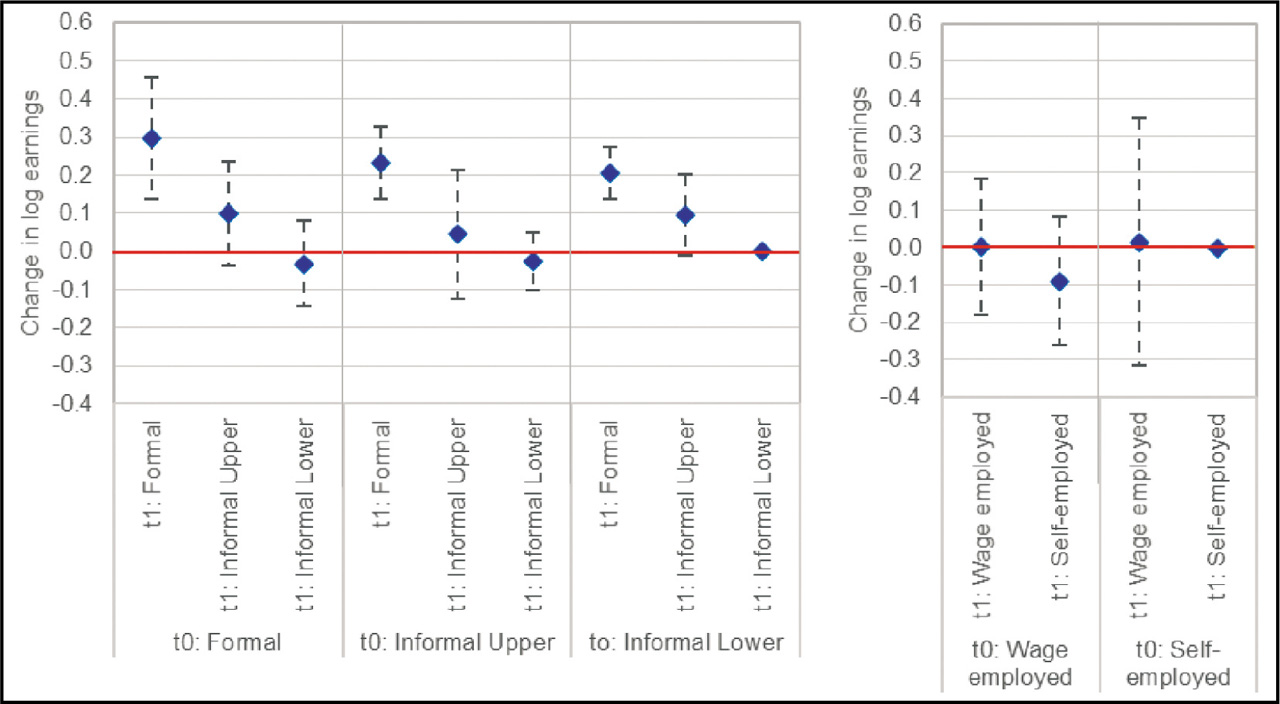
Figure 2
Labor income dynamics.
Note: Each point shows the estimated marginal effect on changes in log earnings by initial and destination employment state, with “Informal Lower” and “Wage Employed” being the base categories. The dashed lines show the 95% confidence intervals.
Source: Authors’ own calculations based on survey data from GSPS 2009/10-2013/14, NIDS 2014/15-2017, TZNPS 2010/11-2012/13, and UNPS 2010/11-2011/12.
Table A1
Data sources
| Country | Survey | t = 0 | t = 1 |
|---|---|---|---|
| Ghana | GSPS | Wave I (2009/10) | Wave II (2013/14) |
| South Africa | NIDS | Wave IV (2014/15) | Wave V (2017) |
| Tanzania | TZNPS | Wave II (2010/11) | Wave III (2012/13) |
| Uganda | UNPS | Wave II (2010/11) | Wave III (2011/12) |
[i] Source: Authors’ own construct.
[ii] GSPS, Ghana Socioeconomic Panel Study Survey; NIDS, National Income Dynamics Study; TZNPS, Tanzania National Panel Study; UNPS, Uganda National Panel Study.
Table B1
Basic socioeconomic, labor market and institutional indicators, 2010–2017
| Ghana | South Africa | Tanzania | Uganda | |
|---|---|---|---|---|
| GDP per capita | ||||
| Annual (constant 2017 PPP $) | 4,505 | 12,731 | 2,256 | 2,004 |
| Growth rate (annual %) | 4.4 | 0.4 | 3.4 | 1.7 |
| Sectoral contribution to GDP (% of GDP) | ||||
| Agriculture | 21.9 | 2.2 | 26.6 | 26.2 |
| Industry | 28.6 | 26.6 | 25.1 | 25.5 |
| Services | 42.8 | 61.1 | 40.6 | 42.0 |
| Poverty headcount (% of population) | ||||
| $1.90 a day (2011 PPP) | 12.0 | 17.5 | 49.5 | 38.5 |
| $3.20 a day (2011 PPP) | 30.1 | 36.5 | 78.2 | 68.5 |
| Educational attainment (% of population 25+ years) (cumulative) | ||||
| At least completed primary | 64.7 | 81.4 | 64.8 | 38.4 |
| At least completed lower secondary | 54.3 | 74.5 | 11.0 | 26.4 |
| At least completed upper secondary | 20.6 | 61.5 | 3.4 | 10.3 |
| Sector employment (% of total) (modeled ILO estimate) | ||||
| Agriculture | 41.6 | 5.0 | 68.3 | 70.1 |
| Industry | 16.2 | 23.7 | 6.1 | 7.2 |
| Services | 42.2 | 71.3 | 25.5 | 22.6 |
| Public sector employment | ||||
| Public sector employment as a share of formal employment (%) | 45.4 | 22.7 | 49.8 | 39.5 |
| Union membership | ||||
| Share of private paid employees with union membership (%) | 17.5 | 20.4 | 9.4 | 3.0 |
| Ease of doing business | ||||
| Score (0 = lowest performance to 100 = best performance) | 57.8 | 65.7 | 52.5 | 57.3 |
| Number of start-up procedures to register a business | 7.6 | 6.5 | 11.3 | 14.0 |
| Days required to start a business | 12.9 | 45.3 | 29.5 | 26.8 |
| New business density (registrations per 1,000 people ages 15–64) | 1.0 | 7.2 | 0.3 | 0.9 |
| Quality of institutions | ||||
| Governance quality index (1–10) | 6.5 | 6.1 | 5.2 | 5.7 |
| Regulatory performance in paying taxes (1–100) | 66.3 | 81.2 | 53.8 | 73.0 |
| Workers’ Rights (1–100) | 79.0 | 86.0 | 71.0 | 70.0 |
[i] Note: Calculated averages for the 2010–2017 study period. The reported public sector employment as a share of formal employment is in 2012 for Ghana, 2014 for South Africa, 2012 for Tanzania, and 2016 for Uganda.
[ii] Source: Authors’ calculations based on data from World Bank (2021), ILO (2021), and Teorell et al. (2021).
[iii] GDP, gross domestic product; PPP, Purchasing power parity.
Table B2
Distribution of workers by work status (%), extended definition
| Ghana | South Africa | Tanzania | Uganda | |||
|---|---|---|---|---|---|---|
| a) Proportion of employment by work status (incl. family farms and unemployment) | ||||||
| Wage employed | Formal | 6.8 | 44.3 | 3.9 | 4.0 | |
| Informal | Upper | 2.8 | 7.0 | 1.1 | 3.7 | |
| Lower | 9.8 | 16.7 | 9.5 | 8.8 | ||
| Self-employed | Formal | 4.6 | 3.1 | 3.0 | 1.1 | |
| Informal | Upper | 6.2 | 4.2 | 1.3 | 2.0 | |
| Lower | 21.7 | 2.9 | 14.4 | 14.5 | ||
| Family farms | 43.4 | 0.9 | 65.5 | 65.0 | ||
| Unemployment | 4.8 | 21.0 | 1.3 | 1.0 | ||
| TOTAL | 100 | 100 | 100 | 100 | ||
| b) Proportion of formal vs. informal employment (incl. family farms as informal lower) | ||||||
| Formal | 12.0 | 59.9 | 7.0 | 5.1 | ||
| Informal | Upper | 9.4 | 14.2 | 2.4 | 5.7 | |
| Lower | 78.6 | 25.9 | 90.6 | 89.2 | ||
| TOTAL | 100 | 100 | 100 | 100 | ||
[i] Note: For each country, summary statistics are compiled for the initial wave of panel study under study.
[ii] Source: Authors’ own calculations based on survey data from GSPS 2009/10, NIDS 2014/15, TZNPS 2010/11, and UNPS 2010/11.
[iii] GSPS, Ghana Socioeconomic Panel Study Survey; NIDS, National Income Dynamics Study; TZNPS, Tanzania National Panel Study; UNPS, Uganda National Panel Study.
Table B3
Change in distribution of workers by work status, balanced panel
| Ghana | South Africa | Tanzania | Uganda | |||
|---|---|---|---|---|---|---|
| a) Change (ppts) in proportion of employment by work status | ||||||
| Wage employed | Formal | 1.7 | −0.4 | 5.0 | −2.7 | |
| Informal | Upper | −2.5 | 1.6 | −2.4 | 0.0 | |
| Lower | −3.8 | −3.3 | −0.4 | 0.7 | ||
| Self-employed | Formal | 0.8 | 2.0 | −2.8 | 1.3 | |
| Informal | Upper | −1.5 | −0.5 | 0.7 | 0.5 | |
| Lower | 5.3 | 0.6 | −0.1 | 0.3 | ||
| b) Change (ppts) in proportion of formal and informal employment | ||||||
| Formal | 2.5 | 1.5 | 2.3 | −1.5 | ||
| Informal | Upper | −4.0 | 1.1 | −1.7 | 0.5 | |
| Lower | 1.5 | −2.6 | −0.5 | 1.0 | ||
| c) Change (ppts) in proportion of self-employment | ||||||
| Self-employed | 4.6 | 2.1 | −2.2 | 2.1 | ||
[i] Source: Authors’ own calculations based on survey data from GSPS 2009/10-2013/14, NIDS 2014/15-2017, TZNPS 2010/11-2012/13, and UNPS 2010/11-2011/12.
[ii] GSPS, Ghana Socioeconomic Panel Study Survey; NIDS, National Income Dynamics Study; TZNPS, Tanzania National Panel Study; UNPS, Uganda National Panel Study.
Table B4
Average worker characteristics by work status
| Ghana | South Africa | Tanzania | Uganda | |||
|---|---|---|---|---|---|---|
| a) Average age (years) | ||||||
| Wage employed | Formal | 43.5 (0.53) | 37.5 (0.16) | 40.5 (0.52) | 36.1 (0.71) | |
| Informal | Upper | 36.4 (0.82) | 35.6 (0.37) | 33.4 (1.00) | 34.7 (0.84) | |
| Lower | 38.4 (0.46) | 35.4 (0.25) | 30.3 (0.35) | 30.5 (0.53) | ||
| Self-employed | Formal | 41.5 (0.64) | 41.3 (0.72) | 37.5 (0.54) | 34.8 (1.29) | |
| Informal | Upper | 40.3 (0.53) | 40.2 (0.54) | 34.7 (0.83) | 38.8 (0.95) | |
| Lower | 40.8 (0.29) | 38.6 (0.69) | 31.0 (0.33) | 34.8 (0.47) | ||
| TOTAL | 40.5 (0.19) | 37.2 (0.12) | 32.7 (0.20) | 34.1 (0.29) | ||
| b) Share of female workers (%) | ||||||
| Wage employed | Formal | 33.7 (2.41) | 41.5 (0.75) | 32.5 (2.15) | 41.3 (3.77) | |
| Informal | Upper | 30.0 (3.55) | 57.0 (1.65) | 35.5 (4.33) | 34.3 (3.80) | |
| Lower | 33.8 (1.91) | 44.3 (1.09) | 34.0 (1.55) | 26.8 (2.12) | ||
| Self-employed | Formal | 47.9 (3.24) | 45.8 (3.00) | 36.0 (2.83) | 39.7 (6.60) | |
| Informal | Upper | 50.0 (2.67) | 40.3 (2.25) | 25.4 (3.73) | 29.4 (4.25) | |
| Lower | 81.7 (1.08) | 58.4 (2.96) | 63.9 (1.31) | 47.9 (1.85) | ||
| TOTAL | 56.8 (0.90) | 44.2 (0.55) | 46.7 (0.87) | 38.9 (1.19) | ||
| c) Share of workers with secondary or tertiary education (%) | ||||||
| Wage employed | Formal | 52.2 (3.02) | 63.7 (0.74) | 36.4 (2.29) | 60.1 (3.88) | |
| Informal | Upper | 37.8 (4.04) | 55.5 (1.66) | 39.9 (4.76) | 59.7 (4.09) | |
| Lower | 19.1 (1.76) | 28.0 (0.98) | 1.2 (0.36) | 11.8 (1.66) | ||
| Self-employed | Formal | 18.6 (2.80) | 69.3 (2.78) | 2.4 (0.91) | 42.9 (6.74) | |
| Informal | Upper | 10.0 (1.82) | 28.6 (2.07) | 3.3 (1.56) | 37.3 (4.59) | |
| Lower | 8.3 (0.95) | 33.0 (2.82) | 1.7 (0.38) | 12.2 (1.29) | ||
| TOTAL | 19.0 (0.83) | 52.5 (0.55) | 7.1 (0.47) | 25.8 (1.13) | ||
[i] Note: For each country, summary statistics are compiled for the initial wave of panel study under study. Standard errors of mean values in parentheses.
[ii] Source: Authors’ own calculations based on survey data from GSPS 2009/10, NIDS 2014/15, TZNPS 2010/11, and UNPS 2010/11.
[iii] GSPS, Ghana Socioeconomic Panel Study Survey; NIDS, National Income Dynamics Study; TZNPS, Tanzania National Panel Study; UNPS, Uganda National Panel Study.
Table B5
Transition matrices across work status groups, including additional destination states (family farms under lower-tier informal self-employment and unemployment)
| WAVE t = 1 | Share of stayers | ||||||||||
|---|---|---|---|---|---|---|---|---|---|---|---|
| Wage employed | Self-employed | Unempl. | |||||||||
| Formal | Informal | Formal | Informal | ||||||||
| Upper | Lower | Upper | Lower | ||||||||
| a) Ghana | |||||||||||
| WAVE t = 0 | Wage employed | Formal | 59.0 | 6.2 | 8.7 | 3.9 | 3.2 | 16.7 | 2.2 | 7.8 | |
| Informal | Upper | 25.7 | 9.2 | 18.5 | 2.0 | 2.5 | 40.5 | 1.6 | 0.5 | ||
| Lower | 15.5 | 3.8 | 22.9 | 5.4 | 4.5 | 41.2 | 6.8 | 4.3 | |||
| Self-employed | Formal | 1.1 | 1.7 | 6.2 | 14.9 | 8.0 | 64.2 | 4.0 | 1.3 | ||
| Informal | Upper | 2.2 | 1.3 | 8.2 | 8.0 | 24.2 | 52.4 | 3.8 | 2.9 | ||
| Lower | 0.8 | 0.8 | 6.5 | 2.8 | 2.6 | 83.5 | 3.1 | 34.9 | |||
| TOTAL | 11.9 | 2.6 | 10.5 | 5.2 | 6.4 | 59.7 | 3.7 | 51.7 | |||
| b) South Africa | |||||||||||
| WAVE t = 0 | Wage employed | Formal | 78.9 | 6.7 | 5.5 | 2.1 | 1.0 | 0.7 | 5.1 | 44.7 | |
| Informal | Upper | 42.0 | 21.0 | 12.4 | 5.0 | 0.9 | 2.7 | 16.1 | 1.9 | ||
| Lower | 22.0 | 10.9 | 39.8 | 3.9 | 3.2 | 3.9 | 16.2 | 8.5 | |||
| Self-employed | Formal | 10.8 | 8.0 | 4.2 | 42.0 | 11.0 | 8.5 | 15.5 | 1.7 | ||
| Informal | Upper | 9.9 | 9.0 | 15.8 | 13.1 | 19.1 | 14.3 | 18.8 | 1.0 | ||
| Lower | 10.0 | 4.2 | 11.4 | 4.7 | 16.7 | 21.2 | 31.9 | 0.8 | |||
| TOTAL | 56.9 | 8.9 | 13.4 | 4.7 | 3.1 | 3.0 | 10.1 | 58.6 | |||
| c) Tanzania | |||||||||||
| WAVE t = 0 | Wage employed | Formal | 71.9 | 4.0 | 8.8 | 1.4 | 0.9 | 12.7 | 0.4 | 8.4 | |
| Informal | Upper | 40.5 | 5.1 | 29.2 | 5.7 | 2.5 | 15.9 | 1.1 | 0.2 | ||
| Lower | 11.1 | 0.7 | 46.7 | 2.2 | 2.6 | 35.9 | 0.8 | 13.4 | |||
| Self-employed | Formal | 1.6 | 0.0 | 4.1 | 25.8 | 14.8 | 53.6 | 0.0 | 2.3 | ||
| Informal | Upper | 3.8 | 0.0 | 18.5 | 12.9 | 19.6 | 45.2 | 0.0 | 0.8 | ||
| Lower | 3.8 | 1.0 | 9.9 | 5.4 | 2.7 | 74.8 | 2.5 | 32.5 | |||
| TOTAL | 16.5 | 1.3 | 20.4 | 6.4 | 4.5 | 49.6 | 1.3 | 57.5 | |||
| d) Uganda | |||||||||||
| WAVE t = 0 | Wage employed | Formal | 57.7 | 26.8 | 8.1 | 5.2 | 0.0 | 2.2 | 0.0 | 6.8 | |
| Informal | Upper | 17.8 | 43.1 | 12.6 | 5.1 | 5.5 | 16.0 | 0.0 | 4.7 | ||
| Lower | 3.2 | 4.2 | 46.1 | 1.8 | 2.9 | 41.4 | 0.5 | 12.0 | |||
| Self-employed | Formal | 2.6 | 0.0 | 10.1 | 19.8 | 14.3 | 53.3 | 0.0 | 0.6 | ||
| Informal | Upper | 0.0 | 3.7 | 4.0 | 11.2 | 32.1 | 49.1 | 0.0 | 1.8 | ||
| Lower | 1.2 | 0.5 | 6.3 | 2.3 | 3.8 | 85.4 | 0.5 | 36.4 | |||
| TOTAL | 10.2 | 9.1 | 16.7 | 3.9 | 5.4 | 54.3 | 0.3 | 62.3 | |||
[i] Note: Each row indicates work status in the base period, and each column in transition matrices indicates work status in the next period; transition matrix rows sum to 100. The likelihood of staying in the same employment status conditional on the base year employment status is highlighted in gray. The share of stayers (proportion of workers who remain in their work status) is calculated as the product of highlighted diagonals and initial size.
[ii] Source: Authors’ own calculations based on survey data from GSPS 2009/10-2013/14, NIDS 2014/15-2017, TZNPS 2010/11-2012/12, and UNPS 2010/11-2011/12.
[iii] GSPS, Ghana Socioeconomic Panel Study Survey; NIDS, National Income Dynamics Study; TZNPS, Tanzania National Panel Study; UNPS, Uganda National Panel Study.
Table B6
(Non-farm) employment and panel retention rates (%)
| Ghana | South Africa | Tanzania | Uganda | |||||
|---|---|---|---|---|---|---|---|---|
| Employed (non-farm) | Panel retention | Employed (non-farm) | Panel retention | Employed (non-farm) | Panel retention | Employed (non-farm) | Panel retention | |
| Percentage share | 51.7 | 70.8 | 78.1 | 75.9 | 33.2 | 69.1 | 34.0 | 71.9 |
[i] Note: The dummy variable capturing (non-farm) employment equals one if the individual is working in formal or informal wage or self-employment and zero if working on a family farm or is unemployed. For individuals who responded to the employment module in t = 0, the dummy variable capturing panel retention equals one if the individual was successfully re-interviewed in the employment module in t = 1, and zero otherwise.
[ii] Source: Authors’ own calculations based on survey data from GSPS 2009/10-2013/14, NIDS 2014/15-2017, TZNPS 2010/11-2012/13, and UNPS 2010/11-2011/12.
[iii] GSPS, Ghana Socioeconomic Panel Study Survey; NIDS, National Income Dynamics Study; TZNPS, Tanzania National Panel Study; UNPS, Uganda National Panel Study.
Table B7
Probability of employment (non-farm) in the baseline and panel retention
| Variables | Ghana | South Africa | Tanzania | Uganda | ||||
|---|---|---|---|---|---|---|---|---|
| (1) | (2) | (1) | (2) | (1) | (2) | (1) | (2) | |
| Employed (non-farm) | Panel retention | Employed (non-farm) | Panel retention | Employed (non-farm) | Panel retention | Employed (non-farm) | Panel retention | |
| Level of education (base: no schooling) | ||||||||
| Primary | 0.164* (0.086) | −0.044 (0.080) | −0.040 (0.025) | 0.013 (0.024) | 0.091*** (0.013) | 0.014 (0.013) | −0.052** (0.022) | 0.004 (0.020) |
| Post-primary | 0.216** (0.085) | −0.034 (0.079) | −0.047* (0.024) | 0.013 (0.023) | 0.332*** (0.019) | 0.014 (0.018) | 0.108*** (0.029) | −0.033 (0.026) |
| Secondary | 0.328*** (0.088) | −0.044 (0.082) | 0.001 (0.024) | 0.010 (0.024) | 0.602*** (0.038) | 0.127*** (0.032) | 0.089** (0.035) | −0.030 (0.031) |
| Post-secondary | 0.506*** (0.093) | −0.018 (0.090) | 0.069*** (0.025) | −0.013 (0.025) | 0.556*** (0.045) | 0.024 (0.045) | 0.356*** (0.040) | −0.041 (0.037) |
| Tertiary | 0.521*** (0.091) | −0.081 (0.089) | 0.160*** (0.028) | −0.022 (0.032) | 0.593*** (0.063) | 0.145*** (0.040) | 0.124** (0.063) | −0.111* (0.059) |
| Age | 0.033*** (0.004) | 0.052*** (0.003) | 0.026*** (0.002) | 0.010*** (0.002) | 0.004* (0.002) | 0.031*** (0.002) | 0.010*** (0.003) | 0.027*** (0.003) |
| Age squared (×0.01) | −0.042*** (0.005) | −0.064*** (0.004) | −0.024*** (0.003) | −0.013*** (0.003) | −0.010*** (0.003) | −0.039*** (0.003) | −0.016*** (0.004) | −0.030*** (0.004) |
| Female | 0.189*** (0.017) | −0.015 (0.014) | −0.089*** (0.008) | 0.061*** (0.008) | −0.001 (0.011) | −0.074*** (0.010) | −0.115*** (0.015) | 0.019 (0.013) |
| Urban | 0.264*** (0.012) | −0.032** (0.015) | 0.113*** (0.008) | −0.011 (0.008) | 0.375*** (0.007) | −0.092*** (0.011) | 0.340*** (0.015) | −0.050*** (0.016) |
| Head of household | 0.268*** (0.018) | 0.106*** (0.008) | 0.108*** (0.012) | 0.140*** (0.017) | ||||
| Sample member in the previous wave | n.a. n.a. | 0.234*** (0.008) | 0.044*** (0.012) | 0.073*** (0.016) | ||||
| Wald test of rho = 0 | 15.216 | 10.086 | 17.313 | 9.811 | ||||
| F-statistic (p-value) | 0.000 | 0.002 | 0.000 | 0.002 | ||||
| Observations | 6,718 | 21,498 | 7,870 | 4,315 | ||||
Note:
Source: Authors’ own calculations based on survey data from GSPS 2009/10-2013/14, NIDS 2014/15-2017, TZNPS 2010/11-2012/13, and UNPS 2010/11-2011/12.
GSPS, Ghana Socioeconomic Panel Study Survey; NIDS, National Income Dynamics Study; TZNPS, Tanzania National Panel Study; UNPS, Uganda National Panel Study.
Table B8
Excludability of instruments from main employment dynamics equation
| Head of household | Sample member in the previous wave | |
|---|---|---|
| F-statistic (p-value) | 0.1800 | 0.9647 |
[i] Source: Authors’ own calculations based on survey data from GSPS 2009/10-2013/14, NIDS 2014/15-2017, TZNPS 2010/11-2012/13, and UNPS 2010/11-2011/12.
[ii] GSPS, Ghana Socioeconomic Panel Study Survey; NIDS, National Income Dynamics Study; TZNPS, Tanzania National Panel Study; UNPS, Uganda National Panel Study.
Table B9
Employment dynamics, including inactivity/unemployment as an additional destination state
| Multinomial logistic regression | Number of obs = 9,851 | |||||
|---|---|---|---|---|---|---|
| Average marginal effects on work status in t = 1 | Log-likelihood = −12,048 | |||||
| Base outcome: Lower-tier informal wage employed | Pseudo R2 = 0.284 | |||||
| Variables | (1) | (2) | (3) | (4) | (5) | (6) |
| Formal wage employed | Upper-tier informal wage employed | Lower-tier informal wage employed | Formal self-employed | Upper-tier informal self-employed | Inactive/unemployed | |
| Work status in t = 0 (base: lower-tier informal self-employed) | ||||||
| (1) Formal wage employed | 0.584*** (0.016) | 0.051*** (0.009) | −0.002 (0.020) | −0.070*** (0.009) | −0.052*** (0.018) | −0.271*** (0.012) |
| (2) Upper-tier informal wage employed | 0.264*** (0.011) | 0.168*** (0.007) | 0.084*** (0.019) | −0.048*** (0.009) | −0.038** (0.017) | −0.210*** (0.022) |
| (3) Lower-tier informal wage employed | 0.130*** (0.008) | 0.053*** (0.013) | 0.228*** (0.023) | −0.054*** (0.010) | −0.028* (0.015) | −0.137*** (0.019) |
| (4) Formal self-employed | −0.006 (0.012) | 0.006 (0.013) | −0.022* (0.012) | 0.195*** (0.024) | 0.051* (0.027) | −0.168*** (0.017) |
| (5) Upper-tier informal self-employed | 0.008 (0.010) | 0.023** (0.011) | 0.008 (0.023) | 0.027** (0.013) | 0.151*** (0.044) | −0.101*** (0.038) |
| Level of education (base: no schooling) | ||||||
| Primary | 0.035** (0.016) | 0.001 (0.007) | −0.065** (0.027) | 0.018*** (0.005) | 0.002 (0.004) | −0.003 (0.018) |
| Post-primary | 0.093*** (0.017) | 0.012 (0.020) | −0.113*** (0.032) | 0.040*** (0.004) | 0.006 (0.005) | −0.021 (0.019) |
| Secondary | 0.157*** (0.024) | 0.011 (0.017) | −0.157*** (0.033) | 0.042*** (0.003) | 0.001 (0.009) | −0.036** (0.015) |
| Post-secondary | 0.219*** (0.028) | 0.031* (0.019) | −0.204*** (0.035) | 0.082*** (0.017) | 0.005 (0.010) | −0.072*** (0.014) |
| Tertiary | 0.329*** (0.029) | 0.013 (0.014) | −0.249*** (0.040) | 0.088*** (0.032) | −0.009 (0.018) | −0.099*** (0.023) |
| Age | 0.015*** (0.004) | 0.002 (0.001) | −0.001 (0.001) | 0.006* (0.003) | 0.002 (0.002) | −0.030*** (0.006) |
| Age squared (×0.01) | −0.018*** (0.004) | −0.003 (0.002) | −0.001 (0.001) | −0.006* (0.004) | −0.003 (0.002) | 0.038*** (0.006) |
| Female | −0.050*** (0.010) | 0.016*** (0.003) | −0.028* (0.016) | −0.023*** (0.003) | −0.019*** (0.001) | 0.078*** (0.024) |
| Urban | 0.012*** (0.004) | −0.022*** (0.005) | 0.015 (0.016) | 0.006 (0.007) | −0.009*** (0.004) | 0.018 (0.013) |
| Country (base: Ghana) | ||||||
| South Africa | 0.085*** (0.007) | 0.020*** (0.003) | −0.035*** (0.008) | −0.020*** (0.005) | −0.032*** (0.002) | 0.107*** (0.006) |
| Tanzania | 0.162*** (0.017) | −0.021*** (0.004) | 0.030*** (0.006) | 0.026*** (0.002) | −0.024*** (0.004) | −0.188*** (0.005) |
| Uganda | −0.053*** (0.003) | 0.100*** (0.009) | 0.042*** (0.007) | −0.009*** (0.002) | 0.016*** (0.002) | −0.151*** (0.009) |
| Sample selection | ||||||
| Panel retention From t = 0 to t = 1 | −0.037 (0.039) | −0.020* (0.012) | −0.033*** (0.012) | −0.012 (0.009) | −0.015* (0.008) | 0.031 (0.030) |
| Employed (non-farm) in t = 0 | −0.034 (0.033) | −0.009 (0.013) | −0.003 (0.022) | 0.001 (0.013) | −0.022*** (0.007) | 0.087 (0.056) |
Note:
Source: Authors’ own calculations based on survey data from GSPS 2009/10-2013/14, NIDS 2014/15-2017, TZNPS 2010/11-2012/13, and UNPS 2010/11-2011/12.
GSPS, Ghana Socioeconomic Panel Study Survey; NIDS, National Income Dynamics Study; TZNPS, Tanzania National Panel Study; UNPS, Uganda National Panel Study.
Table B10
Employment dynamics, using ordered logistic regression
| Ordered logistic regression, average marginal effects, split sample | ||||||
|---|---|---|---|---|---|---|
| (1) | (2) | (3) | ||||
| Formality status in t = 0 | Lower-tier informal | Upper-tier informal | Formal | |||
| Formality status in t = 1 | Formal | Upper-tier informal | Formal | Lower-tier informal | Upper-tier informal | Lower-tier informal |
| Variables | ||||||
| Employment status (base: Wage employed) | ||||||
| Self-employed | −0.036 (0.026) | −0.013 (0.012) | −0.122** (0.057) | 0.114** (0.055) | 0.081*** (0.007) | 0.185*** (0.034) |
| Level of education (base: no schooling) | ||||||
| Primary | 0.033 (0.020) | 0.019** (0.008) | 0.022 (0.021) | −0.033 (0.035) | −0.034* (0.020) | −0.125* (0.073) |
| Post-primary | 0.121** (0.053) | 0.056*** (0.011) | 0.117 (0.080) | −0.145 (0.109) | −0.069*** (0.016) | −0.197*** (0.055) |
| Secondary | 0.208*** (0.074) | 0.077*** (0.005) | 0.238*** (0.068) | −0.245*** (0.093) | −0.092*** (0.020) | −0.232*** (0.055) |
| Post-secondary | 0.281*** (0.043) | 0.084*** (0.004) | 0.328*** (0.076) | −0.300*** (0.096) | −0.114*** (0.024) | −0.263*** (0.059) |
| Tertiary | 0.575*** (0.064) | 0.048** (0.023) | 0.554*** (0.101) | −0.395*** (0.084) | −0.133*** (0.024) | −0.286*** (0.054) |
| Age | 0.003 (0.004) | 0.001 (0.001) | 0.013 (0.010) | −0.011 (0.009) | −0.004** (0.002) | −0.007** (0.003) |
| Age squared (×0.01) | −0.002 (0.004) | −0.001 (0.001) | −0.014 (0.009) | 0.012 (0.009) | 0.004* (0.002) | 0.006* (0.004) |
| Female | −0.066** (0.031) | −0.023*** (0.005) | −0.014 (0.048) | 0.013 (0.044) | 0.019*** (0.005) | 0.034*** (0.009) |
| Urban | 0.021* (0.012) | 0.007 (0.006) | 0.046** (0.019) | −0.042** (0.018) | 0.001 (0.007) | 0.003 (0.013) |
| Country (base: Ghana) | ||||||
| South Africa | 0.102*** (0.015) | 0.036*** (0.009) | 0.068*** (0.010) | −0.061*** (0.010) | −0.058*** (0.012) | −0.122*** (0.004) |
| Tanzania | 0.038 (0.031) | 0.016** (0.007) | 0.027 (0.035) | −0.026 (0.033) | −0.049*** (0.004) | −0.106*** (0.008) |
| Uganda | −0.040*** (0.010) | −0.021* (0.012) | −0.080*** (0.014) | 0.090*** (0.015) | 0.013*** (0.001) | 0.045*** (0.005) |
| Sample selection | ||||||
| Panel retention From t = 0 to t = 1 | −0.144* (0.082) | −0.049*** (0.014) | −0.024 (0.044) | 0.021 (0.040) | 0.026* (0.014) | 0.045 (0.030) |
| Employed (non-farm) in t = 0 | 0.013 (0.023) | 0.004 (0.009) | 0.090*** (0.030) | −0.082*** (0.026) | 0.025* (0.014) | 0.043* (0.024) |
| Observations | 2,869 | 1,166 | 3,781 | |||
| Pseudo R2 | 0.0728 | 0.0614 | 0.1220 | |||
Note:
* p < 0.1. Standard errors clustered at the country level in parentheses. We group together workers in wage and self-employment and define the individual's formality status, Fi, on an ordinal scale, taking on three possible values: lower-tier informal employment, Fi = 1; upper-tier informal employment Fi = 2 ; and formal employment, Fi = 3. We split the sample by the formality status at time t = 0 and express the formality status at time t = 1 as a function of the same set of initial worker attributes Xi0.
Source: Authors’ own calculations based on survey data from GSPS 2009/10-2013/14, NIDS 2014/15-2017, TZNPS 2010/11-2012/13, and UNPS 2010/11-2011/12.
GSPS, Ghana Socioeconomic Panel Study Survey; NIDS, National Income Dynamics Study; TZNPS, Tanzania National Panel Study; UNPS, Uganda National Panel Study.
Table B11
Change in log labor earnings
| All countries | Excl. South Africa | |||
|---|---|---|---|---|
| Variables | (1) | (2) | (3) | (4) |
| Log labor earnings (t = 0) | −0.335*** (0.057) | −0.334** (0.058) | −0.375* (0.123) | −0.375* (0.124) |
| Formality status in t = 0 (base: Lower informal in t = 0) | ||||
| Formal (t = 0) | −0.033 (0.037) | −0.033 (0.035) | 0.018 (0.045) | 0.016 (0.044) |
| Upper informal (t = 0) | −0.023 (0.023) | −0.025 (0.024) | 0.016 (0.031) | 0.021 (0.030) |
| Formality status in t = 0 and t = 1 (base: Lower informal in t = 0 and t = 1) | ||||
| Formal (t = 0) × Formal (t = 1) | 0.337** (0.081) | 0.330** (0.077) | 0.240 (0.101) | 0.243 (0.110) |
| Formal (t = 0) × Upper informal (t = 1) | 0.136 (0.076) | 0.133 (0.073) | 0.014 (0.080) | 0.013 (0.087) |
| Upper informal (t = 0) × Formal (t = 1) | 0.257*** (0.029) | 0.256*** (0.030) | 0.265** (0.035) | 0.260** (0.045) |
| Upper informal (t = 0) × Upper informal (t = 1) | 0.071 (0.057) | 0.070 (0.056) | 0.109 (0.118) | 0.099 (0.121) |
| Lower informal (t = 0) × Formal (t = 0) | 0.206*** (0.022) | 0.206*** (0.021) | 0.211* (0.054) | 0.212* (0.054) |
| Lower informal (t = 0) × Upper informal (t = 0) | 0.082* (0.029) | 0.095* (0.033) | 0.067 (0.062) | 0.069 (0.045) |
| Employment status in t = 0 (base: Wage employed in t = 0) | ||||
| Self-employed (t = 0) | 0.045 (0.106) | −0.091** (0.014) | ||
| Employment status in t = 0 and t = 1 (base: Wage employed in t = 0 and t = 1) | ||||
| Self-employed (t = 0) × Self-employed (t = 0) | −0.090 (0.054) | −0.021 (0.041) | ||
| Wage employed (t = 0) × Self-employed (t = 0) | 0.015 (0.104) | −0.067 (0.087) | ||
| Characteristics in t = 0 | ||||
| Level of education (base: No schooling) | ||||
| Primary | 0.058 (0.036) | 0.061 (0.031) | 0.076 (0.036) | 0.076 (0.029) |
| Post-primary | 0.103** (0.022) | 0.106*** (0.018) | 0.104* (0.033) | 0.108* (0.032) |
| Secondary | 0.205*** (0.035) | 0.207*** (0.032) | 0.212* (0.054) | 0.219* (0.063) |
| Post-secondary | 0.328*** (0.039) | 0.332*** (0.037) | 0.227** (0.045) | 0.236** (0.055) |
| Tertiary | 0.542*** (0.089) | 0.544*** (0.088) | 0.474* (0.143) | 0.482* (0.154) |
| Age | 0.005 (0.004) | 0.004 (0.003) | 0.004 (0.009) | 0.003 (0.008) |
| Age squared (×0.01) | −0.004 (0.004) | −0.004 (0.004) | −0.002 (0.009) | −0.001 (0.008) |
| Female | −0.134** (0.029) | −0.135** (0.030) | −0.152 (0.082) | −0.157 (0.083) |
| Urban | 0.076** (0.023) | 0.076** (0.023) | 0.095 (0.064) | 0.100 (0.062) |
| Country (base: Uganda) | ||||
| South Africa | 0.110 (0.052) | 0.102 (0.067) | ||
| Tanzania | 0.073 (0.033) | 0.067 (0.036) | 0.096 (0.094) | 0.097 (0.099) |
| Uganda | −0.014 (0.018) | −0.021 (0.023) | 0.013 (0.058) | 0.013 (0.065) |
| Sample selection | ||||
| Panel retention From t = 0 to t = 1 | −0.021 (0.029) | −0.018 (0.024) | −0.136 (0.149) | −0.140 (0.140) |
| Employed (non-farm) in t = 0 | 0.005 (0.010) | 0.005 (0.011) | −0.044 (0.115) | −0.038 (0.114) |
| Constant | 1.500** (0.269) | 1.504** (0.269) | 1.765* (0.490) | 1.805* (0.484) |
| Observations | 7,240 | 7,240 | 2,760 | 2,760 |
| Adj. R2 | 0.371 | 0.376 | 0.382 | 0.384 |
Note:
Source: Authors’ own calculations based on survey data from GSPS 2009/10-2013/14, NIDS 2014/15-2017, TZNPS 2010/11-2012/13, and UNPS 2010/11-2011/12.
GSPS, Ghana Socioeconomic Panel Study Survey; NIDS, National Income Dynamics Study; TZNPS, Tanzania National Panel Study; UNPS, Uganda National Panel Study.
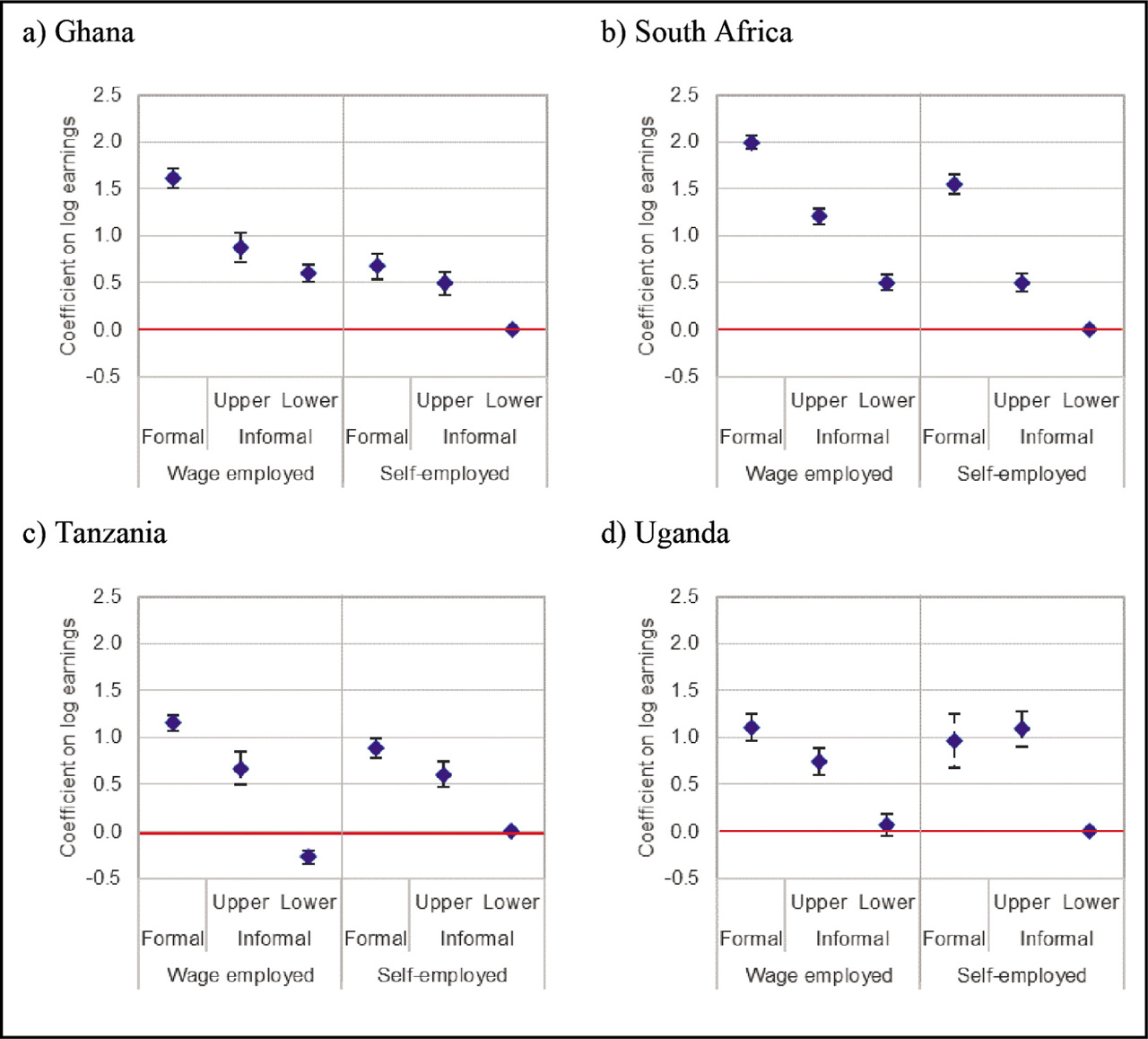
Figure C1
ANOVA of log mean labor income (in 2005 PPPs) across work status groups.
Note: Coefficient estimates and 95% confidence interval of fitted one-way ANOVA model of log mean labor income using formal self-employment as the base category, controlling for wave fixed effects.
Source: Authors’ own calculations based on survey data from GSPS 2009/10-2013/14, NIDS 2014/15-2017, TZNPS 2010/11-2012/13, and UNPS 2010/11-2011/12. GSPS, Ghana Socioeconomic Panel Study Survey; NIDS, National Income Dynamics Study; PPP, Purchasing power parity; TZNPS, Tanzania National Panel Study; UNPS, Uganda National Panel Study.
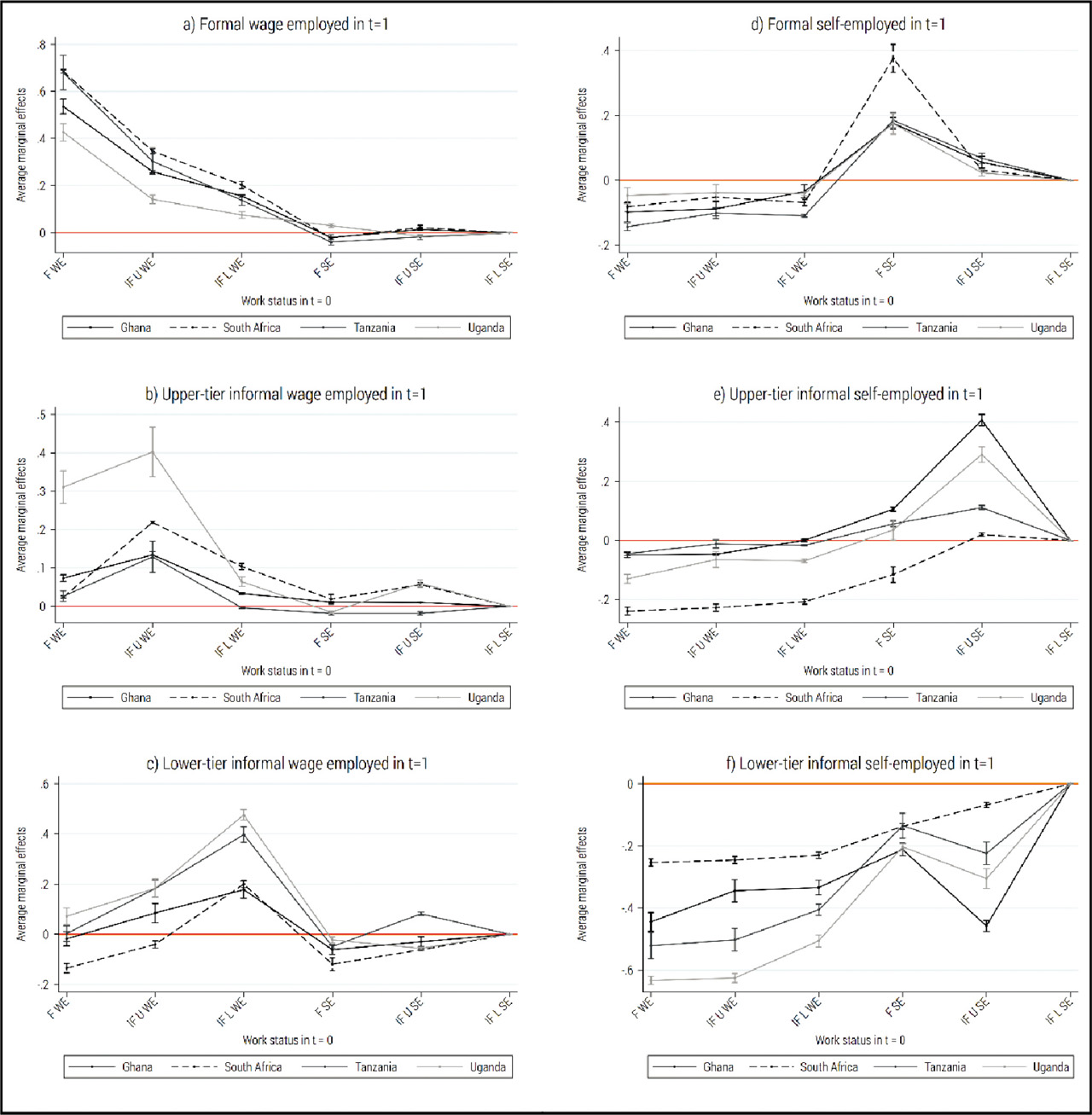
Figure C2
Marginal effect on employment transition probabilities, by country and destination state.
Note: Average marginal effects estimated from same model specification and controls as in Table 3 but including interactions between the initial work status and country fixed effects. Each point shows the estimated marginal effect on the employment transition probability by country and destination state, with “lower-tier informal self-employed” being the base category in each country. The dashed lines show the 95% confidence intervals. Work status abbreviations: F, formal, IF U, informal upper-tier, IF L, informal lower-tier; SE, self-employed; WE, wage employed.
Source: Authors’ own calculations based on survey data from GSPS 2009/10-2013/14, NIDS 2014/15-2017, TZNPS 2010/11-2012/13, and UNPS 2010/11-2011/12. GSPS, Ghana Socioeconomic Panel Study Survey; NIDS, National Income Dynamics Study; TZNPS, Tanzania National Panel Study; UNPS, Uganda National Panel Study.
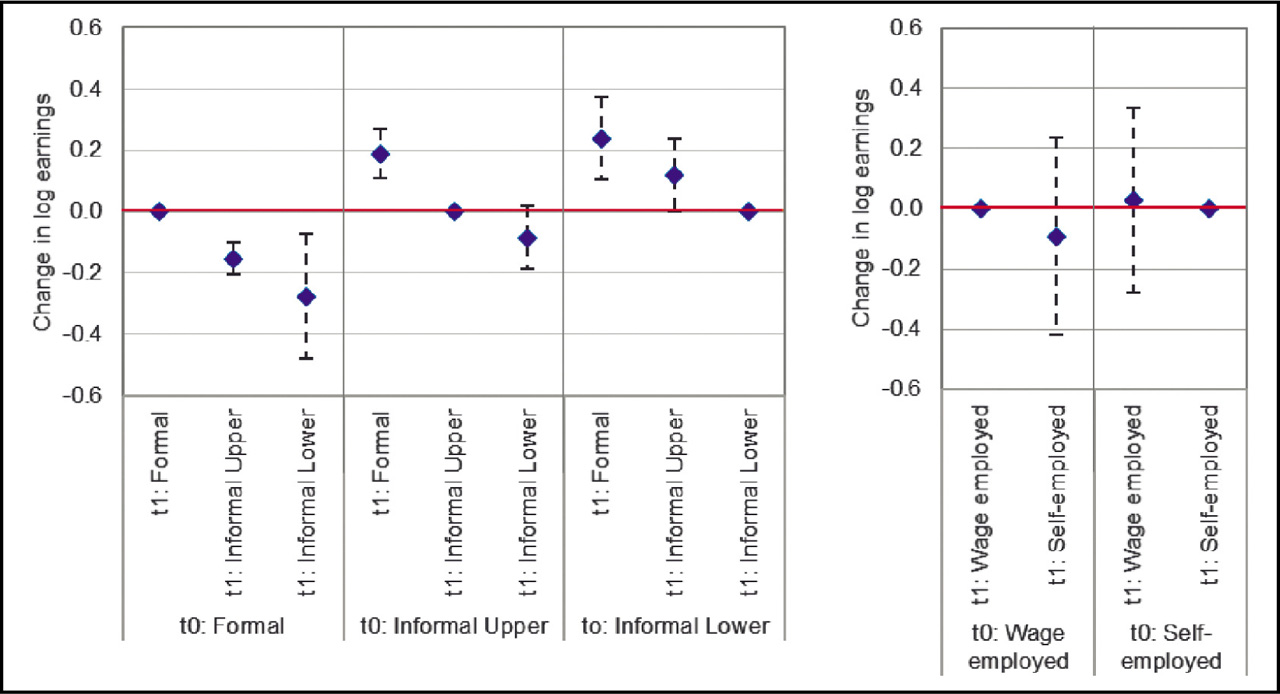
Figure C3
Coefficient estimate on change in log earnings, split-sample regressions.
Note: Coefficient estimates based on same model specification and controls as in Table B10, but splitting the sample by initial formality status (formal, upper-tier informal, lower-tier informal) and initial occupational position (wage employed, self-employed). Standard errors have been clustered at the country level. Each point shows the estimated marginal effect on log earnings by employment state, with “Informal Lower” and “Wage Employed” being the base categories. The dashed lines show the 95% confidence intervals.
Source: Authors’ own calculations based on survey data from GSPS 2009/10-2013/14, NIDS 2014/15-2017, TZNPS 2010/11-2012/13, and UNPS 2010/11-2011/12. GSPS, Ghana Socioeconomic Panel Study Survey; NIDS, National Income Dynamics Study; TZNPS, Tanzania National Panel Study; UNPS, Uganda National Panel Study.
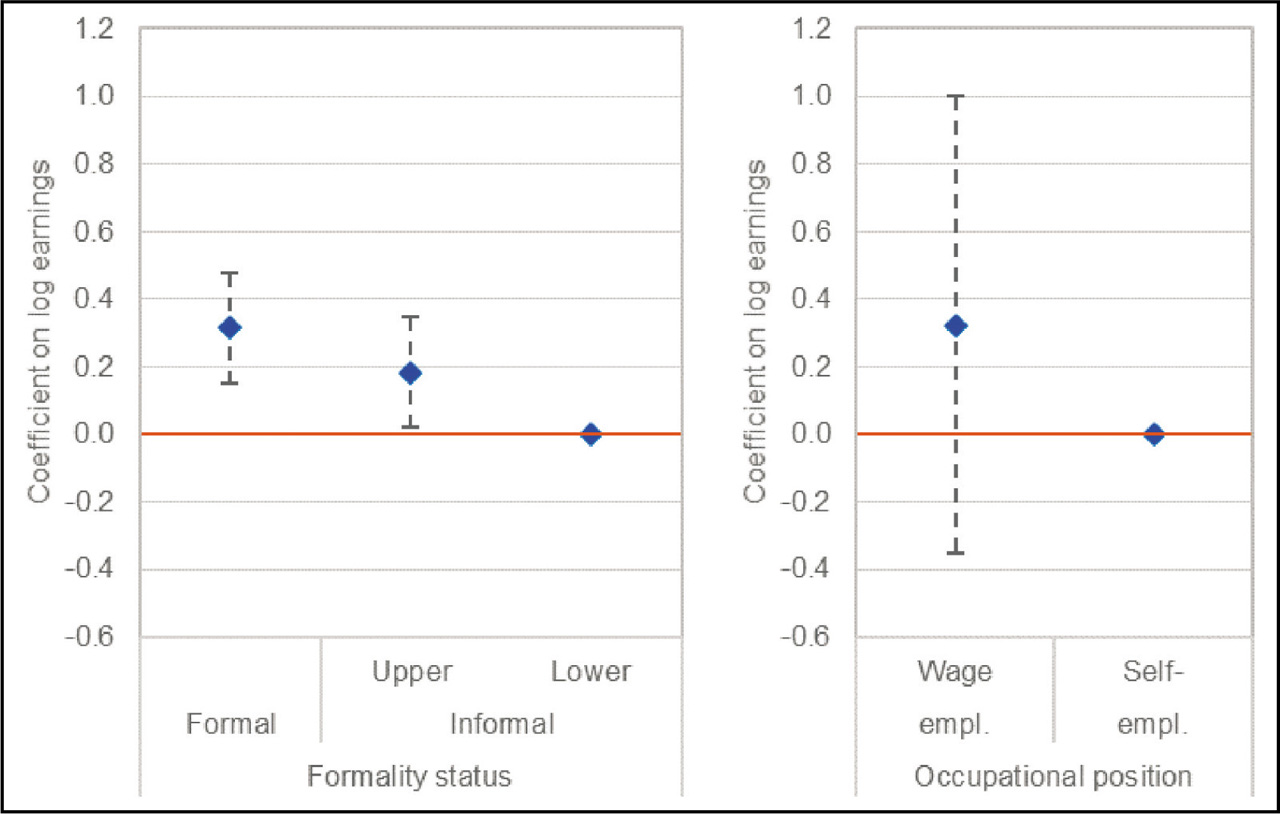
Figure C4
Coefficient estimate on log earnings, panel fixed effects regression.
Note: Coefficient estimates based on fixed effects panel regression, controlling for individual's age and age squared and country-time fixed effects. Standard errors have been clustered at the country level. Each point shows the estimated marginal effect on log earnings by employment state, with “Informal Lower” and “Wage Employed” being the base categories. The dashed lines show the 95% confidence intervals.
Source: Authors’ own calculations based on survey data from GSPS 2009/10-2013/14, NIDS 2014/15-2017, TZNPS 2010/11-2012/13, and UNPS 2010/11-2011/12. GSPS, Ghana Socioeconomic Panel Study Survey; NIDS, National Income Dynamics Study; TZNPS, Tanzania National Panel Study; UNPS, Uganda National Panel Study.