
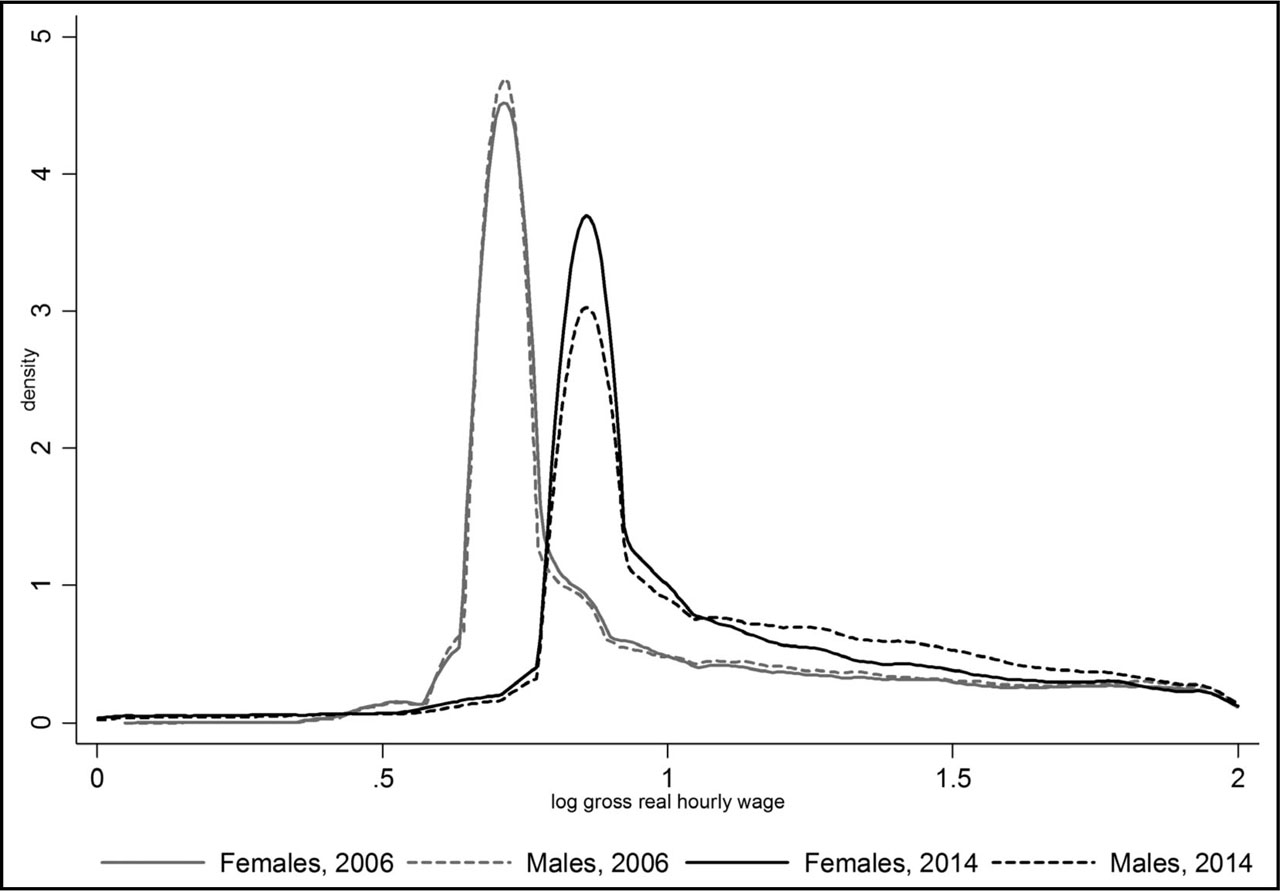
Figure 1
Kernel density estimates of the wage distributions, by year and sex.
Data source: Author's calculations based on the SES 2006 and 2014.
Notes: The density functions are estimated using the Epanechnikov Kernel estimator. SES, Structure of Earnings Survey.
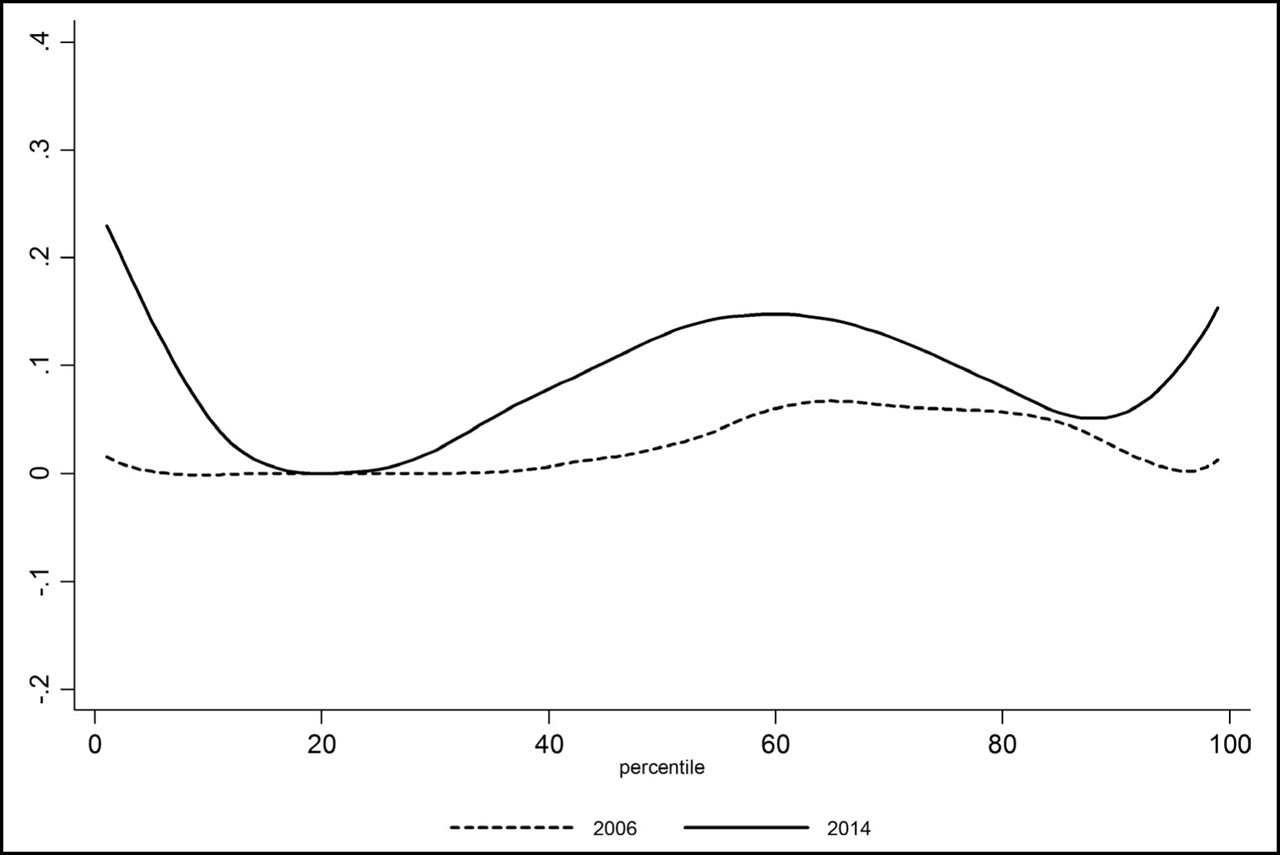
Figure 2
Observed GWG, 2006 and 2014.
Data source: Author's calculations based on the SES 2006 and 2014.
Notes: The observed GWG is the difference between the log hourly wages of men and women. The graph is created using lowess smoothing, with a bandwidth of 0.25. GWG, gender wage gap; SES, Structure of Earnings Survey.
Table 1
Raw and adjusted GWG at the mean
| Specification | Raw GWG | Adjusted GWG | |||
|---|---|---|---|---|---|
| (1) | (2a) | (2b) | (2c) | (2d) | |
| 2006 | 0.024*** (0.007) | 0.051*** (0.005) | 0.048*** (0.004) | 0.048*** (0.004) | 0.051*** (0.002) |
| 2014 | 0.084*** (0.009) | 0.122*** (0.007) | 0.108*** (0.006) | 0.106*** (0.006) | 0.095*** (0.004) |
| Personal characteristics | No | Yes | Yes | Yes | Yes |
| Work-related characteristics | No | No | Yes | Yes | Yes |
| Observed firm and establishment characteristics | No | No | No | Yes | No |
| Establishment fixed effects | No | No | No | No | Yes |
[i] Data source: Author's calculations based on the SES 2006 and 2014.
[ii] Notes: (i) Sample is restricted to individuals of working age (between 15 years old and 64 years old), excluding paid stagers and apprentices, who are employed in establishments that employ both males and females. The data are not weighted. (ii) The numbers in parentheses are establishment-level clustered standard errors. (iii) *, **, and *** denote significance at 0.001, 0.01, and 0.05 significance levels, respectively. (iv) Reported are male dummy coefficient estimates from various specifications. Each coefficient and associated standard error reported comes from a separate regression. Personal characteristics include educational attainment and potential experience (and experience squared). Work-related characteristics are tenure (and tenure squared), full-time employment, permanent employment contract, and an overtime work indicator. Observed firm characteristics include firm size, collective agreement coverage, and industry. All specifications include a constant term. See Table A1 in Appendix A for variables definitions. (v) Number of observations is 241,361 (132,253) in 2006 (2014) in all regressions.
[iii] GWG, gender wage gap; SES, Structure of Earnings Survey.
Table 2
Decomposition of the GWG at the mean
| Specification | ||||
|---|---|---|---|---|
| (2a) | (2b) | (2c) | (2d) | |
| 2006 | ||||
| Raw GWG | 0.024*** (0.006) | 0.024*** (0.006) | 0.024*** (0.006) | 0.024*** (0.006) |
| Explained gap | −0.023*** (0.004) | −0.025*** (0.004) | −0.024*** (0.005) | −0.016*** (0.001) |
| [−97.2%] | [−104.8%] | [−103.1%] | [−65.9%] | |
| Unexplained gap | 0.047*** (0.005) | 0.049*** (0.004) | 0.048*** (0.004) | 0.039*** (0.001) |
| [197.2%] | [204.8%] | [203.1%] | [165.9%] | |
| 2014 | ||||
| Raw GWG | 0.084*** (0.008) | 0.084*** (0.008) | 0.084*** (0.008) | 0.084*** (0.008) |
| Explained gap | −0.035*** (0.005) | −0.024*** (0.005) | −0.019*** (0.006) | −0.008*** (0.002) |
| [−41.9%] | [−29.1%] | [−22.8%] | [−9.0%] | |
| Unexplained gap | 0.119*** (0.007) | 0.108*** (0.006) | 0.103*** (0.006) | 0.092*** (0.003) |
| [141.9%] | [129.1%] | [122.8%] | [109.0%] | |
[i] Data source: Author's calculations based on the SES 2006 and 2014.
[ii] Notes: (i) Sample is restricted to individuals of working age (between 15 years old and 64 years old), excluding paid stagers and apprentices, who are employed in establishments that employ both males and females. The data are not weighted. (ii) Figures in () are establishment level clustered standard errors. (iii) *, **, and *** denote significance at 0.001, 0.01, and 0.05 significance levels, respectively. (iv) BO method is used to decompose the mean GWG using relevant male coefficients as the baseline. (v) Specifications (2a)–(2d) are as set out in the text. (vi) Figures in [] are proportions of the raw GWG.
[iii] BO, Blinder-Oaxaca; GWG, gender wage gap; SES, Structure of Earnings Survey.
Table 3
Raw and adjusted GWG at selected percentiles of the wage distribution
| Year and specification | RIF-OLS regressions (percentile of the wage distribution) | OLS | ||||||
|---|---|---|---|---|---|---|---|---|
| 5th | 10th | 25th | 50th | 75th | 90th | 95th | Mean | |
| 2006 | ||||||||
| (1) Raw GWG | 0.001 (0.001) | −0.000 (0.001) | −0.000 (0.001) | 0.020*** (0.005) | 0.056*** (0.016) | 0.029*** (0.016) | −0.009 (0.021) | 0.024*** (0.007) |
| (2) Adjusted GWG | ||||||||
| a. Personal characteristics | 0.001 (0.001) | 0.001 (0.001) | 0.001 (0.001) | 0.042*** (0.004) | 0.107*** (0.012) | 0.077*** (0.012) | 0.071*** (0.017) | 0.051*** (0.005) |
| b. Personal and work-related characteristics | 0.001 (0.001) | 0.001 (0.001) | 0.001 (0.001) | 0.037*** (0.004) | 0.100*** (0.010) | 0.072*** (0.012) | 0.077*** (0.017) | 0.048*** (0.004) |
| c. Personal, work-related, observed firm and observed establishment characteristics | 0.000 (0.001) | 0.001 (0.001) | 0.001 (0.001) | 0.040*** (0.004) | 0.089*** (0.009) | 0.070*** (0.011) | 0.102*** (0.016) | 0.048*** (0.004) |
| d. Personal and work-related characteristics and establishment fixed effects | 0.001* (0.000) | 0.001*** (0.000) | 0.001*** (0.000) | 0.026*** (0.002) | 0.082*** (0.006) | 0.111*** (0.008) | 0.179*** (0.012) | 0.051*** (0.002) |
| 2014 | ||||||||
| (1) Raw GWG | 0.132*** (0.031) | 0.011*** (0.002) | 0.011*** (0.002) | 0.138*** (0.010) | 0.097*** (0.015) | 0.046* (0.020) | 0.084*** (0.021) | 0.084*** (0.009) |
| (2) Adjusted GWG | ||||||||
| a. Personal characteristics | 0.114*** (0.030) | 0.011*** (0.002) | 0.011*** (0.002) | 0.175*** (0.008) | 0.172*** (0.011) | 0.143*** (0.016) | 0.160*** (0.019) | 0.122*** (0.007) |
| b. Personal and work-related characteristics | 0.075* (0.029) | 0.009*** (0.002) | 0.009*** (0.002) | 0.155*** (0.007) | 0.154*** (0.010) | 0.138*** (0.016) | 0.162*** (0.019) | 0.108*** (0.006) |
| c. Personal, work-related, observed firm and observed establishment characteristics | 0.114*** (0.030) | 0.011*** (0.002) | 0.012*** (0.002) | 0.146*** (0.007) | 0.143*** (0.010) | 0.124*** (0.015) | 0.158*** (0.018) | 0.106*** (0.006) |
| d. Personal and work-related characteristics and establishment fixed effects | 0.038 (0.023) | 0.006*** (0.001) | 0.006*** (0.001) | 0.113*** (0.004) | 0.132*** (0.007) | 0.170*** (0.011) | 0.222*** (0.015) | 0.095*** (0.004) |
[i] Data source: Author's calculations based on SES 2006 and 2014.
[ii] Notes: (i) Sample is restricted to individuals of working age (between 15 years old and 64 years old), excluding paid stagers and apprentices, who are employed in establishments that employ both males and females. The data are not weighted. (ii) *, **, and *** denote significance at 0.001, 0.01, and 0.05 significance levels, respectively. (iv) Figures in () are establishment-level clustered standard errors. (iii) Reported in the table are male dummy coefficient estimates from various specifications. Each coefficient and associated standard error reported comes from a separate regression. Raw GWG includes a male dummy and a constant term without any additional control variables. Personal characteristics include education and potential experience (and experience squared). Work-related characteristics are tenure (and tenure squared), full-time employment, permanent employment contract, and an indicator for overtime work. Observed firm characteristics include firm size, collective agreement coverage, and industry. All specifications include a constant term. See Table A1 in Appendix A for variable definitions. (v) Number of observations is 241,361 (132,253) in 2006 (2014) in all regressions.
[iii] GWG, gender wage gap; OLS, Ordinary Least Squares; RIF, Recentered Influence Function; SES, Structure of Earnings Survey.
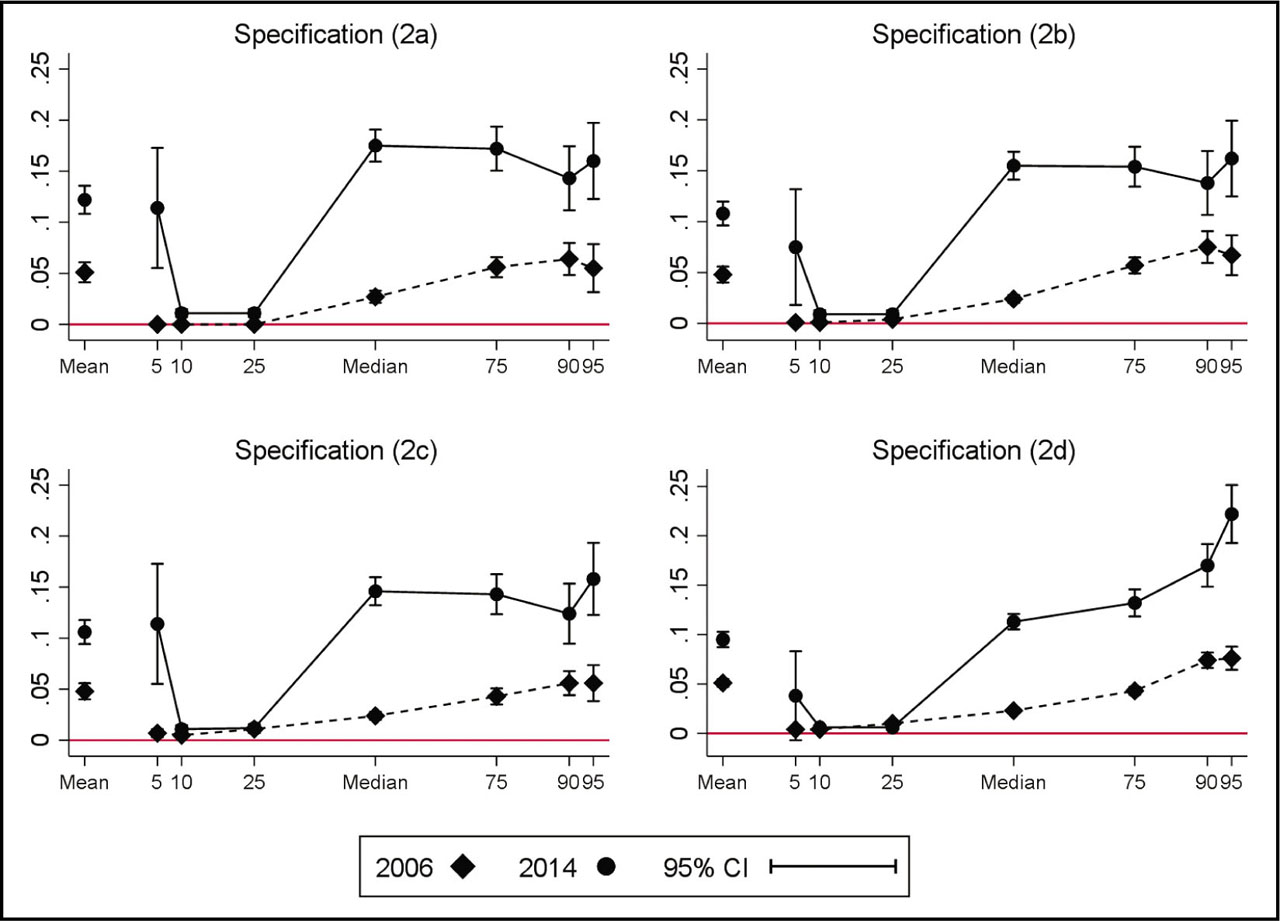
Figure 3
Adjusted GWG at the mean and selected percentiles of the wage distribution.
Data source: Author's calculations based on the SES 2006 and 2014.
Notes: (i) Sample is restricted to individuals of working age (between 15 years old and 64 years old), excluding paid stagers and apprentices, who are working in establishments that employ both males and females. The data are not weighted. (ii) Each coefficient estimate and associated 95% CI come from a separate regression. Specifications (2a)–(2d) are as set out in the text. Point estimates are provided in Table 3. CI, confidence interval; GWG, gender wage gap; SES, Structure of Earnings Survey.
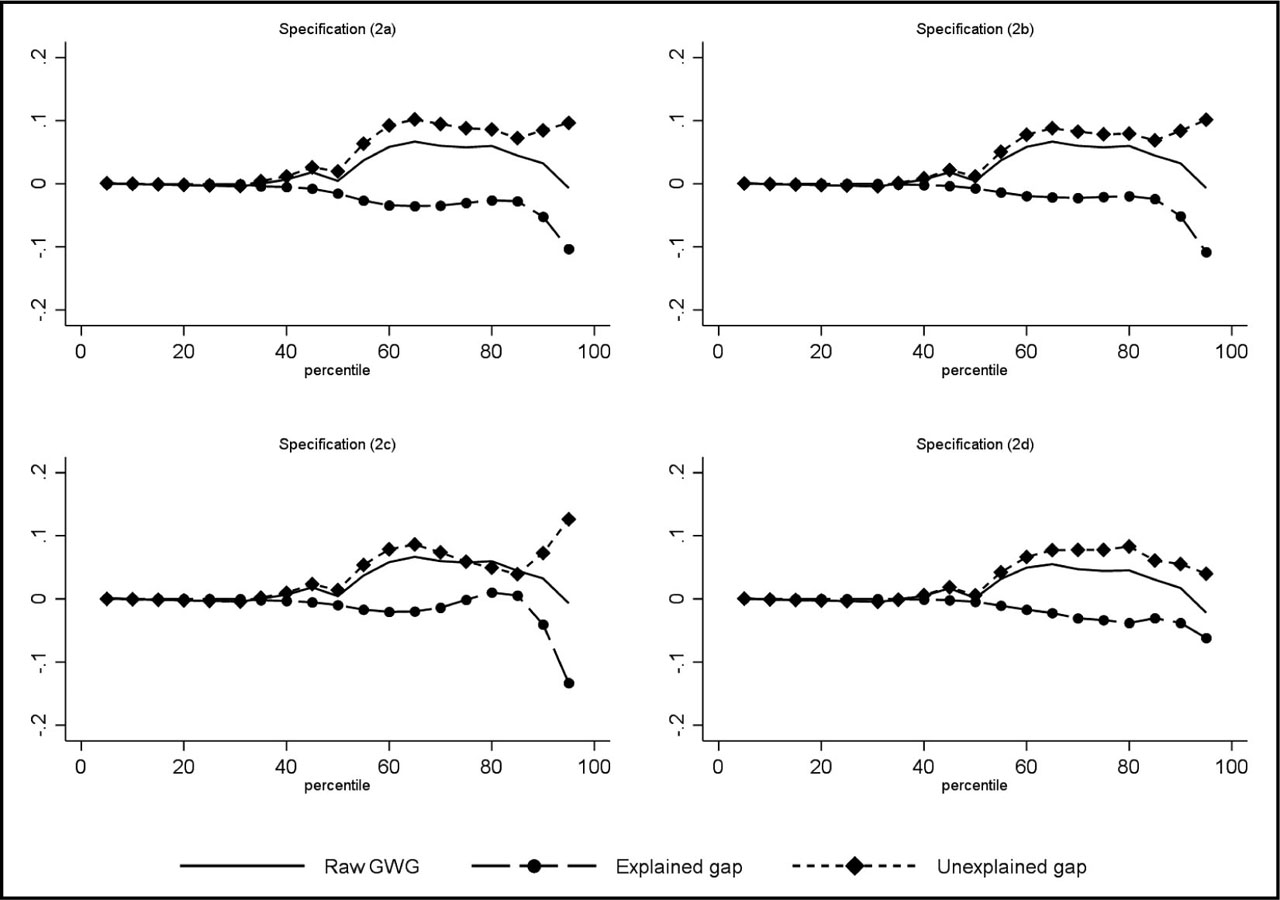
Figure 4
Decomposition of the GWG at selected percentiles of the wage distribution, 2006.
Data source: Author's calculations based on the SES 2006.
Notes: (i) Specifications (2a)–(2d) are as set out in the text. (ii) RIF-BO method is used to decompose the GWG using male coefficients as the baseline. (iii) “Explained gap” is that part of the raw GWG that is due to gender differences in productivity-related characteristics included in the specification. “Unexplained gap” is that part of the raw GWG that remains unexplained after controlling for the productivity-related characteristics. BO, Blinder-Oaxaca; GWG, gender wage gap; RIF, Recentered Influence Function; RIF-BO, BO decomposition that relies on the RIF regression; SES, Structure of Earnings Survey.
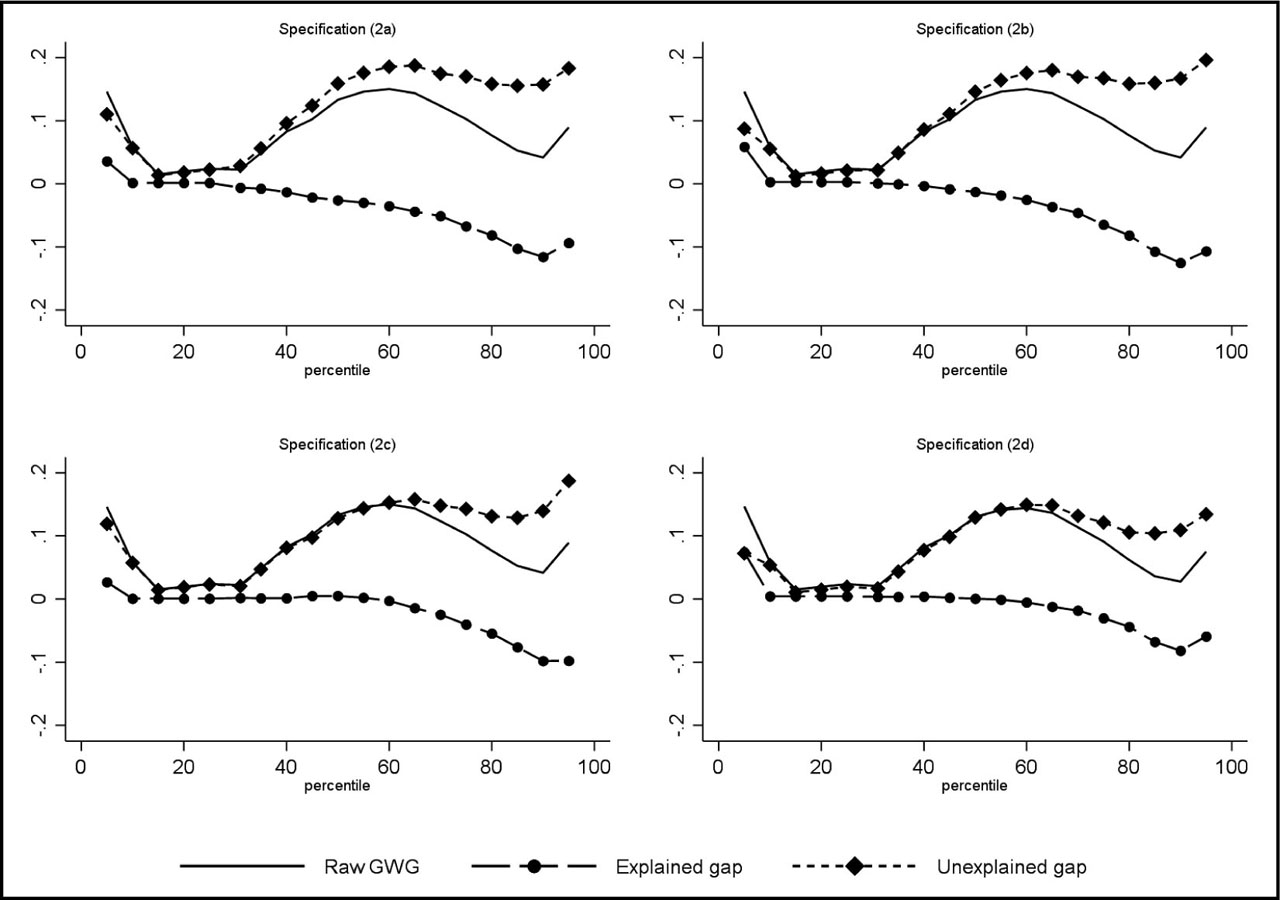
Figure 5
Decomposition of the GWG at selected percentiles of the wage distribution, 2014.
Data source: Author's calculations based on the SES 2014.
Notes: (i) Specifications (2a)–(2d) are as set out in the text. (ii) RIF-BO method is used to decompose the GWG using male coefficients as the baseline. (iii) “Explained gap” is that part of the raw GWG that is due to gender differences in productivity-related characteristics included in the specification. “Unexplained gap” is that part of the raw GWG that remains unexplained after controlling for the productivity-related characteristics. BO, Blinder-Oaxaca; GWG, gender wage gap; RIF, Recentered Influence Function; RIF-BO, BO decomposition that relies on the RIF regression; SES, Structure of Earnings Survey.
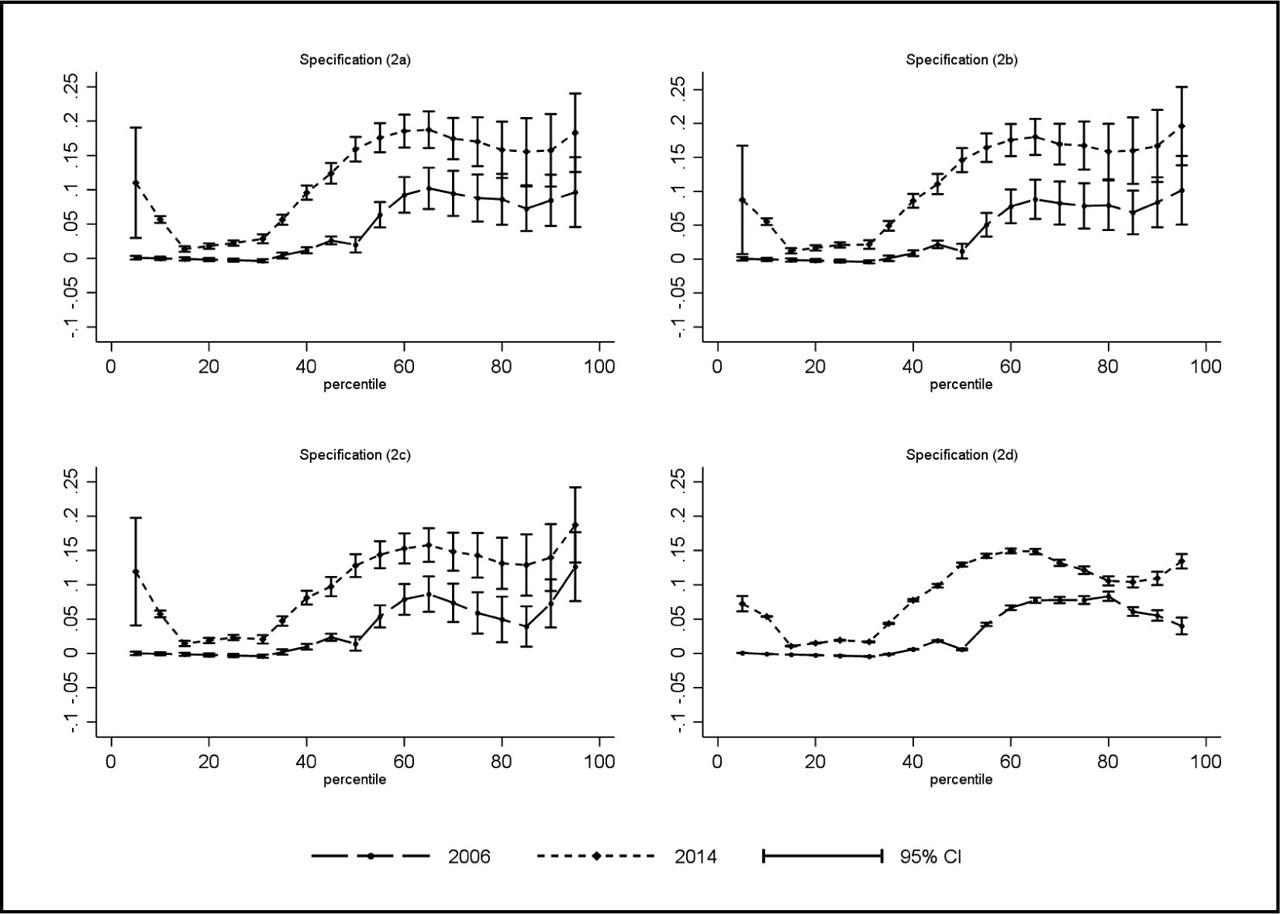
Figure 6
Unexplained gap at selected percentiles of the wage distribution, 2006 and 2014.
Data source: Author's calculations based on the SES 2006 and 2014.
Notes: (i) Specifications (2a)–(2d) are as set out in the text. (ii) Each point estimate and associated 95% CI are estimated using the RIF-BO method to decompose the GWG using male coefficients as the baseline. (iii) “Unexplained gap” is that part of the observed GWG that remains unexplained after controlling for the productivity-related characteristics included in each specification. BO, Blinder-Oaxaca; CI, confidence interval; GWG, gender wage gap; RIF, Recentered Influence Function; RIF-BO, BO decomposition that relies on the RIF regression; SES, Structure of Earnings Survey.
Table A1
Variable definitions
| Variable | Type | Definition |
|---|---|---|
| Log hourly gross wage | Continuous | Constructed by the author: the monthly gross wage (the sum of monthly basic wages, overtime payments, payments for shift work/night work, and other regular payments paid to employees) in the reference montha divided by monthly paid hours (the sum of contractual working hours pertaining to basic wage and overtime hours worked) during the reference month (deflated using the Consumer Price Index base year 2003, in 2003 TRY) |
| Gender | Binary | Recoded by the author as follows: |
| Educational attainment | Categorical | The highest successfully completed level of education which the employee has received according to the International Standard Classification of Education (ISCED 97 in 2006 and ISCED 2011 in 2014). |
| Potential labor market experience | Continuous | Constructed by the author: age–years of schooling–6. Years of schooling are taken as 5 years for primary school and below, 8 years for primary education and secondary education, 11 years for high school and vocational high school, and 14 years for higher education following Cebeci (2015). |
| Tenure | Continuous | The total length of service in the firm to which the establishment belongs in the reference month (in years). |
| Full-time employment | Binary | Contractual working time. Recoded by the author as: |
| Type of employment contract | Binary | Type of employment contract of the worker. Recoded by the author as: |
| Overtime work | Binary | Constructed by the author based on the monthly hours of overtime work during the reference month. Recoded by the author as: |
| Firm size | Categorical | Size of the firm (in terms of number of employees) to which the establishment belongs. |
| Collective agreement coverage | Binary | Collective agreement coverage of the establishment. Recoded by the author as: |
| Industry | Categorical | Principal economics activity of the establishment coded according to the Statistical Classification of Economic Activities in the European Community (NACE Rev. 1.1 in 2006 and NACE Rev. 2 in 2014). Recoded by the author at section level according to NACE Rev. 2 (12 categories). |
| Occupation | Categorical | Occupation of the employee in the reference month coded according to the ISCO88 in 2006 and ISCO 08 in 2014. Recoded by the author at one-digit ISCO 08 level (9 categories) |
| Regionb | Categorical | Region of the establishment codded according to the NUTS-1 – only available in 2014 (12 categories) |
Notes:
a The SES 2006 and 2014 were applied in 2007 and 2015, respectively, by taking November as a reference month since it was a month without seasonal payments and absences.
ISCO, International Standard Classification of Occupations; NUTS, Nomenclature of Territorial Units for Statistics; SES, Structure of Earnings Survey; TRY, Turkish Lira.
Table A2
Number of employees to be sampled in establishments (SES second stage of sampling) by size band of the establishment
| Establishment size band | Number of employees to be sampled |
|---|---|
| 1–19 | All |
| 20–49 | 20 |
| 50–99 | 25 |
| 100–299 | 35 |
| 250–499 | 40 |
| 500–999 | 50 |
| 1,000–2,499 | 75 |
| 2,500–4,999 | 125 |
| 5,000 and over | 150 |
[i] Source: The SES 2006 and 2014 Quality Reports. Available at https://ec.europa.eu/eurostat/cache/metadata/en/earn_ses06_esms.htm and https://ec.europa.eu/eurostat/cache/metadata/EN/earn_ses2014_esms.htm.
[ii] SES, Structure of Earnings Survey.
Table A3
SES sample coverage by year
| Year | SESa Total number of employeesb (1) | HLFSc Total employment (2) | HLFS Total number of employees (formal and informal) (3) | HLFS Total number of employees (formal) (4) | (3)/(2) | (4)/(3) | (1)/(4) |
|---|---|---|---|---|---|---|---|
| 2006 | 5,986,247 | 20,423,000 | 12,028,000 | 8,242,000 | 0.59 | 0.69 | 0.73 |
| 2014 | 9,651,017 | 25,932,000 | 17,125,000 | 13,777,000 | 0.66 | 0.80 | 0.70 |
Notes:
c Author's own elaboration based on Aslan, Gurdal (2019): The Number of Minimum Wage Workers and the Change in Wage Levels (2003–2017) Household Labour Force Surveys Data Analysis. Journal of Social Security 9(1), 141–159.
HLFS, Household Labour Force Survey; SES, Structure of Earnings Survey.
Table B1
List of selected gender equality policies, Turkey 2000–2018
| Year | Policy | Description |
|---|---|---|
| 2001 | Amendment to the Constitution (Article 41) | Added “based on the equality between spouses” to the previous version of the article, which stated that “Family is the foundation of the Turkish society”. |
| 2002 | New Civil Code (Law no: 4721) | Increased the legal marriage age to 18 for men (from 17) and women (from 15); established the equality of men and women in the family, including abolishment of the term “head of household” and of needing the permission of spouses to work; introduced the legal basis for the sharing of marital assets in case of divorce; granted the same heredity rights to children born out of wedlock as to those of legitimate birth. |
| 2003 | New Labor Law (Law no: 4857) | Set the legal basis for equal pay for equal work; reinforced the equal treatment principle for women and men; decreased the restrictions on temporary employment; provided a legal basis for atypical employment; lifted the ban on employment of women in night shifts of manufacturing establishments; extended paid maternity leave from 12 weeks to 16 weeks (8 weeks before and 8 weeks after childbirth); introduced breastfeeding leave to a total of one and a half hours for mothers of children below the age of one; obliged companies employing 100–150 female workers to provide comprehensive nursery rooms for children under the age of one and companies employing >150 female workers to provide comprehensive childcare centers and pre-school facilities for children under the age of six. |
| 2003 | Family Court Law (Law no: 4787) | Established Family Courts in districts with >100,000 population to enforce the Civil Code and ensure gender equality. |
| 2004 | Amendments to the Constitution (Articles 10 and 90) | Amendments to Article 10 reinforced equal rights of women and men and emphasized the responsibility of the State to ensure equality. Amendments to Article 90 ensured the supremacy of international laws (including the Convention on the Elimination of All Forms of Discrimination against Women in 1985 and the European Social Charter in 1996) in the case of a conflict between Turkish law and international treaties with regards to human rights. |
| 2005 | New Penal Code (Law no: 5237) | Defined sexual harassment in work; reinforced prohibition of gender-based discrimination. |
| 2006 | Social Insurance and General Health Insurance Act (Law no: 5510) | Merged different security systems into one structure; adopted harmonized legislation for maternity and breastfeeding leaves and for the pension plans regulating the working conditions for women. |
| 2008 | Employment Package (Law no: 5763) | Introduced a direct employment subsidy program (with a limit that corresponds to the minimum wage level) with a one-year participation period (extended to June 30, 2010, with Law 5838) by reducing the employers’ contribution to social security payment of new hires for 5 years, covering 100% of social security payments of new employees for the first year and reducing its participation by 20% each year for the following 4 years. Targeted young men (ages between 18 and 29) and women >18 who were not employed as a tax-registered workers in the preceding 6 months. |
| 2010 | Amendment to the Constitution (Article 10) | Added “Measures taken for this purpose shall not be interpreted as contrary to the principle” to Article 10. |
| 2011 | Amendments to the Labor Law (Law No. 6111) | Enforced the rules of maternity leave for women (mandatory for 16 weeks and fully paid by the social security system); introduced the right to use paid leaves for breastfeeding; ruled out terminating job contracts on grounds of pregnancy; brought new regulations for part-time work; incorporated domestic help workers into the social security system; extended maternity leave to 12 months for civil servants and 6 months for others on an unpaid basis; granted 10 days’ voluntary paid paternity leave to civil servants whose wives give birth. Extended the period (for the period between March 2011 and December 2015) and coverage (both men and women of all ages and relaxing the subsidy limit covering the total social security payment amount regardless of the wage level) of the 2008 employment subsidy program. |
| 2016 | Amendments to the Labor Law (Law no: 6663) | Introduced unpaid maternity leave to mothers as half of their weekly working hours for 60 days for the first birth, 120 days for the second birth, and 160 days for following births; introduced the right to request part time work for the period between when maternity leave ends until the beginning of the month after the child's compulsory education begins for both parents whose spouse is also working; extended the coverage of maternity leave and the right to request part-time work to couples or individuals adopting a child under 3 years’ old. |
[i] Sources: Anderson (2017), Balkan et al. (2016), Dedeoglu (2012), World Bank (2009).
Table B2
Sample means for establishments
| 2006 | 2014 | |
|---|---|---|
| Firm and establishment characteristics | ||
| Firm size | ||
| 10–49 employees | 0.57 | 0.41 |
| 50–249 employees | 0.20 | 0.16 |
| 250–499 employees | 0.08 | 0.13 |
| 500–999 employees | 0.06 | 0.13 |
| 1000+ employees | 0.10 | 0.16 |
| Collective agreement coverage of the establishment | 4.74 | 0.05 |
| Industry of the establishment | ||
| Mining and quarrying | 0.01 | 0.01 |
| Manufacturing | 0.35 | 0.24 |
| Electricity, gas, and water supply | 0.02 | 0.02 |
| Construction | 0.05 | 0.05 |
| Wholesale and retail trade | 0.24 | 0.31 |
| Hotels and restaurants | 0.05 | 0.06 |
| Transport, storage, and communication | 0.08 | 0.05 |
| Financial intermediation | 0.06 | 0.05 |
| Real estate, renting and business activities | 0.06 | 0.11 |
| Education | 0.04 | 0.03 |
| Health and social work | 0.02 | 0.03 |
| Other social and personal service activities | 0.02 | 0.04 |
| Number of establishments | 12,874 | 7,867 |
[i] Data source: Author's calculations based on the SES 2006 and 2014.
[ii] Notes: Sample is restricted to individuals of working age (between 15 years old and 64 years old), excluding paid stagers and apprentices, who are employed in establishments that employ both males and females. The data are unweighted.
[iii] SES, Structure of Earnings Survey.
Table B3
Sample means within establishments
| 2006 | 2014 | |||||
|---|---|---|---|---|---|---|
| All | Males | Females | All | Males | Females | |
| Personal characteristics | ||||||
| Male | 0.71 | – | – | 0.67 | – | – |
| Educational attainment | ||||||
| Primary school and below | 0.26 | 0.28 | 0.17 | 0.16 | 0.16 | 0.15 |
| Primary education and secondary school | 0.15 | 0.16 | 0.10 | 0.14 | 0.15 | 0.10 |
| High school | 0.27 | 0.26 | 0.31 | 0.32 | 0.32 | 0.33 |
| Vocational high school | 0.09 | 0.09 | 0.10 | 0.07 | 0.08 | 0.06 |
| Higher education | 0.23 | 0.22 | 0.32 | 0.31 | 0.29 | 0.37 |
| Potential labor market experience (years) | 16.68 | 17.66 | 14.25 | 17.09 | 17.74 | 15.76 |
| Work-related characteristics | ||||||
| Tenure (years) | 3.20 | 3.29 | 2.93 | 2.86 | 2.97 | 2.61 |
| Full-time | 0.99 | 0.99 | 0.99 | 0.98 | 0.98 | 0.98 |
| Permanent contract | 0.97 | 0.97 | 0.97 | 0.94 | 0.94 | 0.95 |
| Overtime work | 0.11 | 0.11 | 0.8 | 0.15 | 0.16 | 0.12 |
| Occupation distribution | ||||||
| Legislators, senior officials, and managers | 0.07 | 0.08 | 0.06 | 0.06 | 0.08 | 0.05 |
| Professionals | 0.08 | 0.07 | 0.12 | 0.10 | 0.10 | 0.13 |
| Technicians and associate professionals | 0.18 | 0.17 | 0.20 | 0.09 | 0.09 | 0.08 |
| Clerks | 0.14 | 0.01 | 0.28 | 0.17 | 0.13 | 0.28 |
| Service, shop and market sales’ workers | 0.13 | 0.14 | 0.11 | 0.26 | 0.25 | 0.26 |
| Skilled agricultural and fishery workers | 0.00 | 0.00 | 0.00 | 0.00 | 0.00 | 0.00 |
| Craft and related trade workers | 0.16 | 0.17 | 0.08 | 0.11 | 0.12 | 0.03 |
| Plant and machine operators and assemblers | 0.11 | 0.13 | 0.04 | 0.09 | 0.11 | 0.04 |
| Elementary occupations | 0.13 | 0.13 | 0.12 | 0.12 | 0.11 | 0.13 |
| Average number of employees per establishment | 19 | 14 | 5 | 17 | 12 | 5 |
[i] Data source: Author's calculations based on the SES 2006 and 2014.
[ii] Notes: Sample is restricted to individuals of working age (between 15 years old and 64 years old), excluding paid stagers and apprentices, who are employed in establishments that employ both males and females. The data are unweighted.
[iii] SES, Structure of Earnings Survey.
Table B4
Sample means across all establishments
| 2006 | 2014 | |||||
|---|---|---|---|---|---|---|
| All | Males | Females | All | Males | Females | |
| Personal characteristics | ||||||
| Educational attainment | ||||||
| Primary school and below | 0.27 | 0.31 | 0.19 | 0.17 | 0.19 | 0.15 |
| Primary education and secondary school | 0.15 | 0.16 | 0.11 | 0.15 | 0.18 | 0.11 |
| High school | 0.24 | 0.23 | 0.28 | 0.28 | 0.27 | 0.29 |
| Vocational high school | 0.10 | 0.11 | 0.09 | 0.08 | 0.10 | 0.06 |
| Higher education | 0.23 | 0.19 | 0.33 | 0.31 | 0.27 | 0.40 |
| Potential labor market experience (years) | 17.09 | 18.23 | 14.01 | 17.40 | 18.30 | 15.32 |
| Work-related characteristics | ||||||
| Tenure (years) | 3.67 | 3.92 | 3.03 | 3.18 | 3.39 | 2.70 |
| Full-time | 0.99 | 0.99 | 0.99 | 0.98 | 0.98 | 0.98 |
| Permanent contract | 0.96 | 0.96 | 0.97 | 0.93 | 0.94 | 0.93 |
| Overtime work | 0.14 | 0.15 | 0.11 | 0.20 | 0.22 | 0.15 |
| Firm and establishment characteristics | ||||||
| Firm size (number of employees) | ||||||
| 10–49 | 0.46 | 0.46 | 0.46 | 0.32 | 0.32 | 0.32 |
| 50–249 | 0.24 | 0.24 | 0.24 | 0.19 | 0.20 | 0.18 |
| 250–499 | 0.10 | 0.10 | 0.10 | 0.17 | 0.17 | 0.17 |
| 500–999 | 0.08 | 0.08 | 0.08 | 0.16 | 0.16 | 0.17 |
| 1000+ | 0.12 | 0.12 | 0.11 | 0.15 | 0.15 | 0.16 |
| Collective agreement coverage of the establishment | 0.10 | 0.12 | 0.06 | 0.10 | 0.12 | 0.08 |
| Industry of the establishment | ||||||
| Mining and quarrying | 0.01 | 0.02 | 0.01 | 0.02 | 0.02 | 0.01 |
| Manufacturing | 0.42 | 0.44 | 0.37 | 0.33 | 0.36 | 0.25 |
| Electricity, gas, and water supply | 0.03 | 0.03 | 0.01 | 0.02 | 0.02 | 0.01 |
| Construction | 0.04 | 0.05 | 0.02 | 0.04 | 0.04 | 0.02 |
| Wholesale and retail trade | 0.19 | 0.19 | 0.20 | 0.23 | 0.23 | 0.23 |
| Hotels and restaurants | 0.05 | 0.05 | 0.04 | 0.06 | 0.06 | 0.06 |
| Transport, storage, and communication | 0.07 | 0.07 | 0.06 | 0.06 | 0.06 | 0.06 |
| Financial intermediation | 0.04 | 0.03 | 0.07 | 0.04 | 0.03 | 0.06 |
| Real estate, renting and business activities | 0.06 | 0.06 | 0.07 | 0.11 | 0.10 | 0.13 |
| Education | 0.04 | 0.03 | 0.07 | 0.04 | 0.03 | 0.06 |
| Health and social work | 0.03 | 0.02 | 0.06 | 0.04 | 0.02 | 0.08 |
| Other social and personal service activities | 0.02 | 0.02 | 0.02 | 0.03 | 0.03 | 0.03 |
| Occupation | ||||||
| Legislators, senior officials, and managers | 0.06 | 0.06 | 0.05 | 0.06 | 0.06 | 0.05 |
| Professionals | 0.08 | 0.06 | 0.13 | 0.12 | 0.10 | 0.16 |
| Technicians and associate professionals | 0.17 | 0.16 | 0.21 | 0.09 | 0.10 | 0.09 |
| Clerks | 0.12 | 0.09 | 0.22 | 0.15 | 0.11 | 0.24 |
| Service workers; shop and market sales’ workers | 0.11 | 0.11 | 0.09 | 0.19 | 0.18 | 0.22 |
| Skilled agricultural and fishery workers | 0.002 | 0.003 | 0.001 | 0.001 | 0.001 | 0.001 |
| Craft and related trade workers | 0.19 | 0.21 | 0.11 | 0.13 | 0.17 | 0.05 |
| Plant and machine operators and assemblers | 0.13 | 0.15 | 0.06 | 0.13 | 0.15 | 0.07 |
| Elementary occupations | 0.14 | 0.15 | 0.13 | 0.13 | 0.12 | 0.13 |
| Region | ||||||
| Istanbul | – | – | – | 0.27 | 0.25 | 0.30 |
| West Marmara | – | – | – | 0.07 | 0.07 | 0.07 |
| Aegean | – | – | – | 0.11 | 0.11 | 0.12 |
| East Marmara | – | – | – | 0.12 | 0.12 | 0.10 |
| West Anatolia | – | – | – | 0.10 | 0.10 | 0.11 |
| Mediterranean | – | – | – | 0.09 | 0.09 | 0.08 |
| Central Anatolia | – | – | – | 0.06 | 0.06 | 0.05 |
| West Black Sea | – | – | – | 0.04 | 0.04 | 0.05 |
| East Black Sea | – | – | – | 0.04 | 0.04 | 0.05 |
| Northeast Anatolia | – | – | – | 0.02 | 0.03 | 0.02 |
| Central East Anatolia | – | – | – | 0.03 | 0.04 | 0.03 |
| Southeast Anatolia | – | – | – | 0.04 | 0.05 | 0.04 |
| Number of observations | 241,361 | 175,938 | 65,423 | 132,235 | 91,881 | 40,354 |
| Number of establishments | 12,874 | 7,867 | ||||
[i] Data source: Author's calculations based on the SES 2006 and 2014.
[ii] Notes: Sample is restricted to individuals of working age (between 15 years old and 64 years old), excluding paid stagers and apprentices, who are employed in establishments that employ both males and females. Region information is only available in 2014. The data are unweighted.
Table B5
Sensitivity analysis, BO decomposition of the mean GWG using the female coefficients as the baseline
| Specification | ||||
|---|---|---|---|---|
| (2a) | (2b) | (2c) | (2d) | |
| 2006 | ||||
| Raw GWG | 0.024*** (0.006) | 0.024*** (0.006) | 0.024*** (0.006) | 0.024*** (0.006) |
| Explained gap | −0.041*** (0.003) | −0.031*** (0.004) | −0.032*** (0.005) | −0.012*** (0.001) |
| [−174.8%] | [−131.3%] | [−133.6%] | [−48.8%] | |
| Unexplained gap | 0.065*** (0.005) | 0.055*** (0.004) | 0.055*** (0.004) | 0.035*** (0.002) |
| [274.8%] | [231.3%] | [233.6%] | [148.8%] | |
| 2014 | ||||
| Raw GWG | 0.084*** (0.008) | 0.084*** (0.008) | 0.084*** (0.008) | 0.084*** (0.008) |
| Explained gap | −0.045*** (0.005) | −0.024*** (0.005) | −0.023*** (0.006) | 0.001 (0.002) |
| [−54.1%] | [−28.1%] | [−28.0%] | [1.7%] | |
| Unexplained gap | 0.129*** (0.007) | 0.108*** (0.006) | 0.107*** (0.006) | 0.083*** (0.003) |
| [154.1%] | [128.1%] | [128.0%] | [98.3%] | |
[i] Data source: Author's calculations based on the SES 2006 and 2014.
[ii] Notes: (i) Sample is restricted to individuals of working age (between 15 years old and 64 years old), excluding paid stagers and apprentices, who are employed in establishments that employ both males and females. The data are not weighted. (ii) Figures in () are establishment level clustered standard errors. (iii)*, **, and *** denote significance at 0.001, 0.01, and 0.05 significance levels, respectively. (iv) BO method is used to decompose the mean GWG using relevant female coefficients as the baseline. (v) Specifications (2a)–(2d) are as set out in the text. (vi) Figures in [] are proportions of the raw GWG.
[iii] BO, Blinder-Oaxaca; GWG, gender wage gap; SES, Structure of Earnings Survey.
Table B6
Components of the BO decomposition of the mean GWG, 2006
| Specification | ||||
|---|---|---|---|---|
| (2a) | (2b) | (2c) | (2d) | |
| Raw GWG | 0.024*** (0.006) | 0.024*** (0.006) | 0.024*** (0.006) | 0.024*** (0.006) |
| Explained gap | −0.023*** (0.003) | −0.025*** (0.004) | −0.024*** (0.005) | −0.016*** (0.001) |
| [−97.2] | [−104.8%] | [−103.1%] | [−65.9%] | |
| Unexplained gap | 0.047*** (0.005) | 0.049*** (0.004) | 0.048*** (0.004) | 0.039*** (0.001) |
| Explained | [197.2] | [204.8%] | [203.1%] | [165.9%] |
| Personal characteristics | ||||
| Education | −0.138*** (0.004) | −0.119*** (0.003) | −0.106*** (0.003) | −0.067*** (0.001) |
| [−580.0%] | [−503.1%] | [−447.8%] | [−282.4%] | |
| Potential labour market experience | 0.115*** (0.003) | 0.054*** (0.002) | 0.054*** (0.002) | 0.046*** (0.001) |
| [482.8%] | [225.8%] | [227.7%] | [192.1%] | |
| Work-related characteristics | ||||
| Tenure | 0.038*** (0.002) | 0.024*** (0.002) | 0.016*** (0.000) | |
| [160.6%] | [101.1%] | [68.7%] | ||
| Permanent contract | 0.000 (0.000) | −0.000 (0.000) | −0.000*** (0.000) | |
| [0.6%] | [−0.8%] | [−0.8%] | ||
| Full-time | −0.005*** (0.001) | −0.006*** (0.001) | −0.006*** (0.000) | |
| [−20.3%] | [−23.8%] | [−24.5%] | ||
| Overtime work | 0.007*** (0.001) | 0.003*** (0.000) | −0.005*** (0.000) | |
| [31.4%] | [12.7%] | [−19.1%] | ||
| Observed firm and establishment characteristics | ||||
| Firm size | 0.001 (0.001) | |||
| [3.9%] | ||||
| Collective agreement coverage | 0.012*** (0.001) | |||
| [49.3%] | ||||
| Industry of the establishment | −0.006* (0.002) | |||
| Unexplained | [−25.5%] | |||
| Characteristics | 0.006 (0.011) | −0.010 (0.051) | −0.031 (0.051) | 0.056** (0.022) |
| [26.3%] | [−42.8%] | [−132.1%] | [237.8%] | |
| Constant | 0.041*** (0.010) | 0.059 (0.051) | 0.080 (0.052) | −0.017 (0.022) |
| [170.9%] | [247.6%] | [335.2%] | [−71.9%] | |
[i] Data source: Author's calculations based on the SES 2014.
[ii] Notes: (i) Figures in () are establishment level clustered standard errors. Figures in [] are proportions of the raw GWG. (ii)*, **, and *** denote significance at 0.001, 0.01, and 0.05 significance levels, respectively. (iii) BO method is used to decompose the mean raw GWG using relevant male coefficients as the baseline. (iv) Specifications (2a)–(2d) are as set out in the text. The reported constant in Specification (2d) is the gender difference in average value of the establishment fixed effects capturing the unobserved establishment heterogeneity.
[iii] BO, Blinder-Oaxaca; GWG, gender wage gap; SES, Structure of Earnings Survey.
Table B7
Components of the BO decomposition of the mean GWG, 2014
| Specification | ||||
|---|---|---|---|---|
| (2a) | (2b) | (2c) | (2d) | |
| Raw GWG | 0.084*** (0.008) | 0.084*** (0.008) | 0.084*** (0.008) | 0.084*** (0.003) |
| Explained gap | −0.035*** (0.005) | −0.024*** (0.005) | −0.019*** (0.006) | −0.008*** (0.002) |
| [−41.9%] | [−29.1%] | [−22.8%] | [−9.0%] | |
| Unexplained gap | 0.119*** (0.007) | 0.108*** (0.006) | 0.103*** (0.006) | 0.092*** (0.003) |
| Explained | [141.9%] | [129.1%] | [122.8%] | [109.0%] |
| Personal characteristics | ||||
| Education | −0.115*** (0.005) | −0.109*** (0.005) | −0.101*** (0.004) | −0.066*** (0.002) |
| [−137.0%] | [−129.6%] | [−119.7%] | [−79.2%] | |
| Potential labour market experience | 0.080*** (0.003) | 0.051*** (0.002) | 0.054*** (0.002) | 0.045*** (0.001) |
| [95.2%] | [61.2%] | [64.9%] | [54.0%] | |
| Work-related characteristics | ||||
| Tenure | 0.028*** (0.002) | 0.023*** (0.002) | 0.017*** (0.001) | |
| [33.5%] | [27.0%] | [20.6%] | ||
| Permanent contract | 0.000 (0.001) | 0.000 (0.001) | 0.000 (0.000) | |
| [0.3%] | [0.3%] | [0.6%] | ||
| Full-time | −0.000 (0.000) | −0.000 (0.000) | −0.001*** (0.000) | |
| [−0.3%] | [−0.3%] | [−1.3%] | ||
| Overtime work | 0.005*** (0.001) | −0.001 (0.001) | −0.003*** (0.000) | |
| [5.8%] | [−1.2%] | [−3.7%] | ||
| Observed firm and establishment characteristics | ||||
| Firm size | −0.002 (0.002) | |||
| [−1.9%] | ||||
| Collective agreement coverage | 0.003*** (0.001) | |||
| [3.8%] | ||||
| Industry of the establishment | 0.004 (0.003) | |||
| Unexplained | [4.3%] | |||
| Characteristics | 0.054** (0.017) | 0.133* (0.056) | 0.072 (0.059) | 0.110** (0.033) |
| [64.0%] | [157.9%] | [85.6%] | [130.8%] | |
| Constant | 0.065*** (0.018) | −0.024 (0.057) | 0.031 (0.060) | −0.018 (0.033) |
| [77.8%] | [−28.8%] | [37.2%] | [−21.8%] | |
[i] Data source: Author's calculations based on the SES 2014.
[ii] Notes: (i) Figures in () are establishment level clustered standard errors. Figures in [] are proportions of the raw GWG. (ii)*, **, and *** denote significance at 0.001, 0.01, and 0.05 significance levels, respectively. (iii) BO method is used to decompose the mean raw GWG using relevant male coefficients as the baseline. (iv) Specifications (2a)–(2d) are as set out in the text. The reported constant in Specification (2d) is the gender difference in average value of the establishment fixed effects capturing the contribution of unobserved establishment heterogeneity.
[iii] BO, Blinder-Oaxaca; GWG, gender wage gap; SES, Structure of Earnings Survey.
Table B8
Sensitivity analysis, PSM estimation of the GWG
| Specification | 2006 | 2014 | ||||||
|---|---|---|---|---|---|---|---|---|
| Without occupation and industry | Treated | Controls | Difference | Robust S.E. | Treated | Controls | Difference | Robust S.E. |
| Unmatched | 1.127 | 1.151 | −0.024*** | 0.003 | 1.203 | 1.287 | −0.084*** | 0.004 |
| Matched | 1.127 | 1.155 | −0.028*** | 0.003 | 1.203 | 1.286 | −0.084*** | 0.004 |
| With industry | Treated | Controls | Difference | S.E. | Treated | Controls | Difference | S.E. |
| Unmatched | 1.127 | 1.151 | −0.024*** | 0.003 | 1.203 | 1.287 | −0.084*** | 0.004 |
| Matched | 1.127 | 1.148 | −0.021*** | 0.003 | 1.203 | 1.287 | −0.084*** | 0.005 |
| With industry and occupation | Treated | Controls | Difference | S.E. | Treated | Controls | Difference | S.E. |
| Unmatched | 1.127 | 1.151 | −0.024*** | 0.003 | 1.203 | 1.287 | −0.084*** | 0.004 |
| Matched | 1.127 | 1.146 | −0.020*** | 0.004 | 1.203 | 1.268 | −0.065*** | 0.005 |
[i] Data source: Author's calculations based on the SES 2006 and 2014.
[ii] Notes: (i) Outcome variable = log of hourly wages. Treatment = female. Covariates: educational attainment, potential experience (and squared), tenure with the current employer (and tenure squared), full-time employment (a binary indicator that takes a value of 1 if the job is full-time and 0 otherwise), permanent employment contract (a binary indicator that takes a value of 1 if the job is temporary and 0 otherwise), overtime work (a binary indicator that takes a value of 1 if the employee worked overtime and 0 otherwise), the size of the firm to which an establishment belongs (in terms of the number of employees), collective bargaining (a binary indicator that takes a value of 1 if a collective pay agreement exists in the establishment and 0 otherwise) and the industry of the establishment. Reported differences are the ATT estimated. S.E. Robust Abadie-Imbens standard errors with two matches.
[iii] *, **, and *** denote significance at 0.001, 0.01, and 0.05 significance levels, respectively.
[iv] ATT, average treatment effect on the treated; GWG, gender wage gap; PSM, Propensity Score Matching; SES, Structure of Earnings Survey.
Table B9
Sensitivity analysis, adjusted GWG, 2006
| Specification | Selected percentiles of the wage distribution | OLS | ||||
|---|---|---|---|---|---|---|
| 10th | 25th | 50th | 75th | 90th | mean | |
| (2a) personal characteristics | ||||||
| Benchmark | 0.001 (0.001) | 0.001 (0.001) | 0.042*** (0.004) | 0.107*** (0.012) | 0.077*** (0.012) | 0.051*** (0.005) |
| Sample (aged 18–64 years) | 0.001 (0.001) | 0.001 (0.001) | 0.045*** (0.005) | 0.107*** (0.012) | 0.076*** (0.012) | 0.051*** (0.005) |
| Weighteda | 0.001 (0.001) | 0.001 (0.001) | 0.091*** (0.011) | 0.125*** (0.022) | 0.072* (0.029) | 0.064*** (0.010) |
| Conditional quantile regression | 0.000 (0.000) | −0.000 (0.000) | 0.027*** (0.003) | 0.056*** (0.005) | 0.064*** (0.008) | 0.051*** (0.005) |
| (2b) personal and work-related characteristics | ||||||
| Benchmark | 0.001 (0.001) | 0.001 (0.001) | 0.037*** (0.004) | 0.100*** (0.010) | 0.072*** (0.012) | 0.048*** (0.004) |
| Sample (aged 18–64 years) | 0.001 (0.001) | 0.001 (0.001) | 0.040*** (0.004) | 0.100*** (0.010) | 0.071*** (0.012) | 0.048*** (0.004) |
| Weighteda | 0.001 (0.001) | 0.001 (0.001) | 0.088*** (0.010) | 0.127*** (0.019) | 0.070** (0.025) | 0.064*** (0.008) |
| Conditional quantile regression | 0.001 (0.001) | 0.004*** (0.000) | 0.024*** (0.002) | 0.057*** (0.004) | 0.075*** (0.008) | 0.048*** (0.004) |
| Excluding overtime | 0.001 (0.001) | 0.001 (0.001) | 0.045*** (0.004) | 0.109*** (0.011) | 0.074*** (0.012) | 0.053*** (0.004) |
| Including occupation | 0.001 (0.001) | 0.001 (0.001) | 0.052*** (0.004) | 0.133*** (0.010) | 0.067*** (0.011) | 0.057*** (0.004) |
| (2c) personal, work-related, observed firm and establishment characteristics | ||||||
| Benchmark | 0.001 (0.001) | 0.001 (0.001) | 0.040*** (0.004) | 0.089*** (0.009) | 0.070*** (0.011) | 0.048*** (0.004) |
| Sample (aged 18–64 years) | 0.000 (0.001) | 0.000 (0.001) | 0.041*** (0.004) | 0.088*** (0.009) | 0.070*** (0.011) | 0.048*** (0.004) |
| Weighteda | 0.000 (0.001) | 0.000 (0.001) | 0.083*** (0.009) | 0.105*** (0.016) | 0.063** (0.022) | 0.057*** (0.007) |
| Conditional quantile regression | 0.005*** (0.001) | 0.011*** (0.002) | 0.024*** (0.002) | 0.043*** (0.004) | 0.056*** (0.006) | 0.048*** (0.004) |
| Excluding overtime | 0.001 (0.001) | 0.001 (0.001) | 0.044*** (0.004) | 0.089*** (0.009) | 0.068*** (0.011) | 0.049*** (0.004) |
| Including occupation | 0.001 (0.001) | 0.001 (0.001) | 0.048*** (0.004) | 0.101*** (0.009) | 0.053*** (0.011) | 0.048*** (0.004) |
| Including detailed industryc | −0.000 (0.001) | −0.000 (0.001) | 0.027*** (0.004) | 0.062*** (0.009) | 0.058*** (0.011) | 0.036*** (0.004) |
| (2d) personal and work-related characteristics and establishment fixed effects | ||||||
| Benchmark | 0.001*** (0.000) | 0.001*** (0.000) | 0.026*** (0.002) | 0.082*** (0.006) | 0.111*** (0.008) | 0.051*** (0.002) |
| Sample (aged 18–64 years) | 0.001*** (0.000) | 0.001*** (0.000) | 0.027*** (0.002) | 0.082*** (0.006) | 0.110*** (0.008) | 0.051*** (0.002) |
| Weighteda | 0.001*** (0.000) | 0.001*** (0.000) | 0.045*** (0.005) | 0.079*** (0.012) | 0.088*** (0.013) | 0.050*** (0.004) |
| Conditional quantile regression | 0.004*** (0.001) | 0.010*** (0.001) | 0.023*** (0.001) | 0.043*** (0.002) | 0.074*** (0.004) | 0.051*** (0.002) |
| Excluding overtime | 0.001*** (0.000) | 0.001*** (0.000) | 0.027*** (0.002) | 0.075*** (0.006) | 0.101*** (0.008) | 0.048*** (0.002) |
| Including occupation | 0.001*** (0.000) | 0.001*** (0.000) | 0.028*** (0.002) | 0.075*** (0.006) | 0.077*** (0.008) | 0.042*** (0.002) |
Data source: Author's calculations based on the SES 2006.
{ label (or @symbol) needed for fn[@id='j_izajodm-2021-0014_table-fn_013'] } Notes: (i) Sample is restricted to individuals of working age (between 15 years old and 64 years old unless otherwise stated), excluding paid stagers and apprentices, who are employed in establishments that employ both males and females. The data are not weighted. (ii) *, **, and *** denote significance at 0.001, 0.01, and 0.05 significance levels, respectively. (iii) Reported in the table are male dummy coefficient estimates from various specifications. Numbers in parentheses are establishment level clustered standard errors. Each coefficient and associated standard error reported comes from a separate regression. Personal characteristics include education and potential experience (and experience squared). Work-related characteristics are tenure (and tenure squared), full-time employment, permanent employment contract, and overtime work (unless otherwise stated). Observed firm characteristics include firm size, collective agreement coverage, and industry. All specifications include a constant term.
c Specification includes detailed industry dummies (NACE Rev. 1.1 classification subsections - 25 categories).
See Table A1 in Appendix A for variable definitions. Number of observations is 241,361 in all models, except when sample is restricted to aged 18–64 years old (number of observations 239,862).
GWG, gender wage gap; OLS, Ordinary Least Squares; SES, Structure of Earnings Survey.
Table B10
Sensitivity analysis, adjusted GWG, 2014
| Specification | Selected percentiles of the wage distribution | OLS | ||||
|---|---|---|---|---|---|---|
| 10th | 25th | 50th | 75th | 90th | Mean | |
| (2a) Personal characteristics | ||||||
| Benchmark | 0.011*** (0.002) | 0.011*** (0.002) | 0.175*** (0.008) | 0.172*** (0.011) | 0.143*** (0.016) | 0.122*** (0.007) |
| Sample (aged 18–64 years) | 0.011*** (0.002) | 0.012*** (0.002) | 0.177*** (0.008) | 0.171*** (0.011) | 0.140*** (0.016) | 0.123*** (0.007) |
| Weighteda | 0.015** (0.005) | 0.013** (0.004) | 0.140*** (0.013) | 0.132*** (0.019) | 0.064 (0.033) | 0.092*** (0.012) |
| Conditional quantile regression | 0.038*** (0.006) | 0.025*** (0.002) | 0.096*** (0.005) | 0.148*** (0.007) | 0.153*** (0.009) | 0.122*** (0.007) |
| (2b) Personal and work-related characteristics | ||||||
| Benchmark | 0.009*** (0.002) | 0.009*** (0.002) | 0.155*** (0.007) | 0.154*** (0.010) | 0.138*** (0.016) | 0.108*** (0.006) |
| Sample (aged 18–64 years) | 0.009*** (0.002) | 0.010*** (0.002) | 0.157*** (0.007) | 0.153*** (0.010) | 0.135*** (0.016) | 0.108*** (0.006) |
| Weighteda | 0.012** (0.005) | 0.011** (0.004) | 0.121*** (0.012) | 0.110*** (0.016) | 0.048 (0.033) | 0.074*** (0.011) |
| Conditional quantile regression | 0.037*** (0.005) | 0.041*** (0.003) | 0.068*** (0.004) | 0.129*** (0.007) | 0.162*** (0.008) | 0.108*** (0.006) |
| Excluding overtime | 0.010*** (0.002) | 0.010*** (0.002) | 0.164*** (0.007) | 0.152*** (0.010) | 0.126*** (0.016) | 0.111*** (0.006) |
| Including occupation | 0.011*** (0.002) | 0.011*** (0.002) | 0.154*** (0.007) | 0.153*** (0.010) | 0.113*** (0.016) | 0.103*** (0.006) |
| (2c) Personal, work-related, observed firm and establishment characteristics | ||||||
| Benchmark | 0.011*** (0.002) | 0.012*** (0.002) | 0.146*** (0.007) | 0.143*** (0.010) | 0.124*** (0.015) | 0.106*** (0.006) |
| Sample (aged 18–64 years) | 0.011*** (0.002) | 0.012*** (0.002) | 0.148*** (0.007) | 0.141*** (0.010) | 0.121*** (0.015) | 0.106*** (0.006) |
| Weighteda | 0.014*** (0.004) | 0.013*** (0.004) | 0.122*** (0.012) | 0.120*** (0.018) | 0.094** (0.032) | 0.090*** (0.012) |
| Conditional quantile regression | 0.058*** (0.006) | 0.052*** (0.004) | 0.077*** (0.004) | 0.112*** (0.006) | 0.141*** (0.008) | 0.106*** (0.006) |
| Excluding overtime | 0.012*** (0.002) | 0.012*** (0.002) | 0.149*** (0.007) | 0.136*** (0.010) | 0.109*** (0.015) | 0.105*** (0.006) |
| Including occupation | 0.012*** (0.002) | 0.012*** (0.002) | 0.138*** (0.007) | 0.125*** (0.009) | 0.081*** (0.015) | 0.092*** (0.006) |
| Including detailed industryb | 0.010*** (0.002) | 0.010*** (0.001) | 0.127*** (0.007) | 0.122*** (0.009) | 0.116*** (0.015) | 0.095*** (0.005) |
| Including regionc | 0.013*** (0.002) | 0.012*** (0.002) | 0.160*** (0.007) | 0.148*** (0.009) | 0.123*** (0.015) | 0.113*** (0.006) |
| (2d) Personal and work-related characteristics and establishment fixed effects | ||||||
| Benchmark | 0.006*** (0.001) | 0.006*** (0.001) | 0.113*** (0.004) | 0.132*** (0.007) | 0.170*** (0.011) | 0.095*** (0.004) |
| Sample (aged 18–64 years) | 0.006*** (0.001) | 0.006*** (0.001) | 0.114*** (0.004) | 0.131*** (0.007) | 0.168*** (0.011) | 0.095*** (0.004) |
| Weighteda | 0.007* (0.003) | 0.006** (0.002) | 0.103*** (0.008) | 0.119*** (0.016) | 0.150*** (0.033) | 0.089*** (0.012) |
| Conditional quantile regression | 0.030*** (0.004) | 0.039*** (0.003) | 0.061*** (0.003) | 0.099*** (0.004) | 0.147*** (0.006) | 0.095*** (0.004) |
| Excluding overtime | 0.007*** (0.001) | 0.007*** (0.001) | 0.115*** (0.004) | 0.124*** (0.007) | 0.152*** (0.011) | 0.094*** (0.004) |
| Including occupation | 0.006*** (0.001) | 0.006*** (0.001) | 0.102*** (0.004) | 0.109*** (0.007) | 0.113*** (0.011) | 0.076*** (0.004) |
Data source: Author's calculations based on the SES 2014.
{ label (or @symbol) needed for fn[@id='j_izajodm-2021-0014_table-fn_017'] } Notes: (i) Sample is restricted to individuals of working age (between 15 years old and 64 years old unless otherwise stated), excluding paid stagers and apprentices, who are employed in establishments that employ both males and females. The data are not weighted. (ii) *, **, and *** denote significance at 0.001, 0.01, and 0.05 significance levels, respectively. (iii) Reported in the table are male dummy coefficient estimates from various specifications. Numbers in parentheses are establishment level clustered standard errors. Each coefficient and associated standard error reported comes from a separate regression. Personal characteristics include education and potential experience (and experience squared). Work-related characteristics are tenure (and tenure squared), full-time employment, permanent employment contract, and overtime work (unless otherwise stated). Observed firm characteristics include firm size, collective agreement coverage, and industry. All specifications include a constant term.
b Specification includes detailed industry dummies (NACE Rev. 2 classification subsections - 81 categories).
See Table A1 in Appendix A for variable definitions. Number of observations is 132,235 in all models, except when sample is restricted to aged 18–64 years old (number of observations 131,495).
GWG, gender wage gap; OLS, Ordinary Least Squares; SES, Structure of Earnings Survey.
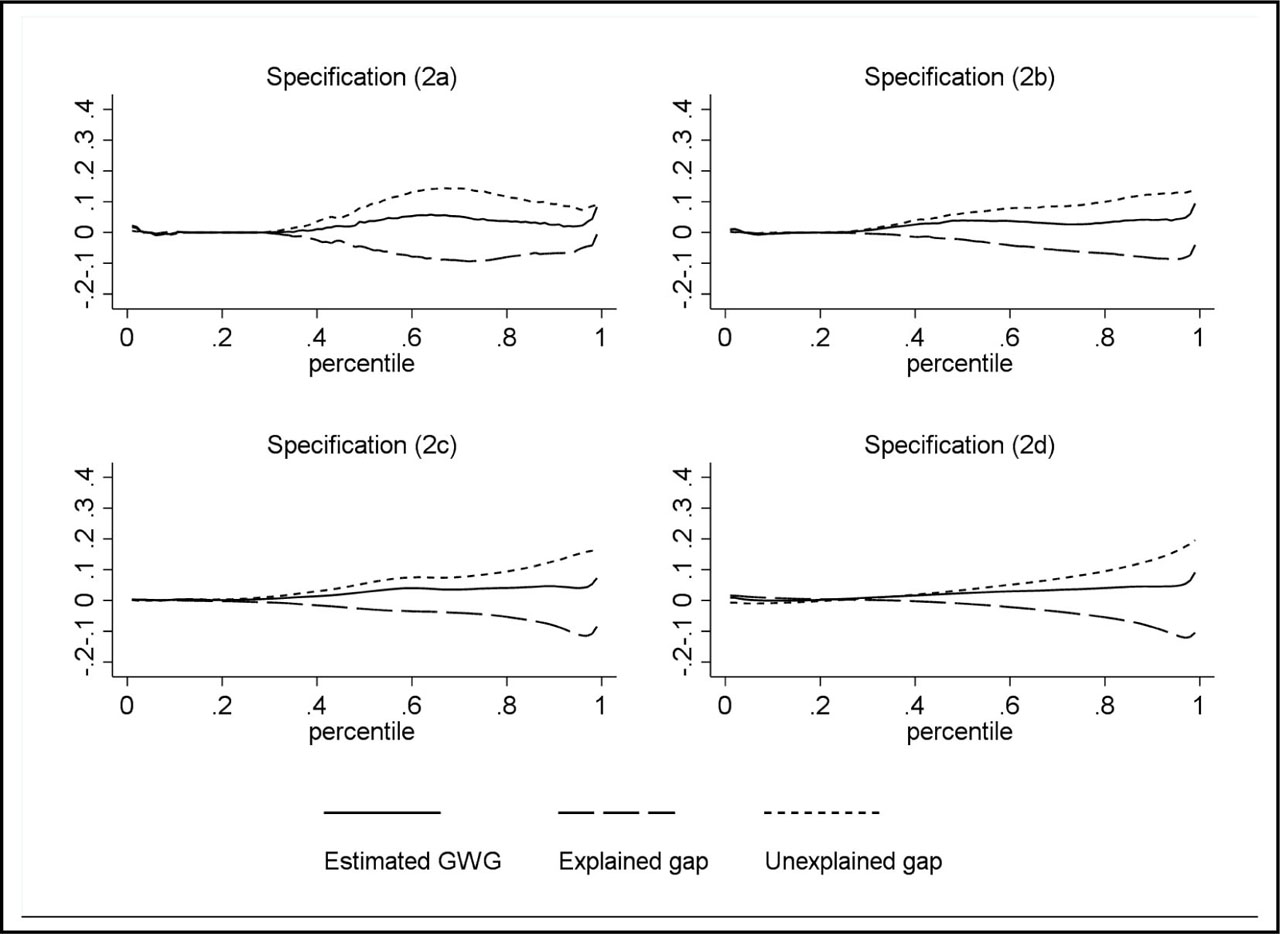
Figure B1
Sensitivity analysis, MM decomposition of the GWG across the distribution, 2006.
Data source: Author's calculations based on the SES 2006.
Notes: (i) Specifications (2a)–(2d) are as set out in the text. (ii) MM decomposition method is used to decompose the GWG using male coefficients as the baseline. (iii) “Estimated GWG” is the estimated raw GWG using the conditional quantile regression model and integrating over the set of covariates. “Explained gap” is that part of the observed gap that is due to gender differences in productivity-related characteristics included in the specification. “Unexplained gap” is that part of the observed gap that remains unexplained after controlling for the productivity-related characteristics. GWG, gender wage gap; MM, Machado-Mata; SES, Structure of Earnings Survey.
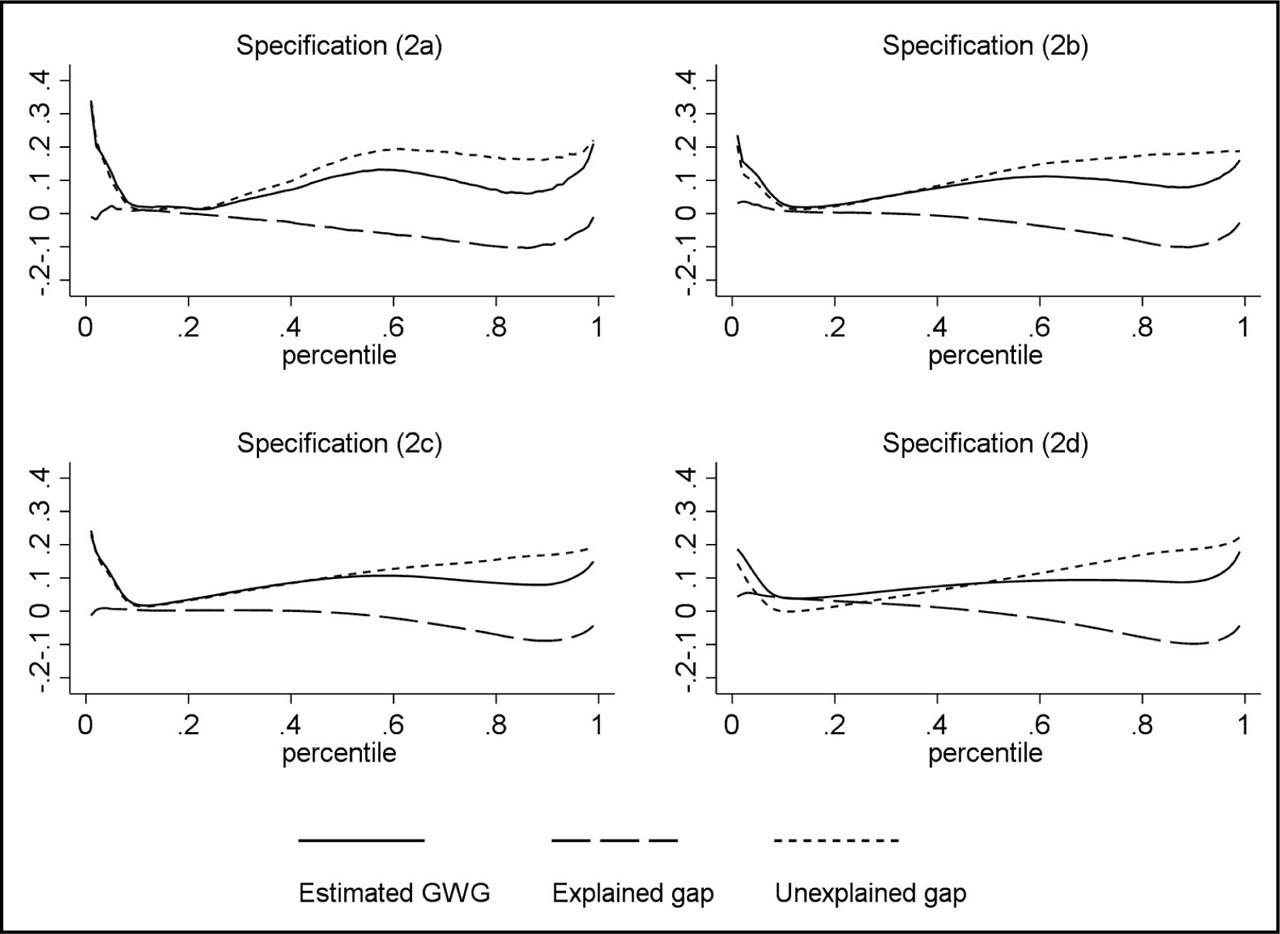
Figure B2
Sensitivity analysis, MM decomposition of the GWG across the distribution, 2014.
Data source: Author's calculations based on the SES 2014.
Notes: (i) Specifications (2a)–(2d) are as set out in the text. (ii) MM decomposition method is used to decompose the GWG using male coefficients as the baseline. (iii) “Estimated GWG” is the estimated raw GWG using the conditional quantile regression model and integrating over the set of covariates. “Explained gap” is that part of the observed gap that is due to gender differences in productivity-related characteristics included in the specification. “Unexplained gap” is that part of the observed gap that remains unexplained after controlling for the productivity-related characteristics. GWG, gender wage gap; MM, Machado-Mata; SES, Structure of Earnings Survey.