
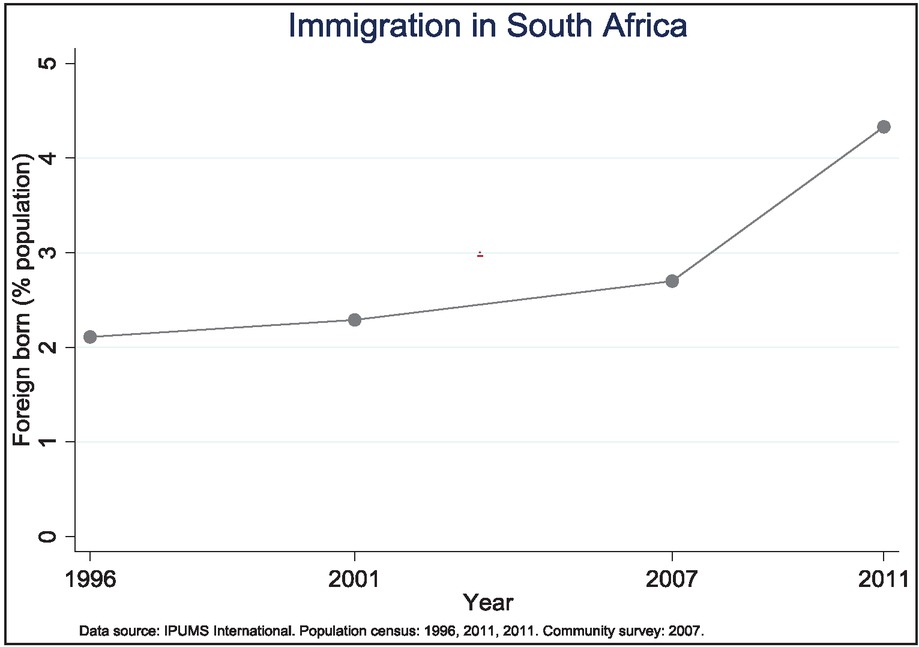
Figure 1
Immigration in South Africa.
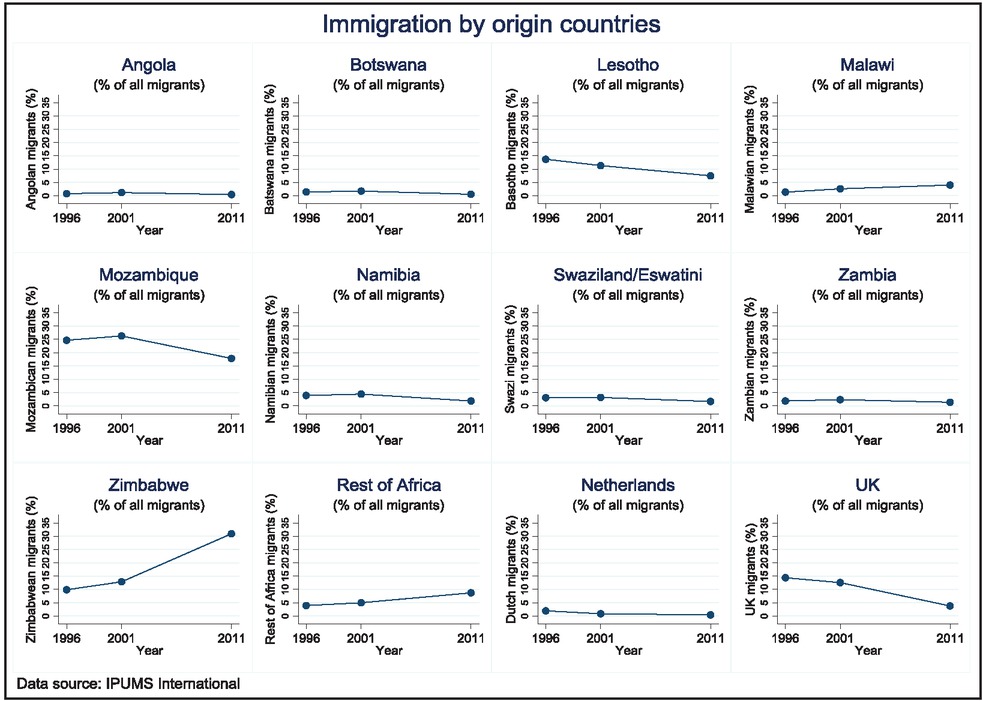
Figure 2
Immigrants’ origin countries.
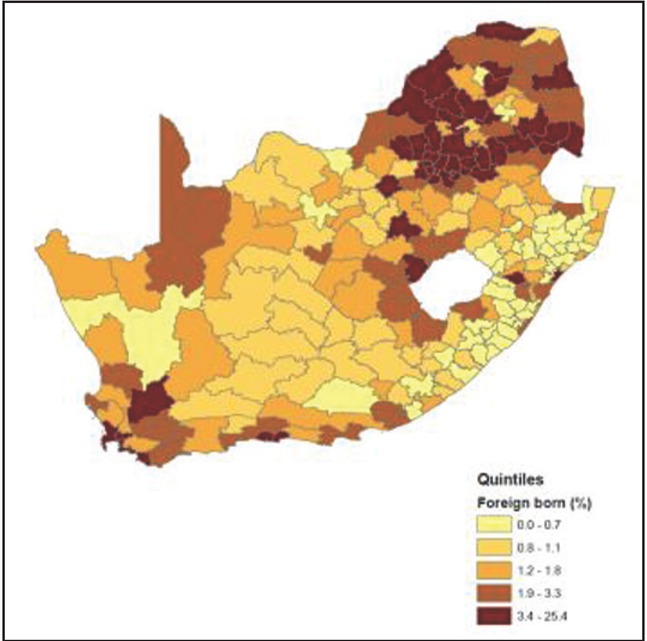
Figure 3
Spatial distribution of immigrants (2011 census data).
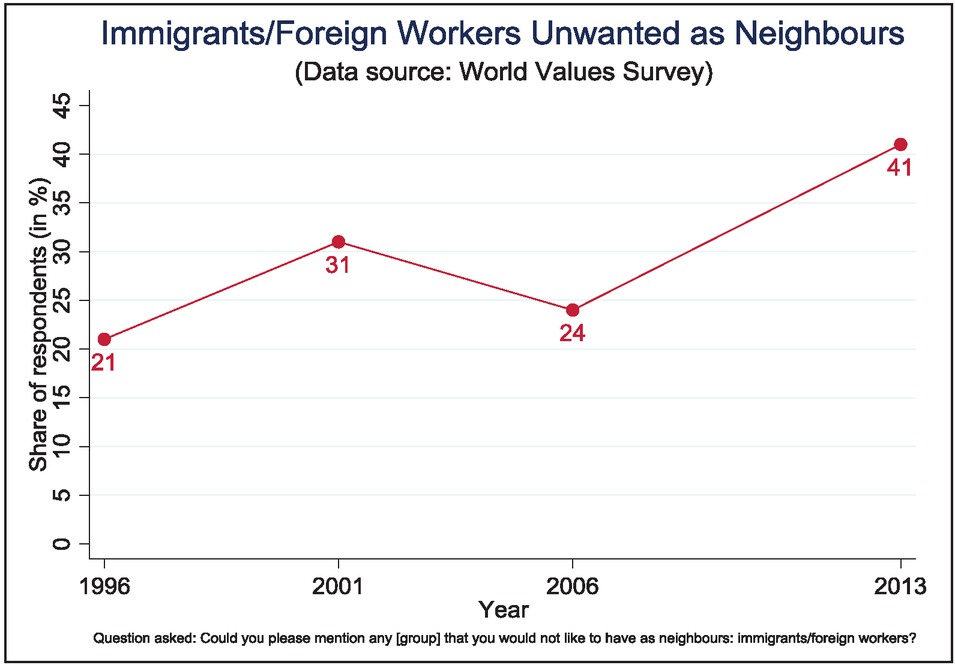
Figure 4
Attitudes toward migrants.
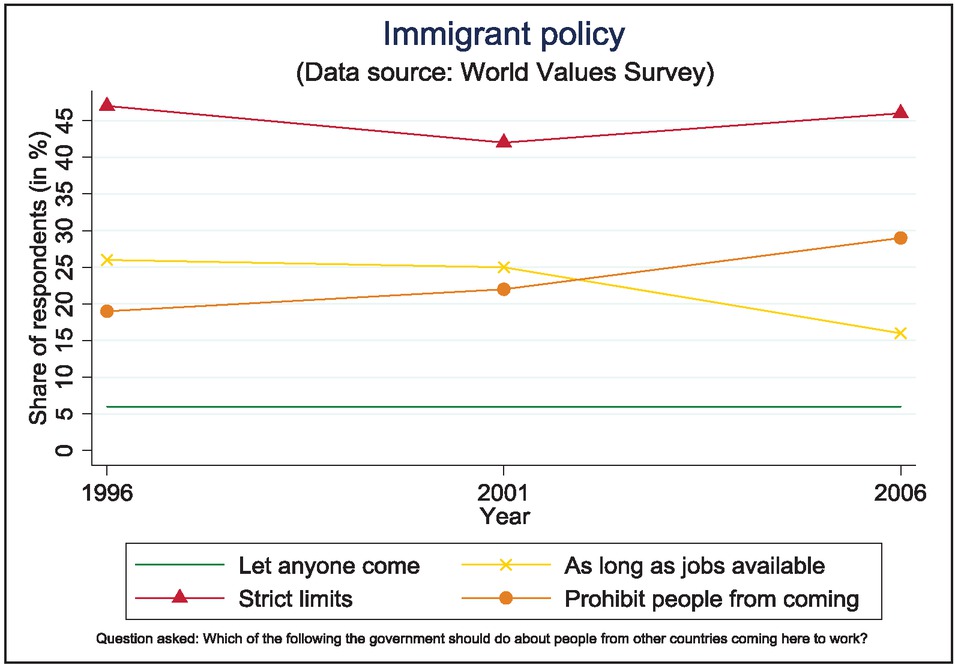
Figure 5
Attitudes toward policy.
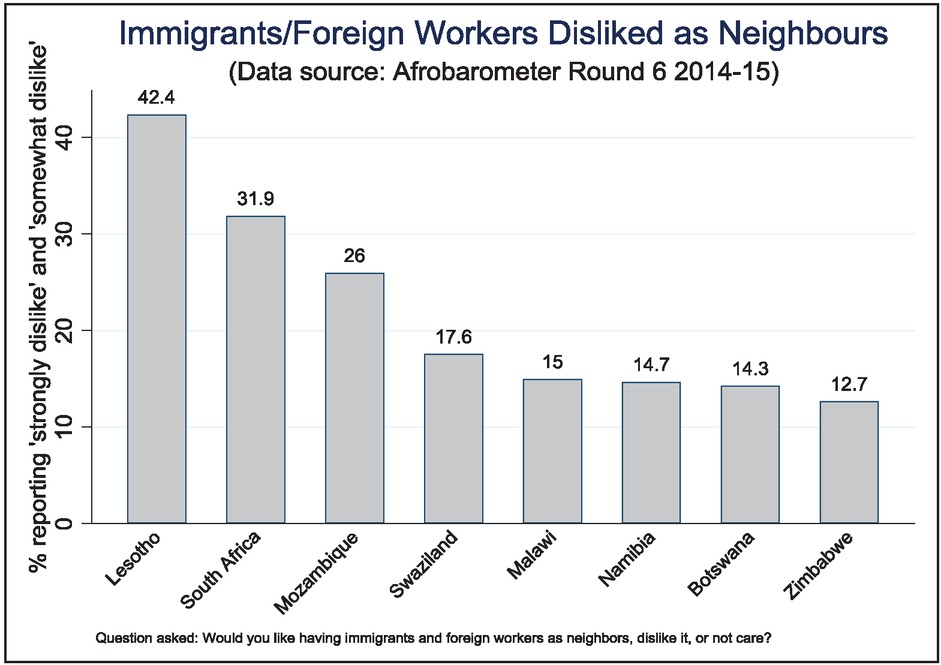
Figure 6
Attitude toward migrants—3.
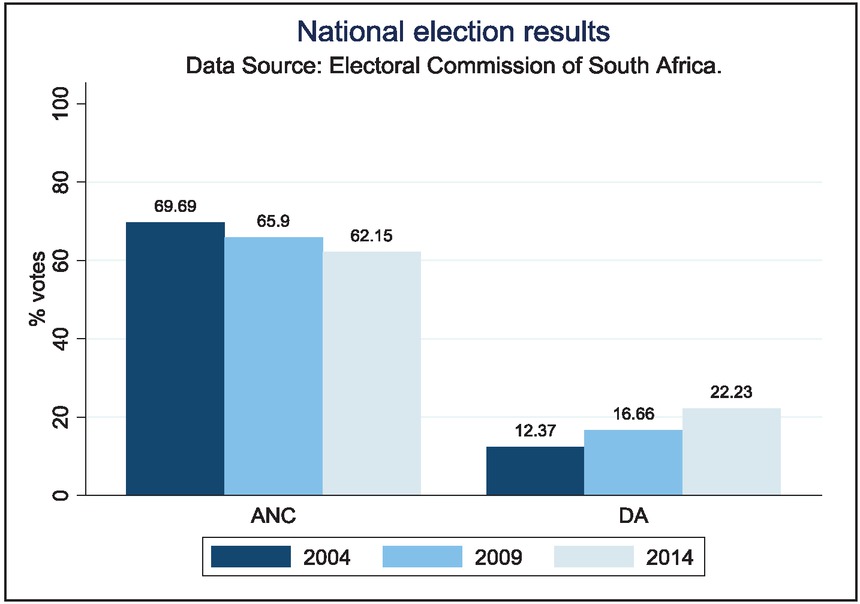
Figure 7
National elections results.
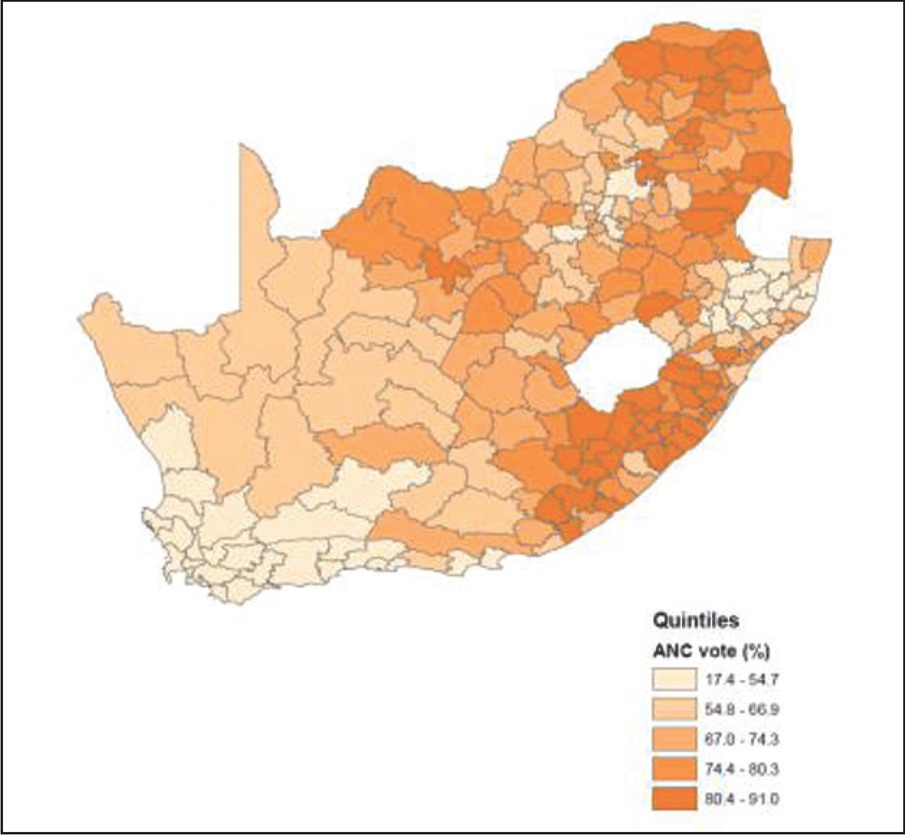
Figure 8
ANC vote share (2014 election).
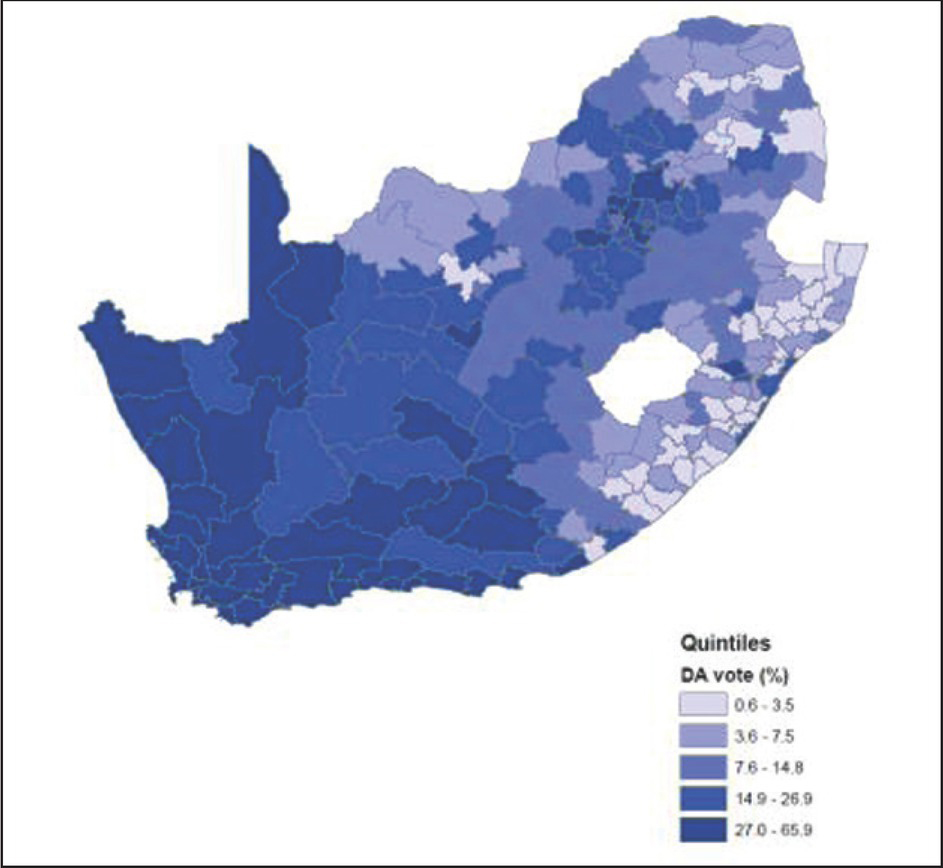
Figure 9
DA vote share (2014 election).
Table 1
Individual opinion survey—part 1
| (1) | (2) | (3) | (4) | |
|---|---|---|---|---|
| Dependent variable | Prohibit foreigners | Distrust foreigners | Govt mismanages immigration | Would vote ANC |
| Foreign born (% pop) | 0.0105* (0.00604) | 0.00421 (0.00541) | 0.0143** (0.00608) | -0.00902*** (0.00309) |
| Age | -0.00637** (0.00319) | –0.00373 (0.00284) | 0.00562 (0.00481) | 0.00754** (0.00329) |
| Age squared | 0.0000514 (0.0000388) | 0.0000469 (0.0000350) | –0.0000522 (0.0000530) | –0.000105*** (0.0000367) |
| Female | –0.0232 (0.0200) | –0.0178 (0.0134) | –0.0288 (0.0214) | –0.00442 (0.0154) |
| Language—English | –0.103* (0.0597) | 0.0225 (0.0270) | –0.0626 (0.0415) | –0.131*** (0.0401) |
| Language—Afrikaan | –0.0417 (0.0946) | 0.0269 (0.0336) | 0.0483 (0.0542) | –0.269*** (0.0445) |
| Language—Xhosa | –0.0848 (0.0707) | 0.0690* (0.0352) | –0.0957** (0.0378) | –0.183*** (0.0408) |
| Education—less than primary | 0.102*** (0.0358) | –0.0139 (0.0270) | –0.0646 (0.0416) | 0.0471 (0.0367) |
| Education—secondary completed | 0.0378 (0.0340) | 0.000322 (0.0252) | –0.0387 (0.0375) | –0.00819 (0.0272) |
| Education—tertiary | –0.0571 (0.0432) | –0.00792 (0.0332) | 0.0174 (0.0397) | 0.0172 (0.0342) |
| Employed | –0.00424 (0.0303) | –0.0246 (0.0209) | –0.0124 (0.0307) | 0.00891 (0.0237) |
| Piped water in house | 0.0609* (0.0353) | –0.0372 (0.0300) | 0.0758* (0.0452) | –0.0971*** (0.0279) |
| Informal housing (%) | 0.000937** (0.000370) | 0.000198 (0.000511) | 0.000328 (0.000659) | 0.00152*** (0.000517) |
| Urban | –0.0135 (0.0385) | 0.0139 (0.0285) | 0.00295 (0.0436) | –0.0172 (0.0364) |
| Observations | 2,279 | 2,271 | 2,164 | 2,331 |
Table 2
Individual opinion survey—part 2
| (5) | (6) | (7) | (8) | |
|---|---|---|---|---|
| Dependent variable | Govt mismanages immigration | Would vote ANC | Govt mismanages immigration | Would vote ANC |
| Prohibit foreigners | 0.0814*** (0.0265) | –0.0400 (0.0455) | ||
| Distrust foreigners | 0.0762 (0.0476) | –0.0561 (0.0393) | ||
| Age | 0.00687 (0.00484) | 0.00753** (0.00330) | 0.00628 (0.00481) | 0.00681** (0.00324) |
| Age squared | –0.0000653 (0.0000530) – | 0.000105*** (0.0000374) | –0.0000618 (0.0000534) | –0.0000968*** (0.0000369) |
| Female | –0.0287 (0.0223) | –0.00880 (0.0154) | –0.0245 (0.0213) | –0.00703 (0.0160) |
| Language—English | –0.0408 (0.0409) | –0.155*** (0.0413) | –0.0588 (0.0393) | –0.131*** (0.0388) |
| Language—Afrikaan | 0.0636 (0.0534) | –0.281*** (0.0450) | 0.0513 (0.0534) | –0.268*** (0.0458) |
| Language—Xhosa | –0.109*** (0.0408) | –0.185*** (0.0431) | –0.114*** (0.0397) | –0.168*** (0.0416) |
| Education—less than primary | –0.0551 (0.0414) | 0.0450 (0.0378) | –0.0517 (0.0403) | 0.0400 (0.0387) |
| Education—secondary completed | –0.0459 (0.0362) | –0.0133 (0.0271) | –0.0337 (0.0365) | –0.0138 (0.0253) |
| Education—tertiary | 0.0279 (0.0398) | 0.00820 (0.0336) | 0.0198 (0.0388) | 0.0207 (0.0354) |
| Employed | –0.00688 (0.0319) | 0.00780 (0.0266) | –0.00466 (0.0331) | –0.00238 (0.0261) |
| Piped water in house | 0.0762 (0.0477) | –0.0973*** (0.0268) | 0.0847* (0.0481) | –0.104*** (0.0278) |
| Informal housing (%) | 0.000393 (0.000702) | 0.00148*** (0.000521) | 0.000358 (0.000700) | 0.00162*** (0.000536) |
| Urban | 0.0350 (0.0510) | –0.0452 (0.0361) | 0.0355 (0.0519) | –0.0433 (0.0352) |
| Observations | 2,124 | 2,279 | 2,114 | 2,271 |
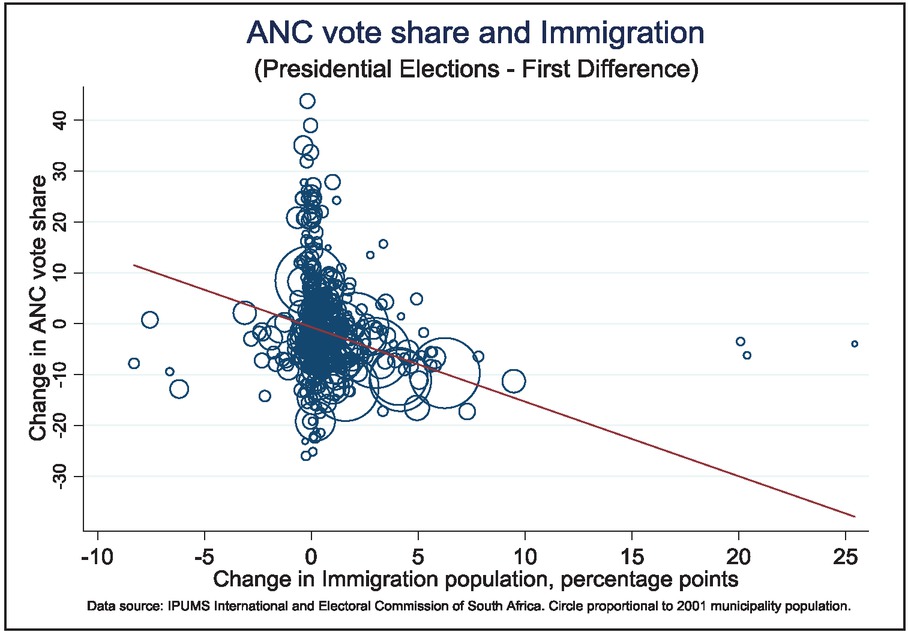
Figure 10
ANC vote and immigration.
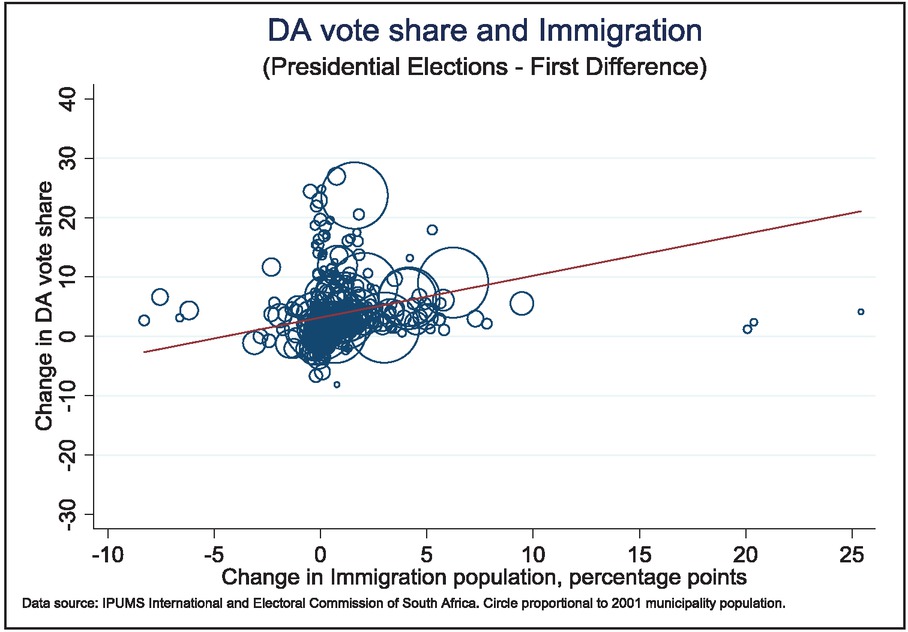
Figure 11
DA vote and immigration.
Table 3
First stage results
| (1) | (2) | |
|---|---|---|
| Dependent variable: Immigration | ||
| IV predicted immigration | 1.249*** (0.277) | 1.286*** (0.342) |
| Urban population | 0.0249 (0.0519) | |
| Female population | −0.327 (0.208) | |
| Unemployment rate | −0.0520 (0.0473) | |
| Internal migration | 0.0687 (0.143) | |
| Ethnic diversity (HHI) | 0.0532 (0.0366) | |
| Electricity access | −0.0319** (0.0142) | |
| No schooling | 0.0510 (0.0606) | |
| Observations | 210 | 210 |
| Adjusted R2 | 0.610 | 0.625 |
| Weighted | Yes | Yes |
| Estimator | FD | FD |
| F-statistic IV predicted immigration | 20.40 | 14.18 |
[i] Notes: Robust standard errors clustered at the district level in parentheses. Census data for 2001 and 2011 (IPUMS International). First differenced regressions. Covariates defined at the municipality level and as a share of the relevant native population include urban population, female population, unemployment rate, internal migration, ethnic diversity measured as the Herfindahl index based on languages spoken, access to electricity, and adult illiteracy (no schooling). Immigration is instrumented with a shift-share Bartik instrument using the 1991 census data.
*p < 0.1, **p < 0.05, ***p < 0.01.
Table 4
Main results—national elections
| (1) | (2) | (3) | (4) | (5) | (6) | (7) | (8) | |
|---|---|---|---|---|---|---|---|---|
| Dependent variable | ANC vote share | DA vote share | ||||||
| Immigration | –1.903*** (0.282) | –2.097*** (0.504) | –1.982*** (0.447) | –2.898*** (0.965) | 1.698*** (0.545) | 2.260*** (0.815) | 1.126** (0.471) | 1.863** (0.898) |
| Urban population | –0.538*** (0.168) | –0.593*** (0.161) | –0.247 (0.196) | –0.203 (0.175) | ||||
| Female population | –2.479** (1.212) | –2.091* (1.092) | 0.412 (0.889) | 0.0987 (0.936) | ||||
| Unemployment rate | 0.483* (0.287) | 0.276 (0.305) | 0.361 (0.372) | 0.528 (0.400) | ||||
| Internal migration | 0.148 (0.345) | 0.265 (0.383) | 0.204 (0.246) | 0.109 (0.313) | ||||
| Ethnic diversity (HHI) | 0.0116 (0.217) | 0.0646 (0.218) | 0.768** (0.330) | 0.725** (0.320) | ||||
| Electricity access | 0.161 (0.116) | 0.0311 (0.125) | –0.226*** (0.0583) | –0.121 (0.0840) | ||||
| No schooling | –0.197 (0.305) | –0.367 (0.320) | –0.422*** (0.156) | –0.285* (0.161) | ||||
| Observations | 210 | 210 | 210 | 210 | 210 | 210 | 210 | 210 |
| Adjusted R2 | 0.273 | 0.338 | 0.334 | 0.493 | ||||
| Weighted | Yes | Yes | Yes | Yes | Yes | Yes | Yes | Yes |
| Estimator | FD | FD-2SLS | FD | FD-2SLS | FD | FD-2SLS | FD | FD-2SLS |
| KP F-statistic | 20.40 | 14.18 | 20.40 | 14.18 | ||||
[i] Notes: Robust standard errors clustered at the district level in parentheses. Census data for 2001 and 2011 (IPUMS International). National election results from 2004 and 2014 (Electoral Commission). First differenced regressions. Covariates defined at the municipality level and as a share of the relevant native population include urban population, female population, unemployment rate, internal migration, ethnic diversity measured as the Herfindahl index based on languages spoken, access to electricity, and adult illiteracy (no schooling). Immigration is instrumented with a shift-share Bartik instrument using 1991 census data.
*p < 0.1, **p < 0.05, ***p < 0.01.
Table 5
Main results—provincial elections
| (1) | (2) | (3) | (4) | (5) | (6) | (7) | (8) | |
|---|---|---|---|---|---|---|---|---|
| Dependent variable | ANC vote share | DA vote share | ||||||
| Immigration | –1.989*** (0.288) | –2.204*** (0.514) | –2.048*** (0.452) | –2.985*** (0.967) | 1.936*** (0.580) | 2.573*** (0.883) | 1.289** (0.502) | 2.115** (0.958) |
| Urban population | –0.538*** (0.167) | –0.594*** (0.159) | –0.264 (0.208) | –0.214 (0.187) | ||||
| Female population | –2.409** (1.197) | –2.012* (1.074) | 0.432 (0.928) | 0.0816 (0.975) | ||||
| Unemployment rate | 0.493* (0.287) | 0.281 (0.302) | 0.364 (0.388) | 0.551 (0.415) | ||||
| Internal migration | 0.183 (0.363) | 0.303 (0.399) | 0.191 (0.273) | 0.0856 (0.346) | ||||
| Ethnic diversity (HHI) | 0.0474 (0.221) | 0.102 (0.223) | 0.785** (0.340) | 0.737** (0.330) | ||||
| Electricity access | 0.178 (0.117) | 0.0451 (0.125) | –0.265*** (0.0625) | –0.147* (0.0888) | ||||
| No schooling | –0.164 (0.308) | –0.338 (0.323) | –0.492*** (0.163) | –0.338** (0.166) | ||||
| Observations | 210 | 210 | 210 | 210 | 210 | 210 | 210 | 210 |
| Adjusted R2 | 0.291 | 0.354 | 0.370 | 0.526 | ||||
| Weighted | Yes | Yes | Yes | Yes | Yes | Yes | Yes | Yes |
| Estimator | FD | FD-2SLS | FD | FD-2SLS | FD | FD-2SLS | FD | FD-2SLS |
| KP F-statistic | 20.40 | 14.18 | 20.40 | 14.18 | ||||
[i] Notes: Robust standard errors clustered at the district level in parentheses. Census data for 2001 and 2011 (IPUMS International). Provincial election results from 2004 and 2014 (Electoral Commission). First differenced regressions. Covariates defined at the municipality level and as a share of the relevant native population include urban population, female population, unemployment rate, internal migration, ethnic diversity measured as the Herfindahl index based on languages spoken, access to electricity, and adult illiteracy (no schooling). Immigration is instrumented with a shift-share Bartik instrument using 1991 census data.
*p < 0.1, **p < 0.05, ***p < 0.01.
Table 6
Local election results
| (1) | (2) | (3) | (4) | |
|---|---|---|---|---|
| Dependent variable: ANC | vote share | |||
| Immigration | −0.684** (0.279) | −0.676 (0.542) | −0.708** (0.281) | −1.102** (0.536) |
| Urban population | −0.371** (0.167) | −0.370** (0.154) | −0.350** (0.162) | −0.376** (0.154) |
| Female population | −1.074 (0.962) | −1.077 (0.905) | −0.842 (0.949) | −0.683 (0.934) |
| Unemployment rate | 0.00826 (0.266) | 0.0101 (0.284) | −0.0547 (0.266) | −0.140 (0.265) |
| Internal migration | 0.145 (0.410) | 0.144 (0.378) | 0.107 (0.402) | 0.160 (0.400) |
| Ethnic diversity (HHI) | 0.140 (0.232) | 0.140 (0.220) | 0.208 (0.232) | 0.230 (0.233) |
| Electricity access | 0.0751 (0.0827) | 0.0763 (0.107) | 0.0925 (0.0834) | 0.0369 (0.101) |
| No schooling | −0.445* (0.251) | −0.443 (0.270) | −0.401 (0.256) | −0.475* (0.269) |
| Observations | 210 | 210 | 215 | 215 |
| Adjusted R2 | 0.258 | . | 0.288 | . |
| Weighted | Yes | Yes | Yes | Yes |
| Estimator | FD | FD-2SLS | FD | FD-2SLS |
| IV | 1991 | census | 1996 | census |
| KP F-statistic | . | 14.18 | . | 15.17 |
[i] Notes: Robust standard errors clustered at the district level in parentheses. Census data for 2001 and 2011 (IPUMS International). Local election results from 2001 and 2011 (Electoral Commission). First differenced regressions. Covariates defined at the municipality level and as a share of the relevant native population include urban population, female population, unemployment rate, internal migration, ethnic diversity measured as the Herfindahl index based on languages spoken, access to electricity, and adult illiteracy (no schooling). Immigration is instrumented with a shift-share Bartik instrument using 1991 or 1996 census data.
*p < 0.1, **p < 0.05, ***p < 0.01.
Table 7
Turnout
| (1) | (2) | (3) | (4) | (5) | (6) | (7) | (8) | |
|---|---|---|---|---|---|---|---|---|
| Dependent variable: Turnout | ||||||||
| FD | FD-2SLS | FD | FD-2SLS | |||||
| Immigration | –0.187 (0.176) | 0.175 (0.153) | –0.353 (0.360) | 0.856** (0.392) | –0.193 (0.179) | 0.173 (0.153) | –0.976 (0.729) | –0.125 (0.371) |
| Urban population | –0.269* (0.135) | –0.228* (0.137) | –0.259* (0.134) | –0.278** (0.127) | ||||
| Female population | –1.047* (0.623) | –1.336** (0.651) | –1.026* (0.608) | –0.906 (0.580) | ||||
| Unemployment rate | 0.186 (0.133) | 0.340*** (0.124) | 0.182 (0.126) | 0.117 (0.153) | ||||
| Internal migration | 0.138 (0.208) | 0.0503 (0.243) | 0.148 (0.205) | 0.188 (0.197) | ||||
| Ethnic diversity | 0.102 (0.108) | 0.0626 (0.106) | 0.0900 (0.103) | 0.107 (0.110) | ||||
| Electricity access | –0.161** (0.0615) | –0.0636 (0.0662) | –0.180*** (0.0596) | –0.222*** (0.0823) | ||||
| No schooling | 0.193 (0.124) | 0.319*** (0.121) | 0.182 (0.125) | 0.125 (0.128) | ||||
| Observations | 210 | 210 | 210 | 210 | 215 | 215 | 215 | 215 |
| Adjusted R2 | 0.005 | 0.444 | 0.005 | 0.481 | ||||
| Weighted | Yes | Yes | Yes | Yes | Yes | Yes | Yes | Yes |
| IV | 1991 census | 1996 census | ||||||
| KP F-statistic | 20.40 | 14.18 | 16.34 | 15.17 | ||||
[i] Notes: Robust standard errors clustered at the district level in parentheses. Census data for 2001 and 2011 (IPUMS International). National election results from 2004 and 2014 (Electoral Commission). First differenced regressions. Covariates defined at the municipality level and as a share of the relevant native population include urban population, female population, unemployment rate, internal migration, ethnic diversity measured as the Herfindahl index based on languages spoken, access to electricity, and adult illiteracy (no schooling). Immigration is instrumented with a shift-share Bartik instrument using 1991 census data.
*p < 0.1, **p < 0.05, ***p < 0.01.
Table 8
Heterogeneity analysis
| (1) | (2) | |
|---|---|---|
| Dependent variable | ANC vote share | DA vote share |
| Immigration | −4.980*** (1.646) | 1.736** (0.662) |
| x Urban population | −0.670 (0.696) | −0.283 (0.455) |
| x Female population | −0.549 (0.353) | −0.0525 (0.222) |
| x Internal migration | 0.0436 (0.497) | −0.890*** (0.305) |
| x Unemployment rate | −0.742 (1.107) | 0.194 (0.557) |
| x Electricity access | −2.104** (1.036) | −0.417 (0.627) |
| x No schooling | 0.559 (0.888) | −1.142 (0.803) |
| x Piped water access | 1.578 (1.488) | −0.608 (0.845) |
| x Ethnic diversity | 2.140** (0.827) | 0.336 (0.475) |
| x Black population | 0.226 (0.665) | −3.876*** (0.573) |
| x White population | −0.670* (0.345) | −0.249 (0.259) |
| x Asian population | 1.072*** (0.221) | −0.351** (0.172) |
| Observations | 215 | 215 |
| Adjusted R2 | 0.428 | 0.838 |
| Weighted | Yes | Yes |
| Covariates | Yes | Yes |
| Estimator | FD | FD |
[i] Notes: Robust standard errors clustered at the district level in parentheses. Census data for 2001 and 2011 (IPUMS International). National election results from 2004 and 2014 (Electoral Commission). First differenced regressions. Covariates defined at the municipality level and as a share of the relevant native population include urban population, female population, unemployment rate, internal migration, ethnic diversity measured as the Herfindahl index based on languages spoken, access to electricity, and adult illiteracy (no schooling). Immigration is instrumented with a shift-share Bartik instrument using 1991 census data.
*p < 0.1, **p < 0.05, ***p < 0.01.
Table 9
Immigrant skill level
| (1) | (2) | (3) | (4) | (5) | (6) | (7) | (8) | |
|---|---|---|---|---|---|---|---|---|
| Dependent variable | ANC vote share | DA vote share | ||||||
| Low-skill immigration | –2.770*** (0.590) | –5.420*** (2.044) | 1.285** (0.489) | 3.485* (1.859) | ||||
| High-skill immigration | –6.692*** (1.624) | –7.733*** (2.292) | 4.840** (2.131) | 4.972** (2.124) | ||||
| Observations | 210 | 210 | 210 | 210 | 210 | 210 | 210 | 210 |
| Adjusted R2 | 0.299 | 0.371 | 0.451 | 0.575 | ||||
| Estimator | FD | FD-2SLS | FD | FD-2SLS | FD | FD-2SLS | FD | FD-2SLS |
| Covariates | Yes | Yes | Yes | Yes | Yes | Yes | Yes | Yes |
| Weighted | Yes | Yes | Yes | Yes | Yes | Yes | Yes | Yes |
| KP F-statistic | 10.05 | 19.23 | 10.05 | 19.23 | ||||
[i] Notes: Robust standard errors clustered at the district level in parentheses. Census data for 2001 and 2011 (IPUMS International). National election results from 2004 and 2014 (Electoral Commission). First differenced regressions. Covariates defined at the municipality level and as a share of the relevant native population include urban population, female population, unemployment rate, internal migration, ethnic diversity measured as the Herfindahl index based on languages spoken, access to electricity, and adult illiteracy (no schooling). Immigration is instrumented with a shift-share Bartik instrument using 1991 census data.
*p < 0.1, **p < 0.05, ***p < 0.01.
Table 10
Racial background of immigrants
| (1) | (2) | (3) | (4) | (5) | (6) | |
|---|---|---|---|---|---|---|
| Dependent variable | ANC vote share | DA vote share | ||||
| Immigration—Whites | −3.413 (6.390) | − | 0.111 (3.537) | |||
| Immigration—Blacks | −2.006*** (0.455) | 1.028** (0.406) | ||||
| Immigration—Others | −19.44*** (2.872) | 16.84*** (3.807) | ||||
| Observations | 210 | 210 | 210 | 210 | 210 | 210 |
| Adjusted R2 | 0.158 | 0.308 | 0.450 | 0.403 | 0.465 | 0.741 |
| Covariates | Yes | Yes | Yes | Yes | Yes | Yes |
| Weighted | Yes | Yes | Yes | Yes | Yes | Yes |
| Estimator | FD | FD | FD | FD | FD | FD |
[i] Notes: Robust standard errors clustered at the district level in parentheses. Census data for 2001 and 2011 (IPUMS International). National election results from 2004 and 2014 (Electoral Commission). First differenced regressions. Covariates defined at the municipality level and as a share of the relevant native population include urban population, female population, unemployment rate, internal migration, ethnic diversity measured as the Herfindahl index based on languages spoken, access to electricity, and adult illiteracy (no schooling).
*p < 0.1, **p < 0.05, ***p < 0.01.
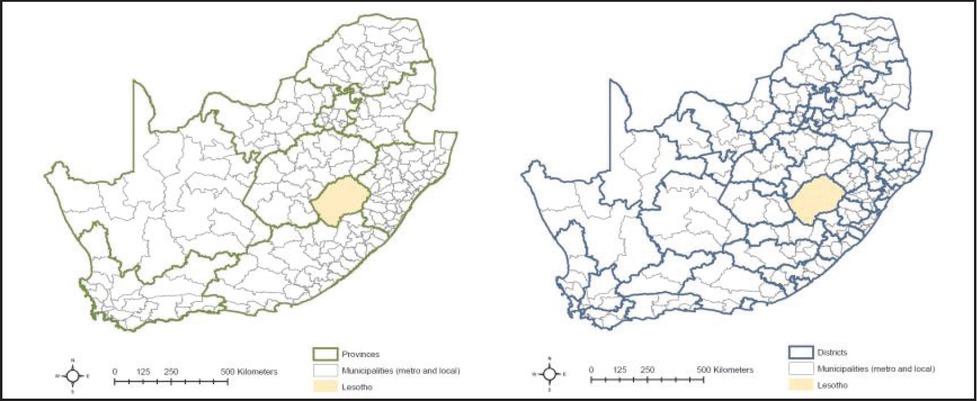
Figure A1
Administrative territorial divisions of South Africa.
Sources: Authors, GADM.
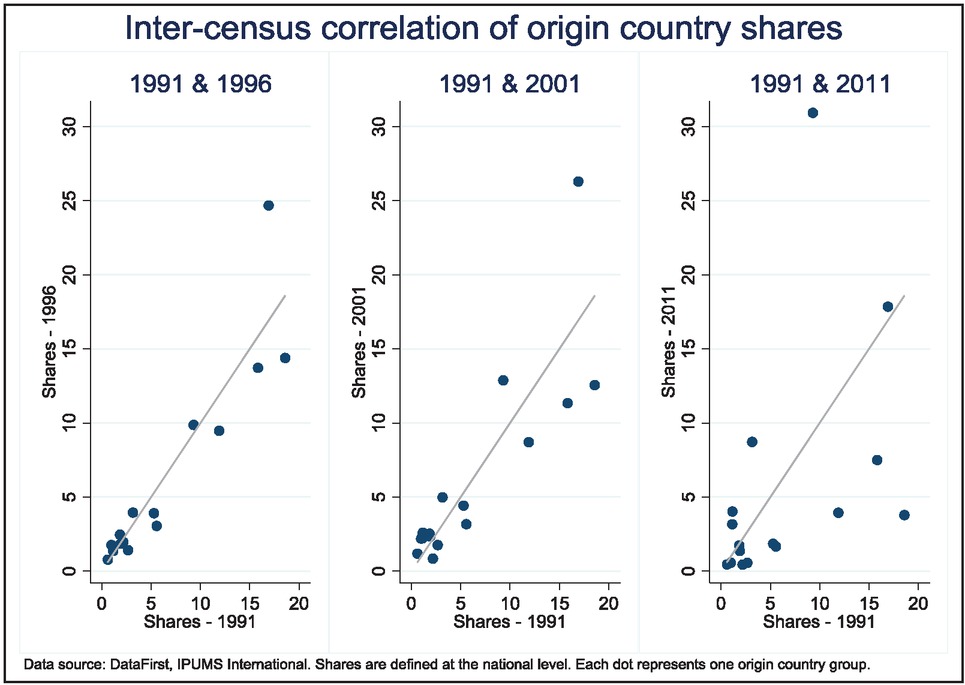
Figure A2
Serial correlation in immigrant stocks.
Table A1
Summary statistics
| N | Mean | SD | Min | Max | |
|---|---|---|---|---|---|
| ANC—national elections (%) | 430 | 67.73 | 18.70 | 3.876 | 94.44 |
| DA—national elections (%) | 430 | 12.84 | 13.04 | 0.117 | 65.92 |
| ANC—provincial elections (%) | 430 | 67.43 | 18.96 | 3.586 | 94.56 |
| DA—provincial elections (%) | 430 | 12.84 | 13.58 | 0.0811 | 67.56 |
| ANC—local elections (%) | 430 | 61.22 | 19.63 | 1.750 | 93.18 |
| Foreign-born-immigration (%) | 430 | 1.934 | 2.746 | 0.0127 | 25.41 |
| Low-skill immigration | 430 | 1.272 | 2.266 | 0 | 19.77 |
| High-skill immigration | 430 | 0.577 | 0.688 | 0 | 5.021 |
| Foreign-born—Whites—immigration (%) | 430 | 0.422 | 0.608 | 0 | 4.071 |
| Foreign-born—Blacks—immigration (%) | 430 | 1.301 | 2.528 | 0 | 24.483 |
| Foreign-born—Others—immigration (%) | 430 | 0.211 | 0.278 | 0 | 2.542 |
| Urban population (%) | 430 | 46.00 | 34.52 | 0 | 99.27 |
| Female population (%) | 430 | 52.38 | 2.098 | 42.47 | 58.39 |
| Unemployment rate (%) | 430 | 48.87 | 16.38 | 8.728 | 87.68 |
| Internal migration (%) | 430 | 11.05 | 10.80 | 0.919 | 60.62 |
| No schooling (%) | 430 | 31.24 | 12.25 | 7.011 | 72.16 |
| Electricity access (%) | 430 | 70.44 | 20.80 | 3.705 | 95.53 |
| Ethnic diversity (HHI)—language spoken based | 430 | 36.90 | 23.65 | 1.088 | 87.73 |
| Black (%) | 430 | 78.73 | 28.34 | 1.938 | 99.99 |
| White (%) | 430 | 7.037 | 6.832 | 0 | 41.00 |
| Coloured (%) | 430 | 13.34 | 24.56 | 0 | 88.03 |
| Asian (%) | 430 | 0.778 | 2.404 | 0 | 21.78 |
Table A2
Votes as a share of registered voters
| (1) | (2) | (3) | (4) | |
|---|---|---|---|---|
| Dependent variable | ANC vote share | DA vote share | ||
| Immigration | −1.321*** (0.380) | −1.521** (0.689) | 0.868** (0.372) | 1.504** (0.719) |
| Observations | 210 | 210 | 210 | 210 |
| Adjusted R2 | 0.294 | . | 0.488 | . |
| Weighted | Yes | Yes | Yes | Yes |
| Covariates | Yes | Yes | Yes | Yes |
| Estimator | FD | FD-2SLS | FD | FD-2SLS |
| KP F-statistic | 14.18 | 14.18 | ||
[i] Notes: Robust standard errors clustered at the district level in parentheses. Census data for 2001 and 2011 (IPUMS International). National election results from 2004 and 2014 (Electoral Commission). First differenced regressions. Covariates defined at the municipality level and as a share of the relevant native population include urban population, female population, unemployment rate, internal migration, ethnic diversity measured as the Herfindahl index based on languages spoken, access to electricity, and adult illiteracy (no schooling). Immigration is instrumented with a shift-share Bartik instrument using 1991 census data.
*p < 0.1, **p < 0.05, ***p < 0.01.
Table A3
Robustness to the exclusion of provinces
| (1) | (2) | (3) | (4) | (5) | (6) | |
|---|---|---|---|---|---|---|
| Sample | Excludes Western Cape | Excludes Gauteng | Excludes KwaZulu-Natal | |||
| Panel A: National elections | ||||||
| ANC | ANC | ANC | ||||
| Immigration | –1.733*** (0.366) | –2.596*** (0.933) | –2.958*** (0.778) | –7.263*** (2.555) | –1.057*** (0.229) | –1.605*** (0.475) |
| Observations | 187 | 187 | 200 | 200 | 160 | 160 |
| Adjusted R2 | 0.346 | 0.223 | 0.809 | |||
| DA | DA | DA | ||||
| Immigration | 0.597*** (0.118) | 1.087*** (0.336) | 2.118 (1.313) | 6.131*** (1.519) | 0.877** (0.385) | 1.454* (0.825) |
| Observations | 187 | 187 | 200 | 200 | 160 | 160 |
| Adjusted R2 | 0.606 | 0.469 | 0.550 | |||
| Panel B: Provincial elections | ||||||
| ANC | ANC | ANC | ||||
| Immigration | –1.804*** (0.377) | –2.700*** (0.945) | –2.968*** (0.784) | –7.299*** (2.565) | –1.125*** (0.242) | –1.718*** (0.495) |
| Observations | 187 | 187 | 200 | 200 | 160 | 160 |
| Adjusted R2 | 0.362 | 0.224 | 0.800 | |||
| DA | DA | DA | ||||
| Immigration | 0.734*** (0.150) | 1.297*** (0.385) | 2.280 (1.393) | 6.743*** (1.521) | 1.056** (0.416) | 1.702* (0.881) |
| Observations | 187 | 187 | 200 | 200 | 160 | 160 |
| Adjusted R2 | 0.649 | 0.487 | 0.570 | |||
| Weighted | Yes | Yes | Yes | Yes | Yes | Yes |
| Covariates | Yes | Yes | Yes | Yes | Yes | Yes |
| Estimator | FD | FD-2SLS | FD | FD-2SLS | FD | FD-2SLS |
| KP F-statistic | 10.93 | 5.846 | 18.32 | |||
[i] Notes: Robust standard errors clustered at the district level in parentheses. Census data for 2001 and 2011 (IPUMS International). National and provincial election results from 2004 and 2014 (Electoral Commission). First differenced regressions. Covariates defined at the municipality level and as a share of the relevant native population include urban population, female population, unemployment rate, internal migration, ethnic diversity measured as the Herfindahl index based on languages spoken, access to electricity, and adult illiteracy (no schooling). Immigration is instrumented with a shift-share Bartik instrument using 1991 census data.
*p < 0.1, **p < 0.05, ***p < 0.01.
Table A4
East-West split
| (1) | (2) | (3) | (4) | (5) | (6) | (7) | (8) | |
|---|---|---|---|---|---|---|---|---|
| Dependent variable | ANC vote share | DA vote share | ||||||
| East | West | East | West | |||||
| Immigration | –1.950*** (0.427) | –3.122*** (1.150) | –1.505*** (0.379) | –4.734*** (1.193) | 0.720*** (0.154) | 1.210*** (0.395) | 1.569 (1.607) | 6.710*** (1.918) |
| Observations | 123 | 123 | 87 | 87 | 123 | 123 | 87 | 87 |
| Adjusted R2 | 0.418 | 0.682 | 0.787 | 0.630 | ||||
| Weighted | Yes | Yes | Yes | Yes | Yes | Yes | Yes | Yes |
| Covariates | Yes | Yes | Yes | Yes | Yes | Yes | Yes | Yes |
| Estimator | FD | FD-2SLS | FD | FD-2SLS | FD | FD-2SLS | FD | FD-2SLS |
| KP F-statistic | 8.871 | 11.16 | 8.871 | 11.16 | ||||
[i] Notes: Robust standard errors clustered at the district level in parentheses. Census data for 2001 and 2011 (IPUMS International). National election results from 2004 and 2014 (Electoral Commission). First differenced regressions. Covariates defined at the municipality level and as a share of the relevant native population include urban population, female population, unemployment rate, internal migration, ethnic diversity measured as the Herfindahl index based on languages spoken, access to electricity, and adult illiteracy (no schooling). Immigration is instrumented with a shift-share Bartik instrument using 1991 census data.
*p < 0.1, **p < 0.05, ***p < 0.01.
Table A5
Excluding immigration distribution tails
| (1) | (2) | (3) | (4) | |
|---|---|---|---|---|
| Dependent variable | ANC vote share | DA vote share | ||
| Immigration | –4.474*** (0.806) | –4.889*** (1.386) | 3.476** (1.352) | 4.011*** (1.458) |
| Observations | 189 | 189 | 189 | 189 |
| Adjusted R2 | 0.336 | 0.635 | ||
| Weighted | Yes | Yes | Yes | Yes |
| Covariates | Yes | Yes | Yes | Yes |
| Estimator | FD | FD-2SLS | FD | FD-2SLS |
| KP F-statistic | 12.18 | 12.18 | ||
[i] Notes: Robust standard errors clustered at the district level in parentheses. Census data for 2001 and 2011 (IPUMS International). National election results from 2004 and 2014 (Electoral Commission). First differenced regressions. Covariates defined at the municipality level and as a share of the relevant native population include urban population, female population, unemployment rate, internal migration, ethnic diversity measured as the Herfindahl index based on languages spoken, access to electricity, and adult illiteracy (no schooling). Immigration is instrumented with a shift-share Bartik instrument using 1991 census data.
*p < 0.1, **p < 0.05, ***p < 0.01.
Table A6
District-level regressions
| (1) | (2) | (3) | (4) | (5) | (6) | (7) | (8) | |
|---|---|---|---|---|---|---|---|---|
| Dependent variable | ANC vote share | DA vote share | ||||||
| Immigration | –2.058*** (0.401) | –2.061*** (0.504) | –2.422*** (0.745) | –3.254*** (1.248) | 1.887*** (0.673) | 2.298*** (0.830) | 1.475** (0.656) | 2.411** (1.092) |
| Urban population | –0.842** (0.360) | –0.925*** (0.336) | –0.452 (0.326) | –0.358 (0.302) | ||||
| Female population | –3.220 (3.290) | –2.619 (2.938) | –1.163 (2.486) | –1.839 (2.330) | ||||
| Unemployment rate | 0.528 (0.563) | 0.226 (0.615) | 0.859 (0.566) | 1.199** (0.568) | ||||
| Internal migration | 0.735 (0.961) | 0.862 (0.869) | 0.105 (0.572) | –0.0379 (0.627) | ||||
| Ethnic diversity | 0.0183 (0.451) | 0.0709 (0.416) | 1.319*** (0.393) | 1.260*** (0.334) | ||||
| Electricity access | 0.183 (0.307) | 0.0255 (0.329) | –0.303 (0.185) | –0.125 (0.213) | ||||
| No schooling | –0.259 (0.525) | –0.428 (0.522) | –0.507** (0.222) | –0.317 (0.243) | ||||
| Observations | 51 | 51 | 51 | 51 | 51 | 51 | 51 | 51 |
| Adjusted R2 | 0.299 | 0.297 | 0.365 | 0.583 | ||||
| Weighted | Yes | Yes | Yes | Yes | Yes | Yes | Yes | Yes |
| Estimator | FD | FD-2SLS | FD | FD-2SLS | FD | FD-2SLS | FD | FD-2SLS |
| KP F-statistic | 20.08 | 12.76 | 20.08 | 12.76 | ||||
[i] Notes: Robust standard errors clustered at the district level in parentheses. Census data for 2001 and 2011 (IPUMS International). National election results from 2004 and 2014 (Electoral Commission). First differenced regressions. Covariates defined at the district level and as a share of the relevant native population include urban population, female population, unemployment rate, internal migration, ethnic diversity measured as the Herfindahl index based on languages spoken, access to electricity, and adult illiteracy (no schooling). Immigration is instrumented with a shift-share Bartik instrument using 1991 census data.
*p < 0.1, **p < 0.05, ***p < 0.01.
Table A7
1991 economic conditions
| (1) | (2) | (3) | (4) | |
|---|---|---|---|---|
| ANC vote share | DA vote share | |||
| Panel A: National elections | ||||
| Immigration | −2.147*** (0.468) | −2.819*** (0.932) | 1.226** (0.466) | 2.129** (0.949) |
| Observations | 210 | 210 | 210 | 210 |
| Adjusted R2 | 0.387 | . | 0.503 | . |
| Panel B: Provincial elections | ||||
| Immigration | −2.198*** (0.474) | −2.897*** (0.937) | 1.386*** (0.498) | 2.407** (1.026) |
| Observations | 210 | 210 | 210 | 210 |
| Adjusted R2 | 0.395 | . | 0.534 | . |
| Weighted | Yes | Yes | Yes | Yes |
| Covariates | Yes | Yes | Yes | Yes |
| Estimator | FD | FD-2SLS | FD | FD-2SLS |
| KP F-statistic | . | 21.06 | . | 21.06 |
[i] Notes: Robust standard errors clustered at the district level in parentheses. Census data for 2001 and 2011 (IPUMS International). National and provincial election results from 2004 and 2014 (Electoral Commission). First differenced regressions. Covariates defined at the municipality level and as a share of the relevant native population include urban population, female population, unemployment rate, internal migration, ethnic diversity measured as the Herfindahl index based on languages spoken, access to electricity, and adult illiteracy (no schooling). District-level covariates defined in 1991 include the agriculture and mining sectors employment shares. Immigration is instrumented with a shift-share Bartik instrument using 1991 census data.
*p < 0.1, **p < 0.05, ***p < 0.01.
Table A8
IV based on the 1996 census
| (1) | (2) | (3) | (4) | |
|---|---|---|---|---|
| ANC vote share | DA vote share | |||
| Panel A: National elections | ||||
| Immigration | −2.002*** (0.442) | −2.942*** (1.040) | 1.123** (0.466) | 1.256** (0.582) |
| Observations | 215 | 215 | 215 | 215 |
| Adjusted R2 | 0.330 | . | 0.494 | . |
| Panel B: Provincial elections | ||||
| Immigration | −2.067*** (0.446) | −2.965*** (1.018) | 1.288** (0.497) | 1.440** (0.622) |
| Observations | 215 | 215 | 215 | 215 |
| Adjusted R2 | 0.346 | . | 0.526 | . |
| Weighted | Yes | Yes | Yes | Yes |
| Covariates | Yes | Yes | Yes | Yes |
| Estimator | FD | FD-2SLS | FD | FD-2SLS |
| KP F-statistic | . | 15.17 | . | 15.17 |
[i] Notes: Robust standard errors clustered at the district level in parentheses. Census data for 2001 and 2011 (IPUMS International). National and provincial election results from 2004 and 2014 (Electoral Commission). First differenced regressions. Covariates defined at the municipality level and as a share of the relevant native population include urban population, female population, unemployment rate, internal migration, ethnic diversity measured as the Herfindahl index based on languages spoken, access to electricity, and adult illiteracy (no schooling). Immigration is instrumented with a shift-share Bartik instrument using 1996 census data.
*p < 0.1, **p < 0.05, ***p < 0.01.
Table A9
Channels—ANC
| (1) | (2) | (3) | (4) | (5) | (6) | (7) | (8) | (9) | (10) | (11) | (12) | |
|---|---|---|---|---|---|---|---|---|---|---|---|---|
| Dependent variable: ANC vote share | ||||||||||||
| Immigration | –2.314*** | –2.612*** | –2.867** | –1.984*** | –1.446** | –1.843** | –2.521*** | –4.235*** | –1.828*** | –2.310*** | –1.654*** | –2.521*** |
| (0.552) | (0.770) | (1.167) | (0.738) | (0.570) | (0.813) | (0.785) | (1.333) | (0.398) | (0.410) | (0.522) | (0.383) | |
| x Urban population | 0.254 | |||||||||||
| (0.378) | ||||||||||||
| x Female population | –0.792 | |||||||||||
| (0.587) | ||||||||||||
| x Internal migration | 0.408 | |||||||||||
| (0.468) | ||||||||||||
| x Unemployment rate | 0.0272 | |||||||||||
| (0.925) | ||||||||||||
| x Electricity access | –0.708 | |||||||||||
| (0.905) | ||||||||||||
| x No schooling | 0.0948 | |||||||||||
| (0.496) | ||||||||||||
| x Piped water access | 0.553 | |||||||||||
| (0.780) | ||||||||||||
| x Ethnic diversity | 1.192* | |||||||||||
| (0.636) | ||||||||||||
| x Black population | 1.233*** | |||||||||||
| (0.409) | ||||||||||||
| x Colored population | –1.477*** | |||||||||||
| (0.334) | ||||||||||||
| x White population | –0.322 | |||||||||||
| (0.245) | ||||||||||||
| x Asian population | 0.868*** | |||||||||||
| (0.197) | ||||||||||||
| Observations | 215 | 215 | 215 | 215 | 215 | 215 | 215 | 215 | 215 | 215 | 215 | 215 |
| Adjusted R2 | 0.328 | 0.339 | 0.334 | 0.326 | 0.330 | 0.327 | 0.329 | 0.348 | 0.351 | 0.363 | 0.330 | 0.370 |
| Weighted | Yes | Yes | Yes | Yes | Yes | Yes | Yes | Yes | Yes | Yes | Yes | Yes |
| Covariates | Yes | Yes | Yes | Yes | Yes | Yes | Yes | Yes | Yes | Yes | Yes | Yes |
| Estimator | FD | FD | FD | FD | FD | FD | FD | FD | FD | FD | FD | FD |
[i] Notes: Robust standard errors clustered at the district level in parentheses. Census data for 2001 and 2011 (IPUMS International). National election results from 2004 and 2014 (Electoral Commission). First differenced regressions. Covariates defined at the municipality level and as a share of the relevant native population include urban population, female population, unemployment rate, internal migration, ethnic diversity measured as the Herfindahl index based on languages spoken, access to electricity, and adult illiteracy (no schooling).
*p < 0.1, **p < 0.05, ***p < 0.01.
Table A10
Channels—DA
| (1) | (2) | (3) | (4) | (5) | (6) | (7) | (8) | (9) | (10) | (11) | (12) | |
|---|---|---|---|---|---|---|---|---|---|---|---|---|
| Dependent variable: DA vote share | ||||||||||||
| Immigration | –0.0253 | 1.873* | 1.798 | –0.708 | –0.767 | –0.807 | –0.614 | 2.149 | 0.624** | 1.853*** | 0.345 | 1.210** |
| (0.239) | (0.981) | (1.135) | (0.638) | (0.612) | (0.730) | (0.429) | (1.397) | (0.254) | (0.245) | (0.343) | (0.554) | |
| x Urban population | 0.937* | |||||||||||
| (0.472) | ||||||||||||
| x Female population | 0.974 | |||||||||||
| (0.747) | ||||||||||||
| x Internal migration | –0.318 | |||||||||||
| (0.384) | ||||||||||||
| x Unemployment rate | –2.710** | |||||||||||
| (1.335) | ||||||||||||
| x Electricity access | 2.407* | |||||||||||
| (1.346) | ||||||||||||
| x No schooling | –1.152* | |||||||||||
| (0.652) | ||||||||||||
| x Piped water access | 1.850** | |||||||||||
| (0.846) | ||||||||||||
| x Ethnic diversity | –0.548 | |||||||||||
| (0.570) | ||||||||||||
| x Black population | –3.541*** | |||||||||||
| (0.482) | ||||||||||||
| x Colored population | 3.499*** | |||||||||||
| (0.345) | ||||||||||||
| x White population | 0.719** | |||||||||||
| (0.344) | ||||||||||||
| x Asian population | –0.145 | |||||||||||
| (0.260) | ||||||||||||
| Observations | 215 | 215 | 215 | 215 | 215 | 215 | 215 | 215 | 215 | 215 | 215 | 215 |
| Adjusted R2 | 0.532 | 0.521 | 0.499 | 0.560 | 0.556 | 0.542 | 0.532 | 0.499 | 0.800 | 0.808 | 0.523 | 0.493 |
| Weighted | Yes | Yes | Yes | Yes | Yes | Yes | Yes | Yes | Yes | Yes | Yes | Yes |
| Covariates | Yes | Yes | Yes | Yes | Yes | Yes | Yes | Yes | Yes | Yes | Yes | Yes |
| Estimator | FD | FD | FD | FD | FD | FD | FD | FD | FD | FD | FD | FD |
[i] Notes: Robust standard errors clustered at the district level in parentheses. Census data for 2001 and 2011 (IPUMS International). National election results from 2004 and 2014 (Electoral Commission). First differenced regressions. Covariates defined at the municipality level and as a share of the relevant native population include urban population, female population, unemployment rate, internal migration, ethnic diversity measured as the Herfindahl index based on languages spoken, access to electricity, and adult illiteracy (no schooling).
*p < 0.1, **p < 0.05, ***p < 0.01.
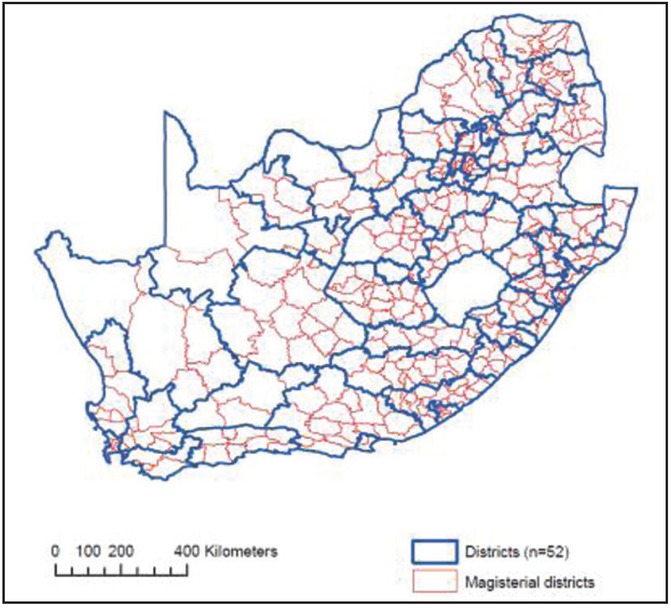
Figure B1
Magisterial units and district boundaries.
Sources: Authors, GADM.
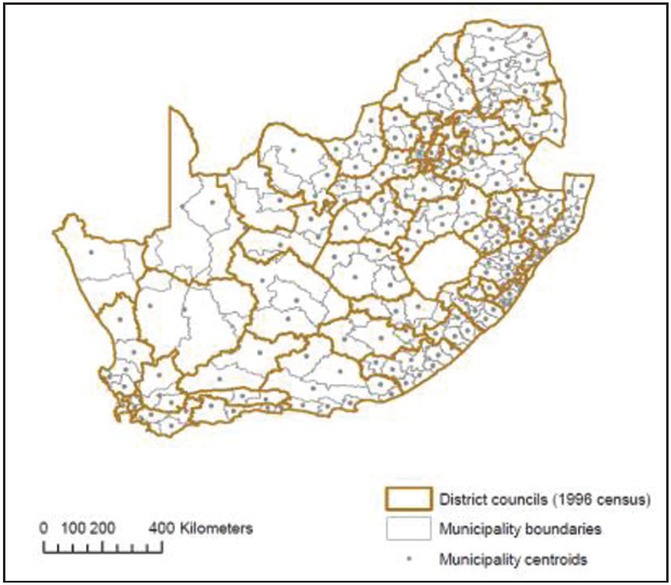
Figure B2
Municipality and the 1996 district council boundaries.
Sources: Authors, GADM.
Table B1
First stage results
| (1) | (2) | |
|---|---|---|
| Dependent variable | Immigration | |
| IV predicted immigration (1996 census) | 0.777*** (0.192) | 0.720*** (0.185) |
| Urban population | −0.0265 (0.0435) | |
| Female population | −0.113 (0.211) | |
| Unemployment rate | −0.0590 (0.0650) | |
| Internal migration | 0.170 (0.135) | |
| Ethnic diversity (HHI) | 0.0573 (0.0353) | |
| Electricity access | −0.100*** (0.0260) | |
| No schooling | −0.0497 (0.0441) | |
| Observations | 215 | 215 |
| Adjusted R2 | 0.554 | 0.630 |
| Weighted | Yes | Yes |
| Estimator | FD | FD |
| F-statistic IV | 16.54 | 16.16 |
[i] Notes: Robust standard errors clustered at the district level in parentheses. Census data for 2001 and 2011 (IPUMS International). First differenced regressions. Covariates defined at the municipality level and as a share of the relevant native population include urban population, female population, unemployment rate, internal migration, ethnic diversity measured as the Herfindahl index based on languages spoken, access to electricity, and adult illiteracy (no schooling). Immigration is instrumented with a shift-share Bartik instrument using 1996 census data.
*p < 0.1, **p < 0.05, ***p < 0.01.
Table C1
Belief and opinion variable definitions
| Variable name | Detailed question | Binary coding |
|---|---|---|
| Prohibit foreigners | How about people from other countries coming to South Afri- ca? Which one of the following do you think the government should do? 1 = Prohibit people entering from other countries, 2 = Place strict restrictions on the number of foreigners who can enter, 3 = Let people in as long as there are jobs available, 4 = Let anyone in who wants to enter, 9 = Do not know | Variable equal to 1 if respondent answer is option 1, and zero otherwise |
| Distrust foreigners | How much do you trust each of the following types of people: what about foreigners living here in South Africa? Trust foreigners living here in SAF. 0 = Not at all, 1 = Just a little, 2 = I trust them somewhat, 3 = I trust them a lot, 9 = Do not know | Variable equal to 1 if respondent answer is option 0 or option 1, and zero otherwise |
| Govt mismanages immigration | How well or badly would you say the former Mbeki govern- ment was handling the following matters: Managing immigration. 1 = Very badly, 2 = Fairly badly, 3 = Fairly well, 4 = Very well, 9 = Do not know/Have not heard enough | Variable equal to 1 if respondent answer is option 1 or option 2, and zero otherwise |
| Would vote ANC | If a presidential election were held tomorrow, which party’s candidate would you vote for? | Variable equal to 1 if respondent answer is ANC, and zero otherwise |
Table C2
Summary statistics
| N | Mean | SD | Min | Max | |
|---|---|---|---|---|---|
| Prohibit foreigners | 2,347 | 0.215 | 0.411 | 0 | 1 |
| Prohibit or place strict restrictions on foreigners | 2,347 | 0.657 | 0.475 | 0 | 1 |
| Distrust foreigners | 2,339 | 0.846 | 0.361 | 0 | 1 |
| Govt mismanages immigration | 2,230 | 0.689 | 0.463 | 0 | 1 |
| Would vote ANC | 2,400 | 0.705 | 0.456 | 0 | 1 |
| Foreign born (% population) | 2,400 | 3.893 | 3.327 | 0.0127 | 25.41 |
| Age | 2,375 | 37.79 | 14.21 | 18 | 97 |
| Age squared | 2,375 | 1,630 | 1,244 | 324 | 9,409 |
| Female | 2,400 | 0.500 | 0.500 | 0 | 1 |
| Language—English | 2,400 | 0.456 | 0.498 | 0 | 1 |
| Language—Afrikaan | 2,400 | 0.232 | 0.422 | 0 | 1 |
| Language—Xhosa | 2,400 | 0.146 | 0.353 | 0 | 1 |
| Language—Zulu | 2,400 | 0.166 | 0.372 | 0 | 1 |
| Education—less than primary | 2,400 | 0.136 | 0.343 | 0 | 1 |
| Education—secondary completed | 2,400 | 0.285 | 0.452 | 0 | 1 |
| Education—tertiary | 2,400 | 0.174 | 0.379 | 0 | 1 |
| Employed | 2,386 | 0.497 | 0.500 | 0 | 1 |
| Piped water in house | 2,367 | 0.554 | 0.497 | 0 | 1 |
| Informal housing in the area (%) | 2,400 | 14.16 | 23.30 | 0 | 100 |
| Urban area | 2,400 | 0.657 | 0.475 | 0 | 1 |