
I. Introduction
The economic and social fabric of the region has been greatly influenced by migrants from the southern Indian state of Kerala for many decades. Since its inception in the 1970s, several migration opportunities have presented themselves to those seeking improved employment prospects, greater living standards, and means to provide for their families. About 2.5 million Keralite people have worked or are working in Gulf nations, and their remittances bring in a substantial amount of money for the state of Kerala. The economy of the state benefits from this funding [1]. However, as an integral aspect of this movement, the narrative of Gulf returnees—Kerala natives who worked in the Gulf for a period but ultimately returned—deserves further investigation. Reintegrating socially and economically isn’t always simple, and when they return, they often encounter many opportunities and challenges.
a. History of the Gulf migration
Many people from Kerala moved to the Gulf states after the oil boom in the 1970s. The construction, hotel, and domestic service sectors in Kerala were in great demand; thus, the state dispatched a large number of people to the Gulf. With the hope of returning with a comfortable income and better working circumstances, many Keralites sought employment as temporary migrants [2]. As a means of subsistence for many Keralite families, this movement eventually had an effect on the state’s economic and social dynamics [3]. Nevertheless, migration from the Gulf has historically followed a cyclical pattern. When contracts end or when economic circumstances in the Gulf nations change—for instance, when oil prices drop, or some governments nationalize their labor markets—many migrants return to their home states [4].
b. Difficulties faced by Gulf returnees
Even though migration has brought financial benefits to many Keralites, returnees often encounter challenges. One of the most significant problems that Gulf returnees face is the lack of employment opportunities in Kerala. Many individuals who worked as unskilled or semi-skilled workers in the Gulf have a tough time finding domestic work that is a good fit for their skills and experience when they return to Kerala [5]. Psychological stress and social isolation are common outcomes for returnees who are unable to get meaningful employment due to the difficulty of adjusting to a drastically different way of life after their time abroad [6].
Another important issue is the lack of services that help people reintegrate into society. While other countries have established programs to assist Gulf returnees in reintegrating into society (SRD), Kerala’s procedures are sometimes insufficient and made on an as-needed basis. While there are some welfare programs out there, such as those that provide resources to assist individuals in learning new skills or start their own enterprises, they are often somewhat limited in scope and accessibility [7]. Access to these programs is a problem for many returning citizens because of bureaucratic red tape or just plain ignorance. Without a structure to assist them in coping with problems like unemployment and financial instability, reintegration into society is already a challenge for returns. You may see the emigrant list of Keralaites from 1998 to 2023 in Table 1 and Figure 1. Health care is another critical area where Gulf returnees face difficulties. Many migrant workers return home sick due to the hazardous and unpleasant working conditions they endured in the Gulf. But it’s still not easy to reach a good hospital in Kerala, especially if you live in the country [8]. The high cost of medical treatment and the lack of health insurance put a strain on the budgets of many returnees. In addition, when returnees encounter difficulty finding employment or reintegrating into their communities, they are more likely to experience mental health issues including anxiety and depression [9].
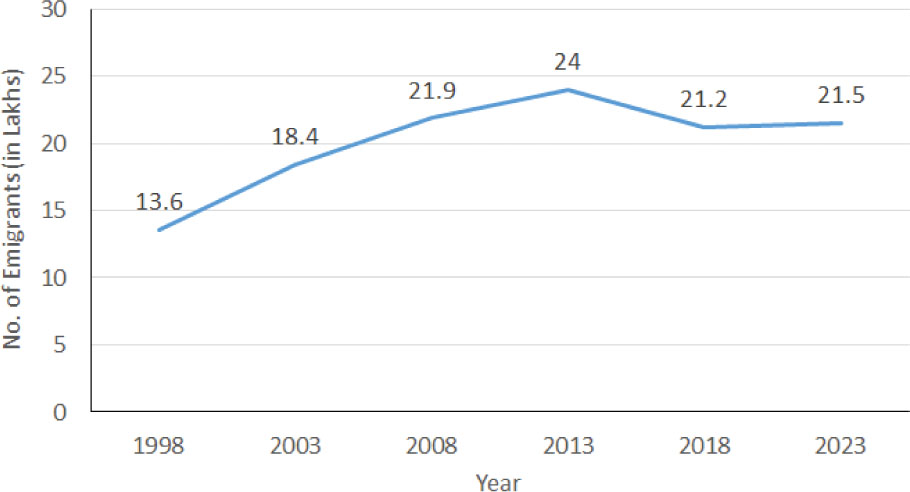
Figure 1:
Kerala emigrant list 1998–2023.
Table 1:
Emigrant list of Keralites (1998–2023)
| Year | Emigrants | Inter-survey difference | Increase/decrease (%) |
|---|---|---|---|
| 1998 | 13.6 L | - | - |
| 2003 | 18.4 L | 4.8 L | 35.00 |
| 2008 | 21.9 L | 3.5 L | 19.30 |
| 2013 | 24 L | 2.1 L | 9.40 |
| 2018 | 21.2 L | −2.8 L | −11.60 |
| 2023 | 21.5 L | 32.4 K | 1.50 |
Returnees often have the additional challenge of SRD. Reintegrating into Keralan society after a lengthy period of residing outside could be tough. Feeling disconnected from loved ones and the outside world might lead to feelings of isolation. Returnees risk stigmatization and mistrust from others around them if they are perceived as a failure or unable to maintain the same standard of living they had in the Gulf [10]. The lasting consequences of social isolation may have a detrimental influence on their psychological and overall health.
c. Potential and opportunities for Gulf returnees
Opportunities and challenges await Gulf returnees in Kerala. One of the biggest benefits of returning from the Gulf is the wealth that emigrants bring with them. Businesses and real estate owned by returnees have contributed to Kerala’s economic progress [11]. A lot of people from the Gulf have shown a real entrepreneurial spirit by starting small and medium-sized enterprises (SMEs) in many industries, such as health care, retail, and tourism. Not only do these businesses give the returnees a way to make ends meet, but they also employ other residents of the state [12].
After returning from service in the Gulf, veterans can use the skills and knowledge they gained to take advantage of new opportunities. Although many migrants may have had low-skilled jobs before arriving in Kerala, the state’s rapidly growing information technology, health care, and education sectors might benefit from individuals with managerial or technical expertise [13]. Prior to putting the skills acquired during an international education to use, they must be officially acknowledged and validated. Making an attempt to link the abilities acquired in the Gulf with what is needed in the local labor market can significantly improve the job possibilities of returnees.
Table 1 presents the trend of emigrants from Kerala between 1998 and 2023, highlighting the changes in migration patterns over successive survey periods. It shows both inter-survey differences and the percentage increase or decrease in emigrant numbers, reflecting the dynamic nature of Gulf migration over time.
The government of Kerala has established many initiatives to assist Gulf returnees because of their significant contributions to the state’s economic and social development. Returnees get social security and financial help through various self-employment initiatives and programs such as the Pravasi Pension Scheme, which is administered by the Non-Resident Keralites Affairs (NORKA) department [14]. Vocational training and skill development programs have been put in place to assist returnees in finding employment, particularly in rapidly expanding sectors such as health care, renewable energy, and tourism [15, 16]. Ganesan [17] proposed a dynamic secure data management framework using attribute-based encryption to enhance data protection and access control in mobile financial cloud environments. The study highlights how advanced technological frameworks can improve system efficiency and security, which complements the present research by emphasizing the role of structured institutional mechanisms in improving the management and support systems available to migrant returnees. These projects are still in their early stages, but they have the potential to enhance the long-term prospects of Gulf returnees in Kerala. The tremendous impact of Keralites’ emigration to Gulf states on Kerala’s economy and society is well-documented. While many have benefited by leaving the Gulf area, those who return encounter severe challenges such as high unemployment, social isolation, and health issues. However, opportunities do exist for those who return, particularly in the realms of business and skill development. Assuming they have the support they require from the state and its inhabitants, returnees from the Gulf can greatly influence Kerala’s future prosperity. Helping returnees overcome difficulties and attain their full potential requires a combination of policy actions, social support networks, and economic opportunities. Kerala must address the difficulties and possibilities faced by Gulf returnees if they are to have a seamless reintegration and contribute positively to the state’s economy and society.
d. Limitations of the study
This study has several methodological limitations. First, the research adopts a cross-sectional design, which captures the reintegration experiences of migrants at a single point in time and therefore does not allow causal relationships to be established. Second, the data were collected from selected districts in Kerala, which may limit the generalizability of the findings to all Gulf return migrants. Future research may adopt longitudinal approaches and broader geographic coverage to better understand the long-term reintegration dynamics of return migrants.
II. Objective of the Study
This study aims to examine the key structural and socio-economic barriers affecting the reintegration of Gulf return migrants in Kerala and to analyze how these factors influence their emotional and psychological well-being. Specifically, the study investigates the impact of financial constraints, government support (GS) limitations, family reintegration challenges, societal reintegration barriers, and career transition difficulties on the reintegration process of return migrants using Structural Equation Modeling (SEM).
III. Literature Survey
Hu et al. [18] developed an interpretable and uncertainty-informed machine learning framework to accelerate the discovery of lead-free piezoceramic materials, demonstrating how advanced analytical models can improve predictive accuracy and decision-making in complex systems. Similarly, Wang [19] examined the relationship between local economic autonomy and enterprises’ green total factor productivity, showing that policy mechanisms and governance structures significantly influence sustainable economic performance. Pessoa et al. [20] examined the green transition paradox in natural resource–rich economies such as Brazil, Russia, and Uzbekistan, highlighting how economic structures and institutional policies influence sustainable development outcomes. Their findings emphasize the importance of effective policy frameworks and institutional support systems, which aligns with the present study by underscoring the role of government programs and policy interventions in facilitating the successful reintegration and socio-economic stability of Gulf returnees in Kerala. Ponkratov et al. [21] developed a model for knowledge-based transformation and sustainable development in Brazil, Russia, India, China, South Africa, and Turkiye (BRICS-T) countries, emphasizing the role of institutional support and policy coordination in economic growth. Their findings highlight the importance of effective policy frameworks, which supports the present study by underscoring the need for structured government programs to improve the reintegration prospects of Gulf returnees in Kerala. Sgantzos et al. [22] introduced triple-entry accounting as a transparent auditing framework for monitoring and verifying outputs generated by large language models. The proposed research adapted this concept by emphasizing structured validation and verification mechanisms in data analysis, thereby improving reliability and accountability in the interpretation of reintegration-related survey data.
a. Data sources and methodology
Northern Kerala’s Malappuram and Kozhikode, Southern Kerala’s Alappuzha and Kollam, and Central Kerala’s Thrissur and Kottayam were the survey sites. The 2018 Kerala Migration Survey (KMS) determined its high rate of return migration, which had a role in its selection. A total of 1,000 samples were randomly selected from 18 taluks, 3 from each district: Kozhikode’s Vadakara and Quilandi and Malappuram’s Tirur, Tirurangadi, and Ernad. Kottayam, Changanassery, Meenachil, and Thalappally in the Kottayam District; Thrissur, Mukundapuram, and Thalappally in the Thrissur District. Taluks Kollam, Karunagappally, and Kottarakkara were chosen from the Kollam district, whereas Ambalappuzha, Karthikappally, and Mavelikkara were chosen from the Alappuzha district. There were 768 complete and valid samples out of a total of 1,000. We did not consider 232 samples since they were determined to be invalid. Out of the 1,000 questionnaires collected, 232 responses were excluded during the data screening stage to ensure the reliability of the analysis. Samples were considered invalid if they contained incomplete responses, significant missing values across multiple measurement items, inconsistent or contradictory answers, or patterned responses indicating lack of respondent engagement (e.g., selecting the same option for all items). Removing these responses helped improve the overall data quality and ensured that the final dataset of 768 valid samples was suitable for reliable statistical analysis and SEM.
To ensure representativeness, the demographic composition of the final sample (N = 768) was compared with the broader patterns reported in the KMS 2018. The distribution of respondents across age groups, gender, religion, destination countries, and occupational categories closely reflects the general profile of Gulf return migrants documented in the KMS reports. In particular, the dominance of middle-aged male migrants and the high representation of Muslim migrants are consistent with earlier migration studies on Kerala’s Gulf migration patterns. Although the sampling was conducted across selected districts, the demographic similarities with the statewide migration profile indicate that the sample reasonably represents the characteristics of Gulf returnees in Kerala, allowing cautious generalization of the findings.
b. Hypothesis
Problems with funding have been identified [23,24,25]. Once they get back to their native countries, most returnees have financial limitations. Family reintegration concerns are another concern [26], and [27] discusses government-related challenges. According to [24, 26], returnees are most affected by social isolation when it comes to reintegration issues. According to previous research [25], the most pressing issue is the constant flux between different types of jobs and industries. We examined the following hypotheses to see if the aforementioned factors significantly affect the difficulties:
H1: One difficulty that returnees encounter while reintegrating into their home culture is the financial aspect.
H2: Reintegration into society can be difficult for ex-offenders due to government terms.
H3: It can be difficult for returnees to reintegrate into their families.
H4: As they readjust to life back home, returnees have the difficulty of SRD.
H5: One of the difficulties that returnees encounter when reintegrating into their native society is the transition in vocation and employment sector.
c. Measurement scale
The five-factor model of problems experienced by expats from Gulf states was used in this research. Prior to the main survey, the questionnaire was subjected to a pilot test involving 30 Gulf return migrants from Kozhikode district to ensure conceptual clarity and respondent understanding of the items. Minor modifications were made to improve wording and remove ambiguity between economic and psychological dimensions. Feedback from the pilot respondents helped refine several items to ensure that each construct clearly represented its intended dimension. This section lays forth the variables, measurement items, and sources upon which the questionnaire is based:
Economic difficulties (EDF) [28, 29]
Debt is becoming a bigger problem for me as my financial condition becomes worse (EDF1).
I feel that my current income isn’t enough compared to what I made in the Gulf (EDF2).
Postponed consumption (EDF3) is a result of debt.
Coming home has diminished my capacity to save (EDF4).
My faith in my investing choices has not wavered, even though I have been experiencing some financial troubles (EDF5).
Problems with GS That Have Persisted [30]
In my own nation, I am currently unemployed (GS1).
In terms of government programs (GS2), I am clueless.
The inadequacy of the government’s returnee programs (GS3) is my primary worry.
A large number of migrant laborers, both skilled and unskilled, work in this area (GS4).
In my opinion, GS5 will not improve returnees’ quality of life through rehabilitation programs.
Families face difficulties when attempting to reintegrate (FRI) [31]
Family adjustment (FRI1) is a problem that I’m now trying to solve.
I am separated from my children (FRI2).
It was too much for me (FRI3) to handle the family’s stringent cleanliness regulations.
Everyone in my family seems to be staring down on me (FRI4).
Since coming back (FRI5), I’ve lost all power to sway family decisions.
Challenges in SRD [29]
Making new acquaintances is challenging for me in my hometown (SRD1).
Adapting to the local social milieu (SRD2) is proving to be quite a challenge for me.
Some people in society treat me unfairly (SRD3).
It’s challenging for me to fit in with most clubs and social organizations (SRD4).
A Change in Employment and Career Path (CE)
Working for oneself seems like a more practical way to make ends meet (CE1).
Formal certification is not readily available in my own country, making it difficult to demonstrate my professional abilities (CE2).
I am having a hard time finding a permanent position here after my experience in the Gulf (CE3).
There are chances for business in Kerala, but they appear to be more challenging to pursue than in other states (CE4).
It seems more challenging to acquire different talents here than in the Gulf (CE5).
Figure 2 represents the structural model. In addition to the respondents’ socio-demographic information, the study included the aforementioned 5 constructs, which include a total of 24 statements. Whenever returning to the home nation occurred, financial difficulties proved to be the most significant concern. In order to assess financial difficulties, we used the metrics proposed [26] to track debt levels, savings and investment, and consumption. To begin, we used a five-point scale coding system ranging from “strongly disagree” to “strongly agree” to assess the returnees’ perspectives on financial difficulties. Although the study primarily measures structural reintegration barriers such as economic constraints, limited GS, and social reintegration difficulties, these dimensions are closely linked to the emotional and psychological well-being of return migrants. Prior migration studies indicate that financial insecurity, social exclusion, and employment instability significantly influence migrants’ psychological adjustment after return. Therefore, the constructs used in this study function as indirect indicators of emotional and psychological stress experienced by returnees during reintegration. The study interprets these socio-economic pressures as key contextual determinants affecting psychological well-being rather than measuring psychological symptoms directly.
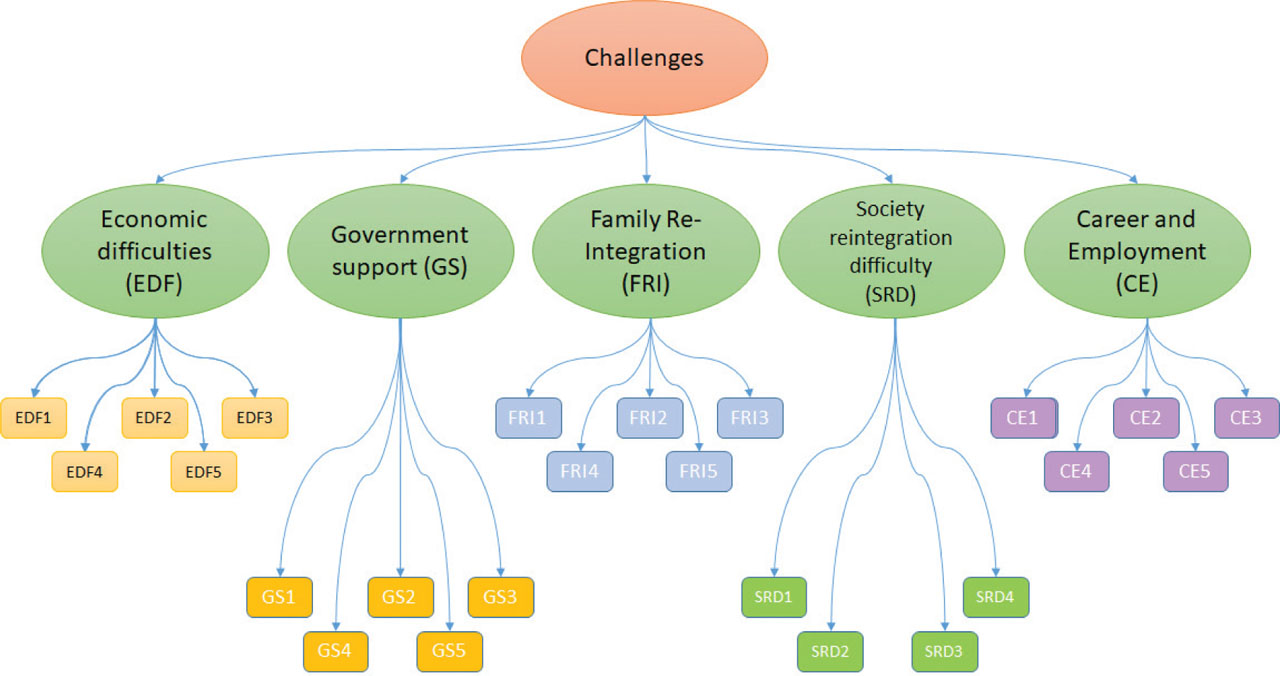
Figure 2:
Structural model.
IV. Results and Analysis
The original study design included 5 themes and 24 variables to determine the difficulties experienced by returns to Kerala. Nevertheless, six variables were removed from consideration after evaluating convergent validity, since their regression coefficients were less than 0.4. Both the average variance extracted (AVE) approach developed and the composite reliability (CR) method developed were used to assess convergent validity. Acceptable CR and AVE values were in the interval of 0.5–0.9 and 0.6–0.8, respectively.
Respondents view the monetary impact as large, according to the study’s stated Cronbach’s alpha of 0.733. We used AMOS version 24 (IBM Corp., IBM SPSS Amos, Version 24, Armonk, NY, USA) to perform confirmatory factor analysis (CFA) on the first five financial statements. In addition to Cronbach’s alpha, CR was calculated for each construct to further confirm internal consistency. The CR values for all five constructs exceeded the recommended threshold of 0.70, indicating satisfactory reliability across the measurement model. The results demonstrate that the constructs of financial constraints, GS limitations, family reintegration challenges, societal reintegration barriers, and career transition difficulties exhibit adequate internal consistency for structural analysis.
In this study, we looked at how the financial variables affected the difficulties. According to these data, the model was found to have a satisfactory match in the CFA results: χ2 = 13.21, N = 768, p = 0.05, root mean square error of approximation (RMSEA) = 0.073, goodness-of-fit index (GFI) = 0.982, normed fit index (NFI) = 0.972, and comparative fit index (CFI) = 0.979. Goodness of fit indices are considered more favorable when they are more than 0.9, and according to Norhayati (2014), RMSEA values below 0.08 are considered acceptable [15]. The model may be utilized as-is, as all indices showed substantial relevance in Table 2.
Table 2:
Fit of the model to financial variables FC
| Fit Index | χ2 | RMSEA | GFI | NFI | CFI |
|---|---|---|---|---|---|
| Value | 13.21 | 0.073 | 0.982 | 0.972 | 0.979 |
Table 2 presents the goodness-of-fit indices obtained from the CFA for the financial variables in the measurement model. These indices evaluate how well the proposed model fits the observed data and indicate the reliability and validity of the financial construct used in the study.
Table 3 presents the goodness-of-fit indices obtained from the CFA for the government-related variables in the measurement model. These indices assess the model’s adequacy in explaining the relationship between GS factors and the reintegration challenges faced by Gulf returnees.
Table 3:
How well the model handles government challenges
| Fit Index | χ2 | RMSEA | GFI | NFI | CFI |
|---|---|---|---|---|---|
| Value | 4.82 | 0.078 | 0.995 | 0.993 | 0.986 |
Statements about government difficulties were measured using a 5-point Likert scale; a score of 5 indicated strong agreement, a score of 3 was neutral, and a score of 1 indicated severe disagreement. A higher score indicated that people felt the government had more of an impact on their problems in Table 3. A high level of internal consistency was shown by the five assertions pertaining to the government, which had a Cronbach’s alpha of 0.833. With these parameters: χ2 = 4.82, N = 768, p > 0.05, RMSEA = 0.078, GFI = 0.995, NFI = 0.993, and CFI = 0.986, the CFA findings verified that the model fit well. Returnees’ problems were examined in this investigation in relation to elements associated with the government.
Table 4 presents the goodness-of-fit indices obtained from the CFA for the family reintegration construct. These indicators demonstrate the adequacy of the measurement model in explaining the relationship between family-related factors and the reintegration experiences of Gulf returnees.
Table 4:
The Family Reintegration (FRI) Model fit
| Fit Index | χ2 | RMSEA | GFI | NFI | CFI |
|---|---|---|---|---|---|
| Value | 12.43 | 0.074 | 0.993 | 0.991 | 0.992 |
Respondents were requested to use the same 5-point scale to indicate their level of agreement with five statements on family reintegration. The internal consistency was moderate, according to Cronbach’s alpha, which was 0.754. With the following values: χ2 = 12.43, N = 768, p > 0.05, RMSEA = 0.074, GFI = 0.993, NFI = 0.991, and CFI = 0.992, the CFA demonstrated a robust model fit. This assessment model was approved due to the high loadings of all characteristics on latent variables in Table 4. Additionally, returnees were requested to rate how much they agreed with four statements on difficulties in SRD. These variables demonstrated high reliability with a Cronbach’s alpha of 0.765. Without including the χ2 test, the CFA findings demonstrated an excellent fit with the following values: χ2 = 7.22, N = 768, p > 0.05, RMSEA = 0, GFI = 0.996, NFI = 0.992, and CFI = 0.991. As a last step, people were asked to score how much they agreed with five statements on job changes. The reliability was moderate, as shown by a Cronbach’s alpha of 0.73, and the fit of the model was excellent according to the CFA: χ2 = 8.92, N = 768, p > 0.05, RMSEA = 0.085, GFI = 1, NFI = 1, and CFI = 0.991. All characteristics loaded strongly onto latent constructs, indicating model acceptance as in Table 5.
Table 5 presents the goodness-of-fit indices obtained from the CFA for the societal reintegration construct. These values indicate how well the model explains the relationship between social integration factors and the challenges experienced by Gulf returnees in their communities.
Table 6 presents the goodness-of-fit indices obtained from the CFA for the career and employment (CE) transition construct. These indicators evaluate the suitability of the model in explaining how employment changes influence the reintegration challenges of Gulf returnees.
During the convergent validity assessment, several measurement items showed standardized regression weights below the acceptable threshold of 0.40 and were therefore removed to improve model reliability. The removed variables included EDF4 from the EDF construct, FRI1, FRI3, and FRI5 from the Family Reintegration construct, SRD1 from the Societal Reintegration construct, and CE2 and CE5 from the CE Transition construct. Removing these items strengthened the internal consistency and validity of the measurement model. SEM is a highly valued tool for social science researchers to use when trying to visualize correlations [32]. The findings of the evaluation of the goodness-of-fit indices prior to applying the SEM model are as follows: χ2 = 376.8, N = 768, p < 0.05, RMSEA = 0.083, GFI = 0.912, NFI = 0.909, and CFI = 0.904. Indicators like this pointed to the structural model being an excellent choice for the hypothesis test. The structural model further quantified the relative influence of each construct on reintegration barriers. EDF exhibited the strongest standardized path coefficient (β ≈ 0.46), followed by societal reintegration challenges (β ≈ 0.42) and government-related constraints (β ≈ 0.40), all statistically significant at p < 0.05. In contrast, family reintegration (β ≈ 0.29) and career transition difficulties (β ≈ 0.24) demonstrated weaker and statistically insignificant effects. These findings indicate that structural economic pressures and social reintegration barriers represent the primary determinants of reintegration challenges among Gulf returnees.
The total obstacles experienced by returnees are highly impacted by five elements. A significant variable would have a standardized coefficient of 0.4 or above. These results provide credence to Hypotheses 1, 2, and 4, which postulate that returnees encounter difficulties as a result of societal variables, government regulations, and budgetary restrictions. Nevertheless, both family reintegration and work transitions had standardized direct impacts below the 0.4 threshold, with 0.299 and 0.241, respectively. Since returnees in Kerala did not encounter any substantial influence from these factors, Hypotheses 3 and 5 were rejected.
a. Demographic profile of the returnee
You can learn a lot about the age range, gender, religious affiliation, level of education, country of destination, duration of stay in the Gulf, occupation, and income of Gulf returnees in Kerala from the data presented in Table 7.
Table 7:
Returnees demographic profiles from the Gulf
| Category | Group | Count | Proportion (%) |
|---|---|---|---|
| Age bracket (years) | 20–30 | 32 | 4.10 |
| 31–41 | 44 | 5.60 | |
| 42–51 | 328 | 43.20 | |
| 52–61 | 244 | 32.10 | |
| >61 | 114 | 15.00 | |
| Sex | Male | 738 | 96.10 |
| Female | 30 | 3.90 | |
| Faith | Hindu | 32 | 4.20 |
| Muslim | 652 | 85.00 | |
| Christian | 82 | 10.70 | |
| Educational background | <10th grade | 110 | 14.30 |
| Completed 10th grade | 158 | 20.50 | |
| High school diploma | 150 | 19.60 | |
| Bachelor’s degree | 154 | 20.00 | |
| Postgraduate degree | 88 | 11.40 | |
| Technical education | 104 | 13.70 | |
| Destination country | Saudi Arabia | 254 | 33.00 |
| UAE | 292 | 38.00 | |
| Kuwait | 72 | 9.30 | |
| Qatar | 56 | 7.20 | |
| Oman | 84 | 11.00 | |
| Bahrain | 18 | 2.20 | |
| Gulf stay duration (years) | 3–6 | 18 | 2.20 |
| 7–9 | 148 | 19.20 | |
| 10–12 | 272 | 35.50 | |
| >12 | 338 | 43.10 | |
| Job type in Gulf | Agriculture/shepherding | 190 | 24.80 |
| General labour | 142 | 18.50 | |
| Semi-professional | 196 | 25.50 | |
| Skilled work | 96 | 12.40 | |
| Business/services | 78 | 10.20 | |
| Other | 66 | 8.60 | |
| Monthly income in Gulf (INR) | <30 k | 136 | 17.70 |
| 30 k–40 k | 280 | 36.40 | |
| 40 k–50 k | 130 | 17.00 | |
| 50 k–60 k | 142 | 18.50 | |
| >60 k | 86 | 11.00 |
Returnees aged 42–51 years comprise 43.2% of the overall population, making them the oldest demographic. Those between the ages of 52 years and 61 years make up 32.1% of the total. This data indicates the fact that most returnees are adults in their middle years or beyond. While 15% of returnees are 61 years and over, just 4.1% are in the 20–30 years age bracket and 5.6% are in the 31–41 years age bracket, both of which are notably under-represented. Based on their ages, it seems that a lot of the returnees worked overseas for a long time before deciding to return to Kerala. Looking at the returnee population by gender reveals that men make up 96.1% of the total and females only 3.9%. There is a significant gender gap in the workforce because more and more people are leaving Kerala for the Gulf, where men may find more employment in traditionally male-dominated industries like construction and physical labor. Although women and younger migrants constitute a smaller proportion of the sample, some distinctive challenges were observed. Female returnees reported greater difficulties related to employment opportunities and social mobility due to gendered labor market constraints in Kerala. Younger returnees, particularly those below 40 years of age, appeared to face stronger pressure to re-establish stable employment and economic independence after their return. While these groups represent a smaller segment of the dataset, their experiences suggest that reintegration policies should consider demographic differences in employment access, social expectations, and financial stability.
Additional exploratory analysis was conducted to observe potential variations across returnee subgroups based on educational level and duration of Gulf employment. The findings suggest that migrants who worked in Gulf countries for longer periods reported relatively greater challenges in career transition due to difficulties adapting to changing labor market conditions in Kerala. Similarly, respondents with lower educational attainment reported stronger financial reintegration barriers. Although these subgroup observations were exploratory, they indicate that reintegration experiences may vary across migrant characteristics. The vast majority of the Gulf returnees in Kerala identify as Muslims, constituting 85% of the total population. Just 4.2% of the population identifies as Hindu, whereas 10.7% are Christians. It is evident from this distribution that Muslim groups have been the most numerous in the migratory movements from Kerala to the Gulf. This is probably attributable to a combination of social and historical circumstances, as well as long-standing networks that have made this migration possible.
There is a wide spectrum of educational backgrounds represented among the returnees. Of them, 20.5% have finished tenth grade, 20% have a bachelor’s degree, and 19.6% have only a high school diploma. Fourteen percent have not completed high school, 13% have some sort of technical training, and 11% have earned a bachelor’s or master’s degree. Because of the wide range of educational experiences among returnees, it is reasonable to assume that some may have less formal education than the average Gulf War veteran, but that many more have earned advanced degrees and professional certifications that may have been valuable on the job. With 38% of returnees having worked there, the United Arab Emirates (UAE) topped the list of nations where these persons most often settled. At 33%, Saudi Arabia is in second place. Even though they were less frequent, other Gulf countries, including Oman (11%), Kuwait (9.3%), Qatar (7.2%), and Bahrain (2.2%), were still important destinations. The UAE and Saudi Arabia have traditionally been the two biggest receivers of migrant labor from Kerala, and this distribution is in line with their traditions. Since the study relies on self-reported survey responses, potential response biases such as recall bias and social desirability bias may occur. To minimize these effects, respondents were assured anonymity and confidentiality, which encouraged more accurate responses. In addition, the questionnaire used structured and clearly defined items to reduce misunderstanding and improve response consistency. Data screening procedures were also applied to identify patterned responses and incomplete questionnaires.
They spent a lot of time in the Gulf, most of the returnees. The majority (43.1%) were likely long-term migrants because they remained for over a decade. In addition, 35.5% of those who returned worked in the Gulf for a decade or more, while 19.2% spent 7–9 years overseas. Fewer than 2% had stays ranging from 3 years to 6 years. This trend indicates that many of the returnees had secure jobs in the Gulf before returning to Kerala, which may have an effect on their capacity to reintegrate and their financial situation.
A large number of returnees were engaged in low- and semi-skilled jobs, although they worked in a variety of industries overall. 25.5% of the returnees’ positions are classified as semi-professional, which includes technical and clerical roles. Along with regular laborers, there is a sizable number of people engaged in agriculture and shepherding, making up 24.8% of the total. Twelve percent are employed in skilled labor, and 10% are employed in business and services. Another 8.6% were employed in different industries. The distribution reveals that a significant number of returnees had more specialized or professional employment, especially in the business and service sectors, despite the fact that many were involved in low- or semi-skilled labor. There was a wide range of incomes among them while they were in the Gulf. The middle-class income category is represented by the largest group, 36.4%, whose monthly earnings were between INR 30,000 and INR 40,000. Additionally, 17.5% had monthly salaries ranging from INR 40,000 to 50,000, and 18.5% earned between INR 50,000 and INR 60,000. On the bottom end of the economic spectrum, 17.7% of returnees had monthly incomes below INR 30,000. There was a dearth of well-paying employment opportunities for Gulf migrants from Kerala, since just 11% of the population had monthly incomes over INR 60,000.
Table 7 provides a detailed description of the Gulf returnees in Kerala in terms of demographics and employment. Muslims in their middle years who have worked for extended periods in countries like Saudi Arabia and the UAE, usually in moderately paid, low- or semi-skilled positions, make up the majority of returnees. Their levels of education range greatly; some have technical or professional credentials, while others have barely completed high school. Insights into the traits of Gulf returnees are essential for comprehending the possibilities and difficulties of their reintegration into Kerala’s social and economic environment.
Table 7 presents the demographic and socio-economic profile of Gulf returnees included in the study sample. It provides detailed information on respondents’ age, gender, religion, education, destination country, duration of stay in the Gulf, job type, and income levels.
V. Discussion
A thorough survey was conducted throughout important districts in Northern, Central, and Southern Kerala to gather data for this research on Gulf returnees in Kerala. The 2018 KMS highlighted the districts of Kottayam, Kozhikode, Alappuzha, Kollam, and Thrissur as having a high percentage of return migration. Careful consideration was given to geographical variety when selecting a sample size of 1,000 from 18 taluks. The data for analysis was determined to be reliable and legitimate after 768 replies were considered valid after extensive screening. In terms of demographics, socioeconomic status, and other characteristics, the chosen taluks capture a wide range of Kerala’s migrant returnee community. The difficulties that returnees have during reintegration can be better understood with the help of this diversified sample.
In order to comprehend the difficulties encountered by Gulf returnees, the research tested five important assumptions. Financial issues were the focus of the first hypothesis (H1) since they have been highlighted as a key impediment for returnees in various research [33]. Some of these issues include getting into more debt, having less money coming in, and having trouble saving money once you get back. The second hypothesis (H2) sought to understand how inadequate government policies contribute to the difficulty of reintegration. In line with findings, we also looked into family reintegration concerns (H3); however, we discovered that they didn’t significantly affect the reintegration process as a whole. A common thread in studies of migration, the fourth hypothesis (H4) centered on the relative importance of social separation and reintegration into society. As a last step, we looked at the career and job sector shift (H5) in light is found. These theories provide a methodical framework for comprehending the multifaceted difficulties that returnees face on their return. The findings of this study can also be interpreted within broader migration and reintegration frameworks. Reintegration theory suggests that return migrants often experience economic, social, and psychological adjustment challenges upon returning to their home communities. The strong influence of financial and societal reintegration barriers observed in this study aligns with migration reintegration literature, which emphasizes the importance of economic stability and social acceptance for successful reintegration. These results reinforce the argument that reintegration is a multidimensional process shaped by both structural and socio-cultural factors.
The research used a five-factor model to measure the obstacles returnees encounter, which included EDF, lack of government assistance, family reintegration issues, societal reintegration, and professional changes, among other things. The most important issue, out of 24 total items evaluated using a 5-point Likert scale, was money problems. To evaluate the model’s robustness, the investigation comprised SEM and confirmatory factor analysis (CFA). In order to improve the model’s accuracy, variables with weak loadings were deleted, leaving a set of valid and trustworthy indicators for each construct.
Returnees confront the most important obstacles in terms of economic hurdles, government deficiencies, and social reintegration difficulties, according to the study’s results, which supported three major hypotheses (H1, H2, and H4). Consistent with the high factor loadings in the CFA results, financial difficulties—including debt and limited income—were the most prevalent. Poor rehabilitation programs and a lack of knowledge contribute to the problems of returnees, and prior studies indicated that government assistance systems are usually inadequate. Another major obstacle was social reintegration, which brought attention to the fact that many returns experience social isolation. Nevertheless, there was less of an effect from family reintegration (H3) and work transitions (H5), suggesting that these components, although present, are not important in Kerala’s reintegration process. Despite the barriers identified, the data also suggest several potential prospects for Gulf returnees. Many respondents reported possessing savings, overseas work experience, and technical skills that could be used for entrepreneurial activities or small business development in Kerala. In addition, exposure to international work environments often improved managerial and organizational skills, which may support self-employment opportunities. Government programs such as skill development schemes and migrant welfare initiatives also provide institutional support that can help returnees reintegrate economically. These prospects indicate that, with appropriate policy support, Gulf returnees can contribute positively to local economic development.
VI. Conclusion
This research reveals substantial obstacles across five main domains: financial difficulties, absence of governmental assistance, reintegrating into families and communities, SRD at large, and navigating professional changes. Research involving 768 Kerala returnees shows that the main issues are monetary and social problems, such as having a lot of debt and not being able to get government aid. According to SEM, these aspects are the most important for reintegration, with family and job changes taking a back seat. Muslim middle-aged males who worked low- or medium-skilled occupations in the Gulf for more than 10 years make up the bulk of the returns. There is an immediate need for programs that offer customized financial and social assistance for returns, since our findings highlight the complicated emotional and socioeconomic challenges they encounter. Improving their emotional and psychological health and facilitating their effective reintegration depend on resolving these challenges. The SEM results indicate that financial constraints and societal reintegration barriers exert the strongest influence on the reintegration challenges faced by Gulf returnees. Based on these findings, policy interventions should prioritize financial rehabilitation programs such as debt restructuring support, entrepreneurship funding, and skill-based employment initiatives. In addition, strengthening awareness and accessibility of government reintegration schemes through agencies such as NORKA could significantly reduce institutional barriers and improve the reintegration prospects of returning migrants.
Declarations
[9] Data Availability Statement
The data that support the findings of this study are available from the corresponding author upon reasonable request.
[11] Contributed by Authors’ Contributions
Nithin Ninan Thomas is responsible for designing the framework, analyzing the performance, validating the results, and writing the article. Dr. Anu KM is responsible for collecting the information required for the framework, providing the software, critical review, and administering the process.