
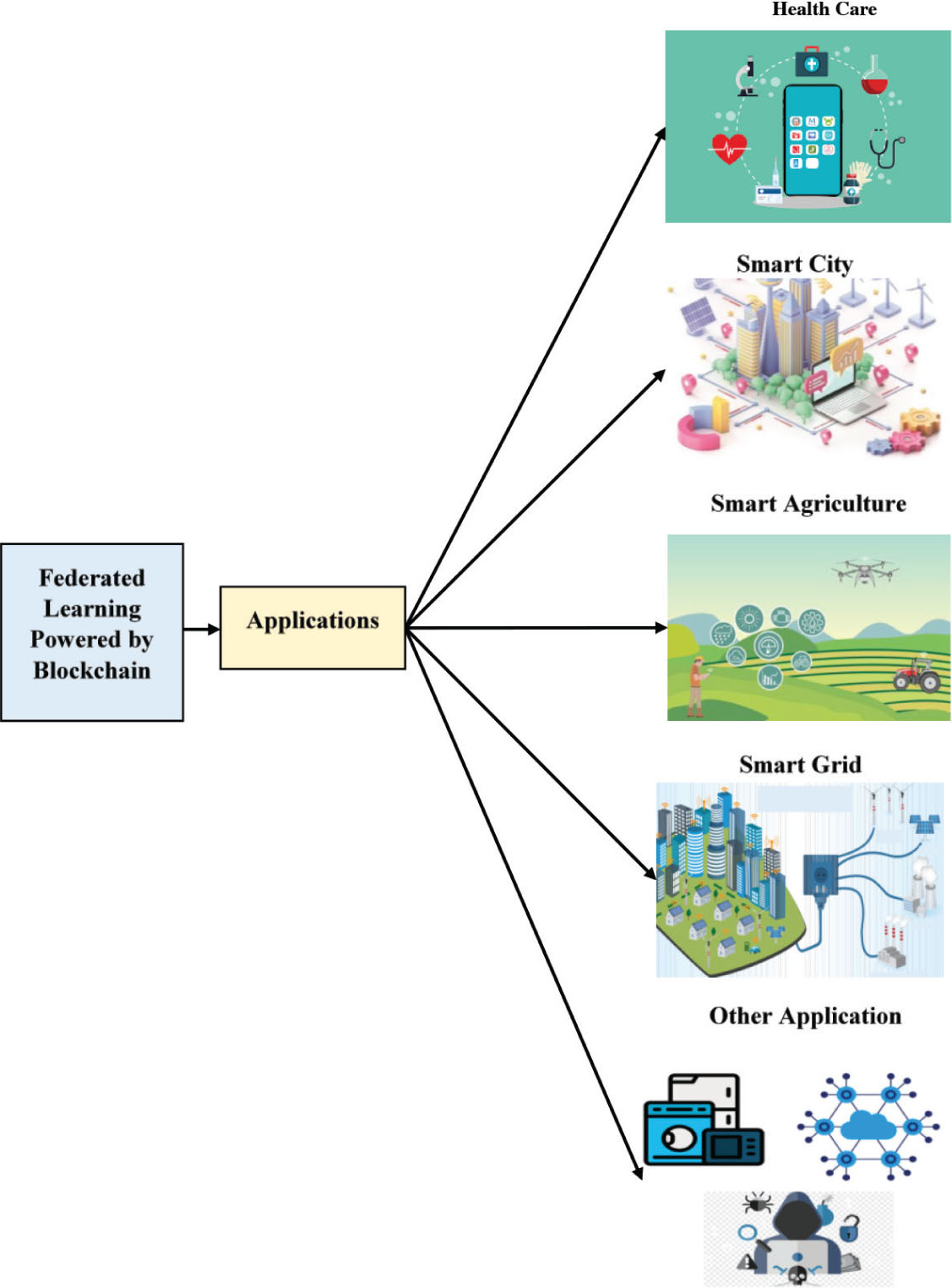
Figure 1:
Directions of surveying blockchain integrated FL techniques in various application. FL, federated learning.
Table 1:
Blockchain-powered FL survey for medical uses
| Ref No | Techniques used | Significance | Drawbacks |
|---|---|---|---|
| Lakhan et al. [18] | FL-BETS framework using FL and blockchain, dynamic heuristics | Privacy preservation, fraud prevention, minimized energy consumption, delay reduction, and meeting health care workload deadlines in distributed fog and cloud nodes | No mechanism for dynamically adjusting to unforeseen changes in network topology affecting real-time task allocation |
| Baucas et al. [19] | FL, private blockchain, adaptive network for wearable IoT devices | Ensures privacy and integrity of classifiers; secures data within fog-IoT networks | Scalability issues with large volumes of wearable devices causing bottlenecks in processing and communication |
| Rahman et al. [20] | Lightweight hybrid FL framework, smart contracts, additive and multiplicative encryption | Handles training plans, trust management, authentication, reputation tracking, and encryption for privacy; effective in clinical trials for COVID-19 | Lacks efficient synchronization for high-frequency updates, causing latency in model aggregation |
| Alshudukhi et al. [21] | FL, blockchain for emergency response based on historical patient data | Improves treatment results by summarizing medical history, ensures data security and privacy | Poor trade-off handling between real-time responsiveness and computational overhead of blockchain verification |
| Alsamhi et al. [22] | Conceptual FL-blockchain framework for decentralized health care data sharing | Balances utility and privacy; builds trust, security, and data integrity in collaborative AI model training across health care institutions | Struggles with handling different data formats, restricting system interoperability |
| Waheed et al. [23] | Hybrid FL-blockchain approach with public-key cryptosystem and access control | Provides secure and privacy-preserved solutions for IoT-enabled health care; computationally efficient | Imbalanced computational loads in heterogeneous IoT devices degrade system performance |
| Ahmed et al. [24] | FL for classifying AIoMT devices, decentralized processing | Maintains data privacy and extracts interconnected device attributes; applies generic labels to categorize devices in communication | Prone to errors in high-diversity environments; scalability issues |
| Ganapathy et al. [25] | BFL-hIoT model for decentralized deep learning in health care IoT | Balances privacy demands and performance; multi-class classification of user data records differentiates normal and anomalous users | Communication overheads in low bandwidth scenarios affect clients and CSs |
| Ali et al. [26] | Blockchain-enabled FL framework with EMRs | Ensures immutability, traceability, and consent management; trains ML models collaboratively without centralizing EMR data | Significant computational and energy costs make it less practical for resource-constrained environments |
| Kumar et al. [27] | PBDL framework using permissioned blockchain, smart contracts, SSVAE, SA-BiLSTM | Secures data sharing, enhances attack detection through SA-BiLSTM, and converts health care data with SSVAE for better analysis | Complexity of DL models increases training and inference times, hindering real-time application |
[i] CS, central server; EMR, electronic medical record; FL, federated learning; FL-BETS, federated learning-enabled blockchain-based task scheduling; IoT, internet of things; PBDL, pyramidal deep-broad learning; SA-BiLSTM, self-attention-based bidirectional long short-term memory; SSVAE, stacked sparse variational autoencoder.
Table 2:
Survey on FL for blockchain-securized smart cities
| Ref No | Techniques used | Significance | Drawbacks |
|---|---|---|---|
| Hai et al. [28] | Blockchain-assisted FL for IoT smart cities | Enhanced security, resilience, and performance in smart city applications | High computational demands for blockchain operations, unsuitable for resource-constrained IoT devices |
| Abbas et al. [29] | ARS with IPFS and FL for UAV networks | Decentralized control, model integrity through IPFS, and privacy preservation | Latency introduced by ARS-based aggregator selection hindered real-time UAV operations |
| Guo et al. [30] | Blockchain-integrated FL with work node selection and IPoQ incentive mechanism | Credibility of node performance, efficient FL tasks, and defense against differential attacks | Predefined parameters in IPoQ lead to suboptimal performance in dynamic environments |
| Qolomany et al. [31] | PSO-based hyperparameter optimization for FL in smart cities and IIoT | Effective hyperparameter tuning for traffic prediction and machine failure predictions | Inconsistent results in complex or high-dimensional search spaces due to convergence issues |
| Kumar et al. [32] | TP2SF with blockchain and PCA | Enhanced privacy, security, and intrusion detection for smart cities | Significant processing delays from PCA transformations and ePoW computations, reducing responsiveness in time-critical applications |
| Abdel-Basset et al. [33] | Blockchain-FL with CKKS encryption (BFLPD) for automated diagnosis in smart cities | Secure and trustworthy aggregation, protection against adversarial attacks, and improved system efficiency | Limited scalability evaluation when handling an increasing number of decentralized participants |
| Muhammad et al. [34] | FL with blockchain for traffic congestion control | Secure, privacy-preserving traffic data analysis with improved safety, integrity, and transparency | No adaptive mechanism for handling real-time traffic anomalies due to emergencies or accidents |
| Yin et al. [35] | Attribute-based participant selection with consortium blockchain for FL | Efficient, reliable participant selection and incentivized client participation in smart city FL applications | Biased participant selection reduced the model’s generalizability |
| Padma et al. [36] | SecPrivPreserve framework with permissioned blockchain for IoT | Enhanced confidentiality, privacy, and integrity with tamper-proofing and non-repudiation | Limited interoperability with other blockchain systems, restricting wider use |
| Far et al. [37] | Blockchain and DRL integration for IoT in smart cities | Privacy-preserving and efficient mobile transmission with improved IoT network performance | Lack of rigorous energy consumption analysis for resource-constrained IoT devices, impacting system efficiency |
Table 3:
Blockchain-based FL survey for smart agriculture
| Ref No | Techniques used | Significance | Drawbacks |
|---|---|---|---|
| Shen et al. [38] | Blockchain-assisted FL with SVM, homomorphic encryption, secret sharing | Ensures secure data sharing and achieves higher recognition accuracy for rice pest and disease detection | High computational requirements for encryption and decryption, impractical for low-power devices |
| Praharaj et al. [39] | Multi-layered DT architecture, federated transfer learning, FL-based AD, CNNs, LSTM models | Enhances security and detects unknown cyber-attacks effectively in smart farming | High latency and communication overhead, negatively impacting real-time anomaly detection |
| Singh et al. [40] | Blockchain with FL, EL, PoAh consensus algorithm | Maintains data authenticity, privacy, and collaborative training for intrusion detection in SMSs | Scalability challenges with a large number of nodes due to consensus algorithms |
| Vimalajeewa et al. [41] | Joint FL model (FL-NNPLS) with NN and PLS regression | Outperforms centralized models, achieving state-of-the-art results in milk quality analysis | Difficulty handling dynamic data distributions, inconsistencies in prediction accuracy |
| Leduc et al. [42] | IoT and ML-based modern ICT applications | Supports sustainable agricultural practices, emphasizing food tracking and traceability | Dependency on stable high-speed networks limits rural farming applicability |
| Hasan et al. [43] | Blockchain-based transparent supply chain solutions | Enhances food source authenticity and reliability, meets various sustainability standards | Poor scalability for larger ecosystems, integration challenges in diverse networks |
| Chaganti et al. [44] | Cloud-enabled security monitoring, blockchain-based smart contracts | Effectively monitors security anomalies and proactively counters attacks in community farms | Single cloud service dependency risks outages and reduces robustness |
| Kumar et al. [45] | SP2F with ePoW, smart contracts, SAE, SLSTM | Prevents data poisoning attacks and enhances anomaly detection in UAV-enabled agriculture | Limited efficiency in resource-constrained UAVs due to hardware constraints |
| Pranto et al. [46] | Blockchain with IoT integration and smart contracts | Provides stepwise clarity for cost management in pre- and post-harvesting | Less effective in resolving complex multi-party contractual disputes |
| Sakthi and DafniRose [47] | Blockchain-assisted smart agriculture with private blockchain services | Ensures authenticity, security, and privacy in the IoV | Centralized cloud dependency introduces point of failure risks |
[i] AD, anomaly detection; EL, ensemble layer; FL, federated learning; ICT, information and communication technologies; IoT, internet of things; IoV, internet of vehicles; LSTM, long short-term memory; SAE, sparse autoencoder; SP2F, secured privacy-preserving framework; SLSTM, stacked long short term memory.
Table 4:
Survey on using blockchain-powered FL to secure smart grid data
| Ref No | Techniques used | Significance | Drawbacks |
|---|---|---|---|
| Ashraf et al. [48] | FL (FedDP), FVC, RF, KNN, BG | Addresses energy theft detection with reduced communication overhead and energy-efficient on-device prediction | Scalability issues when integrating heterogeneous clients with varied computational resources |
| Zhang et al. [49] | Consortium blockchain, certificateless aggregated ring signcryption | Enhances privacy protection for smart meters by eliminating single points of failure and data tampering | Issues with interoperability among blockchain frameworks and legacy systems |
| Yilmaz et al. [50] | Adversarial machine learning, LSTM, blockchain | Protects energy usage data from privacy violations while supporting analytics on energy data | Increased computational load due to deep learning reliance, unsuitable for resource-constrained smart meters |
| Fan et al. [51] | Leader election algorithm, Paillier cryptosystem, Boneh-Lynn-Shacham short signature, SHA 256 | Decentralized privacy-preserving data aggregation with a focus on security and privacy for smart grids | Uneven load distribution and increased latency under heavy network traffic |
| Lu et al. [52] | Edge blockchain, lightweight privacy-preserving aggregation, edge computing | Enhances efficiency and security in smart grids with reduced computation costs and communication overhead | Synchronization issues among edge nodes, particularly during high-frequency updates |
| Jithish et al. [53] | FL, SSL/TLS protocol | Provides anomaly detection while ensuring user privacy by training models locally on smart meters | Reliance on SSL/TLS, which does not fully protect against adversarial poisoning of parameter updates |
| Su et al. [54] | FL, Edge-cloud collaboration, deep reinforcement learning | Privacy-preserving energy data sharing with incentives for participants in smart grids | Scalability issues due to a large number of users and energy providers, causing computation challenges |
| Fekri et al. [55] | FL (FedSGD, FedAVG) | Enables load forecasting on smart meters without sharing local data, improving data privacy | Diversity in consumer load profiles causes suboptimal convergence for some households |
| Li et al. [56] | Secure federated deep learning, transformer, Paillier cryptosystem | Detects FDIA while preserving privacy and enhancing detection accuracy | Increased real-time detection latency due to the computational overhead of the Paillier cryptosystem |
| Shrestha et al. [57] | FL, LSTM, autoencoders, homomorphic encryption (Paillier algorithm) | Identifies anomalies in industrial smart grid data while ensuring data privacy | High computational and energy costs are the primary barriers to deploying modern AI models on edge devices with limited resources |
Table 5:
Survey of FL based on blockchain for additional emerging uses
| Ref No | Techniques used | Significance | Drawbacks |
|---|---|---|---|
| Zhao et al. [58] | FL, blockchain, and a reputation mechanism | Enables privacy-preserving ML training, helps manufacturers predict customer needs and behaviors | Potential bias in global models due to uniform contributions from diverse customers |
| ur Rehman et al. [59] | Fine-grained FL, blockchain | Decentralizes shared ML models, ensures trustworthy training, and addresses heterogeneity and efficiency | High computational overhead during model synchronization in heterogeneous edge environments |
| Li et al. [60] | Blockchain, FL, and committee consensus | Reduces consensus computing, improves scalability, security, and model storage | Delay in model updates in time-sensitive tasks due to network traffic |
| Zhang et al. [61] | Blockchain, FL, and smart agent architecture | Fully decentralized, privacy-preserving model for FL tasks, with smart agents acting as blockchain peers | Increased complexity in architecture, difficulty in managing, and synchronizing a decentralized network |
| Wang et al. [62] | Blockchain, FL, differential privacy, and self-reliability filter | Privacy-preserving with reduced communication overhead while maintaining model quality | Trade-off between privacy preservation and training accuracy due to differential privacy techniques |
| Qi et al. [63] | Consortium blockchain, FL, and differential privacy | Prevents unreliable updates and enhances privacy protection in FL for traffic flow prediction | Delays in real-time prediction performance due to reliance on miners for verification |
| Wang et al. [64] | Blockchain, FL, Multi-Krum, and homomorphic encryption | Provides secure and privacy-preserving model aggregation, incentivizes participation with reputation-based mechanisms | Significant computational overhead from homomorphic encryption, especially in low-resource environments |
| Moulahi et al. [65] | Blockchain, FL, classification approaches, and model aggregation | Applied to VANET and ITS cyber-threat detection, improves classification model aggregation | Slow model aggregation, counter to the fast response needed in high-speed vehicle networks |
| Hua et al. [66] | Blockchain, FL, SVM, and historical driving data | Asynchronous collaborative ML between distributed agents, improves model accuracy | Limited scalability due to SVM’s dependency, inadequate for complex real rail systems |
| Durga et al. [67] | Blockchain, FL, ensemble deep learning, and hybrid capsule learning network | Privacy-preserving data sharing improves prediction accuracy in health care applications | High computational complexity, performance issues in resource-constrained health care environments |
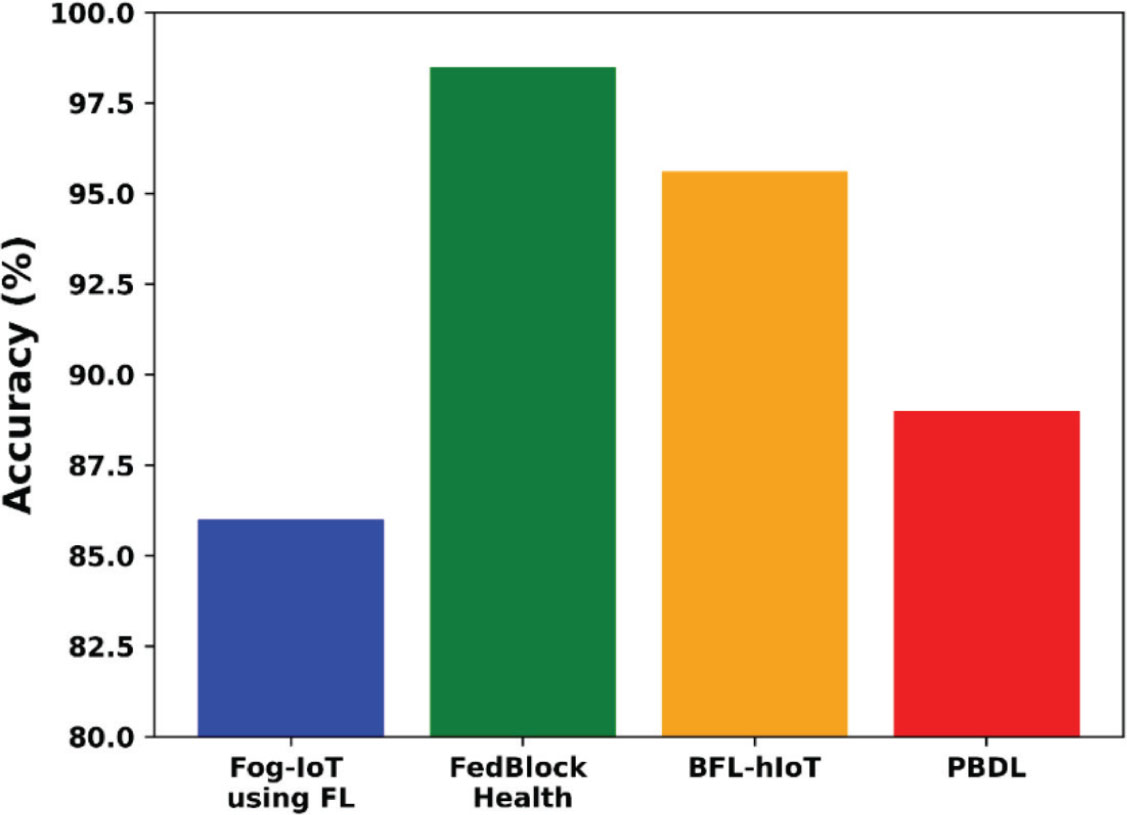
Figure 2:
Comparison of accuracy. FL, federated learning.
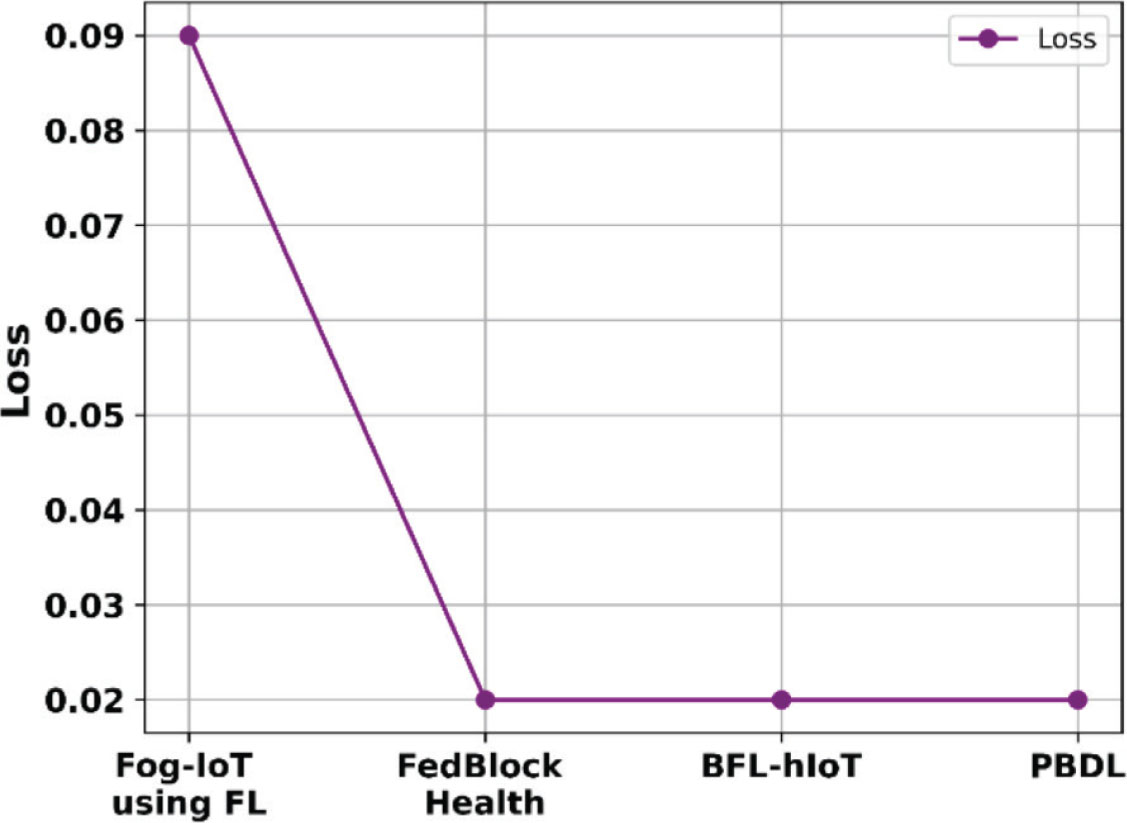
Figure 3:
Comparison of loss. FL, federated learning.
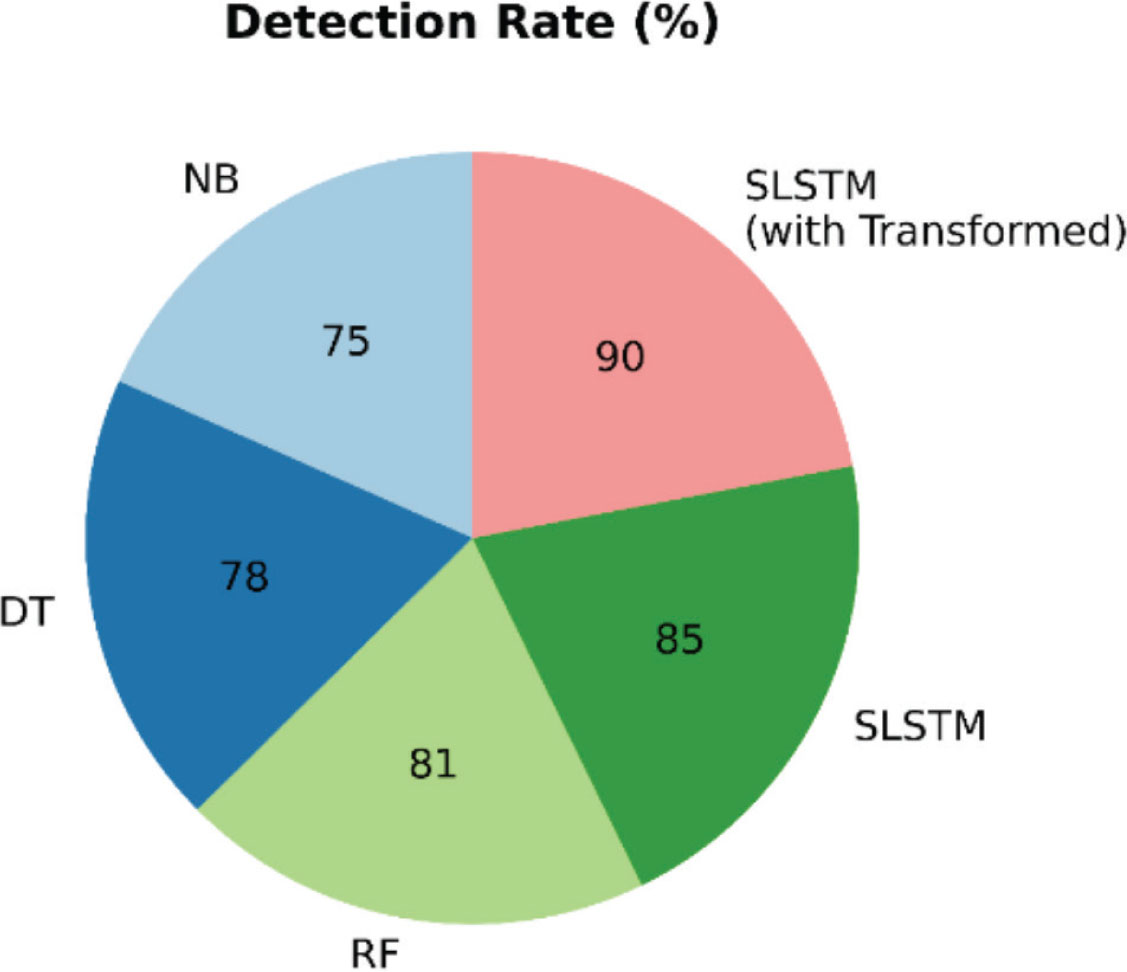
Figure 4:
Comparison of detection rate. SLSTM, stacked long short-term memory.
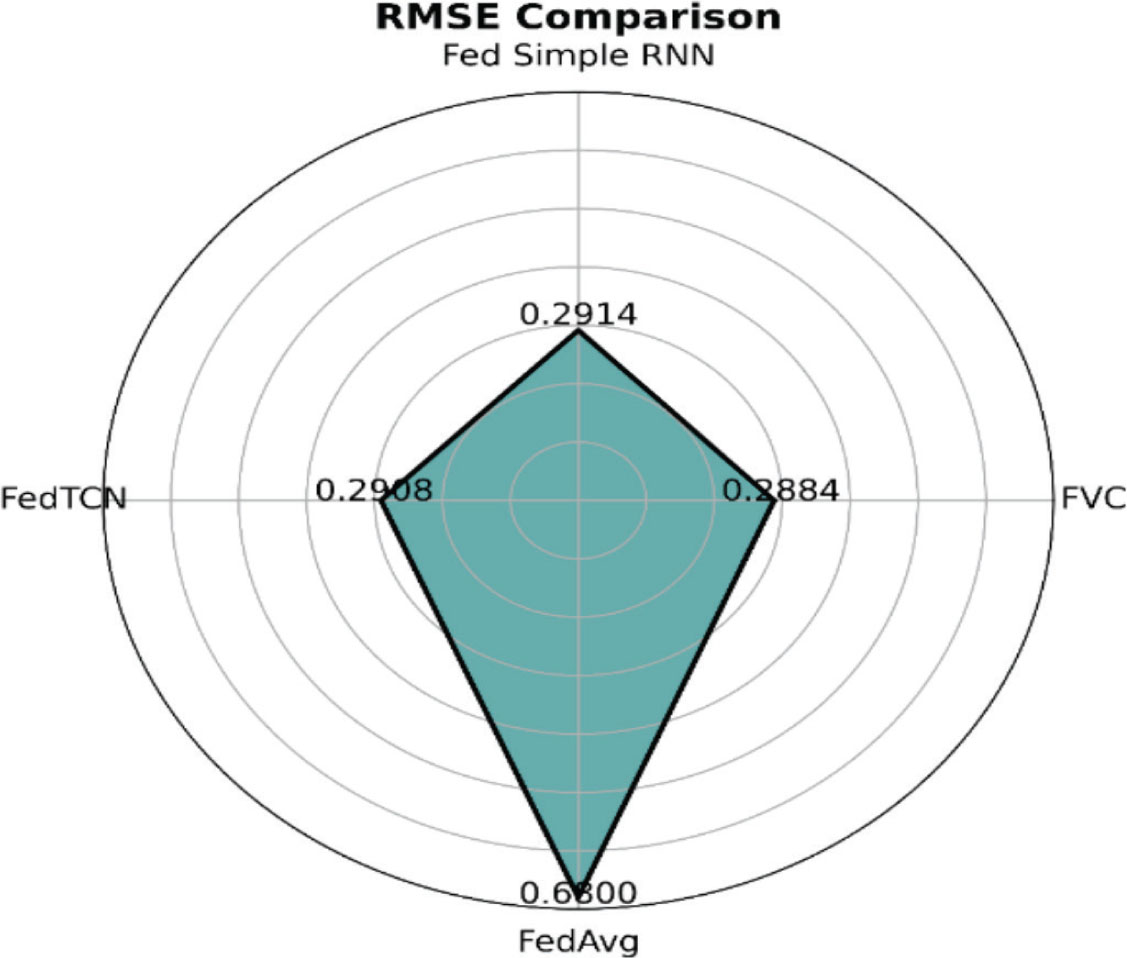
Figure 5:
Comparison of RMSE. FVC, federated voting classifier; RMSE, root mean square error.
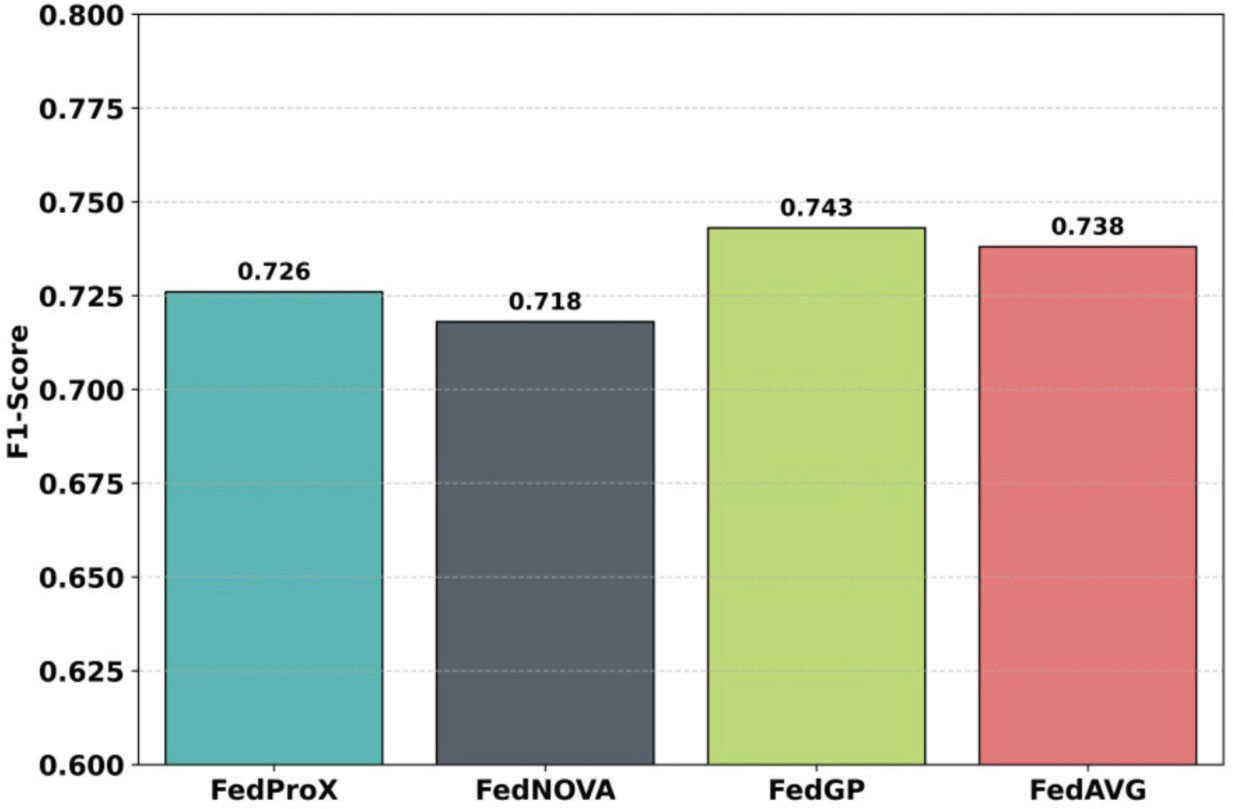
Figure 6:
Comparison of F1-scores.
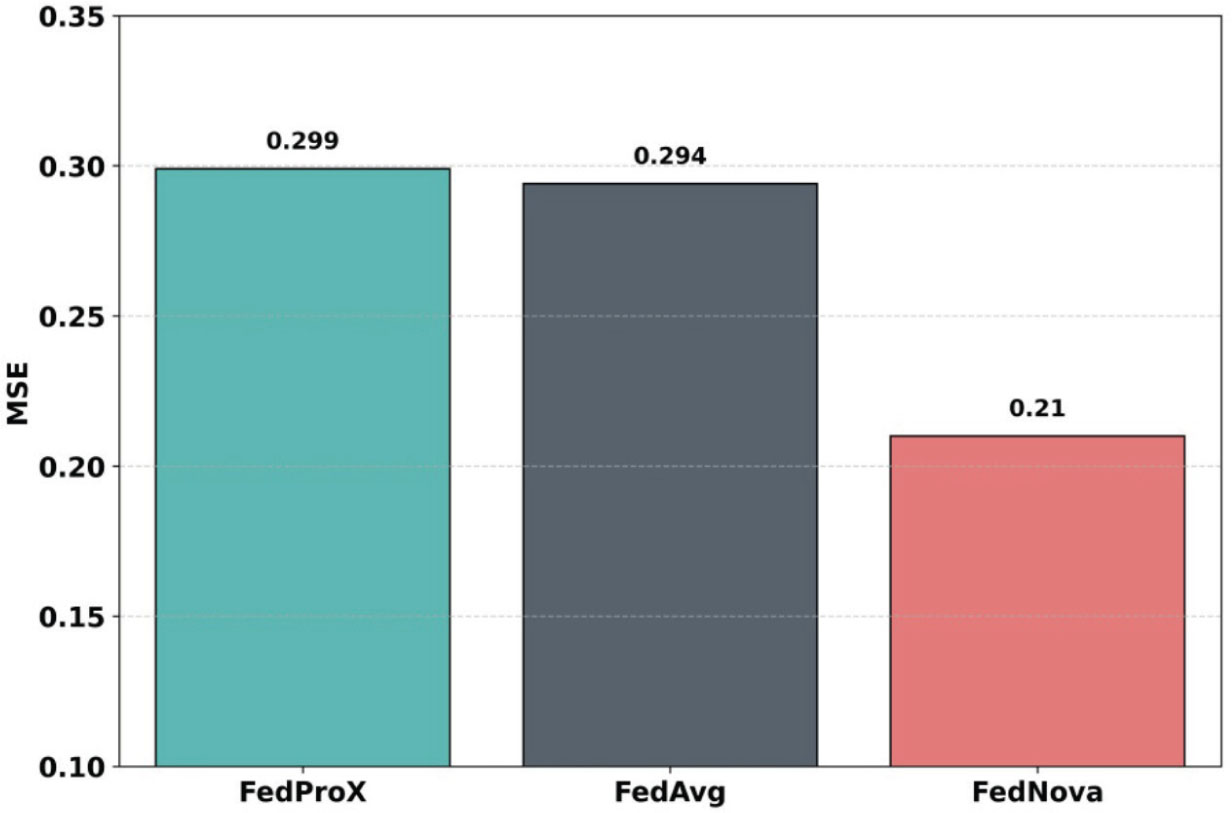
Figure 7:
Comparison of Mean Squared Error (MSE).