
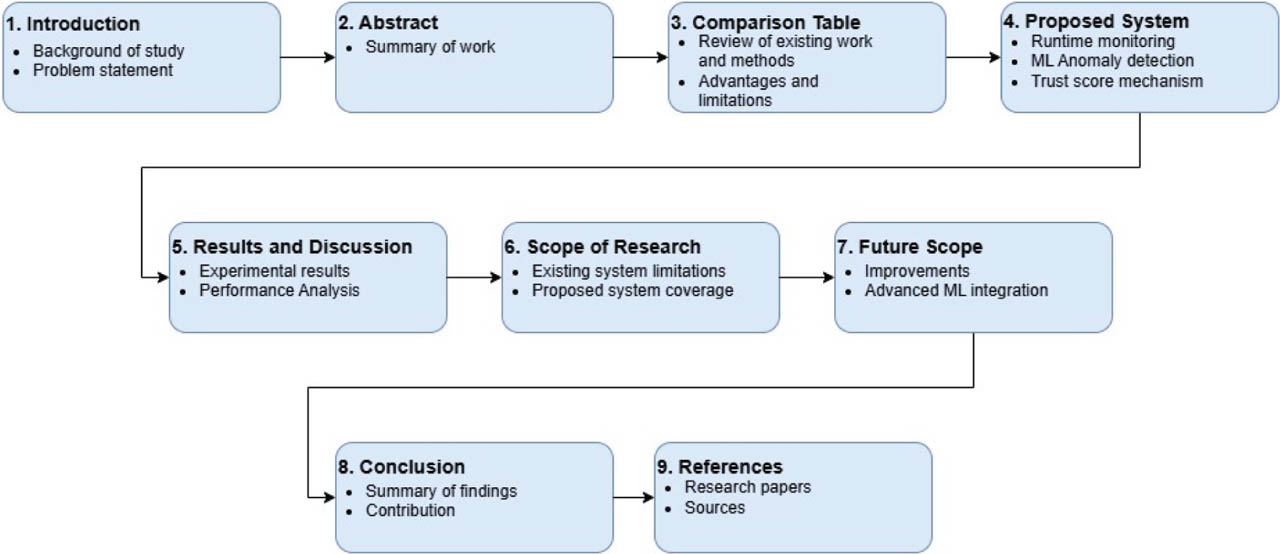
Figure 1:
Organization of paper.
Table 1:
Comparison table
| Authors | Paper title | Technique used | Advantages | Disadvantages | Final remark |
|---|---|---|---|---|---|
| Iskhakov et al. (2023) | Enhanced user authentication algorithm based on behavioral analytics | Machine learning-based anomaly detection using audit logs and browser fingerprints | Improves authentication accuracy and device identification | Limited to the login phase and lacks runtime monitoring | Useful for anomaly detection but not suitable for software license enforcement |
| Kamra and Shekhawat (2025) | Enhancing user authentication with SSO and passkey integration | Passwordless authentication combining SSO and passkey-based verification | Reduces phishing risks and improves usability | Does not monitor runtime behavior | Suitable for secure login but not for continuous license validation |
| Vemuri and Chaitanya (2022) | Insider attack detection using ElGamal encryption | Cryptographic session authentication using ElGamal encryption | Strong protection against insider attacks | High computational complexity and no behavior monitoring | Focuses on encryption rather than license misuse detection |
| Chaudhari et al. (2023) | A comprehensive study on authentication systems | MFA using password, token and biometric verification | Improves authentication reliability | Does not support continuous monitoring | Useful for authentication but lacks runtime license enforcement |
| Wintersgill (2024) | Studying and improving software license compliance in practice | Automated tools for detecting open-source license compliance | Improves understanding of license compliance | No runtime validation mechanism | Focuses on license analysis rather than enforcement |
| Cui et al. (2023) | Empirical study of license conflict in FOSS | Empirical analysis of open-source license conflicts | Identifies patterns of license misuse | No automated prevention mechanism | Useful for research but not practical for runtime validation |
| Kahol et al. (2025) | OSS-LCAF license conflict framework | LLM-based automated license conflict detection | Intelligent detection of license inconsistencies | Does not monitor runtime software usage | Focuses on license identification rather than behavioral monitoring |
| Aisyah and Subekti (2018) | Continuous authentication for online exam systems | Image based biometric authentication during online exams | Provides continuous identity verification | Context specific to exam systems | Not applicable for software license validation |
| Grandi et al. (2023) | Continuous authentication for XR systems | Behavioral and haptic based authentication with TOTP | Enhances immersive system security | Limited to XR environment | Not designed for software licensing |
| Jahanshahi et al. (2025) | OSS license identification using winnowing algorithm | Document fingerprinting for license text detection | Detects embedded license texts effectively | Static analysis only | Does not validate runtime behavior |
Table 2:
ML model evaluation metrics comparison
| Model/study | Accuracy (%) | Precision (%) | Recall (%) | F1 score (%) |
|---|---|---|---|---|
| Iskhakov et al. (2023) | 94 | 91 | 93 | 92 |
| Baig et al. (2023) | 92 | 89 | 90 | 89 |
| Aisyah and Subekti (2018) | 88 | 85 | 87 | 86 |
| Proposed system | 96.33 | 92.93 | 95.83 | 94.36 |
Table 3:
Dataset size comparison (numerical)
| Paper | Dataset size | Data type count | Sessions | Scale Index |
|---|---|---|---|---|
| Iskhakov et al. (2023) | 1,600 | 2 | 1 | 5 |
| Baig et al. (2023) | 2 | 2 | 1 | 2 |
| Aisyah and Subekti (2018) | 500 | 1 | 1 | 3 |
| Kamra and Shekhawat (2025) | 300 | 1 | 1 | 2 |
| Proposed system | 1,000 | 2 | 1 | 4 |
Table 4:
Authentication factors comparison (numerical)
| Paper | Auth factors | ML Models | Security layers | Complexity Index |
|---|---|---|---|---|
| Iskhakov et al. (2023) | 1 | 3 | 2 | 4 |
| Kamra and Shekhawat (2025) | 2 | 1 | 2 | 3 |
| Chaudhari et al. (2023) | 3 | 0 | 3 | 5 |
| Baig et al. (2023) | 1 | 1 | 2 | 3 |
| Proposed system | 2 | 1 | 3 | 4 |
Table 5:
Security indicators comparison (numerical)
| Paper | Breach risk (%) | Detection capability | Dataset size | Security score |
|---|---|---|---|---|
| Kamra and Shekhawat (2025) | 80 | 2 | 300 | 4 |
| Aisyah and Subekti (2018) | 73.6 | 2 | 500 | 3 |
| Iskhakov et al. (2023) | 20 | 4 | 1,600 | 5 |
| Baig et al. (2023) | 25 | 3 | 2 | 3 |
| Proposed system | 10 | 5 | 1,000 | 5 |
Table 6:
Authentication techniques comparison (numerical)
| Paper | Technique count | ML usage | Runtime support | Efficiency score |
|---|---|---|---|---|
| Iskhakov et al. (2023) | 1 | 1 | 0 | 3 |
| Baig et al. (2023) | 1 | 1 | 1 | 3 |
| Kamra and Shekhawat (2025) | 1 | 0 | 0 | 3 |
| Chaudhari et al. (2023) | 3 | 0 | 0 | 4 |
| Proposed system | 2 | 1 | 1 | 5 |
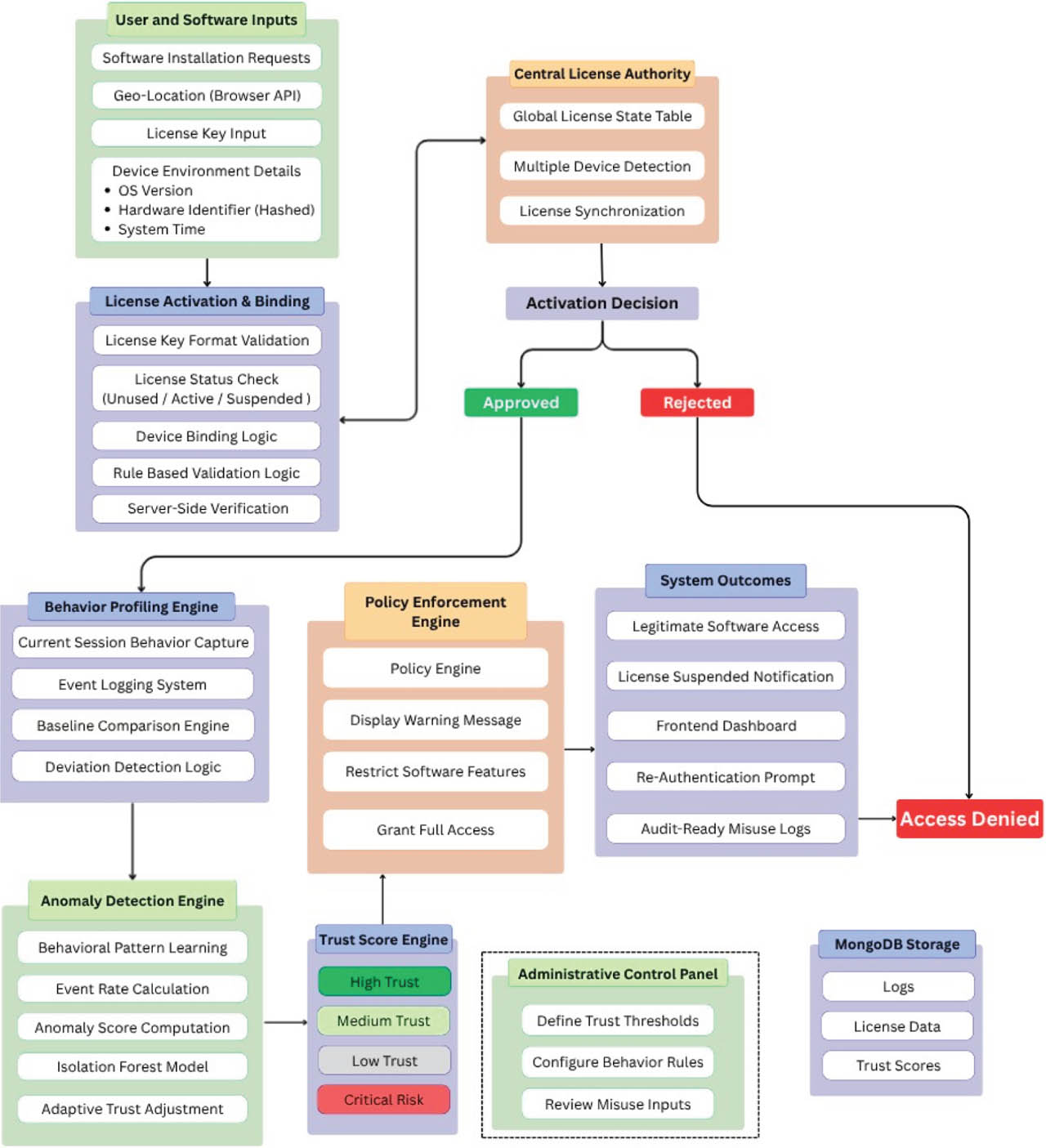
Figure 2.
Architecture of the adaptive runtime software license validation system.
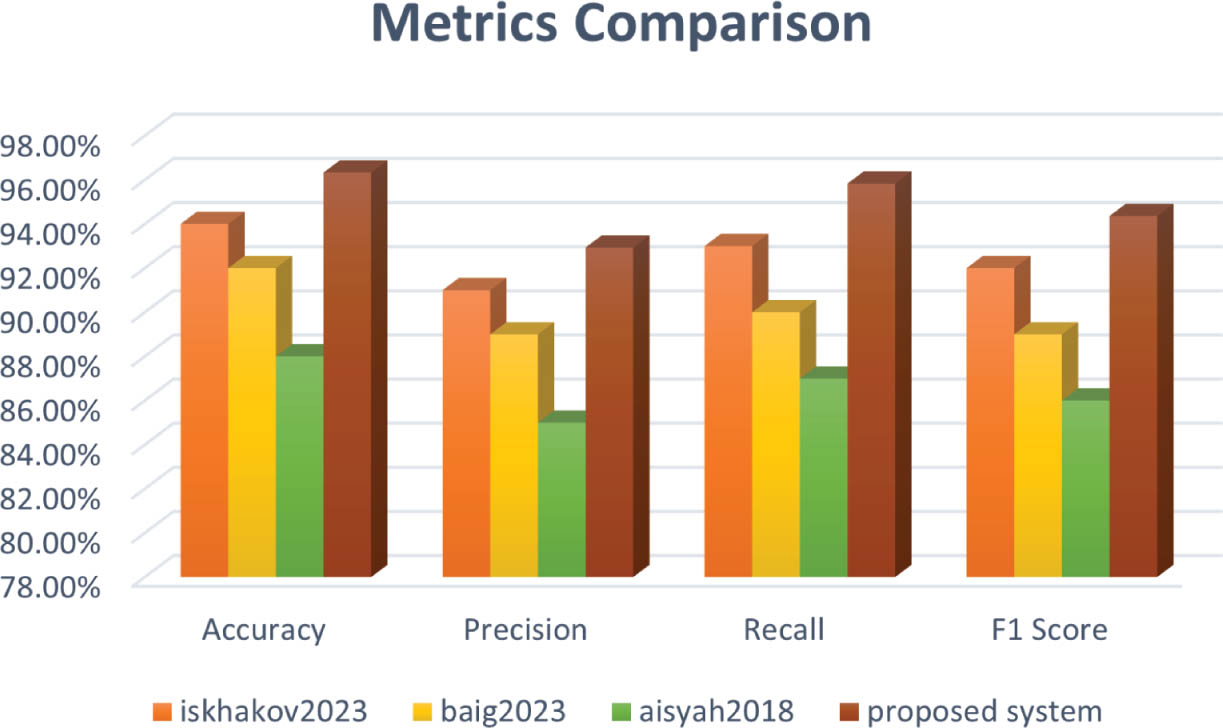
Figure 3.
ML model metrics.
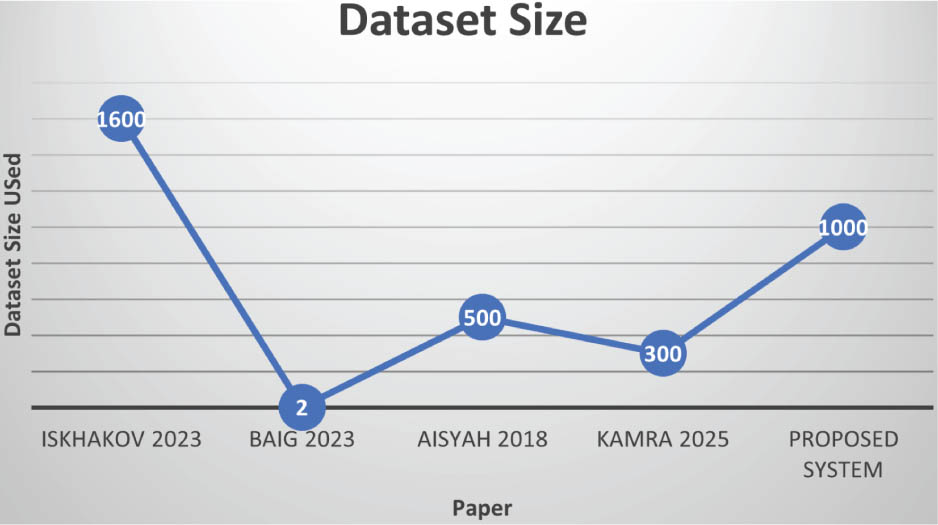
Figure 4.
Dataset size comparison.
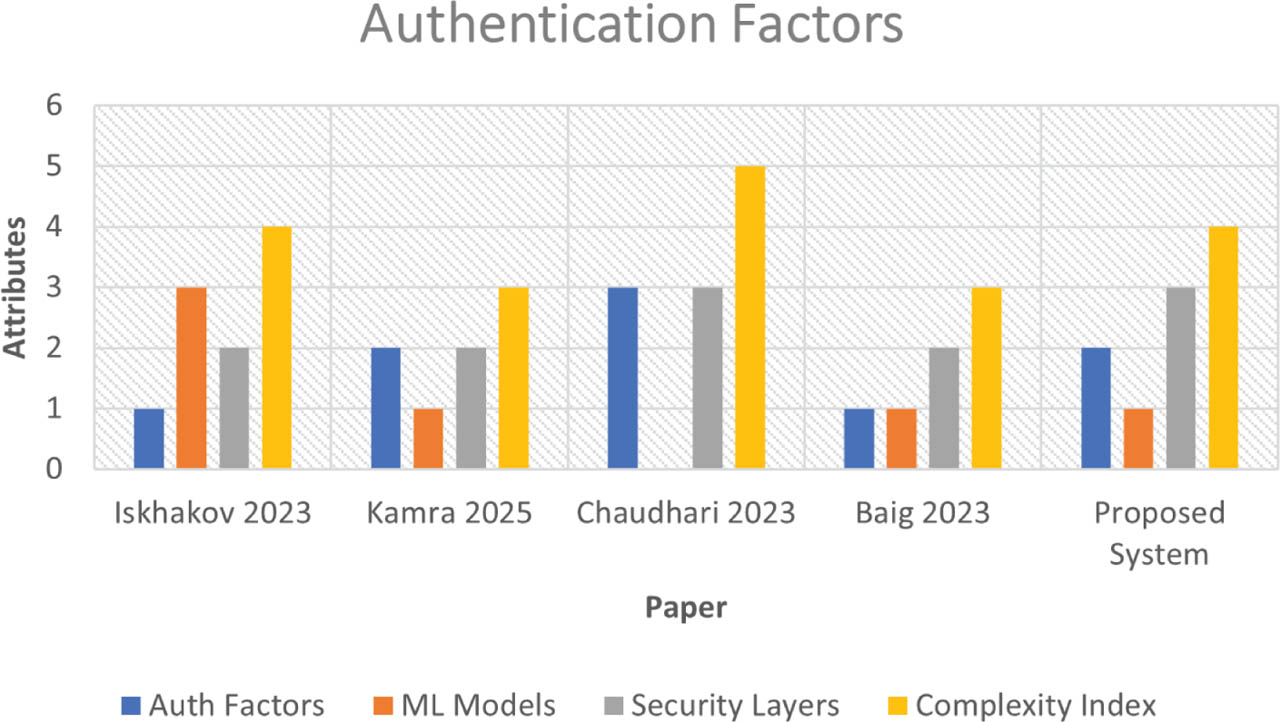
Figure 5.
Authentication factors comparison.
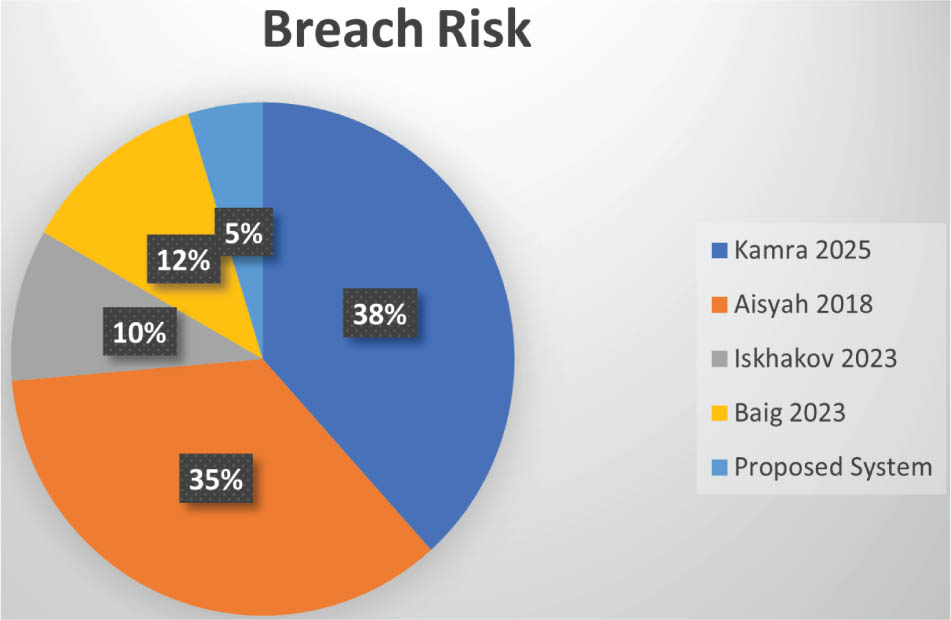
Figure 6.
Security indicators comparison.
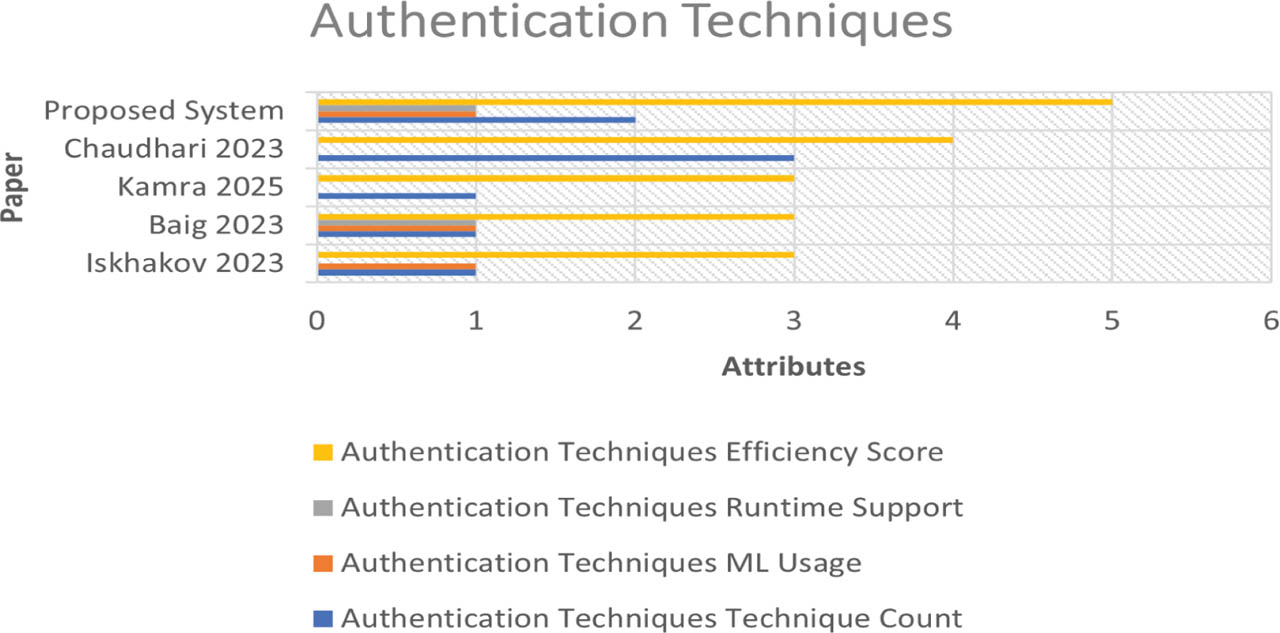
Figure 7.
Authentication techniques comparison.
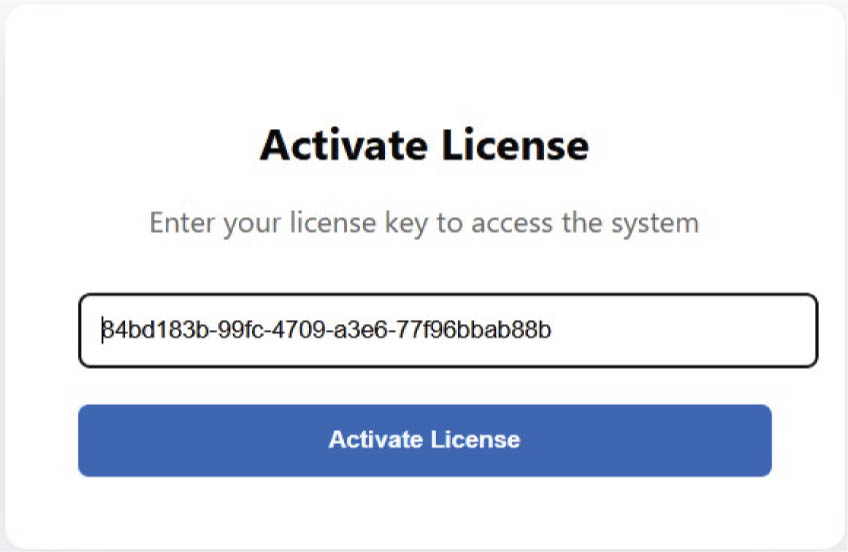
Figure 8.
License activation.
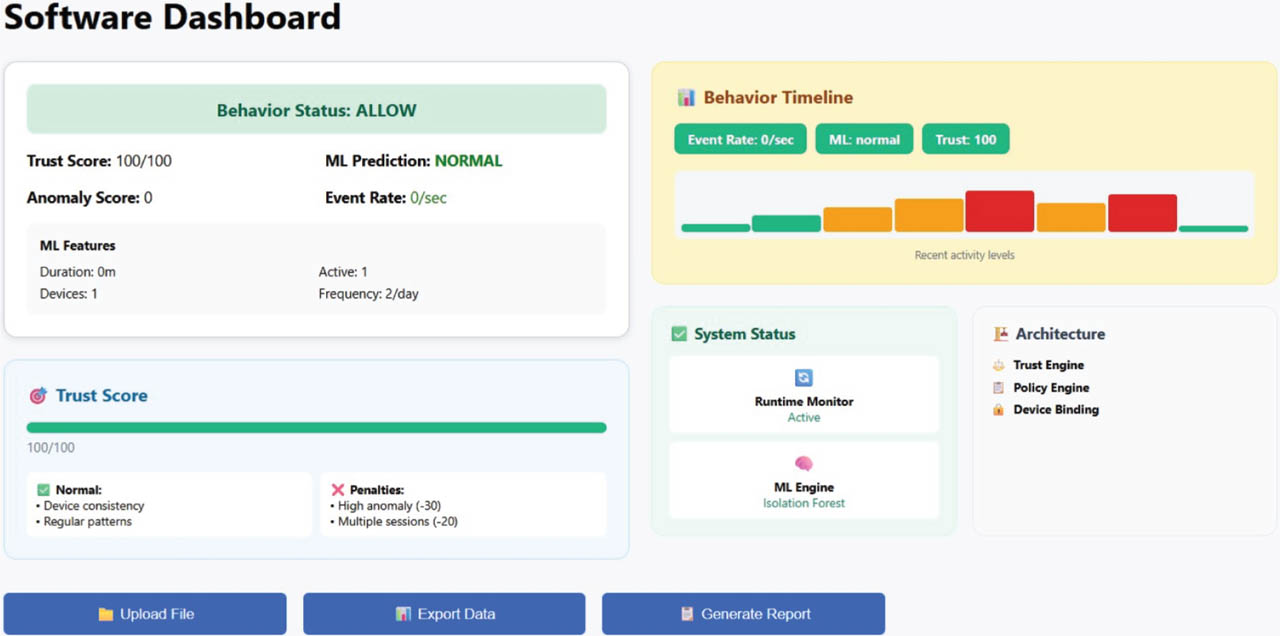
Figure 9.
User panel.
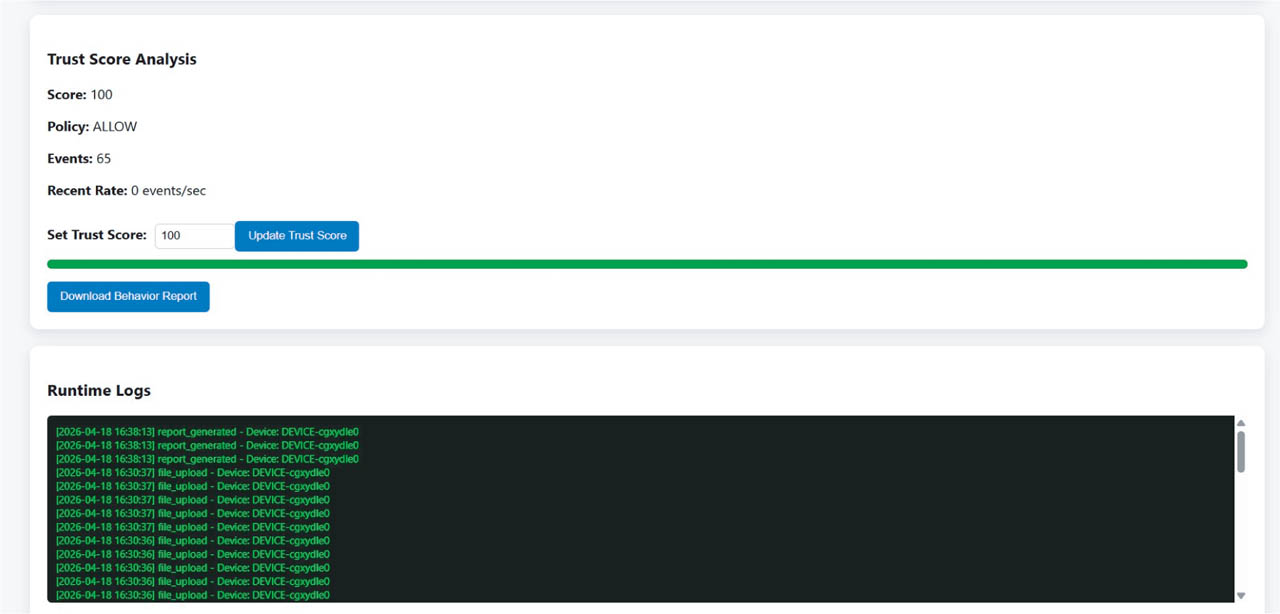
Figure 10.
Admin panel.