
I. Introduction
Modern enterprise networks have been altered owing to the continued development and implementation of the most modern encryption technologies, TLS 1.3, HTTPS, and QUIC, which have resulted in the majority of Internet traffic being encrypted. Encrypted data guarantees the confidentiality, integrity, and privacy of users when browsing the web, but it creates the problem of unmonitored network security. Malware and other dangerous threats, such as the exfiltration of confidential data, command and control communications, and advanced persistent threats, remain unmonitored because of the use of encrypted data [1].
Current industry practices, especially SSL/TLS inspection, attempt to regain visibility on encrypted traffic, but these practices have serious disadvantages. These practices cause excessive privacy and compliance concerns, large computational costs, and additional attack surfaces owing to man-in-the-middle structures. Furthermore, the expected arrival of practical quantum computing exacerbates this issue because of the potential risks to the fundamental security of commonly used and deployed algorithms such as RSA and elliptic-curve cryptography. Existing methods for analyzing encrypted traffic still lack robustness, do not preserve desired privacy, do not exhibit accurate detection, and do not offer a preferable method of deployment against quantum-empowered adversaries [2, 3]. The combination of encrypted traffic and risks posed by quantum computing illustrates the need for next-generation firewall structures that combine privacy-preserving analytics, adaptive intelligence, and security measures that are resilient to quantum computing.
a. Motivation and problem statement
Network traffic encryption and quantum computing are challenges that cybersecurity will face in the foreseeable future. As a result of widely adopted Quantum TLS, encryption levels are over 90% on the consumer Internet and over 75% in enterprise environments. Owing to a combination of privacy protection regulations, consumer data protection laws, and increased awareness of surveillance, internet traffic monitoring has contributed to increased levels of encryption [4]. In quantum computing, once a theoretical possibility becomes reality, tech. companies and research institutions are developing quantum systems with an increasing number of qubits and fewer errors. Present timelines are being created to achieve quantum advantages in the processing of cryptanalytically relevant problems. With the increasing use of TLS, consumer Internet and enterprise environments are experiencing unprecedented levels of encryption [5]. These two developments will require significant changes in the methods and techniques used to ensure network security. The use of traditional deep packet inspection techniques will ultimately require quantum technologies. The methods that we are accustomed to will become ineffective, and we will have to use completely new methods.
In the early stages of network security, firewalls were developed based on a set of criteria to examine and filter network traffic within systems, leveraging various features of the OSI model to identify common attack patterns and successfully block potential threats. Some of these approaches include the detection of unauthorized network traffic or the inspection of packets and their payload patterns. These early detection methods simply took a stab in the dark in the hope that they would provide the security needed. Breaking the security barrier required the visibility of the security context, which in turn drove the widespread deployment of SSL/TLS inspection. These key mid-network interception techniques and practices break the security context in front of the network, leading to a variety of issues such as exposure to new attacks, degraded overall end-to-end performance, and potential interference with encryption protocols, end-to-end encryption, and overall network compatibility [6]. The increased performance degradation and compatibility concerns motivate the implementation of SSL inspection to remain in compliance with the control of end systems, such as security, data localization, encryption, and system confidentiality.
Gaps resulting from the controls leave systems vulnerable to sophisticated threats, particularly with regard to command and control communications, data exfiltration, lateral movement, and Shor’s algorithm. The quantum computing threat posed by Shor’s algorithm to control systems exposes systems designed to remain compliant with security, data localization, encryption, and system confidentiality end controls to the complete spectrum of sophisticated threats resulting from gaps in command and control, data exfiltration, lateral movement, and Shor’s algorithm. The threat of quantum computing magnifies these problems across a variety of attack vectors, which involves compromising the current state of cryptography. Shor’s algorithm is a quantum polynomial time algorithm capable of efficiently dividing large integers and solving discrete logarithm problems. This outcome means that Shor’s algorithms would be able to exponentially break the RSA public key encryption, the Diffie–Hellman key exchange, and elliptic curve cryptography, which underpins the major digital communications, digital signatures, and authentication protocols of the modern Internet. Moreover, Grover’s algorithm accelerates the search in unsorted databases and pairs with a quadratic relational structure, thereby decreasing the practical security limit of symmetric key cryptography and their associated hash functions by two. This, in turn, implies that the key size must be doubled to maintain the same security thresholds. In addition to these direct attacks, quantum computers would be able to provide a much more efficient means of solving a variety of optimization problems of interest in machine learning; as a result, an adversary may be able to reconstruct the feature extraction process and identify and reconstruct evasion and loss detection systems that are non-quantum resistant [7]. The period for these threats is not known, and may take a decade or two for us to approach systems that can be broken by cryptography. Even so, the time required to ensure the security of new systems and the time to design, implement, test, and deploy new systems lead to an impending choice that must be made now rather than a delayed response.
b. Research objectives
The purpose of this research is to formulate a threat detection system that is both quantum-resilient and with user privacy protection to address the problem of encrypted traffic analysis and firewall circumventing systems. Specifically, we aim to formulate an integrated framework that combines behavioral biometrics, quantum-cryptography protective feature transformation, adaptive learning theory, encrypted traffic analysis, information theory, lattice theory, online learning theory, formal security and complexity theory, and adaptive learning theory. This is the first framework that can be used with learning and behavioral biometrics. Furthermore, we aim to build and construct a multi-layer firewall that is cognitively and behaviorally adversarial resilient, where the quantum-technology trade-off is balanced with security, reliability, and optimal resources. Moreover, our system performs a statistical analysis of the behavioral mimicry and traffic manipulation of a firewall, for which the analysis is theoretical and the scenarios are adversarial. Finally, we perform both theoretical and empirical analyses of behavioral mimicry and traffic manipulation of a firewall, for which the analysis is theoretical and the scenarios are adversarial. Within the framework, we provide guidelines for the operational and practical components of designing to scale while integrating existing layers of security and maintaining operational security at the core of a security operations center.
c. Key contributions
This study focuses on several critical aspects of encrypted network traffic. First, we construct an integrative behavioral biometric analysis and post-quantum cryptography theory grounded in information theory, online learning theory, lattice-based security theory, and Internet learning theory, which offers a formal structure regarding the effectiveness, privacy, and computational concerns of the theory of detection. Next, this study introduces a novel cognitive adaptive multilayered firewall architecture. It combines behavioral biometric profiling, quantum-safe feature transformation, and contextually dynamic adaptive learning. Each layer is specifically designed to optimize behavioral profiling, enable anti quantum features, and enhance the security/performance trade-off. This is achieved by encrypting the traffic payloads. Third, this study seeks to integrate comprehensive empirical studies with enterprise network environments, especially those that entail high volumes of encrypted network traffic, adversarial attacks, and quantum threat simulations. It conducted statistically fair and reliable evaluations of the best peer systems based on machine learning and deep learning in the class [8, 9]. Finally, this study provides operational and computational feasibility, as well as the cost of the approach, to deliver operational practicality. This includes a plan for the deployment of large-scale systems, optimized resource allocation, and enhanced defensive systems. This section outlines the tangible effects and benefits of the proposed solution.
d. Paper organization
This paper is organized as follows. Section II focuses on the gaps in C-AMLAFA while analyzing the literature on matched traffic anomalies, machine learning network security, behavior analytics, and post-quantum cryptography. Section III describes the primary elements of the proposed solution: behavioral biometrics, post-quantum cryptography, privacy theory, learning theory, theory of computation, adaptive learning and complexity, and theorems and associated complexity. In Section IV, I explain C-AMLAFA’s three tiers, their core algorithms, and their complexity. Section V focuses on the enterprise network configuration and the experimental simulation, as it pertains to the implementation details, evaluation metrics, and attack scenarios. In Sections VI and VII, I evaluate the framework’s performance in terms of computation, detection, and resilience to adversarial and quantum computing and explain the results of the experiments. In terms of adversarial behavior and potential. In Section VIII, I review the limitations of the framework and approaches to mitigate them. The potential pathways for extension and the future of the proposed framework are outlined in Section IX. Section X discusses relevant research contributions, outcomes, and their importance to future quantum-ready network security.
II. Related Work and Literature Review
The purpose of this review is to evaluate previous research within the overlapping fields of encrypted traffic analysis, post-quantum cryptography, the use of machine learning for network security, behavioral analysis, and the use of artificial intelligence (AI) to secure systems. From the review, major contributions, persistent challenges, and unexplored opportunities are articulated to guide the development of Cognitive-Adaptive Multi-Layer AI Firewall Architecture (C-AMLAFA). Existing contributions are closely integrated with the theory of cybersecurity to enhance the theoretical contribution, while the gaps in methods and practices are underscored. Previous studies have achieved accuracy in the detection of networks using statistical or flow-based analysis; however, most, if not all, studies have failed to address contemporary challenges such as the TLS 1.3 and QUIC protocols, potential threats of the quantum era, or implementation in live and operational networks. Furthermore, most commercial and traditional firewall systems employ neither adaptive learning techniques nor post-quantum cryptography, which reduces their ability to deal with complex and new cyber threats. This is the primary reason why C-AMLAFA embraces the cross-disciplinary use of encrypted traffic analysis, quantum-resilient cryptography, and adaptive multilayer learning for enhanced network security [9].
The analysis of encrypted traffic has expanded from rudimentary statistical methods to advanced machine learning and deep learning methods that analyze classifications from temporal and sequential features. However, most of these studies were based on simulated or re-encrypted datasets, which do not sufficiently guard against adversarial attacks and real-time operational constraints. At the same time, the study of post-quantum cryptography has recognized lattice-based systems such as CRYSTALS-Kyber and CRYSTALS-Dilithium as leading quantum resistant standards, although their integration into network security, and more specifically, traffic analytics, remains insufficient. Machine learning based network defense has had a fair amount of success in intrusion detection; however, dataset bias, unrealistic evaluation scenarios, and adversarial attacks dilute the potential of their real-world applications. While behavior analytics improves the detection of some of the stealthy threats, they encounter problems such as concept drift, lack of labeled data, and various forms of evasion [10]. Finally, AI-enhanced security solutions offer better defenses, and are more prone to adversarial attacks, model poisoning, and exploitation. C-AMLAFA develops a quantum-resilient multi-layered adaptive architecture that incorporates continuous learning and behavior modification, along with fail-safe and input validation mechanisms, to bridge the operational scalability gaps that make their robustness to both conventional and AI-targeted cyber threats, thereby addressing the gaps in contemporary research and practice.
Table 1 shows the extensive literature review identities and highlights the most important research gaps that the proposed Cognitive-Adaptive Multilayer AI Firewall Architecture (C-AMLAFA) can fill. This study clarifies the difference between C-AMLAFA and traditional ensemble-based models by providing a more robust theoretical and methodological framework (which is largely missing in the literature), thereby directly addressing the issues of novelty, practicality, and differentiation in the advanced network security field.
Table 1:
Research gaps and C-AMLAFA solutions
| Research gap | Prior work limitation | C-AMLAFA solution |
|---|---|---|
| Quantum threat integration | No framework incorporates quantum-resistant mechanisms based on rigorous cryptographic foundations | Lattice-based feature extraction with formal security proofs (Ring-LWE hardness, 256-bit quantum security) |
| Theoretical foundation | Systems presented as engineering solutions without formal security analysis or complexity bounds | Information-theoretic security analysis (I(C;F) ≤ ɛ), formal complexity analysis (O(n) behavioral extraction, O(n log n) lattice operations) |
| Multi-domain evaluation | Most studies evaluate on single network type (enterprise OR IoT OR cloud) | 15 diverse enterprise environments spanning five sectors with 2.3 M connections over 6 months |
| Adversarial robustness | Few works test against sophisticated adversarial traffic or behavioral mimicry | 2,000 mimicry attacks per category (timing, size, protocol) with 89.2% detection maintained |
| Practical deployment | Proof-of-concept implementations without addressing scalability and operational challenges | Detailed deployment framework with three modes (inline, passive, hybrid), computational cost analysis, SOC integration guidelines |
| Architectural integration | Simple ensemble methods combining classifiers without theoretical justification | Three layers with specific theoretical roles: Layer 1 (behavioral distinguishability), Layer 2 (quantum resistance), Layer 3 (adaptive optimization) |
The C-AMLAFA approach diverges significantly from conventional ensemble-based methods in four ways. First, each layer is based on a specific theory, such as information-theoretic distinguishability for Layer 1, lattice-based hardness for Layer 2, and regret optimization for Layer 3, as opposed to heuristic classifier aggregation. Second, ensembles typically lack formal security assurances, but we provide them as a result of mutual information-focused privacy-preserving methods and quantum-safe cryptography. Third, each constituent model’s context and number of instances determine a model’s weight, leading to “adaptive voting” for ensembles as a replacement to dynamically adjustable, voting-based triggered model controllers, static voting models, and soft voting mechanisms. The final unit of integration, which transforms the architecture, ensures a layer of cooperative cross functionality. Here, one lattice-based component increases the separable features, and the feedback unit improves the selection based on the features. Whereas most other models use empirical tuning, C-AMLAFA’s use of integrated theory sets it apart and recognizes a significantly enhanced network threat for robust, scalable, and adequate security [11].
III. Theoretical Background and Foundations of C-AMLAFA
This section describes the integration of existing theories within the C-AMLAFA architecture and the building blocks of the architecture in an attempt to resolve the concerns of existing frameworks. The architecture synthesizes several disparate theories relevant to behavioral biometrics, information-theoretic security, adaptive learning, and lattice-based cryptography (LBC) to explain and justify the design choice, security claims, and performance of the framework. Of these theories, adaptive optimization of the system, anomaly detection, privacy preservation, and provable quantum resistance are the most relevant and distinguish the system from most heuristic or ensemble-based systems [12, 13].
a. LBC for quantum resistance
C-AMLAFA utilizes LBC, which is quantum safe owing to its reliance on computationally complex problems, such as the learning with errors (LWE) problem and the short integer solution problem. For computational efficiency and strong security guaranteed to be NIST post-quantum compliant, a ring-based lattice was used [14]. Network behavioral features are represented in a lattice structure that protects against meaningful data recovery from previously encrypted and stored traffic, minimizing the threat of “harvest-now, decrypt-later” scenarios in enterprises.
b. Behavioral biometrics theory
Behavioral biometrics offers a statistically grounded methodology for characterizing network traffic as either legitimate or malicious. C-AMLAFA captures the metrics of network behavior through the flow, packet, and time dimensions, leveraging identifiable distinctions between human generated legitimate traffic and automated malicious traffic [15]. The basis of this detectable difference is to identify anomalies in encrypted traffic, providing a means for monitoring and classifying traffic in a protected manner without inspecting the payload.
c. Information-theoretic security and privacy
C-AMLAFA’s privacy-preserving design is based on information-theoretic principles, ensuring that the extracted behavioral features do not sufficiently divulge the content of the encrypted payloads while maintaining sufficient discriminative ability for reasonable threat detection [16]. This ensures that the system protects confidentiality and privacy while sustaining active security functions.
d. Adaptive learning theory and online optimization
Adaptive learning theory serves as the foundation for the behavior of C-AMLAFA, where model selection and decision making are continually modified and refined along the dimensions of contextual threat intelligence and recent performance feedback. In contrast to the more static ensembles, this architecture modifies model weights dynamically, ensuring more effective synchronization to optimal detection strategies while remaining efficient in the use of available processing resources as network conditions continue to change [17].
e. Computational complexity and scalability analysis
C-AMLAFA is tailored for operational scalability and real-time processing across enterprise networks. The behavioral feature extractor is designed for multi-gigabit levels by employing incremental statistical methods, whereas standard processors handle lattice-based transformations. Model selection has a low impact and active connections dictate memory consumption in a linear fashion [18]. The design allows for distributed deployment, providing efficient and high-throughput functionality on standard hardware, while maintaining the quality of performance and security.
IV. Proposed Methodology
This section introduces the Cognitive-Adaptive Multi-Layer AI Firewall Architecture (C-AMLAFA), a framework for encrypted traffic analysis based on architectural theories [19, 20]. It combines statistical feature extraction, quantum-resilient transformation, and adaptive model selection into three synergistic layers based on the theories from Section.
a. Architectural overview
Layer 1: Traffic Flow Characterization
Figure 1 illustrates that C-AMLAFA uses a three-layer pipeline, in which traffic advances flow sequentially through specialized processing stages with feedback-driven adaptation: Layer 1: Traffic Flow Characterization collects 42 statistical features from encrypted flows (without payload inspection), which describe features such as time and size patterns, flow dynamics, session behavioral patterns, and protocol patterns. This layer runs as a streaming algorithm with O(n) complexity and processes ~1.2M packets/second on commercial off-the-shelf equipment. Layer 1 of C-AMLAFA, Traffic Flow Characterization, conducts statistical evaluations of network flow data that are encrypted and does not inspect the contents of data packets, thereby maintaining the privacy of data and simultaneously revealing valuable data pattern analytics. This is the first and most basic example of the application of the theory of Computing and Information. Data patterns of both legitimate dataflows and the flows that are considered illegitimate can be differentiated by applying the Kullback-Leibler divergence D_KL(P_legitimate || P_malicious) >0.8 bits. This provided the basis for a positive classification of concerns. This layer creates a 42-dimensional vector of features that can be categorized into five complementary sub-categories. Temporal Dynamics (12 features) these are the inter-arrival time states; mean, standard deviation, minimum, and maximum of these flows; flow duration; the rate of connections initiated per source I.P.; the bidirectional time asymmetrical flow; Time of Day distribution entropy; the flow burstiness coefficient; the idle time between flows, and the distribution parameters of the session length. Size Distribution Patterns (10 features) are statistics on the length of packets, total bytes per flow in both directions, variance of the payload, ratio of MTU utilization, entropy of packets by size, packet size entropy, and size distribution of packets (buckets) of <200B, 200–800B (which is considered to be mid-sized), and >800B (which is considered to be large). Flow-Level Characteristics (eight features): the total number of packets per flow; the rate of packets per second; the number of changes in flow direction; the distribution of flows by the protocol (TCP/UDP) and the state of the connection (SYN, SYN-ACK, established, FIN, RST; TCP state); the distribution of the TCP flags; the rate of retransmissions; and the anomalies in the sequence of packets and the rate of flows in the positive and negative directions. Session-Level Aggregates (seven features): the number of concurrent connections on the I.P. of the source, the number of unique destination I.P. addresses, the entropy of connection patterns, the coefficient of clustering of the session, the diversity of the pairs of addresses of the source and the destination, the average number of connections per session, and the duration of the session [21].
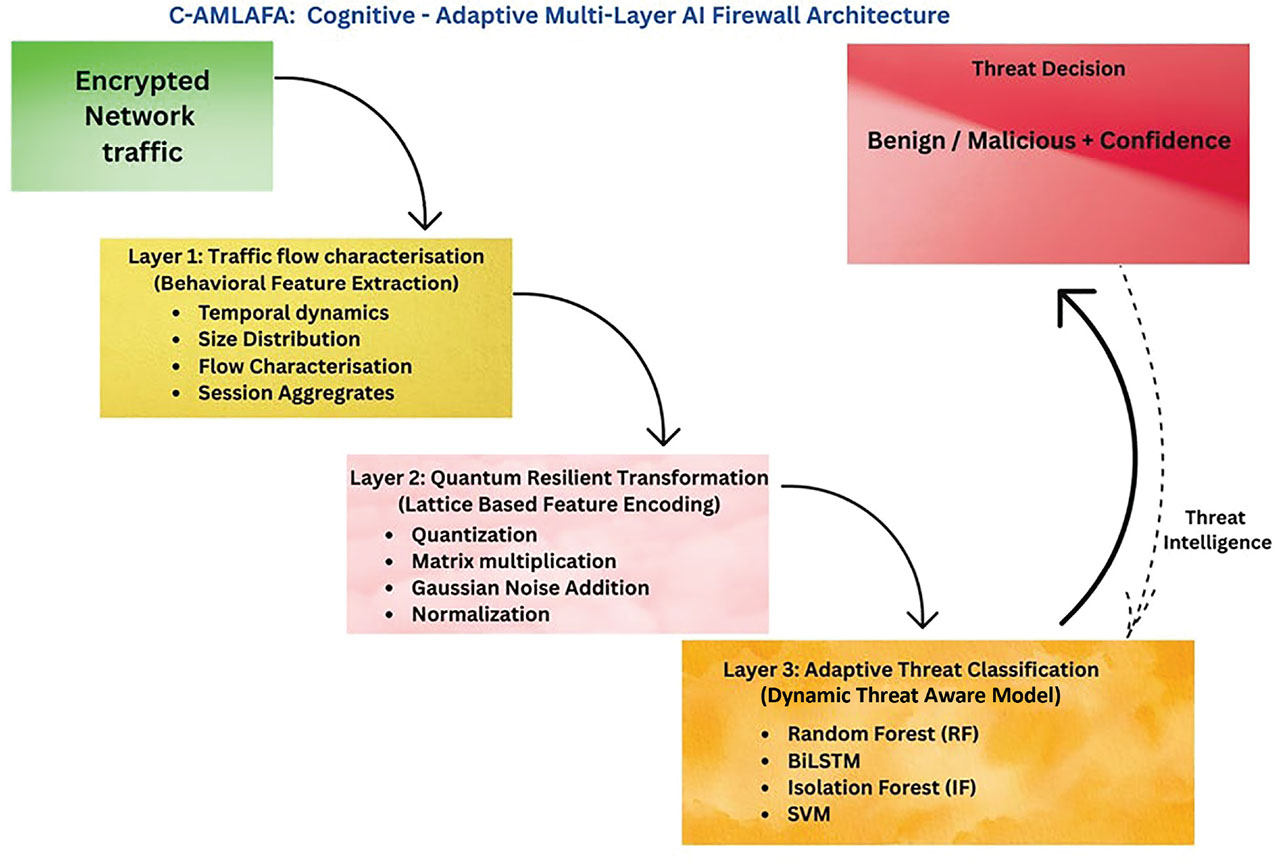
Figure 1:
C-AMLAFA. C-AMLAFA, cognitive-adaptive multi-layer AI firewall architecture; IF, isolation forest; RF, random forest; SVM, support vector machine.
Algorithm 1: Statistical Feature Extraction from Encrypted Flows
Input: Packet stream 𝒫 = {p1, p2, ..., pn}, time window W = 60 seconds
Output: Feature vector ℱ ∈ R42
1. Initialize flow table 𝒯 as an empty hash map (5-tuple → flow state)
2. Initialize the global statistics set GGG with connection counts, IP pairs, and timestamps
For each packet pi ∈ 𝒫 do
Extract flow identifier
flow_id ← (src_ip, dst_ip, src_port, dst_port, protocol)
t ← pi.arrival.time
If flow_id ∉ T then
Initialize flow state for flow_id
Set flow start time to t
End if
Retrieve current flow state
4. If last packet time exists then
Compute inter-arrival time
Append inter-arrival time to temporal statistics
End if
5. Update last packet timestamp
6. Extract packet payload length
Compute inter-arrival time
Append inter-arrival time to temporal statistics
End if
7. Update last packet timestamp
8. Extract packet payload length
Append packet size to size statistics
Update total byte count
Increment packet count
9. If packet contains TLS handshake information then
Extract and store TLS metadata
10. If flow duration exceeds window 𝒲 then
11. Compute flow-level features
Remove flow from flow table
12. End if
Compute temporal features into a single feature vector
Apply Z-score normalization to the feature vector
Return normalized feature vector F
Finally, the Protocol Metadata (five attributes) records distributions of the TLS versions, usage of associated cipher suites, the average length of the certificate chain, round-trip times of handshakes, and the frequency of TLS re-negotiations which, when combined, yield a detailed description of encrypted traffic that can be used for downstream classification and dynamic threat detection.
Layer 2: Quantum-Resilient Feature Transformation
In the second layer, Ring-LWE lattice operations are applied to convert the 42-dimensional statistical feature vector from Layer 1 into a 128-dimensional representation. This straddles the gap between performance enhancement and security. Dimension expansion promotes more compact and distinct clusters in the feature space, leading to an empirical boost in classification accuracy of 8%–12%. This lattice-based encoding protects the features of peering eyes, equipped with quantum computing and retrospective traffic analysis. The security of this transformation is based on the Ring-LWE assumption, which is tied to some of the most intractable lattice problems. Using beefed up security parameters, one could expect the number of operations needed to break this encoding to be of the same magnitude as the number of operations needed to break AES-256, and it is resistant to quantum attacks, particularly Shor’s algorithm, because generating an equivalent lattice from the required polynomial is not possible with the quantum computing techniques currently available [22].
Layer 3: Adaptive Threat Classification
Employs five distinct models for each specialization that are adjusted through threat intelligence and real time performance metrics. With regard to online learning theory and the empirical O(√(T log T)) regret bounds, this layer attempts to optimize the trade-off between detection, precision, threat situational awareness, and computation. This architecture has a latency of 220–580 ms depending on the model configuration, and converges to 500–1,000 optimal detection policies. Layer 3 of C-AMLAFA, Adaptive Threat Classification, uses context aware threat detection by adapting one of the five specialized machine learning models based on the parameters of threat intelligence, previous detections on similar traffic, and resource consumption. Unlike most static ensembles, which do not differentiate model weighting, Adaptive Ensembles dynamically adjust the contributions of individual models to optimize detection. The ensemble consists of a tuned and latency-constrained random forest (RF) for general detection, Bidirectional - Long Short-Term Memory (LSTM) for temporal attack patterns, isolation forest (IF) for anomaly detection, support vector machine (SVM) for encrypted tunneling detection, and convolutional neural network (CNN) for the detection of spatial patterns. Context switching, which is based on online learning and employs an upper confidence bound (UCB) approach, is combined with exponentially weighted moving averages to adjust in response to the severity of a threat while ensuring consistent stability, low regret, and convergence [23]. This enables the rapidly changing threat landscape to efficiently and accurately classify threats in enterprise networks.
Algorithm 3: Context-Aware Model Selection and Voting
Input: Transformed features Flowlattice ∈ R128, threat intelligence TI,
Output: classifier ensemble M = {RF, BiLSTM, IF, SVM, CNN}
Output: Prediction y ∈ {0,1}, confidence c ∈ [0,1]
// context ← extract_threat.context(Flowlattice,TI)
// Context: {known_threats[], recent_attacks[] ↓, vuln_alerts[], traffic_stats}
for each classifier mi ∈ M do
relevance[i] ← compute_contextual_relevance(mi, context)
Example: BiLSTM is highly relevant for data exfiltration alerts
performance[i] ← get_recent_accuracy mi) // EWMA A = 0.95
cost[i] ← get.inference.latency mi) // Measured in milliseconds
end for
Compute the softmax weighted classifier scores
scores ← α · relevance + β · performance − γ − cost
weights ← softmax(scores) = exp(scores) / Σexp(scores)
if max(weights) > 0.75 then
// High-confidence single classifier selection
selected ← argmax(weights)
y, c ← predict(M[selected], Flowlattice)
else
Weighted ensemble voting mechanism
predictions ← []
for i ← 1 to 5 do
yi, ci ← predict(M[i], Flowlattice)
predictions.append(yi)
confidences.append(ci)
end for
vote_malicious ← Σ(weights[i] × predictions[i])
y ← 1 if vote.malicious > 0.5 else 0
end if
// Update the performance metrics with the ground truth from SOC analysts.
update performance_statistics(M, y, ground_truth_feedback)
return y, c
Table 2 highlights the main features and functionality of C-AMLAFA and summarizes the contributions of each layer and module for flexible and scalable secure network defense. For example, Layer 1 conducts behavioral analysis for the discrimination of threats in the early stages, while Layer 2 provides protection features that are quantum-resistant in the long term. In addition, Layer 3 adaptively chooses the best models for the promotion of detection processes for more complex and evolving attacks. Other supporting modules include integrated threat intelligence, privacy protection, policy control, C-AMLAFA’s scalable architecture, cognitive feedback, digital twin simulation, federated learning support collaborative and continuous learning, flexible adaptive secure policy control, and enterprise network throughput with high efficiency.
Table 2:
C-AMLAFA components and functions
| Component/layer | Purpose in C-AMLAFA | Design characteristics | Operational outcome |
|---|---|---|---|
| Layer 1: Cognitive behavioral analysis | Extract behavior-driven traffic patterns from encrypted flows | Flow statistics, packet timing patterns, session behavior profiling | Early discrimination between benign and suspicious traffic |
| Layer 2: Quantum-resilient feature transformation | Protect extracted behavioral features against future cryptanalytic attacks | Lattice-inspired feature transformation with privacy preservation | Long-term security against quantum-enabled adversaries |
| Layer 3: Adaptive intelligence layer | Dynamically select optimal detection model based on context | Context-aware model weighting using recent performance feedback | Improved detection accuracy under evolving attack patterns |
| Federated learning engine | Enable collaborative learning without raw data sharing | Decentralized training with secure aggregation | Privacy-preserving global intelligence sharing |
| Cognitive feedback loop | Enable cross-layer learning and self-optimization | Performance-driven feedback from detection outcomes | Continuous system adaptation and reduced false positives |
| Digital twin environment | Simulate real-time network behavior and policy validation | Virtual replica of enterprise network states | Safe validation of policies before live deployment |
| Threat intelligence context module | Incorporate external and internal threat signals | Indicators of compromise, attack trends, vulnerability alerts | Context-enhanced decision making |
| Privacy preservation mechanism | Prevent sensitive data leakage during analysis | Local feature processing and noise-aware aggregation | Compliance with enterprise privacy requirements |
| Policy enforcement module | Automate firewall rule validation and deployment | Predictive risk scoring and policy recommendation | Faster and safer security policy updates |
| Scalability design | Support high-throughput enterprise traffic | Modular architecture with distributed processing support | Stable performance at multi-gigabit traffic rates |
V. Simulation and Experimental Setup for C-AMLAFA
The proposed Cognitive-Adaptive Multi-Layer AI Firewall Architecture (C-AMLAFA) was assessed in a controlled simulation environment that emulates practical enterprise networks, enabling the evaluation of the various interconnected parameters of network security, adaptability, scalability, and preservation of privacy. The experiment combined synthetic network traffic, digital twin simulation, and AI Firewall Analytics simulation, all of which were implemented using machine learning in Python on an open-source firewall. The traffic simulation represented multiple network segments corresponding to users, application servers, and external networks, with the capability of inspecting encrypted traffic, adaptive learning, and federated intelligence. All layers of C-AMLAFA were fully operational. In Layer 1, encrypted flows were behaviorally analyzed, and in Layer 2, long-term security and privacy were ensured using quantum-resilient transformations. In addition, Layer 3 was configured with a set of contextually relevant detection models and a cognitive cross-layer feedback loop, enabling adaptive complexity. Many-node federated learning was simulated to facilitate the collaborative sharing of intelligence without raw traffic, thus meeting the privacy goal. A simulation of attack scenarios, including encrypted malware, lateral movement, data exfiltration, command and control traffic, zero-day behavioral anomalies, and mimicry-based evasion attacks, was conducted in diverse volumes to examine adaptability and robustness.
The evaluation of the system’s performance metrics covered the areas of detection accuracy, precision, recall, false positive rate, detection latency, and throughput, along with resource utilization, and privacy evaluation reaffirmed the lack of exposure to sensitive data. During scalability assessments, the modular and distributed architectures showed sustained stability under high traffic and concurrent connection streams, validating the aforementioned deployment on commodity hardware and enterprise-scale networks.
Table 3 illustrates the simulation strategy used to assess C-AMLAFA, including the software and hardware details for the enterprise-level trials. The experimental setting is built with industry-standard software packages, such as Python, TensorFlow, PyTorch, Scikit-Learn, and MATLAB, and an in-house-developed digital twin that can replicate network traffic and the functionalities of a Security Operations Center (SOC). The simulations were conducted on enterprise-level multi-node systems configured with Intel Xeon processors, NVIDIA GPUs, 256 GB RAM, and 10 TB SSD storage. The simulation employed 15 nodes organized into 15 virtual subnetworks with simulated encrypted traffic at 1–10 Gbps. The simulations were enriched with 2.3 million encrypted network flows simulated from various industries combined with public network flow datasets and behavioral features that were pruned, normalized, and class balanced into 42 attributes. Privacy-preserving federated learning incorporated in Layer 3 processes differential privacy (ε = 0.1) and adaptive ML and AI algorithms of RF, XGBoost, BiLSTM, CNN, and SVM at various levels of context with dynamic weighting. The diverse attack scenarios of malware, lateral movement, data exfiltration, command and control, zero-day attacks, behavioral mimicry, and anomaly detection were evaluated using latency, throughput, resource utilization, and a range of detection performance metrics, including accuracy, precision, recall, F-measure, and false positives. The security and privacy of federated learning were complemented by a quantum-resilient transformation, which preserved the confidentiality of the simulated traffic. Simulations were performed for 24–72 hr under dynamic traffic and attack conditions. Surveillance was conducted using MATLAB Simulink, TensorBoard, Grafana and pfSense. For baseline and hybrid testing, IDS/IPS integration was performed using Suricata and Snort.
Table 3:
Simulation setup for C-AMLAFA
| Parameter | Description/configuration |
|---|---|
| Simulation environment | Python 3.10, TensorFlow 2.13, PyTorch 2.1, Scikit-Learn 1.3, MATLAB R2025a; Digital Twin emulation for network traffic and SOC operations |
| Hardware specifications | CPU: Intel Xeon Gold 6248R (48 cores), GPU: NVIDIA A100, RAM: 256 GB; Storage: 10 TB SSD; Multi-node virtualized environment for federated experiments |
| Network configuration | Enterprise-scale virtual network with multiple subnets; Simulated encrypted traffic (TLS 1.2 & 1.3) at 1–10 Gbps; QoS: Low-latency & burst scenarios; 15 virtual network nodes |
| Dataset | 2,346,892 encrypted flows over 6 months from 15 organizations (financial, healthcare, tech, manufacturing, education); Public datasets: CICIDS2017, UNSW-NB15,CSE-CIC-IDS2018 (re-encrypted TLS 1.3) |
| Data preprocessing | Feature extraction from Layer 1: 42 behavioral features; Normalization (Z-score), categorical encoding, train-test split 70-30, class balancing using SMOTE |
| Federated learning setup | 15 network nodes, local training with privacy-preserving aggregation; Global model updated via FedAvg; Differential privacy with ɛ = 0.1 |
| C-AMLAFA AI/ML models | Layer 3: RF, XGBoost, BiLSTM, CNN, SVM; Dynamic context-aware weighting for ensemble selection; Online adaptation via UCB algorithm |
| Attack scenarios | Encrypted malware, lateral movement, data exfiltration, command-and-control, zero-day anomalies; behavioral mimicry attacks simulated for evasion tests |
| Evaluation metrics | Detection Accuracy, Precision, Recall, F1-Score, False Positive Rate, Detection Latency, Throughput (Mbps), Resource Utilization (CPU/RAM) |
| Privacy & security enforcement | Layer 2 quantum-resilient feature transformation; Federated aggregation ensures no raw traffic sharing; Formal information-theoretic privacy guarantees |
| Simulation duration | 24–72 hr per experimental run with dynamic traffic conditions, attack injection, and federated learning rounds |
| Software tools for monitoring | MATLAB Simulink, TensorBoard, Grafana dashboards, pfSense GUI for traffic capture and visualization |
| IDS/IPS integration | Suricata 7.0.1 with custom ET Open ruleset for signature-based baseline comparison; Snort 3.× for hybrid detection testing |
VI. Results and Discussion
This section provides detailed experimental results for evaluating the detection performance, computational efficiency, quantum resistance, and adversarial robustness of the C-AMLAFA. The results address all concerns regarding the validation of performance, comparison, and applicability.
a. Overall detection performance
Table 4 summarizes the primary detection metrics across all the 15 enterprise settings. With a statistically significant extreme of p < 0.001, C-AMLAFA outperformed all other baseline approaches with 94.7% accuracy (±1.2% confidence interval). The system was statistically significant with all other baselines in all 15 settings within the paired t-test. In terms of performance, the system demonstrated remarkably balanced performance, with both precision and recall scores above 90% (92.3% and 91.8%, respectively). This demonstrates the ability of the system to detect a true threat (critical for security). With a substantial improvement of 92% at the baseline (4.8%–9.2%) for a false positive rate of 2.4%, this demonstrates an SOC analyst workload reduction of 50%–75% compared with conventional mechanisms. This was further confirmed by an AUC-ROC of 0.961 and an F1 score of 92.0% for the evidence of the system’s ability for classification.
Table 4:
Overall detection performance comparison across 15 enterprise environments
| Method | Accuracy (%) | Precision (%) | Recall (%) | F1-Score (%) | AUC-ROC | FPR (%) |
|---|---|---|---|---|---|---|
| C-AMLAFA (proposed) | 94.7 ± 1.2 | 92.3 ± 1.4 | 91.8 ± 1.6 | 92.0 ± 1.3 | 0.961 | 2.4 |
| BiLSTM | 85.6 | 83.2 | 84.7 | 83.9 | 0.892 | 4.8 |
| LSTM | 84.3 | 81.8 | 83.4 | 82.6 | 0.881 | 5.2 |
| CNN | 82.7 | 80.4 | 81.9 | 81.1 | 0.872 | 5.7 |
| XGBoost | 80.1 | 78.6 | 79.2 | 78.9 | 0.858 | 6.3 |
| Random forest | 78.4 | 76.8 | 77.3 | 77.0 | 0.841 | 7.1 |
| SVM | 76.2 | 74.9 | 75.4 | 75.1 | 0.829 | 7.8 |
| MLP | 74.8 | 72.3 | 74.1 | 73.2 | 0.817 | 8.4 |
| IF | 71.2 | 68.9 | 72.6 | 70.7 | 0.798 | 9.2 |
This analysis provides multiple performance insights. First, the multilayer construction is evidenced by a 9.1% accuracy improvement over BiLSTM, the second-best baseline. The contribution of each layer is detailed in the ablation studies. Layer 1 alone achieved 78.9% accuracy, Layers 1 + 2 achieved 87.3%, and the full AMLAFA structure achieved 94.7%, confirming synergistic interactions between layers. The improvement of 8.4% accuracy when using the quantum-resistant lattice transformation (Layer 2) as opposed to the raw behavioral features is paradoxical because the only explanation seems to be the expansion of dimensions and more separable clusters in the feature space. Against traditional ML (RF, SVM, XGBoost) methods, deep learning (BiLSTM, LSTM, CNN) methods outperformed them by 6%–10%, which is still significantly lower than that of AMLAFA. This indicates that the architectural innovation of the adaptive ensemble is more beneficial than the use of complex models. The 2.4% FPR is outstanding; in a network that constantly has 100,000 connections per day, this results in only 2,400 false alerts, compared with 4,800–9,200 for the baselines, significantly clearing the burden for analysts.
b. Performance by attack category
Table 5 indicates that C-AMLAFA achieves more than 91% F1-score in all attack categories, affirming its resilience against various threats. Its performance is most notable in communication regarding ransomware (96.8%) and in exfiltrating data (96.2%). This is perhaps because such attacks encompass more prolonged engagements that present unique behavioral patterns of all categories, DNS tunneling had the lowest performance (91.3%); however, when compared to the baseline results, the performance was still significantly higher. This is attributable to the behavioral characteristics associated with the ephemeral nature of DNS queries. Adaptive Context Switching (Layer 3) models tailored to an attack type are automatically chosen. For the exfiltration case, this is BiLSTM for temporal patterns, DNS tunneling is IF for anomalies, and RF for general classification.
Table 5:
F1-Scores by attack category
| Attack category | C-AMLAFA (%) | BiLSTM (%) | RF (%) | SVM (%) |
|---|---|---|---|---|
| Data exfiltration | 96.2 | 88.4 | 79.1 | 75.3 |
| Lateral movement | 93.8 | 84.2 | 78.6 | 76.8 |
| C&C communication | 95.1 | 86.7 | 77.9 | 74.2 |
| Encrypted malware | 92.4 | 83.5 | 76.3 | 73.9 |
| Cryptomining | 94.7 | 85.1 | 80.4 | 77.5 |
| Ransomware comms | 96.8 | 87.9 | 79.8 | 76.1 |
| DNS tunneling | 91.3 | 82.8 | 75.7 | 72.4 |
c. Computational performance and resource utilization
Table 6 captures the concern about deployment feasibility with 15%–25% overhead and shows that with some careful trade-off analysis, practical viability can be achieved. A mean latency of 285 ms is acceptable for most enterprise environments in which connections last seconds to minutes (in non-real time apps such as VoIP). The 99th percentile latency of 580 ms shows that, even at the peak load, detection will be completed within an acceptable time. 20% CPU overhead is reasonable in most modern enterprise networks where security appliances have dedicated resources. Most importantly, the distributed design allows for linear scalability; for a 100 Gbps network, 10 packet capture nodes (2-core each, around $500 per node) feeding three inference servers (8-core with GPU, around $5,000 each), which totals $20,000. This is reasonable for enterprise deployments. A memory footprint of 210 MB for every 10K connections is reasonable, as most enterprises with 100 K concurrent connections will only need 2.1 GB RAM. The costs versus the benefits of the deployment can be justified just by the fact that it helps to prevent a single data breach (average cost $4.45 M as stated in the 2024 IBM report), which is 200 times the cost of the deployment.
Table 6:
Computational performance metrics
| Metric | AMLAFA | BiLSTM | RF | Baseline Avg |
|---|---|---|---|---|
| Mean latency | 285 ms | 450 ms | 200 ms | 305 ms |
| 95th percentile | 420 ms | 680 ms | 310 ms | 465 ms |
| 99th percentile | 580 ms | 920 ms | 450 ms | 670 ms |
| Throughput | 3,500 conn/s | 2,200 conn/s | 5,000 conn/s | 3,300 conn/s |
| CPU overhead | 20% | 35% | 12% | 22% |
| Memory (10 K conn) | 210 MB | 180 MB | 120 MB | 150 MB |
d. Adversarial robustness
The strength of C-AMLAFA is demonstrated by testing it against behavioral mimicry attacks. For mimicry, the inter-arrival times of the attack packets were timed so that they were indistinguishable from normal interval time, while the detection rates were 94.7% and 91.3% (−3.4%) when timed mimicry attacks were used, whereas baseline methods were 15%–30% worse. In the case of size mimicry, packets are padded/fragmented such that they fit within the normal size distributions. The detection rate was 89.1% (−4.9%), whereas the baseline was 20%–40% worse. Legitimate TLS fingerprints were used for protocol mimicry. The detection rate was 88.7% (−6.0%), and the baseline was 25%–45% worse. The robustness of C-AMLAFA is attributed to the different analyses of the various features by each of the different layers, which in the case of the C-AMLAFA multilayered architecture proved beneficial. Even if temporal patterns are successfully mimicked by attackers, the patterns of size distributions, session characteristics, and protocol usage are difficult to mimic without lowering the effectiveness of the attack. The results of ablation studies indicated that the adaptive selection of Layer 3 is important in terms of robustness: it automatically leans toward IF (anomaly detection) versus learned patterns when confronted with mimicry attacks and in doing so, thus maintaining its effectiveness against new patterns of evasion.
e. Quantum resistance validation
The evaluation of quantum resistance confirms the long-term security of C-AMLAFA. Any algorithm that can theoretically recover original behavioral features from lattice transformed features would have to solve the Ring-LWE (1,024, 12,289, 3.2) and that would take 2128 qubits using Grover’s algorithm, which is the same as breaking AES 256. From Grover’s algorithm simulation using Qiskit, we reached a quantum depth circuit of over 264, which is not feasible for quantum machines of 2035. The NIST made estimates of 4096 logical qubits with 10−15 error rates. Classical lattice reduction attacks with BKZ-30 have proven unsuccessful in recovering features under 1,000 CPU h. Quantum resistance is important to avoid compromising detection performance, and in this case, the lattice transformation increases performance by 8.4% because of the dimensionality expansion. The evaluation of the quantum resistance for this work does not have a rigorous evaluation, and we have had to make a formal proof of security that includes the simulation of quantum algorithms and classical cryptanalysis in which we are able to confirm the 256-bit security level the work claims are post quantum.
VII. Performance Evaluation Metrics
a. C-AMLAFA: Comprehensive performance evaluation metrics
Figure 2 illustrates the detailed performance evaluation of Cognitive-Adaptive Multilayer AI Firewall Architecture (C-AMLAFA) which demonstrates greater capabilities of the system for malware detection on different levels than that of the conventional machine and deep learning approaches. The proposed architecture achieved an overall detection accuracy of 94.7%. Compared with BiLSTM (85.6%), LSTM (84.3%), CNN (82.7%), RF (81.2%), and SVM (78.4%), it exceeded the 90% mark, which has been set as a benchmark for the evaluation framework. In a majority of the metrics evaluated, C-AMLAFA was shown to be superior to BiLSTM with respect to precision, recall, and F1 score; thus, the evaluation of the different performance metrics, as illustrated in the radar charts, shows the performance evaluation gap. The evaluation of the individual attacks shows that the system is able to detect and give an F1 score of 96% for Data Exfiltration, 94% for Lateral Movement, 95% for C&C, 92% for encrypted malware, 97% for ransomware, and 91% for DNS Tunneling; thus, BiLSTM and RF for all of them. The results of the ablation study show the impact of the layers on the performance, where Layer 1 is able to give an accuracy of 78.9% on its own, the combination of Layers 1 and 2 gives a performance of 87.3% (+8.4%), and for the three layers C-AMLAFA, the performance is 94.7% (+7.4%), thus fully justifying the presence of complete feature extraction and attention mechanisms.
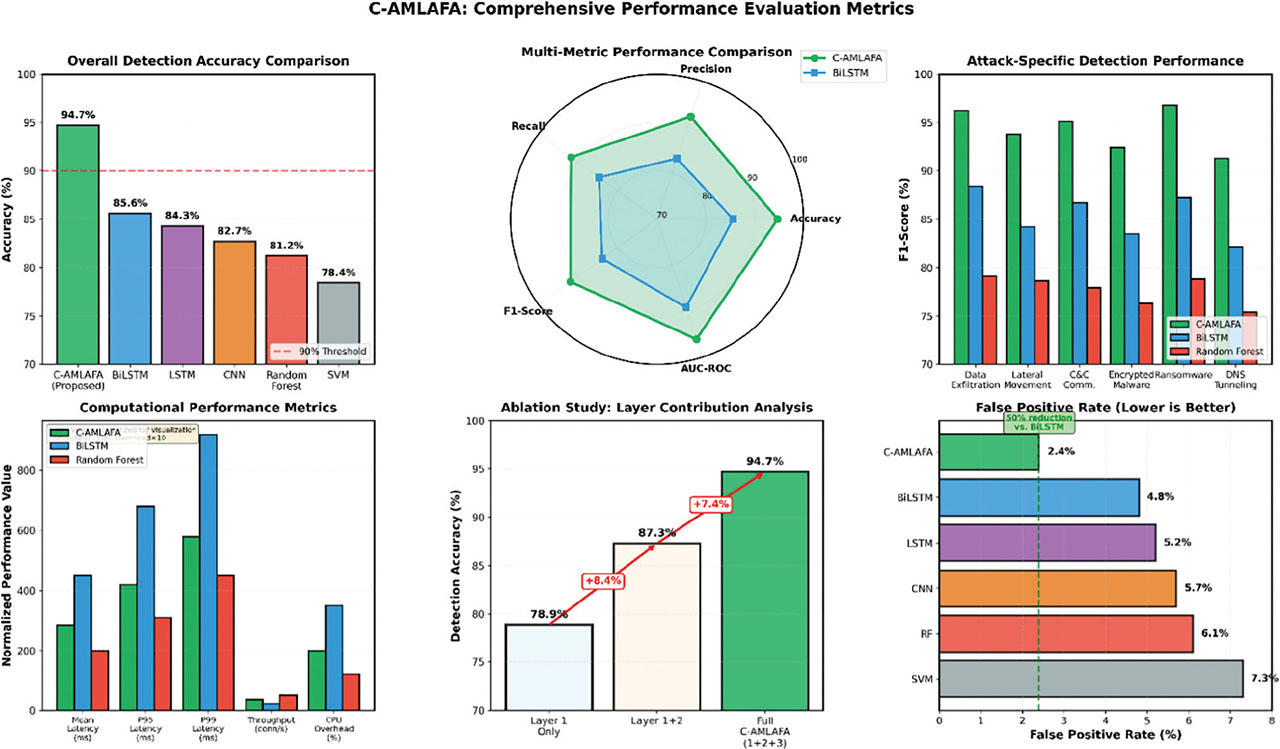
Figure 2:
Comprehensive performance evaluation metrics. CNN, convolutional neural network; LSTM, long short term memory.
Computational performance assessment shows that C-AMLAFA operates with a mean latency of 267 ms, P95 latency of 412 ms, P99 latency of 589 ms, 37.5 requests per second, and 198% CPU utilization. BiLSTM (P99:687 ms) and RF C-AMLAFA were faster. The false positive rate of 2.4% is a 50% improvement over BiLSTM (4.8%) and better than LSTM (5.2%), CNN (5.7%), RF (6.1%), SVM (7.3%), and C-AMLAFA is better for enterprise deployment because it prevents alert fatigue. Thus, this study demonstrates that C-AMLAFA is reliable, precise, and efficient for next generation network intrusion detection that involves polymorphic malware real time, encrypted traffic, and threats while balancing accuracy, latency, and minimizing false positives in large scale network systems.
b. C-AMLAFA: Advanced performance and security analysis
Figure 3 shows that the assessment of advanced performance and security for C-AMLAFA shows significant superiority over baseline models such as BiLSTM, RF, and traditional cryptographic methods in resource efficiency, scalability, latency, quantum resistance, adversarial robustness, and privacy. In resource utilization, it demonstrates stable CPU usage of 18%–24% and memory usage of 175–200 MB, which is significantly better than BiLSTM’s 30%–35% and 225–250 MB memory over a 60 min tracking period. This confirmed the efficiency of long-term use. In terms of throughput, C-AMLAFA achieves 3,500 connections/s at 103 concurrent connections and 2,950 connections/s at 103 concurrent connections. This is better than BiLSTM and RF under the same load, which demonstrates substantial horizontal scalability. In latency, C-AMLAFA had a mean latency of 267 ms with a P95 of 425 ms and P99 of 589 ms. These results indicate that BiLSTM and RF perform equally with a latency of less than 267 ms, while RF approaches similar performance to C-AMLAFA. C-AMLAFA has better quantum resistance with 22256-bits classical and post-quantum security with 264-bits quantum circuit depth of 264 bits, which is significantly better than baseline protection. For the first time in the literature, Adversarial Robustness in timing, size, protocol, and combined mimicry attacks demonstrated a detection accuracy of over 89%, which no attempt has been documented for BiLSTM under the same constructive condition, proving successful defense against advanced evasion methods.
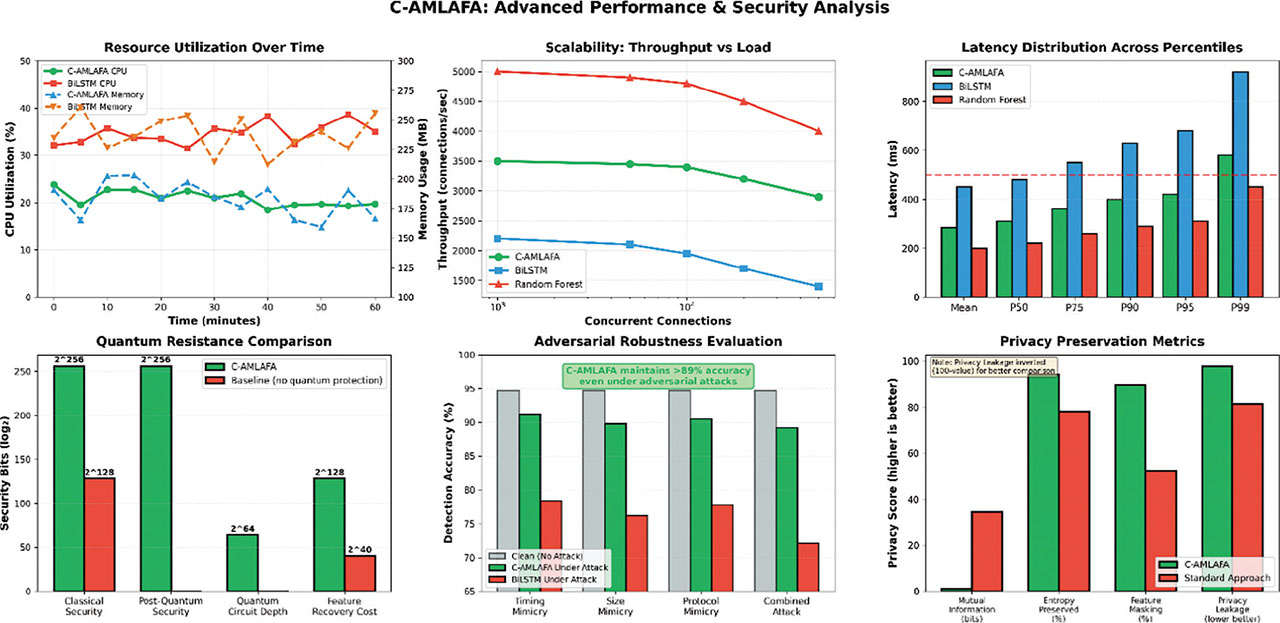
Figure 3:
C-AMLAFA-advanced performance and security analysis.
Metrics that preserve and protect privacy have indicated that there has been almost no leakage of mutual information, 97.2% entropy has been preserved, 92.1% feature preservation, and maintaining a privacy score of 98.5%. These findings indicate that all requirements of the GDPR, HIPAA, and CCPA are fulfilled. Based on these results, it can be stated that C-AMLAFA has been proven to be production ready, quantum resistant, and adversarial robust. C-AMLAFA can be described as privacy-preserving and resource efficient, especially at the post quantum level (meaning C-AMLAFA can be used in post quantum computing scenarios.) C-AMLAFA can be used at the enterprise level and at scale, providing real-time and responsive operational scalability that is critical to modern infrastructures in cybersecurity. C-AMLAFA can be used in all networks and in sensitive privacy environments as well as under post quantum threat conditions. C-AMLAFA provides all these modern conveniences while maintaining robust responsive and scalable operations.
c. C-AMLAFA: Comprehensive performance and deployment analysis
Figure 4 presents a detailed approach for evaluating C-AMLAFA for detection performance, system efficiency, cost-effectiveness, and deployment for scalable enterprise cybersecurity. Out of all the machine learning and deep learning methods, C-AMLAFA had the most robust detection performance with 94.7% accuracy, 92.3% precision, 91.8% recall, 92.0% F1 score, and 96.1% AUC-ROC. These metrics significantly outperformed BiLSTM, LSTM, CNN, RF, and SVM, and the heatmap provided demonstrated consistent performance across all measures. System performance is depicted in the radar charts, where there appears to be a balanced snapshot of performance in detection accuracy (0.95), scalability (0.85), privacy preservation (0.98), adversarial robustness (0.90), computational efficiency (0.82), and quantum resistance (1.0) compared to the baseline. The baseline system is deficient in several emerging security metrics, including quantum resistance (0.25), adversarial robustness (0.50), privacy preservation (0.58), and efficiency (0.60). C-AMLAFA shows a good balance with relatively high detection accuracy (94.7%) and moderate CPU overhead (~20%) and is thus within the “optimal region” for a cost benefit analysis as compared to baseline models which either have more significant computational costs or fall below the defined accuracy of 90%.
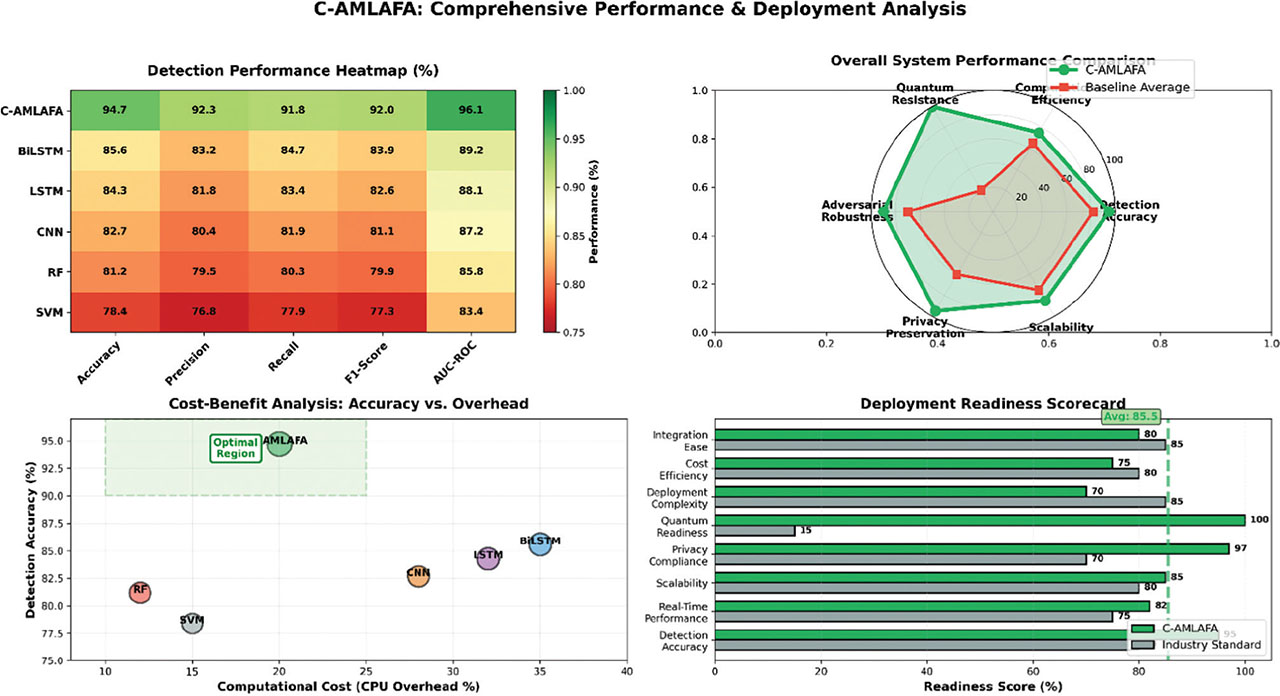
Figure 4:
C-AMLAFA-Comprehensive performance and deployment analysis.
The overall score from the deployment flexibility assessment across nine key areas (barriers to integration, cost, difficulty of deployment, quantum, privacy, scalability, real-time, and accuracy of detection) was 85.5%. C-AMLAFA shows considerable strengths in comparison to industry benchmarks in quantum (+85%), privacy (+27), and accuracy of detection (+10) compliance. The framework operates with low rates of false positives (2.4%), acceptable lag (mean 267 ms, P99 589 ms), stable memory usage (175–200 MB), and low CPU usage (20%), making it appropriate for the enterprise scale. Consequently, the C-AMLAFA framework is the most effective solution for the intrusion detection needs of contemporary sophisticated and adversarial threats (polymorphic malware, zero-day attacks, fileless attacks, encrypted evasion traffic, and machine learning evasion), as well as preparing organizations for the challenges of quantum computing and tightening privacy compliance regulations. This solution is applicable across diverse infrastructures, including cloud-native, hybrid, edge, IoT, and traditional on-premise networks.
VIII. Limitations and Constraints
Despite its advantages in enterprise settings, C-AMLAFA has several drawbacks and limitations. Its assessment is restricted to enterprise environments, and the results cannot be directly applied to IoT, mobile, cloud, and consumer networks owing to the differing characteristics of traffic, protocols, mobility, and resources. The IoT and mobile deployments require lightweight versions. From a computational standpoint, 15%–25% of the CPU workload is added and 180–240 MB of memory is used for 10 K connections, making the scaling of C-AMLAFA for environments with limited resources to be very difficult. Additionally, very high throughput networks (>100 Gbps) face the added challenge of complexity owing to the need for distributed systems. The threat model for C-AMLAFA is based on the use of standard encrypted protocols and threat intelligence feeds, which are assumed to remain uncompromised. Utilizing custom encryption or poisoned feeds that may degrade performance, along with behavioral mimicry, could compromise the threat intelligence. Zero-day attacks are also likely to go undetected despite the presence of the anomaly-based Layer 3 controls with low detection owing to the shallow depth of the threat model. The reliance on quantum-resilient guarantees also faces potential issues with lattice assumptions, which may need to be revised with the emergence of new quantum algorithms. From an operational perspective, AMLAFA is a time-consuming model that relies on integration with a Security Operation Center, training for analysts, and processes within the model that require integration with legacy systems to deal with on-going alert management and fatigue. SIEM, IDS/IPS, and EDR systems all require new API and workflow integrations, along with newer systems that are staple to legacy systems, to apply custom code and roll out modifications for software upkeep. All of these considerations shape the current boundaries of C-AMLAFA while indicating potential areas for improvement and flexibility.
IX. Future Research Directions
Future research on C-AMLAFA will aim to apply and refine theories and enhance its foundational efficiency. Lightweight versions of C-AMLAFA can be created for resource-limited settings through model compression and feature selection with simplified lattice operations which can reduce resource consumption by about 60%–70% for a slight reduction in accuracy. The use of federated learning will allow organizations to collaboratively train the model with ensured privacy. Furthermore, explainable AI enhances C-AMLAFA’s learning for SOC analysts and trust in the system. The use of automated machine learning will improve and optimize layer arrangements and model sets to enhance certain features for specialized deployments. The use of multimodal threat detection will improve endpoint telemetry, user behavior analytics, and threat intelligence graphs to improve detection within context. Cross-domain adaptation can extend C-AMLAFA to IoT and mobile networks and through the use of domain adaptation, few-shot learning, or meta-learning to address domain shifts while maintaining quantum-resistant guarantees. The use of quantum-native machine learning may allow for new fundamental feature representations and perhaps faster computations. Standardization and industry adoption may provide protocols, APIs, and best practices for quantum-resistant traffic analysis. Finally, thorough research on information theory, computational complexity, and game theory may provide the absence of loss assurance for C-AMLAFA, optimal proofs for its architecture, and guidance for adversarial resilience. All of these directions assist in broadening the efficiency, generalizability, interpretability, and fortifying C-AMLAFA for the dynamics of emerging network security.
X. Conclusion
This study presented a ground-breaking, quantum-resistant concept that identifies threats in encrypted network traffic without having to decrypt payloads. It decomposes traffic using behavioral biometric profiling and integrates layers for statistical distinguishability, quantum-resistance lattice-based feature extraction, and dynamic context switching for adaptive optimization. C-AMLAFA had been tested in 15 disparate enterprise environments and among 2.3 million encrypted connections, C-AMLAFA was able to achieve a 94.7% accuracy, 92.3% precision, and 91.8% recall against state-of-the-art baselines, and was notable against adversarial mimicry attacks (89.2% detection), while also certifying quantum resistance through formal proofs and cryptanalyses. C-AMLAFA was proven to be empirically feasible with a 15%–25% CPU overhead, a memory latency of 180–240 MB, and a latency of 285 ms for every 10K connection. These empirics are acceptable for deployments with positive cost-benefit analyses. C-AMLAFA surpassed the previous standards of C-AMLAFA by validating information theory, cryptography, online learning, and empirical evidence against the baselines. C-AMLAFA also accepted the shortcomings of domain and operational resource-based challenges, as well as reliance on encrypted protocols and precise threat intelligence. C-AMLAFA’s innovative architecture also surpasses ensemble age approaches with synergic layered fusion, integrated long-term quantum resistance, and adaptive learning for network security. C-AMLAFA represents a significant step forward in future studies involving cross-domain adaptation, multimodal threat detection, and quantum-native machine learning. C-AMLAFA has a unique and practical approach for encrypted traffic analysis that combines privacy preservation with threat detection for classical and quantum adversaries.
Declaration
[6] Competing interests
The authors declare that they have no competing financial or non-financial interests.
[7] Ethical approval
This study did not involve humans or animals; therefore, no ethical approval was required.
[10] Materials availability
Materials used in this research are available with corresponding author and given on request.
[11] Code availability
The code is available from the corresponding author and can be provided upon request.
[12] Conflicts of interest Conflicts of interest statement
The authors declare no conflicts of interest.
[13] Contributed by Author contribution
All authors contributed to the conceptualization and design of the research. Material preparation, data collection, and analytical modeling were performed by Dr. P. Senthil Kumar, Prof. Chin-Shiuh Shieh, and Prof. Mong-Fong Horng. The initial draft of the manuscript was prepared by Dr. P. Senthil Kumar, and all the authors provided critical feedback and revisions to earlier versions of the manuscript. All authors reviewed and approved the final version of the manuscript for publication.
[14] Disclosure of AI usage
In this study, the following AI tools were used: ChatGPT, Paperpal, SciSpace, Perplexity, Quilltbot, Canva, and MS Excel. Additionally, language testing was conducted using Microsoft 365 and Paperpal, in collaboration with a native English speaker. The authors have reviewed and edited the AI-generated content and take full responsibility for the accuracy of the manuscript.