
I. Introduction
Orthogonal frequency division multiplexing (OFDM) [1, 2] is one of the breakthroughs in implementing high speed data networks & applications. Multiple input Multiple Output (MIMO)-OFDM [1, 2, 3] and its variants are still the best candidates in 4G and 5G communications. OFDM supremacy is due to its immunity towards frequency selective fading and inter-symbol interference apart from this cyclic prefix ensures there are no adverse effects of inter-carrier interference (ICI) [4, 5].
However, OFDM spectral efficiency can be further enhanced by integrating it with subcarrier index modulation resulting into OFDM with index modulation (OFDM-IM) system. OFDM-IM [6, 7, 8] systems are primarily derived from spatial modulation used in MIMO channels. OFDM-IM system not only uses M-ary constellation symbols but subcarrier indices too for information transmission. In OFDM-IM system subcarrier indices are activated based on input data stream. Using subcarrier indices for data transmission saves on bandwidth and improves spectral efficiency.
Although OFDM-IM system provides numerous benefits, it is adversely affected due to high peak to average power ratio (PAPR) [9, 10]. In time domain high peaks and variation in time domain envelopes are caused due to IFFT taking place at the transmitter. In time domain IFFT sums up the modulated subcarriers which are aligned in phase generate high peaks leading to large power variations. When such high-power signals pass through high power amplifiers (HPA) used in the downlink, which have non-linearity in its input-output characteristics causes harmonic distortion. High PAPR also causes out of band radiation when it encounters the non-linearity of HPA.
For PAPR reduction, a number of schemes have been suggested in the literature such as clipping [11] where envelopes peak beyond a threshold value get clipped off, however non-linearity involved in the operation causes distortion taken care of by clipping–filtering [12, 13]. Peak windowing method [14] works in line with clipping where windowing function is applied to the envelope to hard limit the peaks. Companding [15, 16] transforms can also be applied on signal envelopes to reduce PAPR, in peak cancellation and orthogonal peak cancellation [16, 17] method a PAPR reduction waveform is subtracted from OFDM signal for reduction of high peaks. But all the above listed methods improve PAPR performance at the cost of distortion & poor bit error rate (BER) performance.
However, some of the methods are distortion-less such as the scrambling method where multiple representations of the same signal is generated and the one with minimum PAPR is chosen for final transmission. Such methods are Selective mapping [18, 19] and Partial transmit sequence [20, 21]. Tone injection [22], Tone reservation [23], Active constellation extension [24] are methods where existing constellation is modified for PAPR reduction. However, additional constellation points result in larger transmission power requirement.
Error control coding methods can also be used for PAPR reduction purpose; however, constructing such codes for a larger set of constellations is complex & tedious. Some of the codes used for PAP reduction purpose are Reed–Solomon, Golay codes [25], Reed-Muller codes [25], LDPC codes [26] and Turbo codes [27].
In this paper we have considered OFDM-IM system as it has been proven a better option when it comes to spectral efficiency as compared to conventional OFDM systems. But the IFFT block in the system is replaced by discrete wavelet transform (DWT) block. DWT based OFDM [28] system doesn’t require cyclic prefix as DWT has inherent frequency time synchronization. So in terms of complexity & spectral efficiency DWT based systems are better since cyclic prefix reduces spectral efficiency too. Low side lobe levels in DFT are also one of the reasons why they have better PAPR performance than IFFT based systems. For performance analysis we have simulated the system considering α − κ −µ fading environment [29]. Since multipath phenomenon leads to fading and among all the available mathematical distributions α − κ −µ is universally accepted as the most flexible distribution which optimally fits into the practical statistical data set.
II. OFDM-IM System Model
System block diagram of IFFT based OFDM-IM system is given in Figure 1. The input bit stream of r bits is divided in g groups, with each group carrying s bits such that . Let N be the number of sub-carriers in each OFDM symbol, these subcarriers are also divided in g subgroups with each having subcarriers. In each of these subgroups only a fraction of k subcarriers are active and rest of the p-k are inactive.
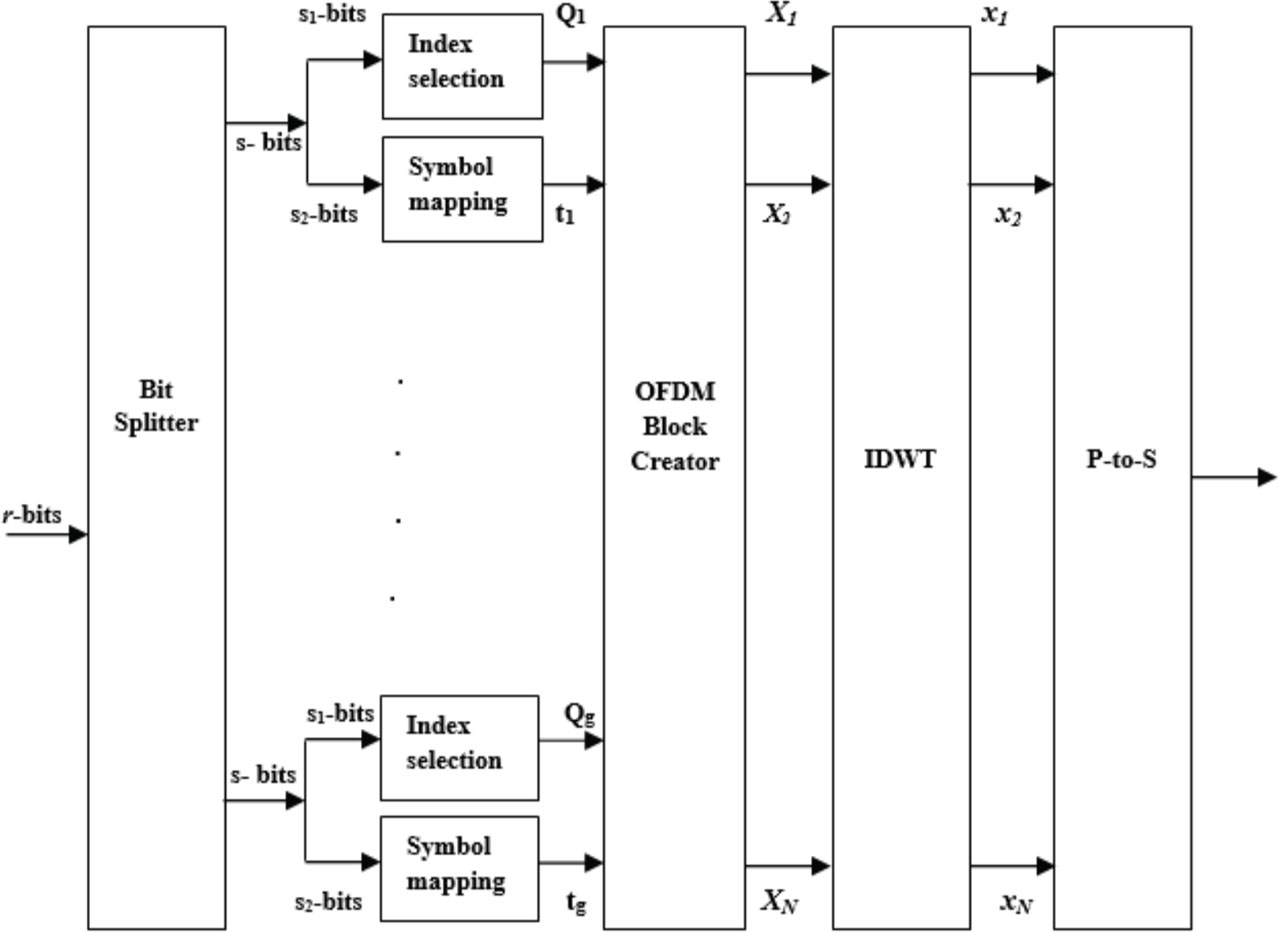
Figure 1:
Building blocks of IFFT based OFDM-IM system. IFFT, inverse fast Fourier transform; OFDM, orthogonal frequency division multiplexing; OFDM-IM, OFDM with index modulation.
Only the active subcarriers carry the constellation mapped symbols while inactive ones do not carry any data with them.
In each subgroup s1 bits are used for selection of k active subcarriers from a pool of p and s2 bits which are used for constellation mapping of M-ary modulated signal. Where:
So information is transmitted by active subcarrier indices and the symbol mapped of M-ary modulated signal carried by these active subcarriers, thus achieving data rate of k log2 M + ⌊log2 C (p,k)⌋ bits per subgroup or OFDM subblock. The overall data rate would be -
Unused subcarriers can be used for transmitting additional information in spatial domain. For each subgroup j = 1,2….g the active subcarrier indices are represented as . Whereas in Qa, a represents the active subcarrier.
The output of the symbol mapper is represented as:
Where , for j = 1, 2….g and a = 1, 2...,k. T represents the symbol set which are transmitted using k active subcarriers, considering each of the OFDM subblock is normalized to unity power i.e. represents Hermitian transpose. For p = 4 & k = 2 the subblocks can be created as follows:
Bits {0,0} Active subcarrier indices {1, 2} subblocks {t1,t2,0,0}
Bits {0,1} Active subcarrier indices {2, 3} subblocks {0,t2,t3,0}
Bits {1,0} Active subcarrier indices {3, 4} subblocks {0,0,t3 ,t4}
Bits {1,1} Active subcarrier indices {1, 4} subblocks {t1,0,0,t4}
With the help Qj & tj the OFDM block creator generates the output given by
Since carrier wither carries a 0 or symbol thus Xi ∈ {T,0} for i = 1, 2…N. After performing IFFT operation we get:
Where M is the number of OFDM symbols, xγ is time domain OFDM block, W represents DFT matrix & and is scaling factor for normalization . After IFFT cyclic prefix is placed at the beginning of OFDM block. Finally parallel to serial convertor & D/A conversion takes place.
III. DWT Based OFDM-IM System Model
DWT based OFDM-IM system given in Figure 2 where IFFT block is replaced by DWT. In DWT signal is decomposed into basic functions which are called wavelets, they can be assumed as oscillatory shapes. Wavelet allows easier representation of unpredictable signals than Fourier analysis. In contrast to Fourier, here signal generated using fixed wavelet function rather than trigonometric functions.
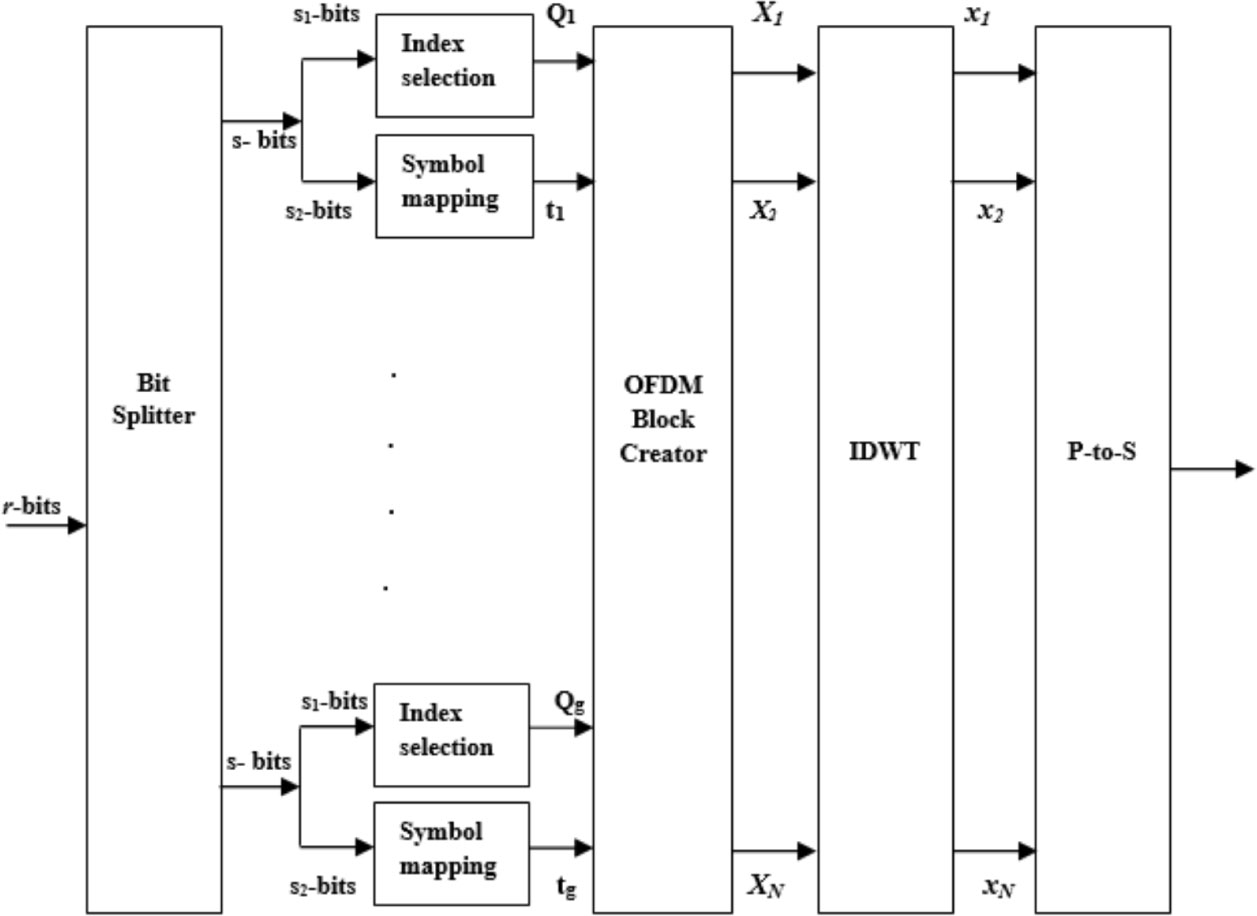
Figure 2:
Building blocks of DWT based OFDM-IM system. DWT, discrete wavelet transform; OFDM, orthogonal frequency division multiplexing; OFDM-IM, OFDM with index modulation.
Replacing IFFT/FFT Blocks with IDW T/DWT blocks leads to better spectral efficiency of DWT based OFDM-IM system as there is no need of cyclic prefix insertion. This advantage in spectral efficiency does not hamper BER performance of the system. In the presence of noise effecting phase of signal DWT based OFDM system performs better than conventional IFFT based OFM system [30]. As far as PAPR performance is concerned, DWT based OFDM system outperforms IFFT based OFDM system.
DWT generates wavelet carriers which are orthogonal and completely replaces time domain windowed complex terms generated from IFFT operation. If A & B are time location and scale index respectively, to ensure orthogonality between A & B using time frequency localization, the mother wavelet χ is defined as:
The DWT OFDM symbol a(t) represented as:
Where ρℜ,A, (t) is scaling function, OA,B are approximation coefficients, UA,B Wavelet coefficients, ℜ scale with best frequency localization of carriers.
IV. Computational Complexity
Let DWT is using up-sampling factor of 2 with wavelet coefficients UA,B and approximation coefficients OA,B. Then the number of complex multiplications and additions will be and Nlog2 N respectively, thus the order of complexity will be O(Nlog2 N)
FFT based OFDM systems have similar order of complexity but in DWT based overall system complexity decreases with removal of cyclic prefix.
V. Peak to Average Power Ratio
IFFT sum used at the transmitter may result into high peaks in the OFDM signal envelope. For an OFDM signal with N subcarrier the PAPR is given as:
VI. α − κ − µ Fading Environment
A variety of channel distribution functions are available to characterize the wireless channel. One of the best suited fading models for practical statistical data is α − κ − µ. The values of α, κ and µ for various fading distribution is shown in
In non-homogenous scattering conditions the α − κ − µ fading model is used for representing signal variations. As per Table 1, this model includes all the possible small-scale signal fading models. The p.d.f for the model is given as:
Where:
- α
non-linearity of multipath
- κ
ratio of dominant power component to total power of scattered components
- µ
Number of multipath channels
is the rms value of signal envelope Y
- Ie(.)
Modified Bessel’s function of the first kind and order e.
VII. Performance Analysis in α − κ − µ Fading Environment
Average value of received signal to noise ratio for α −κ − µ channel (Average SNR) for bit energy Eb it can be written as Where Es is symbol energy, H channel coefficients. The distribution of received signal will be:
The BER equation for the M-QAM signaling is given by [25]
For a system with a number of signal constellation points Z1 = (M)Z2 it can be given as α – κ – µ for fading environment as
Where Z (j1, j2) = 1, if j1 = j2
VIII. Results
The parameters used for PAPR calculations are given in Table 2.
Table 2:
Simulation parameters for OFDM-IM system
| Sl. No. | Distribution | FFT based system | DWT based system |
|---|---|---|---|
| 1 | Number of symbols | 10,000 | 10,000 |
| 2 | FFT/DWT size | 64 | - |
| 3 | Modulation | M-QAM | M-QAM |
| 4 | Subcarriers | 512 | 512 |
| 5 | Cyclic prefix duration | 0.8 µs | - |
| 6 | Sampling frequency | 20 MHz | |
| 7 | Total symbol duration | 4 µs | |
| 8 | Subcarrier index | −26 to −1; +1 to +26 | |
| 9 | Subcarrier spacing | 312.5 KHz | |
| 10 | Mapping scheme | 8-QAM |
The PAPR comparison of both the systems is done by simulating complementary cumulative distribution function (CCDF). CCDF curve suggests that DFT based systems gives better performance than FFT based systems. Simulation curves for the CCDF are given n Figure 3. This clearly indicates that PAPR value of DWT based system is around 8.5 dB whereas for FFT based OFDM system it is around 11 dB.
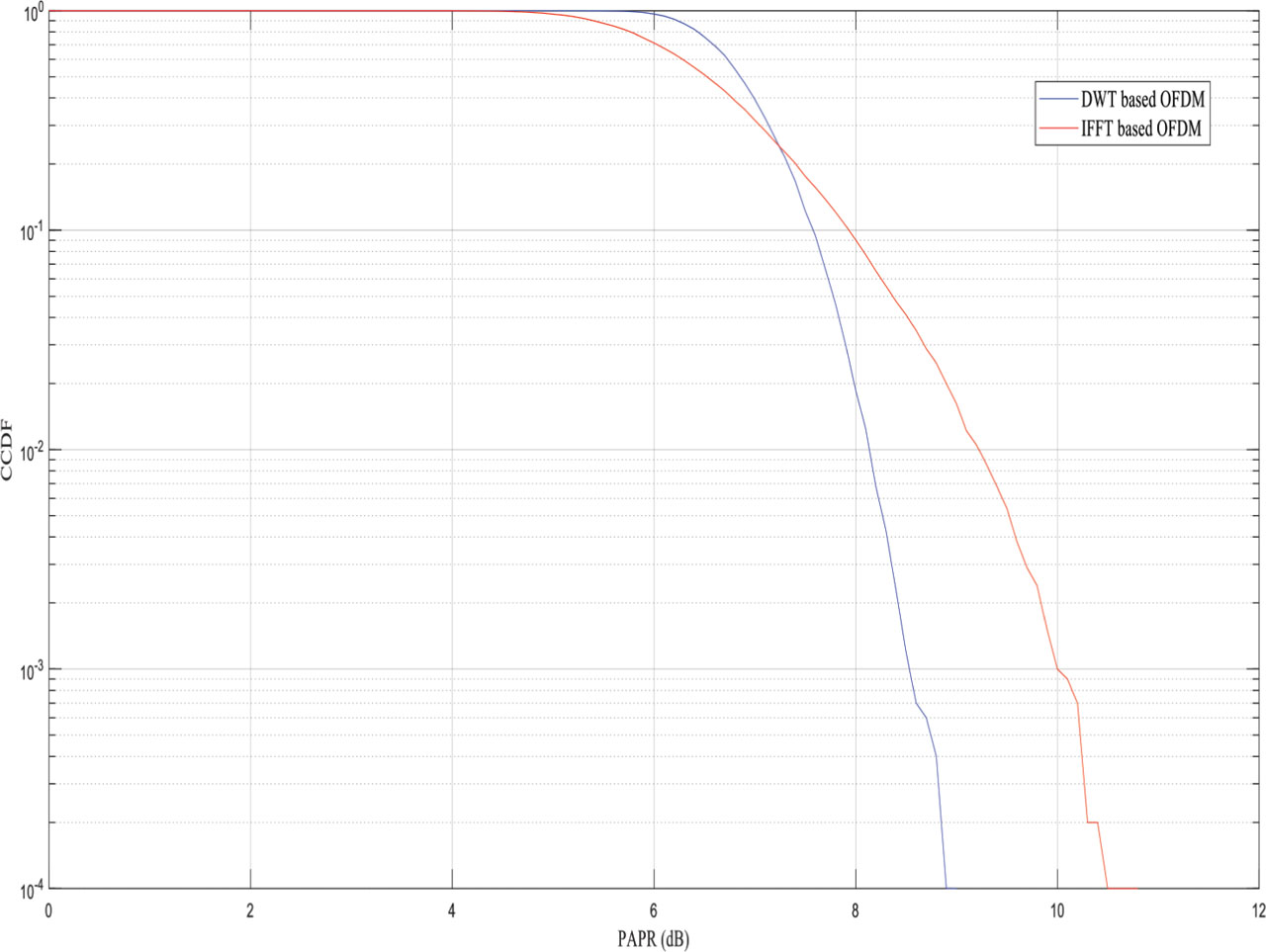
Figure 3:
CCDF curves for FFT & DWT based OFDM-IM system. CCDF, complementary cumulative distribution function; DWT, discrete wavelet transform; IFFT, inverse fast Fourier transform; OFDM, orthogonal frequency division multiplexing; OFDM-IM, OFDM with index modulation.
BER for 8-QAM system is simulated for α = 2,κ = 0,µ =1 and α = 2,κ = 0,µ =0.5, the BER curves are shown in Figure 4.
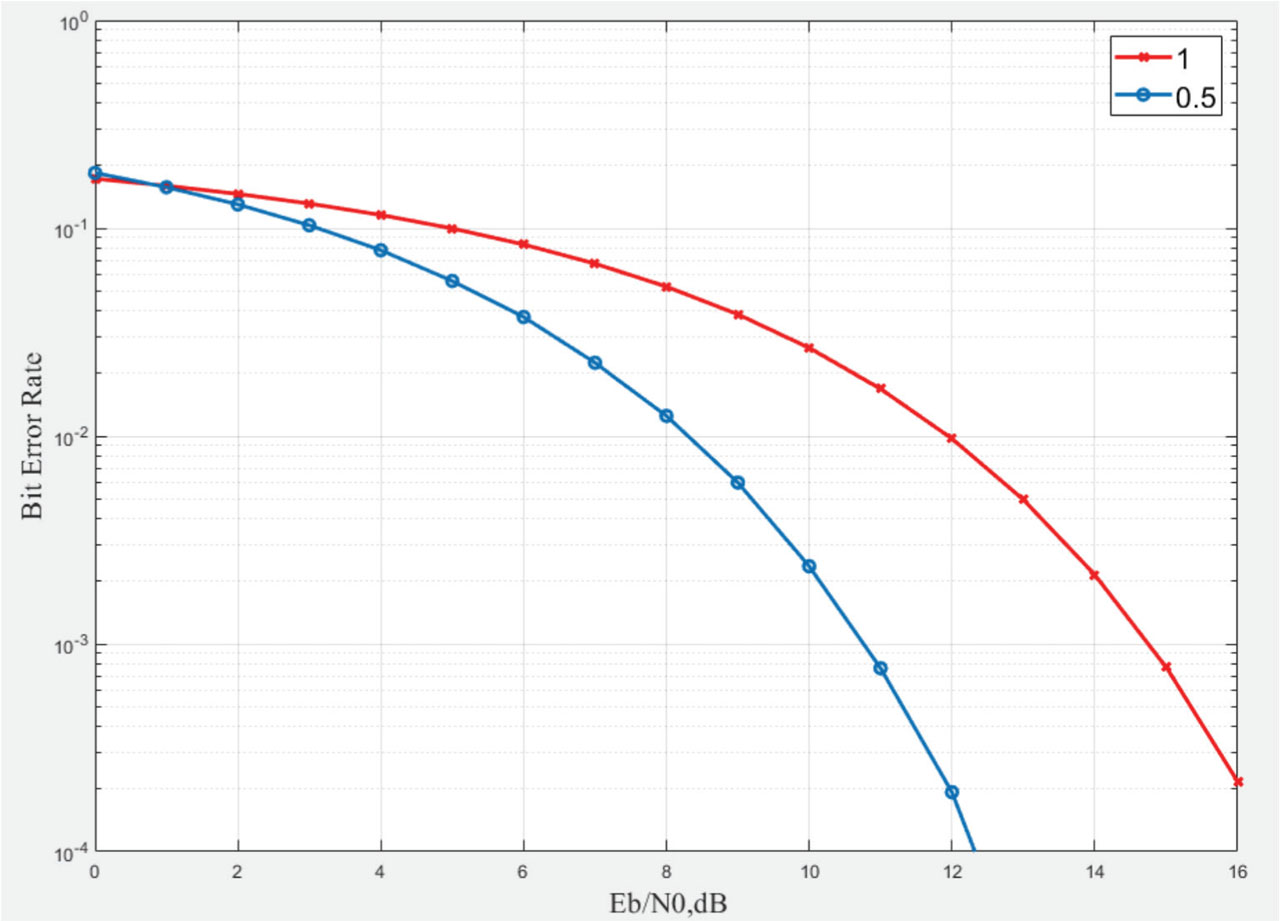
Figure 4:
BER curves for α = 2,κ = 0,µ =1 and α = 2,κ = 0,µ =0.5. BER, bit error rate.
Figure 4 suggests BER performance for α = 2,κ = 0,µ =1 (Rayleigh) is inferior to α = 2,κ = 0,µ =0.5 (Nakagami) which satisfy the general convention.
DWT-based OFDM-IM systems show better spectral efficiency and PAPR performance compared to FFT-based OFDM setups. You know how narrow-band interference works. DWT handles it better than traditional methods, along with reducing ICI issues.
Looking at computational complexity, FFT-based systems for N-subcarrier OFDM require operations on the order of N.log2N. Meanwhile DFT-based approaches only need order N operations. That’s a clear advantage for resource usage. DWT itself is already widely used in signal processing circles, so scaling up deployments shouldn’t pose major hurdles.
Power consumption differences matter here. FFT implementations typically demand high-power DSP or FPGA processors. DFT alternatives can run on lower-power chipsets instead. Though wavelet selection sometimes complicates DFT implementations more than expected. There’s always a trade-off between spectral efficiency gains and practical implementation challenges.
Comparing DWT-OFDM IM against NOMA and FBMC approaches brings more insights. Both FBMC and DWT-OFDM skip cyclic prefixes entirely, freeing up bandwidth for actual data transmission. They’re also more resilient against narrowband interference situations people often see in crowded spectrum areas. But FBMC runs into headaches with MIMO configurations due to requiring multiple filter banks in hardware setups.
NOMA’s non-orthogonal nature does boost system capacity and latency metrics significantly on paper. Spectral efficiency looks great in simulations too. The catch comes during real-world deployment though—receiver designs get super complex fast when channel conditions aren’t perfect. Even minor distortions can throw off the whole decoding process pretty hard you know.
IX. Conclusion
The paper evaluates the PAPR performance of the DWT based OFDM-IM systems and suggests performance improvement over existing FFT based systems. Using the DWT based system decreases the system complexity. OFDM-IM systems are themselves more spectrum efficient than conventional OFDM systems. Paper also evaluated system performance in α − κ − µ fading environment, which is one of the most sought-after choices for real world data in wireless communication. BER performance curves comply with the literature too. DWT based OFDM-IM systems are one of the strong candidates for next generation wireless communication owing to its enhanced spectral efficiency and lower complexity. OFDM acts as a strong pillar to support 4G and 5G technologies and α − κ − µ fading environment is the most sophisticated model for real time scenario. DWT based IM-OFDM enhances conventional OFDM capabilities in terms of improved spectral efficiency and PAPR performance.
Abbreviations
- DFT
Discrete Fourier transform
- FBMC
Filter Bank Multi-Carrier
- FFT
Fast Fourier Transform
- FPGA
Field Programmable Gate Array
- IDWT
Inverse Discrete Wavelet Transform
- LDPC
Low-Density Parity-Check
- MQAM
M-ary Quadrature Amplitude Modulation
- NOMA
Non-Orthogonal Multiple Access
- QAM
Quadrature Amplitude Modulation
- SNR
Signal to Noise Ratio.