
I. Introduction
The current experiment was conducted as part of a local, within at the Hindustan Shipyard in Visakhapatnam, providing a rare opportunity to comprehend into the internal working operations of a big shipbuilding unit. Also, the study provides an original angle by delving into the shipyard processes and the operational practices that were not closely analyzed in earlier exploration. By exploring the different operational methods in this environment, the study exposes features that have not yet been recognized in the literature. Moreover, the on-the-job experience extends the understanding of the shipyard's operations. Subsequently, the study acts as a pioneering project in its domain by making an important educational study and contributing to business repetition, thereby setting the new standard for the following studies and practical applications in shipbuilding milieus.
a. Shipyard equipment and maintenance technologies
A shipyard is located where the ships are constructed, repaired and outfitted. According to the study, Li et al. [1], suggests the classification of shipbuilding can be done based on its services, workers, and arrangement. Moreover, the theoretical model enables the smart shipyard to leverage data from the network platform, smart manufacturing process perspective, and the change implementation process perspective. Thus, this constitutes complete framework for a smart shipyard developed by Diaz et al. [2]. In the future, the shipbuilding industry will be largely influenced by various developments such as VR/augmented reality (AR), Liquefied Natural Gas (LNG)-powered engines, and laser cladding machines, which are detailed by this study Anane et al. [3]. Also, accuracy and time consumption are two of the most significant tasks to fulfill the entire analysis. In this case, maritime projects can successfully avoid the challenges of temporary shortages of resources, similarly, effectively handle the operational stability and flexibility in the environment.
Pivoto et al. [4] developed the decision-making processes used to enable the real-time data collection by combining the various computing paradigms and Internet of Things (IoT) to enhance the safety criteria. Manufacturing environments and resources are linked with both wireless and wired devices, Radio Frequency Identification tags, managed handheld sensors, and embedded coordination, as analyzed in digital world Munín-Doce et al. [5]. Shipbuilders mostly encourage the involvement of Robots in activities. Moreover, robotic technology is employed to manufacture the ships on Heavy industries. This will be the first declaration Jimenez et al. [6]. The three-dimensional curved surface is autonomously shaped using the robotic technology. Also, rapid advances in sensor technology are essential for maritime project sections to monitor the ability by adopting the real-time systems de la Peña Zarzuelo et al. [7]. In addition, the timely maintenance practices such as servicing, equipment replacements, and routine inspections are significant concerns of modern vessel repairing. This would enhance the optimal performance, as well as provide guaranteed safety during the course of their operative lifespan Giallanza et al. [8].
b. Digital maintenance advances
The primary use of fault detection is to enhance the energy efficiency of the hip construction by identifying the performance of degrading machinery and fore-casting failures. Consequently, most of the machinery will not be functioning in a corrupted state, which has demonstrated improved performance of ship equipment Cheliotis et al. [9]. Advanced digital technologies such as cloud computing, blockchain, IoT, big data, AI, digital twins, and augmented/virtual reality are enabled to continue the advance and becoming more affordable. By combining these digital technologies with conventional maintenance practices, it is possible to ensure that equipment, apparatus, and constructions remain purpose, function, and achieve dependably van Dinter et al. [10]. Also, the maintenance Practices continue to progress quickly and integrate recent advanced digital technologies into their outdated conservation functions to restore the effectiveness, efficiency, and accuracy of maintenance. Digital Predictive Maintenance, for example, uses analytics and data to identify potential failures and/or deterioration of machinery before their occurrence to optimize the performance and reliability of machinery Onifade et al. [11].
c. Predictive maintenance for marine floating dock pumps
Researchers developed a recursive grey model (RGMbTM-SSA) for improved prediction accuracy, validated using real-world welding steel sheet cases for cruise ships, demonstrating the feasibility of a digital-twin predictive compensating control technique. To maintain and repair the several approaches that can be employed, including proactive, predictive, preventive, corrective, and reliability-based maintenance, Shang et al. [12]. Among these methods is the Genetic Algorithm; for multi-objective problems, the Non-dominated Sorting Genetic Algorithm II (NSGA-II) algorithms are especially helpful. The environment-health, person-hour, cost, and time goal functions are used. Using an optimization tool, such as NSGA-II, the optimal R&M method was identified, considering the useful criteria and jack-up features, Farizhendy et al. [13].
The corrective and preventive maintenance are significant components of floating dock pumps. For the maintenance of mechanical components on floating docks, predictive maintenance remains a murky field Zhang et al. [14]. The marine sector continues to emphasize preventive and corrective maintenance, so mechanical systems, including plants, machinery, and equipment, undergo periodic over-hauls or replacement of parts. Principal component analysis is used to select the operational parameters that determine whether maintenance or failure is required for the pump Kimera et al. [15]. One of the newest developments in marine maintenance to guarantee the structural health of ships is predictive maintenance. It is best employed in essential ship systems and is applied through condition-based process monitoring. Condition and process monitoring in the maritime sector aims to evaluate the current status of inspected systems and detect emerging faults by collecting specific data from ship systems Ren et al. [16].
II. Literature Studies
The study explores the Ships and Marine Technology subcommittees' International Organization for Standardization (ISO) standards, data collection networks, and challenges, suggesting a combined approach to reduce costs, save time, and ensure data consistency Lim et al. [17]. Hull MASTER is a Windows program executed in the Matlab App Designer that compares hull maintenance scenarios for single cargo vessels in the Baltic Sea area, focusing on economic costs and social/environmental effects Oliveira et al. [18]. Laser trackers and scanners are the best technologies for shipbuilding, improving production and design systems that reduce survey and data processing time, enabling quick comparisons with 3D CAD models. Laser scanning technology can enhance man-machine cooperation in the Industry 5.0 paradigm, making it a promising solution Bertagna et al. [19]. For maritime shipbuilding and repair companies, Ship-RISC provides a real-time data-driven platform that uses scenario analysis and simulation-based models to manage supply chain interruption risks.
a. Innovative technologies in industrial and maritime maintenance
To investigate welding deformation, technological and structural characteristics related to transverse shrinkage of welded butt joints utilizing Flux-Cored Arc Welding (FCAW) and Submerged Arc Welding (SAW) welding processes are evaluated in this article by Urbański et al. [20]. Industry 4.0 integrates digital technologies such as IoT, Big Data analytics, AI, and AR into maintenance activities. Therefore, this will enable a remote monitoring system, a predictive maintenance model, and autonomous features. These innovations not only enhance effectiveness-0020 but also change the out-of-date maintenance plans, which are being changed to the proactive ones Silvestri et al. [21]. AR is the leading-edge technology to unify human interaction with smart factories that are IoT-enabled. It supports activities such as predictive maintenance and machine-to-machine communication, thereby integrating shop floor operations with digital interfaces and captivating experiences Egger et al. [22]. Also, industry 4.0 uses cloud computing and the industrial internet of things technologies to facilitate the real-time data analysis, predictive maintenance, and remote monitoring, thus enhancing productivity and competitiveness in the supply chain. The study is aimed at enhancing the process of maintenance planning for maritime assets by considering personnel availability, site restrictions, operational risks, and uncertainties Forcina et al. [23].
The maritime sector includes AI/Machine Learning (ML) for predictive maintenance, IoT for real-time data collection, and autonomous vessels for enhanced efficiency and safety. These advancements support Industry 4.0 principles by optimizing operations and fostering innovation in both sectors Javaid et al. [24]. The article investigates the potential advantages and cost-effectiveness of integrating Industry 4.0 technologies, particularly Digital Twin and advanced materials, within the Indian electric vehicle sector Kamran et al. [25]. With an emphasis on research gaps, problems, and trends, this study examines logistics and the supply chain of spare parts in the maritime industry. The blockchain technology ensures secure transactions, AI/ML for operational efficiency and predictive maintenance, and IoT for real-time monitoring Mouschoutzi et al. [26]. This systematic review distinguishes between simulated models and interactive simulated environments to address the improper use of “Digital Twins” in the shipping sector. It identifies connections and gaps in Digital Twin systems across various sectors, particularly for new vessel types. This survey explores integrating Edge Computing with Industry, aiming to enhance efficiency and decision-making. It categorizes research based on architecture, platforms, and applications, noting theoretical biases and implementation challenges Vakili et al. [27].
b. ML and DL methods for predictive maintenance
The ML methods for predictive maintenance include support vector machines (SVM), RF, and Long Short Terms Memory Network (LSTM) networks. However, it is constrained by limiting its scope to research conducted through June 2020 and by using a small sample size of 38, which may result in the exclusion of new developments and comprehensive answers to problems Dalzochio et al. [28]. In addition to LSTM networks, RF, and SVM, the study may employ Convolutional Neural Networks (CNNs) for the analysis and feature extraction of time-series data. A concentration on specific bearing types may limit the models' applicability to other bearing types, which is one of its drawbacks Cheng et al. [29]. The study employs ML techniques for predictive maintenance, including Artificial Neural Network (ANN) classifiers, eXtreme Gradient Boosting (XGBoost), SVM, K-Nearest Neighbors (KNN), and decision trees. The framework's complexity, its narrow specialization for some applications, problems with generalizing from case studies, and possible implementation overhead are among its drawbacks Arena et al. [30].
Deep Learning (DL) approaches include more complex models, such as CNNs and Recurrent Neural Networks, which are able to recognize patterns from large datasets. One disadvantage is that the review's comprehensiveness may be limited due to its narrow scope and small sample size Dalzochio et al. [28]. The LSTM networks for temporal dependencies and CNNs for feature extraction. Drawbacks include limited generalizability, high computational demands, poor interpretability, and reliance on large, high-quality datasets Yeter et al. [32]. In the predictive maintenance framework, the article employs ANNs and SVMs to forecast the future state of Mechanical, Electrical, and Plumbing (MEP) components. Integration Difficulties are Data Dependency Complexity, and Validation Limitations are the constraints and associated issues, Cheng et al. [29].
Table 1 presents a comparison of the objectives, applications, parameters used, methodology, outcomes, and limitations of the body of research on different ML techniques used for predictive maintenance.
Table 1:
Existing works comparison
| Author | Objectives | Applications | Parameters used | Methodology | Outcome | Limitations |
|---|---|---|---|---|---|---|
| Yi et al. [34] | Examine intelligent case designs and models for shipyards. | Shipyards with intelligent factories | Case studies and smart factory specifications | Establishing frameworks and analyzing cases | established a framework for the integration of smart technology in shipbuilding | restricted to Chinese shipyards; might not be relevant in other contexts |
| Schwendemann et al. [35] | Examine ML methods for predictive maintenance and bearing condition monitoring. | machines for grinding | Numerous ML techniques with condition data | review of the literature and a comparison of methods | thorough review of ML methods for bearings | restricted to grinding machine bearings; might not apply to other parts |
| Serradilla et al. [36] | Models using DL for predictive maintenance. | Predictive general maintenance | historical maintenance data and DL models | Review of literature, comparison of models, and identification of challenges | Perspectives on DL models, obstacles, and potential paths forward | mostly concentrates on DL; it might not cover other ML methods |
| Ayvaz et al. [37] | Provide a manufacturing line predictive maintenance solution that operates in real time. | production lines for manufacturing | ML algorithms, real-time operational data, and IoT data | Real-time data gathering and predictive ML | Increased production line efficiency and real-time predictive maintenance | Problems with the integration and processing of real-time data |
| Lang et al. [38] | Use ML models using physics knowledge to forecast ship speed. | Prediction of ship speed | Ship characteristics, outside circumstances, and physics-based ML methods | combining ML and physics-based models to accelerate prediction | increased speed prediction accuracy and improved physical constraint management | Complexity of combining ML with physics-based models |
c. Problem statement
A shipyard is a specialized facility dedicated to constructing, repairing, and maintaining ships/existing. This is important for maintaining maritime industry processes and fleet sustainability. Conventional shipyard operations studies struggle with numerous problems, such as data quality issues, complex project ecosystems, data scarcity, industry-specific applicability, and limited generalizability. Moreover, these issues hinder the sustainability and efficient management models. Therefore, the present research provides an advanced solution that is applied to reduce hazards and increase the performance via shipyard environments. Also, effectively solves the complex criteria and through the ship-yard environments. The proposed methodology is designed to be modified and used across different operational contexts to provide better framework for simplifying project administration under challenging environments.
One such methodology, highlights the service of strict data gathering and analysis approaches in order to make the energetic decision-making information, which is more manageable and dependable. Along with that, this research study also supports the implementation of eco-friendly and budget-friendly measures, inspires the reliability of machinery and reduces the negative impact on the environment. Hence, through these measures, the present research has effectively contributed to enhancing shipyard operations and has become a carrier of resilience, sustainability, and efficiency in the maritime sector.
d. Research objectives
Ensuring that the shipyard is properly maintained and each of the machinery and cranes functions as powerfully as promising.
Applying advanced data analytics models, such as DL frameworks as well as sensor or cutting-edge technologies, enables the machinery health in real-time criterions.
By using advanced data analytics, DL algorithms, and sensor technologies to monitor and analyze equipment health in real-time.
The goals of these tactics are to enhance maintenance plans, anticipate possible problems before they arise, and improve overall equipment dependability and operational effectiveness.
By leveraging data-driven insights, shipyards can proactively manage their equipment, reduce downtime, and extend the lifespan of critical assets like cranes and machinery.
III. Proposed Methodology
In modern industrial environments, are significantly adapted in smart monitoring frameworks to enhance the maintain activities as well as minimize downtime. Moreover, this research shows that the combination DL algorithms and sensor technologies with respect to the camera correlated cranes. This is the effective structural process for identifying and addressing the issues related to shipbuilding machinery systems. The developed system is illustrated in Figure 1, which begins with data acquisition by gathering various sensor-related data from machines. This includes both operational and physical parameters such as load, noise, displacement, vibration, dimensions changes, and refraction. Then, cloud storage system is enabled to store the entire incoming images, sounds signs, and sensor measurements. This is ensures that the large data processing is widely supported for real-time assessment. After that, data processing was done with input data for pre-processing, and image classification and detection were performed using the DL model BiLSTM-SPAN.
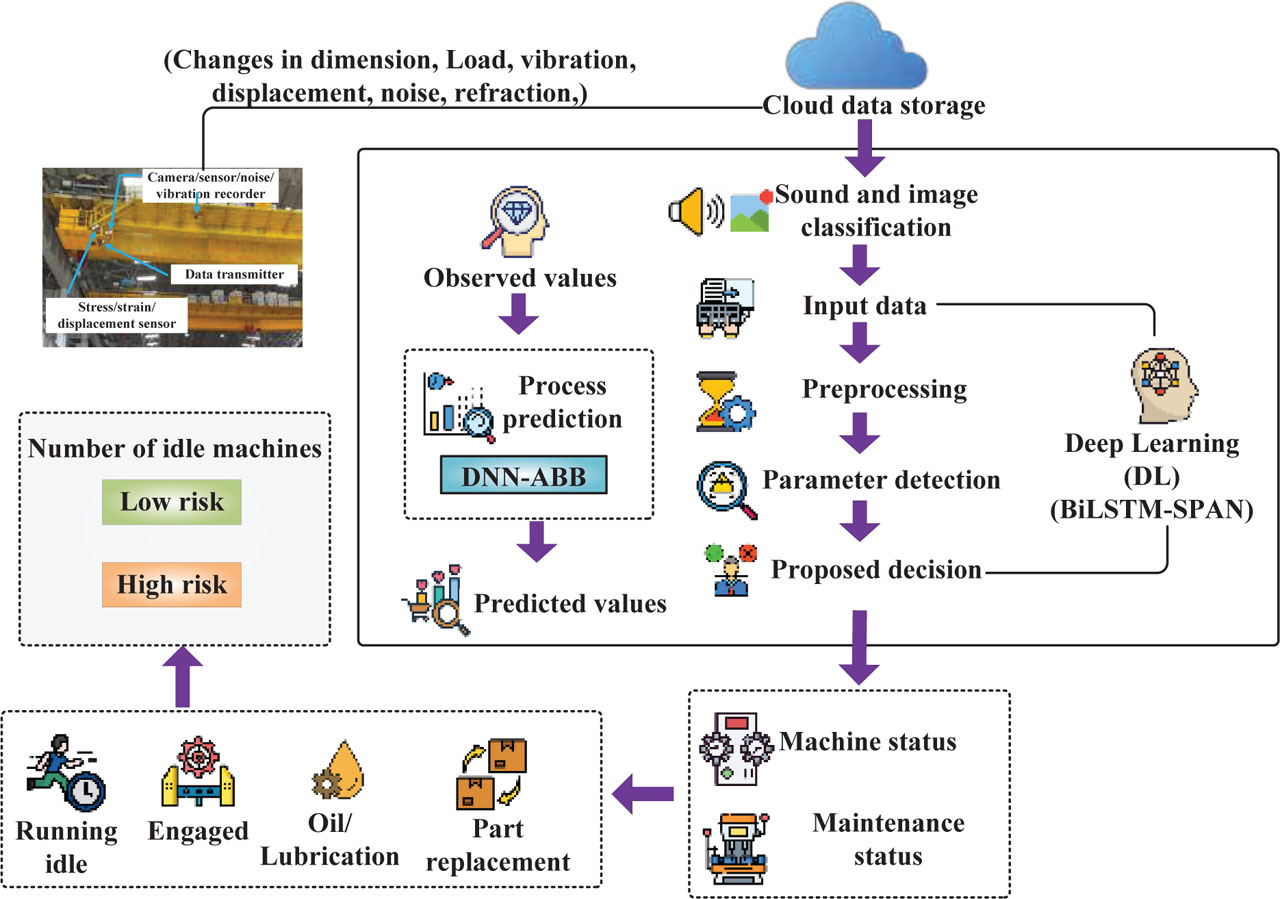
Figure 1:
Proposed methodology. BiLSTM-SPAN, directional long short-term memory network with spatial pyramid attention networks; DL, deep learning.
The developed system effectively detects abnormal activities, maintenance required, and machine health conditions. Then, the monitored detection out-comes are processed to evaluate prediction performance by using DNN-ABB frameworks. Here, four types of prediction analysis have been carried out, such as time-to-failure, machine workload, maintenance requirements, and fault probability. Moreover, these prediction measurements are fed into the decision-making phase to find operational criteria and risk factors. Based on the monitored and fore-casted prediction measures, the system further analyses the higher or lower-risk idle machines in this world to help recognize whether the higher risk or lower risk idle machines represent normal conditions or the probable failures. Finally, machine status and maintenance status are recommended as output. Furthermore, decisions are repeatedly generated using the integrated DL and prediction models.
In addition, the major working process of the shipyard equipment with crane involvement is demonstrated in Figure 2. Cranes are important machinery for handling the wide range of components and supply installations on heavy ship modules during assembly and manufacture, especially in shipyards. The primary lifting procedures were adapted to the crane bridge to raise and lower heavy loads using motors and high-capacity wire ropes. The cranes are equipped with trolleys for horizontal movement and lifting mechanisms for vertical movement, which enable them to transfer items across the shipyard effectively. Cranes are essential for transporting, unloading, and stacking ship parts, and they require routine maintenance and safety inspections to ensure reliable performance and prevent accidents.
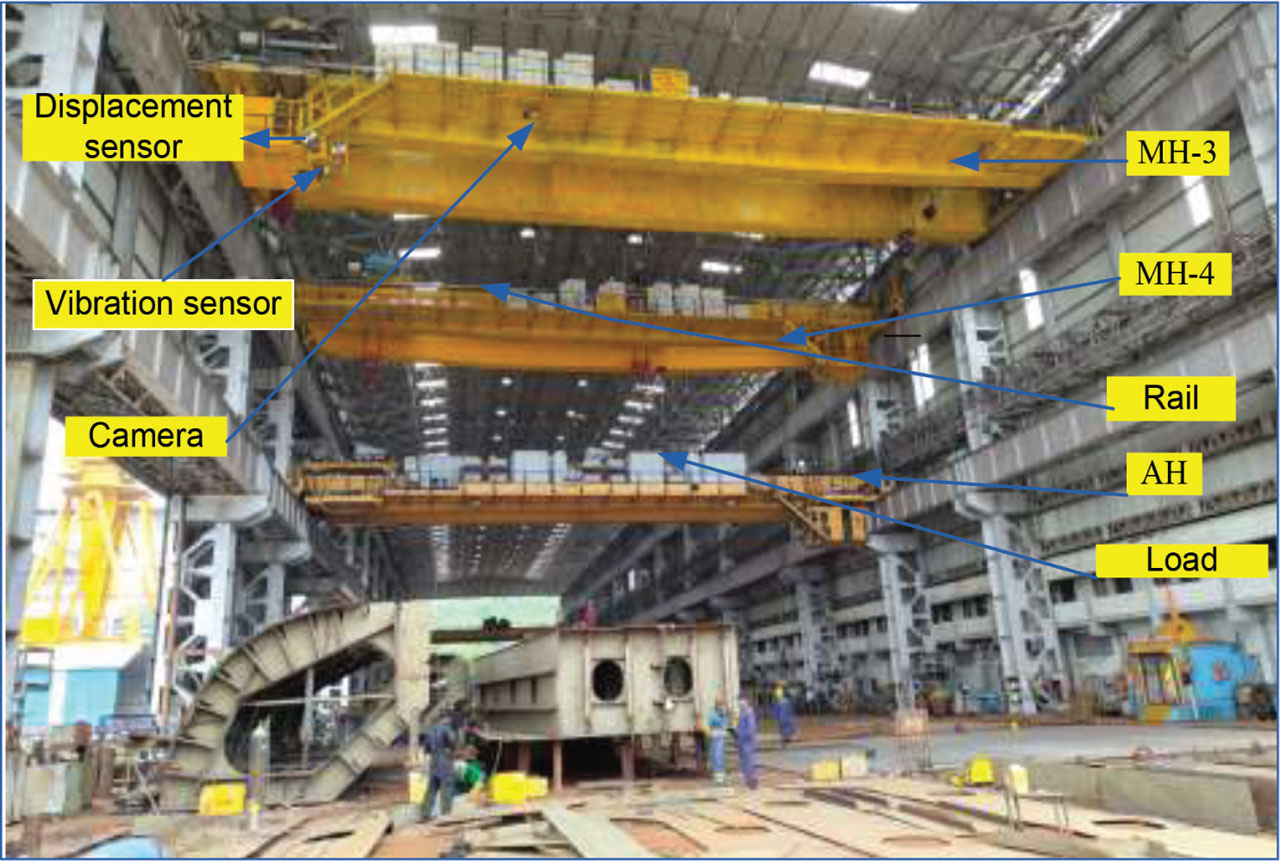
Figure 2:
Working process of crane.
a. Data description and preprocessing
In this work, the data were collected from six cranes, like MH-3, Auxiliary Hoist (AH), MH-4, Long Travel (LT), CT-3, and CT-4 in the shipyard over 31 days. Here, each crane recorded the daily values for current (A), voltage (V), speed (m/min), load (kN), torque (Nm), noise (dB), vibration (Hz), and the change in dimension (mm). Overall, 186 data points per parameter were obtained (6 cranes × 31 days). In addition, the sensors attached to every crane record measurements at a sampling rate of once per day, which aligns the shipyard's standard monitoring routine. All data were directly sourced from the shipyard's maintenance logs and equipment monitoring system. Before training the models, the dataset are forwarded to preprocessing. Missing readings were handled using linear interpolation, and extreme outliers were removed using the interquartile range method. Moreover, all features were normalized to maintain the values within a consistent range, features were normalized using min-max scaling. As a result, this preprocessing guaranteed stable model training with improved prediction accuracy.
b. Hardware used
Surveillance Camera: surveillance cameras are a critical element in enhancing security and safety in shipyard areas. This would allow monitoring of activities, minimize thefts, and act as a live view of processes being operated by workers. These offer the operator tremendous safety benefits and allow for remote monitoring and theft prevention.
Vibration Recorder: The various sensors, data collection devices, and analytics software used to evaluate the information collected, vibration recorders provide an opportunity for early detection of mechanical failure and notification of an operator, ensuring that the crane is utilized safely.
Displacement sensor: Stress sensors measure internal tensions induced by external force, strain sensors measure the excessive bending of the crane, and displacement sensors monitor the movement of the crane's components in real-time.
Load: The mass and the weight, by which the object is lifted, are referred to as the load. The load distribution in a crane is the main factor by which the success of stability maintenance and accident prevention will be judged. At a shipyard, weight must be evenly distributed among all the devices used in the lifting process so that a crane will not put too much stress on a single component when lifting a large or heavy component. In this manner, the stability and safety of the crane will be protected.
Speed: The manner in which a crane's load is managed and the efficiency with which it is positioned depends substantially on the speed of the crane. Consequently, the crane's speed can be used to increase output while maintaining safety measures during the working process.
Current: A current is the electrical energy flowing through the crane's electrical system and engine within a crane located at a shipyard. The amount of current required to operate a crane will vary based on various factors, including the crane's power, load conditions, and the crane's motor performance.
Torque: Torque is another important factor that affects crane's operating and lifting capabilities at a shipyard. Torque refers to the force generated by the rotational motion of the crane components that allow the crane to rotate or turn.
Voltage: This is one of the essential parameters to produce the electrical energy for the motor, control systems, and other electrical components.
Displacement: The displacement of the load or part of the crane is key to ensuring the safe operation of cranes, especially in environments like shipbuilding operations, where precise movements of loads are required.
Changes in dimension: Cranes can experience changes in dimension due to changes in the dimensions or sizes of their structural parts. Because this will impact how and where the crane operates, it is important to take this into account when purchasing or refurbishing cranes. The dimensions that can change include: Reach, height, and booms. Another consideration for crane operation and maintenance is the noise generated by cranes.
Noise: operating environments and local regulations are effectively affected by noise variations. In addition, noise levels affect both safety and comfort for crane operators and workers, as well as the crane operator's reputation within the community.
Vibration: Another factor when operating and maintaining cranes that may affect the life of the crane is the vibration generated during operation.
c. Operational and performance of crane model parameters
Table 2 outlines the operational characteristics of the crane. MH-3 operates for 1.90 hr, completing 533 operations with a load of 147.15 kN at 20 m/min, consuming 100 A and generating 20,000 Nm of torque, with 80 dB noise and 1 Hz vibration. MH-4 runs for 1.54 hr, handling 4905 kN at 30 m/min, using 200 A and producing 30,000 Nm, with 85 dB noise and 2 Hz vibration. AH operates for 0.17 hr at 1962 kN and 20 m/min, drawing 150 A and generating 5,000 Nm, with 80 dB noise and 0.5 Hz vibration. LT has 2.71 hr of operation, lifting 1,471.5 kN at 40 m/min, consuming 100 A and producing 10,000 Nm, with 95 dB noise and 0.5 Hz vibration. CT-3 runs for 0.71 hr at 981 kN and 50 m/min, using 300 A and producing 20,000 Nm, with 85 dB noise and 1 Hz vibration. CT-4 operates for 0.68 hr, lifting 1,471.5 kN at 60 m/min, consuming 400 A and delivering 30,000 Nm, with 90 dB noise and 1.5 Hz vibration. Moreover, these performance measures are to highlight the effectiveness of all measure units.
Table 2:
Operational performance of several cranes
| MH-3 | MH-4 | AH | LT | CT-3 | CT-4 | |
|---|---|---|---|---|---|---|
| Operating hours | 1.8983956 | 1.5413483 | 0.1719212 | 2.7106885 | 0.7127384 | 0.68275827 |
| No of operation | 533 | 315 | 49 | 648 | 290 | 192 |
| Pulsating operation | 112 | 58 | 2 | 215 | 39 | 25 |
| Backtracking operation | 6 | 6 | 1 | 1 | 10 | 1 |
| Load (kN) | 147.15 | 4,905 | 1,962 | 1,471.5 | 981 | 1,471.5 |
| Lifting Speed (m/min) | 20 | 30 | 20 | 40 | 50 | 60 |
| Current (A) | 100 | 200 | 150 | 100 | 300 | 400 |
| Torque(Nm) | 20,000 | 30,000 | 5,000 | 10,000 | 20,000 | 30,000 |
| Voltage (V) | 690 | 690 | 400 | 400 | 690 | 690 |
| Displacement (mm) | 30 | 40 | 10 | 30 | 40 | 45 |
| Change in length(mm) | 10 | 15 | 5 | 10 | 15 | 20 |
| Noise (dB) | 80 | 85 | 80 | 95 | 85 | 90 |
| Vibration (Hz) | 1 | 2 | 0.5 | 0.5 | 1 | 1.5 |
d. Crane operating status
There are six types of operational status used in cranes, including CT-3, CT-4, AH, MH-3, MH-4, and LT, as shown in Figure 3. Here, the compelling performances are indicated during the operating state of the crane. In 1.898 hr, MH-3 performed 533 interventions, including 112 pulsating operations and 6 backtracking operations. In 1.54 hr, MH-4 performed 315 interventions, including 58 pulsating operations and 6 backtracking operations, for a total of 0.17 hr. In 2.71 hr, LT performed 648 interventions, including 215 pulsing procedures. In 0.71 hr, CT-4 performed 290 interventions, comprising 10 backtracking and 39 pulsing operations. With 25 pulsating actions and 1 backtracking operation where it had to change or reverse its actions, CT-4 performed 192 interactions in 0.68 hr. During these interventions, it had to change or reverse course of action to fix issues or improve outcomes.
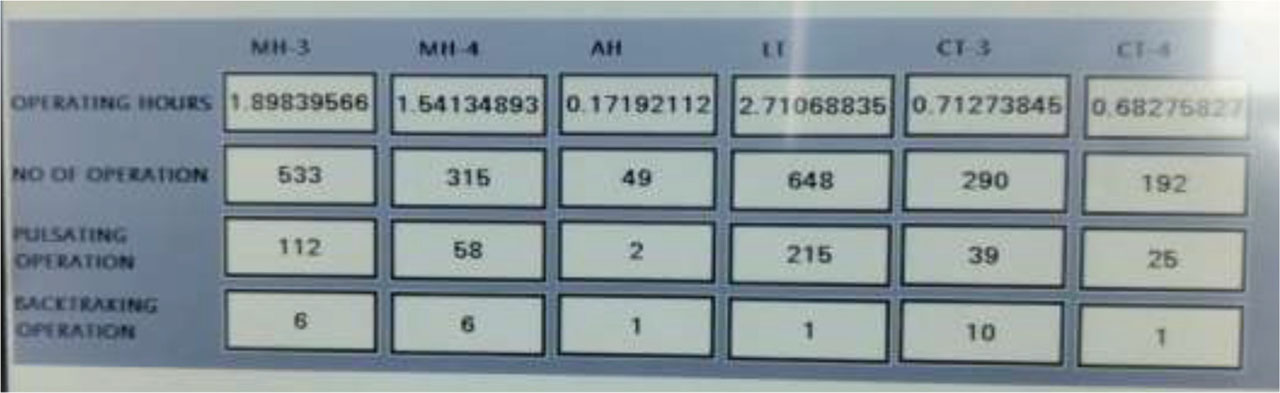
Figure 3:
Operating status of crane.
e. ML algorithms
An ML algorithm trains models on data to generate predictions or judgments. Decision trees are used for structured decision-making, neural networks for complex pattern recognition, and linear regression is used for continuous results. Similar data is grouped using clustering algorithms such as deep neural networks (DNN) and adaptive branch-and-bound methods.
Process of DNN: A type of ANN known as a deep neural network can simulate complex relationships and patterns in data because it has numerous layers between the input and output levels. Weighted connections are used by the networked nodes (neurons) in each layer to process and change the incoming data. Because of their architecture, DNN can learn hierarchical representations and perform tasks such as speech and image recognition with great accuracy. Based on the depth and intricacy of ANN algorithms, it is well-suited to a for range of datasets and complex patterns.
Additionally, the DNN output is tailored to the specific problem being controlled. This could be analyses the apparatus miscarriage and binary classification for predictive preservation. It could involve an estimate of Parameter settings that are ideal for performance optimization. An unusual score or a rating of normal versus aberrant behavior may result from anomaly detection. It could be an instruction to change settings for control systems, or it could be a categorization of fault types for fault diagnosis, as shown in Figure 4.
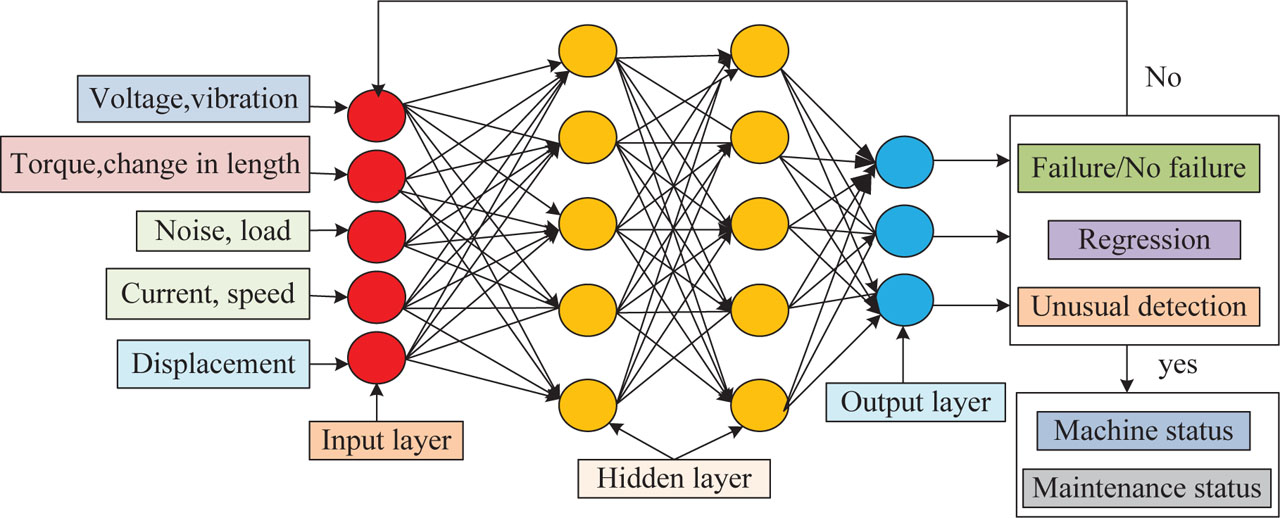
Figure 4:
Structure of DNN.
Adaptive Branch & Bound Method (ABB): The Adaptive Branch and Bound (AB&B) technique is effective at tackling complex optimization problems; it is employed in proactive upkeep for shipyard equipment. It assists in handling the complex choices associated with equipment replacement and maintenance by methodically examining and eliminating less-than-ideal options. Because of the method's flexibility, maintenance techniques can be both economical and environmentally responsive in response to shifting conditions and new data. Because of this, AB&B is very beneficial for optimizing predictive modeling, resource allocation, and maintenance plans at shipyards.
The following equations are pertinent to predictive maintenance's AB&B technique. Reducing the over-all cost of equipment maintenance is the goal of predictive maintenance's objective function Dahito et al. [39]. Usually, it is shown as Eq. (1),
where yj is a binary variable denoting upkeep (1) or no maintenance (0), and cj is the total expense of preserving or replacing equipment j. Then, find the resources available in Eq. (2) where R is the total number of resources available and rj is the quantity of resource needed for equipment j where, Ccur is the total current cost as of the moment.When adjusting for new information and limitations, these formulas aid in the optimization of resource allocation and maintenance schedules.
e.i. Other ML algorithms
Random Forest: To increase forecast accuracy and to manage overfitting, random forest (RF) is used, which is an ensemble learning technique that builds various decision trees during training and combines their outputs. The random portion of the data used for training each tree introduces noise, which allows for more diversity, thus leading to a better regularized model. The RF technique is particularly efficient for high-dimensional datasets owing to its ability to provide additional information about the contribution of each feature. Such info can be a handy map when deciding which features to use for predictive maintenance tasks.
XGBoost: XGBoost is a widely used Gradient Boosting, which is considerably faster and more accessible for implementation. It executes several models, includes regularization to prevent overfitting, and speeds up training through parallel processing. XGBoost is a very powerful tool when applied to structured data and is chosen for its wide-ranging uses, one of which is predictive maintenance, where the timing and accuracy of predictions are of utmost importance.
Gradient Boosting: Gradient Boosting utilizes a sequential ensemble technique; hence, it refines or rectifies the errors of previously created trees. The new one is always constructed based on the residuals of the previous trees; thus, the method is adaptive and enhances the model's performance. The gradient boosting technique is versatile and can be adjusted to optimize any differentiable loss function; it can thus be used for either regression or classification problems, which in turn makes it well-suited for predicting maintenance needs in light of historical performance data.
Multi-layer Perceptron (MLP) regressor: A neural network of artificial neurons with multiple layers, where neurons are interconnected. This scheme enables the MLPs to detect complex, nonlinear inter-actions in the data features. Although MLPs require hyperparameter tuning, they can be trained on equipment performance data to model complex patterns and thus are great at forecasting future maintenance from historical data.
Support Vector Regression (SVR): SVR is a subset of the SVM model that learns the optimal correlation between the inputs and the predicted outputs. SVR is a technique that is less affected by outliers and can use kernel functions to model non-linear relationships in data. Therefore, it is a viable method for predicting maintenance needs in complex data patterns.
AdaBoost: Adaptive Boosting, shortened to Adaptive Boosting (AdaBoost) is a technique that enhances a weak learning algorithm by successively running it on different training data distributions and then combining the classifiers in a weighted sum that represents the final output. This operation is performed by assigning weights to training instances and placing greater focus on those that the classifiers from previous rounds have misclassified. The adaptive nature of AdaBoost makes it raise its performance step-by-step and hence it is good for tasks that involve binary categorization. Predictive maintenance is an environment where, as a result, the technology could be used to improve the models by focusing on the most difficult cases where prediction accuracy is the highest.
f. Deep Learning
DL is a powerful subset of ML models driven by multi-layered, complex neural networks that automatically learn from complex data to identify and evaluate features across a wide range of datasets. Spatial pyramid attention networks (SPAN) and bidirectional long short-term memory (BiLSTM) networks are two sophisticated DL techniques that improve model performance in different ways.
BiLSTM: BiLSTM networks process forward and backward sequences to assess time-series data and perform predictive maintenance on shipyard equipment, improving scheduling, reducing downtime, and increasing operational efficiency.
From Figure 5, when utilizing BiLSTM techniques to analyze shipyard equipment, sensor data such as temperatures, torque, current, and vibration is used to track performance in real-time, operational data such as the equipment's lifespan and operating idle provides data on usage patterns and maintenance records, which include information on repairs and part replacements, are used to forecast maintenance requirements and improve equipment reliability.
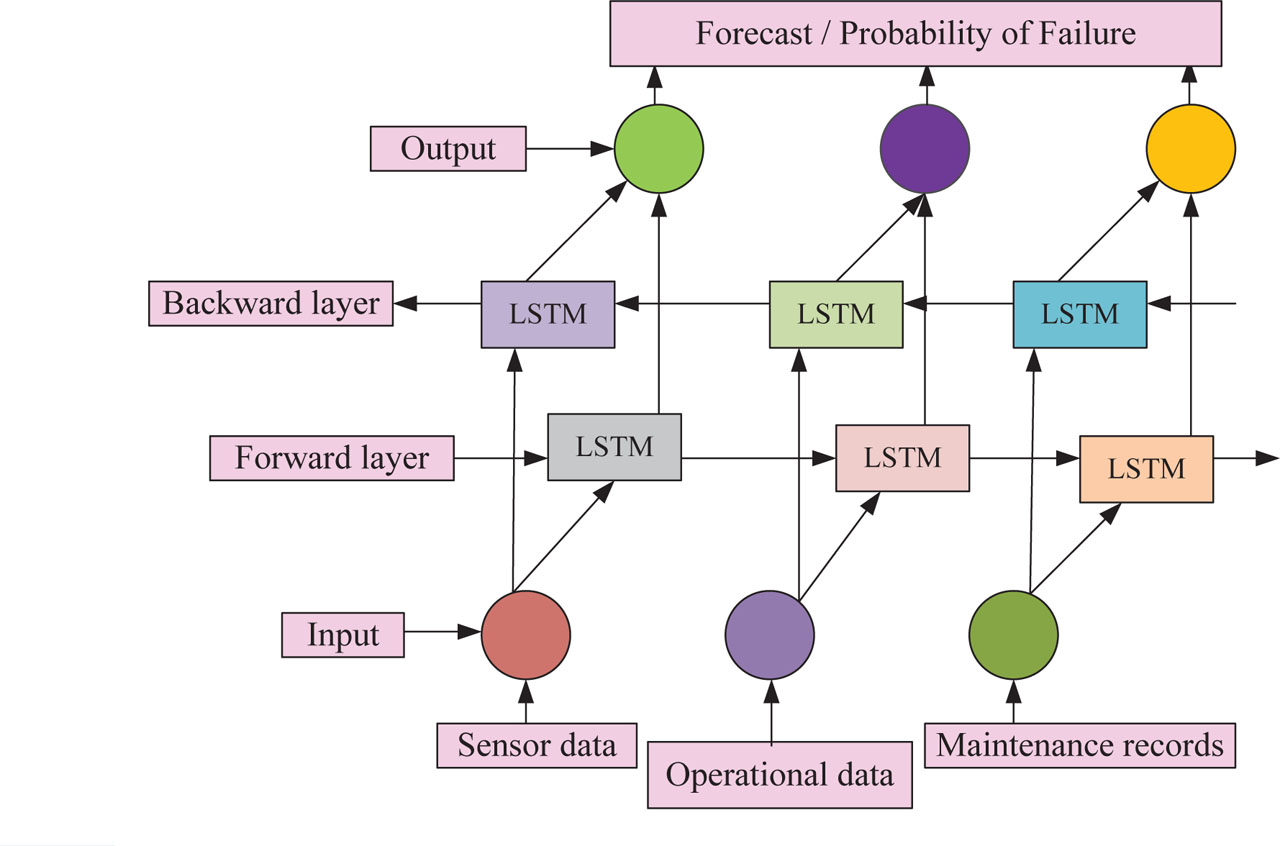
Figure 5:
Structure of BiLSTM. BiLSTM, bidirectional long short-term memory; LSTM, long short-term memory network.
In predictive maintenance, the first step involves gathering time series data from shipyard equipment, including sensor readings (temperature, vibration, and pressure) and operational parameters (load, speed). Normalize this data to ensure consistency, typically scaling values to a range of 0 and 1. The collected data are structured in a sequential representation based on time-dependent interactions. Here, the input sequences are represented as where n is denotes time duration of the entire equipment's components time series data. This study BiLSTM framework consists of dual LSTM layers, both performing well on the input data, with the remaining as backward. Also, this can verify the contextual information from both future and historical feature states of the each machinery thus improving the prediction functions. Then estimate the dual-layer function using Eq. (5).
Moreover, hidden state ( ) of the forward LSTM is considered with the present input It and the previous hidden state .
This method utilizes LSTM gates to successfully acquire sequential dependencies in predictive maintenance data.
Concurrently, the input series is handled oppositely by the diffident LSTM layer. For each time step t, calculate the hidden state value is by the input and the next hidden state value .
Eq. (7) allows the developed model to perform the future data, which is important for developing the potential struggle based on the detected data state.
Moreover, each time series, h′t integrates with the results from both directions, such as forward and backward LSTMs, to structure the complete hidden state , .
This combination enhances the model's representation of the input sequence, improving its ability to predict maintenance needs.
The integrated hidden states of the BiLSTM outcomes are fed into a dense layer, which is specifically designed to predict the probability of each machinery failure or remaining useful life (RUL). Then, the output is estimated using Eq. (9).
Here, Wy is represents matrix weight and by is represents bias of the output layer. Here, Softmax activation is a function being utilized to predict the multi-class elements; also, it is a linear function.
After generating the output at the output layer, it estimates the loss using the appropriate loss function, such as cross-entropy for a classification task, and MSE for each regression analysis. Loss is mentioned in the Eq. (10),
where Yj denotes true label class and the variable Yf is represents predicted probabilities of each class label.Use back propagation through time together with the calculated loss to update the weights of both LSTM layers. The procedure here is to calculate the gradients and change the weights to reduce the loss, thereby allowing the model to learn effectively from its predictions. The model is repeatedly iterated over several epochs, thus it continuously learns and updates its parameters based on the input data and the computed. Such an iterative training process is indispensable in optimizing the performance of the model in predictive maintenance tasks. After training, test the model on a different test or validation dataset. Precision and accuracy metrics are used to measure the quality of the model's predictions of maintenance events. Moreover, there are metrics that are specifically relevant to predictive maintenance, for example, the precision of failure predictions and the accuracy of RUL estimates.
Process of SPAN: SPAN is used to improve ship-building equipment maintenance by applying Spatial Pyramid Collaboration and Attention Mechanisms to precisely estimate failures. Also, this world improves equipment maintenance scheduling and reduces downtime. Moreover, the pyramid of space contains various measures and determinations of structures that are removed by the pooling function. Each pyramid level has a representation of the pooling process Sahal et al. [40], which approximates the following.
where Pool is a representation of pooling operations (such as max pooling and average pooling), and Zij is the characteristic image corresponding to the i-th layer and j-th spatial location. The numerous scales feature vector is created by concatenating the findings. where as stage (fj) is a numerical function that determines the significance of the characteristic fj (such as a learning function or a dot product). The depiction of the weighted features is, where, the attention-weighted function vector is denoted by Satt.The combined features are transformed into the final forecast using a thick layer. This is mentioned following Eq. (15),
where, B′ is denoted as bias with respect to the extremely dense layer, L′ is represents weighting factor and the transformation function is represents M′. The variable A′(f ) is the element-wise activation function that is applied. where, Lout and Bout denote the output layer's weights and bias.IV. Results and Discussions
Here, surveillance cameras are installed on a crane at a strategic point to capture continuous visual footage and analyze in-depth measurements of its parts while they're working. Initially, sizes and any variations from these measurements, which are very detailed in all aspects, are done by the real-time monitoring system, hence ensuring the exactness of tracking the problems that might arise. Moreover, the data is converted using a very advanced predictive analysis method, the BiLSTM-SPAN method, whenever variations or new faults are found. To identify potential faults and issues, this method, along with a separate test or validation dataset, combines a SPAN with BiLSTM model. The performance of the proposed model in terms of its ability to promptly generating warning messages or alerts in the event of potential problems or dimensional can be evaluated using metrics such as precision and accuracy. Figure 6 displays the prediction of changes in the crane component dimensions with BiLSTM-SPAN. Consequently, this proactive method, which is essentially about taking care of problems when they are still at a very minor level, thus significantly decreases the crane's downtime consequent to it being increased in the life span of the crane. The developed study examines the shipyard elements such as speed, torque, vibration, noise, voltage, change in dimension, current, and load. These elements are validated for the months and recorded the data points, which are presentation graphical. Also, the six crane classification was examined, and readings are measured based on the month-wise. This month, the crane recorded the highest values and also measured the lower values.
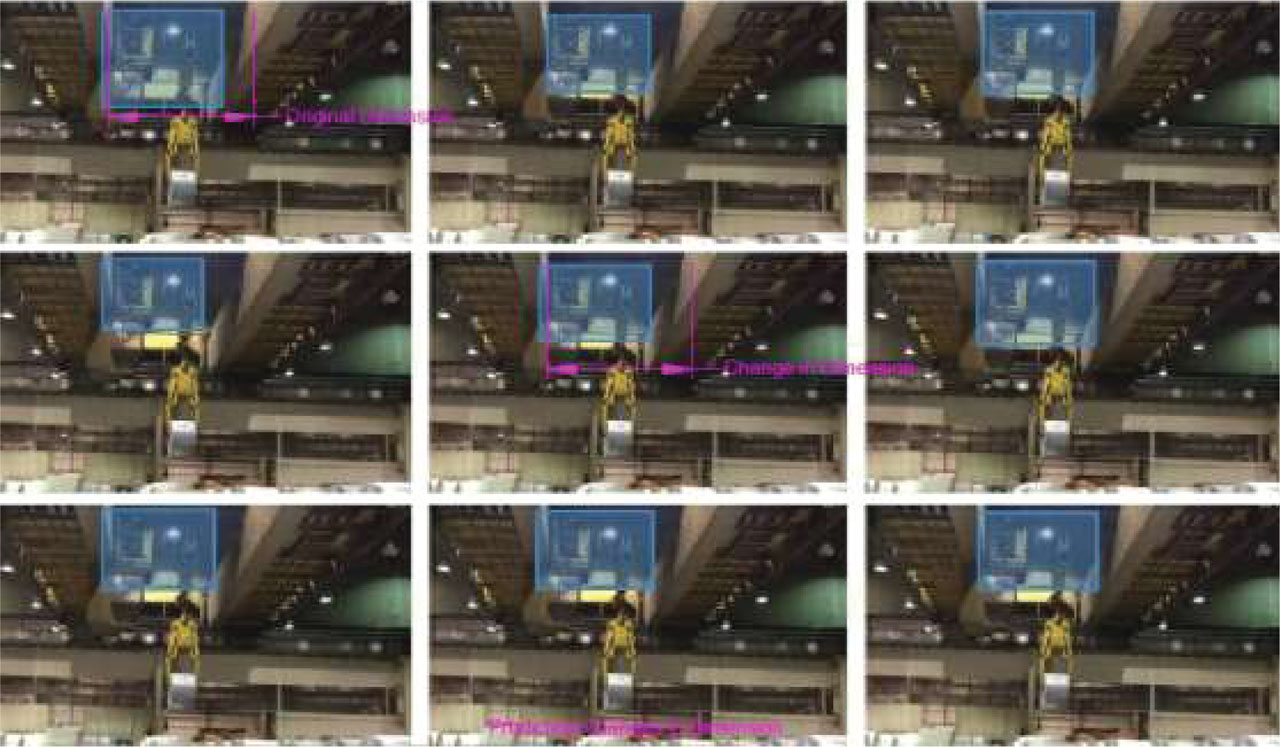
Figure 6:
Crane component dimensions change prediction using BiLSTM-SPAN. BiLSTM-SPAN, directional long short terms memory network with spatial pyramid attention networks.
Figure 7 demonstrates the voltage variation among the six various cranes classification like MH-3, AH, MH-4, LT, CT-3, and CT-4 under the periods of 31 days. From the observation, the MH-3 crane's power supply is a roller coaster of voltage fluctuations with the above-mentioned peak of 14,133.3 on Day 31, after starting the first day at a mere 488.9. In addition, the MH-4 crane voltage changes a percentage; its lowest point on Day 3 is 1,244.4 while the maximum reaches 14,977.8. The AH crane has a wider range with a minimum of 2,400 on Day 1 and a maximum of 16,000 on Day 31; consequently, from 4,088.9 on Day 1 to 17,422 on Day 31 the LT crane's performance increases gradually, showing a steady rising trend. However, it is the CT-3 and CT-4 cranes that are recording their highest output on Day 31. The given data reveals that crane operations are constantly changing, that time-related voltage variations can be very large, and the necessity of continuous monitoring, effectively control and achieve the maximum performance of the equipment.
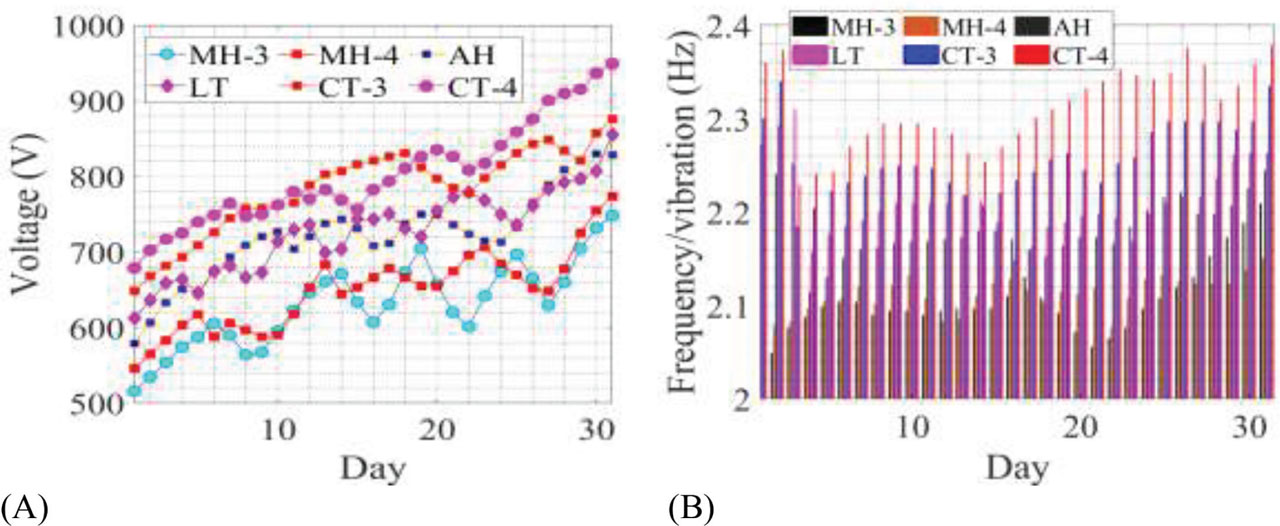
Figure 7:
Voltage (V) and vibration levels (Hz) recorded for six cranes over 31 days (A) Voltage readings and, (B) vibration measurements.
Different patterns of the crane vibration measures during 31 days are presented in Figure 7B. Vibration levels of the MH-3 crane are gradually increasing, moving from 2.0248 to 2.2095. The vibration graph shows that the CT-3 demonstrates a slow increase, rising from 2.3 to 2.35. However, MH-4 shows greater variability in its vibration growth, reaching 2.151 on Days 31. Hence, pointing to less stable functioning of the LT crane, whereas the presentation similarly shows a slight reduction in vibration from 2.27 to 2.26 during the same period. This would indicate a decreasing trend, which is at the same time. Moreover, the AH crane, which shows a prominent vibration peak at 2.2455 on the dissimilar CT-4, is showing a continuously rising trend, fluctuating but ultimately increasing from 2.36 to 2.38. These differences in vibrations of the various cranes reflect different performance patterns of the cranes and acknowledge the necessity of regular checking to ensure operational safety and early detection of any trouble.
Throughout a month, significant changes of crane torque at different hours are exposed in Figure 8A. Moreover, these changes, and the figure also portray the dissimilar concert trends of the numerous crane classification models. The torque of MH-3 is 10,720.7 at the very first time and rises nearly throughout the entire period to 31 days, achieving the maximum value of 36,126.1. Essentially, MH-4 follows the same pattern and leaves up to 37,657.7 with some significant fluctuations along the way, starting at 12,972.98. The torque of the AH crane starts at 16,486.5, drives despondently and up, and finally ends at 41,981.99, pointing out to its unstable performance. The LT crane model slowly but surely follows an upward trend, starting at 19,549.6 and almost doubling to 44,414.4, with slightly increased fluctuation. The performance of CT-4 is outstandingly impressive as it depicts a very clear leading trend right from the 24,234.23 point up to the whopping 49,189.19 position, which in fact is a considerable rise. CT-3 comes to a maximum of 46,306.31 after a steady growth from 21,981.98, and strong torque levels are maintained throughout the whole period. The differences between the performances of the various cranes are reflected in the profiles and pinpoint the need for the uninterrupted listening of the stability of the operation and the efficient regulation of the torque.
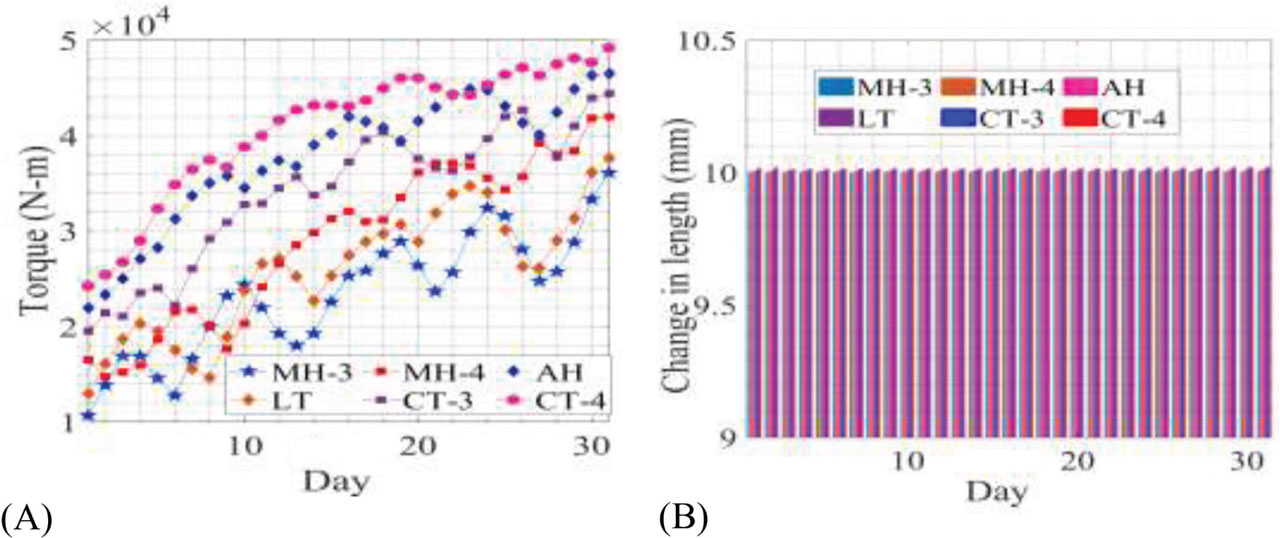
Figure 8:
Torque and dimensional changes (mm) recorded over 31 days. (A) crane torque values and (B) dimensional changes.
The differences in size changes for several crane models during 31 days are demonstrated in Figure 8B. The size ranges of MH-3 and MH-4 cranes are exceptionally dependable. Moreover, MH-3 varies from 10.00021 to 10.005, while MH-4 ranges from 10.002 to 10.008. Nevertheless, the AH crane displays more variation in its size range from 10.005 to 10.015, which implies that there is some variation in its measurements. The LT crane is maintained within a slightly consistent range of 10.008 to 10.013 over the specified period. There are broader deviations in both CT-3 and CT-4, where CT-3 is amongst 10.012 and 10.022, similarly; CT-4 is between 10.015 and 10.022. Although these differences exist, all the cranes frequently display a higher degree of stability in the dimensional depth. In addition, the fluctuations, which are in fact small, point to the differences in measurement accuracy or performance that have taken place during the 31 days and thus emphasize the importance of regular monitoring to be able to regulate and appreciate these deviations properly.
The detailed information about crane noise levels for 31 days is demonstrated in Figure 9A. Through the complete period of 31 days, MH-3 is displaying a continuous increasing trend, going up from 84.9 to 88.4. In a comparable method, MH-4 is moving upward, getting 87.95 from 85.56. The AH and LT are following the increasing paths, with the first one rising from 86.1 to 88.9 and the latter from 86.7 to 89.4. Correspondingly, CT-3 shows a gradual increase with very small changes from 87.1 to 89.9. The most noteworthy constructive change is occurring in CT-4, where the value is increasing from 87.64 to 90.50, suggesting a remarkable overall advancement. Although an overall upward trend can be seen for all the variables, the daily changes are rather substantial. Consequently, it is represented that the development has been constant, but the dimension inconsistency is small. If the data is taken into account, the reliable rise in crane noise can be incidental, which is one of the reasons why it is very important to monitor and control noise levels during crane operations in order to get peak efficiency.
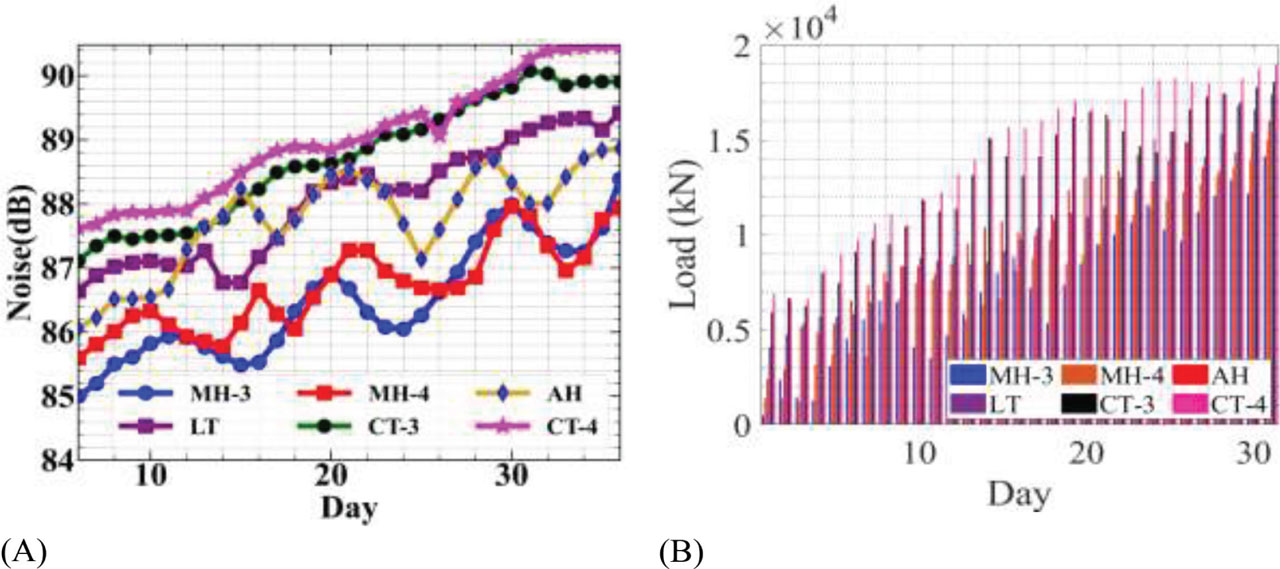
Figure 9:
Noise levels (dB) and load values (kN) recorded for six cranes over 31 days. (A) Noise measurements and (B) load variations.
Figure 9B indicates the changes in load analyses for numerous types of crane classification over a particular period of time. Besides, it depicts the significant trends as well as the variations. MH-3 with the load of 14,133.3 on Day 31 and 488.89 on Day 1, respectively, clearly demonstrates the significant and continuous growth in the load, which is revealing of a continued demand development. In a similar manner, MH-4 is on an upward path, the figure of 1,377.78 being the starting point and 14,977.78 the final one, thus representing the simultaneous developments. The AH metric points to a net increment from 2,400 to 16,000, therefore reflecting a general growing pattern, nevertheless, the variations. LT also shows a general increasing trend which is visible in the rise of the figure from 4,088.89 to 17,422.22 although with some shaking in the middle of the period. The CT-3 and CT-4 have been presenting theatrical growth: CT-3 is moving on from 5,911.1 to 18,044.4, while CT-4 is going from 6,888.9 to 18,933.3. The entire set of data points to a steady tendency of growth in the capacity of crane functionality or load handling. This overall trend serves to highlight the continuous improvements and alterations of the systems being estimated, which over time have resulted in advanced load demands or increased functioning capacity.
Figure 10A portrays a comprehensive summary of the observed performance pointers over 31 days for each crane monitoring mechanism. All six of the tracked cranes have demonstrated significant enhancements according to the measurements obtainable. To be precise, MH-4 is the one that reproduces a very noteworthy increase in this degree, going up from 209.9 to 342.9. Accordingly, MH-3 is also doing better as it goes up from 199.41 to 332.34. A promising trend is also observed in the LT metric, which went up from 236.31 to 370.41. The AH parameter follows a similar rising trend and goes up from 224.01 to 354.01. Besides, the trend of increasing is also apparent for CT-3 and CT-4 where CT-3 goes from 246.85 to 381.53 and CT-4 from 259.14 to 395. There is a steady increase in every one of the metrics which have been under observation, hence, the effectiveness and the performance of the crane have gone up considerably over the time that has been studied, operational gains in general have been highlighted.
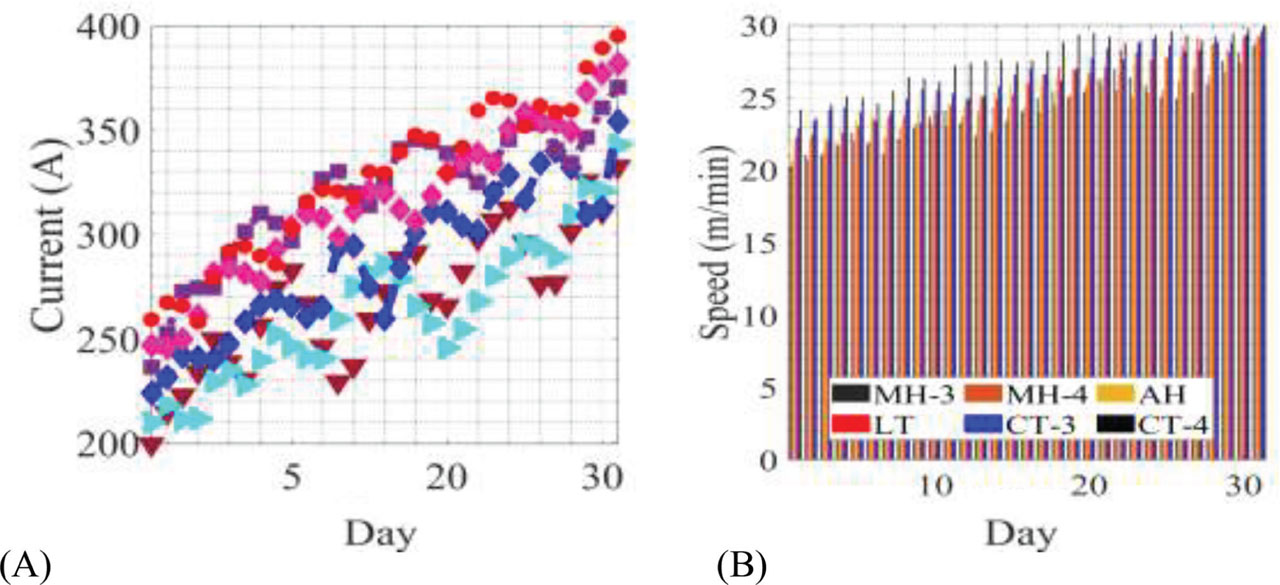
Figure 10:
Current (A) and operational speed (m/min) recorded for six cranes over 31 days. (A) Current measurements and (B) speed variations.
Figure 10B presents six dissimilar signs for the speed variations of the crane over a period of 31 days. MH-3 shows a gradual increase all along the way, beginning at 20.25 and steadily going up to 28.62 at the end of the time frame. There is a similar consistent improvement in the AH crane, which goes up from 21.87 to 29.39. A steady increase in MH-4, which starts at 20.68 and ends at 28.94, is also apparent. The LT measure reveals a steady rise from 22.30 to 29.23, thereby highlighting a positive trend. Moreover, for CT-3 the numbers are going up from 22.89 to 29.64 and for CT-4 from 24.18 to 29.98, thus the general upward trend in all metrics is a clear indication of the performance that has improved expressively, which means the crane's speed and efficiency have increased toward the end of the month. The overall information indicates a positive trend in the crane's operating conditions, suggesting significant performance gains of a significant level.
Moreover, Table 3 displays the readings recorded daily for six different crane classifications such as MH-3, MH-4, AH, LT, CT-3, and CT-4 across the periods of 31 days. Also, the crane classification CT-4 achieves a higher value on day 31, while the other model takes a minimum on day 7. Some noticeable patterns and variances occur throughout the days. Specific indicators, like LT, have consistent peaks and troughs, while other indicators, like AH, and exhibit significant variability. By examining these data points and searching for correlations, trends, and patterns among the various cranes, one might gain insight into the total result influencing these measurements.
Table 3:
Results of displacement
| Days | MH-3 | MH-4 | AH | LT | CT-3 | CT-4 |
|---|---|---|---|---|---|---|
| 1 | 6,215.773 | 9,324.361 | 12,297.11 | 14,999.12 | 17,161.76 | 18,783.39 |
| 2 | 8,511.442 | 11,079.25 | 15,399.62 | 16,347.21 | 18,103.97 | 19,859.8 |
| 3 | 10,536.37 | 12,699.25 | 15,393.54 | 17,423.62 | 18,909.17 | 20,666.17 |
| 4 | 12,966.48 | 14,181.3 | 12,957.13 | 17,148.67 | 17,551.5 | 19,175.47 |
| 5 | 13,637.71 | 12,152.39 | 10,789.58 | 15,388.63 | 15,249.52 | 18,359.51 |
| 6 | 11,471.57 | 11,068.97 | 12,948.01 | 13,493.69 | 16,733.44 | 18,084.56 |
| 7 | 8,088.968 | 8,902.588 | 15,510.67 | 14,166.33 | 17,945.92 | 19,972.02 |
| 8 | 6,328.23 | 7,276.751 | 17,126.93 | 16,054.26 | 19,696.84 | 20,912.59 |
| 9 | 8,890.664 | 9,031.411 | 15,227.54 | 17,671.91 | 18,878.55 | 19,962.67 |
| 10 | 11,996.45 | 11,055.17 | 13,059.76 | 18,612.95 | 17,792.08 | 19,281.38 |
| 11 | 14,019.51 | 13,889.75 | 16,298.81 | 17,663.26 | 17,248.03 | 18,735.46 |
| 12 | 13,472.42 | 15,371.1 | 16,159 | 16,847.77 | 19,136.43 | 20,623.62 |
| 13 | 10,901.33 | 15,365.25 | 13,990.75 | 15,762.24 | 20,620.35 | 22,105.9 |
| 14 | 9,277.367 | 12,522.96 | 13,039.89 | 17,919.74 | 19,939.99 | 21,560.45 |
| 15 | 11,030.16 | 10,627.55 | 11,953.66 | 17,780.16 | 18,044.82 | 19,799.01 |
| 16 | 13,863.8 | 13,191.63 | 12,894.7 | 16,695.57 | 17,230.5 | 18,577.18 |
| 17 | 13,046.67 | 15,621.5 | 16,132.35 | 15,338.83 | 16,414.07 | 18,705.77 |
| 18 | 10,069.24 | 13,724.92 | 17,072.92 | 15,064.12 | 16,544.07 | 20,864.43 |
| 19 | 9,658.225 | 11,422.94 | 15,308.67 | 14,519.13 | 18,837.16 | 22,075.28 |
| 20 | 8,300.322 | 11,147.99 | 13,681.9 | 15,730.91 | 20,050.34 | 21,933.59 |
| 21 | 10,323.62 | 10,330.86 | 13,002.72 | 17,753.27 | 21,126.05 | 20,849.23 |
| 22 | 13,563.83 | 10,461.56 | 14,348.46 | 18,965.05 | 19,500.68 | 19,628.34 |
| 23 | 13,559.16 | 12,486.25 | 15,830.28 | 17,475.05 | 18,550.29 | 18,947.98 |
| 24 | 11,932.39 | 14,915.42 | 16,500.81 | 16,931 | 17,329.16 | 19,889.02 |
| 25 | 9,900.207 | 15,585.96 | 16,361.47 | 16,116.68 | 16,649.51 | 20,695.86 |
| 26 | 8,679.31 | 14,231.33 | 14,736.33 | 15,301.89 | 18,131.79 | 21,231.96 |
| 27 | 9,755.018 | 12,605.02 | 13,112.84 | 14,757.38 | 19,074.47 | 20,958.19 |
| 28 | 12,318.62 | 11,519.5 | 14,326.95 | 16,644.13 | 19,203.29 | 20,684.87 |
| 29 | 14,068.6 | 10,569.11 | 16,218.85 | 17,721.24 | 19,198.85 | 20,005.69 |
| 30 | 12,033.85 | 12,728.94 | 17,434.14 | 17,439.51 | 19,192.07 | 21,759.41 |
| 31 | 10,270.54 | 12,702.52 | 17,432.73 | 18,918.76 | 20,405.48 | 22,432.52 |
a. ML model selection and training
Predicting an instance's class as a failure or regular operation alone is insufficient for predictive maintenance. To the extent that maintenance or other preventative measures can be performed in advance, it is more crucial to accurately estimate the amount of time remaining well in advance of any probable failure. Therefore, rather than being a classification problem, the problem is better understood as a work involving regression. In other words, the model's objective was to estimate the reaming valuable time left before a failure using a method based on data.
It is not appropriate to treat this prediction problem as a time series issue, even if it may seem like one, because the algorithm cannot confirm exactly when it comes to error values at run time until the subsequent failure occurs. Predictions are based on forecasts from earlier input time steps, as it is not feasible to determine prediction errors from source time steps for propagation across time.
b. Comparison of actual and predicted values
The comparison between exiting BiLSTM and AdaBoost models highlights the unambiguous difference in performance for predictive maintenance tasks. From the observation, BiLSTM displays tremendous predictive capability as well as a strong fit to the data as demonstrated by an R2 score of 0.91. It achieves a minimum root mean square error (RMSE) of 35.40 and a mean absolute error (MAE) of 120.00, demonstrating its ability to approximate actual values very closely. On the contrary, AdaBoost achieves an a R2 of 0.327, which is significantly lower than that of BiLSTM, thus indicating inferior model performance is inferior. Consequently, the MAE of 692.89 and RMSE of 889.45 indicate considerable prediction errors, as shown in Figure 11A.
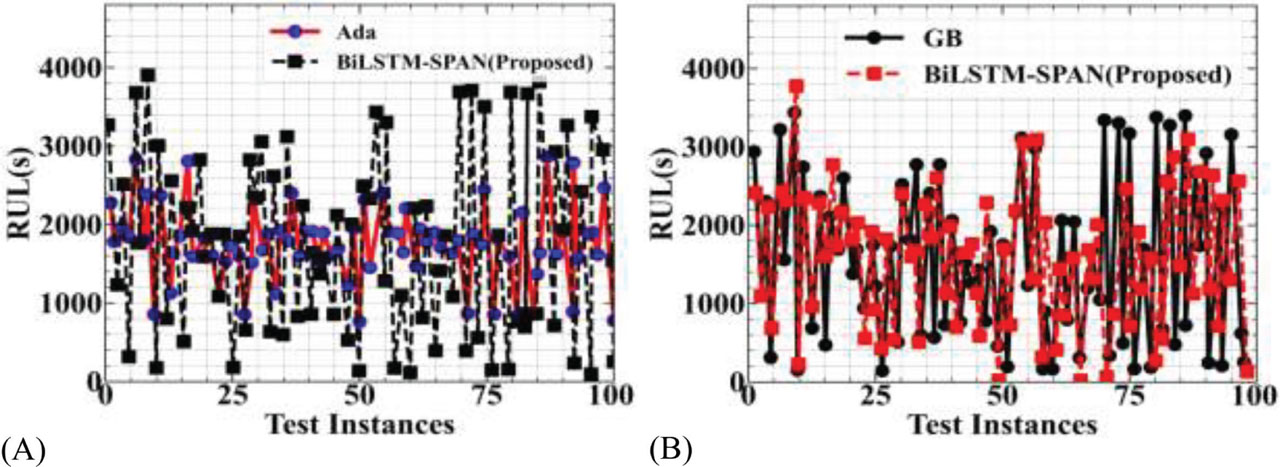
Figure 11:
Comparison of BiLSTM-SPAN (A) AdaBoost and (B) Gradient Boosting. AdaBoost, adaptive boosting; BiLSTM-SPAN, directional long short-term memory network with spatial pyramid attention networks; RUL, remaining useful life.
Figure 11B, which illustrates the performance comparison between conventional Gradient Boosting and BiLSTM shows substantial differences in their relevant analytical competencies concerning the task at hand. Gradient Boosting achieved an MAE of 285.31 and a RMSE of 432.85, with an R2 value of 0.767, thus indicating a reasonable data fit. Meanwhile, BiLSTM performed better than Gradient Boosting as it had a higher R2 of 0.910, which means that there was a stronger correlation between the predicted and actual results. BiLSTM also demonstrated higher accuracy with an RMSE of 120.00 and a significantly lower MAE of 35.40. The results here suggest that BiLSTM is more capable of uncovering the underlying trends in the data, thereby making it the appropriate choice for predictive maintenance use cases in this context.
The comparison of the MLP Regressor and BiLSTM in Figure 12A reveals that BiLSTM clearly outperforms in terms of performance. The MLP Regressor has an R2 of 0.654, an MAE of 378.28, and a moderate level of predicted accuracy with an RMSE of 533.47. BiLSTM, however, attains a lower MAE of 35.40, RMSE of 120.00, and a considerably better R2 of 0.910. This highlights BiLSTM's excellent ability to capture complex data patterns, thus making it the best choice for predictive maintenance tasks.
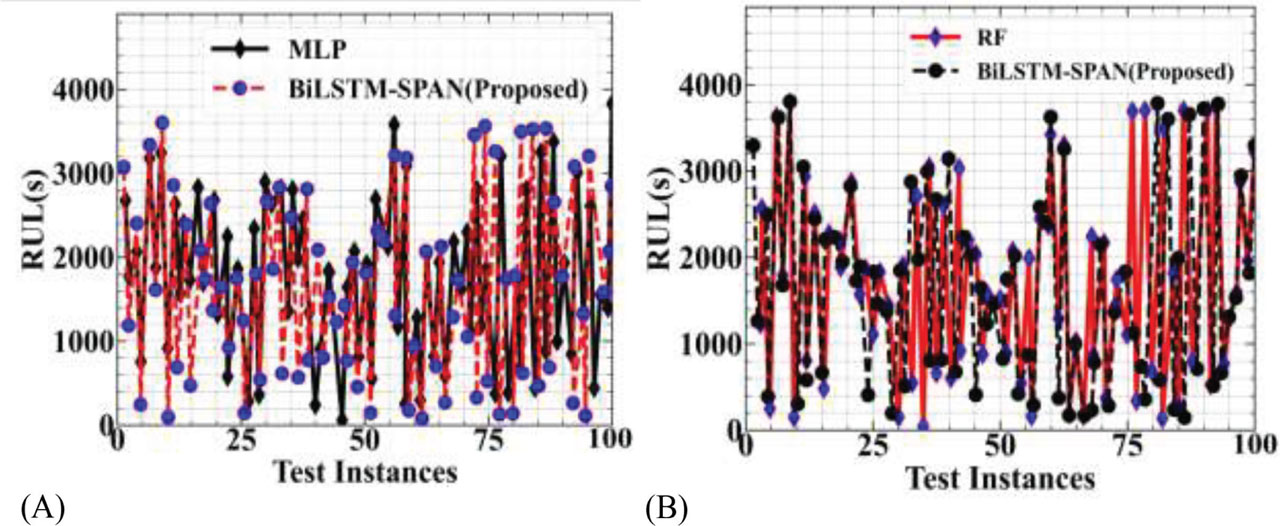
Figure 12:
Comparison of BiLSTM-SPAN (A) MLP Regressor and (B) RF. BiLSTM-SPAN, directional long short-term memory network with spatial pyramid attention networks; MLP, multi-layer perceptron; RF, random forest; RUL, remaining useful life.
Figure 12B demonstrates the comparison between RF and BiLSTM, in which BiLSTM demonstrates better predictive capabilities than the RF model. In addition, the RF model obtains an R2 of 0.892, reproducing a strong fit, with an MAE of 41.9 and an RMSE of 127.2. Though these results are promising, BiLSTM goes beyond them to reach an R2 of 0.91, indicating an even better fit. Besides that, BiLSTM has a lower MAE of 35.4 and RMSE of 120, which suggests that it is more precise in making prediction outcomes. This recommends that the BiLSTM is more efficient in uncovering intricate patterns in data, thus being applicable for predictive maintenance applications.
Figure 13A displays a stark contrast in the performance of SVR and BiLSTM, with BiLSTM expressively outperforming SVR. The SVR is characterized by low predictive accuracy as indicated by an R2 of 0.34, a very high MAE of 593.6, and an RMSE of 798.1. In contrast, BiLSTM has a very low MAE of 35.4, a considerably higher R2 of 0.91, and an RMSE of 120.00. This clearly validates that BiLSTM has a powerful to expose complex patterns in the data, which makes it highly appropriate predictive maintenance.
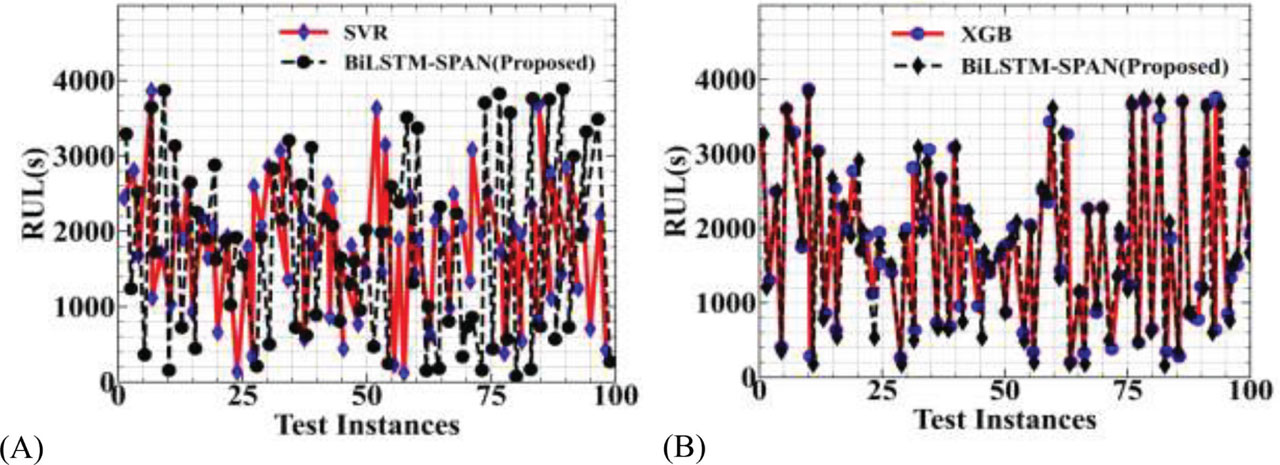
Figure 13:
Comparison of BiLSTM-SPAN (A) SVR and (B) XGBoost. BiLSTM-SPAN, directional long short-term memory network with spatial pyramid attention networks; RUL, remaining useful life; SVR, support vector regression; XGBOOST, eXtreme gradient boosting.
Figure 13B shows the performance comparison of XGBoost and BiLSTM, showing the latter's advantage in prediction accuracy over the former. XGBoost attains an MAE of 71.02 and an RMSE of 147.38, with an R2 of 0.889, indicating a good fit to the data. While these numbers are rather good, BiLSTM still manages to exceed XGBoost performance as demonstrated by an even developed R2 of 0.910. Besides, BiLSTM has an MAE of 35.40 and an RMSE of 120.00, both of which are expressively lower than the equivalent values of the other model, and thus it is a lot more precise in forecasting. The main takeaway from this is that BiLSTM is more capable of discovering complex data patterns and hence is probably to be the best model for predictive maintenance tasks.
c. Comparative analysis of proposed DL with conventional ML algorithms
The proposed model's predictive performance is compared with existing ML models in terms mean absolute percentage error (MAPE), MAE, RMSE, and coefficient of determination (R2) Ayvaz et al. [37].
R2 is the percentage of the dependent variable's overall variability that the predictive model was able to lower. Stated differently, the fraction of total ambiguity that simulation has contributed to explaining is used to gauge the model quality. A greater R2 value often denotes a better model fit.
The MAE calculates the average absolute difference among models predictions and the test sets actual failures.
In the formula, ŷipred is the algorithm's estimated remaining practical time value and yiact is the test dataset's actual value. A lower MAE indicates the algorithm makes better predictions about possible errors. MAE and MAPE are pretty comparable. The primary distinction is that, unlike absolute values, MAPE measures percentage variation.
The deviation of the prediction errors in from the mean is measured by the widely used RMSE metric.
The formula for determining the RMSE measure is shown in Eq. (19). In a similar vein, a lower RMSE number is better since it suggests that the model predictions are more precise.
With the highest R2 (0.910) and the lowest MAE, MAPE, and RMSE, the BiLSTM model performs better than all other algorithms and offers the best accuracy in predictions. While RF and XGBoost trail closely, their error metrics are marginally higher. AdaBoost has the lowest R2 and greatest errors, indicating the worst performance, followed by Gradient Boosting, MLP Regressor, SVR, and AdaBoost, which perform progressively worse as shown in Table 4.
Table 4:
Comparison of prediction result
| Algorithm | R2 | MAE | MAPE | RMSE |
|---|---|---|---|---|
| BiLSTM (proposed) | 0.910 | 35.40 | 2.10 | 120.00 |
| RF | 0.892 | 41.87 | 2.37 | 127.17 |
| XGBoost | 0.889 | 71.02 | 4.19 | 147.38 |
| Gradient boosting | 0.767 | 285.31 | 33.99 | 432.85 |
| MLP regressor | 0.654 | 378.28 | 20.29 | 533.47 |
| SVR | 0.341 | 593.55 | 32.77 | 798.11 |
| AdaBoost | 0.327 | 692.89 | 37.23 | 889.45 |
The cross-validation and statistical significance performances are outlined in Table 5. Here, the 5-fold cross-validation with paired t-tests for assessing statistical significance thereby strengthens the evaluation. To enhance the generalization performance of the proposed model, the standard deviation and mean matrices are valued through the 5-fold cross-validation. Also, the proposed framework achieves better performance than the baseline models and shows statistically significant enhancements (p < 0.05).
Table 5:
Cross validation and statistical significance performances
| Algorithm | R2 (mean ± std) | MAE (mean ± std) | RMSE (mean ± std) | Statistical significance (p-value) |
|---|---|---|---|---|
| BiLSTM-SPAN (proposed) | 0.910 ± 0.008 | 2.51 ± 0.10 | 0.910 ± 0.10 | - |
| RF | 0.841 ± 0.0013 | 3.18 ± 0.14 | 0.841 ± 0.17 | 0.013 |
| XGBoost | 0.859 ± 0.0011 | 3.35 ± 0.16 | 0.859 ± 0.19 | 0.016 |
| Gradient boosting | 0.878 ± 0.009 | 2.98 ± 0.12 | 0.878 ± 0.15 | 0.008 |
| MLP regressor | 0.865 ± 0.0010 | 3.12 ± 0.14 | 0.865 ± 0.17 | 0.012 |
| SVR | 0.872 ± 0.0011 | 3.05 ± 0.13 | 0.872 ± 0.16 | 0.010 |
| AdaBoost | 0.857 ± 0.0012 | 3.21 ± 0.15 | 0.857 ± 0.18 | 0.014 |
d. Practical insights: Using integrated BiLSTM-SPAN based shipyard scheduling
BiLSTM-SPAN's predictive outcomes are directly combined into shipyard maintenance scheduling for converting reactive approaches and conventional preventive models into a fully proactive data-driven system. During the maintenance periods, if there is any variation, such as load, speed, torque, vibrations and dimensional shifts, they are able to provide a signal to the maintenance team before a fault time. This is the effective way to provide better planning to schedule the repairs during a small duration of 31 days as an alternative to devising for the future for failures. Also, these predicted trends are used to enhance the spare-parts standard, so the repaired parts are correctly ordered based on the demand generation. The developed model results were linked to digital technology to achieve better preservation through an automated process in the ship-yards. Overall, the usage of proposed BiLSTM-SPAN in the scheduling functions leads to a maximum in machinery availability, a reduction in unplanned downtime, and an enhancement of security and operational efficiency
V. Conclusion
The research study represents a significant advancement in understanding the function of the shipyard inner working at Hindustan Shipyard in Visakhapatnam. This study provides a complete analysis of shipyard actions with respect to the day-to-day direct exposures in ship repairing practices. The experimental analysis reveals operational processes and analyzes actual shipbuilding processes, which are significantly enhanced based on the large shipbuilding factory.
By closely observing and analyzing vital equipment data, the research merges DNN-ABB with the latest tech to the very limit, which includes vibration and displacement sensors, and recording cameras to boost the precision of predictive maintenance.
The voltage of MH-3 fluctuates between 488.89 and 14,133.33, whereas the torque goes up from 10,720.72 to 36,126.13 over the period of 31 days. The torque of MH-4 is increasing from 12,972.97 to 37,657.66, while the voltage is changing from 1,244.44 to 14,977.78. The AH crane's voltage and torque are going up and down between 2,400 and 16,000 and 41,486.49 and 41,981.98, respectively. CT-3 and CT-4 show significant increments in load and torque, which are quite noticeable, with CT-4 showing the greatest development, while the LT crane performance is going on, strengthening further.
The results describe the suggested BiLSTM-SPAN model as much more capable than the traditional ML methods, especially for handling complex sequential tasks. BiLSTM-SPAN exhibits excellent precision and stability under various test scenarios by registering very low MAE of 35.40, MAPE of 2.10, and RMSE of 0.910, 120.00.
In a similar vein, RF hardly sustains the competitive lead as evidenced by the metrics: R2 of 0.892, RMSE of 127.17, MAE of 41.87, and MAPE of 2.37. This algorithm, however, is still less powerful than the BiLSTM-SPAN model in terms of predictive capability. The rest of the algorithms, i.e., XGBoost, Gradient Boosting, MLP regression, SVR, and AdaBoost, have worse performance metrics than BiLSTM-SPAN, indicating its superiority in predictive maintenance tasks.
The study drawbacks include possible defects in the data collection process and difficulties in extrapolating results across various crane types and operating environments. Furthermore, the BiLSTM-SPAN model's complexity might necessitate a large amount of computer power, which could limit its practical application.
Future scope: For wider application, future research should concentrate on extending the study to multiple shipyards and other types of machinery. For practical application, real-time decision-making systems must be integrated, and data quality must be improved. Predictive maintenance effectiveness can also be increased by investigating scalable solutions and cutting-edge ML approaches.
Acknowledgments
None.
Notes
[6] Compliance with Ethical Standards
Potential Conflict of Interest Disclosure: |None of the authors have any potential conflicts of interest.
Declaration on Human and Animal Rights
Ethical Approval: All relevant national and/or academic regulation for the use and care of animals was strictly adhered to.
Informed Consent
Formal consent is not essential for this particular type of research.