
Table 1:
Performance comparison among existing research work
| Authors | Methodology | Dataset | Key contributions | Performance |
|---|---|---|---|---|
| Dey et al. [16] | Enhanced TF-IDF + Neural Networks | Amazon reviews, social media | Blended sentiment evaluation using textual features | Accuracy: 84.5%–90.2% |
| Jena et al. [17] | Chi-square test + AdaBoost (textual + social media features) | Publicly sourced social datasets | Combined textual and social features for cyber-bullying detection | Accuracy: 90.2% |
| Jadon et al. [18] | Deep learning and social-text features | Custom cyber-bullying dataset | Used deep learning for integrated feature analysis | Accuracy: 93.3% |
| Aliyeva et al. [19] | ANN | 3,000 Twitter posts | Created and trained neural models on Twitter posts for cyber-bullying detection | F1-score: 90% |
| Geng et al. [20] | Spatial-Temporal GNN | Urban traffic data | Used ST-GNN for traffic prediction in dynamic networks | Significant improvement |
| H.Gu et al. [21] | RL-based adaptive traffic signal control | Simulated traffic networks | RL used to outperform fixed signal strategies | Adaptive performance |
| Raman et al. [22] | Deep RL (DQN-based routing) | Communication network traffic traces | Learned routing strategies in dynamic networks | Improved throughput |
| Li et al. [23] | GNN-based state representation for RL | Small synthetic graphs | Early integration of GNNs and RL for decision tasks | Task-specific gains |
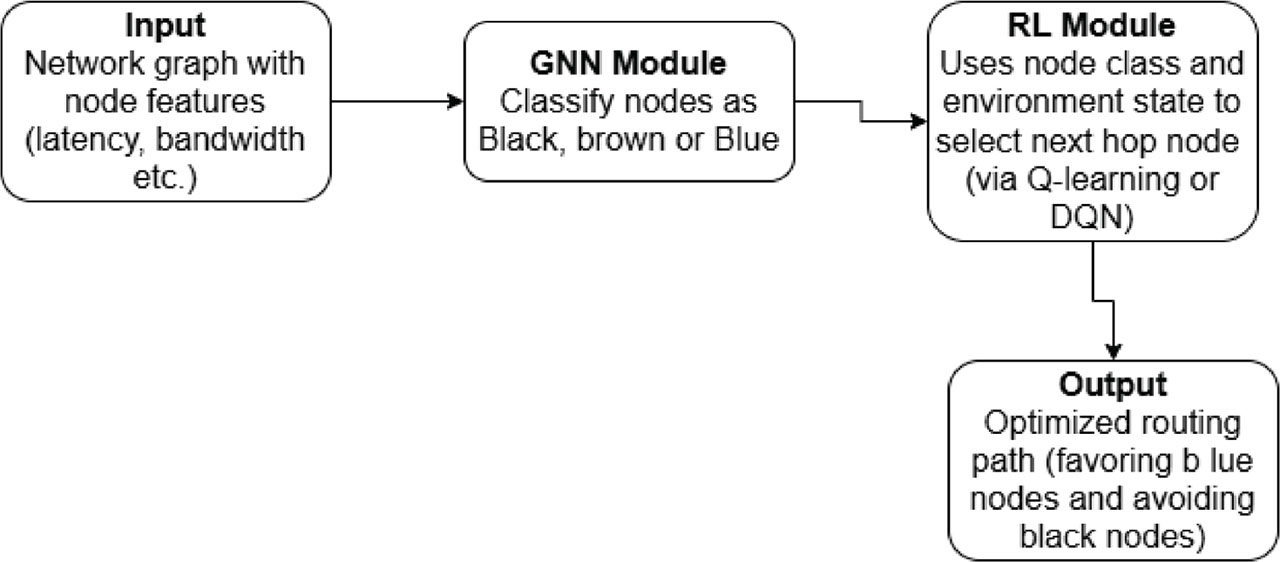
Figure 1:
Architecture of NeuroRoute-GNNRL. DQN, deep Q-networks.
Table 2:
Symbol table summarizing the description of symbols used in the algorithm
| Symbols | Description |
|---|---|
| A | Adjacency matrix |
| Aˆ = D–1/2(A + I) D−1/2 | Normalized adjacency with self-loops |
| GNN parameters W | W = {W(1)} for 1 = θ..L1 |
| GNN forward: H(θ) | H(θ) = X, H(1+1) = σ(Aˆ H(1) W(1)) |
| Z | Z = Softmax(H(L)) ∈ Rn×3, node label y_i = argmax_c Zi, c |
| GNN loss: LGNN(W) | LGNN(W) = - Σi ∈ Ytrain Σc=13 yi,c log zi,c (if labelled set exists) |
| RL reward function r(s, a) |
|
Table 3:
Comparison table with traditional routing
| Topology | Traditional (OSPF) (%) | GNNRL framework (%) | Gain (%) |
|---|---|---|---|
| NSFNet | 93.2 | 98.6 | 5.40 |
| GEANT | 89.7 | 96.1 | 6.40 |
| Random-100 | 82.4 | 90.3 | 7.90 |
| GÉANT2 | 88.5 | 95.0 | 6.50 |
| Internet2 | 90.1 | 96.4 | 6.30 |
| Fat-Tree (K = 4) | 85.2 | 92.7 | 7.50 |
| Barabási-Albert (BA-Scale-Free) | 84.6 | 91.9 | 7.30 |
| Waxman | 83.1 | 90.6 | 7.50 |
| Grid (10 × 10) | 80.5 | 89.8 | 9.30 |
| Real World IX (IXP-based) | 87.4 | 94.2 | 6.80 |
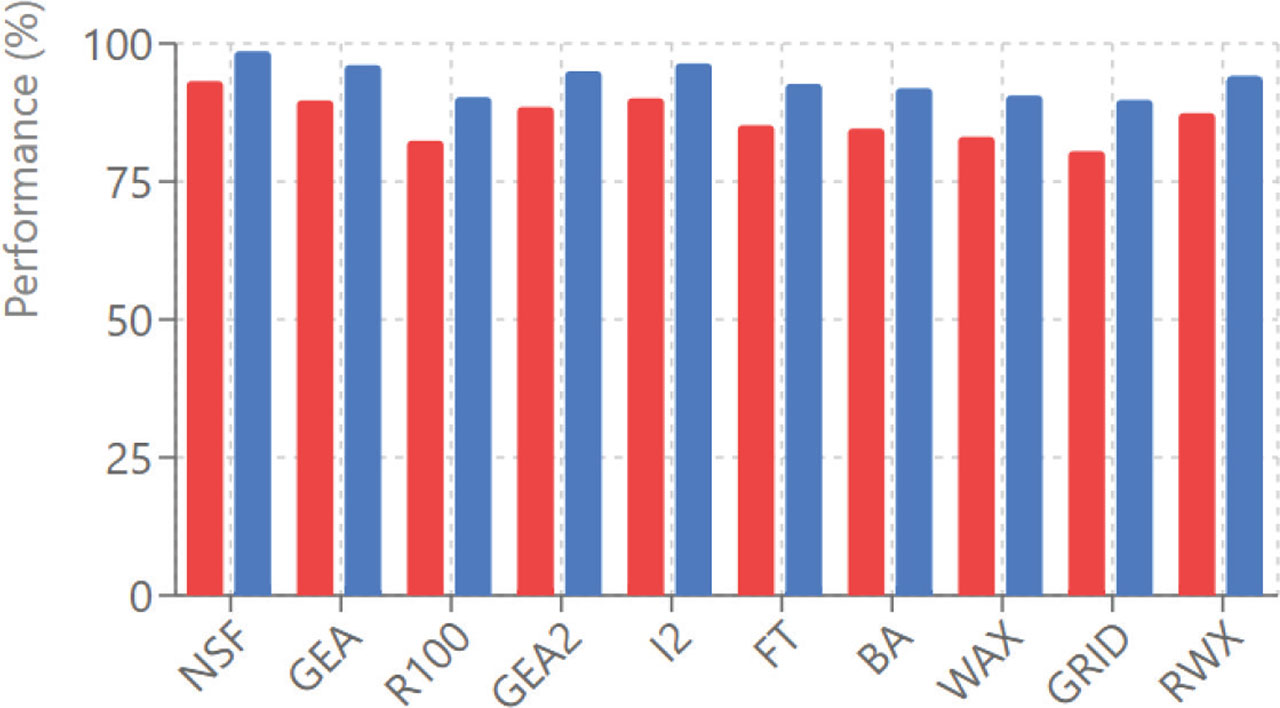
Figure 2:
Performance comparison.
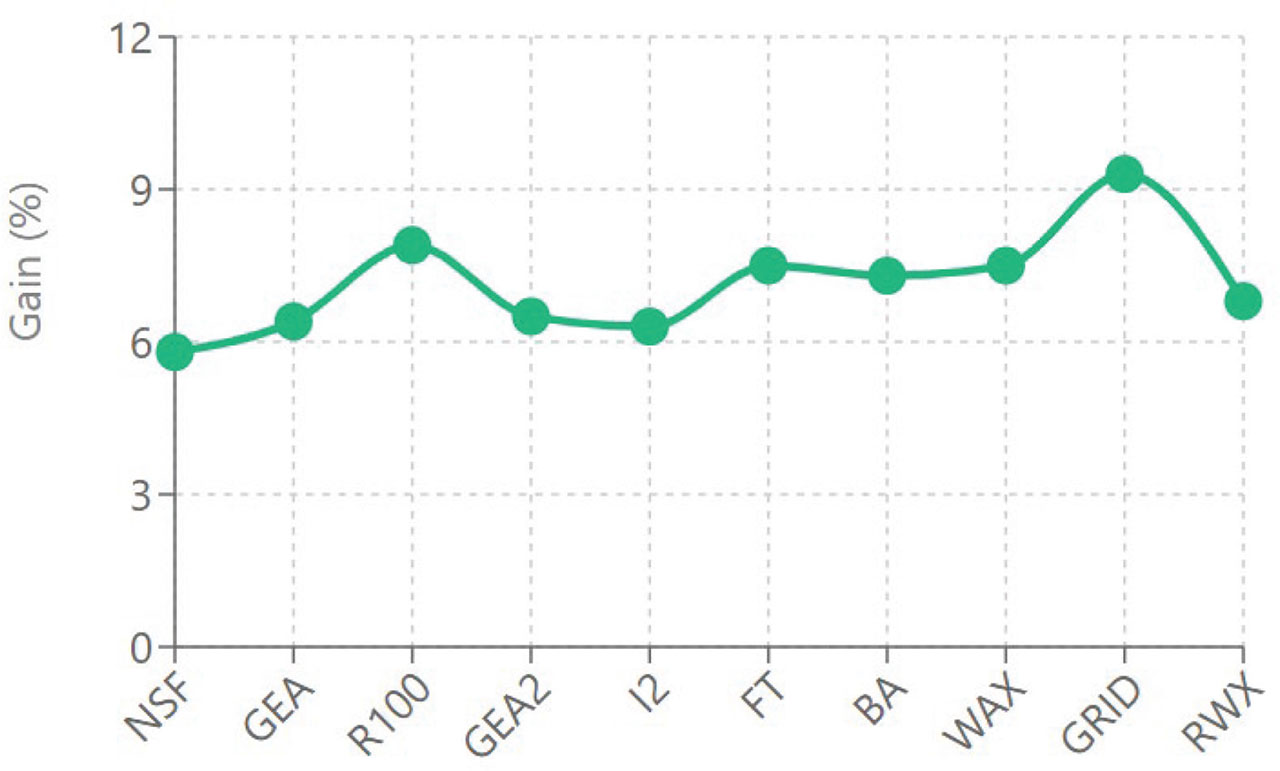
Figure 3:
Performance gain distribution.
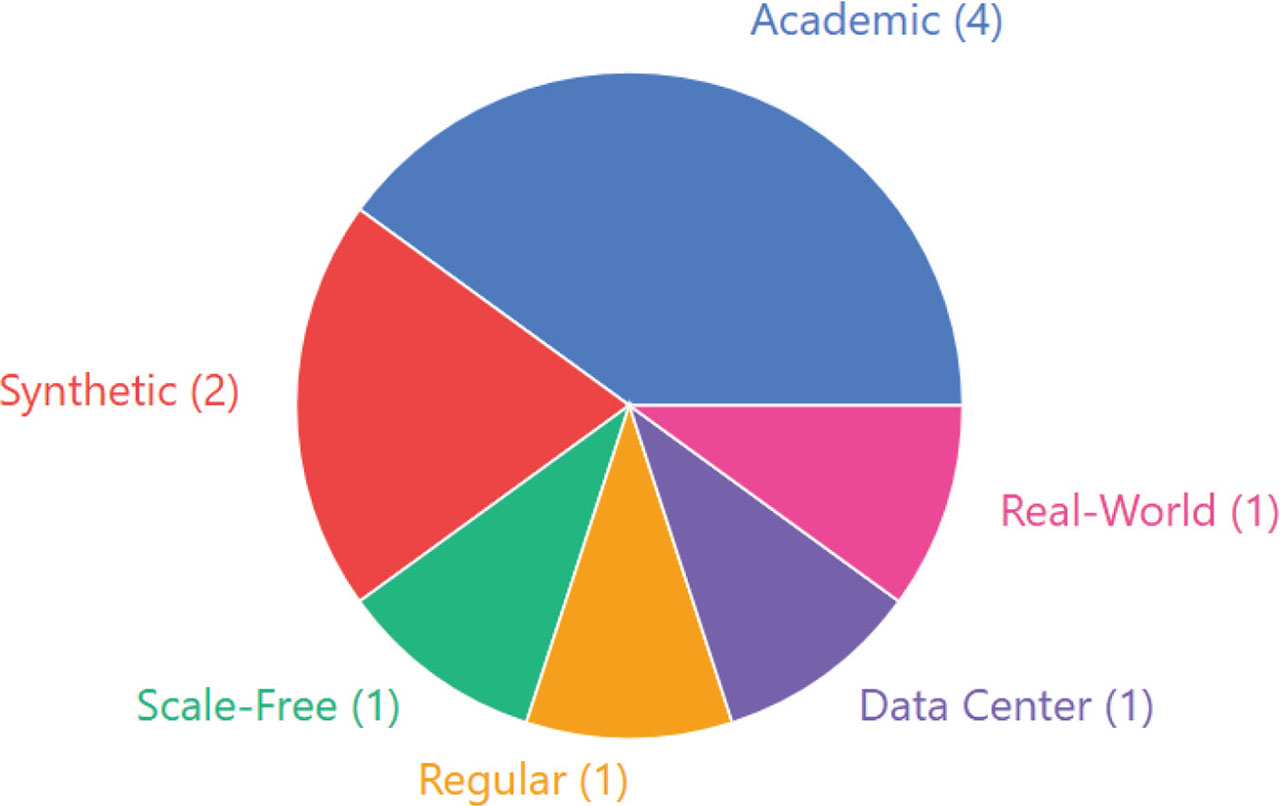
Figure 4:
Network topologies.
Table 4:
Performance based on network size (Nodes)
| Node count | Accuracy (%) | Delay (ms) | Throughput (%) |
|---|---|---|---|
| 20 Nodes | 94.2 | 26.4 | 97.3 |
| 40 Nodes | 93.9 | 29.0 | 96.8 |
| 60 Nodes | 93.5 | 31.8 | 95.9 |
| 80 Nodes | 93.1 | 34.2 | 95.1 |
| 100 Nodes | 92.6 | 36.5 | 94.4 |
| 120 Nodes | 92.0 | 38.9 | 93.5 |
| 140 Nodes | 91.7 | 40.3 | 92.9 |
| 160 Nodes | 91.5 | 41.0 | 92.5 |
| 180 Nodes | 91.4 | 41.4 | 92.3 |
| 200 Nodes | 91.3 | 41.7 | 92.1 |
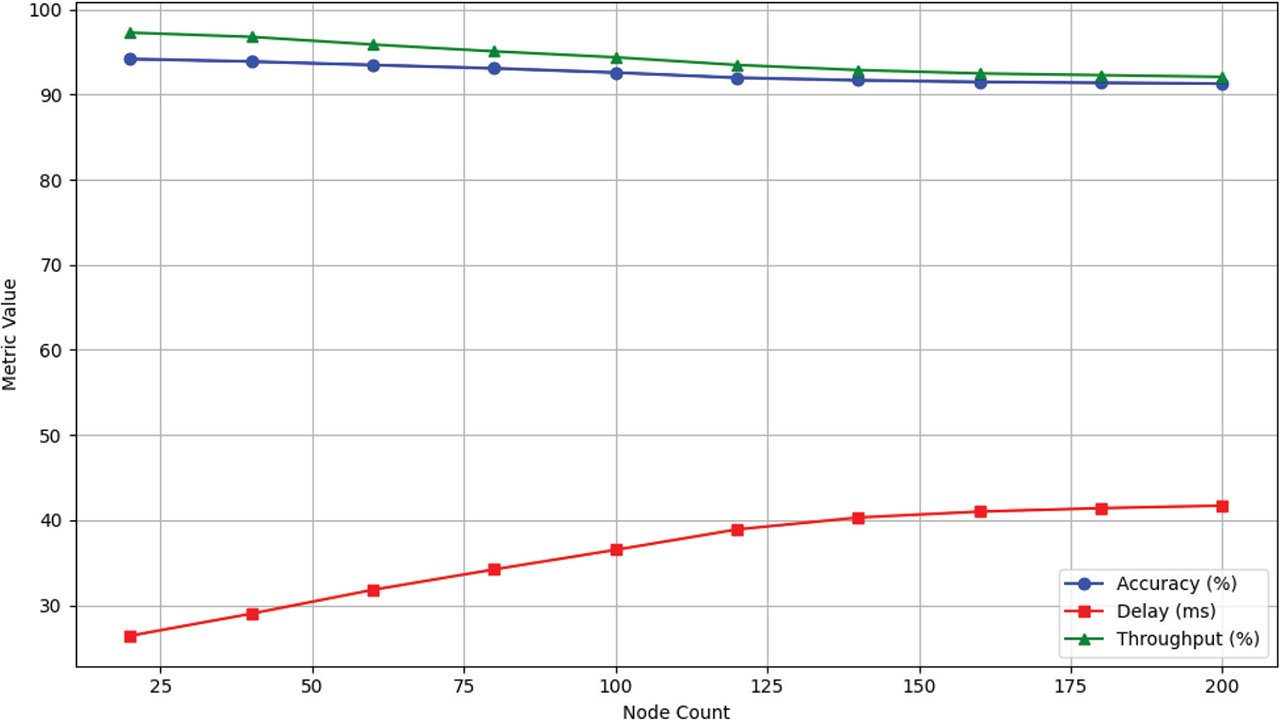
Figure 5:
Network performance vs node count.
Table 5:
Benefits of Neuro-GNN
| Metric | OSPF (traditional) | NeuroGNN (GNNRL) | Benefits of GNNRL over OSPF |
|---|---|---|---|
| Routing logic | Shortest path (static) | Learned dynamic policy | Learns from traffic states |
| Topology adaptation | Manual reconfiguration | Automatic GNN-based reclassification | Adaptive & real-time |
| Prediction accuracy | N/A | 91.3%–94.2% | Prediction accuracy is good |
| End-to-end delay | 31.5–40.6 ms | 26.4–36.5 ms | ↓ Up to 5.3 ms reduction |
| Throughput | 710–870 Mbps | 820–950 Mbps | ↑ Up to 12% improvement |
| Flow completion time | ∼1.78 s | ∼1.32 s | Faster delivery |
| Link failure response | Slow rerouting (seconds–minutes) | RL adapts within ∼2 s | Fast fault tolerance |
| Scalability (nodes) | Declining efficiency at scale | Maintains accuracy & routing | Robust to 200 + nodes |
| Generalization ability | Poor (hardcoded rules) | Strong across topologies | Learns transferable logic |
| Traffic flow/speed | Congestion-prone | High-speed adaptive routing | Efficient resource usage |
| Deployment complexity | Simple but static | Requires training phase | It has one time training cost. The system starts to operate automatically after initial training |