
Table 1:
Summary of major fundus image datasets relevant to the ICDR grading system
| Dataset | Year | Images | Grade | Resolution | Country | Strengths | Limitations |
|---|---|---|---|---|---|---|---|
| EyePACS [19] | 2015 | 88,702 | 5 | Varying dimensions | USA | Large-scale dataset | Class imbalance |
| IDRiD [21] | 2018 | 516 | 5 | 4,288 × 2,848 | India | Classification and segmentation | Small size, limited masks |
| APTOS [20] | 2019 | 3,662 | 512 × 512 | Asia-Pacific | Clean, uniform images | Small dataset, class imbalance | |
| FGADR [22] | 2020 | 1,842 | 5 | 2,048 × 3,072 | China | Balanced dataset | Moderate size, population-specific |
| MESSIDOR [23] | 2008 | 1,200 | 4 | Varying dimensions | France | Good for bench-marking | Uses only 4 grading |
| EOphtha [24] | 2014 | 611 | Not graded | 2,544 × 1,696 | France | Early DR detection | No severity grading |
| DDR | 2020 | 13,673 | 5 | High-resolution | China | Large-scale, diverse images | Variable image quality |
Table 2:
Literature review of various deep learning techniques for DR detection
| Year | Model used | Dataset | Accuracy (%) | Key contributions | Study finding |
|---|---|---|---|---|---|
| 2023 [31] | Resnet50 | APTOS | 83.90 | Compared the model with VGG16, Xception, AlexNet and found Resnet outperformed | Performance can be improved |
| 2021 [32] | Multi-scale attention network (MSA-Net) | EYEPACS and APTOS | 84.40 | MSA-Net helps to retrieve features at multiple scales | Performance can be improved |
| 2022 [33] | Inception-V3 | 89,947 images from various datasets | 99 | Robust binary classification for fundus image quality | ICDR grading can be implemented |
| 2023 [34] | Resnet50 | APTOS | 83.90 | Compared the model with VGG16, Xception, AlexNet and found Resnet outperformed | Performance can be improved |
| 2023 [35] | Inception-V3 | APTOS | 98.7 | Image enhancement using CLAHE | Better performance with preprocessing |
| 2023 [36] | DenseNet121 | APTOS | 97.30 | Combines VGG16, XGBoost, and DenseNet121; highlights overfitting risk | Overfitting due to class 0 dominance |
| 2023 [37] | SqueezeNet, Darknet-53, EfficientNet-B0 | ODIR | 95, 99.4, 90 | Multi-classification: normal, glaucoma, cataract | ICDR DR grading can be extended |
| 2024 [38] | DeepDR Plus (ResNet-50 + self-attention) | 83,500 images from various datasets | ∼84.6 | Predicts DR progression time; supports personalized screening | Time prediction solved; classification remains open |
| 2025 [39] | Inception ResNet V2, MobileNet, Residual Net | 645 clinical images | 93 | Binary classification of eye diseases | DR grading can be implemented |
| 2025 [40] | Inception-ResNet-v2 + GRU | APTOS | 98.00 | FFO fine-tunes GRU | Optimization improves accuracy |
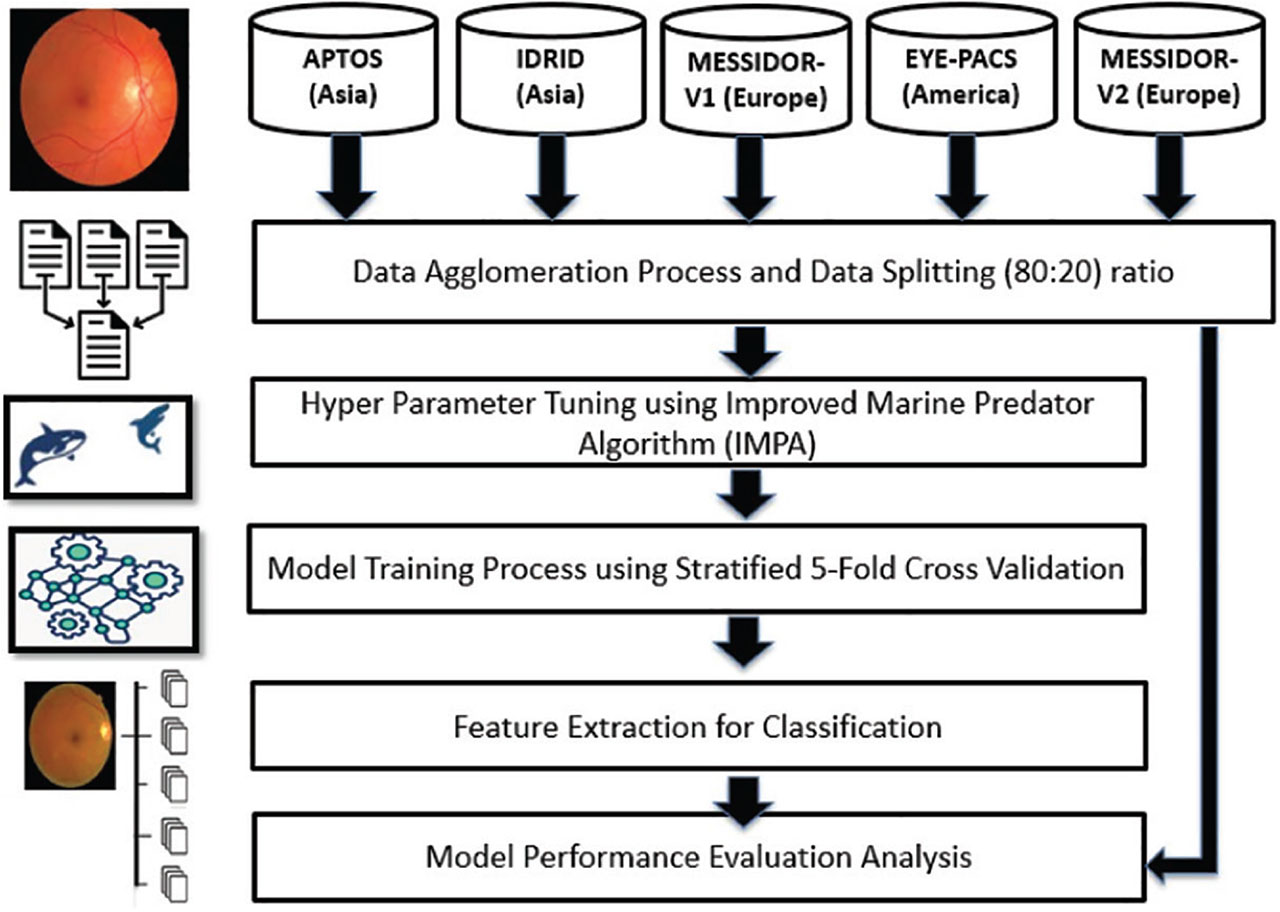
Figure 1:
Proposed ARMDiaRD module-wise system flowchart adopted during experimentation. IMPA, improved marine predator algorithm.
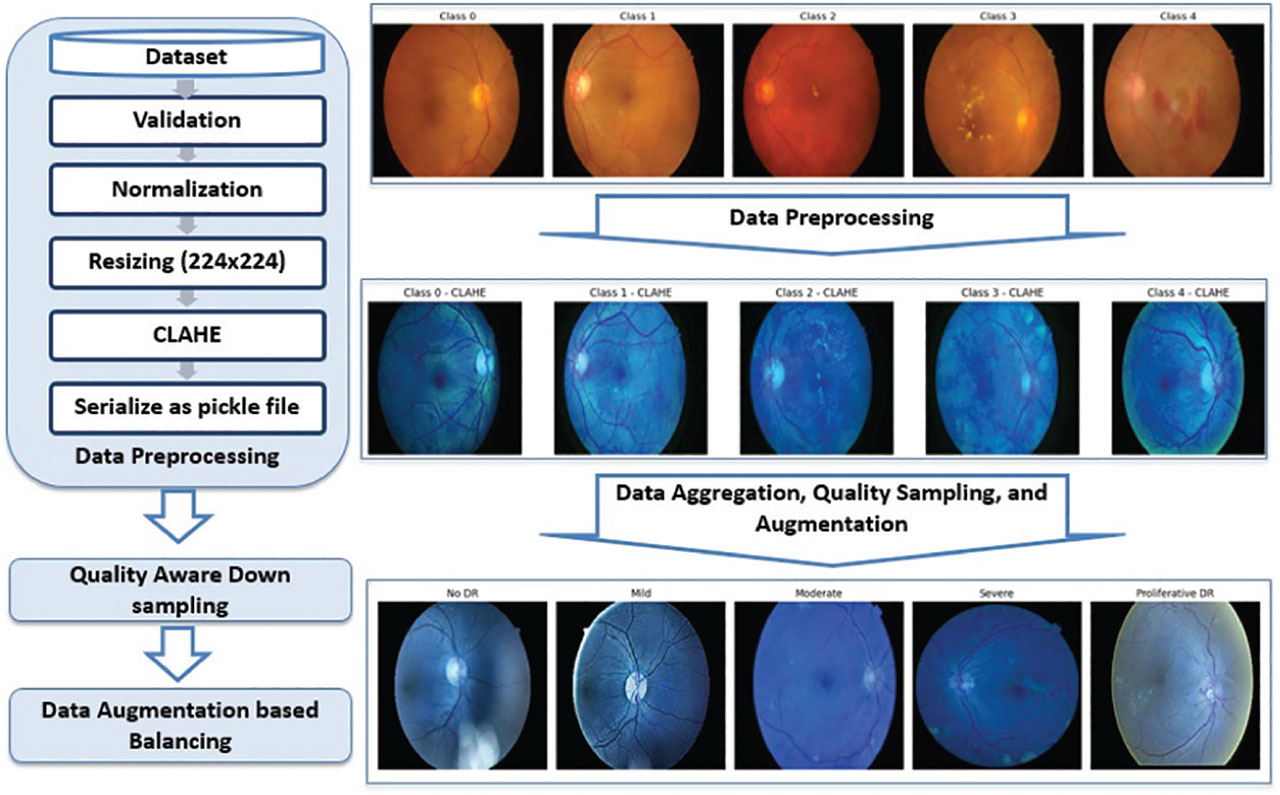
Figure 2:
Data agglomeration pipeline with sample images showing the three stages of data preprocessing, quality-aware down-sampling, and augmentation ending with splitting for the training and testing process.
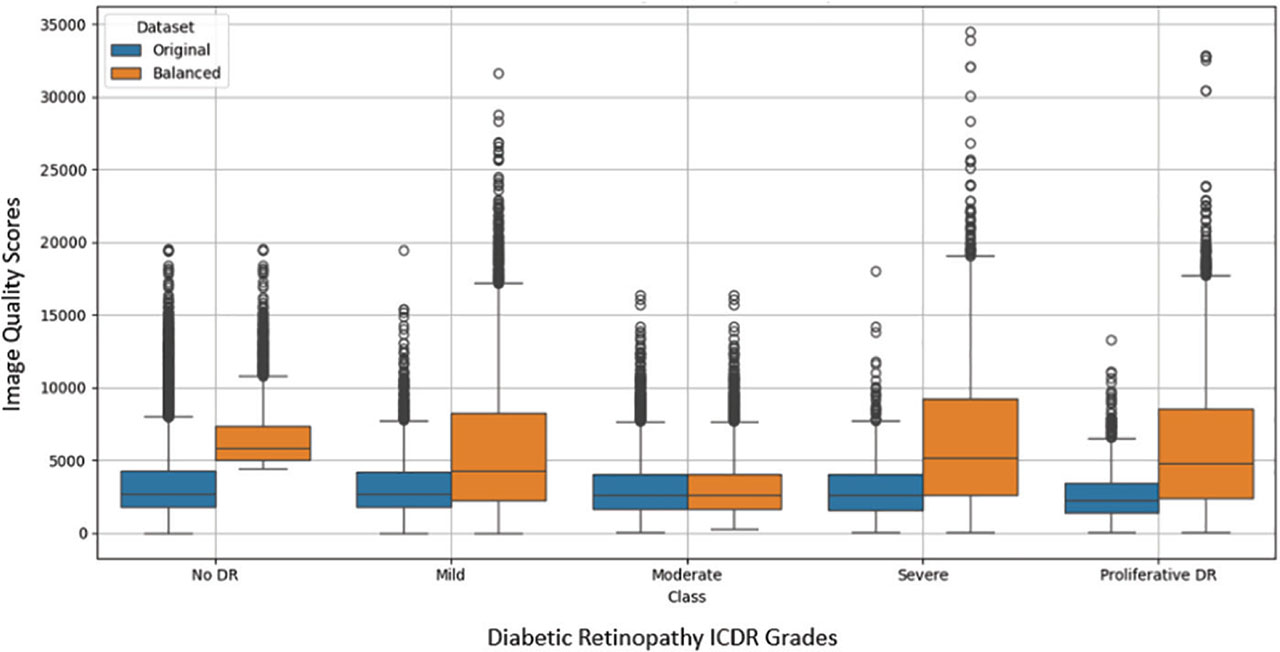
Figure 3:
Histogram of Q-scores calculated for each grade of DR before and after quality-aware down-sampling, which reflects the improvement in quality of images selected for the oversampled classes. DR, diabetic retinopathy; ICDR, international clinical diabetic retinopathy.
Table 3:
Class-wise image summary after dataset agglomeration process used for ARMDiaDR system experimentation
| textbfDataset | No DR | Mild NPDR | Moderate NPDR | Severe NPDR | PDR | Total Images | Dimensions |
|---|---|---|---|---|---|---|---|
| APTOS [20] | 1,805 | 370 | 999 | 193 | 295 | 3,662 | Mixed |
| IDRID [21] | 168 | 25 | 168 | 93 | 62 | 516 | 4,288 × 2,848 |
| EYEPACS [19] | 25,802 | 2,438 | 5,288 | 872 | 708 | 35,108 | Mixed |
| MESSIDOR-V1 [23] | 546 | 153 | 247 | 254 | – | 1,200 | 2,240 × 1,488 |
| MESSIDOR-V2 [46] | 1,017 | 270 | 347 | 75 | 35 | 1,744 | 2,240 × 1,488 |
| Training Dataset | 5,600 | 5,600 | 5,600 | 5,600 | 5,600 | 28,000 | 224 × 224 |
| Testing Dataset | 1,400 | 1,400 | 1,400 | 1,400 | 1,400 | 7,000 | 224 × 224 |
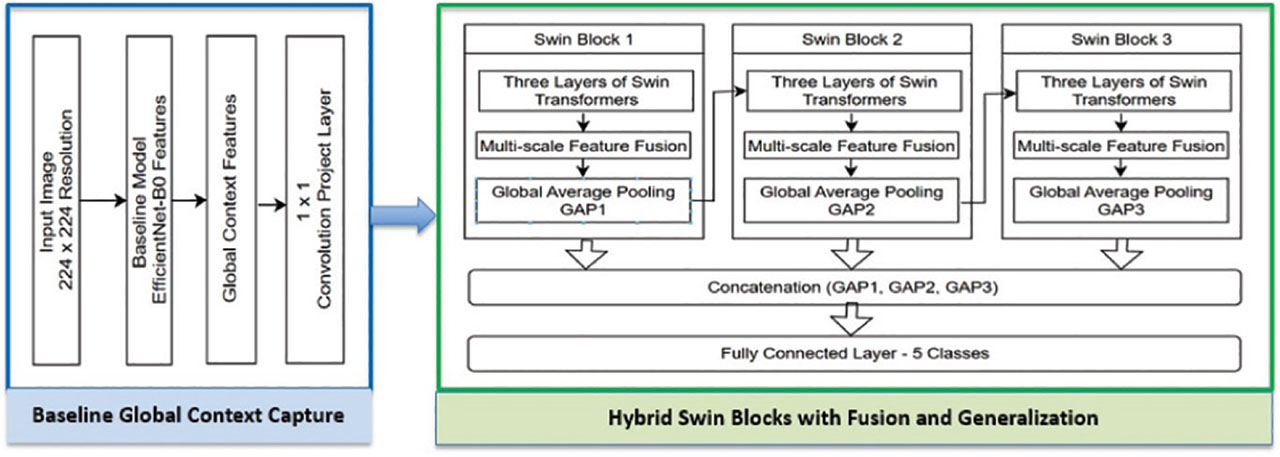
Figure 4:
Proposed robust and hybrid deep learning model architecture with initially capturing the features using EfficientNet and GC block, followed by hybrid Swin Transformer blocks with MSFF and hierarchical aggregation. GC, global context; MSFF, multi-scale feature fusion.
Table 4:
Evaluation performance metrics used
| Performance Metric | Mathematical Expression | Description |
|---|---|---|
| Accuracy | Provides a high-level overview of model performance. | |
| Recall | Measures how many actual positive instances the model correctly identified. | |
| Precision | Measures the accuracy of positive predictions. | |
| F1-Score | Harmonic mean of precision and recall; balances false positives and false negatives. | |
| QWK | Measures agreement between two raters, penalizing bigger disagreements quadratically. | |
| MAE | Measures average magnitude of the errors between predicted and actual values. | |
| MSE | Similar to MAE but penalizes larger errors more by squaring them. | |
| Spearman Correlation | Measures strength and direction of a monotonic relationship in ranked or ordinal data. |
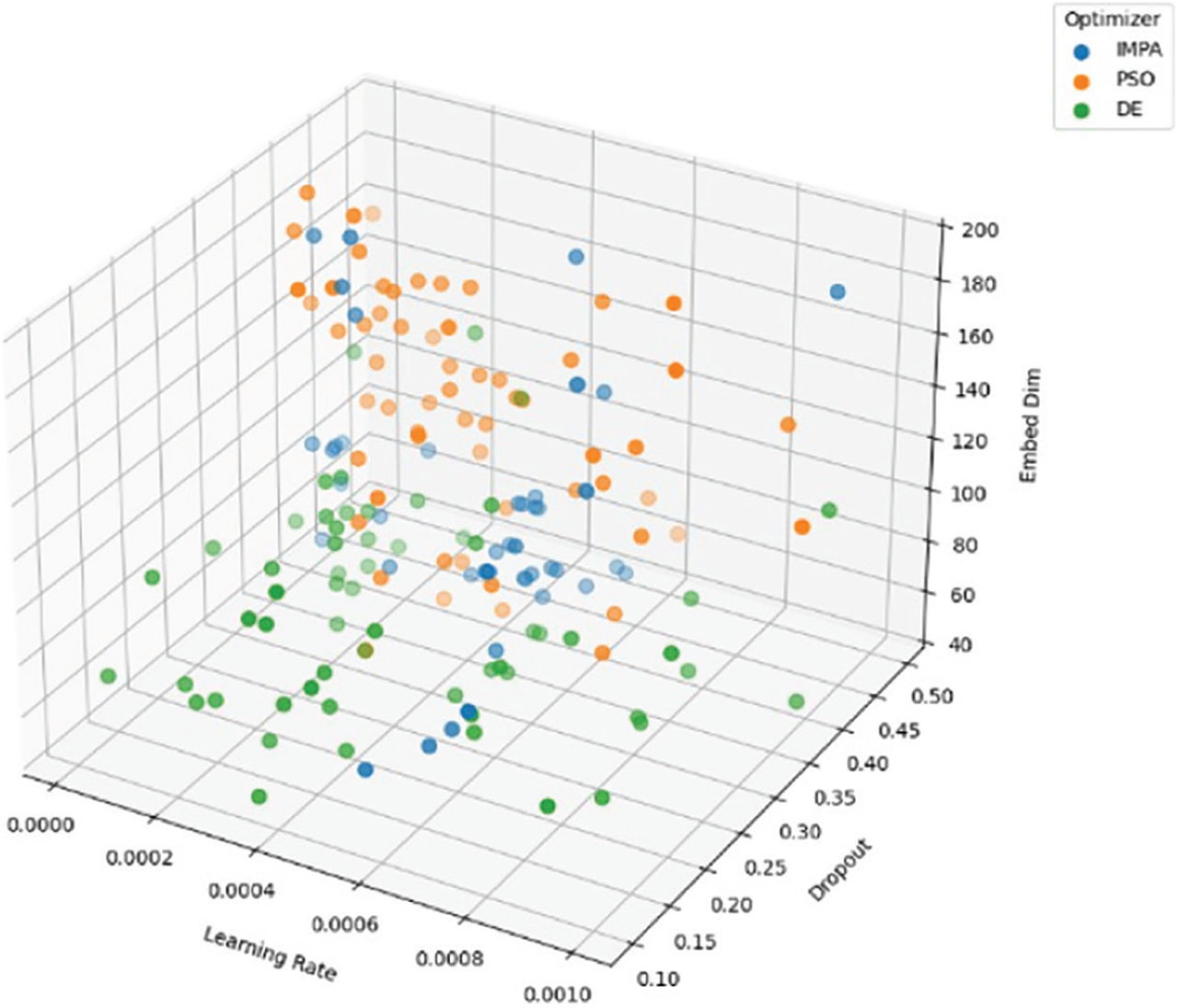
Figure 5:
Scatter plot of the HP lr, dr, and embed dim for the three optimizer algorithms, IMPO, PSO and DE. DE, differential evolution; dr, dropout rate; HP, hyperparameters; lr, learning rate; PSO, particle swarm optimizer.
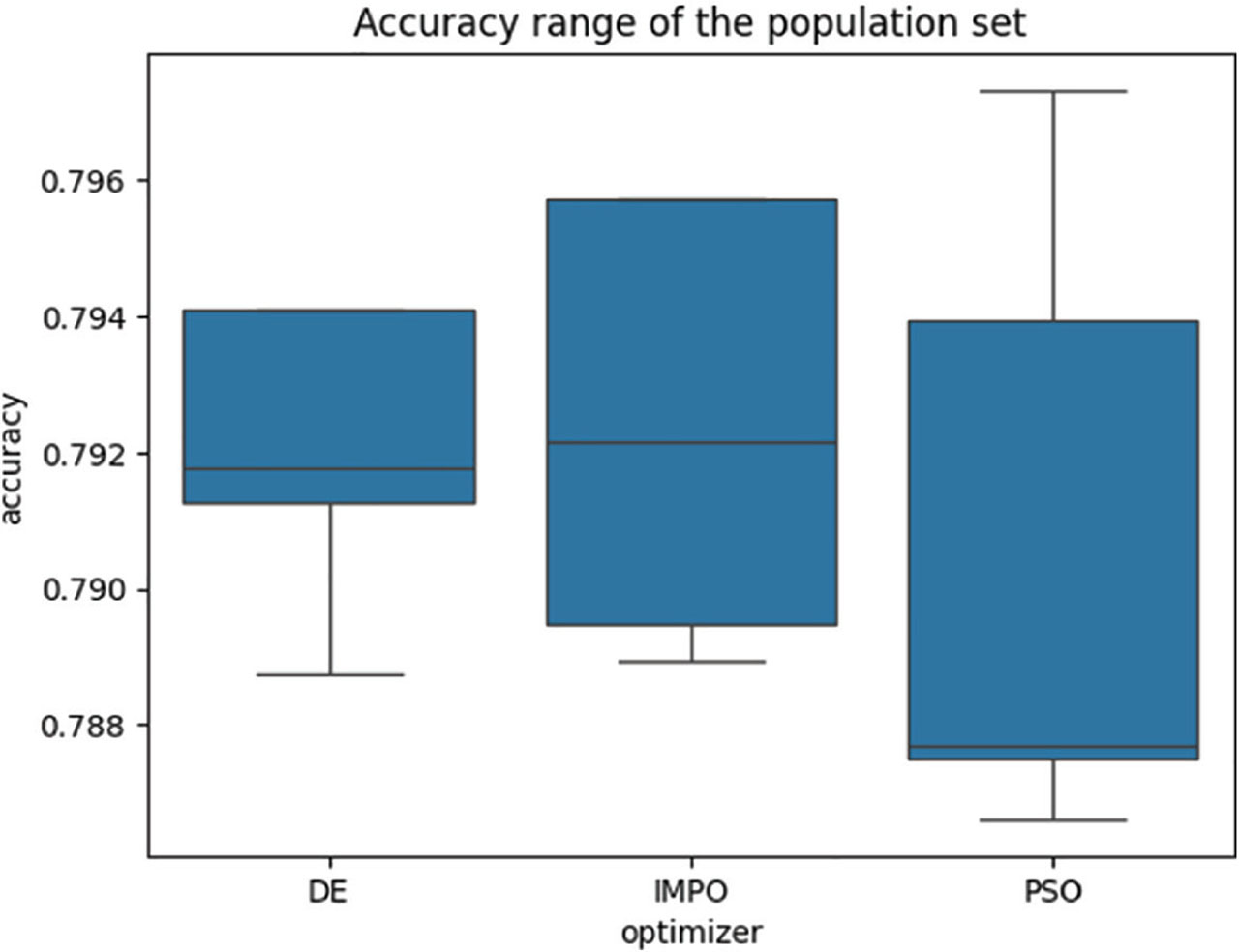
Figure 6:
Accuracy box plot obtained from the three optimizer algorithms, DE, IMPO, and PSO. DE, differential evolution; PSO, particle swarm optimizer.
Table 5:
HP achieved using IMPO optimizer for training the proposed ARMDiaRD
| Sl. No. | Hyperparameter | Specification |
|---|---|---|
| 01 | Learning rate | 0.00039 |
| 02 | Number of epochs | 40 |
| 03 | Batch size | 32 |
| 04 | Dropout | 0.428 |
| 05 | Embed dim | 80 |
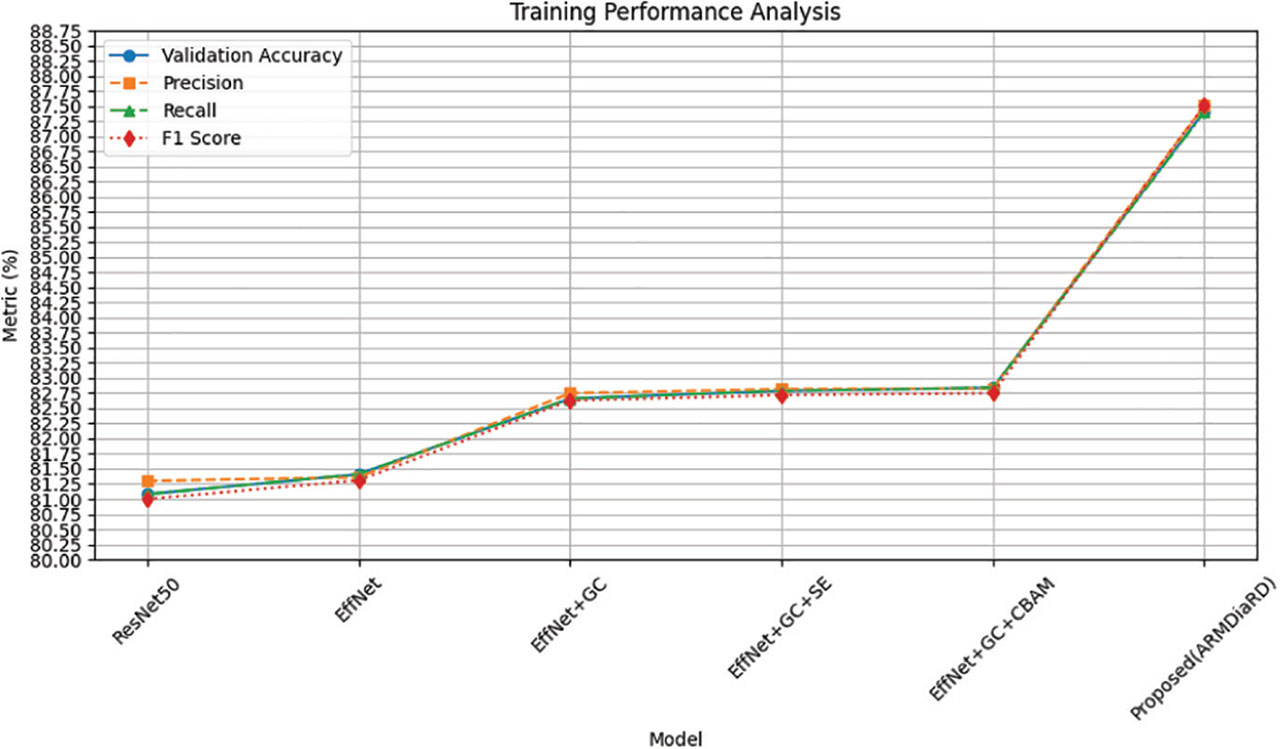
Figure 7:
Results from stratified five-fold validation performed with average metrics of accuracy, precision, recall, and F1-score. CBAM, convolutional block attention module; GC, global context.
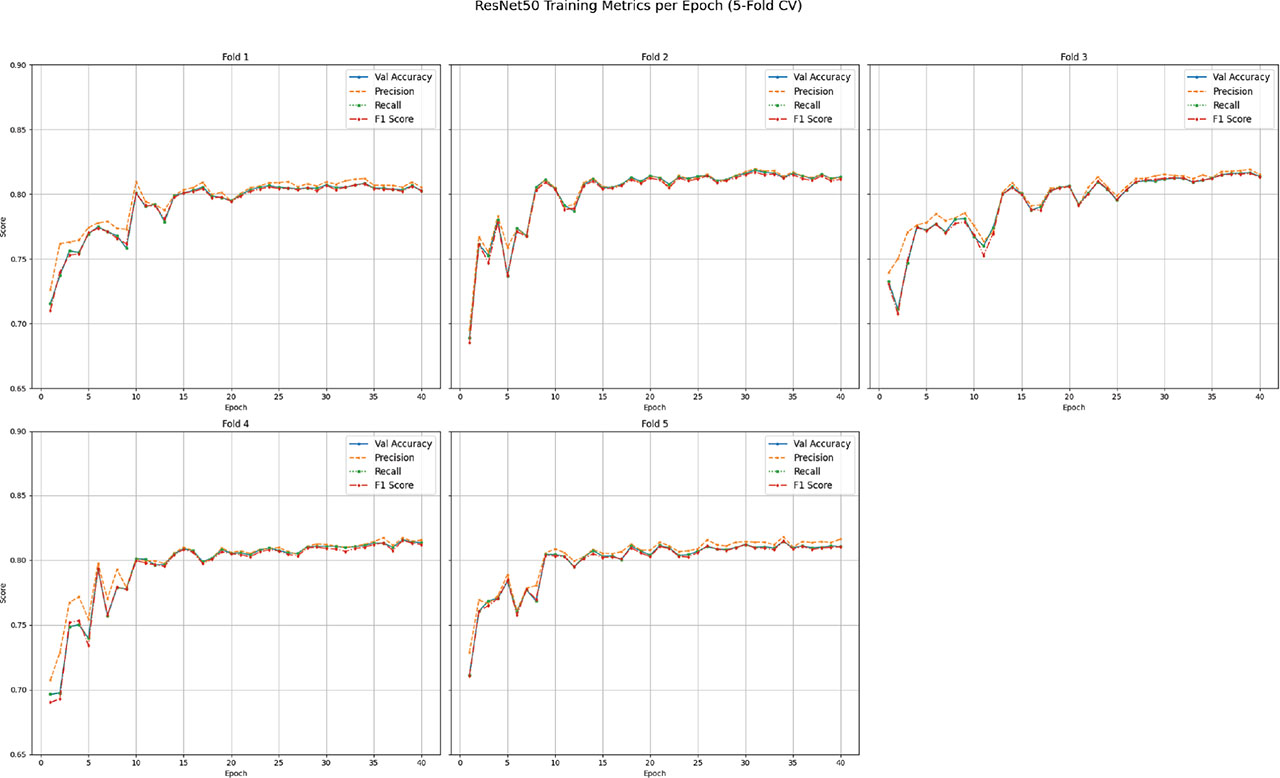
Figure 8:
Results from stratified five-fold validation performed during the training phase using Resnet-50.
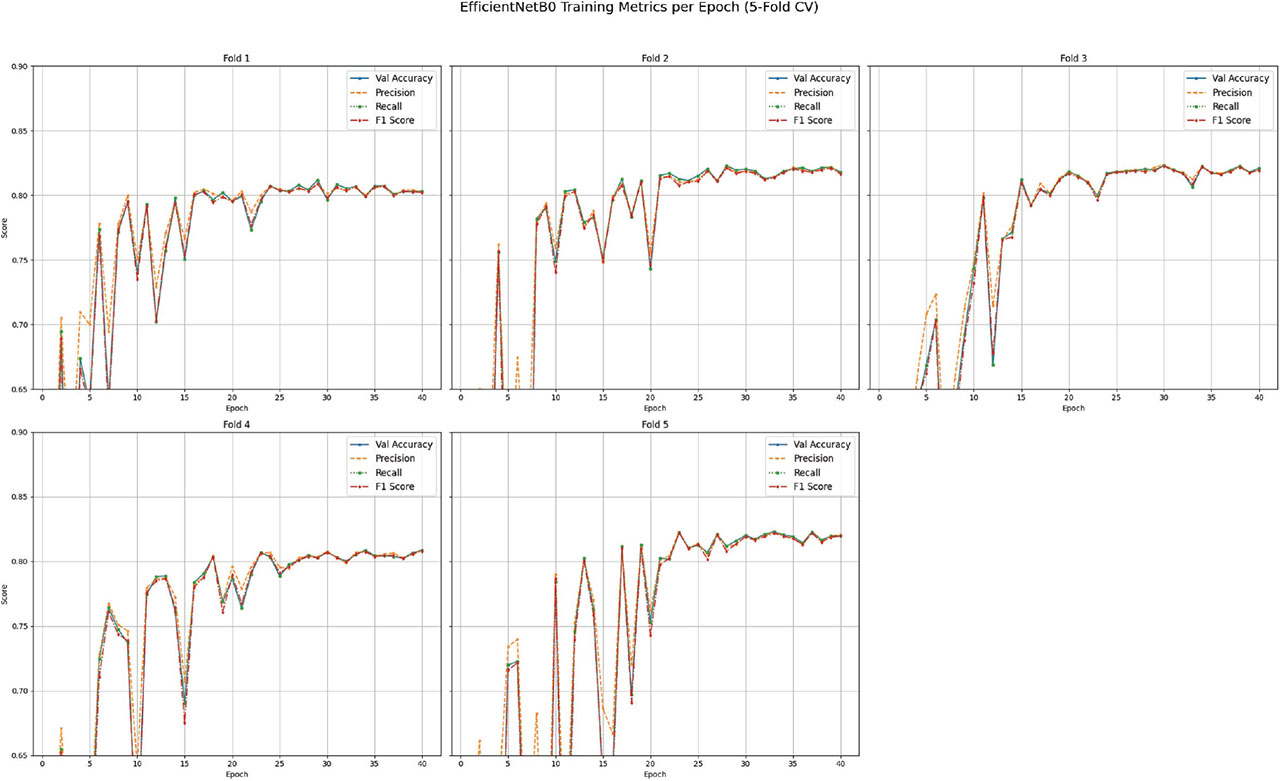
Figure 9:
Results from stratified five-fold validation performed during the training phase using EfficientNet-B0.
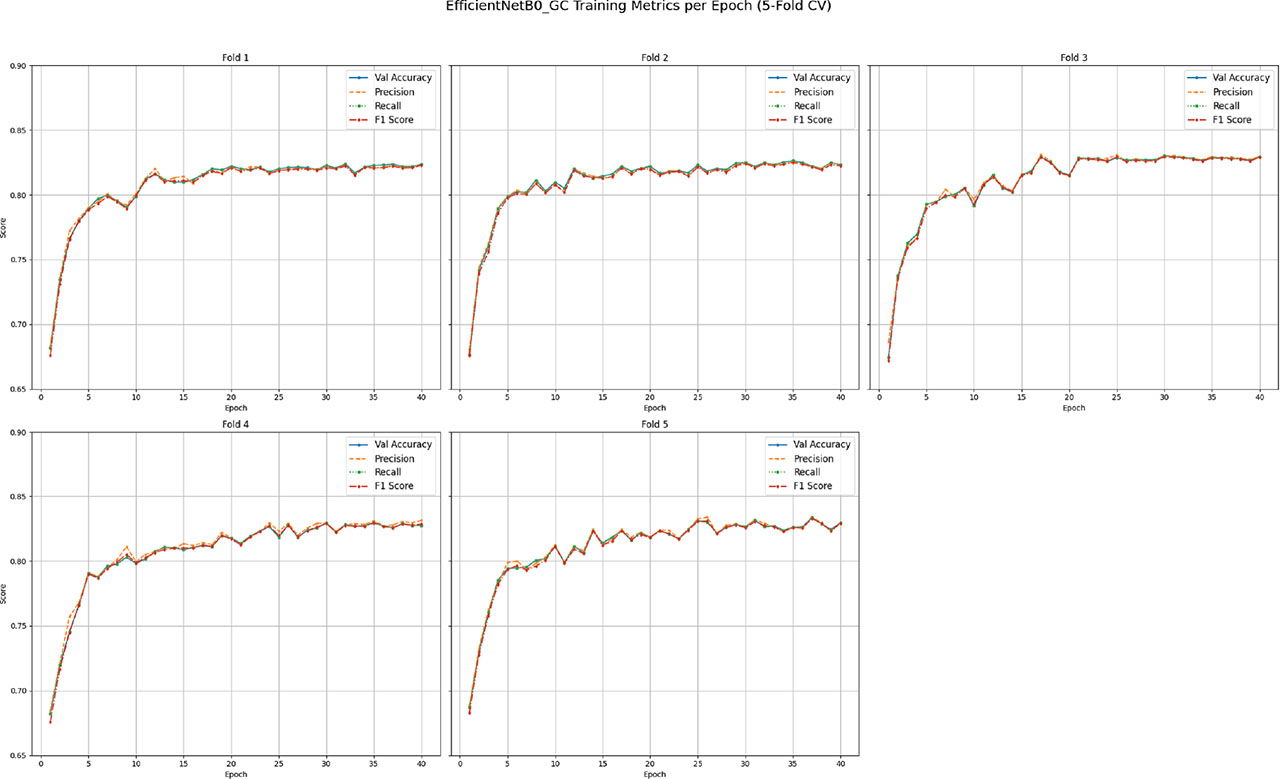
Figure 10:
Results from stratified five-fold validation performed during the training phase using EfficientNet-B0 with GC. GC, global context.
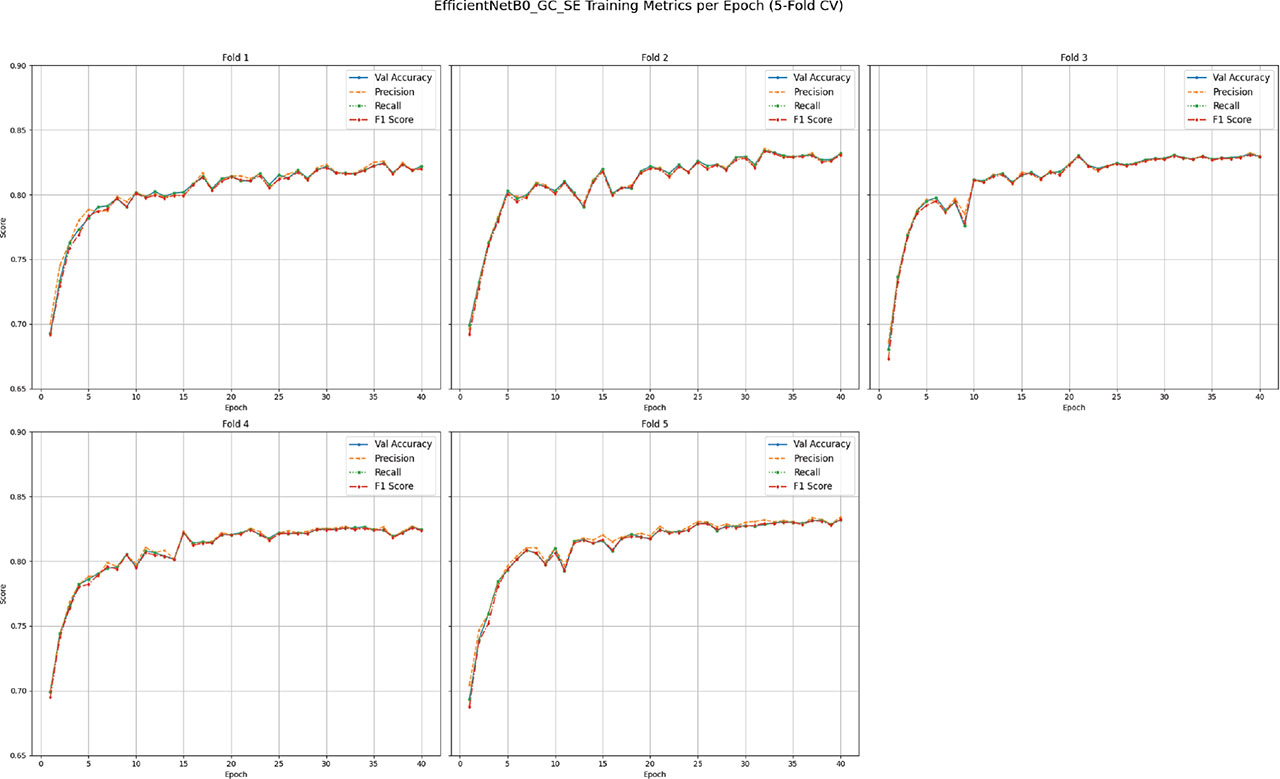
Figure 11:
Results from stratified five-fold validation performed during the training phase using EfficientNet-B0 + GC + SE. GC, global context.
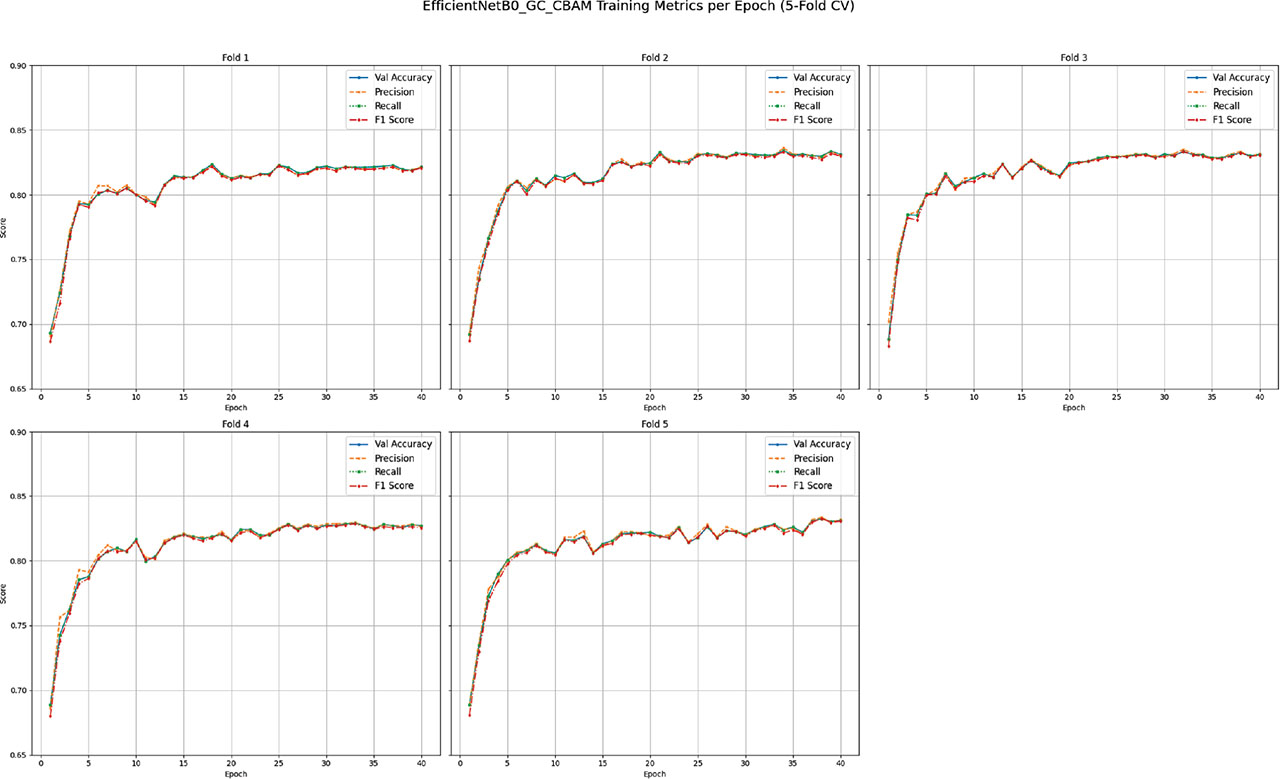
Figure 12:
Results from stratified five-fold validation performed during the training phase using EfficientNet-B0 + GC + CBAM. CBAM, convolutional block attention module; GC, global context.
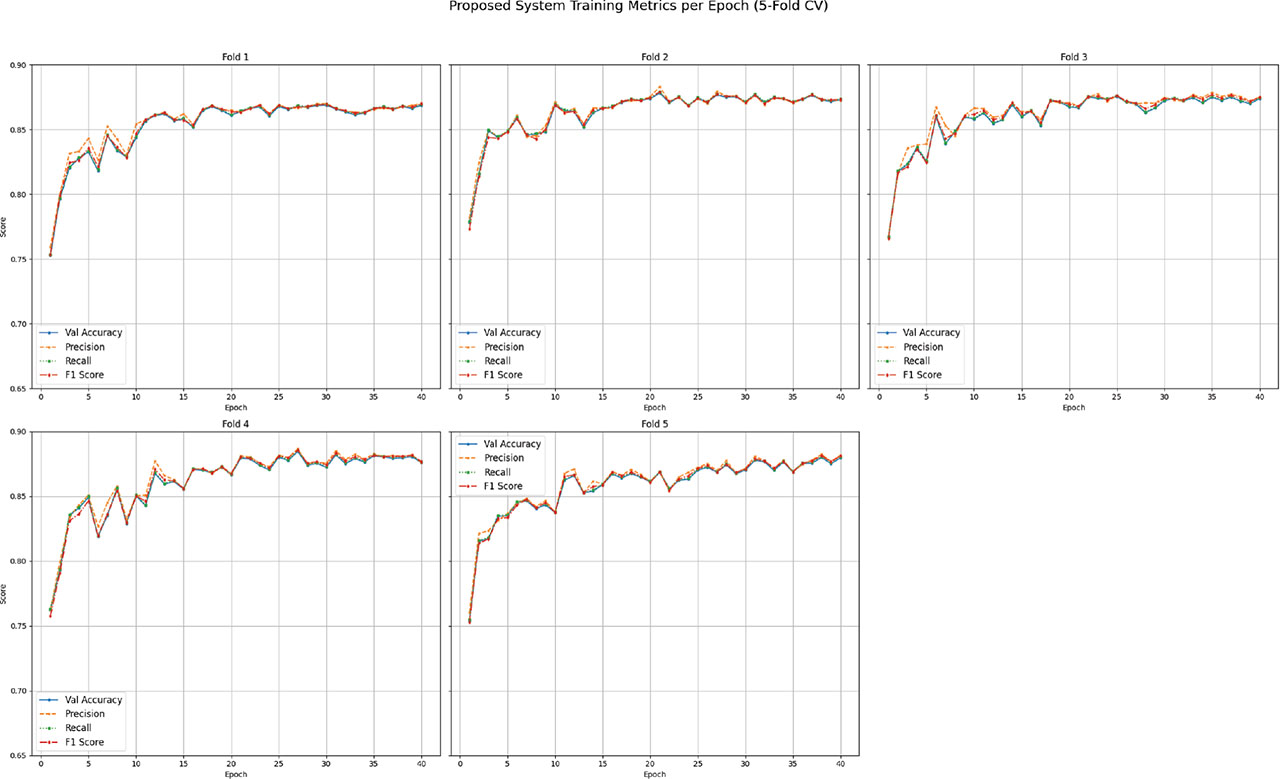
Figure 13:
Results from stratified five-fold validation performed during the training phase using the proposed model ARMDiaRD.
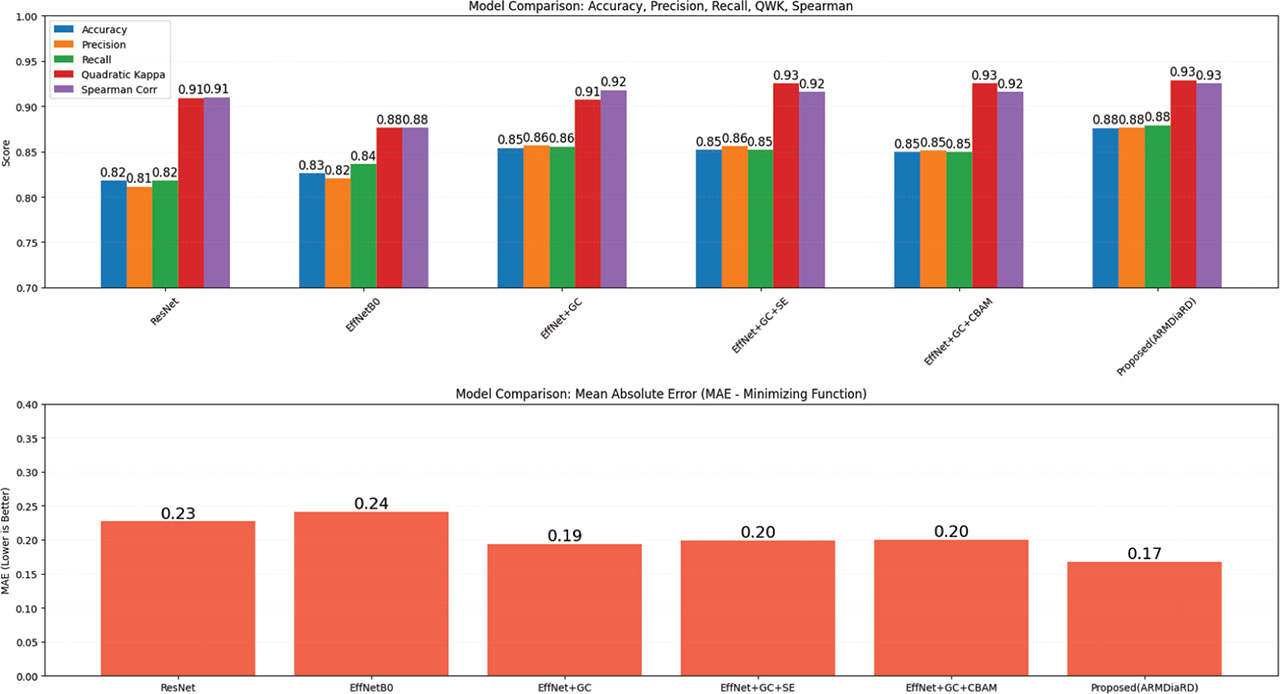
Figure 14:
Results of ablation analysis performed with the various metrics, such as accuracy, precision, recall, QWK, Spearman correlation, and MAE with the training dataset subjected to the proposed agglomeration process, showing the overall improvement of the proposed model. MAE, mean absolute error; QWK, quadratic weighted kappa.
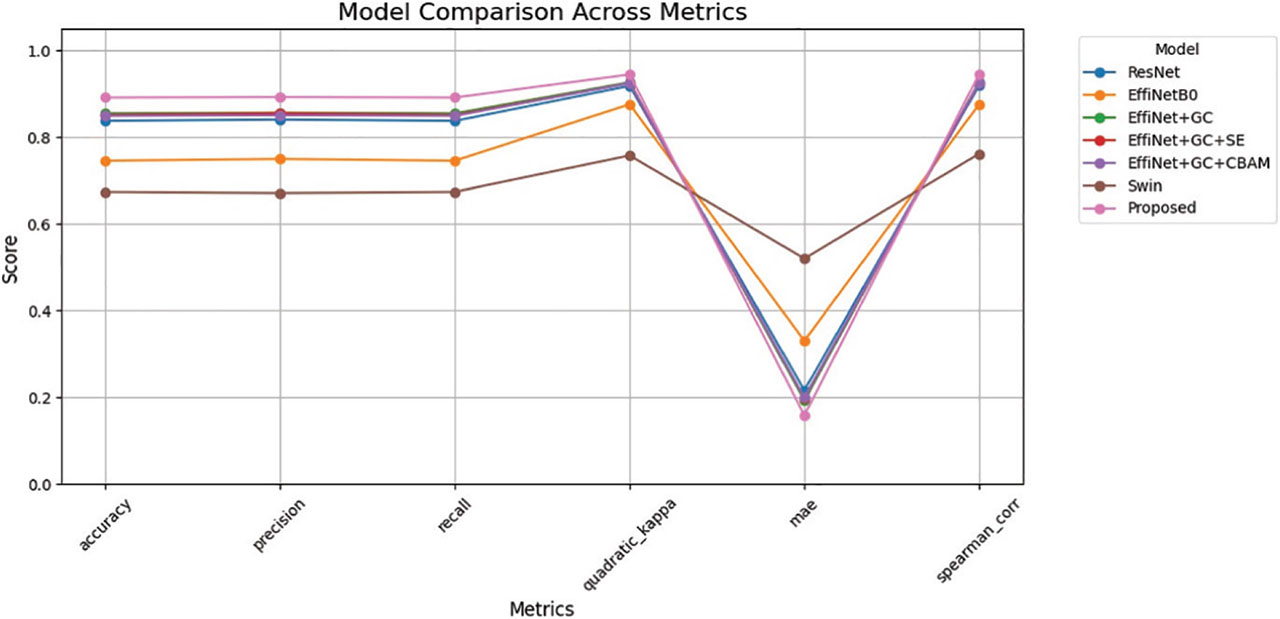
Figure 15:
Results obtained during the testing process with metrics, such as accuracy, precision, recall, QWK, Spearman correlation, and MAE. MAE, mean absolute error; QWK, quadratic weighted kappa.