
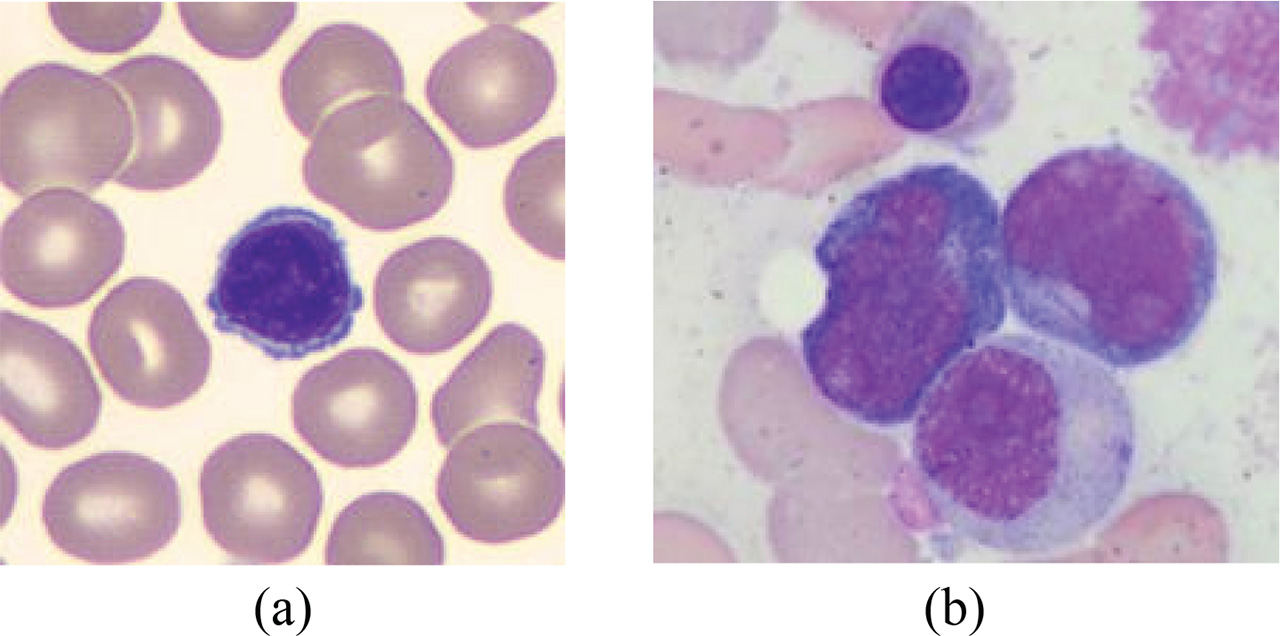
Figure 1:
(a) Normal cells; and (b) leukemia cells [9].
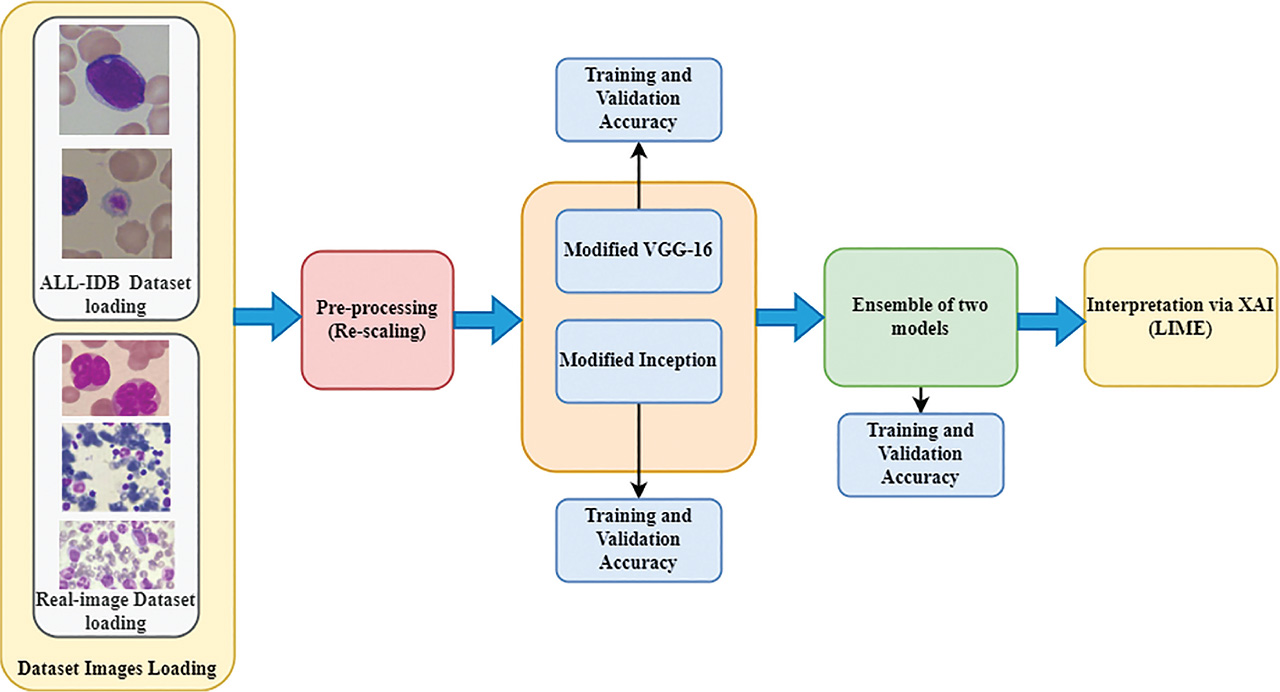
Figure 2:
Proposed methodology for leukemia diagnosis. LIME, Local Interpretable Model-Agnostic Explanations; XAI, explainable artificial intelligence.
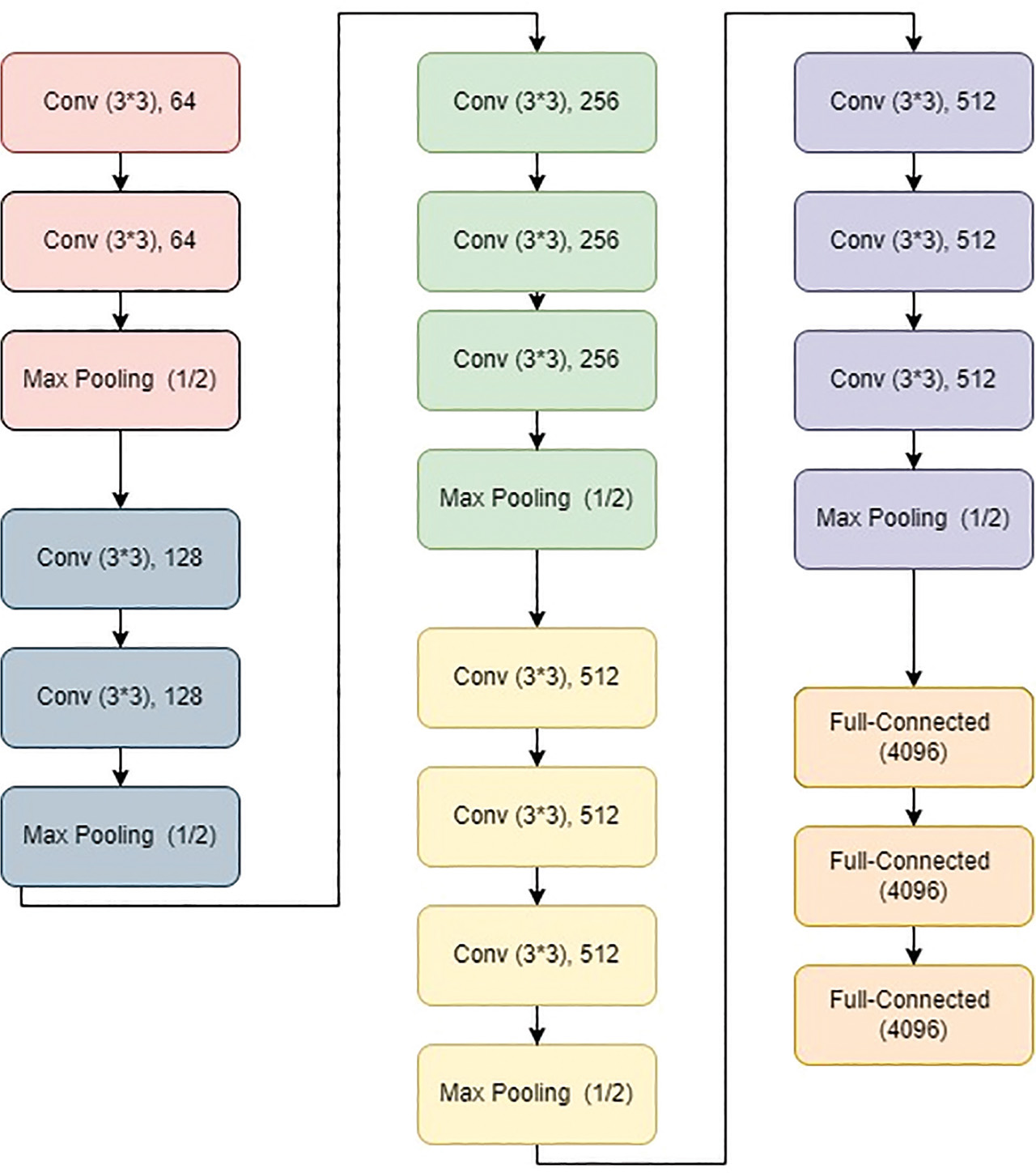
Figure 3:
VGG-16 architecture.
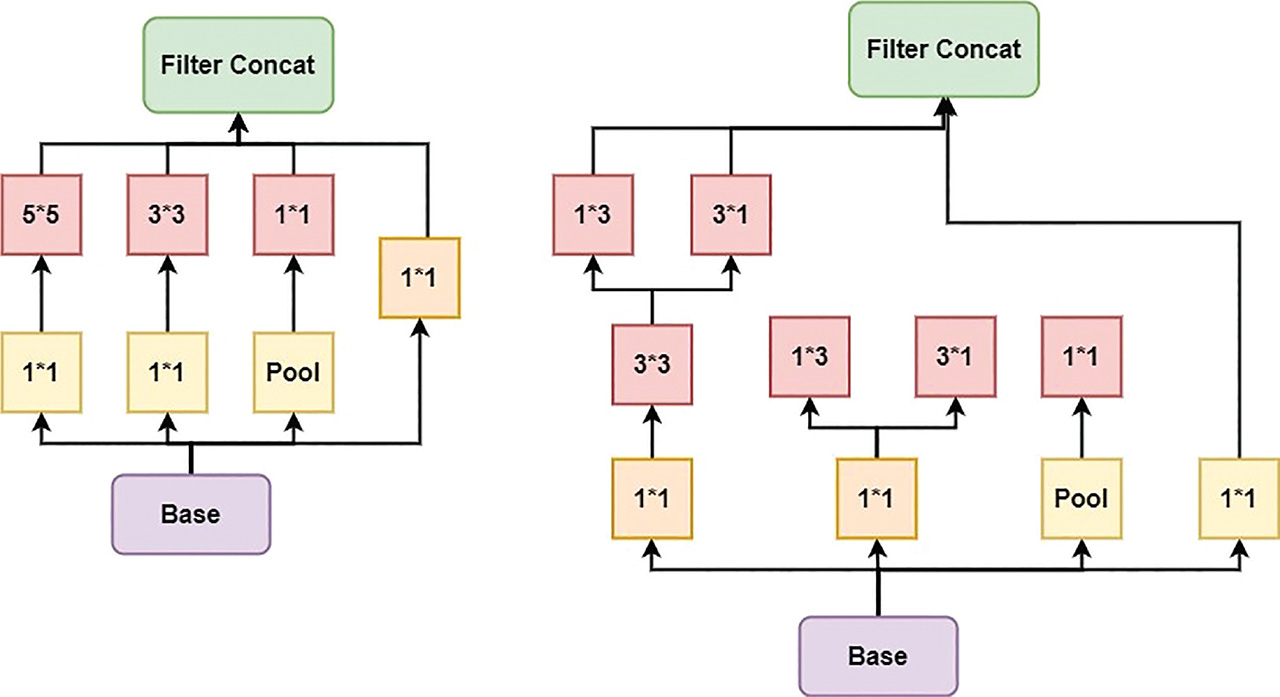
Figure 4:
Asymmetric convolutions.
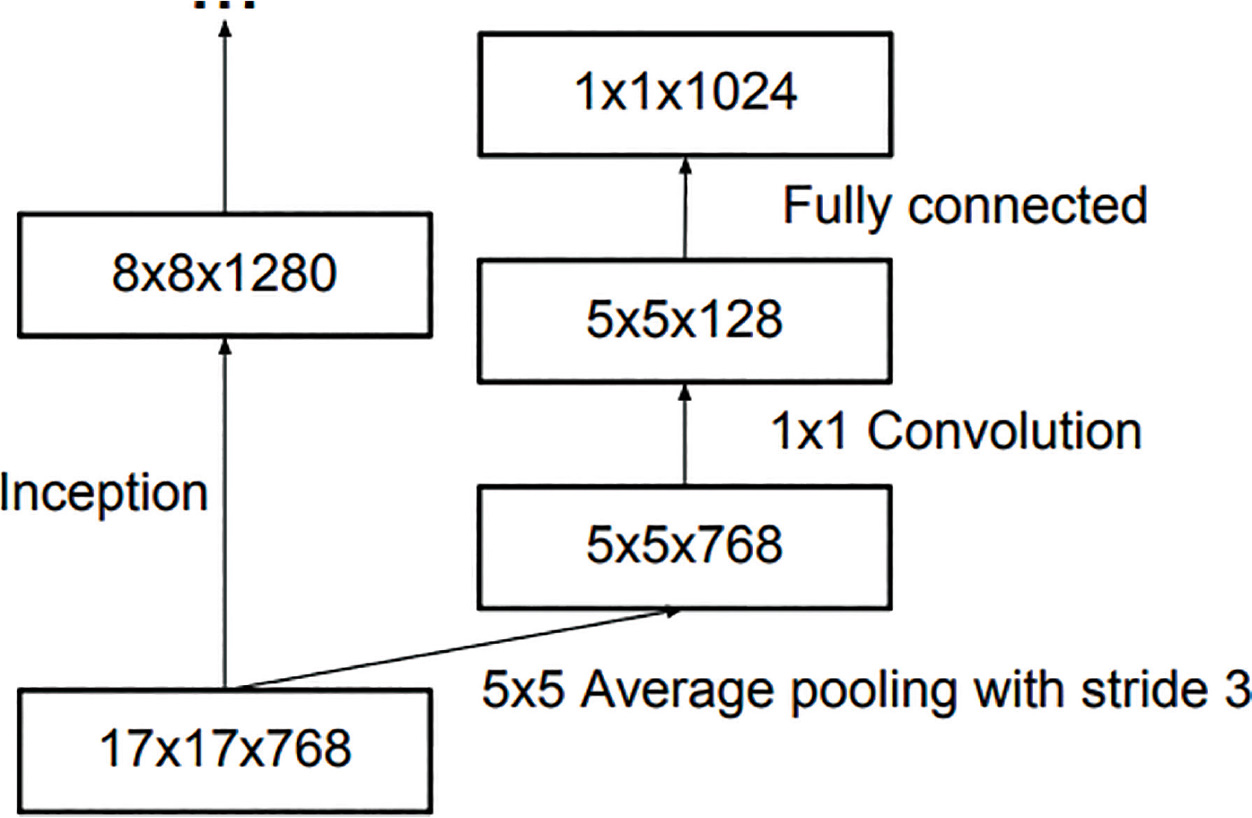
Figure 5:
Auxiliary classifiers.
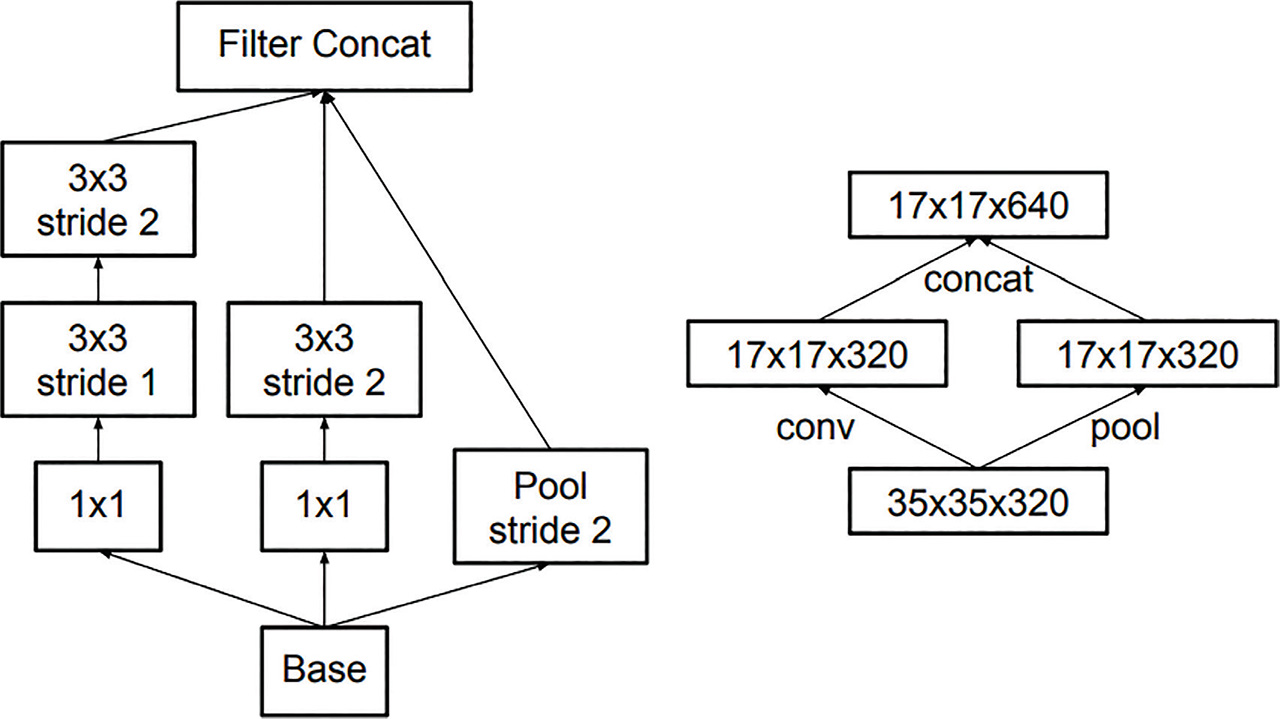
Figure 6:
Grid size reduction.
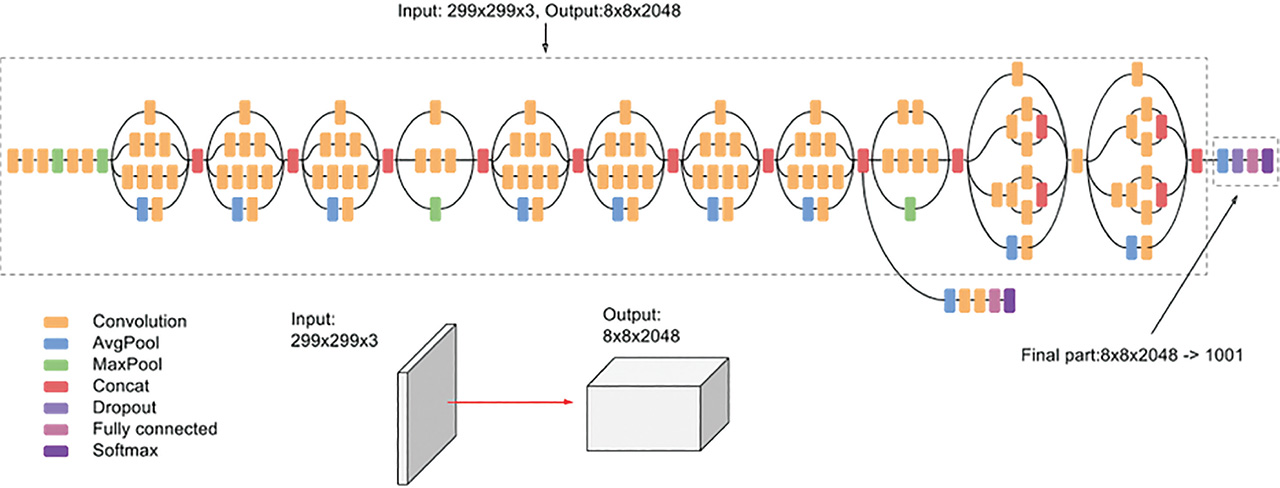
Figure 7:
Final model architecture of inceptionv3.
Table 1.
Comparison of the proposed approach with popular SOTA.
| Advantage criteria | Ensemble (VGG-16 + inception) | Pre-trained VGG-16 | Pre-trained inception | Random forest | SVM | ResNet50 (deep learning) | EfficientNet (deep learning) |
|---|---|---|---|---|---|---|---|
| Diversity in features | Yes | No | Yes | Yes | No | Yes | Yes |
| Generalization performance | Good | Good | Good | Good | Good | Excellent | Excellent |
| Robustness to overfitting | High | High | High | High | Moderate | High | High |
| Ensemble averaging benefit | Yes | No | No | No | No | No | No |
| Feature learning capabilities | Rich | Deep hierarchical | Diverse | Moderate | Linear | Deep hierarchical | Diverse |
| State-of-the-art performance | Yes | No (dated architecture) | Yes (at the time) | No | No | Yes | Yes (as of the time of training) |
[i] SVM, support vector machine; SOTA, State-of-the-art.
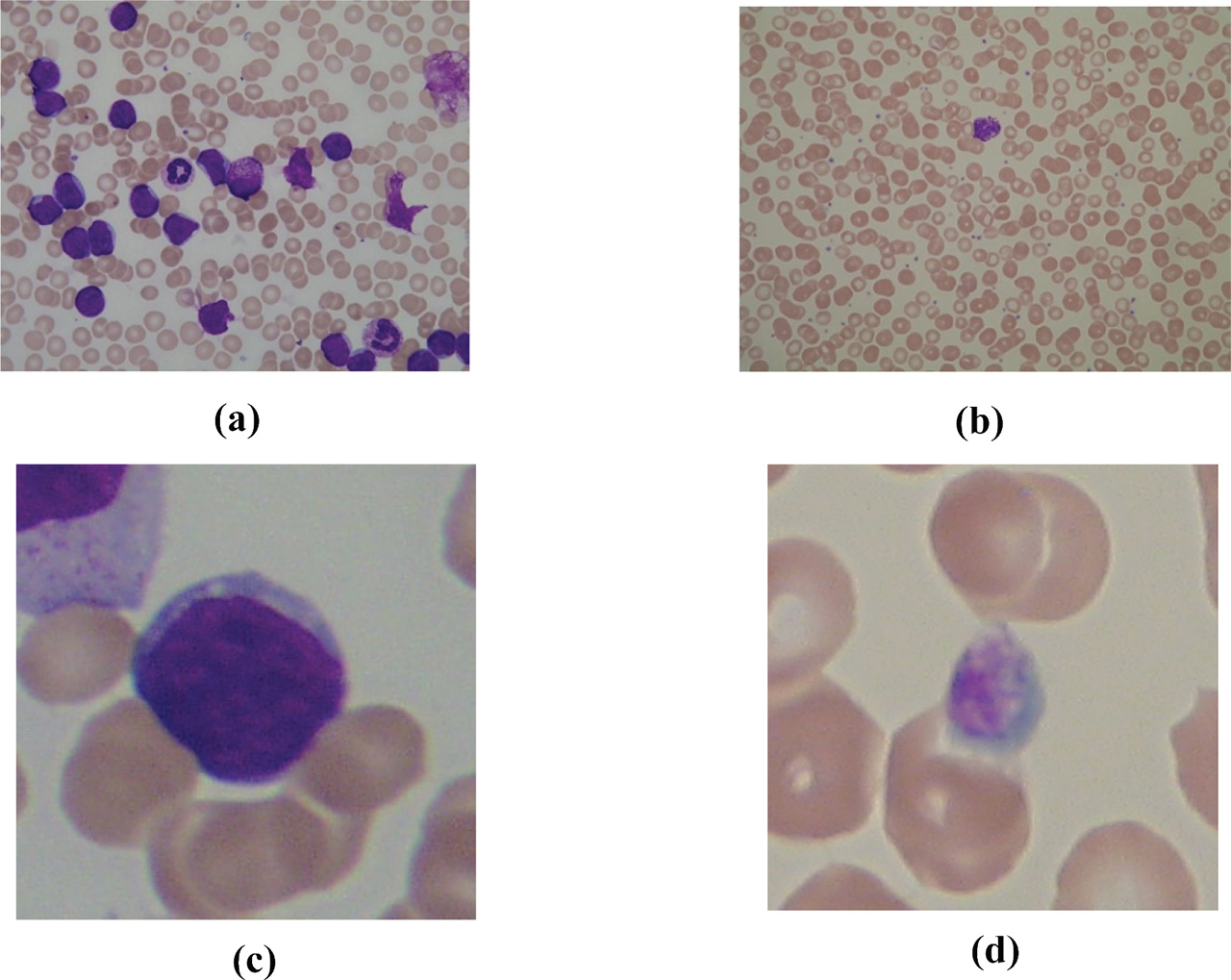
Figure 8:
(a) ALL-IDB-1 infected image; (b) ALL-IDB-1 normal image; (c) ALL-IDB2 infected image, and (d) ALL-IDB2 normal image.
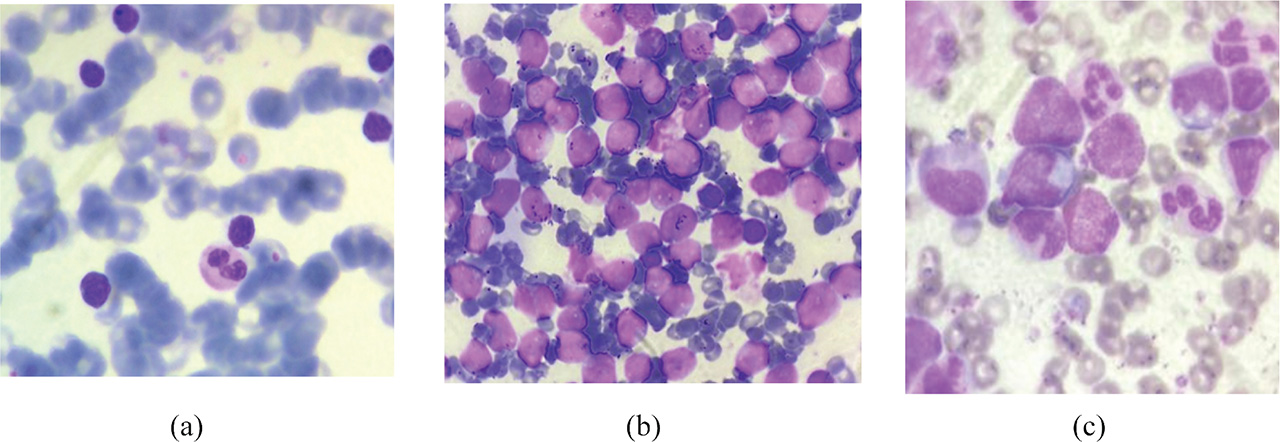
Figure 9:
Images from the real-image dataset: (a) CLL, (b) CML, and (c) AML. AML, acute myeloid leukemia; CLL, chronic lymphocytic leukemia; CML, chronic myeloid leukemia.
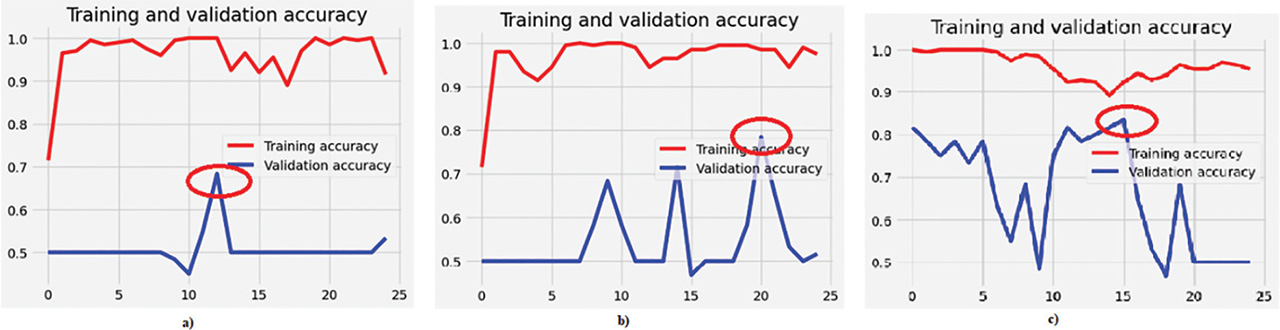
Figure 10:
Training and validation accuracies: (a) modified VGG-16; (b) modified Inception; and (c) ensemble model of modified InceptionNet and VGG-16 classifiers for binary classification.
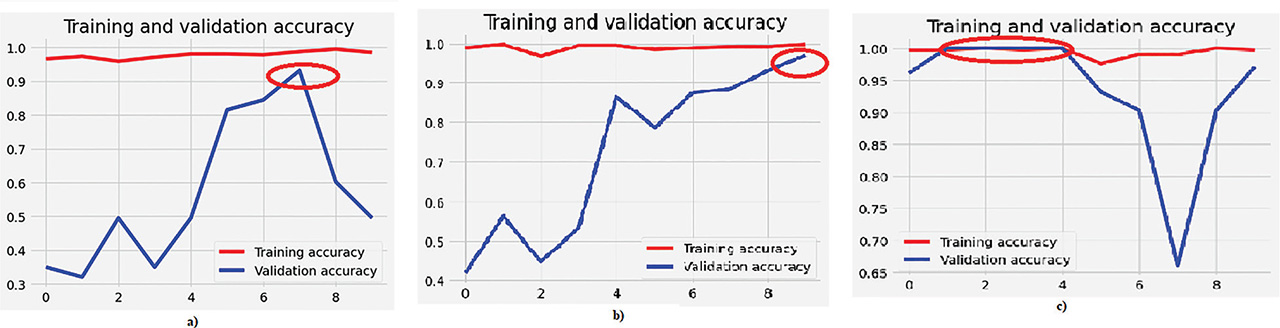
Figure 11:
Training and validation accuracies: (a) Modified VGG-16; (b) Modified Inception; and (c) Ensemble model of modified InceptionNet and VGG-16 Classifier for multi-class classification.
Table 2.
Metrics showing performance metric of binary and multi-class classification.
| DL classifier algorithm | Class/dataset | Maximum training accuracy (%) | Maximum validation accuracy (%) |
|---|---|---|---|
| Modified VGG-16 classifier | Binary (ALL-IDB) | 98.50 | 68.33 |
| Modified InceptionNet classifier | 98.50 | 78.33 | |
| Ensemble classifier | 94.50 | 83.33 | |
| Modified VGG-16 classifier | Multi-class (real-images) | 98.56 | 93.20 |
| Modified InceptionNet classifier | 99.76 | 97.87 | |
| Ensemble classifier | 100 | 100 |
[i] DL, Deep Learning.
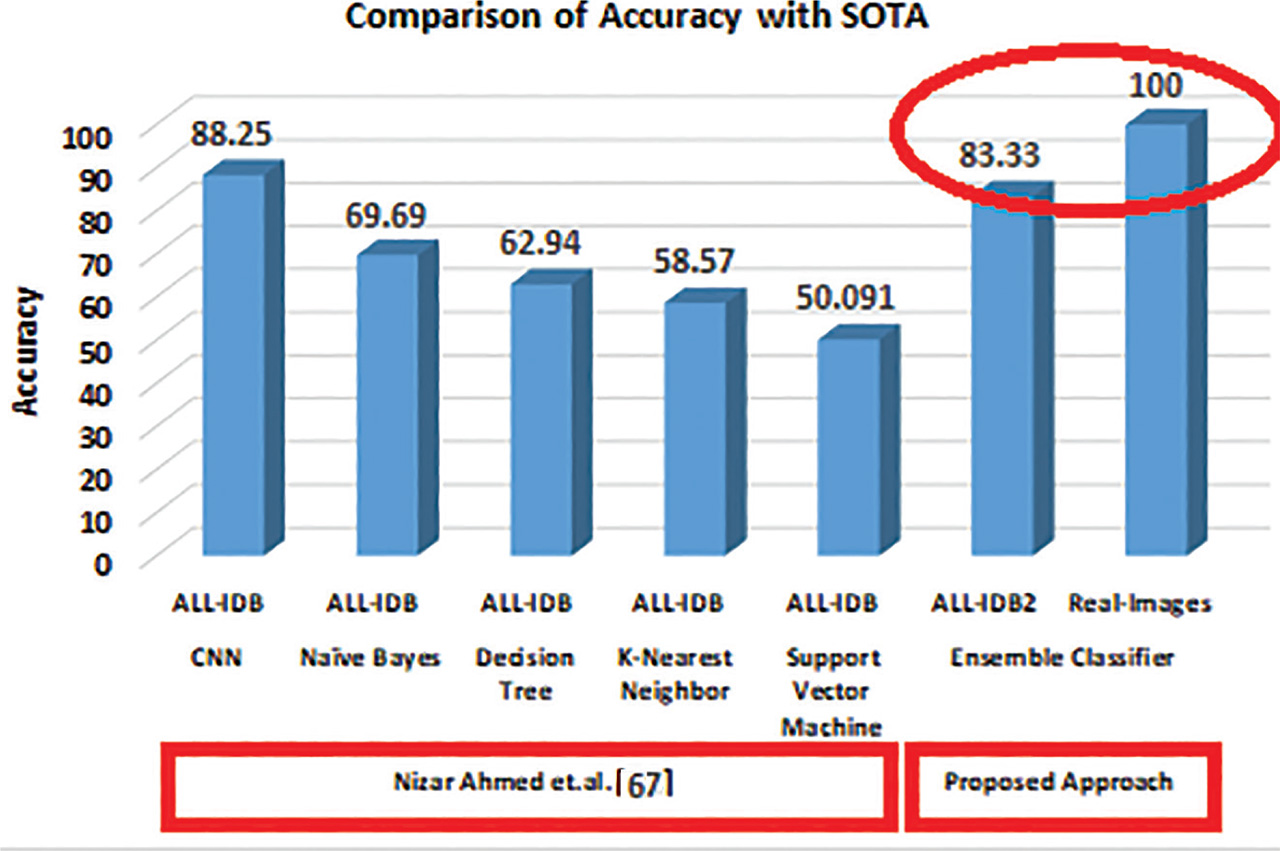
Figure 12:
Comparing the model accuracy with SOTA.
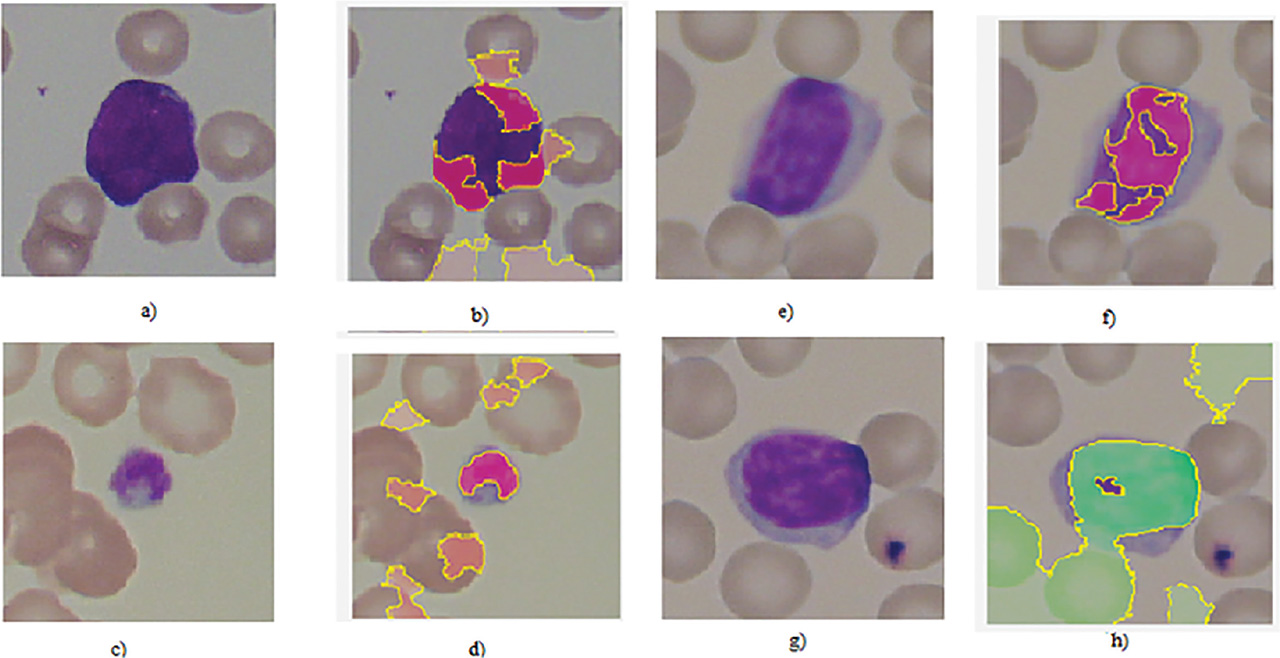
Figure 13:
(a, c, e, g) Original dataset images; and (b, d, f, h) LIME interpretation results. LIME, Local Interpretable Model-Agnostic Explanations.