
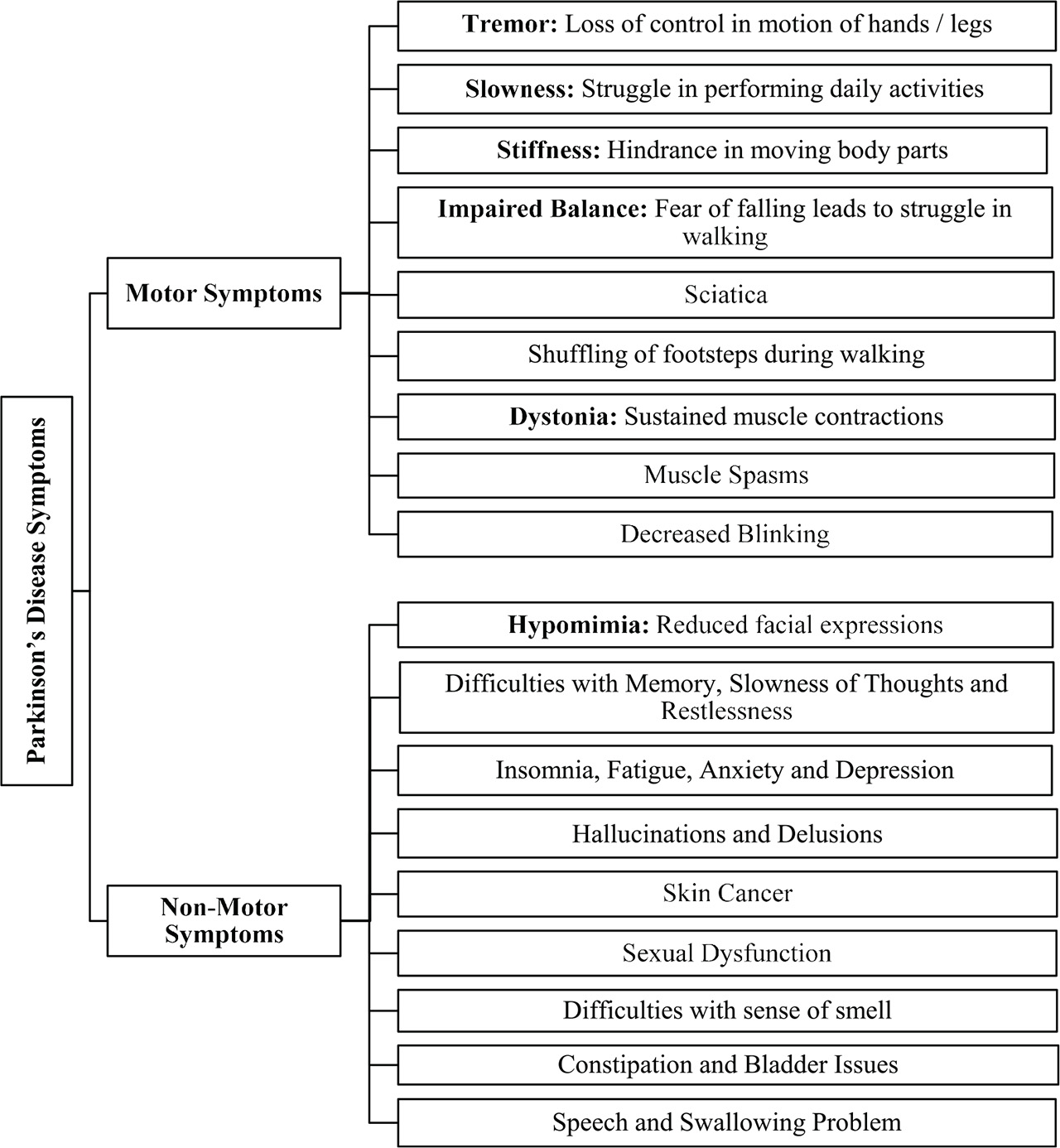
Figure 1:
Table 1:
List of acronyms.
| Acronym | Meaning | Acronym | Meaning |
|---|---|---|---|
| PsD | Parkinson's Disease | FER | Facial emotion recognition |
| HC | Healthy Controls | MRI | Magnetic Resonance Imaging |
| PPMI | Parkinson's Progression Markers Initiative | TNR | True negative rate |
| TPR | True positive rate | SVM | Support Vector Machine |
| PET | Positron emission tomography | MSA | Multiple system atrophy |
| AI | Artificial Intelligence | DL | Deep Learning |
| ML | Machine Learning | DICOM | Digital Imaging and Communications in Medicine |
| SPECT | Single-photon emission computerized tomography | EMG | Electromyogram |
| CNN | Convolutional Neural Network | CRNN | Convolutional Recurrent Neural Network |
| SWEDD | Scans Without Evidence of Dopaminergic Deficit | KNN | K-nearest neighbors |
| ECG | Electrocardiogram | PSP | Progressive supranuclear palsy |
| LC | Locus coeruleus | LDA | Linear discriminant analysis |
| SNpc | Substantia nigra pars compacta | DaTscan | Dopamine Transporter Scan |
| MFCC | Mel-Frequency Cepstral Coefficients | OCSA | Optimized crow search algorithm |
| OCT | Optical coherence tomography | CCSA | Chaotic crow search algorithm |
| EEG | Electroencephalogram | RBD | REM sleep behavior disorder |
| PCA | Principal component analysis | MDS | Movement Disorder Society |
| ROI | Region of interest | RGNN | Regularized graph neural network |
| ANOVA | Analysis of variance | FAWT | Flexible analytic wavelet transform |
| RF | Random forests | Emotion DL | Emotion-aware distribution learning |
| RBF | Radial basis functions | LIWC | Linguistic Inquiry and Word Count |
| RQA | Recurrence quantification analysis | MVLL | Maximum vertical line length |
| MDLL | Maximum diagonal line length | FMI | Face mobility index |
| STRNN | Spatial–temporal recurrent neural network | LDA | Latent Dirichlet Allocation |
| FACS | Facial Action Coding System | VGRF | Vertical ground reaction force |
| AUC | Area under the ROC Curve | EI | Emotional intelligence |
| MEIS | Multi-factor emotional intelligence scale | FNN | Fuzzy neural network |
| ANN | Artificial Neural network | GCNN | Graph Convolutional Neural Network |
| FL | Federated learning | UPDRS | Unified Parkinson's disease rating scale |
| FDG | Fluorodeoxyglucose | MCI | Mild cognitive impairment |
| DN | Dopaminergic Neurons | DT | Dopamine transporter |
| DBN | Deep belief network | LSTM | Long short-term model |
| TL | Transfer learning | SVR | Support vector regression |
| Node DAT | Node-wise domain adversarial training | GSR | Galvanic skin response |
| DNA | Deoxyribonucleic acid | RBC | Red blood cell |
| WHARMPA | Weighted HARMonization Parameters | RNA | Ribonucleic acid |
| FoG | Freezing of Gait | CC | Correlation coefficients |
| MCC | Merkel cell carcinoma | RMSE | Root mean square error |
Table 2:
A relative contrast of the proposed survey with the PsD detection state-of-the-art surveys.
| Author | Year | Conclusion | 1 | 2 | 3 | 4 | 5 | 6 | 7 | 8 | 9 | 10 | 11 | 12 | 13 |
|---|---|---|---|---|---|---|---|---|---|---|---|---|---|---|---|
| Proposed Survey | 2023 | Examines PsD patients’ datasets and PsD diagnosis techniques on various modalities while addressing the open research challenges too | ✓ | ✓ | 9 | ✓ | ✓ | ✓ | ✓ | ✓ | ✓ | ✓ | ✓ | ✓ | ✓ |
| Salari et al. [33] | 2023 | SVM is proposed to be a bridge between psychological research and the clinical facts | ✓ | ✓ | 5 | ✓ | ✓ | ✓ | |||||||
| Shafiq et al. [39] | 2023 | Flower Pollination Algorithm and Extreme Gradient Boost Algorithm pair obtained the accuracy of 93% | ✓ | ✓ | 1 | ✓ | ✓ | ✓ | ✓ | ||||||
| Shaban [40] | 2023 | ANN is the most widely used PsD detection technique and sensory signals, EEG and handwriting are the most utilized data modalities | 4 | ✓ | ✓ | ✓ | ✓ | ||||||||
| Kumar et al. [41] | 2023 | Accelerometer is the most widely used sensor for gait analysis for PsD detection | ✓ | ✓ | 1 | ✓ | ✓ | ✓ | ✓ | ✓ | ✓ | ||||
| Dixit et al. [42] | 2023 | Review of PsD diagnosis along with an extensive discussion of future scope | ✓ | 6 | ✓ | ✓ | ✓ | ✓ | ✓ | ✓ | |||||
| Khanna et al. [43] | 2023 | No existing technique is yet suitable for practical use clinically. MRI, PET and SPECT scans are the most popular neuroimaging modalities | ✓ | ✓ | 3 | ✓ | ✓ | ✓ | ✓ | ✓ | ✓ | ||||
| Zhang [44] | 2022 | SVM and ANN show best accuracy on SPECT scan for PsD detection | ✓ | 3 | ✓ | ✓ | ✓ | ||||||||
| Chandrabhatla et al. [45] | 2022 | Technological evolution in detecting PsD, in-lab to in-home | ✓ | 3 | ✓ | ✓ | |||||||||
| Giannakopoulou and Roussaki [46] | 2022 | ML + IoT can revolutionize PsD diagnosis, mostly used best performing AI models are MLPs, LSTMs, CNNs, other ANN and ensemble learning techniques | ✓ | 5 | ✓ | ✓ | ✓ | ✓ | ✓ | ✓ | ✓ | ||||
| Rana et al. [47] | 2022 | AI has revolutionized detecting early-stage PsD | ✓ | 7 | ✓ | ✓ | ✓ | ✓ | |||||||
| Tanveer et Al. [48] | 2022 | CNN and RNN give better performance than ML | ✓ | 8 | ✓ | ✓ | ✓ | ✓ | ✓ | ✓ | |||||
| A. ul Haq et al. [49] | 2022 | DL techniques are the most appropriate | 4 | ✓ | ✓ | ✓ | ✓ | ✓ | ✓ | ||||||
| Rana et al. [50] | 2022 | Best accuracy to diagnose PsD for voice data was achieved using L1-norm SVM and k-fold cross-validation, for handwritten patterns using bagging ensemble, and for gait analysis by SVM | ✓ | ✓ | 3 | ✓ | ✓ | ✓ | ✓ | ✓ | |||||
| Alzubaidi et al. [51] | 2021 | Best performing and widely used DL models and datasets according to various modalities are identified | 9 | ✓ | ✓ | ✓ | ✓ | ✓ | ✓ | ✓ | |||||
| Loh et al. [52] | 2021 | CNN model achieves higher accuracy in various modalities for PsD detection | ✓ | 8 | ✓ | ✓ | ✓ | ||||||||
| Noor et al. [53] | 2020 | CNN is used mostly in the detection of PsD | 1 | ✓ | ✓ | ✓ | ✓ | ||||||||
| Khachnaoui et al. [54] | 2020 | DL methods show better performance than ML | 2 | ✓ | ✓ | ✓ | ✓ | ||||||||
| Di Biase et al. [55] | 2020 | Very few algorithms are accurate enough to be potentially used clinically for PsD diagnosis and monitoring symptoms | 1 | ✓ | ✓ | ✓ | ✓ | ✓ |
[i] 1, Symptoms; 2, Causes; 3, No. of Modalities Discussed; 4, Private Datasets; 5, Public Datasets; 6, ML Techniques; 7, DL Techniques; 8, EI Technique; 9, Multistage Classification; 10, Accuracy; 11, Sensitivity; 12, Specificity 13, Challenges.
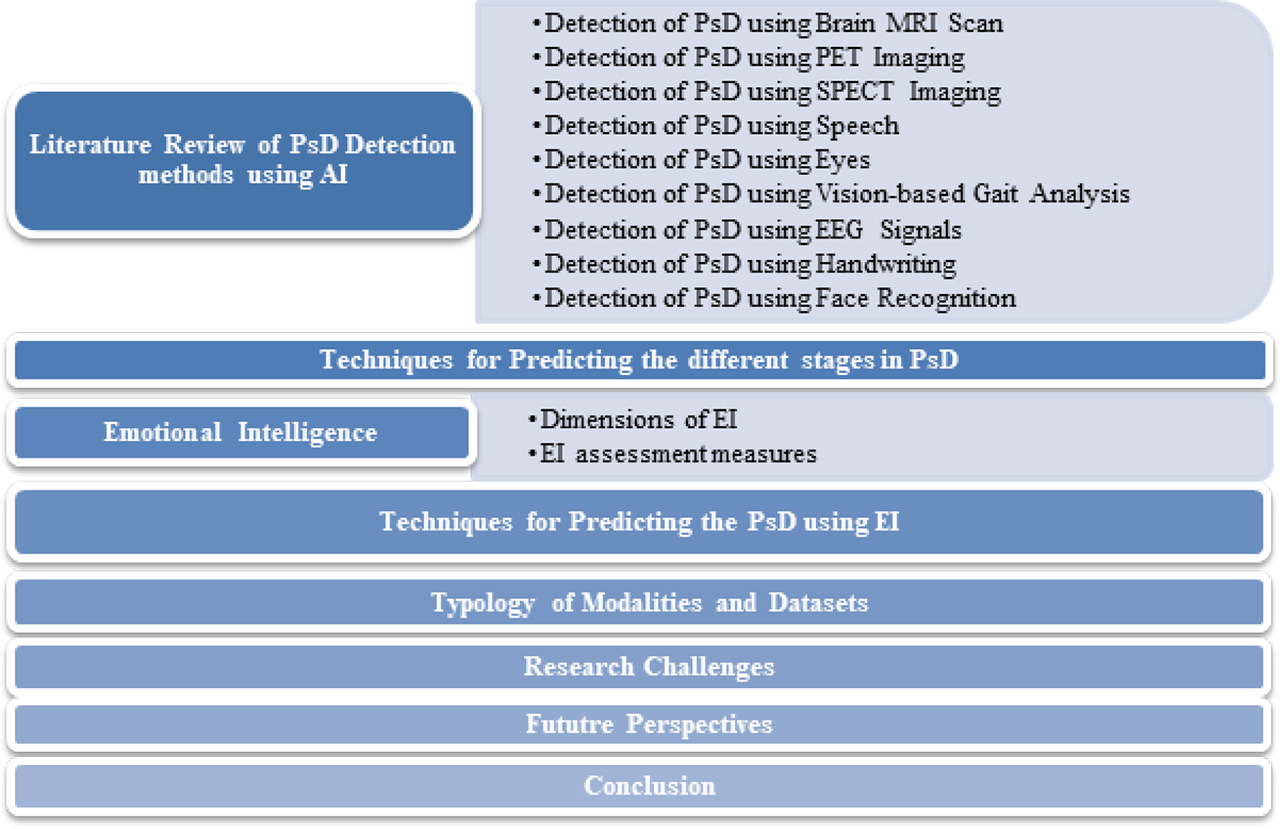
Figure 2:
Roadmap of the proposed review.
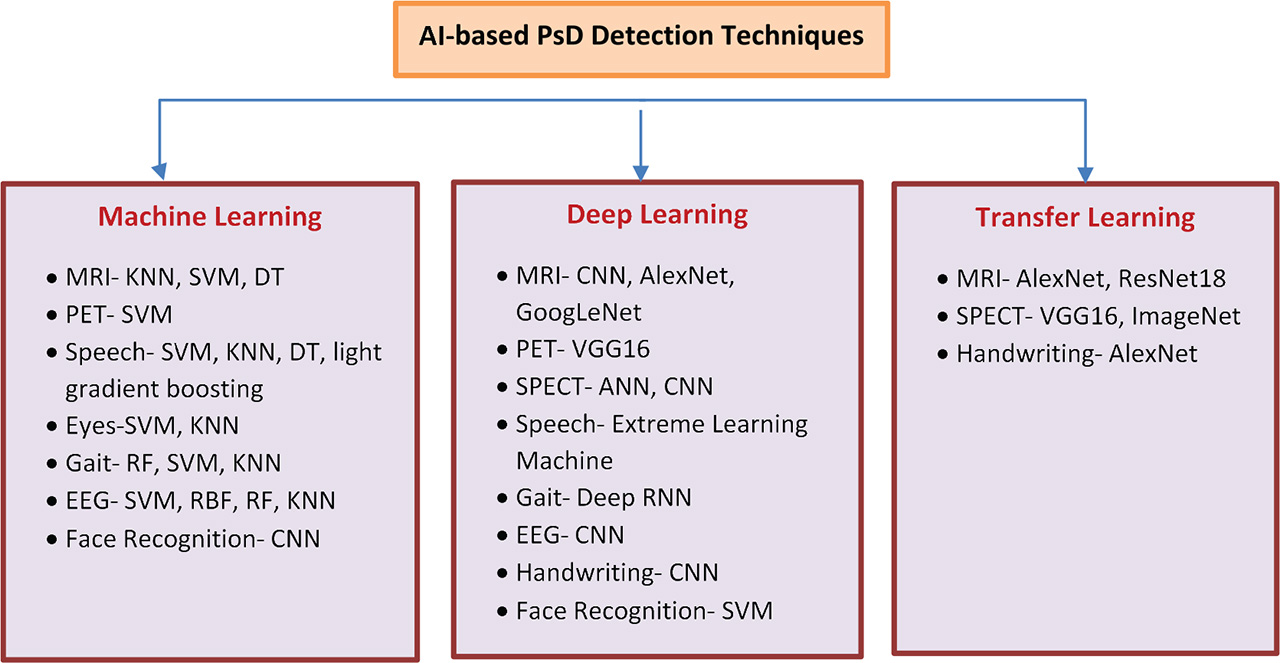
Figure 3:
AI-based PsD detection techniques.
Table 3:
Comparative analysis of techniques used to detect PsD using MRI images.
| Author (s) | Year | Purpose | Algorithm | Dataset | Output | Merits | Demerits |
|---|---|---|---|---|---|---|---|
| Sangeetha et al. [62] | 2023 | PsD Diagnosis | CNN |
| Accuracy = 96% | Preprocessing done and various performance metrics considered | - |
| Cui et al. [61] | 2022 | Classification of PsD and HC | Resnet18 + Support Vector Machine | PPMI dataset | Accuracy = 98.66% | Feature fusion improves classification performance | - |
| Monte-Rubio et al. [63] | 2022 | Parameters from multiple sites to harmonize MRI clinical data for classification of PsD | Weighted HARMonization Parameters (WHARMPA) |
| Balanced accuracy = 78.60%; AUC = 0.90 | WHARMPA encodes global site-effects quantitatively with simple implementation | Unbalanced dataset used, |
| Hathaliya et al. [64] | 2021 | To classify PsD and HC patients | Stacked ML model | PPMI dataset | Accuracy = 92.5%, Precision = 98%, F1_score = 98%, Recall = 97% | Detects PsD and measures the disease progression in PsD patients | - |
| Vyas et al. [5] | 2021 | Detection of PsD using 3D CNN and compare with the 2D CNN | 3D and 2D CNN | PPMI database | Accuracy = 88.9% | Voxel-based morphometry usage is very accurate | Manual feature extraction |
| Sivaranjini and Sujatha [57] | 2021 | Detection of PsD | Transfer learning (TL), AlexNet pre-trained model | PPMI MRI images | Accuracy = 88.9% | Improved efficiency of the model using transfer learning | Only one slice of brain image is used |
| Mangesius et al. [56] | 2020 | Classification of PsD, MSA and PSP | Decision Tree algorithm | - | Accuracy of classification PsD = 83.7% | Distinguishes PsD, MSA, and PSP with very high accuracy | Does not classify HC and PsD |
| Chakraborty et al. [60] | 2020 | Detecting PsD | 3D CNN model | MRI scans of 406 subjects from PPMI database | Accuracy = 95.29%, Average recall = 0.943, Precision = 0.927, F1-score = 0.936 | The maximum focus was on the substantia nigra region to predict PsD as it is the most-affected part of brain | Specific subcortical structures should be considered |
Table 4:
Comparative analysis of techniques used to detect PsD using SPECT images.
| Author (s) | Year | Purpose | Algorithm | Dataset | Output | Merits | Demerits |
|---|---|---|---|---|---|---|---|
| Hathaliya et al. [73] | 2022 | PsD classification and monitoring of the DT (dopamine transporter) level inside the brain | CNN-based scheme | 58692, 11738, and 7826 SPECT images from PPMI for training, validation, and testing, respectively | Accuracy = 88% | Accurate diagnosis of PsD and its progression | - |
| Adams et al. [32] | 2021 | DL algorithm to accurately predict motor-based symptoms | CNN model | 252 subjects DAT SPECT images | Average absolute error = 6.0 ± 4.8 | Enhanced diagnosis of UPDRS_III score with longitudinal data | Features related to PsD are not identified |
| Magesh et al. [74] | 2020 | ML-based early detection of PsD | CNN and VGG16-based TL scheme | 642 DaTscan SPECT images | Accuracy = 95.2% | Quick diagnosis for PsD | Dearth of conclusive diagnostic tests for PsD |
| Pereira and Ferreira [75] | 2020 | To classify PsD, SWEDD, and HC | CNN models | SPECT and MRI images | Accuracy = 65.7% | Classifies PsD, SWEDD, and HC subjects | Lower accuracy |
| Wenzel et al. [76] | 2019 | Robust classification algorithm to diagnose the dopamine transporter | CNN and ImageNet-based TL, semi-quantitative SBR analysis | 645 subjects | Accuracy = 97% | Accurate diagnosis of PsD patient with DT analysis | Trained model with few samples |
| Ortiz et al. [77] | 2019 | To classify HC and PsD using isosurface-based feature extraction | CNN model | 269 DaTscan images | Accuracy = 95% | Low complexity of the input data | Increases overall system complexity |
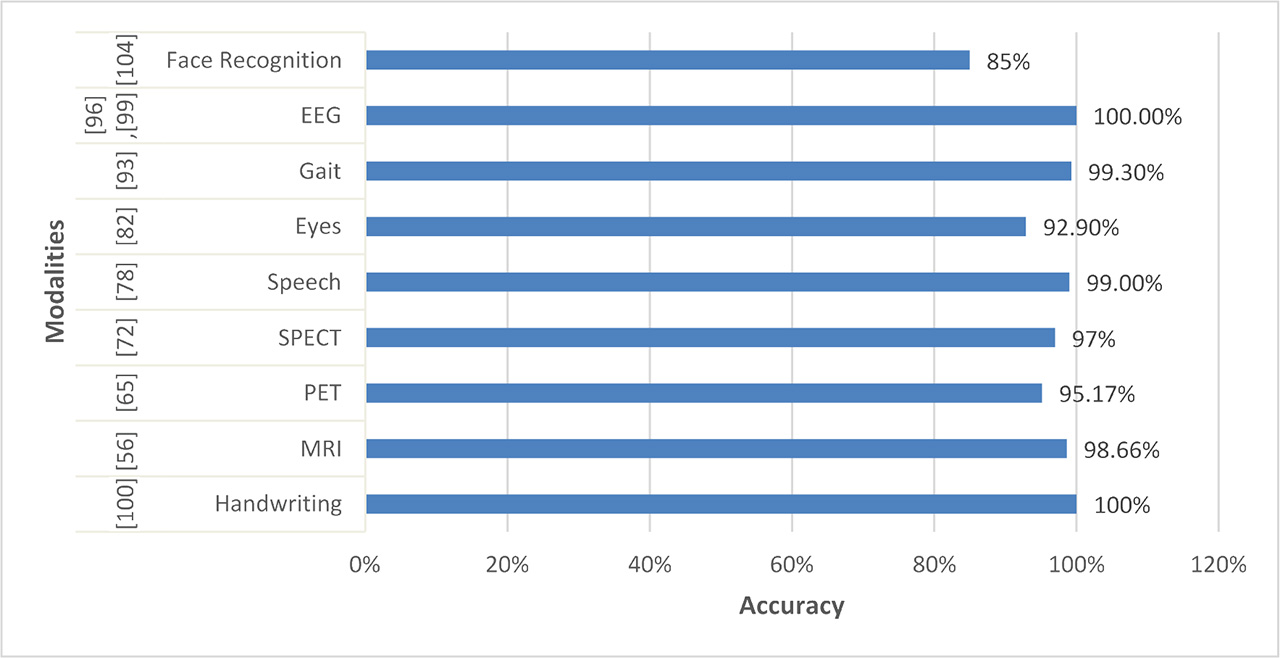
Figure 4:
Comparison of the highest accuracies achieved in various modalities in PsD detection.
Table 5:
Comparative analysis of techniques used to detect Parkinson's disease progression detection.
| Author (s) | Year | Purpose | Algorithm | Dataset | Output | Merits | Demerits |
|---|---|---|---|---|---|---|---|
| Kleinholdermann et al. [112] | 2021 | To predict UPDRS scores | Random Forest regression model outnumbered | Surface electromyography (sEMG) electrodes data; PsD: 45 | Correlation between true and estimated UPDRS values = 0.739 | Support the usage of wearables to detect PsD | Other performance metrics not considered |
| Hssayeni et al. [113] | 2021 | Severity level estimation (UPDRS-III scores) | Dual-channel LSTM and TL Ensemble | Angular velocity data from inertial sensors; PsD:24 | 1D-CNN-LSTM used for raw signals and 2D-CNN-LSTM used for time-frequency data with r = 0.79, MAE = 5.95 | Unobtrusive analysis at home | Fewer subjects |
| Lu et al. [114] | 2021 | Detection and severity estimation for PsD patients | OF-DDNet | Video recordings of MDS-UPDRS exams; PsD: 55 | AUC = 0.69, F1-score = 0.47, prec. = 0.47, and balanced acc. = 48% | Handles model uncertainty, label noise and small dataset and imbalance issues | - |
| Raza et al. [110] | 2021 | Progression of PsD | XGBoost | Speech recordings; I:5875; PsD:42 | MAE = 5.09 ± 0.16 | Enables continuous monitoring and efficient communication | Uses only voice recordings |
| Rupprechter et al. [89] | 2021 | Severity estimation (UPDRS scores) | Ordinal Random Forest classifier | 729 videos of gait assessments | Balanced accuracy = 50%, Binary sensitivity = 73%; Binary specificity = 68% | Provides interpretability | 3D pose estimation not used |
| Abujrida et al. [115] | 2020 | Detection and severity estimation in walking balance | Wavelet (DWT) domain + fine tree/Boosted trees/RF/bagged trees/weighted LR/KNN/LDA, cubic SVM | Signals from gyroscopes, accelerometers, demographics, and lifestyle data PsD:152, HC:304 |
| Large no. of participants, and amalgam of frequency, time, and statistical features with sway area and lifestyle parameters too | Lack of signal segmentation strategies |
| Mehrbakhsh Nilashi et al. [111] | 2020 | Remote tracking of PsD progression | DBN with SVR | Parkinson's telemonitoring dataset; I: 5875 | Average output for testing and training sets are 0.521 and 0.537 respectively for RMSE in detecting motor-UPDRS | Supervised and unsupervised learning techniques used | Feature selection techniques are not used |
| Li et. al. [116] | 2019 | Diagnosis and severity (H&Y scores) estimation | Random Forest regression | Acceleration and angular velocity signals; PsD:13 HC:12 | MAE = 0.166, r = 0.97 | Records user's motion information unobtrusively | - |
| Buongiorno et al. [117] | 2019 | Detection and severity rating of PsD | ANN and SVM |
| ANN: Acc. = 95%, SVM: Acc. = 81%, Spec = 78% | Low-cost and easy and fast setup | Only mild vs. moderate severity is measured |
| Yoon et al. [118] | 2019 | PsD Severity estimation (UPDRS 0–176 scores) | TL | Phonation and speech recordings; PsD:42 | MAE = 2–3 Approximately | Recording done at home, and better accuracy | - |
| Grammatikopoulou et al. [119] | 2019 | PsD Severity estimation | Parallel two LSTMs trained with raw joint-coordinates and the combined line distances | Skeletal features of MS Kinect v2 RGB videos; PsD (advanced stage): 12 and PsD (initial stage):6 | Acc. = 77.7% | - | Very few subjects, only 2 stages |
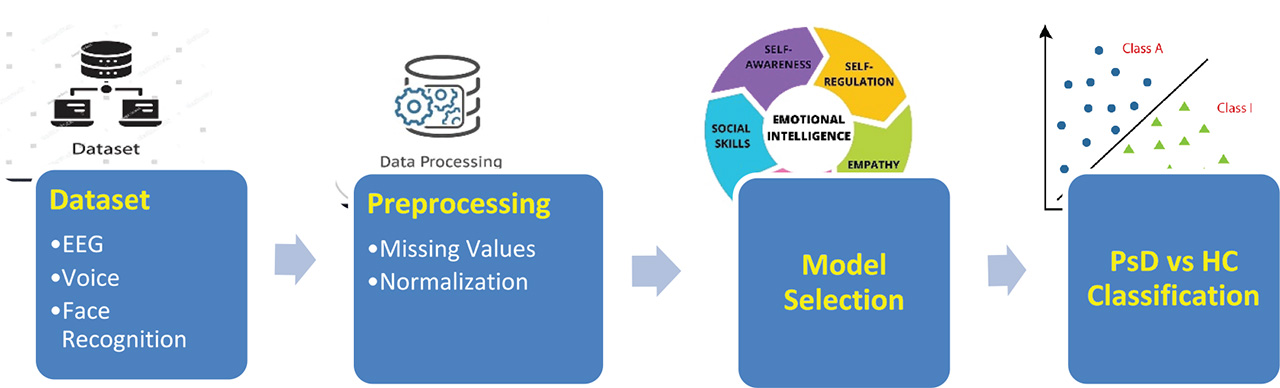
Figure 5:
Process flow diagram of PsD detection using EI.
Table 6:
Comparative analysis of PsD detection using emotional intelligence.
| Author (s) | Year | Purpose | Algorithm | Dataset | Output | Merits | Demerits |
|---|---|---|---|---|---|---|---|
| Pegolo et al. [127] | 2022 | Measuring hypomimia to distinguish between PsD and HC and to classify the emotions | Random Forest showed best results | Frontal face videos; PsD:50 HC:17 | AUC values from 94.3 to 91.6; F1 scores from 76.2 to 71.5 | A stand-alone methodology for quantifying the degree of impairment | Imbalanced data |
| Parameshwara et.al. [124] | 2022 | PsD detection | KNN and Naïve Bayes Classifiers |
| Acc = 99% | Non-invasive use of emotional EEG signals | Inadequate number of PsD patients with mild-to-moderate severity, relation in EEG and motor symptoms is unknown |
| Dar et al. [20] | 2022 | EEG based emotional classification | ELM (extreme learning machine) | PsD dataset, AMIGOS, and SEED-IV datasets | Acc = 83.2% | Implemented on cross-subject and cross-dataset, robust to real-time applications | Datasets with fewer number of subjects |
| Anusri et al. [126] | 2021 | Early detection of PsD using facial emotional intelligence | Alexnet and VGG16 |
| Acc = 96.5% | Early diagnosis justified using different performance metrics | Imbalanced dataset |
| Sechidis et al. [128] | 2021 | Assessment of PsD speech characteristics | Machine learning | Speech dataset | NA | Main focus is on happy and sad emotion only | No dataset of PsD and HC exists thta has labeled emotions |
| Justyna and Burget [22] | 2020 | Analysis of Emotional changes during quick pronunciation exercise | XG Boost |
| Acc = 69%; sadness and surprise are negatively correlated with PsD | Seven emotion classes are considered | Low accuracy |
| Yuvaraj et al. [125] | 2014 | To discriminate PsD patients and HC while emotional information processing | Discriminant analysis |
| Acc = 95% | Distributed spectral powers in EEG frequency bands supply information about emotion processing in PsD patients | Fewer number of subjects |
| Zhao et al. [129] | 2014 | Classification of emotions through speech in PsD patients | Naïve Bayes, Random Forest, and SVM | Recorded speaking short statements | Acc = 3.33% | First automatic classification of emotions in the voice of PsD patients | Low Accuracy |
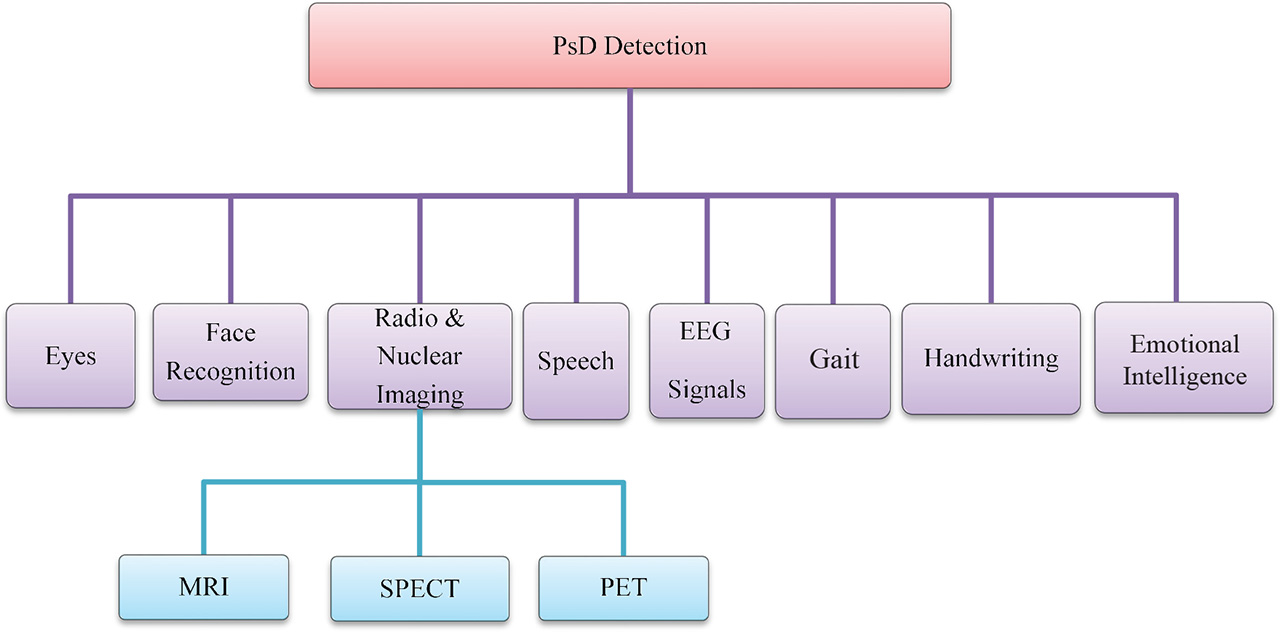
Figure 6:
Taxonomy for detection of Parkinson's disease according to different modalities [42, 48].
Table 7:
Comparative analysis of PsD public datasets.
| Dataset Name | References | Instances and subjects | Attributes | Datatype | Merit | Demerit | Used Device /Sensor |
|---|---|---|---|---|---|---|---|
| Parkinson's Disease dataset | [132, 133, 134] | I-197, PsD:23, HC:8 | 23 | Speech signal | No missing values | Fewer instances, unbalanced and only suitable for binary classification | Recorder |
| PhysioNet/Vertical Ground Reaction (VGRF) | [55, 135, 136, 137, 138] | PsD:93, HC:72 | - | Multi-channel recordings from force sensors | Disease severity is also monitored | - | 8 sensors under each foot |
| PPMI database | [5, 108, 139, 140] | PsD:600, HC:400 | - | MRI Images, DaTscan, PET, etc. | Most widely used database of PsD datasets | Imbalanced dataset | Tesla scanner |
| Parkinson's telemonitoring/Oxford PsD Telemonitoring Dataset | [141, 142] | I-5875, PsD: 42 | 26 | Voice recordings | No missing values | Suitable only for binary classification | Telemonitoring device |
| Daphnet Freezing of Gait Data Set | [134, 143, 144] | I-237, PsD:10 | 9 | Gait monitoring data | Realistic activity monitoring | Very few subjects in dataset | Acceleration sensors at the hip and leg |
| Parkinson Dataset with replicated acoustic features dataset | [141, 145, 146] | I-240, PsD:40, HC:40 | 46 | Voice recording replications | No missing values | ML cannot be applied | Recorder |
| Parkinson Speech Dataset with Multiple Types of Sound Recordings Dataset | [147, 148] | I-1040, PsD:20, HC:20 | 26 | Sound recordings | Useful for classification as well as regression | Fewer subjects | - |
| Parkinson's Disease Classification Data Set | [149, 150, 151, 152] | I-756, PsD:188, HC:64 | 754 | Speech recordings | Features extracted through many speech signal processing algorithms | Imbalanced dataset | Microphone |
| Parkinson Disease Spiral Drawings Using Digitized Graphics Tablet dataset | [153, 154] | I:77, PsD:62, HC:15 | 7 | Handwriting-Spiral drawings | Three different kinds of tests to collect data | Fewer subjects, and imbalanced dataset | Wacom Cintiq 12WX graphics tablet |
| NewHandPsD dataset | [155, 156] | PsD:31, HC:35 | - | Handwriting | Balanced dataset | Fewer subjects | Smart pen (BiSP) |
| PC-GITA Spanish dataset | [157, 158] | PsD:50, HC:50 | - | Voice samples | A well-balanced corpus with respect to age and gender | Recorded under optimal recording conditions | Fast Track C400 sound card and a Professional microphone |
| NTUA Parkinson Dataset | [158, 159] | I:44007, PsD:55, HC:23 | - | MRI and DaTscans | Sufficiently large dataset | Imbalanced dataset | - |
| Neurovoz | [160, 161, 162] | PsD:47, HC:32 | - | Spanish speech samples | No Noise | Fewer subjects | AKG C420 headset microphone coupled with a preamplifier |
| OpenfMRI | [163, 164] | 37 studies with 1411 subjects | - | MRI and EEG scans | NIFTI format | - | - |
| PsD-BioStampRC21 dataset | [165, 166] | PsD:17, HC:17 | - | wearable sensor accelerometry data | 24-hour monitoring data | Fewer subjects | MC 10 BioStamp RC sensors |
| Italian Parkinson's Voice and Speech | [167, 168] | PsD: 28, HC: 37 | - | Voice and Speech data | - | Fewer subjects | - |
| Physio Bank | [94, 169, 170] | PsD: 93, HC:73 | - | Database of Gait | Multichannel recordings, demographic information, and disease severity | - | Ultraflex Computer Dyno Graphy, Infotronic Inc. sensors |
| Neurocon | [171, 172] | I: 303, PsD: 27, HC:16 | - | T1 and resting-state MRI dataset | Includes both T1 and resting-state scans | Fewer subjects of only initial stage PsD | 1.5-Tesla Siemens Avanto MRI scanner |
Table 8:
Comparative analysis of PsD private datasets.
| Dataset/Source/Author Name | References | Instances and subjects | Attributes | Datatype | Merit | Demerit | Used Device/Sensor |
|---|---|---|---|---|---|---|---|
| Hospital Universiti Kebangsaan Malaysia, Kuala Lumpur | [124] |
| - | EEG signals | Non-invasive detection | Fewer subjects | 14-channel wireless Emotiv Epoc headset |
| Wearable Bio mechatronics Laboratory at Western University | [173] |
| - | Video recordings while performing the trials | Resting, postural, and action tremors are monitored | - | Wearable assistive devices |
| Tuncer T. | [174] |
| - | Vowel voice recordings | High classification performance even with heterogeneous dataset, less expensive | Imbalanced dataset | Microphone |
| M. Lu | [114] |
| - | Video recordings of MDS-UPDRS exams | Both gait and finger tapping experiments are performed | Less data | - |
| Pacific Parkinsons Research Centre (PPRC) | [175] |
| - | Resting EEG | High Performance metrics | Fewer subjects | 64-channel EEG cap and a Neuroscan SynAmps2 acquisition system |
| Iakovakis et al. | [176, 177] |
| 913 | Keystroke dynamics information | Combined discriminative potential of enriched keystroke variables | Fewer subjects | Touchscreen smartphone |
| Hospital at Sun Yat-sen University | [178] |
| - | EEG signals | Large number of instances | Fewer hyperparameters | 64-electrode Geodesic Sensor Net (Electrical Geodesics Inc.) |
| RMIT University, Melbourne, Australia | [179] |
| - | Voice samples | all recordings were normalized | Fewer number of samples | Apple iPhone 6S plus |